engine TOYOTA TUNDRA 2011 2.G Owners Manual
[x] Cancel search | Manufacturer: TOYOTA, Model Year: 2011, Model line: TUNDRA, Model: TOYOTA TUNDRA 2011 2.GPages: 732, PDF Size: 16.65 MB
Page 612 of 732
612
5-2. Steps to take in an emergency
If you have a flat tire
Remove the flat tire and replace it with the spare provided.
■Before jacking up the vehicle
●Stop the vehicle on a hard, flat surface.
● Set the parking brake.
● Shift the shift lever to P.
● Stop the engine.
● Turn on the emergency flashers.
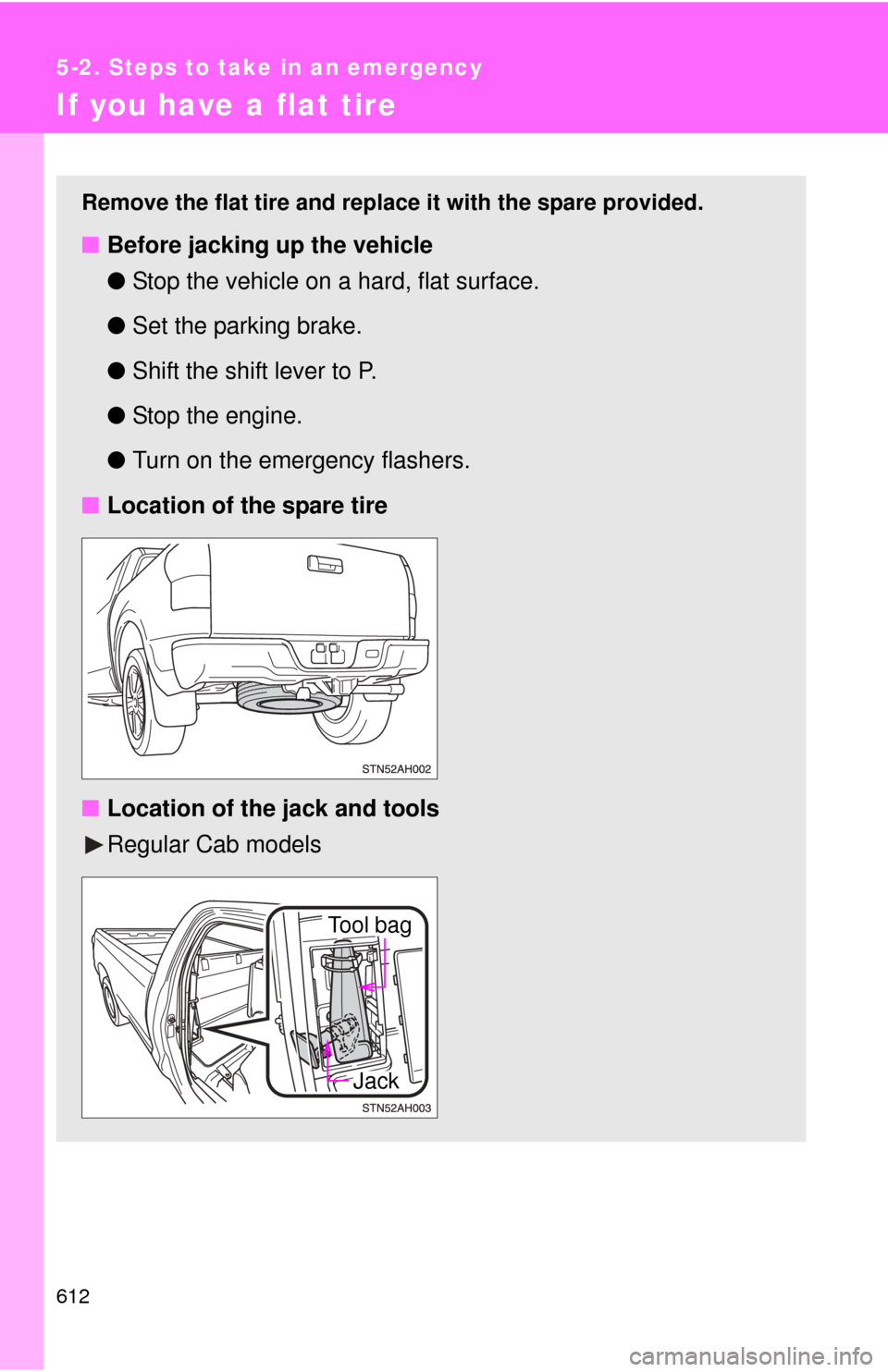
■ Location of the spare tire
■ Location of the jack and tools
Regular Cab models
Tool bag
Jack
Page 624 of 732
624 5-2. Steps to take in an emergency
Stowing the flat tire, jack and all toolsRemove the center wheel ornament by pushing from thereverse side.
Lay down the tire with the outer side facing up, and install the
holding bracket.
Then secure the tire, taking care that the tire goes straight up
without catching on any other part, to prevent it from flying for-
ward during a collisi on or sudden braking.
Keep winding until three clicks are heard.
Stow the tools and jack securely.
■After completing the tire change
The tire pressure warnin g system must be reset. ( P. 548)
■When using the temporary spare tire
As the temporary spare tire is not equipped with the tire pressure warn-
ing valve and transmitter, low inflation pressure of the spare tire will not
be warned. Also, if you replace the temporary spare tire after the tire
pressure warning light comes on, the light remains on.
CAUTION
■Using the jack
Improper use of the jack may lead to death or serious injuries due to the
vehicle suddenly fa lling off the jack.
●Do not use the jack for any purpose ot her than replacing tires or install-
ing and removing tire chains.
●Only use the jack that comes with this vehicle for replacing a flat tire.
Do not use it on other vehicles, an d do not use other jacks for replac-
ing tires on this vehicle.
●Always check that the jack is securely set to the jack point.
●Do not put any part of your body under the vehicle supported by a jack.
●Do not start or run the engine while your vehicle is supported by the
jack.
Page 628 of 732
628
5-2. Steps to take in an emergency
If the engine will not star t
If the engine still does not start after following the correct starting
procedure ( P. 181) or releasing the steering lock (P. 182), confirm
the following points.
■ The engine will not start even when the starter motor oper-
ates normally.
One of the following may be the cause of the problem.
●There may not be sufficient fuel in the vehicle’s tank.
Refuel the vehicle. (
P. 107)
Flex-fuel vehicles: The type of fuel may be different. When
refueling, add the same type of fuel, if available.
After adding a different type of fuel, the engine may run
roughly and driving performance may be reduced for a while
when the engine is first started. In this case, wait until the
engine runs normally.
● The engine may be flooded.
Try to restart the engine once more following correct starting
procedures.
● There may be a malfunction in the engine immobilizer system.
( P. 1 1 2 )
■ The starter motor turns over slowly, the interior lights and
headlights are dim, or the horn does not sound or sounds at
a low volume.
One of the following may be the cause of the problem.
●The battery may be discharged. ( P. 634)
● The battery terminal connec tions may be loose or corroded.
Page 630 of 732
630
5-2. Steps to take in an emergency
If the shift lever cannot be shifted from P
If the shift lever cannot be shifted with your foot on the brake, there
may be a problem with the shift lock system (a system to prevent
accidental operation of the shift lever). Have the vehicle inspected by
your Toyota dealer immediately.
The following steps may be used as an emergency measure to
ensure that the shift lever can be shifted.
Set the parking brake.
Turn the engine switch to the ACC or ON position.
Depress the brake pedal.
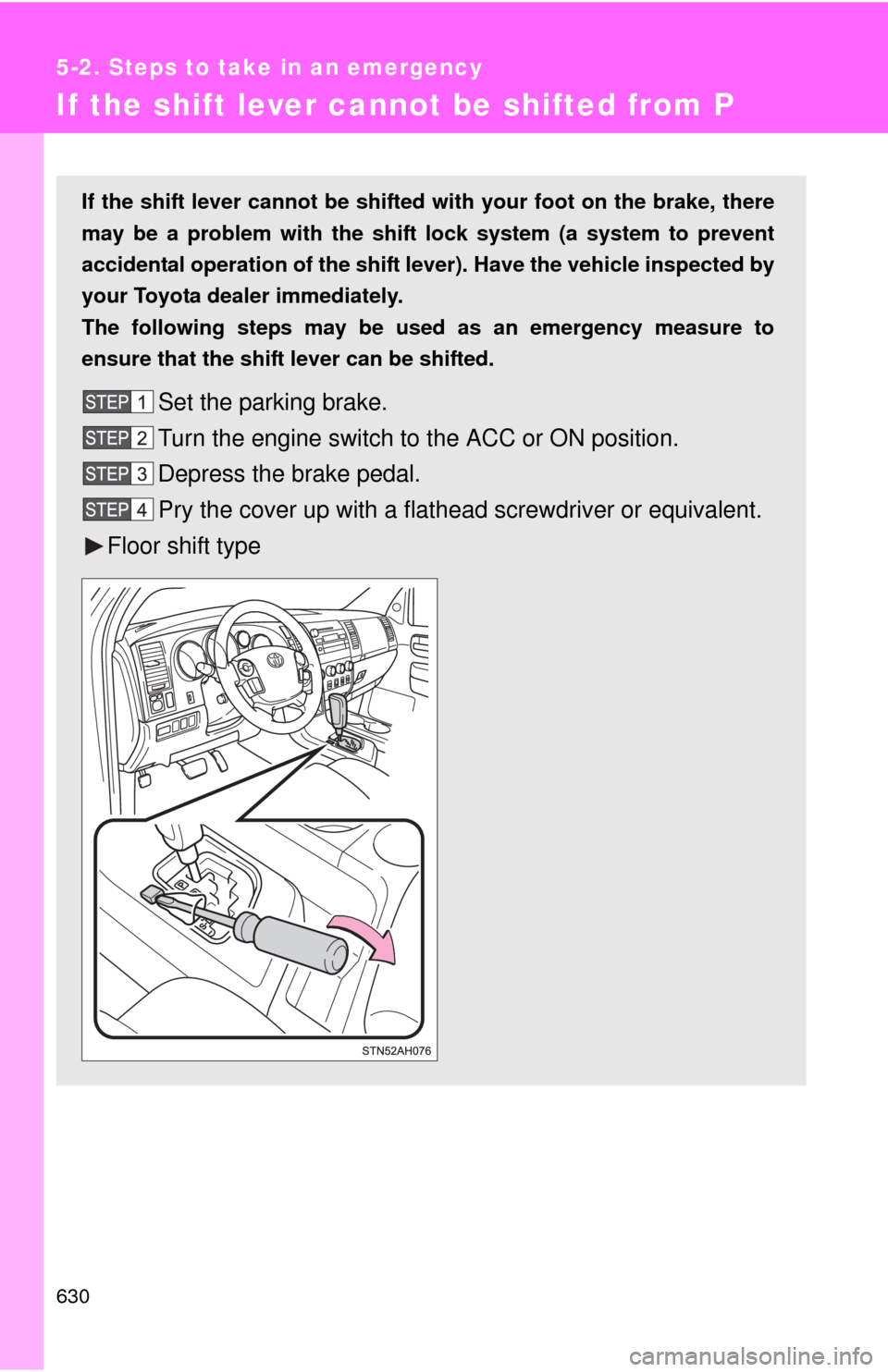
Pry the cover up with a flathead screwdriver or equivalent.
Floor shift type
Page 633 of 732
5
When trouble arises
633
5-2. Steps to take in an emergency
If you lose your keys
■If you lose all your master keys. ( vehicles with engine immobilizer sys-
tem)
You cannot make new keys; the whole engine immobilizer system must be
replaced.
New genuine Toyota keys can be made by your Toyota dealer using
the key number stamped on your key number plate. Vehicles with
engine immobilizer system, the dealer will also need the master key.
( P. 42)
Page 634 of 732
634
5-2. Steps to take in an emergency
If the vehicle batter y is discharged
.
The following procedures may be used to start the engine if the
vehicle’s battery is discharged.
You can call your Toyota dealer or qualified repair shop.
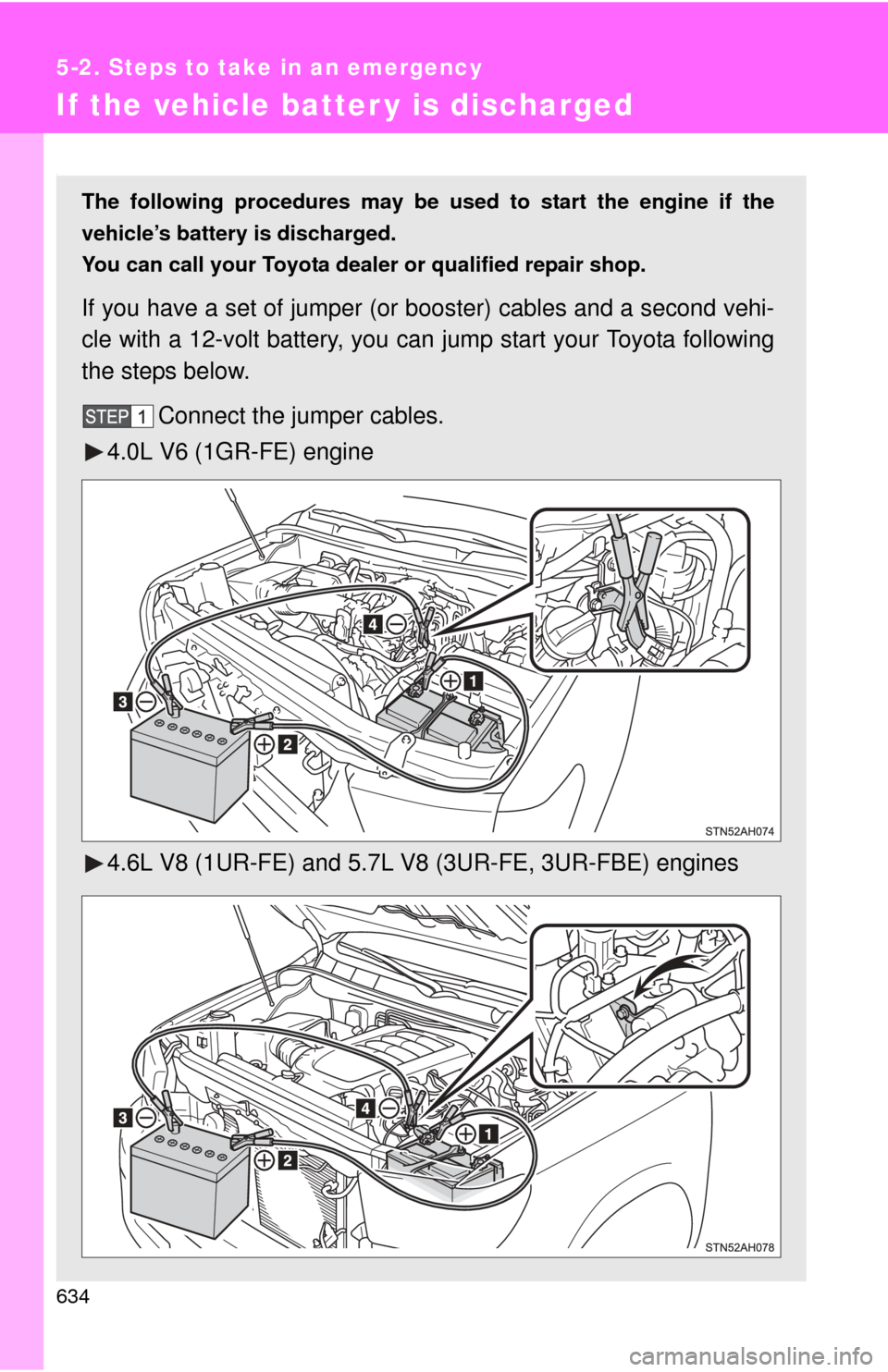
If you have a set of jumper (or boo ster) cables and a second vehi-
cle with a 12-volt battery, you can jump start your Toyota following
the steps below.
Connect the jumper cables.
4.0L V6 (1GR-FE) engine
4.6L V8 (1UR-FE) and 5.7L V8 (3UR-FE, 3UR-FBE) engines
Page 635 of 732
5
When trouble arises
635
5-2. Steps to take in an emergency
■
Starting the engine when the battery is discharged
The engine cannot be started by push-starting.
■ Avoiding a discharged battery
●Turn off the headlights and the audio system while the engine is turned
off.
● Turn off any unnecessary electrical components when the vehicle is run-
ning at a low speed for an extended period, such as in heavy traffic, etc.
■ When the battery is removed or discharged
●The moon roof must be initialized. ( P. 104)
● Flex-fuel vehicles: The information recorded in the computer will be
cleared, which may cause the engine to run roughly and reduce driving
performance for a while when the engine is first started. In this case, wait
until the engine runs normally.
If the vehicle is running on E85, the engine may stall.
In this case, restart the engine, repeatedly if necessary.
Positive (+) battery terminal on your vehicle
Positive (+) battery terminal on the second vehicle
Negative (-) battery terminal on the second vehicle
Connect the jumper cable to ground on your vehicle as shown in
the illustration.
Start the engine of the second vehicle. Increase the engine
speed slightly and maintain at that level for approximately 5
minutes to recharge the battery of your vehicle.
Maintain the engine speed of the second vehicle and start
the vehicle’s engine.
Once the vehicle’s engine has started, remove the jumper
cables in the exact reverse order in which they were con-
nected.
Once the engine starts, have the vehicle checked at your Toyota
dealer as soon as possible.
Page 637 of 732
5
When trouble arises
637
5-2. Steps to take in an emergency
If your vehicle overheats
If your engine overheats:
Stop the vehicle in a safe place and turn off the air condi-
tioning system.
Check to see if steam is coming out from under the hood.
If you see steam: Stop the engine. Carefully lift the hood after the steam
subsides and then restart the engine.
If you do not see steam: Leave the engine running and carefully lift the hood.
Check to see if the cooling fan is operating.
If the fan is operating: Wait until the temperature of the engine (shown on the
instrument cluster) begins to fall and then stop the
engine.
If the fan is not operating: Stop the engine immediately and call your local Toyota
dealer.
Page 638 of 732
638 5-2. Steps to take in an emergency
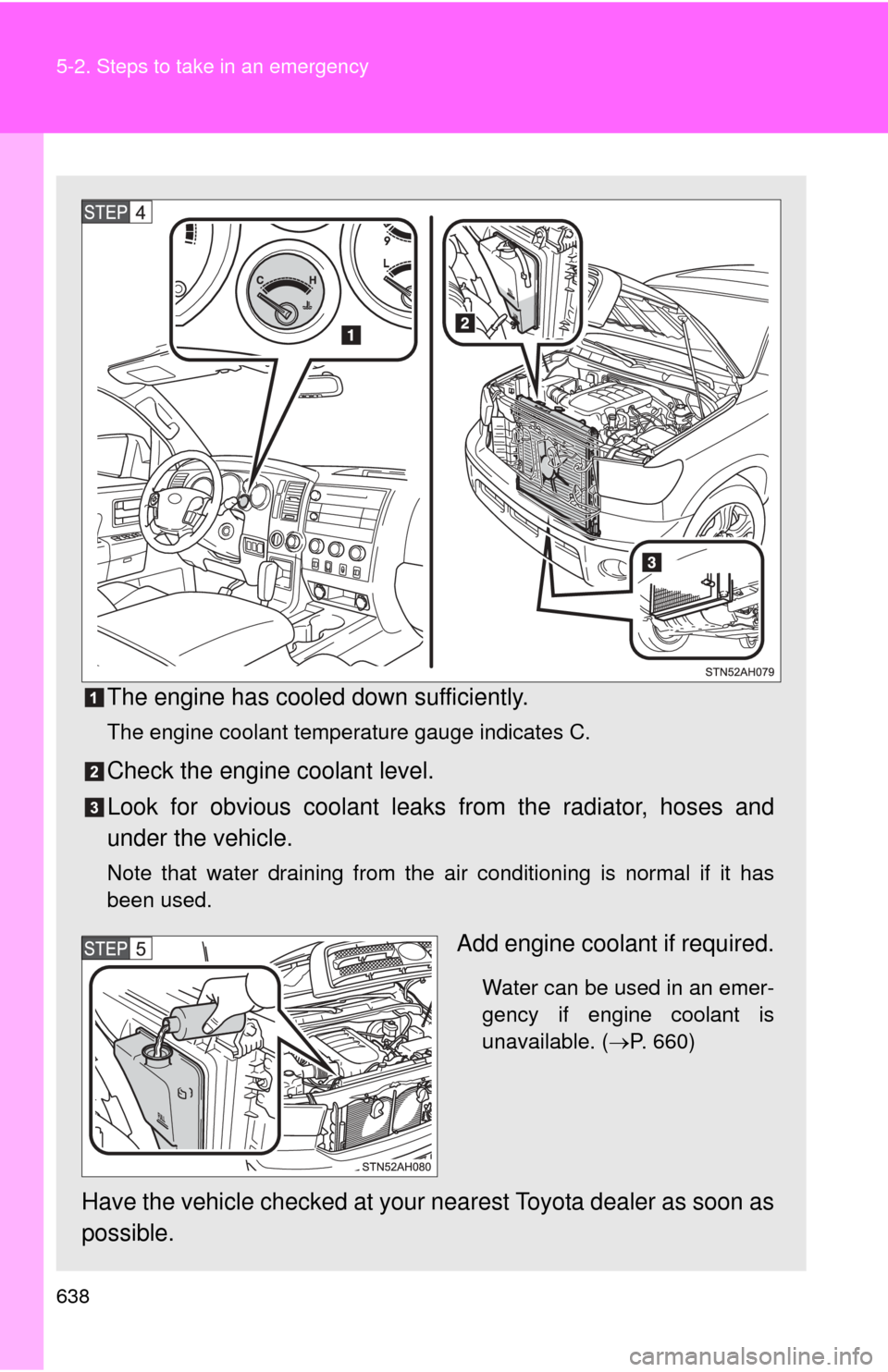
The engine has cooled down sufficiently.
The engine coolant temperature gauge indicates C.
Check the engine coolant level.
Look for obvious coolant leaks from the radiator, hoses and
under the vehicle.
Note that water draining from the air conditioning is normal if it has
been used.
Add engine coolant if required.
Water can be used in an emer-
gency if engine coolant is
unavailable. ( P. 660)
Have the vehicle checked at your nearest Toyota dealer as soon as
possible.
Page 639 of 732
5
When trouble arises
639
5-2. Steps to take in an emergency
■
Overheating
If you observe the following, your vehicle may be overheating.
●The engine coolant temperature gauge enters the red zone or a loss of
power is experienced.
● Steam is coming from under the hood.
● “ENGINE COOLANT HOT” is shown on the multi-information display
(vehicles with multi-information display).
CAUTION
■To prevent an accident or injury when inspecting under the hood of
your vehicle
●If steam is seen coming from under the hood, do not open the hood until
the steam has subsided. The engine compartment may be very hot, caus-
ing serious injury such as burns.
● Keep hands and clothing away from the fan and other belts while the
engine is running.
● Do not loosen the radiator cap while the engine and radiator are hot.
Serious injury, such as burns, may result from hot coolant and steam
released under pressure.
NOTICE
■When adding engine coolant
Wait until the engine has cooled down before adding engine coolant.
When adding coolant, do so slowly. Adding cool coolant to a hot engine too
quickly can cause damage to the engine.