engine TOYOTA TUNDRA 2011 2.G Owners Manual
[x] Cancel search | Manufacturer: TOYOTA, Model Year: 2011, Model line: TUNDRA, Model: TOYOTA TUNDRA 2011 2.GPages: 732, PDF Size: 16.65 MB
Page 669 of 732

669
6-1. Specifications
6
Vehicle specifications
■
If your engine knocks
●Consult your Toyota dealer.
● You may occasionally notice light knocking for a short time while acceler-
ating or driving uphill. This is normal and there is no need for concern.
■ Fuel quality
In very few cases, driveability problems may be caused by the brand of f\
uel
you are using. If driveability problems persist, try changing the brand of fuel.
If this does not correct the problem, consult your Toyota dealer.
■ Gasoline quality standards
●Automotive manufacturers in the US, Europe and Japan have developed
a specification for fuel quality called World-Wide Fuel Charter (WWFC)
that is expected to be applied worldwide.
● The WWFC consists of four categories that are based on required emis-
sion levels. In the US, category 4 has been adopted.
● The WWFC improves air quality by lowering emissions in vehicle fleets,
and customer satisfaction through better performance.
■ E85 fuel (Flex-fuel vehicles)
●E85 fuel is a blend of 85% ethanol and 15% gasoline. However, E85
does not necessarily contain 85% ethanol. The ethanol content of E85 is
required by ASTM to be between 70% and 85%. For example, in cold cli-
mates the ethanol content of E85 may be reduced during the winter
months to maintain cold weather starting performance.
● E85 has less energy per gallon than gasoline, so you will need to fill your
fuel tank more frequently when using E85.
● The number of fuel stations that sell E85 fuel is limited. For more infor-
mation about fueling stations, please refer to the U.S. Department of
Energy Web site.
http://www.afdc.energy.gov/afdc/locator/stations/
■ Toyota recommends the use of gaso line containing detergent additives
● Toyota recommends the use of gasoline that contains detergent additives
to avoid build-up of engine deposits.
● All gasoline sold in the US contains detergent additives to clean and/or
keep clean intake systems.
Page 670 of 732

670 6-1. Specifications
■Toyota recommends the use of cleaner burning gasoline
Cleaner burning gasoline, including reformulated gasoline that contains oxy-
genates such as ethanol or MTBE (Methyl Tertiary Butyl Ether) is available in
many areas.
Toyota recommends the use of cleaner burning gasoline and appropriately
blended reformulated gasoline. These types of gasoline provide excellent
vehicle performance, reduce vehicle emissions and improve air quality.
■ Toyota does not recommend blen ded gasoline (Gasoline engine)
● Toyota allows the use of oxygenate blended gasoline where the oxygen-
ate content is up to 10% ethanol or 15% MTBE.
● If you use gasohol in your Toyota, be sure that it has an octane rating no
lower than 87.
● Toyota does not recommend the use of gasoline containing methanol.
■ Toyota does not recommen d gasoline containing MMT
Some gasoline contains octane enhancing additive called MMT (Methylcy-
clopentadienyl Manganese Tricarbonyl).
Toyota does not recommend the use of gasoline that contains MMT. If fuel
containing MMT is used, your emission control system may be adversely
affected.
The malfunction indicator lamp on the instrument cluster may come on. If
this happens, contact your Toyota dealer for service.
■ Toyota does not recommend blende d gasoline (Flex-fuel engine)
Do not use non-specified fuels such as the following.
• Fuels containing methanol.
• Fuels with more than 85% ethanol.
■ Toyota does not recommend the use of after-market fuel additives
(Flex-fuel engine)
Do not use any after-market fuel additives when repeatedly refueling with
E85, as some after-market fuel additives are not compatible with E85.
Page 671 of 732
671
6-1. Specifications
6
Vehicle specifications
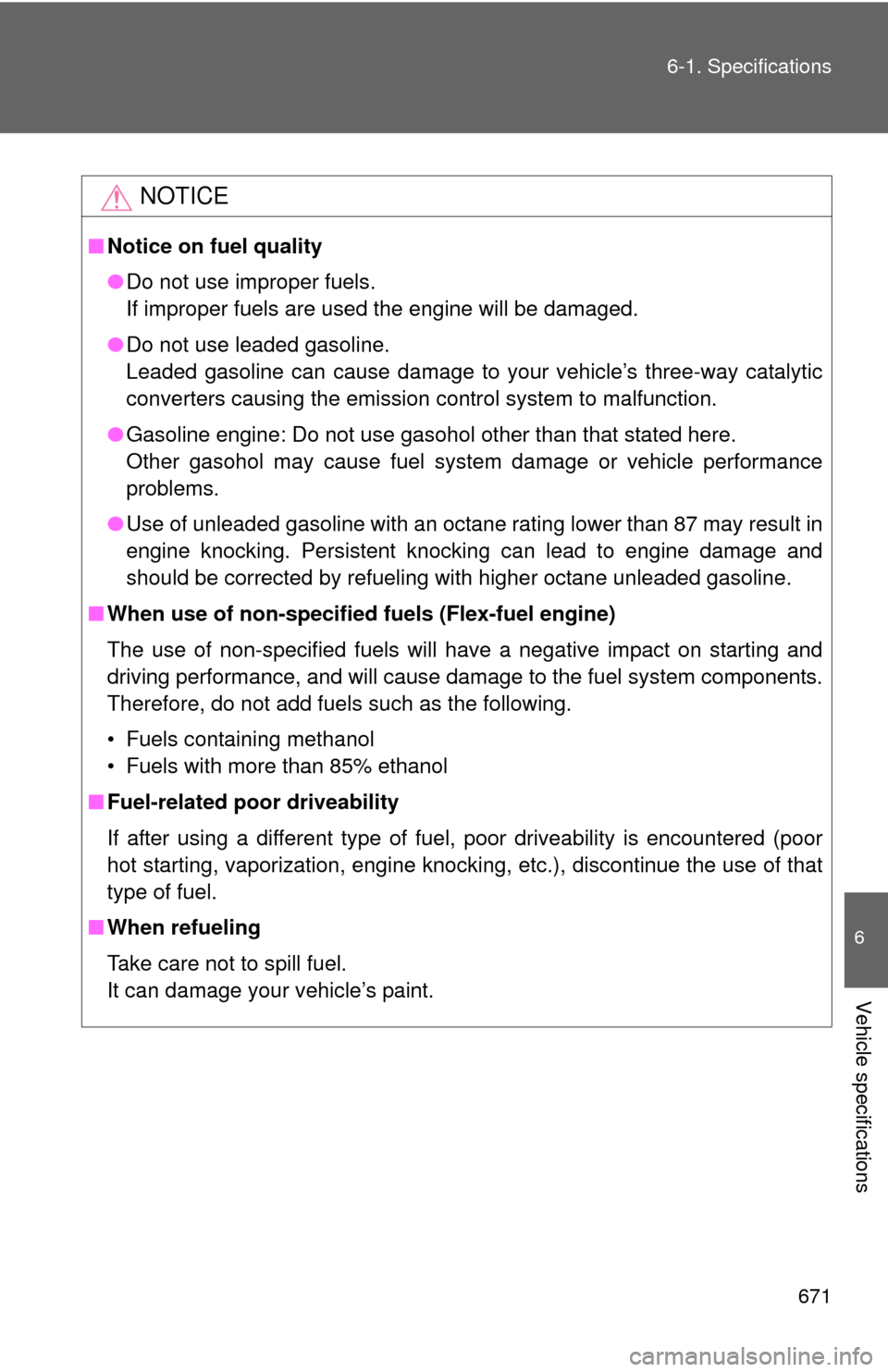
NOTICE
■
Notice on fuel quality
●Do not use improper fuels.
If improper fuels are used the engine will be damaged.
● Do not use leaded gasoline.
Leaded gasoline can cause damage to your vehicle’s three-way catalytic
converters causing the emission control system to malfunction.
● Gasoline engine: Do not use gasohol other than that stated here.
Other gasohol may cause fuel system damage or vehicle performance
problems.
● Use of unleaded gasoline with an octane rating lower than 87 may result in
engine knocking. Persistent knocking can lead to engine damage and
should be corrected by refueling with higher octane unleaded gasoline.
■ When use of non-specified fuels (Flex-fuel engine)
The use of non-specified fuels will have a negative impact on starting and
driving performance, and will cause damage to the fuel system components.
Therefore, do not add fuels such as the following.
• Fuels containing methanol
• Fuels with more than 85% ethanol
■ Fuel-related poor driveability
If after using a different type of fuel, poor driveability is encountered (poor
hot starting, vaporization, engine knocking, etc.), discontinue the use of that
type of fuel.
■ When refueling
Take care not to spill fuel.
It can damage your vehicle’s paint.
Page 677 of 732
677
6-1. Specifications
6
Vehicle specifications
Warning: The temperature grades for this tire are established for a
tire that is properly inflated and not overloaded.
Excessive speed, underinflation, or
excessive loading, either sepa-
rately or in combination, can caus e heat buildup and possible tire fail-
ure.
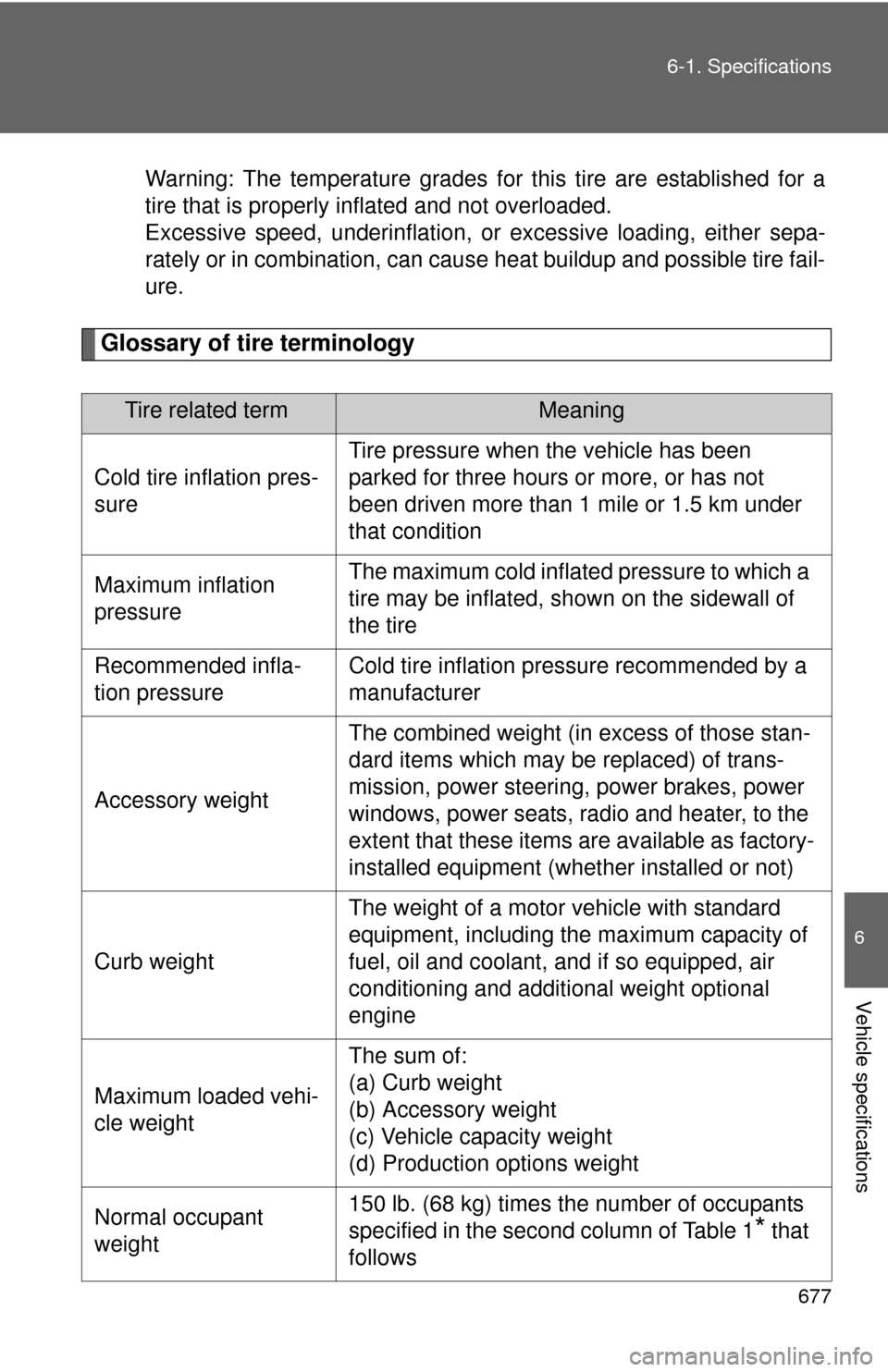
Glossary of tire terminology
Tire related termMeaning
Cold tire inflation pres-
sure
Tire pressure when the vehicle has been
parked for three hours or more, or has not
been driven more than 1 mile or 1.5 km under
that condition
Maximum inflation
pressureThe maximum cold inflated pressure to which a
tire may be inflated, s hown on the sidewall of
the tire
Recommended infla-
tion pressureCold tire inflation pressure recommended by a
manufacturer
Accessory weight
The combined weight (in excess of those stan-
dard items which may be replaced) of trans-
mission, power steering, power brakes, power
windows, power seats, radio and heater, to the
extent that these items are available as factory-
installed equipment (whether installed or not)
Curb weight
The weight of a motor vehicle with standard
equipment, including the maximum capacity of
fuel, oil and coolant, and if so equipped, air
conditioning and additional weight optional
engine
Maximum loaded vehi-
cle weight
The sum of:
(a) Curb weight
(b) Accessory weight
(c) Vehicle capacity weight
(d) Production options weight
Normal occupant
weight150 lb. (68 kg) times the number of occupants
specified in the second column of Table 1
* that
follows
Page 685 of 732
685
6-2. Customization
6
Vehicle specifications
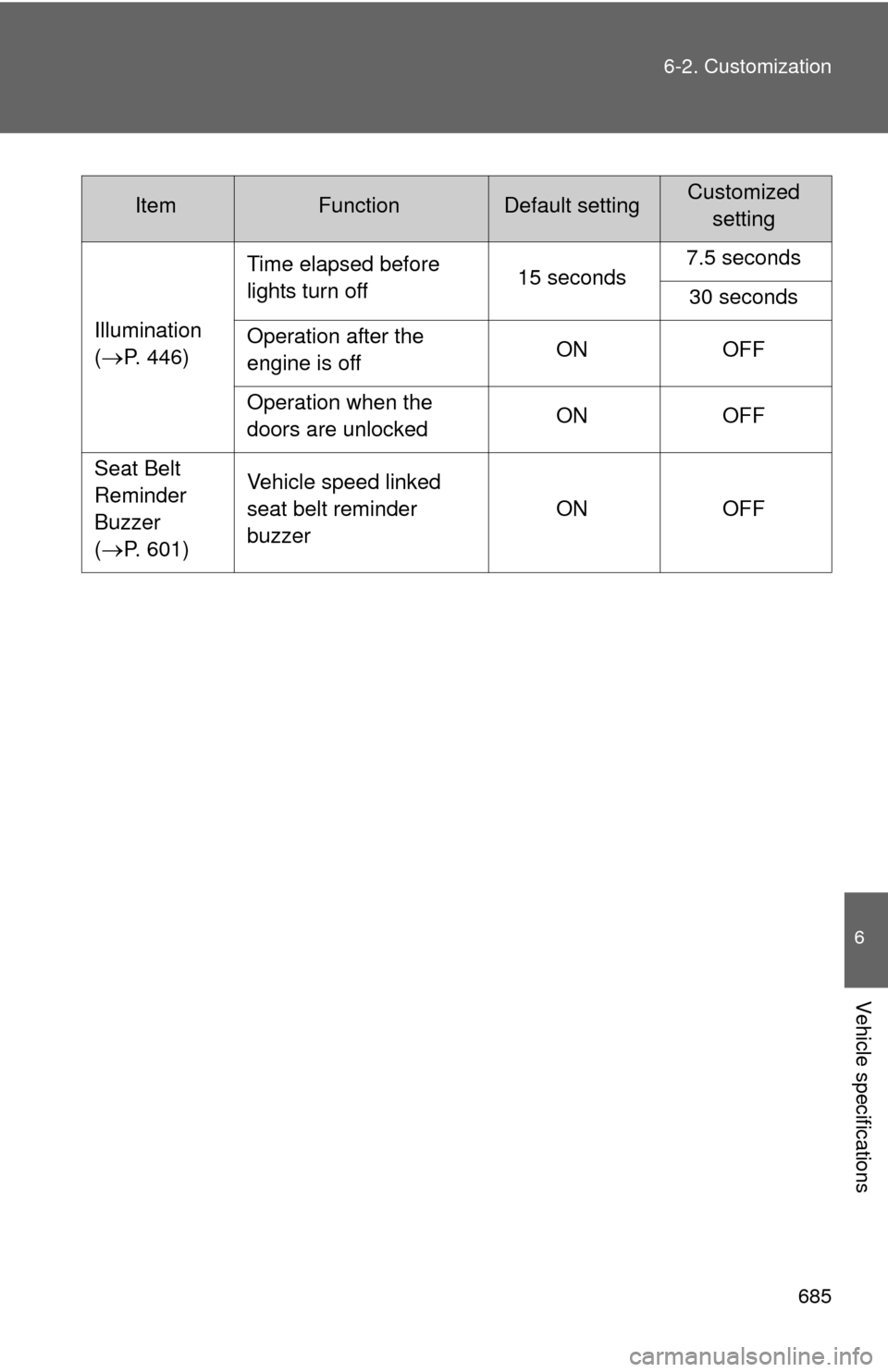
ItemFunctionDefault settingCustomized
setting
Illumination
(
P. 446) Time elapsed before
lights turn off
15 seconds7.5 seconds
30 seconds
Operation after the
engine is off ON OFF
Operation when the
doors are unlocked ON OFF
Seat Belt
Reminder
Buzzer
(
P. 601) Vehicle speed linked
seat belt reminder
buzzer
ON OFF
Page 686 of 732
686
6-2. Customization
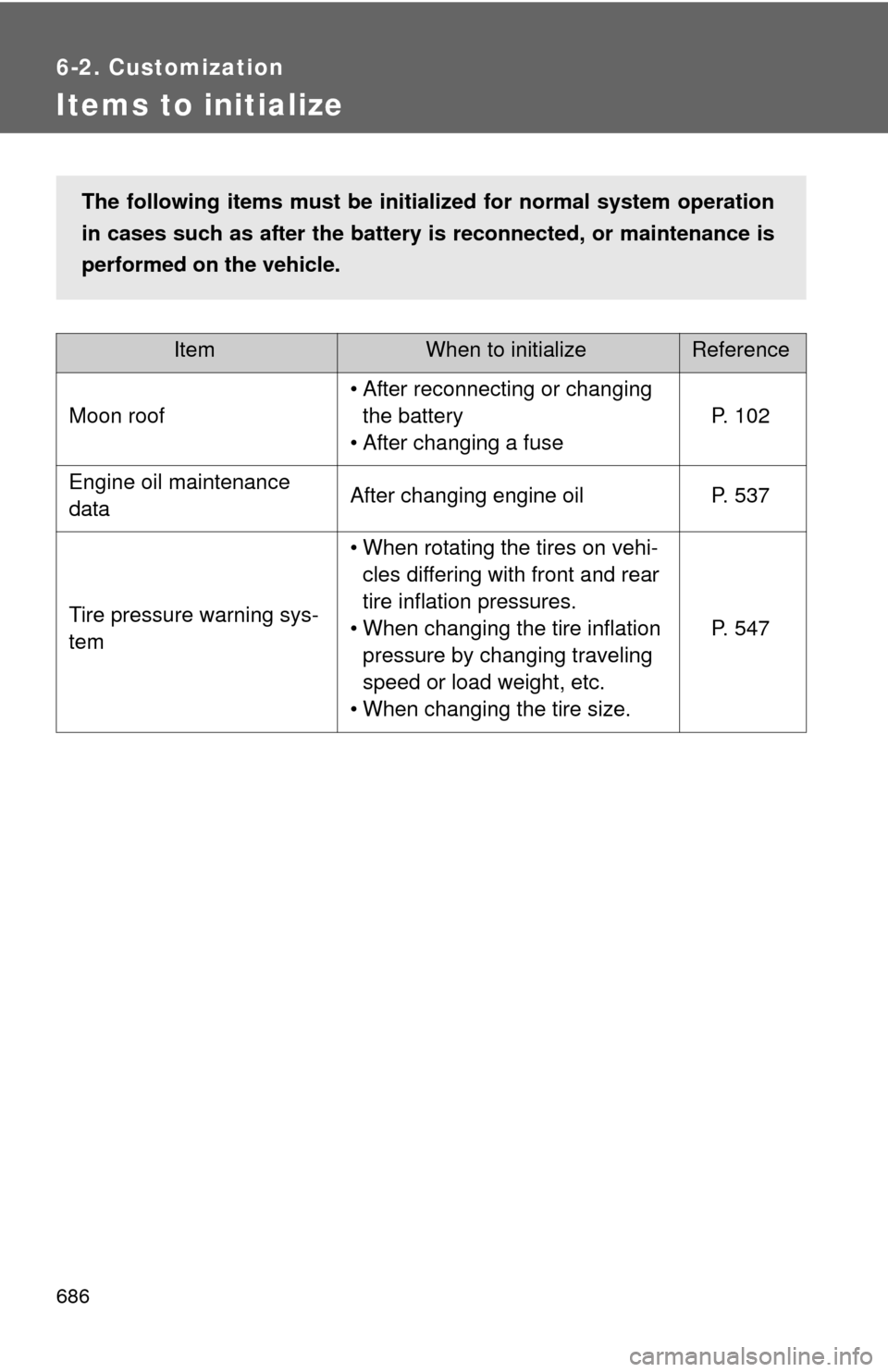
Items to initialize
ItemWhen to initializeReference
Moon roof
• After reconnecting or changing the battery
• After changing a fuse
P. 102
Engine oil maintenance
dataAfter changing engine oilP. 537
Tire pressure warning sys-
tem
• When rotating the tires on vehi- cles differing with front and rear
tire inflation pressures.
• When changing the tire inflation pressure by changing traveling
speed or load weight, etc.
• When changing the tire size.
P. 547
The following items must be initia lized for normal system operation
in cases such as after the battery is reconnected, or maintenance is
performed on the vehicle.
Page 708 of 732
708
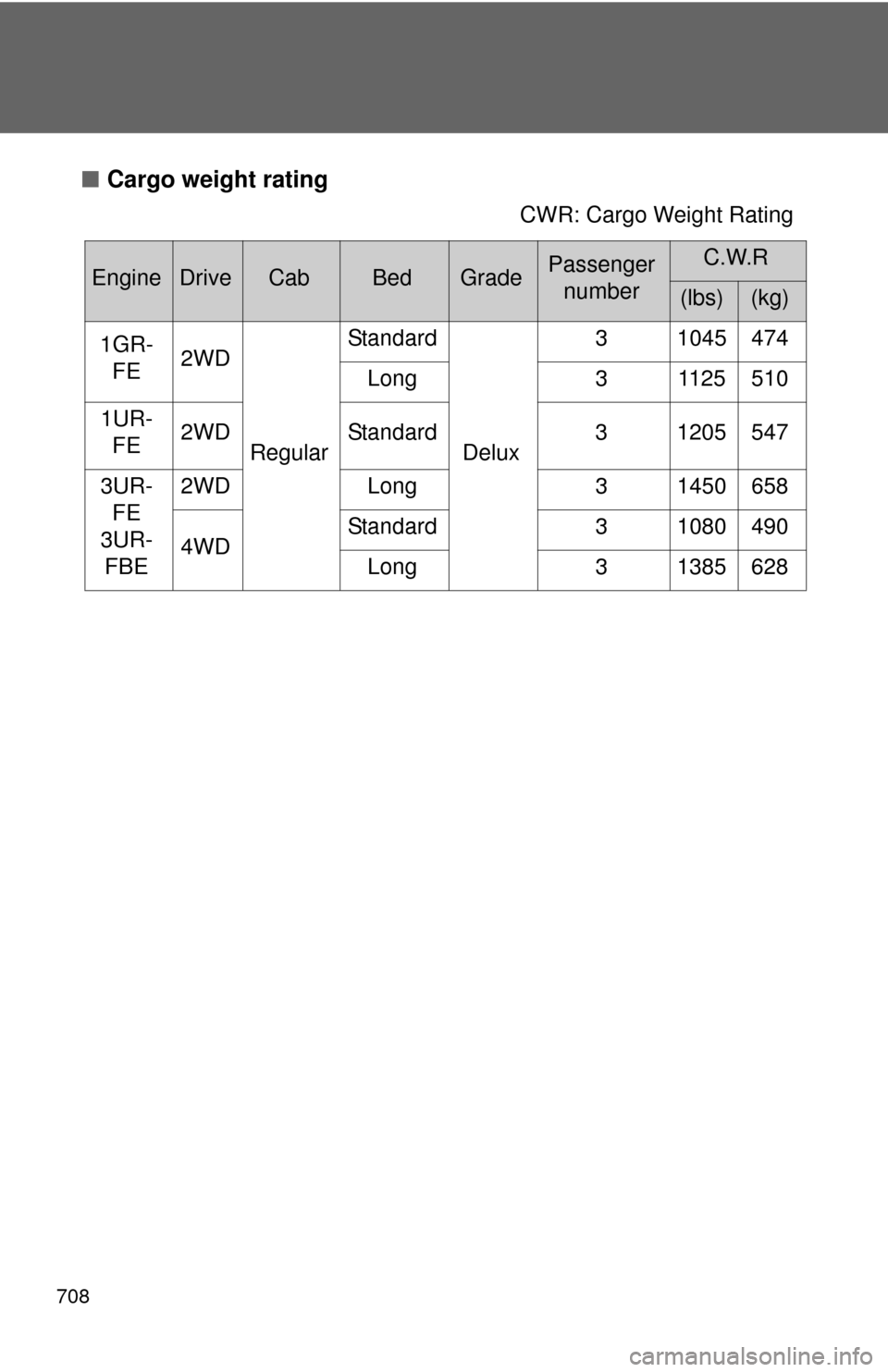
■Cargo weight rating
CWR: Cargo Weight Rating
EngineDriveCabBedGradePassenger
numberC.W.R
(lbs)(kg)
1GR- FE 2WD
Regular Standard
Delux 3 1045 474
Long 3 1125 510
1UR- FE 2WD Standard 3 1205 547
3UR- FE
3UR- FBE 2WD Long 3 1450 658
4WD
Standard 3 1080 490
Long 3 1385 628
Page 709 of 732
709
7
For owners
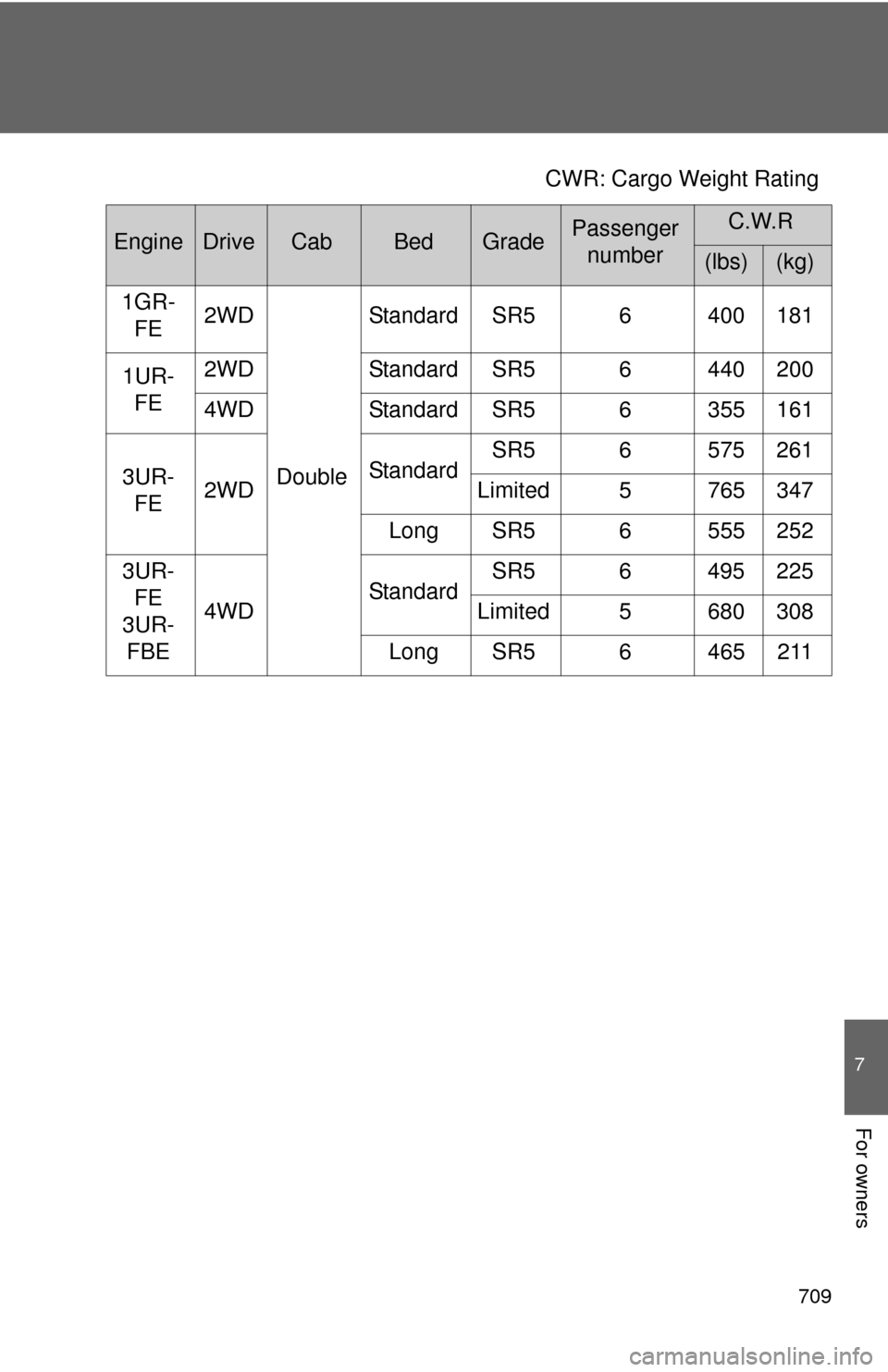
CWR: Cargo Weight Rating
EngineDriveCabBedGradePassenger numberC.W.R
(lbs)(kg)
1GR- FE 2WD
Double Standard SR5 6 400 181
1UR- FE 2WD Standard SR5 6 440 200
4WD Standard SR5 6 355 161
3UR- FE 2WD StandardSR5 6 575 261
Limited 5 765 347
Long SR5 6 555 252
3UR- FE
3UR- FBE 4WD
StandardSR5 6 495 225
Limited 5 680 308
Long SR5 6 465 211
Page 710 of 732
710
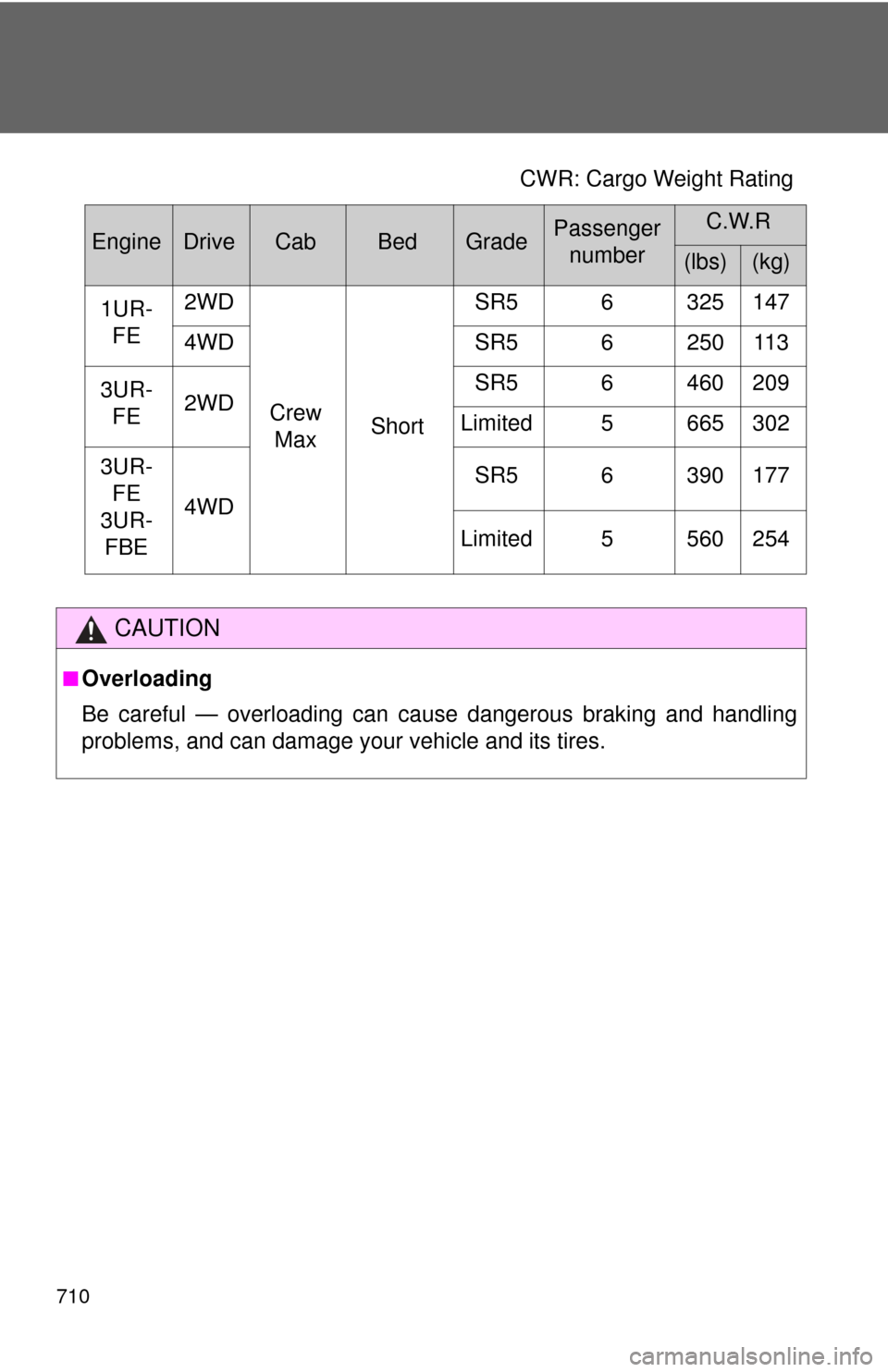
CWR: Cargo Weight Rating
EngineDriveCabBedGradePassenger numberC.W.R
(lbs)(kg)
1UR- FE 2WD
Crew Max Short SR5 6 325 147
4WD SR5 6 250 113
3UR- FE 2WD SR5 6 460 209
Limited 5 665 302
3UR- FE
3UR- FBE 4WD
SR5 6 390 177
Limited 5 560 254
CAUTION
■Overloading
Be careful — overloading can cause dangerous braking and handling
problems, and can damage your vehicle and its tires.
Page 712 of 732
712
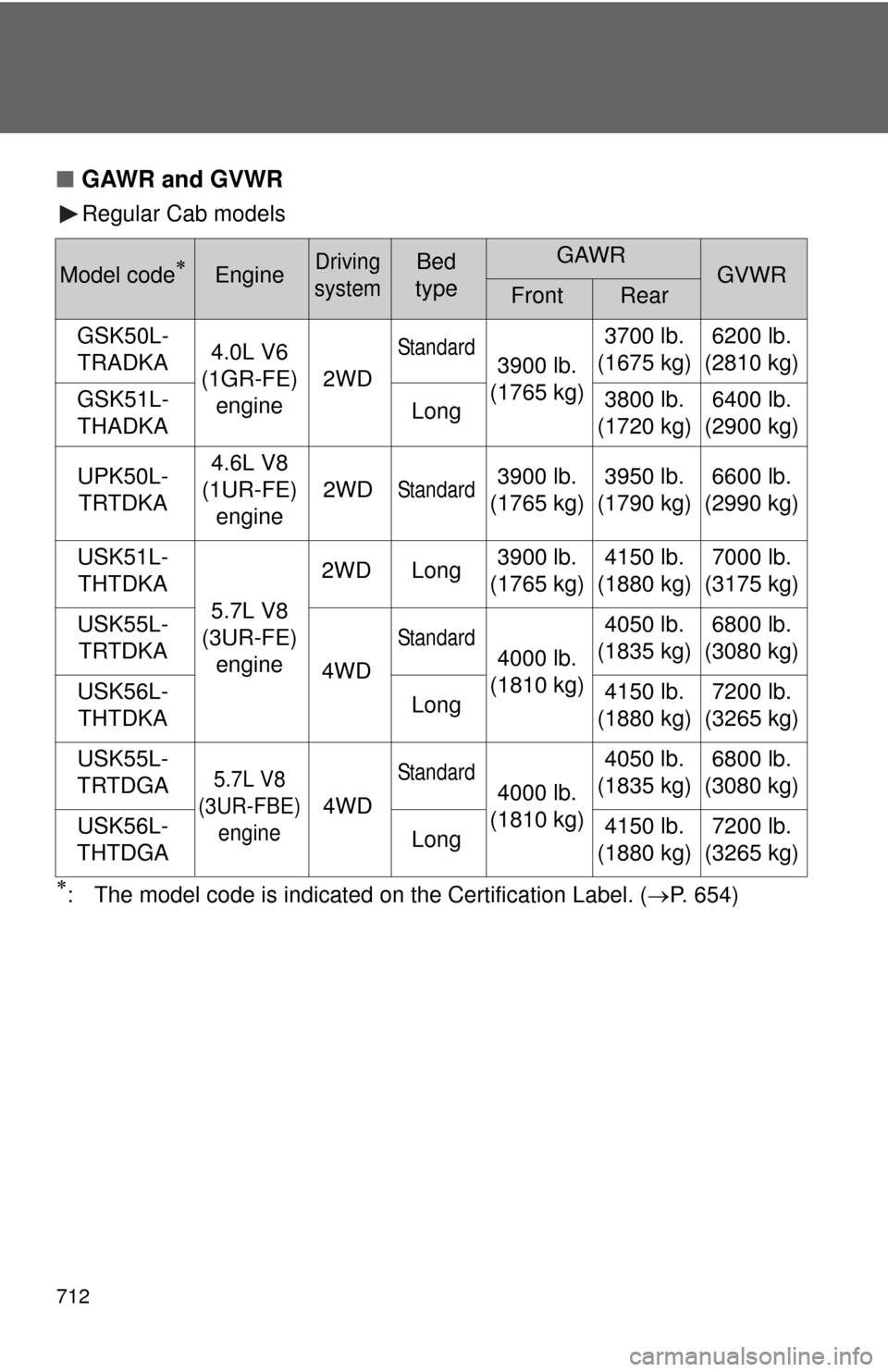
■GAWR and GVWR
Regular Cab models
: The model code is indicated on the Certification Label. (P. 654)
Model codeEngineDriving
systemBed
typeGAWRGVWRFrontRear
GSK50L- TRADKA 4.0L V6
(1GR-FE) engine 2WD
Standard3900 lb.
(1765 kg) 3700 lb.
(1675 kg) 6200 lb.
(2810 kg)
GSK51L- THADKA Long
3800 lb.
(1720 kg) 6400 lb.
(2900 kg)
UPK50L- TRTDKA 4.6L V8
(1UR-FE) engine 2WD
Standard3900 lb.
(1765 kg) 3950 lb.
(1790 kg) 6600 lb.
(2990 kg)
USK51L- THTDKA 5.7L V8
(3UR-FE) engine 2WD
Long3900 lb.
(1765 kg) 4150 lb.
(1880 kg) 7000 lb.
(3175 kg)
USK55L- TRTDKA 4WD
Standard4000 lb.
(1810 kg) 4050 lb.
(1835 kg) 6800 lb.
(3080 kg)
USK56L- THTDKA Long4150 lb.
(1880 kg) 7200 lb.
(3265 kg)
USK55L-
TRTDGA
5.7L V8
(3UR-FBE) engine
4WD
Standard4000 lb.
(1810 kg) 4050 lb.
(1835 kg) 6800 lb.
(3080 kg)
USK56L-
THTDGA Long4150 lb.
(1880 kg) 7200 lb.
(3265 kg)