power steering TOYOTA TUNDRA 2012 2.G User Guide
[x] Cancel search | Manufacturer: TOYOTA, Model Year: 2012, Model line: TUNDRA, Model: TOYOTA TUNDRA 2012 2.GPages: 744, PDF Size: 15.3 MB
Page 176 of 744
176 2-1. Driving procedures
NOTICE
■When driving the vehicle
●Do not depress the accelerator and brake pedals at the same time during
driving. If the brake pedal is depressed while driving with the accelerator
pedal depressed, driving torque may be restrained.
● Do not use the accelerator pedal or depress accelerator and brake pedals
together to hold the vehicle on a hill.
■ When parking the vehicle
Always put the shift lever in P.
Failure to do so may cause the vehicle to move or the vehicle may acceler-
ate suddenly if the accelerator pedal is accidentally depressed.
■ Avoiding damage to vehicle parts
●Do not turn the steering wheel fully in either direction and hold it there for a
long time.
Doing so may damage the power steering pump.
● When driving over bumps in the road, drive as slowly as possible to avoid
damaging the wheels, underside of the vehicle, etc.
■ If you hear a squealing or scrapin g noise while driving (brake pad wear
limit indicators)
Have the brake pads checked and replaced by your Toyota dealer as soon
as possible.
The rotor damage can result if the pads are not replaced when needed.
It is dangerous to drive the vehicle when the wear limits of the brake pads
and/or that of the brake discs are exceeded.
■ If you get a flat tire while driving
A flat or damaged tire may cause the following situations. Hold the steering
wheel firmly and gradually press the brake pedal to slow down the vehicle.
●It may be difficult to control your vehicle.
● The vehicle will make abnormal sounds.
● The vehicle will behave abnormally.
Replace a flat tire with a new one. ( P. 623)
Page 290 of 744
290 2-5. Driving information
●The vehicle remains level when a loaded or unloaded trailer is hitched.
Do not drive if the vehicle is not level, and check for improper tongue
weight, overloading, worn suspension, or other possible causes.
● The trailer cargo is securely loaded.
● The rear view mirrors conform to all applicable federal, state/provincial or
local regulations. If they do not, install rear view mirrors appropriate for
towing purposes.
● Depress TOW/HAUL button (if equipped)
■ Break-in schedule
If your vehicle is new or equipped with any new power train components
(such as an engine, transmission, differential or wheel bearing), Toyota rec-
ommends that you do not tow a trailer until the vehicle has been driven \
for
over 500 miles (800 km).
After the vehicle has been driven for over 500 miles (800 km), you can s\
tart
towing. However, for the next 500 miles (800 km), drive the vehicle at a
speed of less than 50 mph (80 km/h) when towing a trailer, and avoid full
throttle acceleration.
■ Maintenance
●If you tow a trailer, your vehicle will require more frequent maintenance
due to the additional load. (See “Owner’s Warranty Information Booklet”
or “Scheduled Maintenance Guide” /“Owner’s Manual Supplement”.)
● Retighten the fixing bolts of the towing ball and bracket after approxi-
mately 600 miles (1000 km) of trailer towing.
■ If trailer sway occurs
One or more factors (crosswinds, passing vehicles, rough roads, etc.) can
adversely affect handling of your vehicle and trailer, causing instability.
●If trailer swaying occurs:
• Firmly grip the steering wheel. Steer straight ahead.
Do not try to control trailer swaying by turning the steering wheel.
• Begin releasing the accelerator pedal immediately but very gradually to reduce speed.
Do not increase speed. Do not apply vehicle brakes.
If you make no extreme correction with the steering or brakes, your vehicle
and trailer should stabilize. (if enabled, Trailer Sway Control can also help to
stabilize the vehicle and trailer.)
Page 368 of 744
368
3-2. Using the audio system
Using the steering wheel audio switches
: If equipped
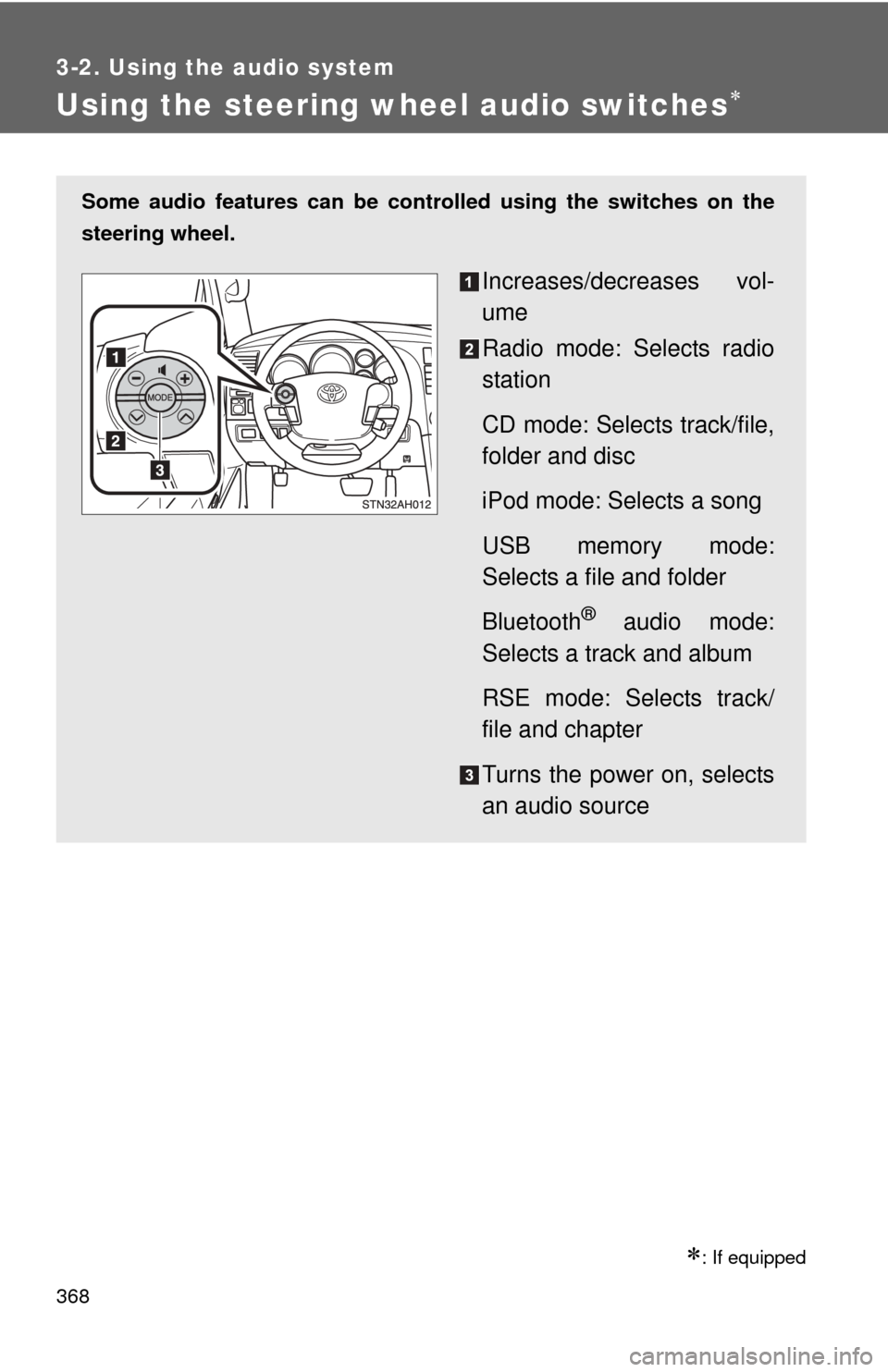
Some audio features can be controlled using the switches on the
steering wheel.
Increases/decreases vol-
ume
Radio mode: Selects radio
station
CD mode: Selects track/file,
folder and disc
iPod mode: Selects a song
USB memory mode:
Selects a file and folder
Bluetooth
® audio mode:
Selects a track and album
RSE mode: Selects track/
file and chapter
Turns the power on, selects
an audio source
Page 534 of 744
534
4-2. Maintenance
General maintenance
Engine compartment
ItemsCheck points
Battery Maintenance-free. ( P. 553)
Brake fluid At the correct level? ( P. 550)
Engine coolant At the correct level? ( P. 549)
Engine oil At the correct level? ( P. 545)
Exhaust system No fumes or strange sounds?
Power steering fluid At the correct level? ( P. 552)
Radiator/condenser/hoses Not blocked with foreign matter?
(P. 550)
Washer fluid At the correct level? (P. 555)
Listed below are the general maintenance items that should be per-
formed at the intervals specified in the “Scheduled Maintenance
Guide” or “Owner’s Manual Supp lement”. It is recommended that
any problem you notice should be brought to the attention of your
Toyota dealer or qualified service shop for advice.
Page 539 of 744
539
4-3. Do-it-yourself maintenance
4
Maintenance and care
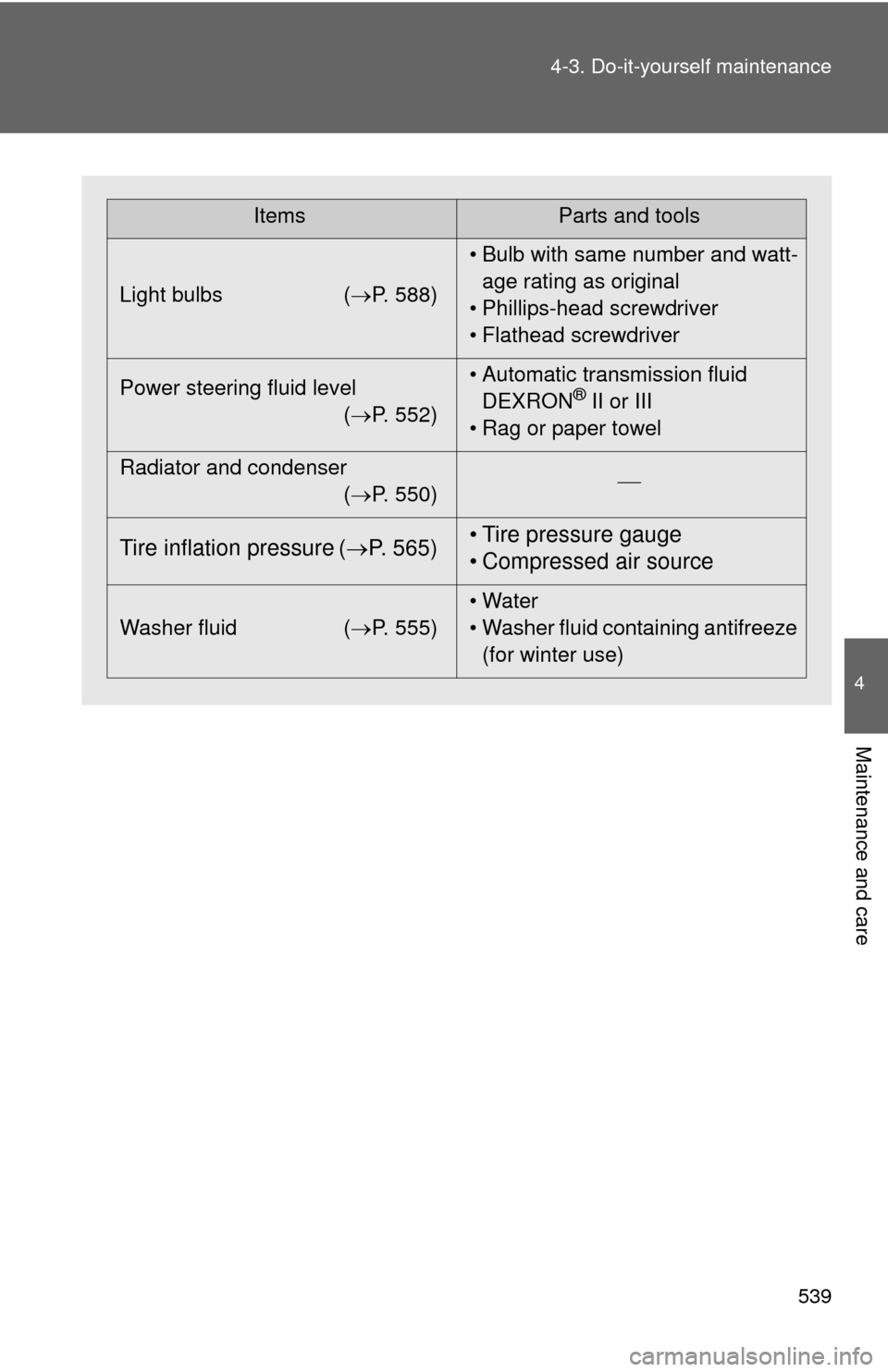
ItemsParts and tools
Light bulbs ( P. 588)• Bulb with same number and watt-
age rating as original
• Phillips-head screwdriver
• Flathead screwdriver
Power steering fluid level (P. 552) • Automatic transmission fluid
DEXRON
® II or III
• Rag or paper towel
Radiator and condenser (P. 550)
Tire inflation pressure (
P. 565) • Tire pressure gauge
• Compressed air source
Washer fluid
(P. 555) • Water
• Washer fluid containing antifreeze
(for winter use)
Page 543 of 744
543
4-3. Do-it-yourself maintenance
4
Maintenance and care
Engine compar tment
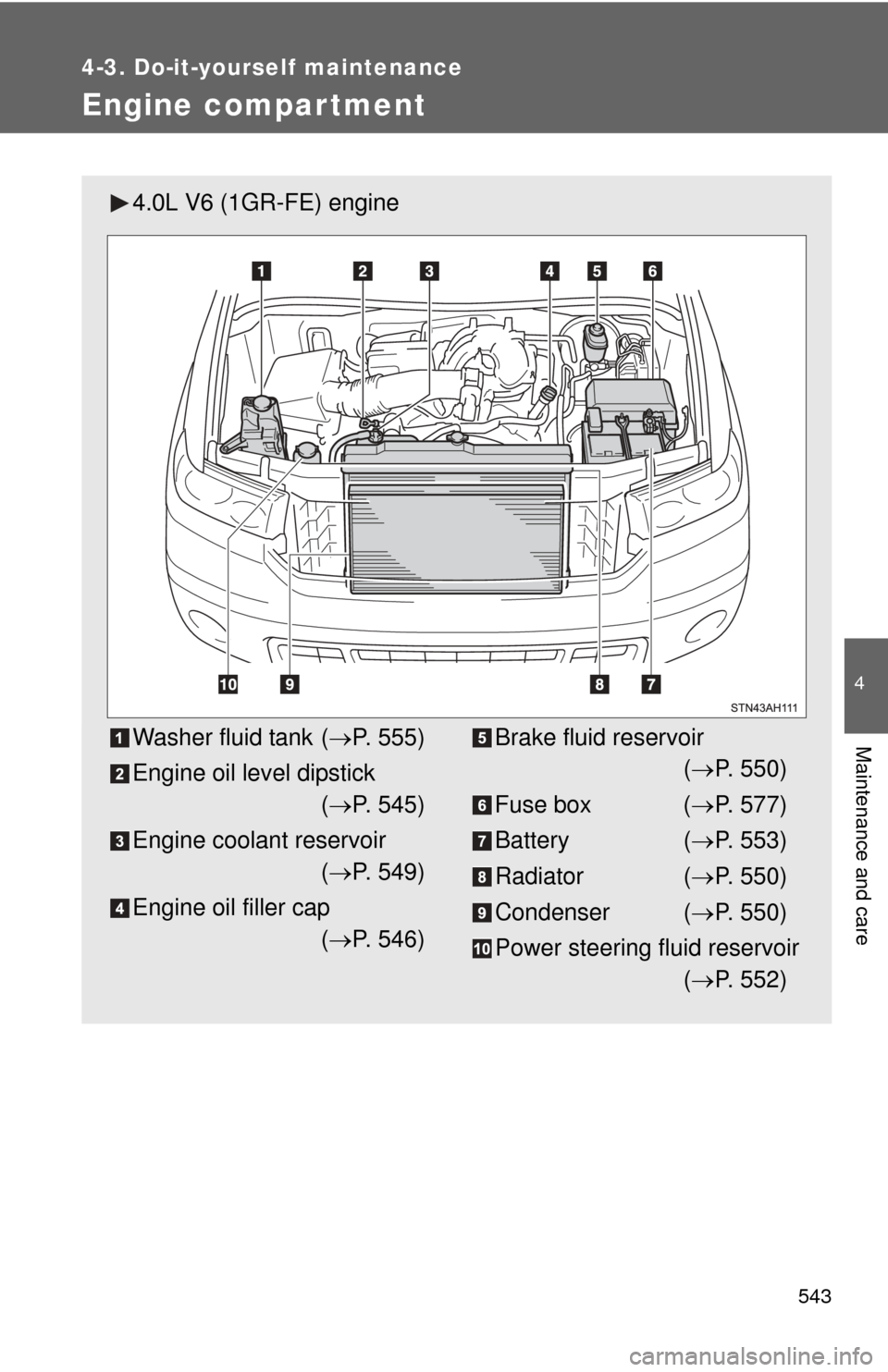
4.0L V6 (1GR-FE) engine
Washer fluid tank (P. 555)
Engine oil level dipstick ( P. 545)
Engine coolant reservoir ( P. 549)
Engine oil filler cap ( P. 546)Brake fluid reservoir
( P. 550)
Fuse box ( P. 577)
Battery ( P. 553)
Radiator ( P. 550)
Condenser ( P. 550)
Power steering fluid reservoir ( P. 552)
Page 544 of 744
544 4-3. Do-it-yourself maintenance
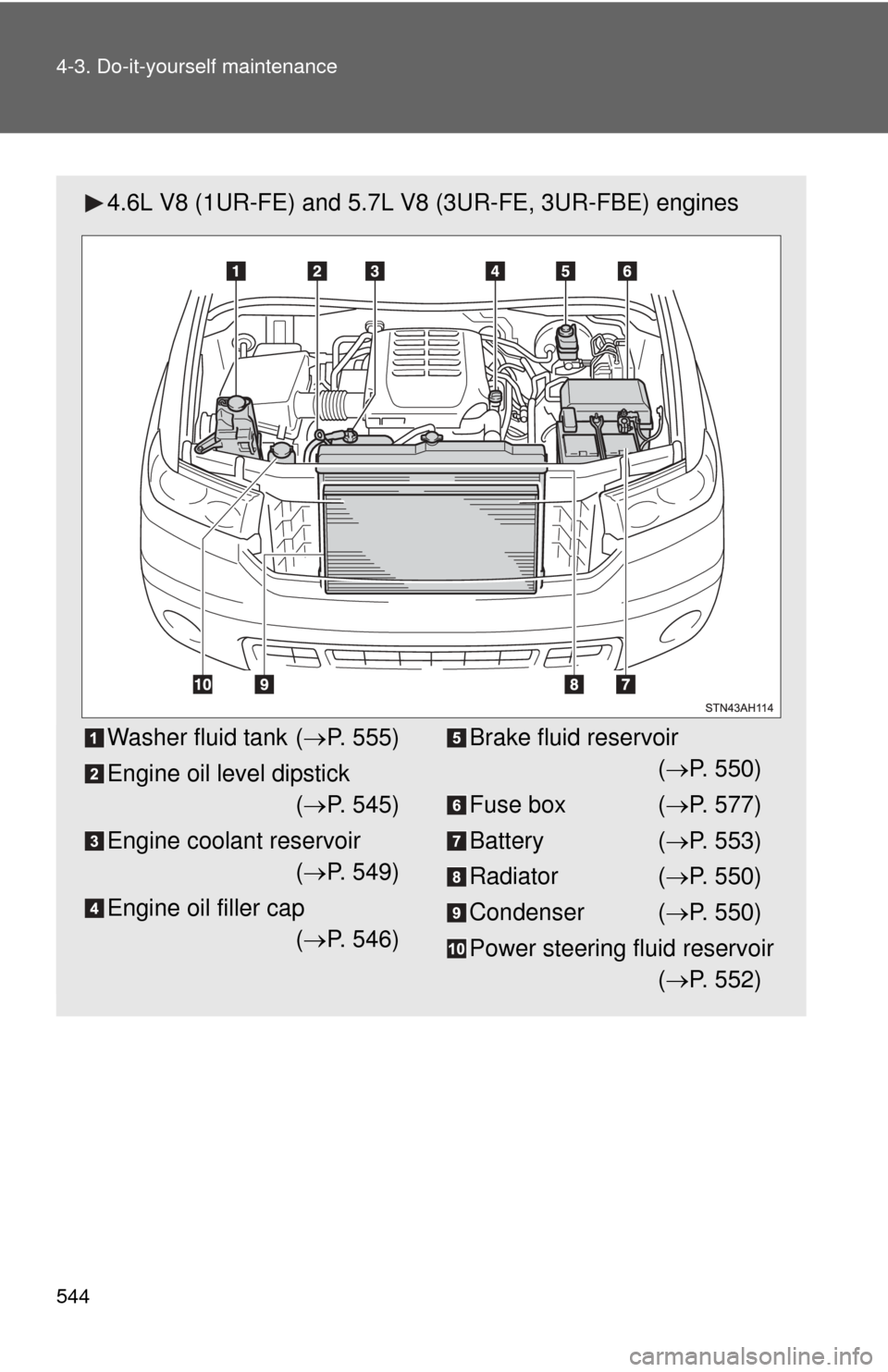
4.6L V8 (1UR-FE) and 5.7L V8 (3UR-FE, 3UR-FBE) engines
Washer fluid tank (P. 555)
Engine oil level dipstick ( P. 545)
Engine coolant reservoir ( P. 549)
Engine oil filler cap ( P. 546)Brake fluid reservoir
( P. 550)
Fuse box ( P. 577)
Battery ( P. 553)
Radiator ( P. 550)
Condenser ( P. 550)
Power steering fluid reservoir ( P. 552)
Page 552 of 744
552 4-3. Do-it-yourself maintenance
Power steering fluid■ Fluid level
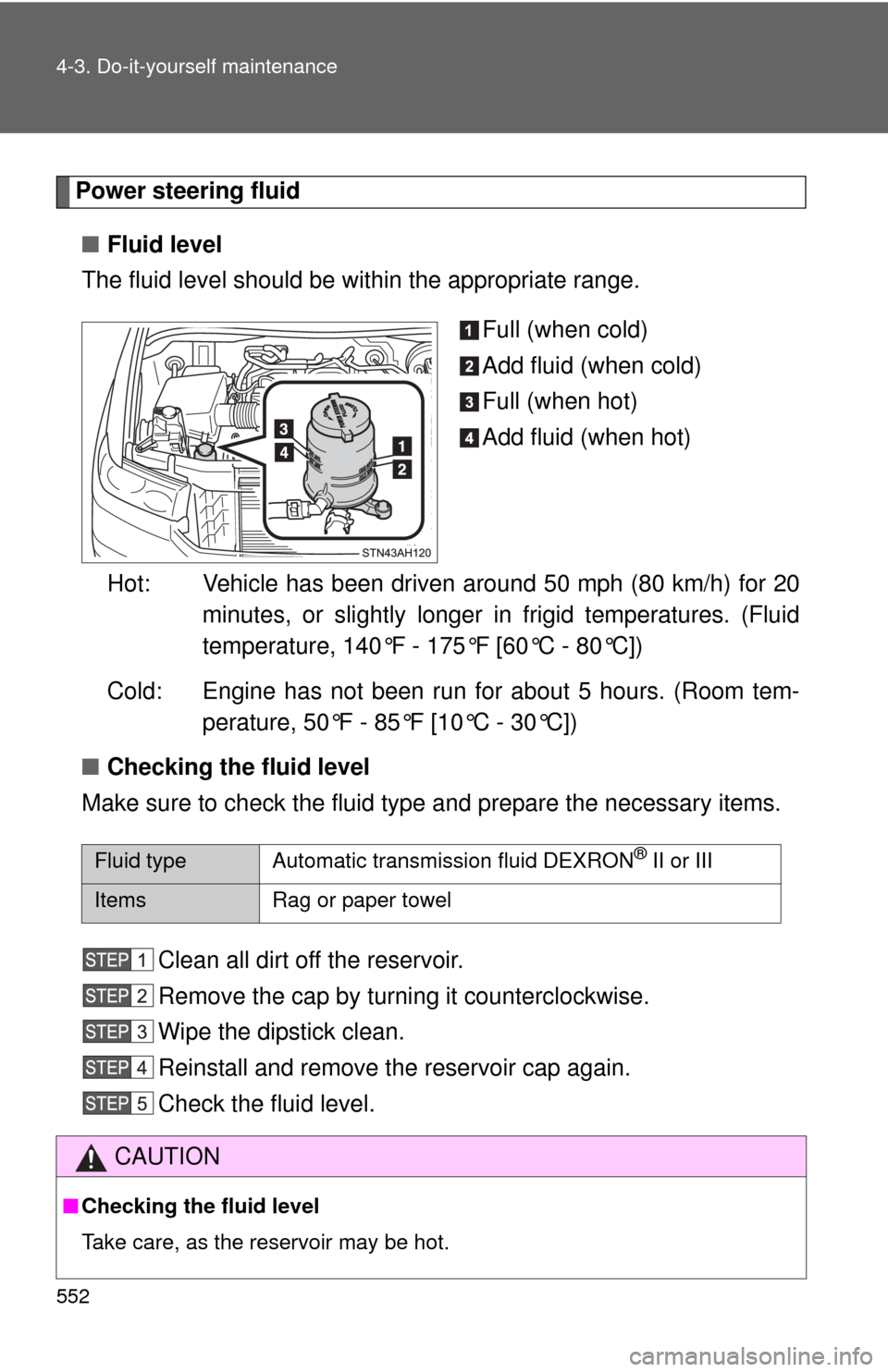
The fluid level should be within the appropriate range.
Full (when cold)
Add fluid (when cold)
Full (when hot)
Add fluid (when hot)
Hot: Vehicle has been driven around 50 mph (80 km/h) for 20 minutes, or slightly longer in frigid temperatures. (Fluid
temperature, 140°F - 175°F [60°C - 80°C])
Cold: Engine has not been run for about 5 hours. (Room tem- perature, 50°F - 85°F [10°C - 30°C])
■ Checking the fluid level
Make sure to check the fluid type and prepare the necessary items.
Clean all dirt off the reservoir.
Remove the cap by turning it counterclockwise.
Wipe the dipstick clean.
Reinstall and remove the reservoir cap again.
Check the fluid level.
Fluid type Automatic transmission fluid DEXRON® II or III
Items Rag or paper towel
CAUTION
■Checking the fluid level
Take care, as the reservoir may be hot.
Page 553 of 744
553
4-3. Do-it-yourself maintenance
4
Maintenance and care
Battery
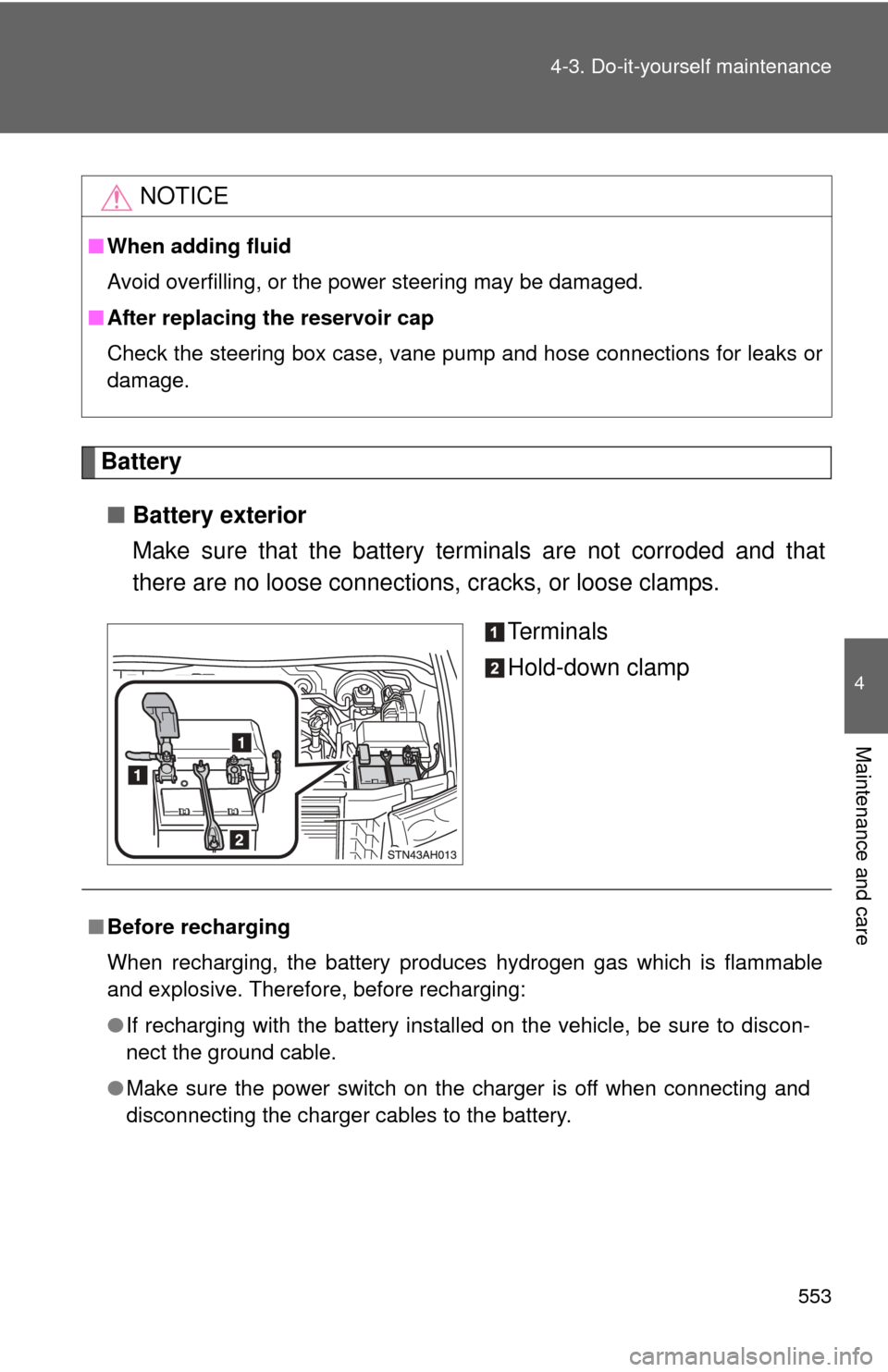
■ Battery exterior
Make sure that the battery terminals are not corroded and that
there are no loose connections, cracks, or loose clamps.
Te r m i n a l s
Hold-down clamp
NOTICE
■When adding fluid
Avoid overfilling, or the power steering may be damaged.
■ After replacing the reservoir cap
Check the steering box case, vane pump and hose connections for leaks or
damage.
■Before recharging
When recharging, the battery produces hydrogen gas which is flammable
and explosive. Therefore, before recharging:
●If recharging with the battery installed on the vehicle, be sure to discon-
nect the ground cable.
● Make sure the power switch on the charger is off when connecting and
disconnecting the charger cables to the battery.
Page 585 of 744
585
4-3. Do-it-yourself maintenance
4
Maintenance and care
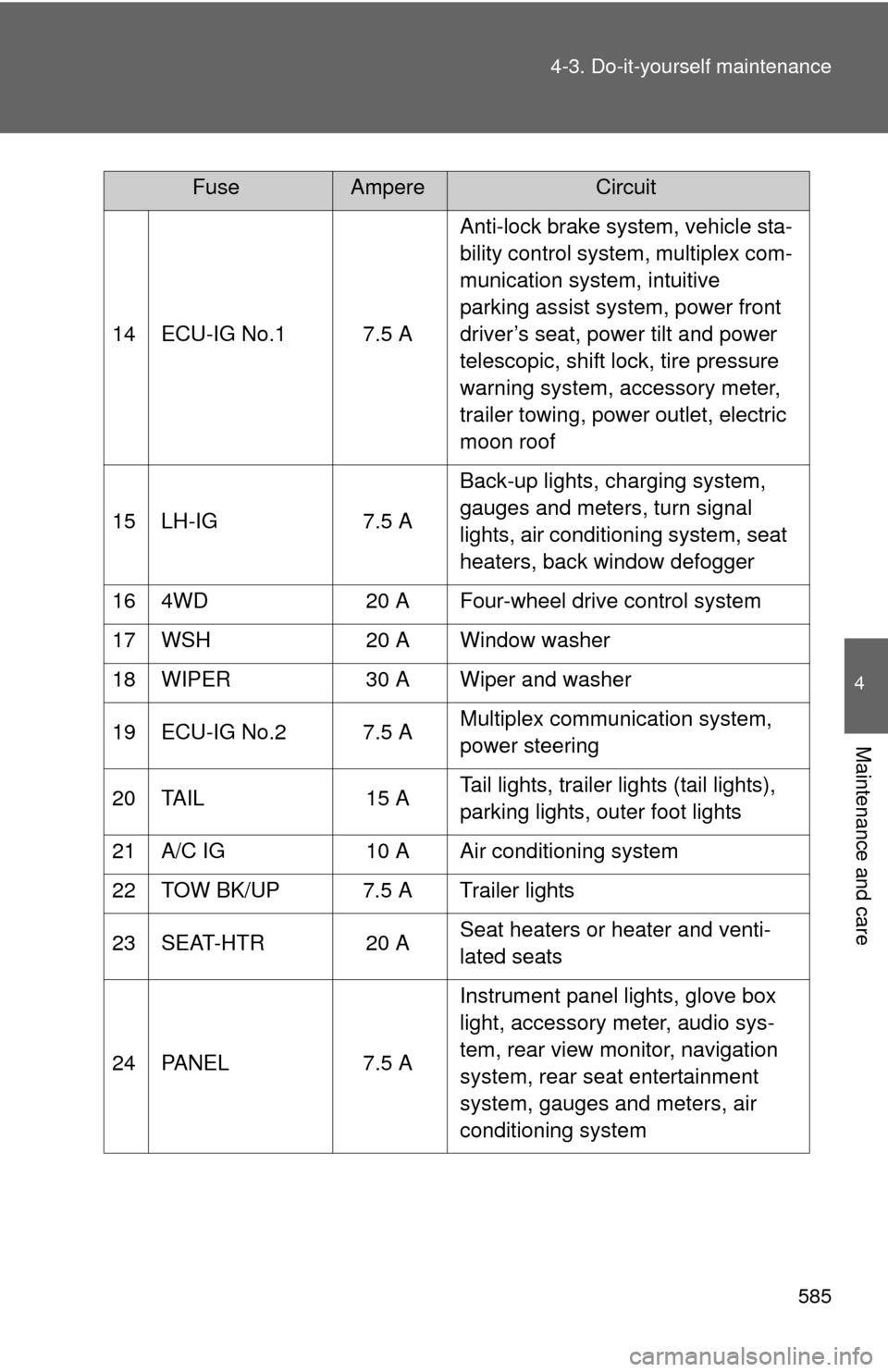
14 ECU-IG No.1 7.5 A
Anti-lock brake system, vehicle sta-
bility control system, multiplex com-
munication system, intuitive
parking assist system, power front
driver’s seat, power tilt and power
telescopic, shift lock, tire pressure
warning system, accessory meter,
trailer towing, power outlet, electric
moon roof
15 LH-IG 7.5 A Back-up lights, charging system,
gauges and meters, turn signal
lights, air conditioning system, seat
heaters, back window defogger
16 4WD 20 A Four-wheel drive control system
17 WSH 20 A Window washer
18 WIPER 30 A Wiper and washer
19 ECU-IG No.2 7.5 A Multiplex communication system,
power steering
20 TAIL 15 A Tail lights, trailer lights (tail lights),
parking lights, outer foot lights
21 A/C IG 10 A Air conditioning system
22 TOW BK/UP 7.5 A Trailer lights
23 SEAT-HTR 20 A Seat heaters or heater and venti-
lated seats
24 PANEL 7.5 A Instrument panel lights, glove box
light, accessory meter, audio sys-
tem, rear view monitor, navigation
system, rear seat entertainment
system, gauges and meters, air
conditioning system
FuseAmpereCircuit