power steering TOYOTA TUNDRA 2012 2.G Owners Manual
[x] Cancel search | Manufacturer: TOYOTA, Model Year: 2012, Model line: TUNDRA, Model: TOYOTA TUNDRA 2012 2.GPages: 744, PDF Size: 15.3 MB
Page 2 of 744

TABLE OF CONTENTSIndex
2
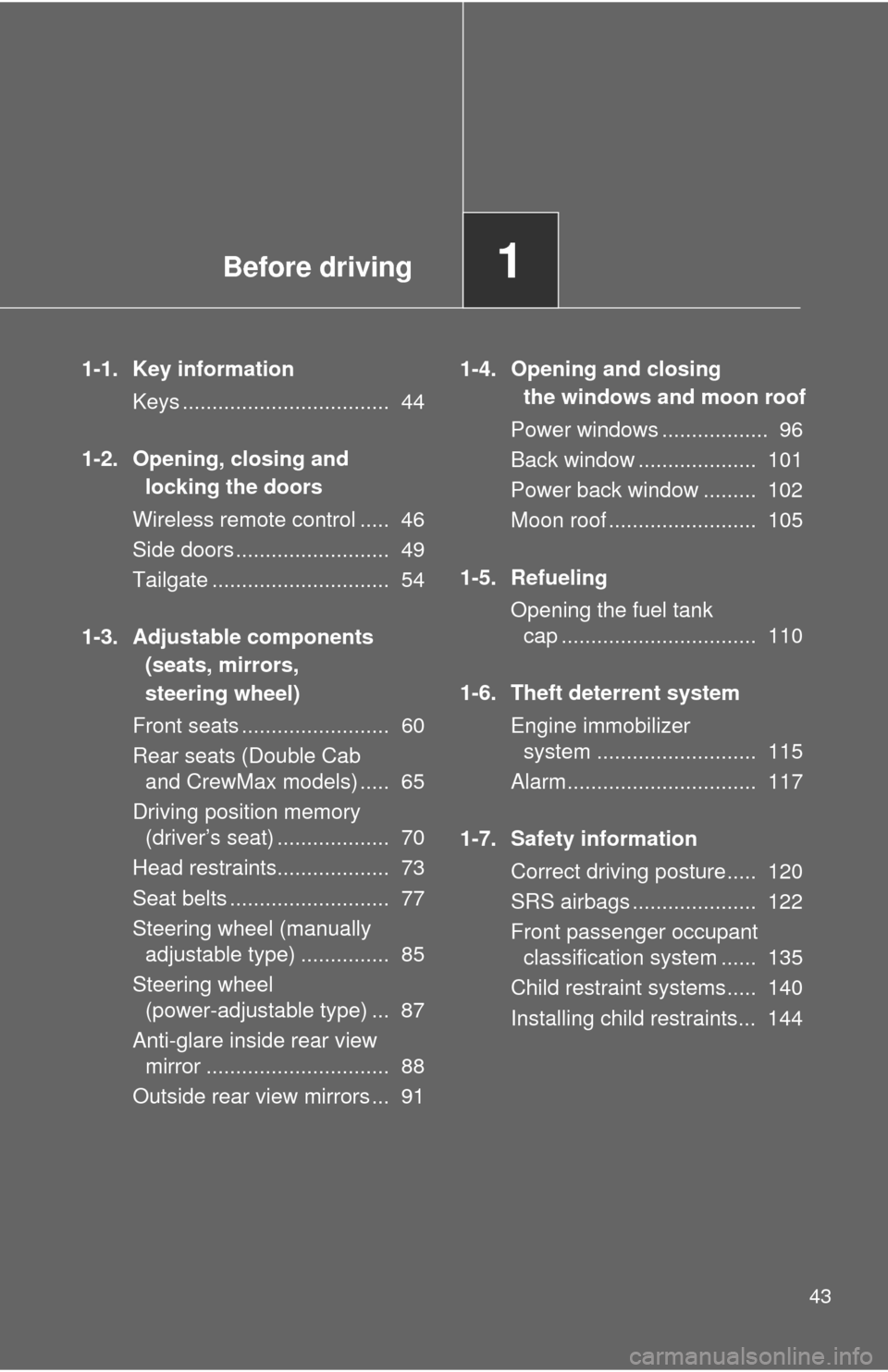
1-1. Key informationKeys ..................................... 44
1-2. Opening, closing and locking the doors
Wireless remote control ....... 46
Side doors ............................ 49
Tailgate ................................ 54
1-3. Adjustable components (seats, mirrors, steering
wheel)
Front seats ........................... 60
Rear seats (Double Cab and CrewMax models) ....... 65
Driving position memory (driver’s seat) ..................... 70
Head restraints ..................... 73
Seat belts ............................. 77
Steering wheel (manually adjustable type) .................. 85
Steering wheel (power-adjustable type)...... 87
Anti-glare inside rear view mirror .................................. 88
Outside rear view mirrors ..... 91
1-4. Opening and closing the windows and moon roof
Power windows .................... 96
Back window ...................... 101
Power back window ........... 102
Moon roof ........................... 105 1-5. Refueling
Opening the fuel tank cap... 110
1-6. Theft deterrent system Engine immobilizer system .............................. 115
Alarm .................................. 117
1-7. Safety information Correct driving posture ....... 120
SRS airbags ....................... 122
Front passenger occupant classification system ......... 135
Child restraint systems ....... 140
Installing child restraints ..... 144
2-1. Driving procedures Driving the vehicle .............. 168
Engine (ignition) switch....... 178
Automatic transmission ...... 181
Turn signal lever ................. 186
Parking brake ..................... 187
Horn .................................... 188
2-2. Instrument cluster Gauges and meters ............ 189
Indicators and warning lights ................................. 195
Multi-information display ..... 200
Accessory meter ................. 207
1Before driving
2When driving
Page 43 of 744
Before driving1
43
1-1. Key informationKeys ................................... 44
1-2. Opening, closing and locking the doors
Wireless remote control ..... 46
Side doors .......................... 49
Tailgate .............................. 54
1-3. Adjustable components (seats, mirrors,
steering wheel)
Front seats ......................... 60
Rear seats (Double Cab and CrewMax models) ..... 65
Driving position memory (driver’s seat) ................... 70
Head restraints................... 73
Seat belts ........................... 77
Steering wheel (manually adjustable type) ............... 85
Steering wheel (power-adjustable type) ... 87
Anti-glare inside rear view mirror ............................... 88
Outside rear view mirrors ... 91 1-4. Opening and closing
the windows and moon roof
Power windows .................. 96
Back window .................... 101
Power back window ......... 102
Moon roof ......................... 105
1-5. Refueling Opening the fuel tank cap ................................. 110
1-6. Theft deterrent system Engine immobilizer system ........................... 115
Alarm................................ 117
1-7. Safety information Correct driving posture..... 120
SRS airbags ..................... 122
Front passenger occupant classification system ...... 135
Child restraint systems..... 140
Installing child restraints... 144
Page 62 of 744
62 1-3. Adjustable components (seats, mirrors, steering wheel)
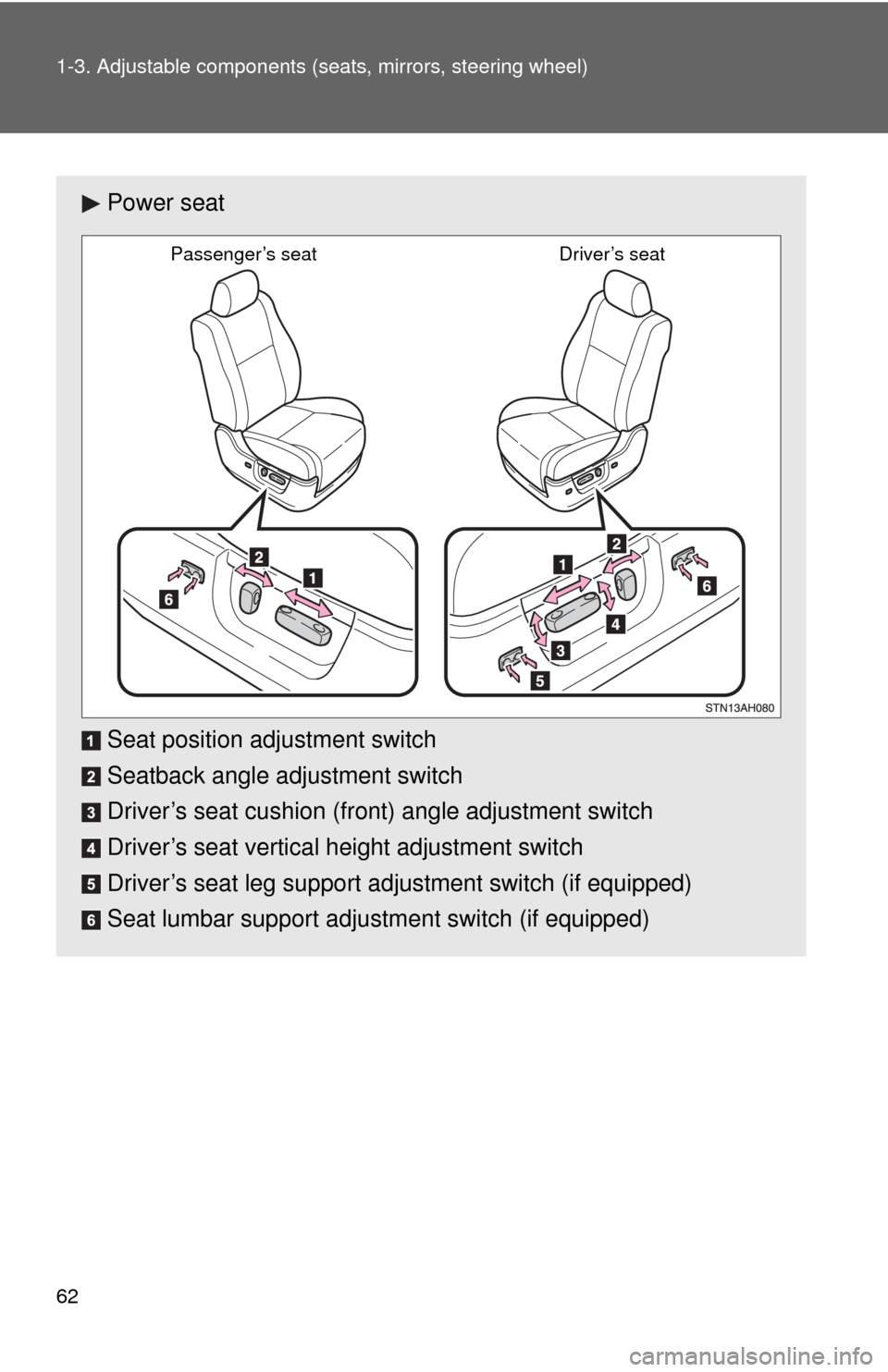
Power seat
Seat position adjustment switch
Seatback angle adjustment switch
Driver’s seat cushion (front) angle adjustment switch
Driver’s seat vertical height adjustment switch
Driver’s seat leg support adjustment switch (if equipped)
Seat lumbar support adjustment switch (if equipped)
Passenger’s seat Driver’s seat
Page 72 of 744

72 1-3. Adjustable components (seats, mirrors, steering wheel)
■Retained accessory power
Each memorized position (except for the tilt and telescopic steering column)
can be activated within 30 seconds after the driver’s door is opened, even if
the key is not in the engine switch.
■ If any position memory button is pushed while the adjustments are
being made
The operation will stop. To reactivate the system, push the button (“1” or “2”)
again.
■ If the battery is disconnected
The memorized positions must be reset because the computer’s memory is
erased when the battery is disconnected.
CAUTION
■Seat adjustment caution
Take care during seat adjustment that the seat does not strike the rear pas-
senger or squeeze your body against the steering wheel.
If this happens, you can stop the movement by pressing another seat posi-
tion memory button.
Page 87 of 744
87
1
1-3. Adjustable components (seats, mirrors, steering wheel)
Before driving
Steering wheel (power-adjustable type)
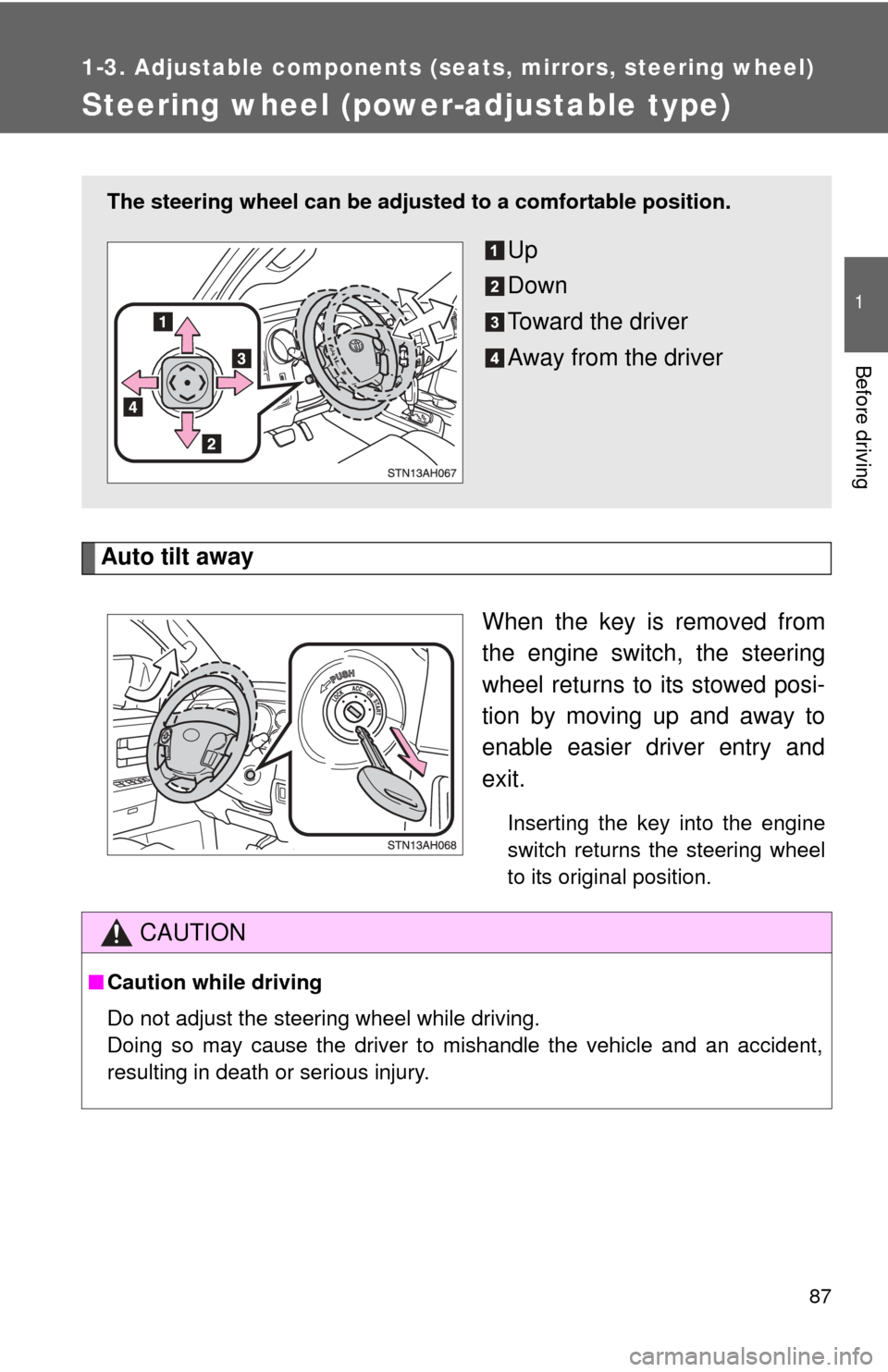
Auto tilt awayWhen the key is removed from
the engine switch, the steering
wheel returns to its stowed posi-
tion by moving up and away to
enable easier driver entry and
exit.
Inserting the key into the engine
switch returns the steering wheel
to its original position.
The steering wheel can be adjusted to a comfortable position.
Up
Down
Toward the driver
Away from the driver
CAUTION
■Caution while driving
Do not adjust the steering wheel while driving.
Doing so may cause the driver to mishandle the vehicle and an accident,
resulting in death or serious injury.
Page 91 of 744
91
1
1-3. Adjustable components (seats, mirrors, steering wheel)
Before driving
Outside rear view mirrors
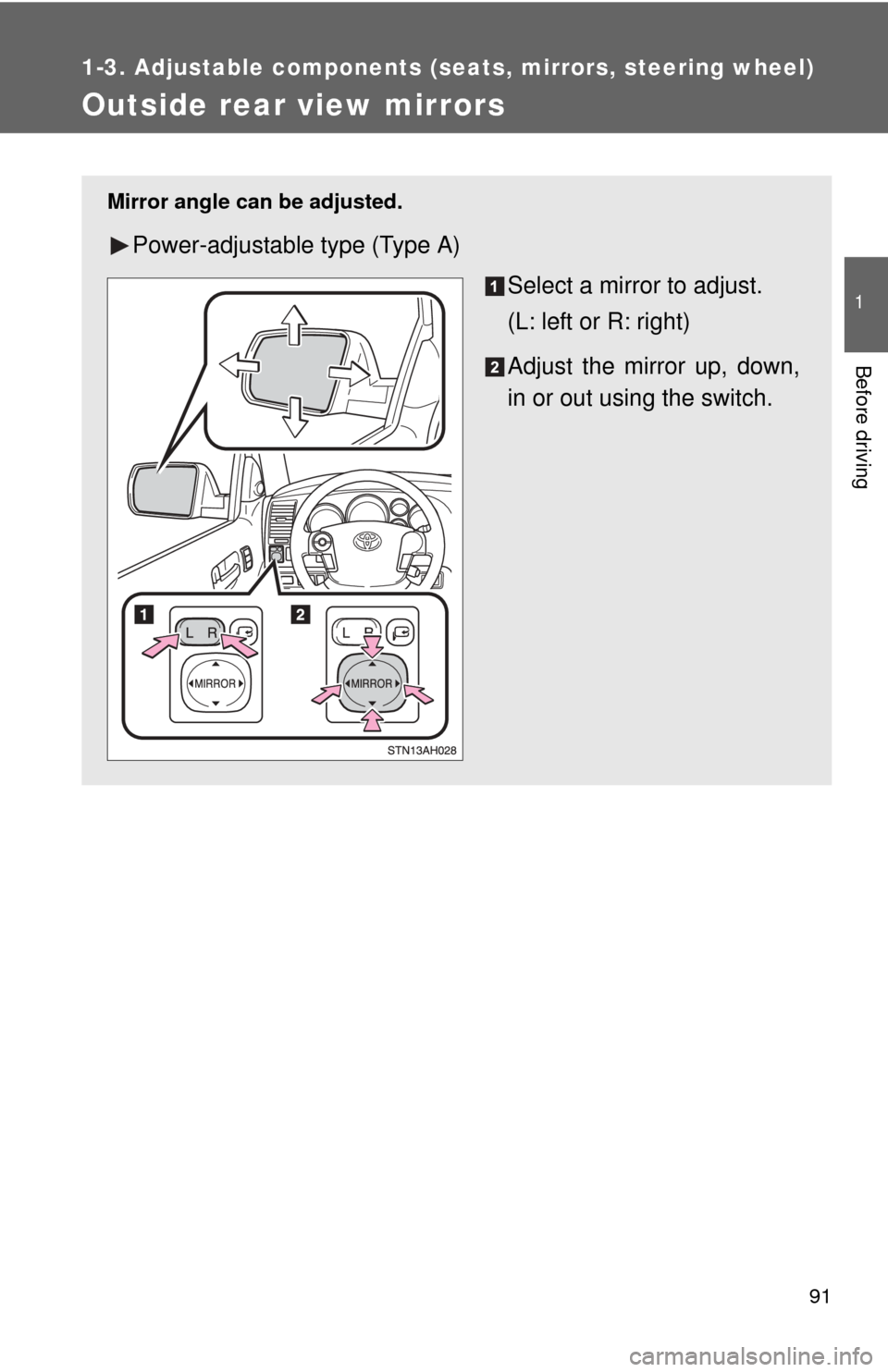
Mirror angle can be adjusted.
Power-adjustable type (Type A)
Select a mirror to adjust.
(L: left or R: right)
Adjust the mirror up, down,
in or out using the switch.
Page 92 of 744
92 1-3. Adjustable components (seats, mirrors, steering wheel)
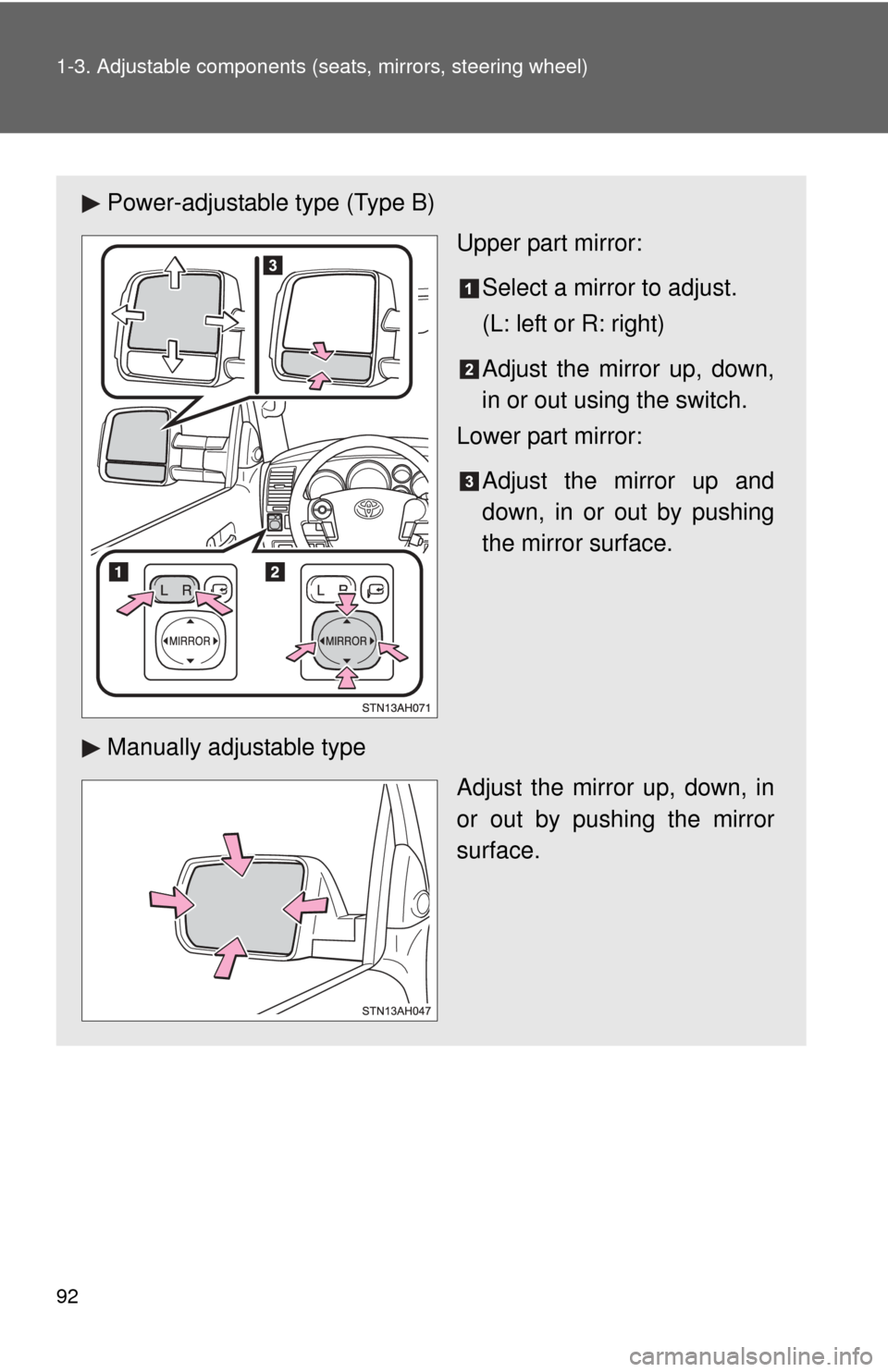
Power-adjustable type (Type B)
Upper part mirror:
Select a mirror to adjust.
(L: left or R: right)
Adjust the mirror up, down,
in or out using the switch.
Lower part mirror:
Adjust the mirror up and
down, in or out by pushing
the mirror surface.
Manually adjustable type Adjust the mirror up, down, in
or out by pushing the mirror
surface.
Page 94 of 744
94 1-3. Adjustable components (seats, mirrors, steering wheel)
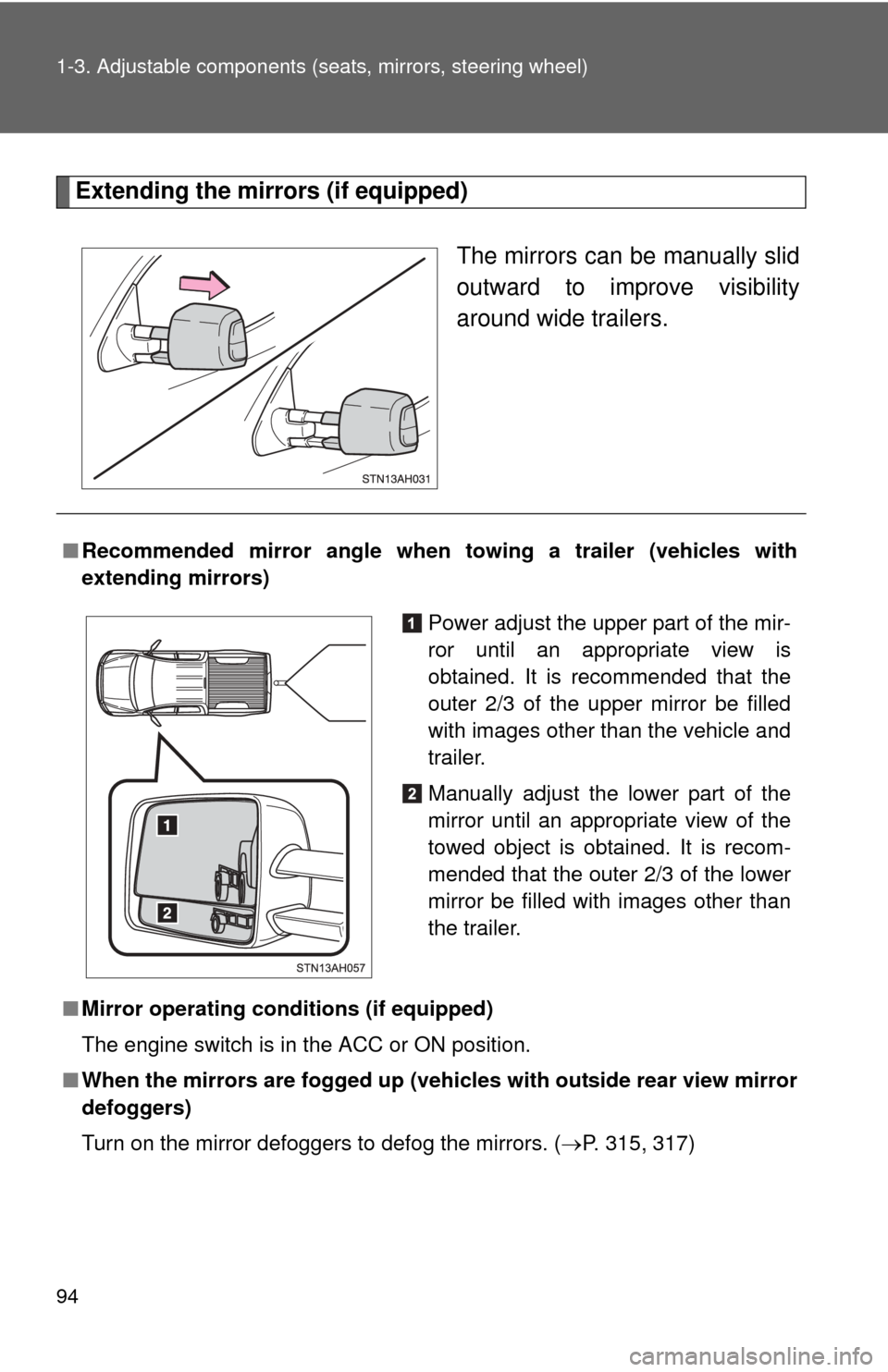
Extending the mirrors (if equipped)
The mirrors can be manually slid
outward to improve visibility
around wide trailers.
■Recommended mirror angle when towing a trailer (vehicles with
extending mirrors)
■ Mirror operating conditions (if equipped)
The engine switch is in the ACC or ON position.
■ When the mirrors are fogged up (veh icles with outside rear view mirror
defoggers)
Turn on the mirror defoggers to defog the mirrors. ( P. 315, 317)
Power adjust the upper part of the mir-
ror until an appropriate view is
obtained. It is recommended that the
outer 2/3 of the upper mirror be filled
with images other than the vehicle and
trailer.
Manually adjust the lower part of the
mirror until an appropriate view of the
towed object is obtained. It is recom-
mended that the outer 2/3 of the lower
mirror be filled with images other than
the trailer.
Page 125 of 744

125
1-7. Safety information
1
Before driving
■
SRS warning light
This warning light system monitors the airbag sensor assembly, front airbag
sensors, side and curtain shield airbag sensor assemblies, curtain shield air-
bag sensor assemblies, driver’s seat position sensor, driver’s seat belt
buckle switch, front passenger occupant classification system, AIR BAG ON
and AIR BAG OFF indicator lights, front passenger’s seat belt buckle switch,
front seat belt pretensioner assemblies , RSCA OFF indicator light, inflators,
interconnecting wiring and power sources. ( P. 610)
■ If the SRS airbags deploy (inflate)
●Bruising and slight abrasions may result from contact with a deploying
(inflating) SRS airbag.
● A loud noise and white powder will be emitted.
● Parts of the airbag module (steering wheel hub, airbag cover and inflator)
as well as the front seats, and parts of the front and rear pillars and roof
side rail, may be hot for several minutes. The airbag itself may also be
hot.
● The front windshield may crack.
■ Operating conditions (front airbags)
●The SRS front airbag will deploy in the event of an impact that exceeds
the set threshold level (the level of force corresponding to an approxi-
mately 12-18 mph [20-30 km/h] frontal collision with a fixed wall that does
not move or deform).
However, this threshold velocity will be considerably higher if the vehicle
strikes an object, such as a parked vehicle or sign pole, which can move or
deform on impact, or if the vehicle is involved in an underride collision (e.g.
a collision in which the front of the vehicle “underrides”, or goes under, the
bed of a truck, etc.).
● It is possible that in some collisions where the forward deceleration of the
vehicle is very close to the designed threshold level, the SRS front air-
bags and the seat belt pretensioners may not activate together.
● The SRS front passenger airbag will not activate if there is no passenger
sitting in the right front passenger seat. However, the front passenger air-
bag may deploy if luggage is put in the seat, or the seat belt is fastened,
even if the seat is unoccupied. ( P. 135)
Page 171 of 744

171
2-1. Driving procedures
2
When driving
CAUTION
■
When driving the vehicle
●If the smell of exhaust is noticed inside the vehicle, open the windows and
check that the back window is closed. Large amounts of exhaust in the
vehicle can cause driver drowsiness and an accident, resulting in death or
a serious health hazard. Have the vehicle inspected by your Toyota dealer
immediately.
● Do not shift the shift lever to P while the vehicle is moving.
Doing so can damage the transmission and may result in a loss of vehicle\
control.
● Do not shift the shift lever to R while the vehicle is moving forward.
Doing so can damage the transmission and may result in a loss of vehicle\
control.
● Do not shift the shift lever to D while the vehicle is moving backward.
Doing so can damage the transmission and may result in a loss of vehicle\
control.
● Moving the shift lever to N while the vehicle is moving will disengage the
engine from the transmission. Engine braking is not available when N is
selected.
● During normal driving, do not turn off the engine. Turning the engine off
while driving will not cause loss of steering or braking control, but the
power assist to these systems will be lost. This will make it more difficult to
steer and brake, so you should pull over and stop the vehicle as soon as it
is safe to do so.
However, in the event of an emergency, such as if it becomes impossible
to stop the vehicle in the normal way: P. 655
● Use engine braking (downshift) to maintain a safe speed when driving
down a steep hill.
Using the brakes continuously may cause the brakes to overheat and lose
effectiveness. ( P. 181)
● When stopped on an inclined surface, use the brake pedal and parking
brake to prevent the vehicle from rolling backward or forward and causing
an accident.