fuel TOYOTA TUNDRA 2016 2.G Owner's Guide
[x] Cancel search | Manufacturer: TOYOTA, Model Year: 2016, Model line: TUNDRA, Model: TOYOTA TUNDRA 2016 2.GPages: 588, PDF Size: 13.44 MB
Page 412 of 588
4127-3. Do-it-yourself maintenance
CAUTION
The engine compartment contains many mechanisms and fluids that may
move suddenly, become hot, or become electrically energized. To avoid death
or serious injury, observe the following precautions.
■When working on the engine compartment
● Keep hands, clothing and tools away from the moving fan and engine
drive belt.
● Be careful not to touch the engine, radiator, exhaust manifold, etc., right
after driving as they may be hot. Oil and other fluids may also be hot.
● Do not leave anything that may burn easily, such as paper and rags, in the
engine compartment.
● Do not smoke, cause sparks or expose an open flame to fuel or the bat-
tery. Fuel and battery fumes are flammable.
● Be extremely cautious when working on the battery. It contains poisonous
and corrosive sulfuric acid.
■ When working near the electric cooling fan or radiator grille
Be sure the engine switch is off.
With the engine switch in the “ON” position, the electric cooling \
fan may
automatically start to run if the air conditioning is on and/or the coolant tem-
perature is high. ( P. 419)
■ Safety glasses
Wear safety glasses to prevent flying or falling material, fluid spray, etc.,
from getting in your eyes.
NOTICE
■If you remove the air cleaner filter
Driving with the air cleaner filter removed may cause excessive engine wear
due to dirt in the air.
Page 433 of 588
4337-3. Do-it-yourself maintenance
7
Maintenance and care
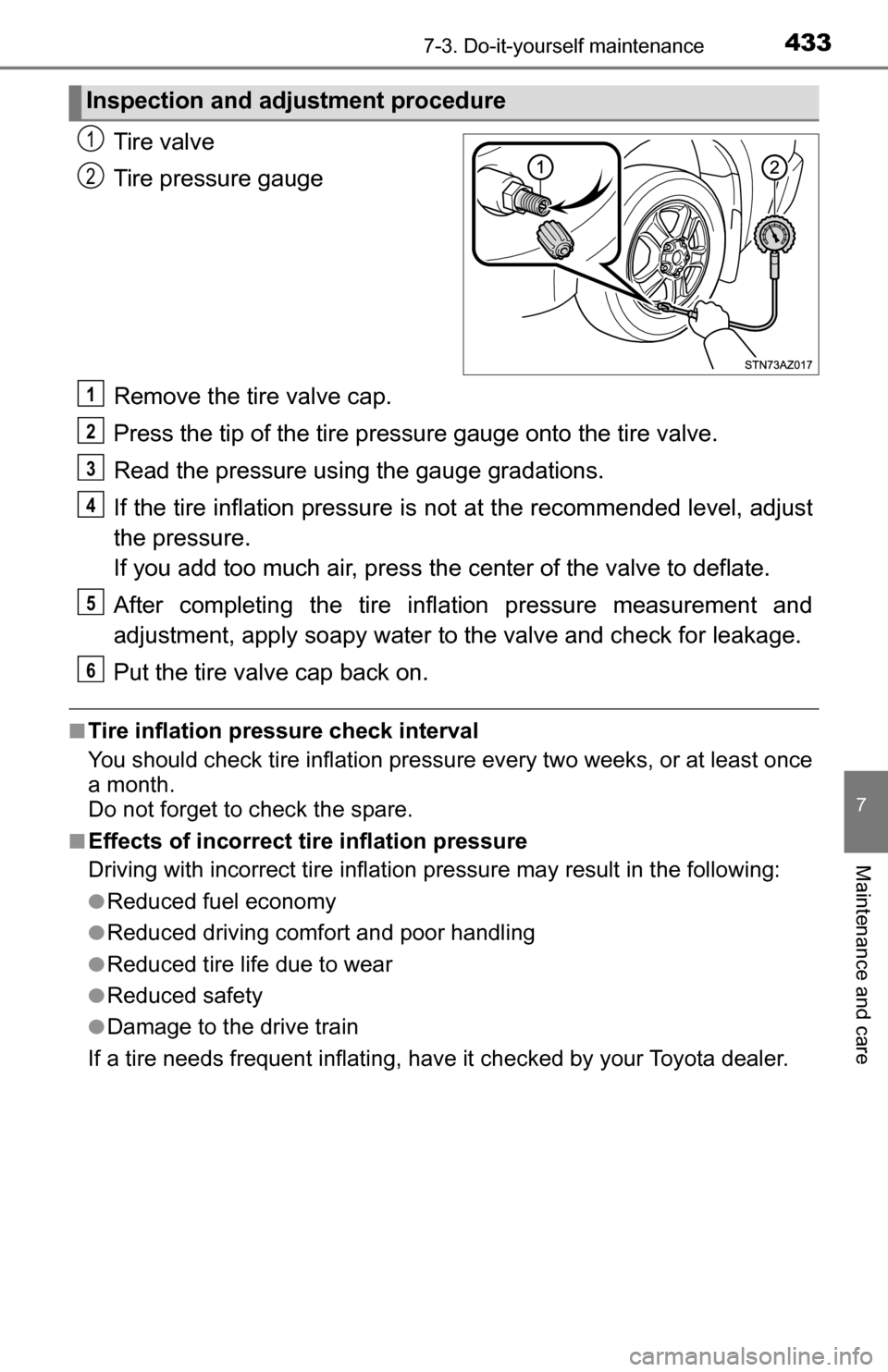
Tire valve
Tire pressure gauge
Remove the tire valve cap.
Press the tip of the tire pressure gauge onto the tire valve.
Read the pressure usi ng the gauge gradations.
If the tire inflation pressure is not at the recommended level, adjust
the pressure.
If you add too much air, press the center of the valve to deflate.
After completing the tire inflation pressure measurement and
adjustment, apply soapy water to the valve and check for leakage.
Put the tire valve cap back on.
■Tire inflation pressure check interval
You should check tire inflation pressure every two weeks, or at least once
a month.
Do not forget to check the spare.
■Effects of incorrect tire inflation pressure
Driving with incorrect tire inflation pressure may result in the following:
●Reduced fuel economy
●Reduced driving comfort and poor handling
●Reduced tire life due to wear
●Reduced safety
●Damage to the drive train
If a tire needs frequent inflating, have it checked by your Toyota dealer.
Inspection and adjustment procedure
1
2
1
2
3
4
5
6
Page 463 of 588
463
8When trouble arises
8-1. Essential informationEmergency flashers .......... 464
If your vehicle has to be stopped in
an emergency ................. 465 8-2. Steps to take in an emergency
If your vehicle needs to be towed ......................... 466
If you think something is wrong .............................. 471
Fuel pump shut off system ............................ 472
If a warning light turns on or a warning buzzer
sounds ............................ 473
If a warning message is displayed......................... 480
If you have a flat tire.......... 484
If the engine will not start ................................. 499
If the shift lever cannot be shifted from P............. 500
If the vehicle battery is discharged ...................... 502
If your vehicle overheats ... 505
If the vehicle becomes stuck ............................... 507
Page 472 of 588
4728-2. Steps to take in an emergency
Fuel pump shut off system
Follow the procedure below to restart the engine after the system is
activated.Turn the engine switch to the “ACC” or “LOCK” position.
Restart the engine.
To minimize the risk of fuel leakage when the engine stalls or
when an airbag inflates upon collision, the fuel pump shut off
system stops supply of fuel to the engine.
NOTICE
■Before starting the engine
Inspect the ground under the vehicle.
If you find that fuel has leaked onto the ground, the fuel system has been
damaged and is in need of repair. Do not restart the engine.
1
2
Page 474 of 588
4748-2. Steps to take in an emergency
(U.S.A.)
(Canada)
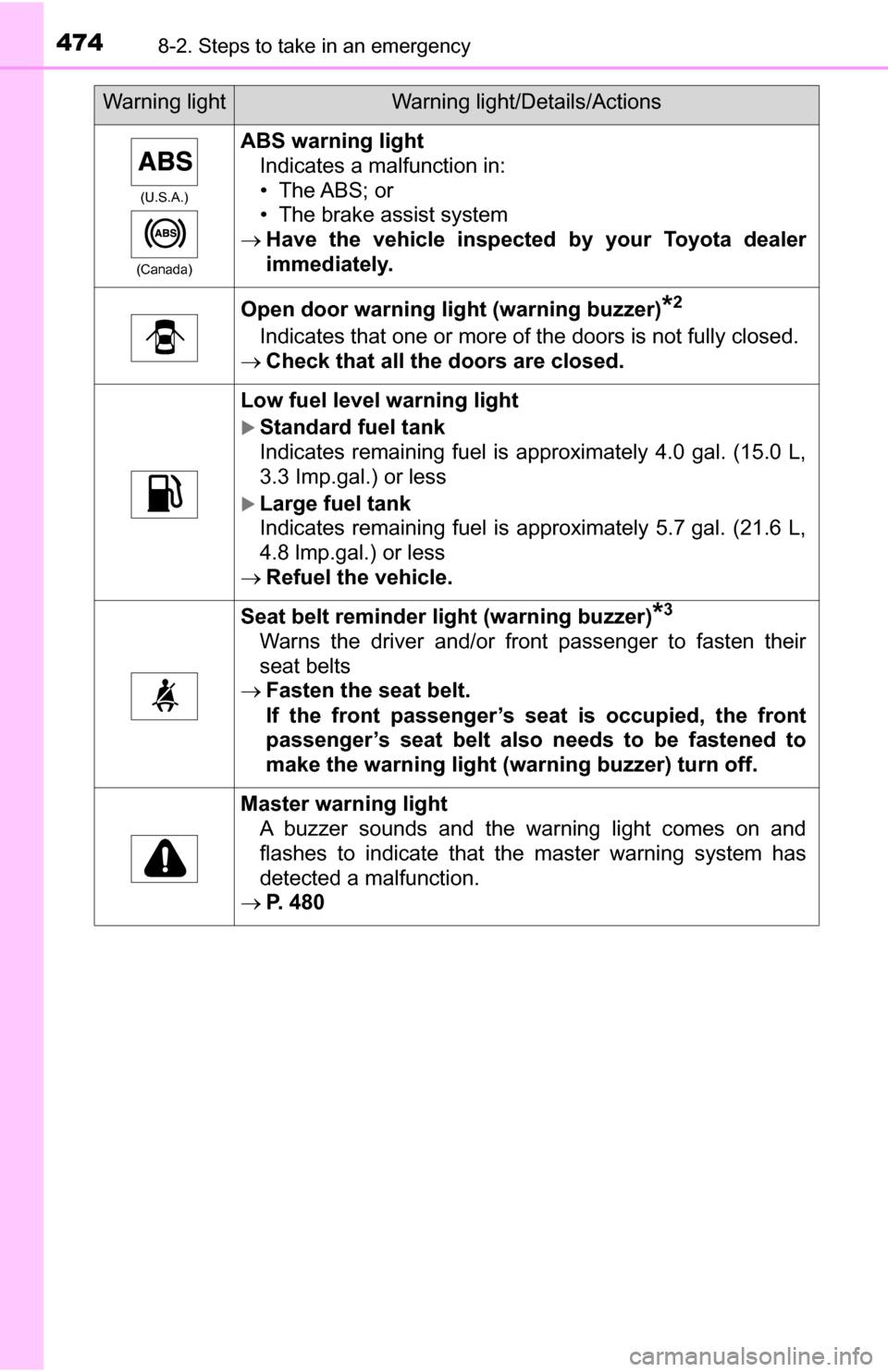
ABS warning light Indicates a malfunction in:
• The ABS; or
• The brake assist system
Have the vehicle inspected by your Toyota dealer
immediately.
Open door warning light (warning buzzer)*2
Indicates that one or more of the doors is not fully closed.
Check that all the doors are closed.
Low fuel level warning light
Standard fuel tank
Indicates remaining fuel is approximately 4.0 gal. (15.0 L,
3.3 Imp.gal.) or less
Large fuel tank
Indicates remaining fuel is approximately 5.7 gal. (21.6 L,
4.8 lmp.gal.) or less
Refuel the vehicle.
Seat belt reminder light (warning buzzer)*3
Warns the driver and/or front passenger to fasten their
seat belts
Fasten the seat belt.
If the front passenger’s seat is occupied, the front
passenger’s seat belt also needs to be fastened to
make the warning light (war ning buzzer) turn off.
Master warning light
A buzzer sounds and the warning light comes on and
flashes to indicate that the master warning system has
detected a malfunction.
P. 480
Warning lightWarning light/Details/Actions
Page 476 of 588
4768-2. Steps to take in an emergency
*3: Driver’s seat belt buzzer:The driver’s seat belt buzzer sounds to alert the driver that his or her seat
belt is not fastened. Once the engine switch is turned to the “ON” or
“START” position mode, the buzzer sounds for 6 seconds. If the vehicle
reaches a speed of 12 mph (20 km/h), the buzzer sounds once. If the seat
belt is still unfastened after 30 seconds, the buzzer will sound intermittently
for 10 seconds. Then, if the seat belt is still unfastened, the buzzer will
sound in a different tone for 20 more seconds.
Front passenger’s seat belt buzzer:
The front passenger’s seat belt buzzer sounds to alert the front passenger
that his or her seat belt is not fastened. The buzzer sounds once if the
vehicle reaches a speed of 12 mph (20 km/h). If the seat belt is sill unfas-
tened after 30 seconds, the buzzer will sound intermittently for 10 seconds.
Then, if the seat belt is still unfastened, the buzzer will sound in a different
tone for 20 more seconds.
■ SRS warning light
This warning light system monitors the airbag sensor assembly, front impact
sensors, side impact sensors (front door), side impact sensors (front), side
impact sensors (rear), driver’s seat posit ion sensor, driver’s seat belt buckle
switch, front passenger occupant classification system (ECU and sensors),
“AIR BAG ON” indicator light, “AIR BAG OFF” indicator light, front passen-
ger’s seat belt buckle switch, seat belt pretensioners assemblies, airbags,
interconnecting wiring and power sources. ( P. 40)
■ Front passenger detection sensor, seat belt reminder and warning
buzzer
● If luggage is placed on the front passenger seat, the front passenger de\
tec-
tion sensor may cause the warning light to flash and the warning buzzer to
sound even if a passenger is not sitting in the seat.
● If a cushion is placed on the seat, the sensor may not detect a passenger,
and the warning light may not operate properly.
■ If the malfunction indicator la mp comes on while driving
First check the following:
● Is the fuel tank empty?
If it is, fill the fuel tank immediately.
● Is the fuel tank cap loose?
If it is, tighten it securely.
The light will go off after several driving trips.
If the light does not go off even after several trips, contact your Toyota dealer
as soon as possible.
Page 478 of 588
4788-2. Steps to take in an emergency
CAUTION
■If both the ABS and the brake system warning lights remain on
Stop your vehicle in a safe place immediately and contact your Toyota
dealer. The vehicle will become extremely unstable during braking, and the
ABS system may fail, which could cause an accident resulting in death or
serious injury.
■ If the tire pressure warning light comes on
Be sure to observe the following precautions. Failure to do so could cause a
loss of vehicle control and result in death or serious injury.
● Stop your vehicle in a safe place as soon as possible. Adjust the tire infla-
tion pressure immediately.
● If the tire pressure warning light comes on even after tire inflation pressure
adjustment, it is probable that you have a flat tire. Check the tires. If a tire
is flat, change it with the spare tire and have the flat tire repaired by the
nearest Toyota dealer.
● Avoid abrupt maneuvering and braking. If the vehicle tires deteriorate, you
could lose control of the steering wheel or the brakes.
■ If a blowout or sudden air leakage should occur
The tire pressure warning system may not activate immediately.
■
Maintenance of the tires
Each tire, including the spare (if provided), should be checked monthly
when cold and inflated to the inflation pressure recommended by the
vehicle manufacturer on the vehicle placard or tire inflation pressure
label (tire and load information label). (If your vehicle has tires of a dif-
ferent size than the size indicated on the vehicle placard or tire inflation
pressure label [tire and load information label], you should determine
the proper tire inflation pressure for those tires.)
As an added safety feature, your vehicle has been equipped with a tire
pressure monitoring system (TPMS-ti re pressure warning system) that
illuminates a low tire pre ssure telltale (tire pressure warning light) when
one or more of your tires is significantly under-inflated. Accordingly,
when the low tire pressure telltale (tire pressure warning light) illumi-
nates, you should stop and check your tires as soon as possible, and
inflate them to the proper pressure. Driving on a significantly under-
inflated tire causes the tire to overheat and can lead to tire failure.
Under-inflation also reduces fuel effi ciency and tire tread life, and may
affect the vehicle’s handling and stopping ability.
Page 482 of 588
4828-2. Steps to take in an emergency
(If equipped)
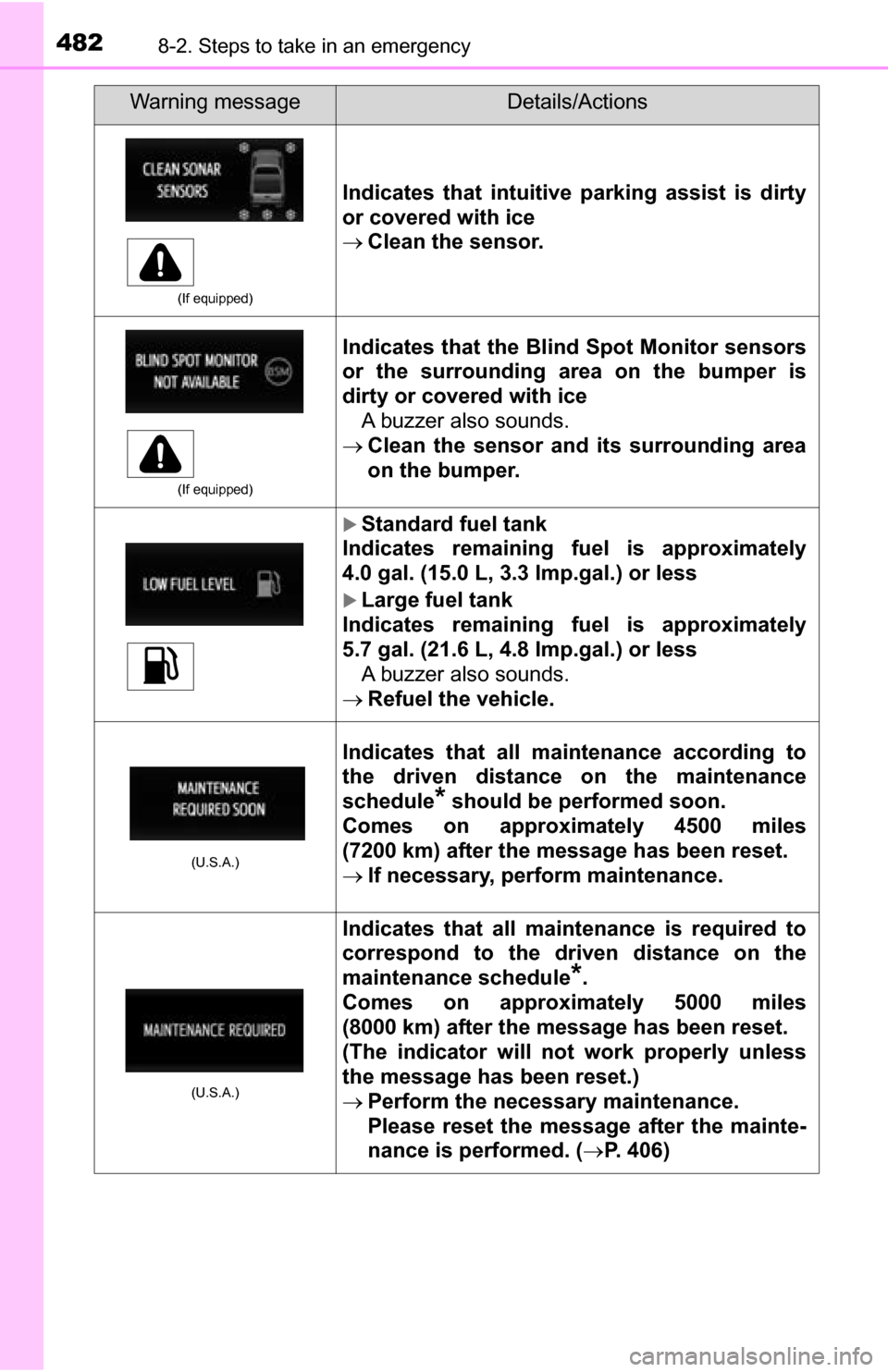
Indicates that intuitive parking assist is dirty
or covered with ice
Clean the sensor.
(If equipped)
Indicates that the Blind Spot Monitor sensors
or the surrounding area on the bumper is
dirty or covered with ice
A buzzer also sounds.
Clean the sensor and its surrounding area
on the bumper.
Standard fuel tank
Indicates remaining fuel is approximately
4.0 gal. (15.0 L, 3.3 Imp.gal.) or less
Large fuel tank
Indicates remaining fuel is approximately
5.7 gal. (21.6 L, 4.8 lmp.gal.) or less A buzzer also sounds.
Refuel the vehicle.
(U.S.A.)
Indicates that all maintenance according to
the driven distance on the maintenance
schedule
* should be performed soon.
Comes on approximately 4500 miles
(7200 km) after the message has been reset.
If necessary, perform maintenance.
(U.S.A.)
Indicates that all maintenance is required to
correspond to the driv en distance on the
maintenance schedule
*.
Comes on approximately 5000 miles
(8000 km) after the message has been reset.
(The indicator will not work properly unless
the message has been reset.)
Perform the necessary maintenance.
Please reset the message after the mainte-
nance is performed. ( P. 406)
Warning messageDetails/Actions
Page 499 of 588
499
8
When trouble arises
8-2. Steps to take in an emergency
If the engine will not start
One of the following may be the cause of the problem:
●There may not be sufficient fuel in the vehicle’s tank.
Refuel the vehicle.
Flex-fuel vehicles: The type of fuel may be different. When refuel-
ing, add the same type of fuel, if available.
After adding a different type of fuel, the engine may run roughly and
driving performance may be reduced for a while when the engine is
first started. In this case, wait until the engine runs normally.
● The engine may be flooded.
Try to restart the engine again following correct starting procedures.
( P. 182)
● There may be a malfunction in the engine immobilizer system.
(if equipped) ( P. 78)
One of the following may be the cause of the problem:
● The battery may be discharged. ( P. 502)
● The battery terminal connections may be loose or corroded.
One of the following may be the cause of the problem:
● One or both of the battery terminals may be disconnected.
● The battery may be discharged. ( P. 502)
Contact your Toyota dealer if the problem cannot be repaired, or if repair
procedures are unknown.
If the engine will not start eve n though correct starting proce-
dures are being followed ( P. 182), consider each of the follow-
ing points.
The engine will not start even though the starter motor operates
normally.
The starter motor turns over slowly, the interior lights and head-
lights are dim, or the horn does not sound or sounds at a low
volume.
The starter motor does not turn over, the interior lights and head-
lights do not turn on, or the horn does not sound.
Page 503 of 588
5038-2. Steps to take in an emergency
8
When trouble arises
Connect the clamp at the other end of the negative cable to a
solid, stationary, unpainted metallic point away from the battery
and any moving parts, as shown in the illustration.
Start the engine of the second v ehicle. Increase the engine speed
slightly and maintain at that level for approximately 5 minutes to
recharge the batter y of your vehicle.
Maintain the engine speed of t he second vehicle and start the
engine of your vehicle.
Once the vehicle’s engine has star ted, remove the jumper cables in
the exact reverse order from which they were connected.
Once the engine starts, have the v ehicle inspected at your Toyota
dealer as soon as possible.
■ Starting the engine when the battery is discharged
The engine cannot be started by push-starting.
■ To prevent battery discharge
●Turn off the headlights and the audio system while the engine is off.
● Turn off any unnecessary electrical components when the vehicle is running
at a low speed for an extended period, such as in heavy traffic.
■ When the battery is removed or discharged
●The moon roof must be initialized. ( P. 143)
● Flex-fuel vehicles: The information recorded in the computer will be cleared,
which may cause the engine to run roughly and reduce driving performance
for a while when the engine is first started. In this case, wait until the engine
runs normally.
If the vehicle is running on E85, the engine may stall.
In this case, restart the engine, repeatedly if necessary.
■ Charging the battery
The electricity stored in the battery will discharge gradually even when the
vehicle is not in use, due to natural discharge and the draining effects of cer-
tain electrical appliances. If the vehicle is left for a long time, the battery may
discharge, and the engine may be unable to start. (The battery recharges
automatically during driving.)
4
4
5
6