engine TOYOTA TUNDRA 2017 2.G Owners Manual
[x] Cancel search | Manufacturer: TOYOTA, Model Year: 2017, Model line: TUNDRA, Model: TOYOTA TUNDRA 2017 2.GPages: 588, PDF Size: 10.76 MB
Page 479 of 588

4798-2. Steps to take in an emergency
8
When trouble arises
■When the tire pressure warning light comes on
Check the tire inflation pressure and adjust to the appropriate level. Push-
ing the tire pressure warning reset switch will not turn off the tire pressure
warning light.
■The tire pressure warning light may come on due to natural causes
The tire pressure warning light may come on due to natural causes such
as natural air leaks and tire inflat ion pressure changes caused by tem-
perature. In this case, adjusting the ti re inflation pressure will turn off the
warning light (after several minutes).
■When a tire is replaced with a spare tire
The temporary spare tire is not equipped with a tire pressure warning
valve and transmitter. If a tire goes flat, the tire pressure warning light will
not turn off even though the flat tire has been replaced with the temporary
spare tire. Replace the temporary spare tire with the repaired tire and
adjust the tire inflation pressure. The tire pressure warning light will go off
after several minutes.
■Conditions that the tire pressure warning system may not function
properly
→ P. 4 3 0
■If the tire pressure warning light frequently comes on after blinking
for 1 minute
If the tire pressure warning light frequently comes on after blinking for 1
minute when the engine switch is turned to “ON” position, have it checked
by your Toyota dealer.
■Warning buzzer
In some cases, the buzzer may not be heard because of noisy place or an
audio sound.
Page 482 of 588
4828-2. Steps to take in an emergency
If a warning message is displayed
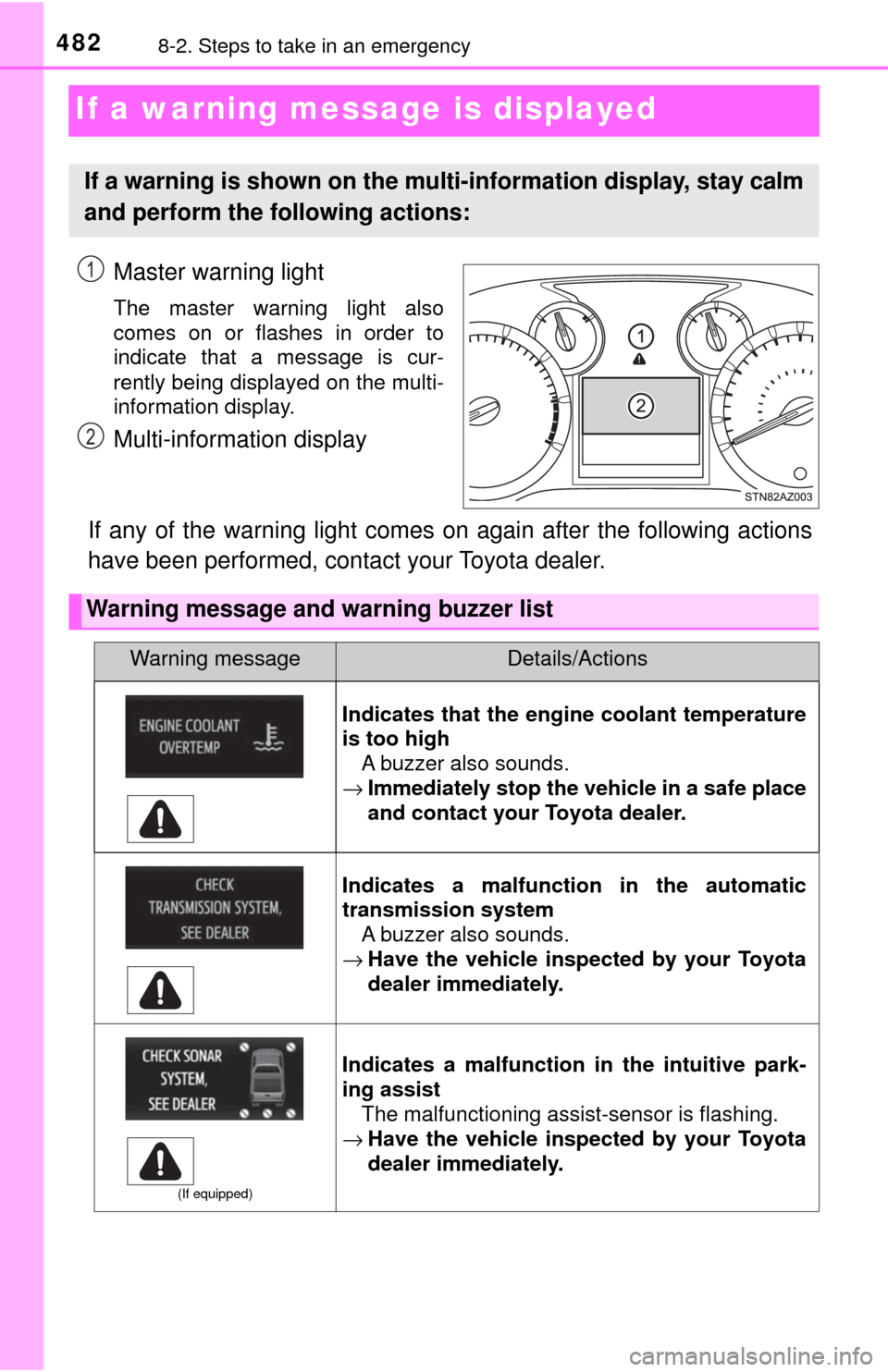
Master warning light
The master warning light also
comes on or flashes in order to
indicate that a message is cur-
rently being displayed on the multi-
information display.
Multi-information display
If any of the warning light comes on again after the following actions
have been performed, contact your Toyota dealer.
If a warning is shown on the mult i-information display, stay calm
and perform the following actions:
1
2
Warning message and warning buzzer list
Warning messageDetails/Actions
Indicates that the engine coolant temperature
is too high A buzzer also sounds.
→ Immediately stop the vehicle in a safe place
and contact your Toyota dealer.
Indicates a malfunction in the automatic
transmission system
A buzzer also sounds.
→ Have the vehicle inspect ed by your Toyota
dealer immediately.
(If equipped)
Indicates a malfunction in the intuitive park-
ing assist The malfunctioning assist-sensor is flashing.
→ Have the vehicle inspect ed by your Toyota
dealer immediately.
Page 486 of 588
4868-2. Steps to take in an emergency
If you have a flat tire
●Stop the vehicle in a safe pl ace on a hard, flat surface.
● Set the parking brake.
● Shift the shift lever to P.
● Stop the engine.
● Turn on the emergency flashers. ( →P. 466)
Your vehicle is equipped with a spare tire. The flat tire can be
replaced with the spare tire.
For details about tires: →P. 4 2 6
CAUTION
■If you have a flat tire
Do not continue driving with a flat tire.
Driving even a short dist ance with a flat tire can damage the tire and the
wheel beyond repair, which could result in an accident.
Before jacking up the vehicle
Page 488 of 588

4888-2. Steps to take in an emergency
CAUTION
■Using the tire jack
Observe the following precautions.
Improper use of the tire jack may cause the vehicle to suddenly fall off
the jack, leading to death or serious injury.
●Do not use the tire jack for any purpose other than replacing tires or
installing and removing tire chains.
●Only use the tire jack that comes with this vehicle for replacing a flat
tire.
Do not use it on other vehicles, and do not use other tire jacks for
replacing tires on this vehicle.
●Put the jack properly in its jack point.
●Do not put any part of your body under the vehicle while it is supported
by the jack.
●Do not start the engine or drive the vehicle while the vehicle is sup-
ported by the jack.
●Do not raise the vehicle while someone is inside.
●When raising the vehicle, do not put an object on or under the jack.
●Do not raise the vehicle to a height greater than that required to
replace the tire.
●Use a jack stand if it is necessary to get under the vehicle.
●When lowering the vehicle, make su re that there is no-one near the
vehicle. If there are people nearby, warn them vocally before lowering.
■Using the jack handle
Insert the square head securely until you hear a click to prevent the
extension parts from coming apart unexpectedly.
Page 499 of 588
4998-2. Steps to take in an emergency
8
When trouble arises
CAUTION
■When using the temporary spare tire
●Remember that the temporary spare tire provided is specifically
designed for use with your vehicle. Do not use your temporary spare
tire on another vehicle.
●Do not use more than one temporary spare tires simultaneously.
●Replace the temporary spare tire with a standard tire as soon as possi-
ble.
●Avoid sudden acceleration, abrupt steering, sudden braking and shift-
ing operations that cause sudden engine braking.
■When the spare tire is attached
The vehicle speed may not be correctly detected, and the following sys-
tems may not operate correctly:
●ABS & Brake assist
●VSC
●TRAC
●A-TRAC
●AUTO LSD
●Cruise control (if equipped)
●Navigation system (if equipped)
Also, not only can the following system not be utilized fully, but it may
even negatively affect the drive-train components:
●4WD system
■Speed limit when using the temporary spare tire
Do not drive at speeds in excess of 50 mph (80 km/h) when a temporary
spare tire is installed on the vehicle.
The temporary spare tire is not designed for driving at high speeds. Fail-
ure to observe this precaution may lead to an accident causing death or
serious injury.
Page 501 of 588
501
8
When trouble arises
8-2. Steps to take in an emergency
If the engine will not start
One of the following may be the cause of the problem:
●There may not be sufficient fuel in the vehicle’s tank.
Refuel the vehicle.
Flex-fuel vehicles: The type of fuel may be different. When refuel-
ing, add the same type of fuel, if available.
After adding a different type of fuel, the engine may run roughly and
driving performance may be reduced for a while when the engine is
first started. In this case, wait until the engine runs normally.
● The engine may be flooded.
Try to restart the engine again following correct starting procedures.
(→ P. 182)
● There may be a malfunction in the engine immobilizer system.
(if equipped) ( →P. 78)
One of the following may be the cause of the problem:
● The battery may be discharged. ( →P. 502)
● The battery terminal connections may be loose or corroded.
One of the following may be the cause of the problem:
● One or both of the battery terminals may be disconnected.
● The battery may be discharged. ( →P. 502)
Contact your Toyota dealer if the problem cannot be repaired, or if repair
procedures are unknown.
If the engine will not start eve n though correct starting proce-
dures are being followed ( →P. 182), consider each of the follow-
ing points.
The engine will not start even though the starter motor operates
normally.
The starter motor turns over slowly, the interior lights and head-
lights are dim, or the horn does not sound or sounds at a low
volume.
The starter motor does not turn over, the interior lights and head-
lights do not turn on, or the horn does not sound.
Page 502 of 588
5028-2. Steps to take in an emergency
If the vehicle battery is discharged
If you have a set of jumper (or booster) cables and a second vehicle
with a 12-volt battery, you can jump start your vehicle by following the
steps below.
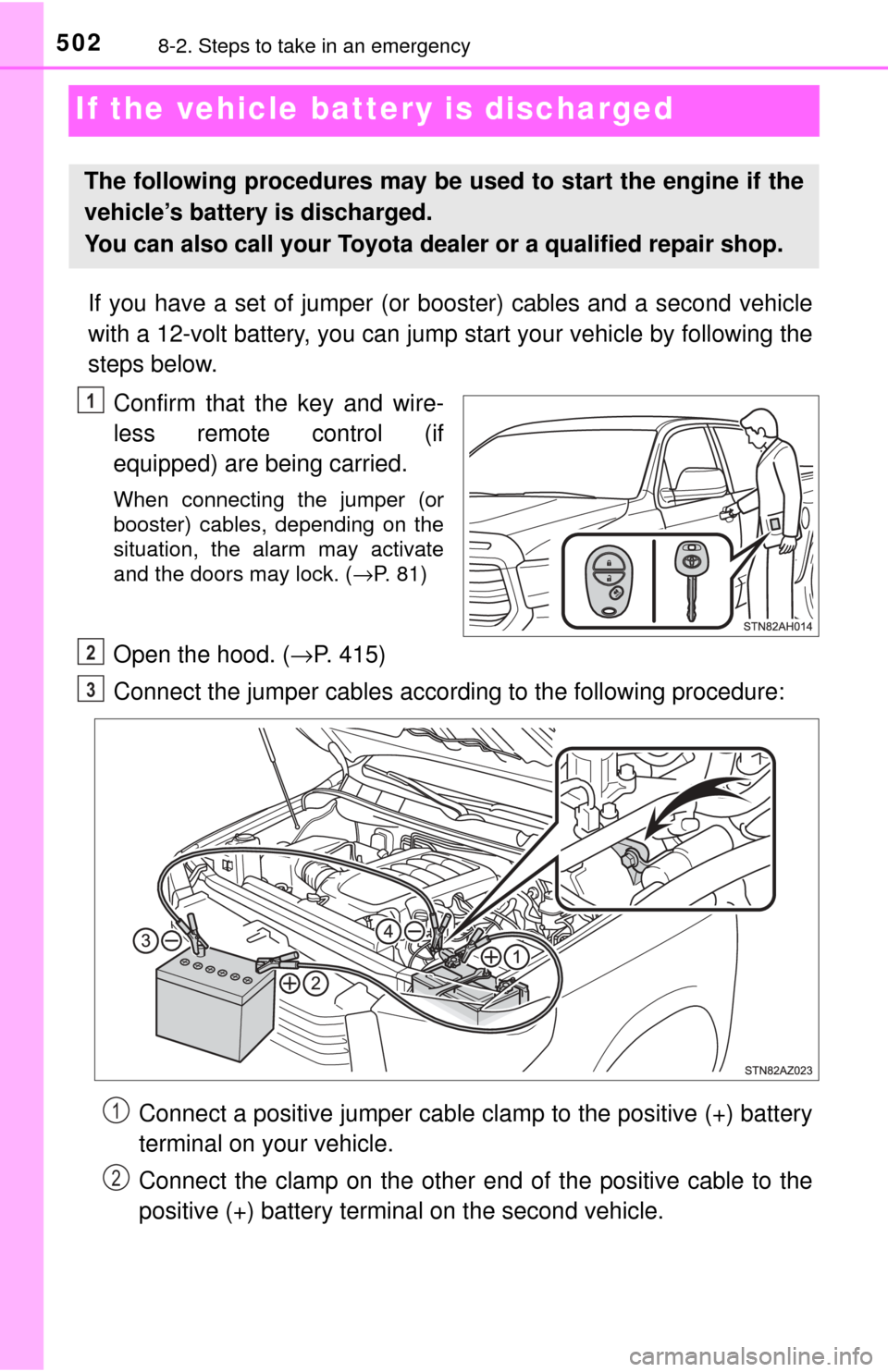
Confirm that the key and wire-
less remote control (if
equipped) are being carried.
When connecting the jumper (or
booster) cables, depending on the
situation, the alarm may activate
and the doors may lock. ( →P. 81)
Open the hood. (→P. 415)
Connect the jumper cables according to the following procedure:
Connect a positive jumper cable clamp to the positive (+) battery
terminal on your vehicle.
Connect the clamp on the other e nd of the positive cable to the
positive (+) battery terminal on the second vehicle.
The following procedures may be used to start the engine if the
vehicle’s battery is discharged.
You can also call your Toyota de aler or a qualified repair shop.
1
2
3
1
2
Page 503 of 588

5038-2. Steps to take in an emergency
8
When trouble arises
Connect a negative cable clamp to the negative (-) battery termi-
nal on the second vehicle.
Connect the clamp at the other end of the negative cable to a
solid, stationary, unpainted metallic point away from the battery
and any moving parts, as shown in the illustration.
Start the engine of the second v ehicle. Increase the engine speed
slightly and maintain at that level for approximately 5 minutes to
recharge the batter y of your vehicle.
Maintain the engine speed of t he second vehicle and start the
engine of your vehicle.
Once the vehicle’s engine has star ted, remove the jumper cables in
the exact reverse order from which they were connected.
Once the engine starts, have the v ehicle inspected at your Toyota
dealer as soon as possible.
■ Starting the engine when the battery is discharged
The engine cannot be started by push-starting.
■ To prevent battery discharge
●Turn off the headlights and the audio system while the engine is off.
● Turn off any unnecessary electrical components when the vehicle is running
at a low speed for an extended period, such as in heavy traffic.
■ When the battery is removed or discharged
●The moon roof must be initialized. ( →P. 143)
● Flex-fuel vehicles: The information recorded in the computer will be cleared,
which may cause the engine to run roughly and reduce driving performance
for a while when the engine is first started. In this case, wait until the engine
runs normally.
If the vehicle is running on E85, the engine may stall.
In this case, restart the engine, repeatedly if necessary.
■ Charging the battery
The electricity stored in the battery will discharge gradually even when the
vehicle is not in use, due to natural discharge and the draining effects of cer-
tain electrical appliances. If the vehicle is left for a long time, the battery may
discharge, and the engine may be unable to start. (The battery recharges
automatically during driving.)
3
4
4
5
6
Page 505 of 588
505
8
When trouble arises
8-2. Steps to take in an emergency
If your vehicle overheats
●The needle of the engine coolant temperature gauge ( →P. 8 8 )
enters the red zone or a loss of engine power is experienced. (For
example, the vehicle sp eed does not increase.)
● “ENGINE COOLANT OVERTEMP” is shown on the multi-informa-
tion display.
● Steam comes out from under the hood.
Stop the vehicle in a safe place and turn off the air conditioning sys-
tem, and then stop the engine.
If you see steam:
Carefully lift the hood after the steam subsides.
If you do not see steam:
Carefully lift the hood.
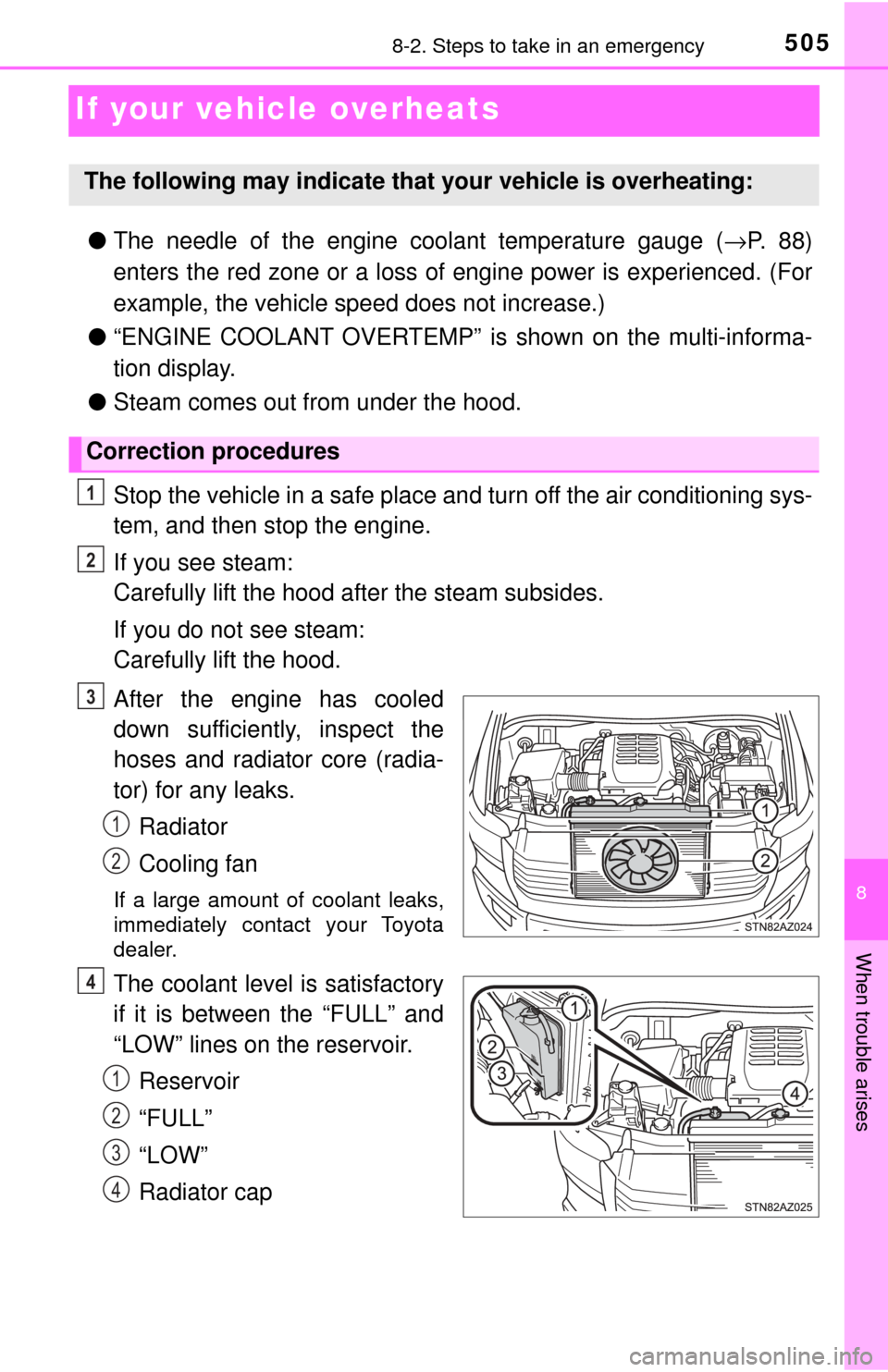
After the engine has cooled
down sufficient ly, inspect the
hoses and radiator core (radia-
tor) for any leaks.
Radiator
Cooling fan
If a large amount of coolant leaks,
immediately contact your Toyota
dealer.
The coolant level is satisfactory
if it is between the “FULL” and
“LOW” lines on the reservoir.Reservoir
“FULL”
“LOW”
Radiator cap
The following may indicate that your vehicle is overheating:
Correction procedures
1
2
3
1
2
4
1
2
3
4
Page 506 of 588
5068-2. Steps to take in an emergency
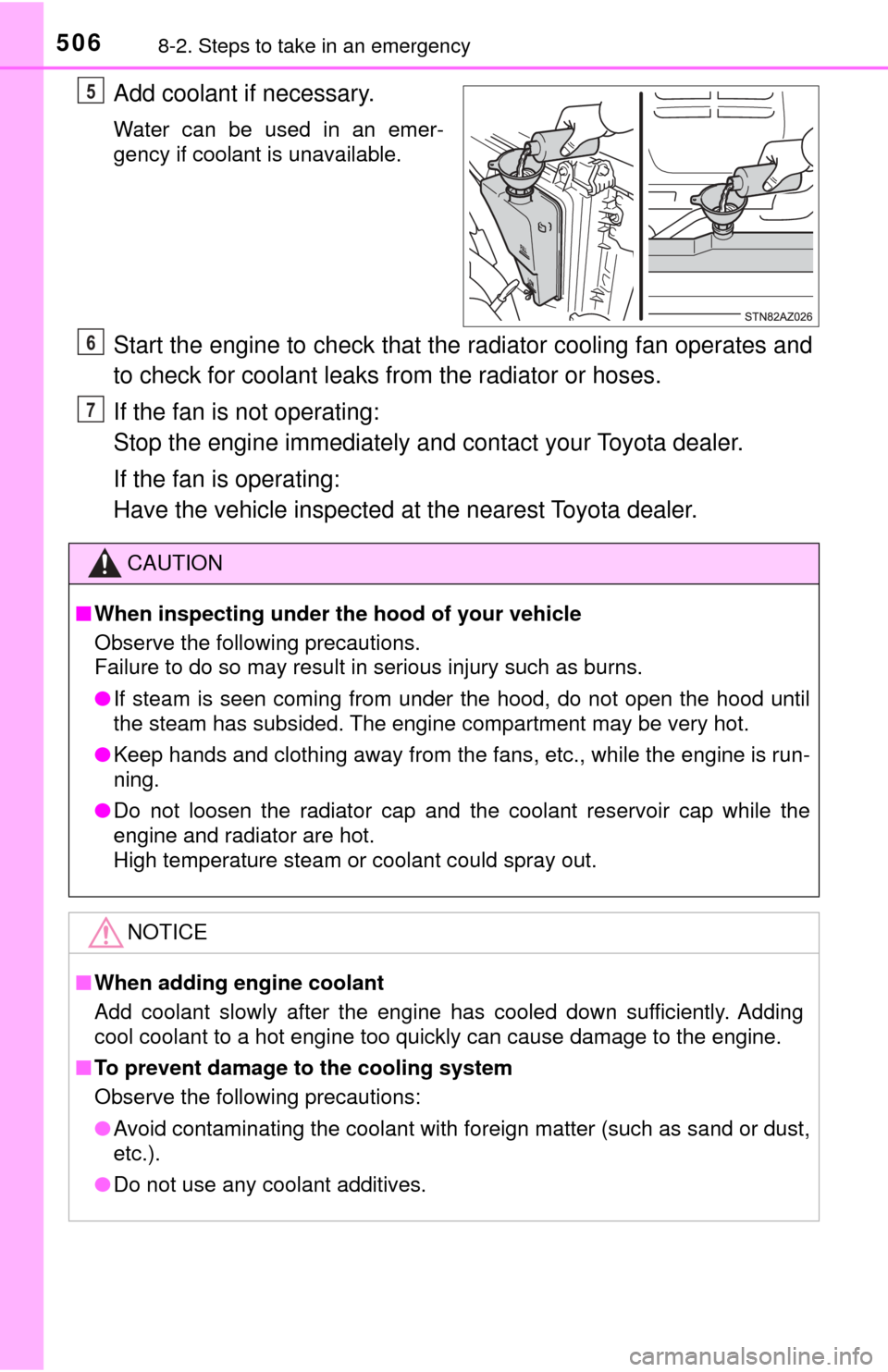
Add coolant if necessary.
Water can be used in an emer-
gency if coolant is unavailable.
Start the engine to check that the radiator cooling fan operates and
to check for coolant leaks from the radiator or hoses.
If the fan is not operating:
Stop the engine immediately and contact your Toyota dealer.
If the fan is operating:
Have the vehicle in spected at the nearest Toyota dealer.
5
CAUTION
■When inspecting under the hood of your vehicle
Observe the following precautions.
Failure to do so may result in serious injury such as burns.
● If steam is seen coming from under the hood, do not open the hood until
the steam has subsided. The engine compartment may be very hot.
● Keep hands and clothing away from the fans, etc., while the engine is run-
ning.
● Do not loosen the radiator cap and the coolant reservoir cap while the
engine and radiator are hot.
High temperature steam or coolant could spray out.
NOTICE
■When adding engine coolant
Add coolant slowly after the engine has cooled down sufficiently. Adding
cool coolant to a hot engine too quickly can cause damage to the engine.
■ To prevent damage to the cooling system
Observe the following precautions:
● Avoid contaminating the coolant with foreign matter (such as sand or dust,
etc.).
● Do not use any coolant additives.
6
7