engine TOYOTA TUNDRA 2017 2.G Workshop Manual
[x] Cancel search | Manufacturer: TOYOTA, Model Year: 2017, Model line: TUNDRA, Model: TOYOTA TUNDRA 2017 2.GPages: 588, PDF Size: 10.76 MB
Page 167 of 588
1674-1. Before driving
4
Driving
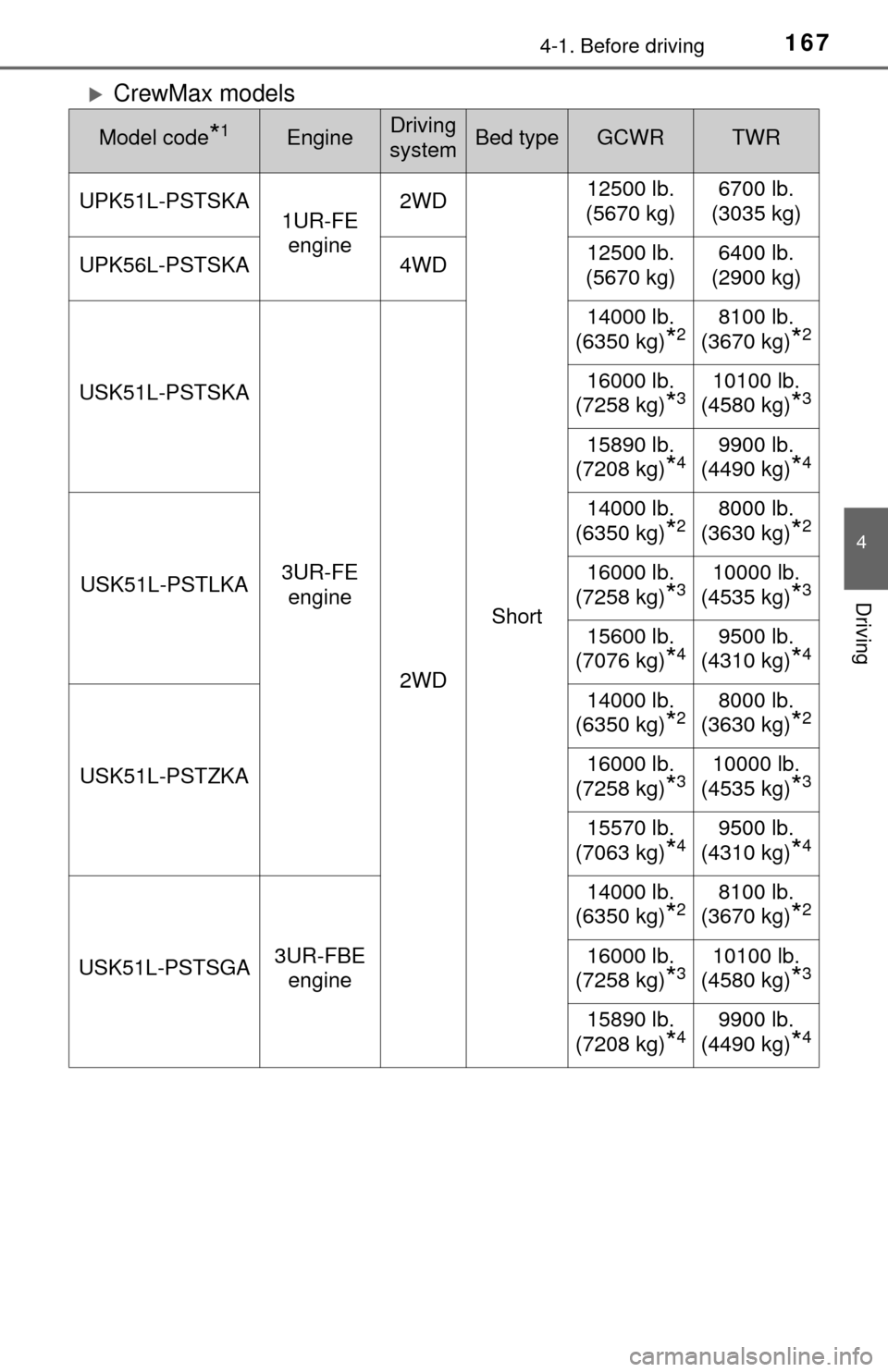
CrewMax models
Model code*1EngineDriving
systemBed typeGCWRTWR
UPK51L-PSTSKA 1UR-FE
engine 2WD
Short 12500 lb.
(5670 kg) 6700 lb.
(3035 kg)
UPK56L-PSTSKA 4WD 12500 lb.
(5670 kg) 6400 lb.
(2900 kg)
USK51L-PSTSKA
3UR-FE engine
2WD 14000 lb.
(6350 kg)
*28100 lb.
(3670 kg)
*2
16000 lb.
(7258 kg)
*310100 lb.
(4580 kg)
*3
15890 lb.
(7208 kg)
*49900 lb.
(4490 kg)
*4
USK51L-PSTLKA 14000 lb.
(6350 kg)
*28000 lb.
(3630 kg)
*2
16000 lb.
(7258 kg)
*310000 lb.
(4535 kg)
*3
15600 lb.
(7076 kg)
*49500 lb.
(4310 kg)
*4
USK51L-PSTZKA 14000 lb.
(6350 kg)
*28000 lb.
(3630 kg)
*2
16000 lb.
(7258 kg)
*310000 lb.
(4535 kg)
*3
15570 lb.
(7063 kg)
*49500 lb.
(4310 kg)
*4
USK51L-PSTSGA 3UR-FBE
engine 14000 lb.
(6350 kg)
*28100 lb.
(3670 kg)
*2
16000 lb.
(7258 kg)
*310100 lb.
(4580 kg)
*3
15890 lb.
(7208 kg)
*49900 lb.
(4490 kg)
*4
Page 168 of 588
1684-1. Before driving
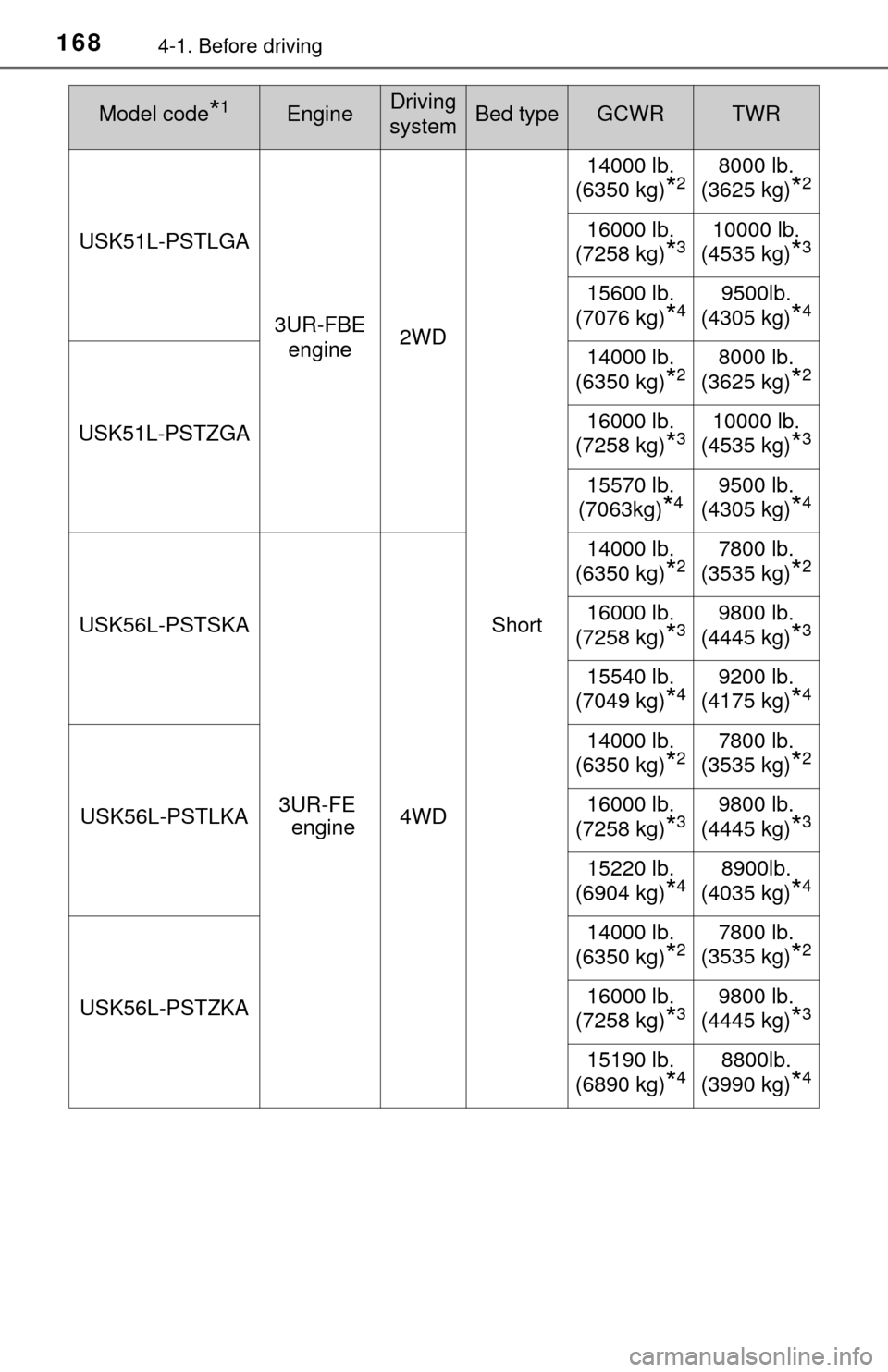
USK51L-PSTLGA3UR-FBE engine 2WD
Short 14000 lb.
(6350 kg)
*28000 lb.
(3625 kg)
*2
16000 lb.
(7258 kg)
*310000 lb.
(4535 kg)
*3
15600 lb.
(7076 kg)
*49500lb.
(4305 kg)
*4
USK51L-PSTZGA 14000 lb.
(6350 kg)
*28000 lb.
(3625 kg)
*2
16000 lb.
(7258 kg)
*310000 lb.
(4535 kg)
*3
15570 lb.
(7063kg)
*49500 lb.
(4305 kg)
*4
USK56L-PSTSKA
3UR-FE engine 4WD 14000 lb.
(6350 kg)
*27800 lb.
(3535 kg)
*2
16000 lb.
(7258 kg)
*39800 lb.
(4445 kg)
*3
15540 lb.
(7049 kg)
*49200 lb.
(4175 kg)
*4
USK56L-PSTLKA 14000 lb.
(6350 kg)
*27800 lb.
(3535 kg)
*2
16000 lb.
(7258 kg)
*39800 lb.
(4445 kg)
*3
15220 lb.
(6904 kg)
*48900lb.
(4035 kg)
*4
USK56L-PSTZKA 14000 lb.
(6350 kg)
*27800 lb.
(3535 kg)
*2
16000 lb.
(7258 kg)
*39800 lb.
(4445 kg)
*3
15190 lb.
(6890 kg)
*48800lb.
(3990 kg)
*4
Model code*1EngineDriving
systemBed typeGCWRTWR
Page 169 of 588
1694-1. Before driving
4
Driving
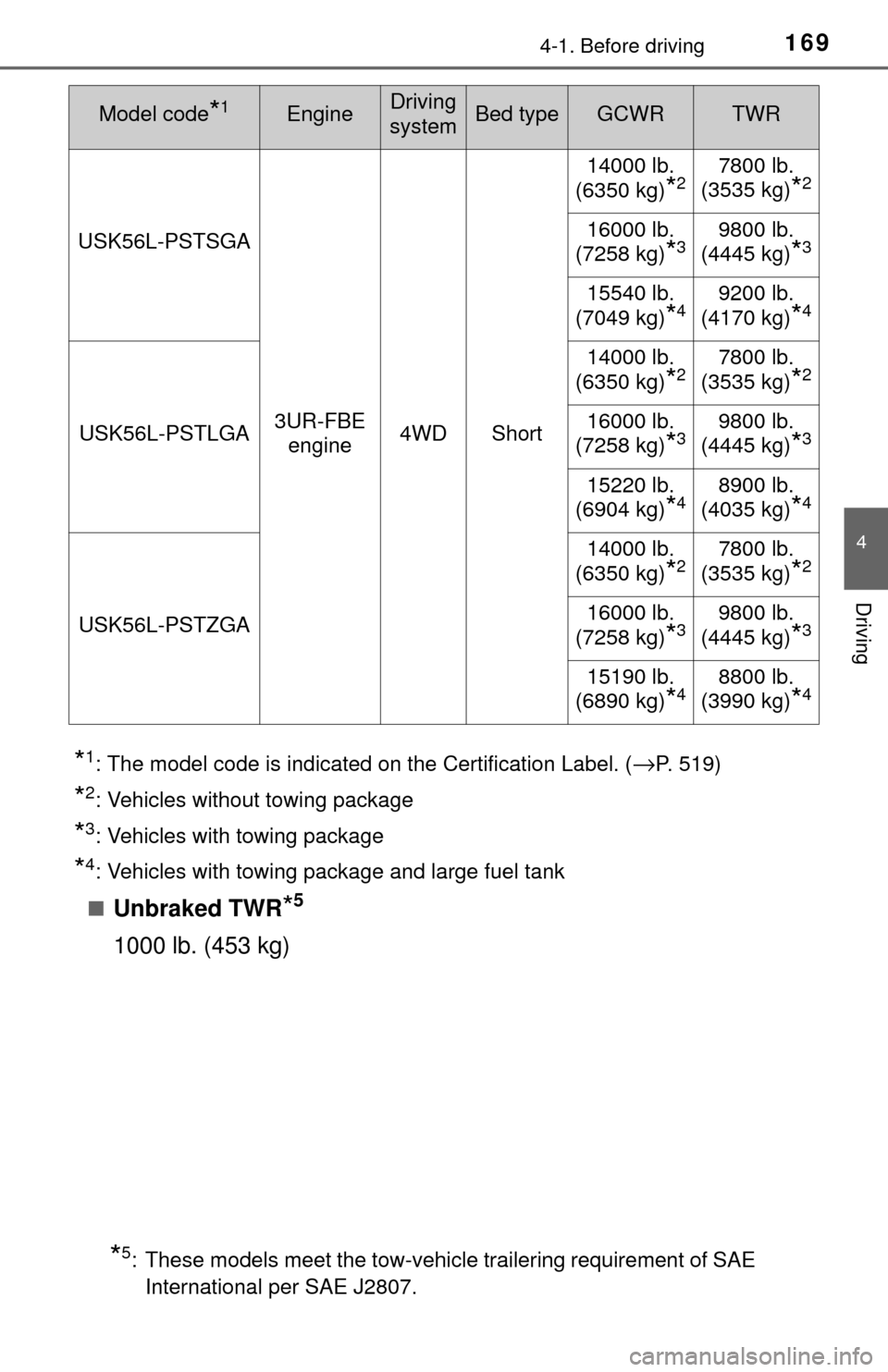
*1: The model code is indicated on the Certification Label. (→P. 519)
*2: Vehicles without towing package
*3: Vehicles with towing package
*4: Vehicles with towing package and large fuel tank
■
Unbraked TWR*5
1000 lb. (453 kg)
USK56L-PSTSGA
3UR-FBE engine 4WD Short 14000 lb.
(6350 kg)
*27800 lb.
(3535 kg)
*2
16000 lb.
(7258 kg)
*39800 lb.
(4445 kg)
*3
15540 lb.
(7049 kg)
*49200 lb.
(4170 kg)
*4
USK56L-PSTLGA 14000 lb.
(6350 kg)
*27800 lb.
(3535 kg)
*2
16000 lb.
(7258 kg)
*39800 lb.
(4445 kg)
*3
15220 lb.
(6904 kg)
*48900 lb.
(4035 kg)
*4
USK56L-PSTZGA 14000 lb.
(6350 kg)
*27800 lb.
(3535 kg)
*2
16000 lb.
(7258 kg)
*39800 lb.
(4445 kg)
*3
15190 lb.
(6890 kg)
*48800 lb.
(3990 kg)
*4
*5: These models meet the tow-vehicle trailering requirement of SAE
International per SAE J2807.
Model code*1EngineDriving
systemBed typeGCWRTWR
Page 175 of 588

1754-1. Before driving
4
Driving
●Avoid sudden braking as you may skid, resulting in the trailer jack-
knifing and a loss of vehicle control. This is especially true on wet or
slippery surfaces.
● Avoid jerky starts or sudden acceleration.
● Avoid jerky steering and sharp turns, and slow down before making
a turn.
● Note that when making a turn, the trailer wheels will be closer than
the vehicle wheels to the inside of the turn. Compensate by making
a wider than normal turning radius.
● Slow down before making a turn, in crosswinds, on wet or slippery
surfaces, etc.
Increasing vehicle speed c an destabilize the trailer.
● Take care when passing other vehicles. Passing requires consider-
able distance. After passing a vehi cle, do not forget the length of
your trailer, and be sure you hav e plenty of room before changing
lanes.
● To maintain engine braking efficiency and charging system perfor-
mance when using engine braking, do not use the transmission in
D.
Transmission shift range positi on must be in 4 in the S mode.
● Instability happens more frequently when descending steep or long
downhill grades. Before descending, slow down and downshift. Do
not make sudden downshifts while descending steep or long down-
hill grades.
● Avoid holding the brake pedal down too long or applying the brakes
too frequently. This could cause the brakes to overheat and result in
reduced braking efficiency.
● Due to the added load of the trailer, your vehicle’s engine may over-
heat on hot days (at temperatures over 85°F [30°C]) when driving
up a long or steep grade. If t he engine coolant temperature gauge
indicates overheating, immediately turn off the air conditioning (if in
use), pull your vehicle off the road and stop in a safe spot.
( → P. 505)
Page 176 of 588

1764-1. Before driving
●Always place wheel blocks under both the vehicle’s and the trailer’s
wheels when parking. Apply the parking brake firmly, and put the
transmission in P. Avoid parking on a slope, but if unavoidable, do
so only after performing the following:
Apply the brakes and keep them applied.
Have someone place wheel blocks under both the vehicle’s and
trailer’s wheels.
When the wheel blocks are in pl ace, release the brakes slowly
until the blocks absorb the load.
Apply the parking brake firmly.
Shift into P and turn off the engine.
● When restarting after parking on a slope:
With the transmission in P, start the engine. Be sure to keep the
brake pedal pressed.
Shift into D or R (if reversing).
Release the parking brake and brake pedal, and slowly pull or
back away from the wheel bloc ks. Stop and apply the brakes.
Have someone retrieve the blocks.
1
2
3
4
5
1
2
3
4
Page 178 of 588

1784-1. Before driving
■Break-in schedule
If your vehicle is new or equipped with any new power train components
(such as an engine, transmission, differential or wheel bearing), Toyota rec-
ommends that you do not tow a trailer until the vehicle has been driven for
over 500 miles (800 km).
After the vehicle has been driven for over 500 miles (800 km), you can start
towing. However, for the next 500 miles (800 km), drive the vehicle at a speed
of less than 50 mph (80 km/h) when towing a trailer, and avoid full throttle
acceleration.
■ Maintenance
●If you tow a trailer, your vehicle will require more frequent maintenance due
to the additional load. (See “Owner’s Warranty Information Booklet” or
“Scheduled Maintenance Guide”/“Owner’s Manual Supplement”.)
● Retighten the fixing bolts of the towing ball and bracket after approximately
600 miles (1000 km) of trailer towing.
■ If trailer sway occurs
One or more factors (crosswinds, passing vehicles, rough roads, etc.) can
adversely affect handling of your vehicle and trailer, causing instability.
●If trailer swaying occurs:
• Firmly grip the steering wheel. Steer straight ahead.
Do not try to control trailer swaying by turning the steering wheel.
• Begin releasing the accelerator pedal immediately but very gradually to reduce speed.
Do not increase speed. Do not apply vehicle brakes.
If you make no extreme correction with the steering or brakes, your vehicle
and trailer should stabilize. (if enabled, Trailer Sway Control can also help to
stabilize the vehicle and trailer.)
● After the trailer swaying has stopped:
• Stop in a safe place. Get all occupants out of the vehicle.
• Check the tires of the vehicle and the trailer.
• Check the load in the trailer.
Make sure the load has not shifted.
Make sure the tongue weight is appropriate, if possible.
• Check the load in the vehicle. Make sure the vehicle is not overloaded after occupants get in.
If you cannot find any problems, the speed at which trailer swaying occurred
is beyond the limit of your particular vehicle-trailer combination.
Drive at a lower speed to prevent instability. Remember that swaying of the
towing vehicle-trailer increases as speed increases.
Page 182 of 588
1824-2. Driving procedures
Engine (ignition) switch
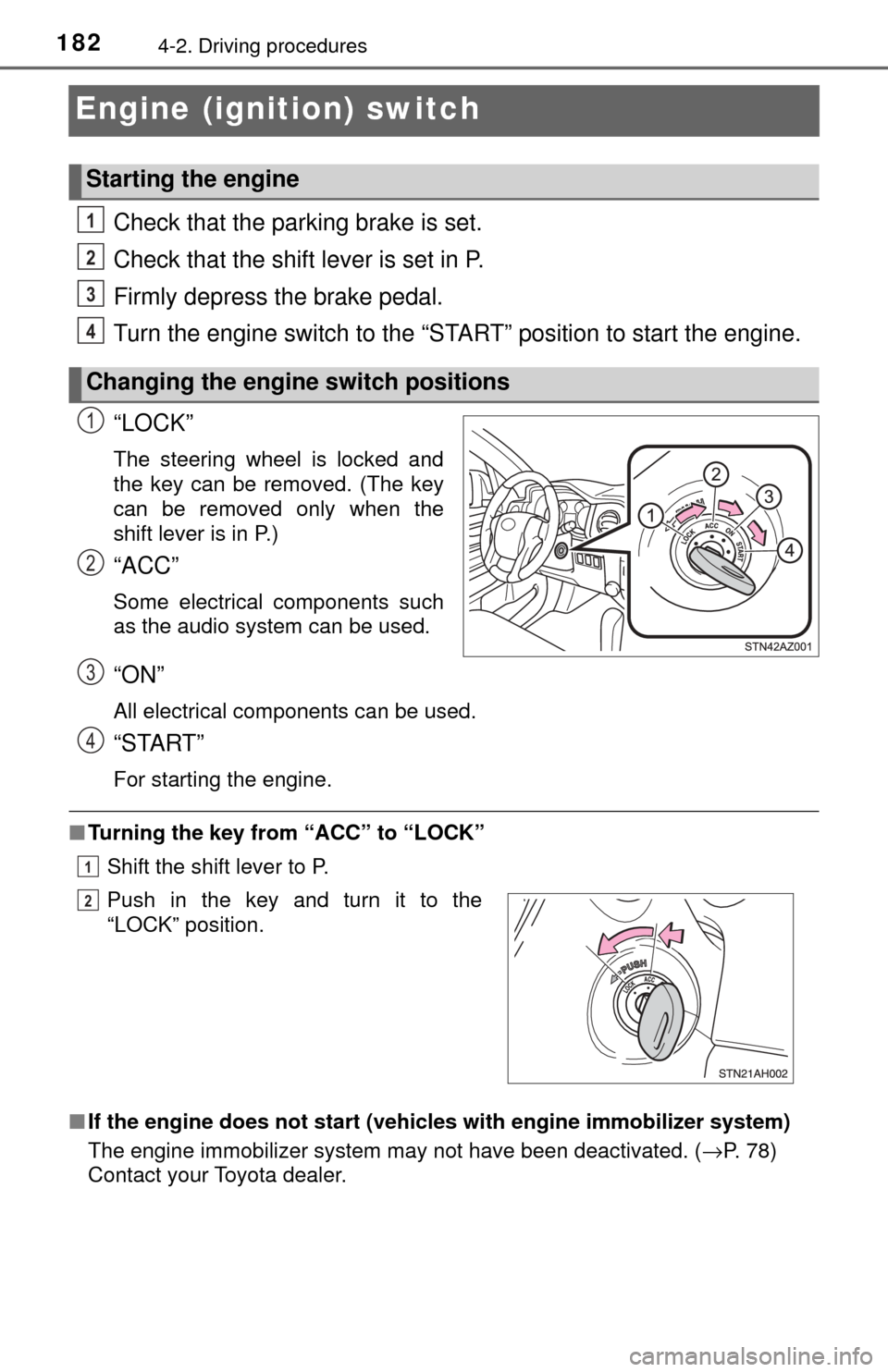
Check that the parking brake is set.
Check that the shift lever is set in P.
Firmly depress the brake pedal.
Turn the engine switch to the “START” position to start the engine.
“LOCK”
The steering wheel is locked and
the key can be removed. (The key
can be removed only when the
shift lever is in P.)
“ACC”
Some electrical components such
as the audio system can be used.
“ON”
All electrical components can be used.
“START”
For starting the engine.
■ Turning the key from “ACC” to “LOCK”
Shift the shift lever to P.
■ If the engine does not start (vehic les with engine immobilizer system)
The engine immobilizer system may not have been deactivated. ( →P. 78)
Contact your Toyota dealer.
Starting the engine
Changing the engine switch positions
1
2
3
4
1
2
Push in the key and turn it to the
“LOCK” position.
3
4
1
2
Page 183 of 588
1834-2. Driving procedures
4
Driving
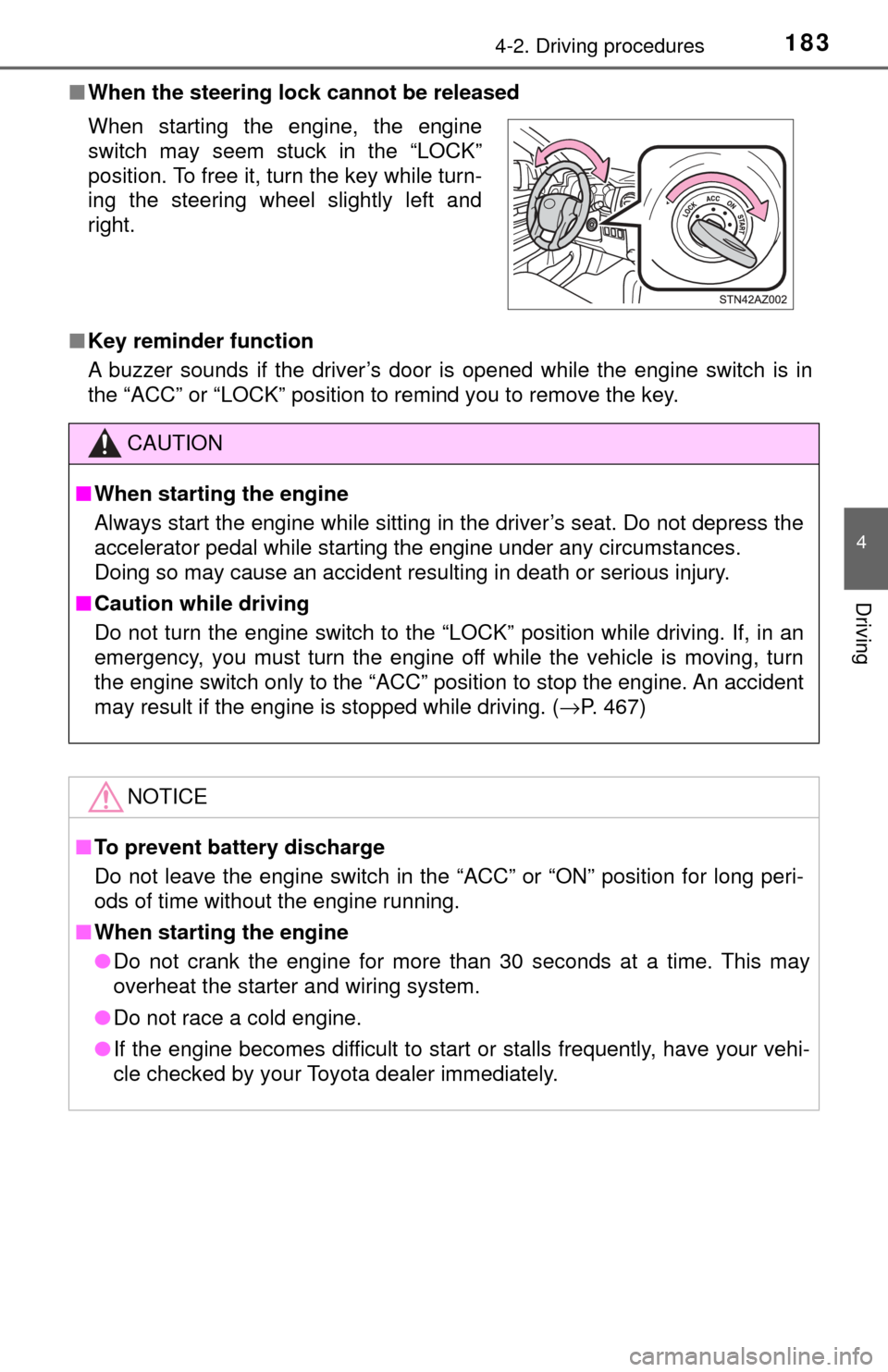
■When the steering lock cannot be released
■ Key reminder function
A buzzer sounds if the driver’s door is opened while the engine switch is in
the “ACC” or “LOCK” position to remind you to remove the key. When starting the engine, the engine
switch may seem stuck in the “LOCK”
position. To free it, turn the key while turn-
ing the steering wheel slightly left and
right.
CAUTION
■When starting the engine
Always start the engine while sitting in the driver’s seat. Do not depress the
accelerator pedal while starting the engine under any circumstances.
Doing so may cause an accident resulting in death or serious injury.
■ Caution while driving
Do not turn the engine switch to the “LOCK” position while driving. If, in an
emergency, you must turn the engine off while the vehicle is moving, turn
the engine switch only to the “ACC” position to stop the engine. An accident
may result if the engine is stopped while driving. ( →P. 467)
NOTICE
■To prevent battery discharge
Do not leave the engine switch in the “ACC” or “ON” position for long peri-
ods of time without the engine running.
■ When starting the engine
● Do not crank the engine for more than 30 seconds at a time. This may
overheat the starter and wiring system.
● Do not race a cold engine.
● If the engine becomes difficult to start or stalls frequently, have your vehi-
cle checked by your Toyota dealer immediately.
Page 184 of 588
1844-2. Driving procedures
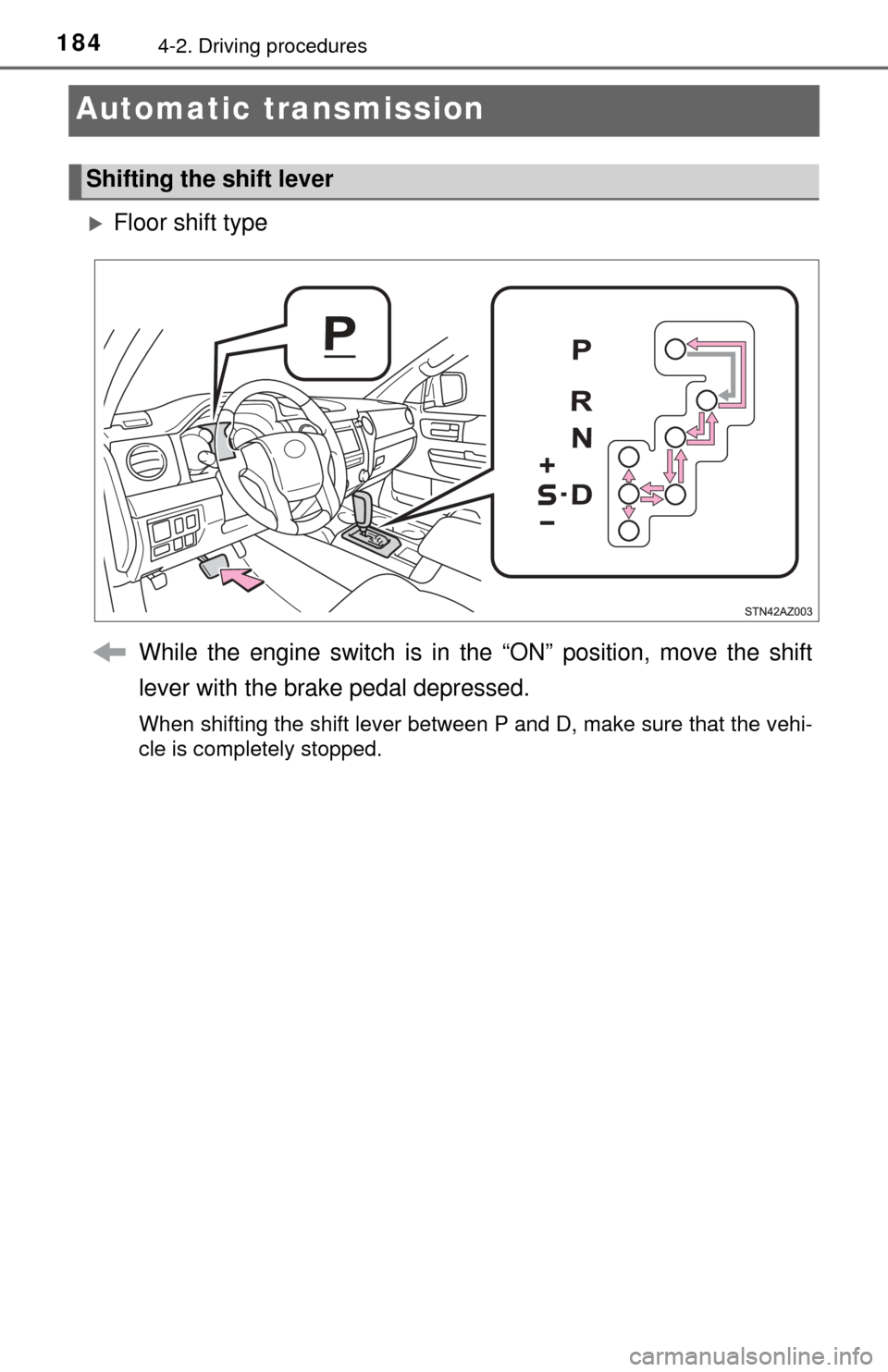
Automatic transmission
Floor shift typeWhile the engine switch is in the “ON” position, move the shift
lever with the brake pedal depressed.
When shifting the shift lever between P and D, make sure that the vehi-
cle is completely stopped.
Shifting the shift lever
Page 185 of 588
1854-2. Driving procedures
4
Driving
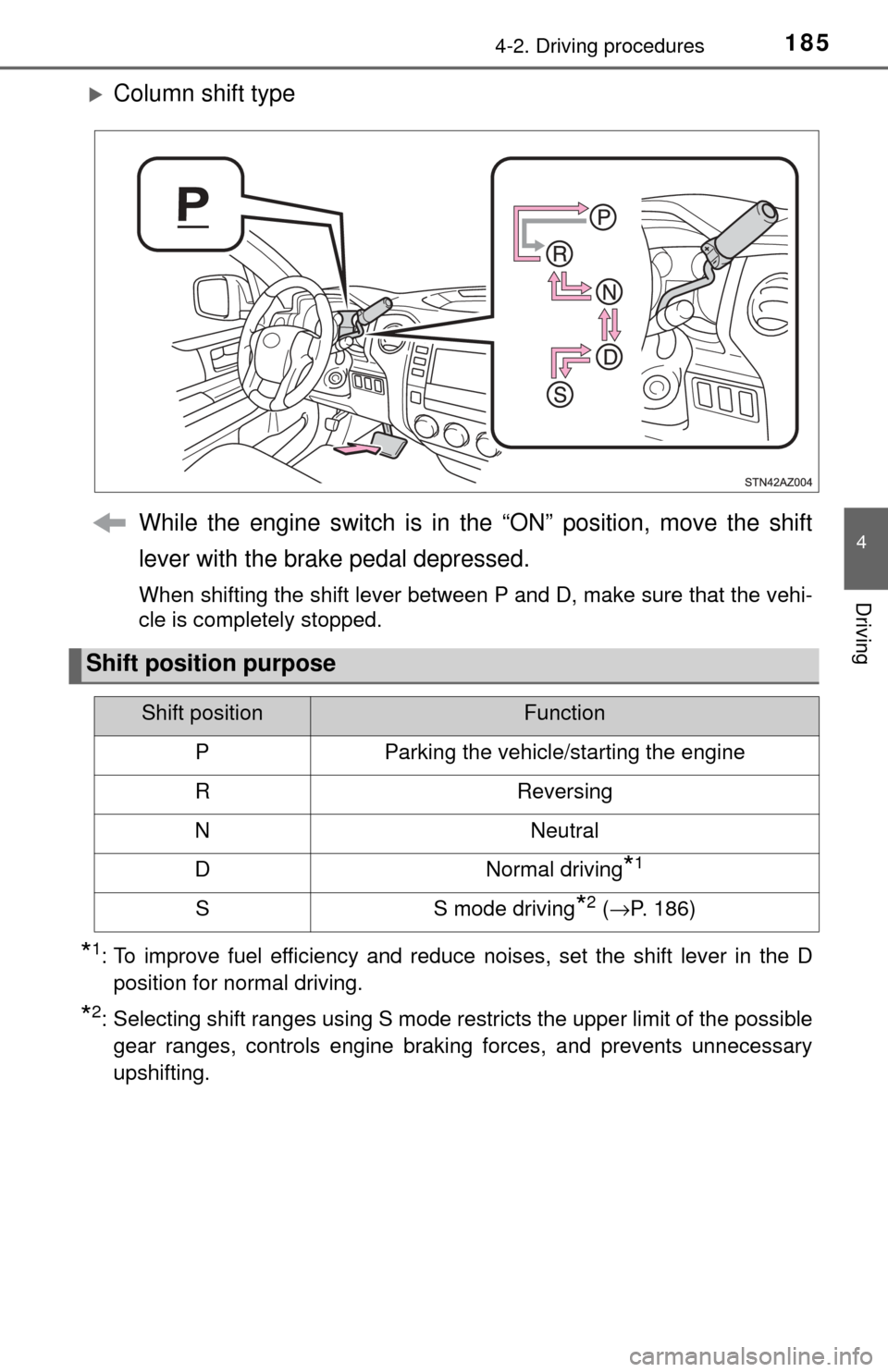
Column shift typeWhile the engine switch is in the “ON” position, move the shift
lever with the brake pedal depressed.
When shifting the shift lever between P and D, make sure that the vehi-
cle is completely stopped.
*1: To improve fuel efficiency and reduce noises, set the shift lever in the Dposition for normal driving.
*2: Selecting shift ranges using S mode restricts the upper limit of the possiblegear ranges, controls engine braking forces, and prevents unnecessary
upshifting.
Shift position purpose
Shift positionFunction
PParking the vehicle/starting the engine
RReversing
NNeutral
DNormal driving*1
SS mode driving*2 ( →P. 186)