fuel TOYOTA TUNDRA 2018 (in English) Owner's Manual
[x] Cancel search | Manufacturer: TOYOTA, Model Year: 2018, Model line: TUNDRA, Model: TOYOTA TUNDRA 2018Pages: 672, PDF Size: 14.09 MB
Page 179 of 672
1794-1. Before driving
4
Driving
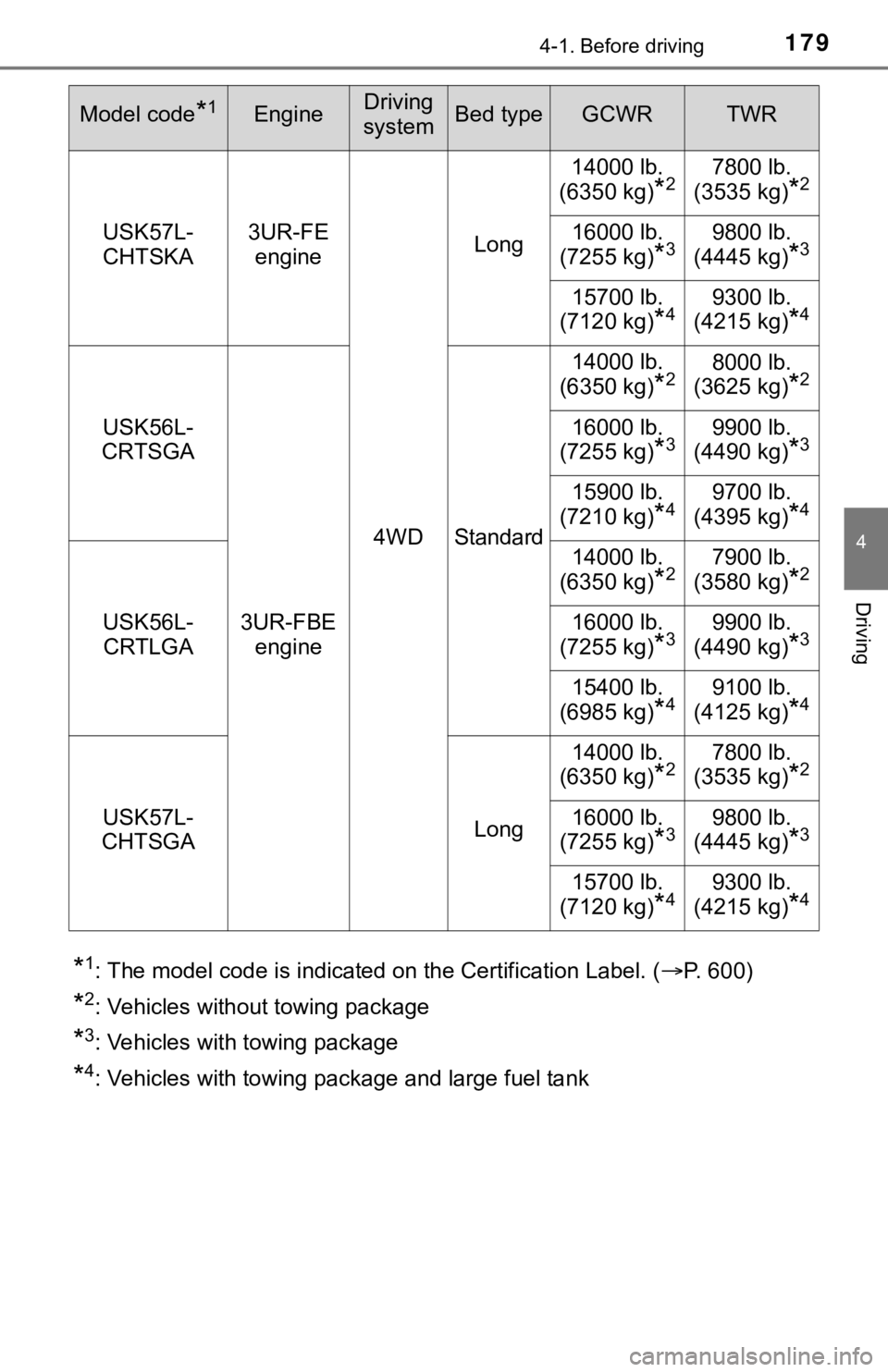
*1: The model code is indicated on the Certification Label. (P. 600)
*2: Vehicles without towing package
*3: Vehicles with towing package
*4: Vehicles with towing package and large fuel tankUSK57L-
CHTSKA
3UR-FE
engine
4WDLong
14000 lb.
(6350 kg)
*27800 lb.
(3535 kg)
*2
16000 lb.
(7255 kg)
*39800 lb.
(4445 kg)
*3
15700 lb.
(7120 kg)
*49300 lb.
(4215 kg)
*4
USK56L-
CRTSGA
3UR-FBE engine Standard14000 lb.
(6350 kg)
*28000 lb.
(3625 kg)
*2
16000 lb.
(7255 kg)
*39900 lb.
(4490 kg)
*3
15900 lb.
(7210 kg)
*49700 lb.
(4395 kg)
*4
USK56L- CRTLGA 14000 lb.
(6350 kg)
*27900 lb.
(3580 kg)
*2
16000 lb.
(7255 kg)
*39900 lb.
(4490 kg)
*3
15400 lb.
(6985 kg)
*49100 lb.
(4125 kg)
*4
USK57L-
CHTSGA Long14000 lb.
(6350 kg)
*27800 lb.
(3535 kg)
*2
16000 lb.
(7255 kg)
*39800 lb.
(4445 kg)
*3
15700 lb.
(7120 kg)
*49300 lb.
(4215 kg)
*4
Model code*1EngineDriving
systemBed typeGCWRTWR
Page 182 of 672
1824-1. Before driving
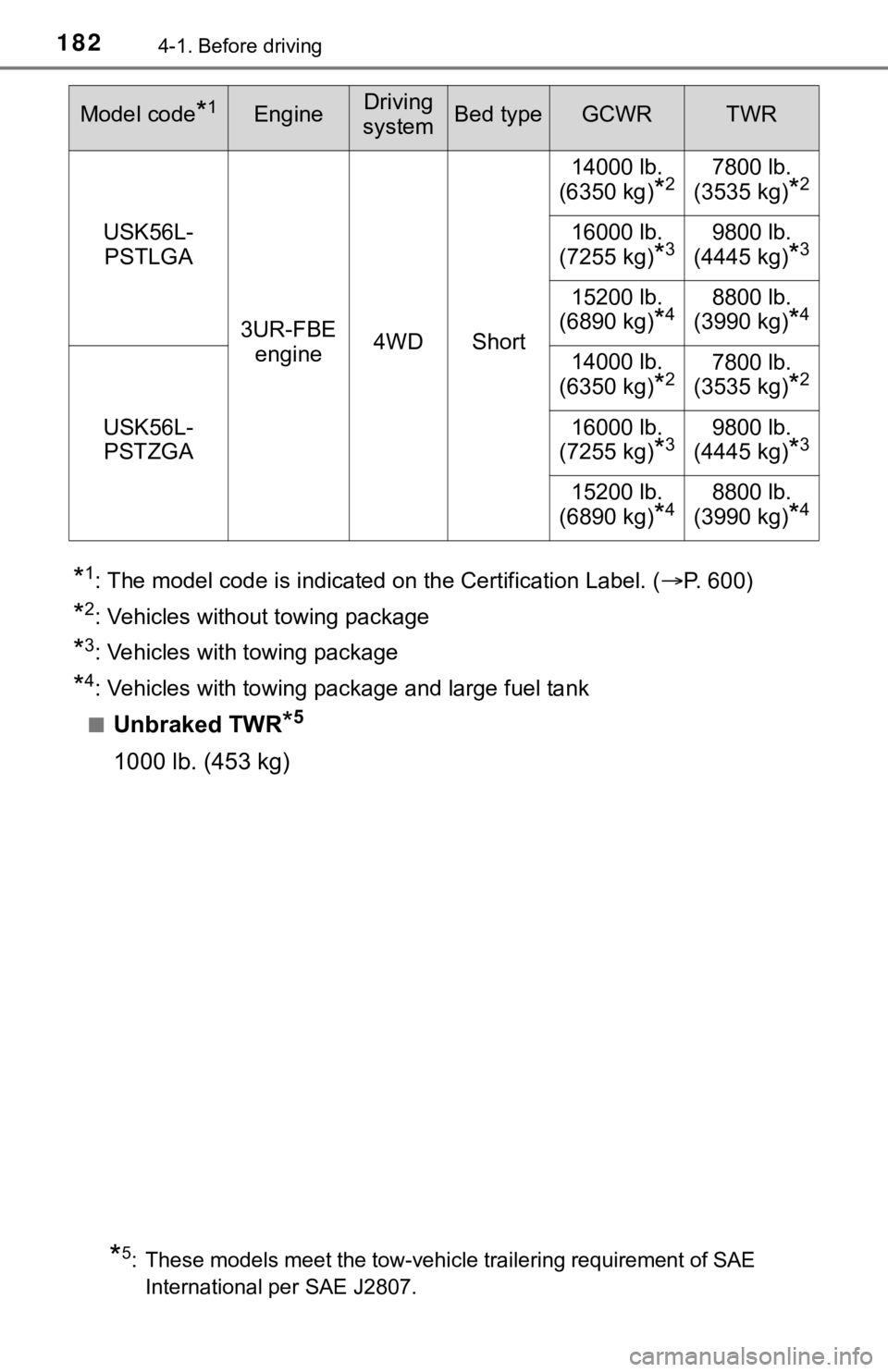
*1: The model code is indicated on the Certification Label. (P. 600)
*2: Vehicles without towing package
*3: Vehicles with towing package
*4: Vehicles with towing package and large fuel tank
■Unbraked TWR*5
1000 lb. (453 kg)
USK56L-
PSTLGA
3UR-FBE engine 4WD Short 14000 lb.
(6350 kg)
*27800 lb.
(3535 kg)
*2
16000 lb.
(7255 kg)
*39800 lb.
(4445 kg)
*3
15200 lb.
(6890 kg)
*48800 lb.
(3990 kg)
*4
USK56L- PSTZGA 14000 lb.
(6350 kg)
*27800 lb.
(3535 kg)
*2
16000 lb.
(7255 kg)
*39800 lb.
(4445 kg)
*3
15200 lb.
(6890 kg)
*48800 lb.
(3990 kg)
*4
*5: These models meet the tow-vehicle trailering requirement of SAE
International per SAE J2807.
Model code*1EngineDriving
systemBed typeGCWRTWR
Page 198 of 672
1984-2. Driving procedures
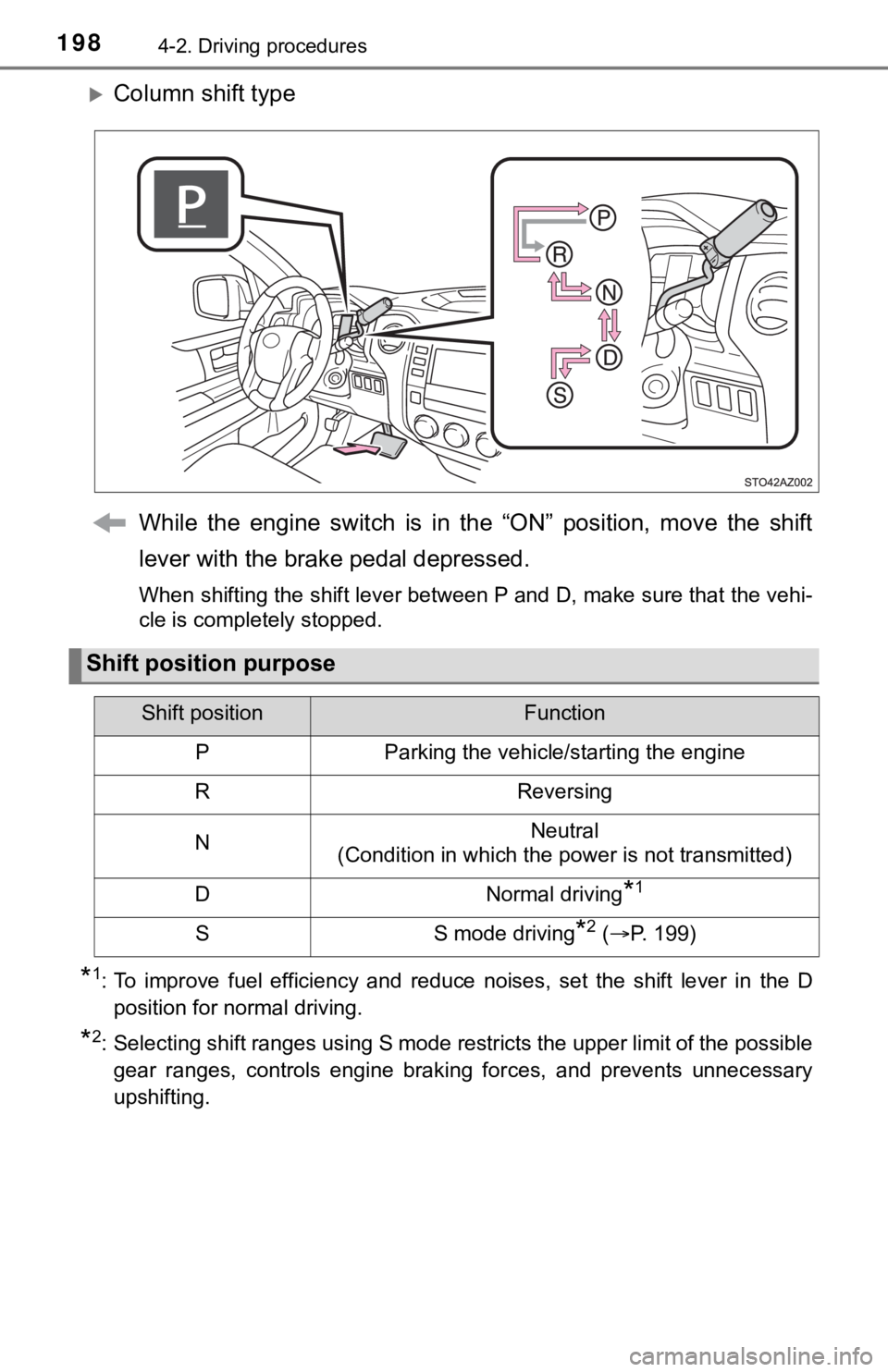
Column shift typeWhile the engine switch is in the “ON” position, move the shift
lever with the brake pedal depressed.
When shifting the shift lever between P and D, make sure that t he vehi-
cle is completely stopped.
*1: To improve fuel efficiency and reduce noises, set the shift le ver in the D
position for normal driving.
*2: Selecting shift ranges using S mode restricts the upper limit of the possible
gear ranges, controls engine braking forces, and prevents unnec essary
upshifting.
Shift position purpose
Shift positionFunction
PParking the vehicle/starting the engine
RReversing
NNeutral
(Condition in which the power is not transmitted)
DNormal driving*1
SS mode driving*2 ( P. 199)
Page 209 of 672
2094-3. Operating the lights and wipers
4
Driving
■Daytime running light system
●The daytime running lights illuminate using the same lights as the parking
lights and illuminate brighter than the parking lights.
● To make your vehicle more visible to other drivers during dayti me driving,
the daytime running lights turn on automatically when all of the following
conditions are met. (The daytime running lights are not designe d for use at
night.)
• The engine is running
• The parking brake is released
• The headlight switch is in the (Canada only), or * position
*: When the surroundings are bright
The daytime running lights remain on after they illuminate, even if the parking
brake is set again.
● For the U.S.A.: Daytime running lights can be turned off by ope rating the
switch.
● For the Canada: Daytime running lights are not designed for use at night.
● Compared to turning on the headlights, the daytime running ligh t system
offers greater durability and consumes less electricity, so it can help improve
fuel economy.
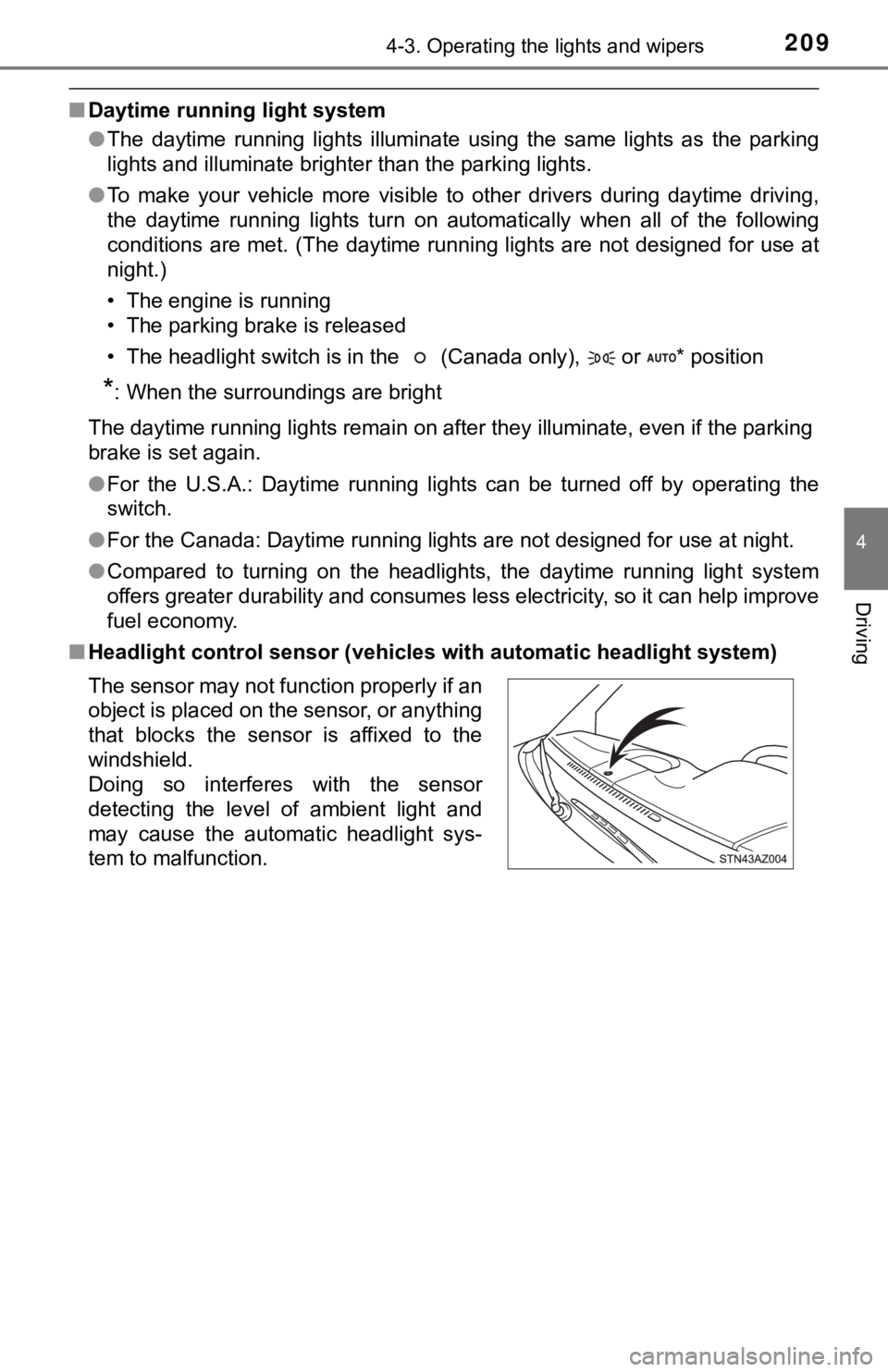
■ Headlight control sensor (vehicles with automatic headlight system)
The sensor may not function properly if an
object is placed on the sensor, or anything
that blocks the sensor is affixed to the
windshield.
Doing so interferes with the sensor
detecting the level of ambient light and
may cause the automatic headlight sys-
tem to malfunction.
Page 220 of 672
2204-4. Refueling
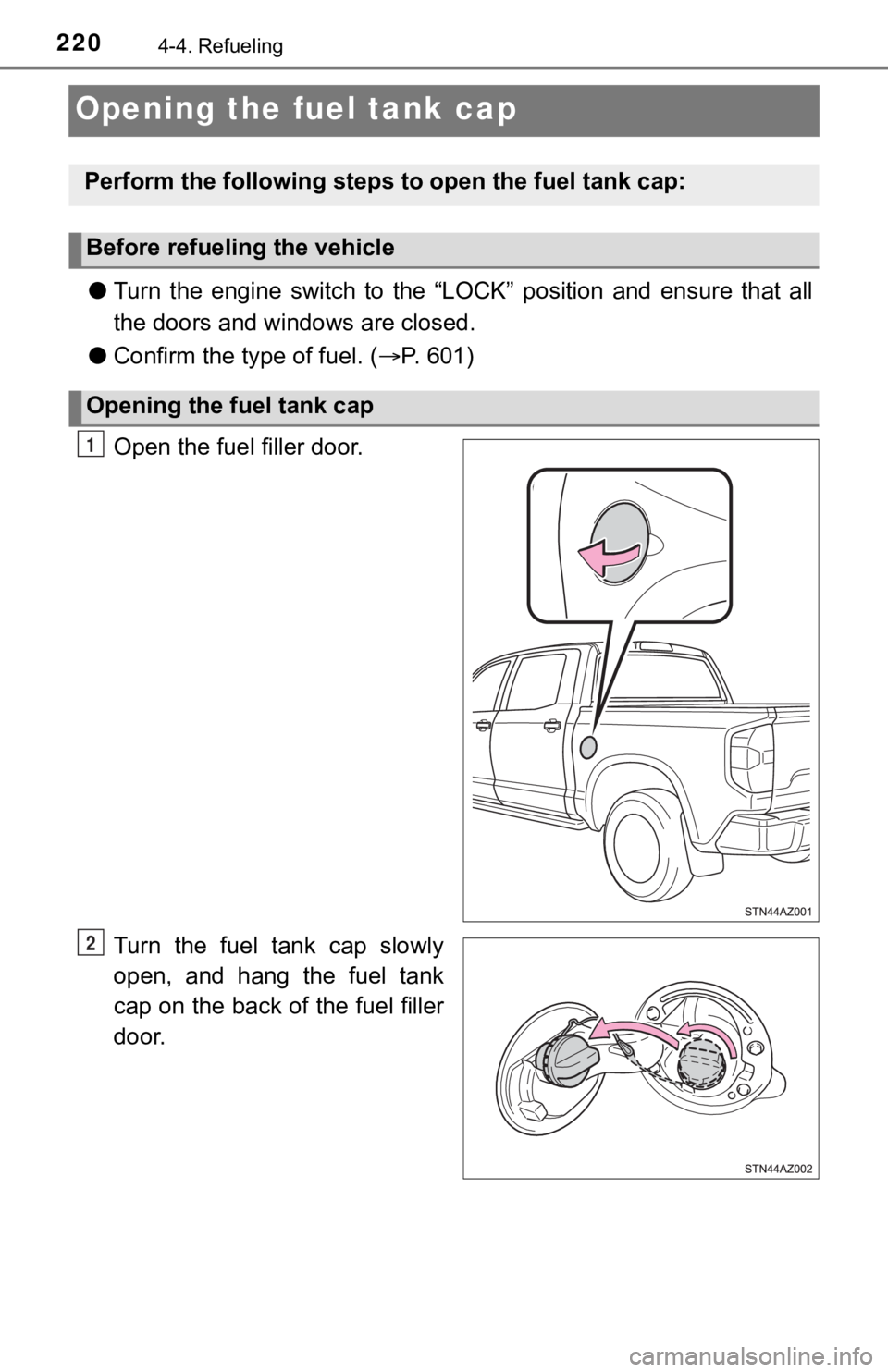
Opening the fuel tank cap
●Turn the engine switch to the “LOCK” position and ensure that a ll
the doors and windows are closed.
● Confirm the type of fuel. ( P. 601)
Open the fuel filler door.
Turn the fuel tank cap slowly
open, and hang the fuel tank
cap on the back of the fuel filler
door.
Perform the following steps to open the fuel tank cap:
Before refueling the vehicle
Opening the fuel tank cap
1
2
Page 221 of 672
2214-4. Refueling
4
Driving
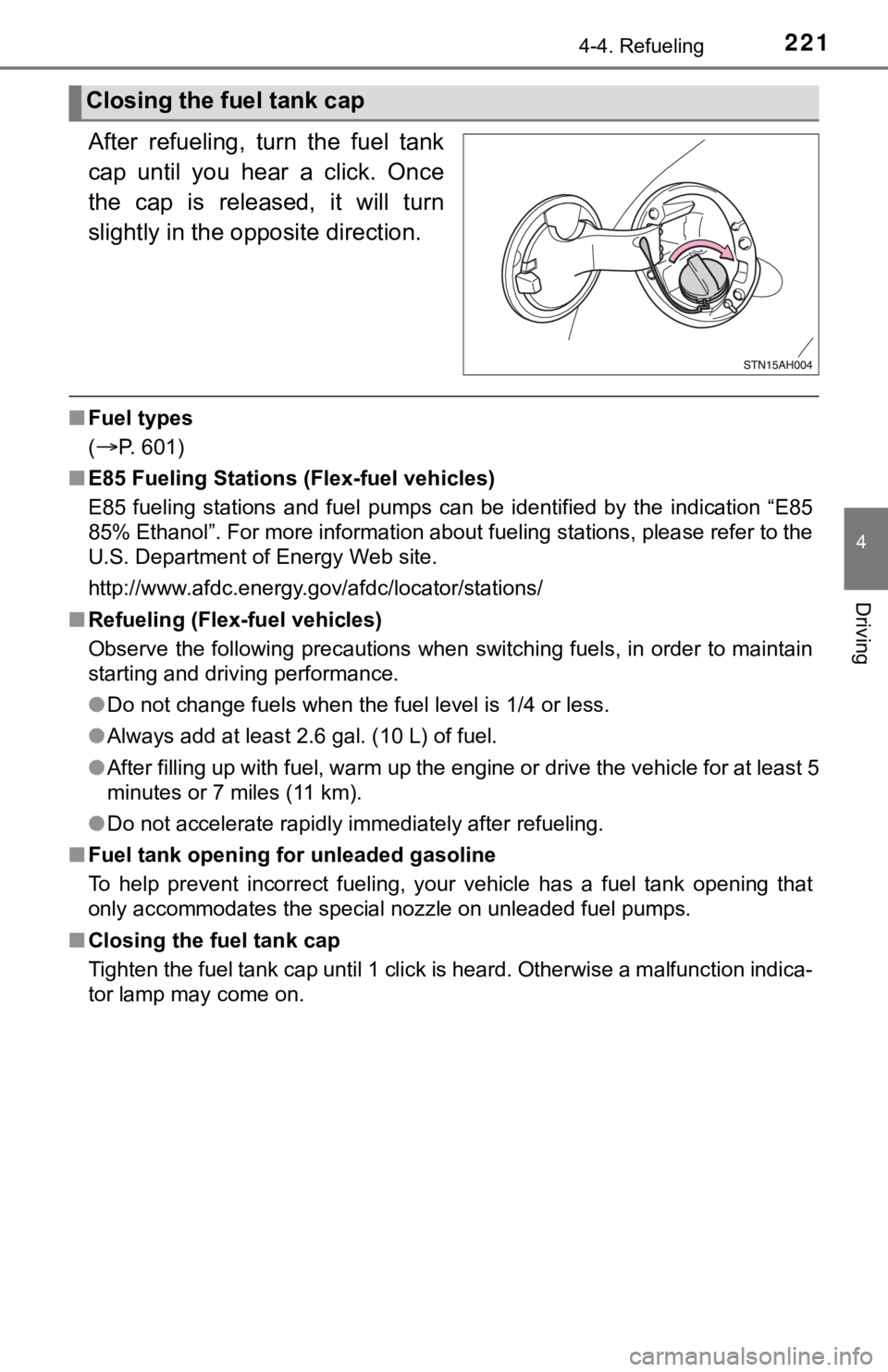
After refueling, turn the fuel tank
cap until you hear a click. Once
the cap is released, it will turn
slightly in the opposite direction.
■Fuel types
(
P. 601)
■ E85 Fueling Stations (Flex-fuel vehicles)
E85 fueling stations and fuel pumps can be identified by the in dication “E85
85% Ethanol”. For more information about fueling stations, plea se refer to the
U.S. Department of Energy Web site.
http://www.afdc.energy.gov/afdc/locator/stations/
■ Refueling (Flex-fuel vehicles)
Observe the following precautions when switching fuels, in order to maintain
starting and driving performance.
●Do not change fuels when the fuel level is 1/4 or less.
● Always add at least 2.6 gal. (10 L) of fuel.
● After filling up with fuel, warm up the engine or drive the vehicle for at least 5
minutes or 7 miles (11 km).
● Do not accelerate rapidly immediately after refueling.
■ Fuel tank opening for unleaded gasoline
To help prevent incorrect fueling, your vehicle has a fuel tank opening that
only accommodates the special nozzle on unleaded fuel pumps.
■ Closing the fuel tank cap
Tighten the fuel tank cap until 1 click is heard. Otherwise a m alfunction indica-
tor lamp may come on.
Closing the fuel tank cap
Page 222 of 672
2224-4. Refueling
WARNING
■When refueling the vehicle
Observe the following precautions while refueling the vehicle. Failure to do
so may result in death or serious injury.
● After exiting the vehicle and before opening the fuel door, tou ch an
unpainted metal surface to discharge any static electricity. It is important to
discharge static electricity before refueling because sparks re sulting from
static electricity can cause fuel vapors to ignite while refuel ing.
● Always hold the grips on the fuel tank cap and turn it slowly to remove it.
A whooshing sound may be heard when the fuel tank cap is loosen ed.
Wait until the sound cannot be heard before fully removing the cap. In hot
weather, pressurized fuel may spray out the filler neck and cause injury.
● Do not allow anyone that has not discharged static electricity from their
body to come close to an open fuel tank.
● Do not inhale vaporized fuel.
Fuel contains substances that are harmful if inhaled.
● Do not smoke while refueling the vehicle.
Doing so may cause the fuel to ignite and cause a fire.
● Do not return to the vehicle or touch any person or object that is statically
charged.
This may cause static electricity to build up, resulting in a p ossible ignition
hazard.
■ When refueling
Observe the following precautions to prevent fuel overflowing f rom the fuel
tank:
● Securely insert the fuel nozzle into the fuel filler neck.
● Stop filling the tank after the fuel nozzle automatically click s off.
● Do not top off the fuel tank.
■ When replacing the fuel tank cap
Do not use anything but a genuine Toyota fuel tank cap designed for your
vehicle. Doing so may cause a fire or other incident which may result in
death or serious injury.
Page 223 of 672
2234-4. Refueling
4
Driving
NOTICE
■Refueling
Do not spill fuel during refueling.
Doing so may damage the vehicle, such as causing the emission c ontrol
system to operate abnormally or damaging fuel system components or the
vehicle’s painted surface.
■ E85 fuel
E85 fuel can be used only in flex-fuel vehicles. Do not add E85 fuel to a
gasoline-engine vehicle.
Filling a gasoline-engine vehicle with E85 fuel will have a neg ative impact
on starting and driving performance and will cause damage to th e fuel sys-
tem components.
Page 313 of 672
3134-6. Driving tips
4
Driving
●Park the vehicle and move the shift lever to P without setting the
parking brake. The parking brake may freeze up, preventing it from
being released. If the vehicle is parked without setting the pa rking
brake, make sure t o block the wheels.
Failure to do so may be dangerou s because it may cause the vehi-
cle to move unexpectedly, pos sibly leading to an accident.
● If the vehicle is parked without setting the parking brake, confirm
that the shift lever c annot be moved out of P
*.
*: The shift lever will be locked if it is attempted to be shift ed from P to any
other position without depressing the brake pedal. If the shift lever can be
shifted from P, there may be a problem with the shift lock syst em. Have the
vehicle inspected by your Toyota dealer immediately.
Observe the following precautions when switching fuels, in orde r to
maintain starting a nd driving performance.
● Do not change fuels when the fuel level is 1/4 or less.
● Always add at least 2.6 gal. (10 L) of fuel.
● After filling up with fuel, warm up the engine or drive the vehicle for
at least 5 minutes or 7 miles (11 km).
● Do not accelerate rapidly im mediately after refueling.
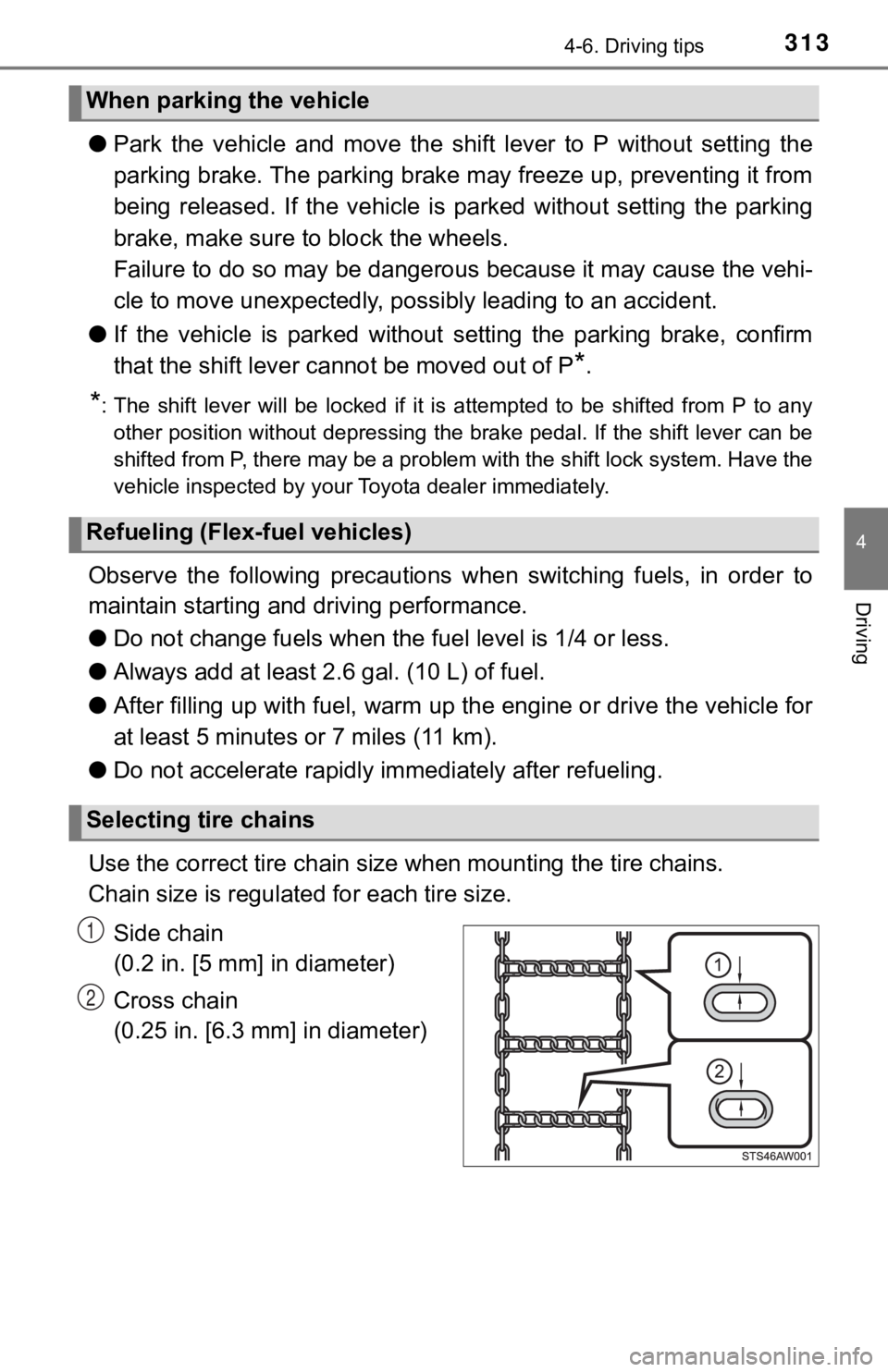
Use the correct tire chain size when mount ing the tire chains.
Chain size is regulate d for each tire size.
Side chain
(0.2 in. [5 mm] in diameter)
Cross chain
(0.25 in. [6.3 mm] in diameter)
When parking the vehicle
Refueling (Flex-fuel vehicles)
Selecting tire chains
1
2
Page 324 of 672
3245-1. Basic Operations
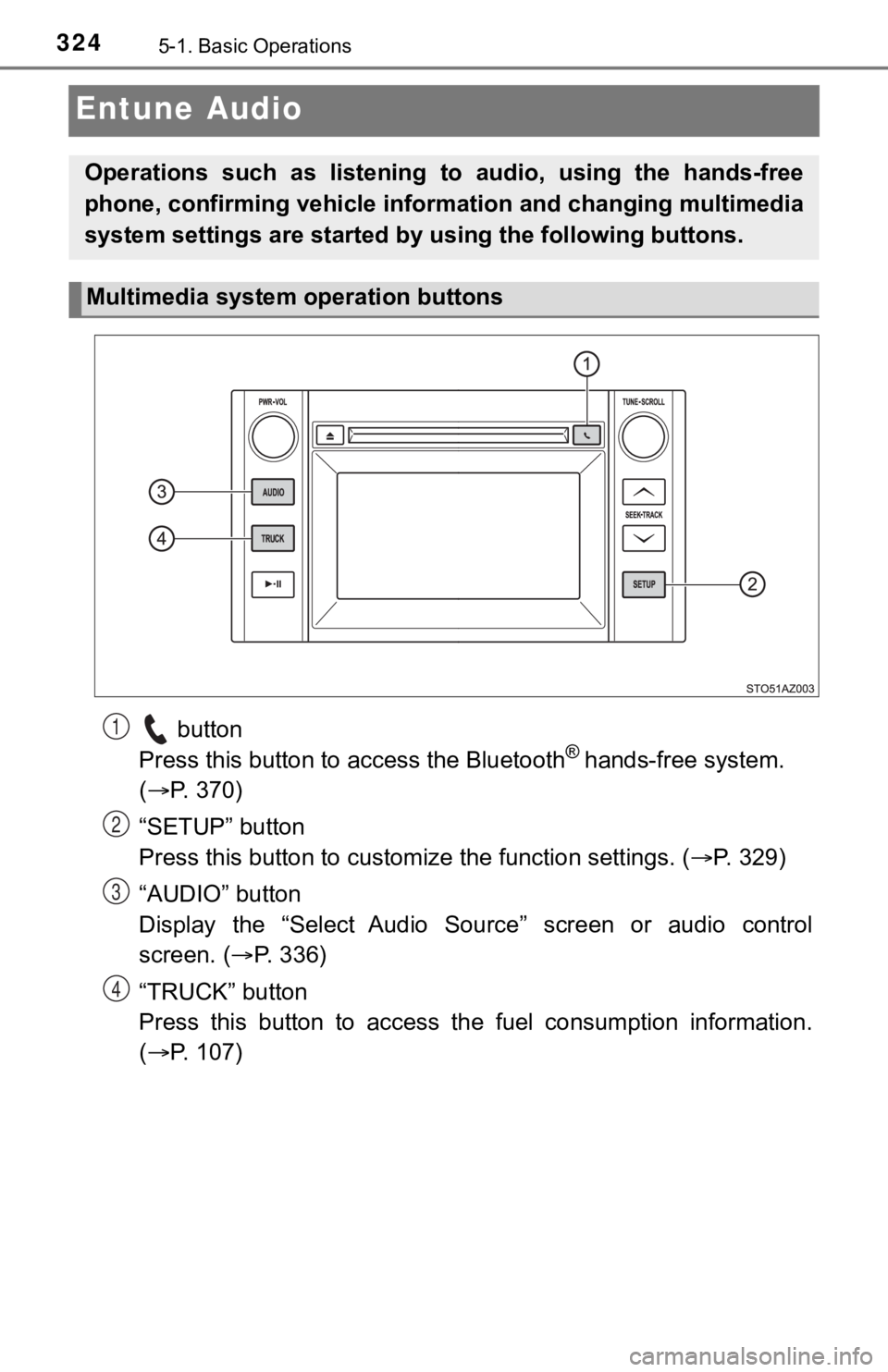
Entune Audio
button
Press this button to a ccess the Bluetooth® hands-free system.
( P. 370)
“SETUP” button
Press this button to customi ze the function settings. (P. 329)
“AUDIO” button
Display the “Select Audio Source” screen or audio control
screen. ( P. 3 3 6 )
“TRUCK” button
Press this button to access the fuel consumption information.
( P. 107)
Operations such as listening to audio, using the hands-free
phone, confirming vehicle inform ation and changing multimedia
system settings are started by using the following buttons.
Multimedia system operation buttons
1
2
3
4