brakes TOYOTA TUNDRA 2020 (in English) Owner's Guide
[x] Cancel search | Manufacturer: TOYOTA, Model Year: 2020, Model line: TUNDRA, Model: TOYOTA TUNDRA 2020Pages: 608, PDF Size: 13.19 MB
Page 499 of 608
4997-2. Steps to take in an emergency
7
When trouble arises
*: Refer to the separate “Scheduled Maintenance Guide” or “Owner’s Manual
Supplement” for the maintenance interval applicable to your veh icle.
■Warning message in radar cruise mode (if equipped)
In the following cases, the warning message may not be displaye d even if
vehicle-to-vehicle distance decreases:
● When your vehicle and the vehicle ahead are traveling at the sa me speed or
the vehicle ahead is traveling more quickly than your vehicle
● When the vehicle ahead is traveling at a very low speed
● Immediately after cruise control speed is set
● At the instant the accelerator pedal is depressed
■
Conditions that the tire pressure warning system may not functi on
properly
P. 4 3 2
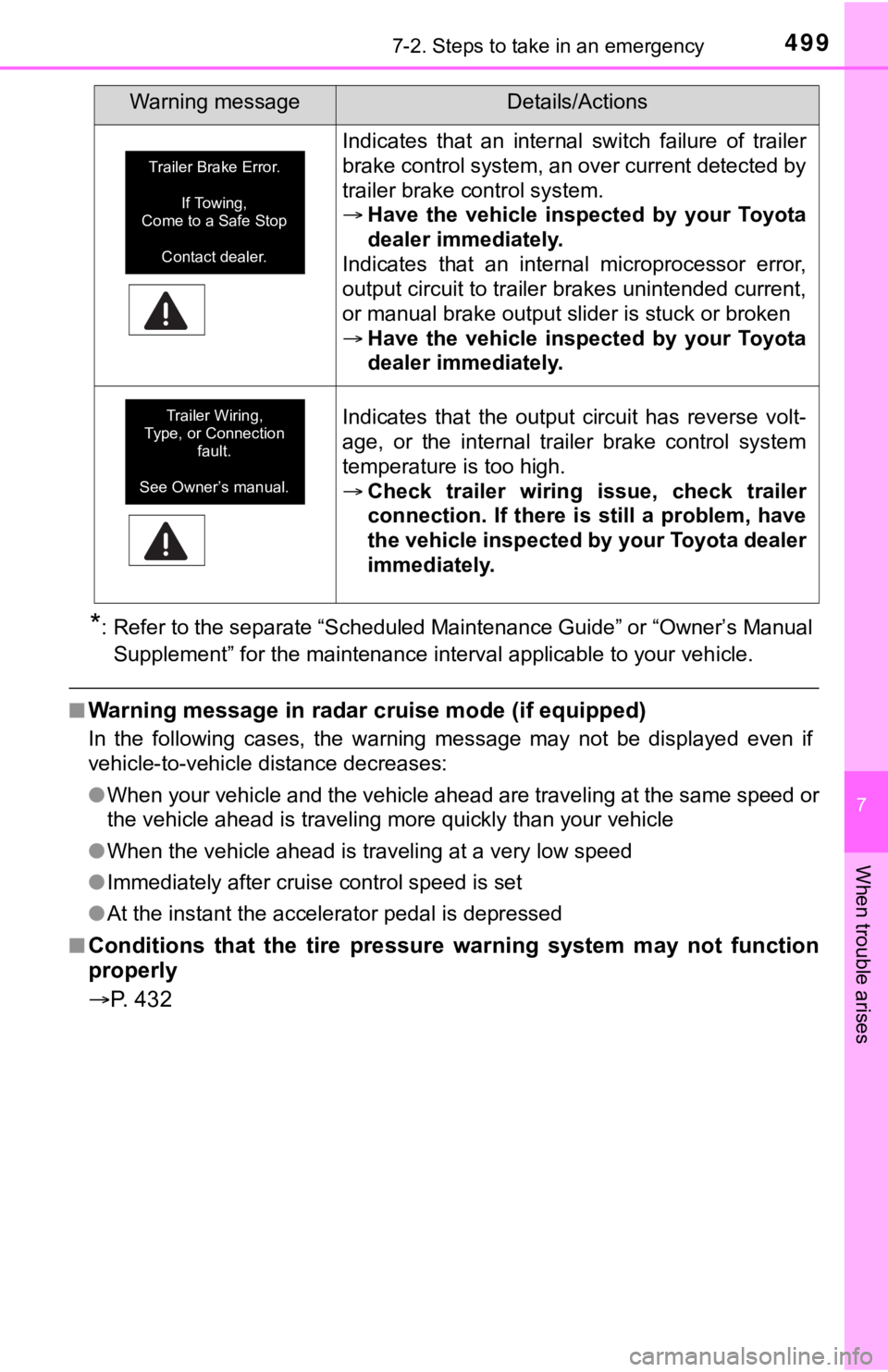
Indicates that an internal switch failure of trailer
brake control system, an over current detected by
trailer brake control system.
Have the vehicle inspected by your Toyota
dealer immediately.
Indicates that an internal microprocessor error,
output circuit to trailer brakes unintended current,
or manual brake output slider is stuck or broken
Have the vehicle inspected by your Toyota
dealer immediately.
Indicates that the output circuit has reverse volt-
age, or the internal trailer brake control system
temperature is too high.
Check trailer wiring issue, check trailer
connection. If there is still a problem, have
the vehicle inspected by your Toyota dealer
immediately.
Warning messageDetails/Actions
Trailer Brake Error.
If Towing,
Come to a Safe Stop
Contact dealer.
Trailer Wiring,
Type, or Connection
fault.
See Owner’s manual.
Page 512 of 608

5127-2. Steps to take in an emergency
WARNING
■Replacing a flat tire
●Observe the following precautions.
Failure to do so may result in serious injury:
• Lower the spare tire completely to the ground before removing it
from under the vehicle.
• Do not try to remove the wheel ornament by hand. Take due care in
handling the ornament to avoi d unexpected personal injury.
• Do not touch the disc wheels or the area around the brakes imm edi-
ately after the vehicle has been driven.
After the vehicle has been driven the disc wheels and the area
around the brakes will be extreme ly hot. Touching these areas with
hands, feet or other body parts while changing a tire, etc., ma y
result in burns.
●Failure to follow these precautions could cause the wheel nuts to
loosen and the t ire to fall off, resulting in death or serious injury.
• Have the wheel nuts tightened with a torque wrench as soon as pos-
sible after changing wheels.
Steel wheel: 154 ft·lbf (209 N·m, 21.3 kgf·m)
Aluminum wheel: 97 ft·lbf (131 N·m, 13.4 kgf·m)
• When installing a tire, only use wheel nuts that have been spe cifi-
cally designed for that wheel.
• Retighten the wheel nuts within 100 miles (160 km) of driving.
• If there are any cracks or defo rmations in the bolt screws, nut
threads or bolt holes of the wheel, have the vehicle inspected by
your Toyota dealer.
• Do not attach a heavily damaged wheel ornament, as it may fly off
the wheel while the vehicle is moving.
• When installing the wheel nuts, b e sure to install them with the
tapered ends facing inward. ( P. 444)
Page 545 of 608
5458-1. Specifications
8
Vehicle specifications
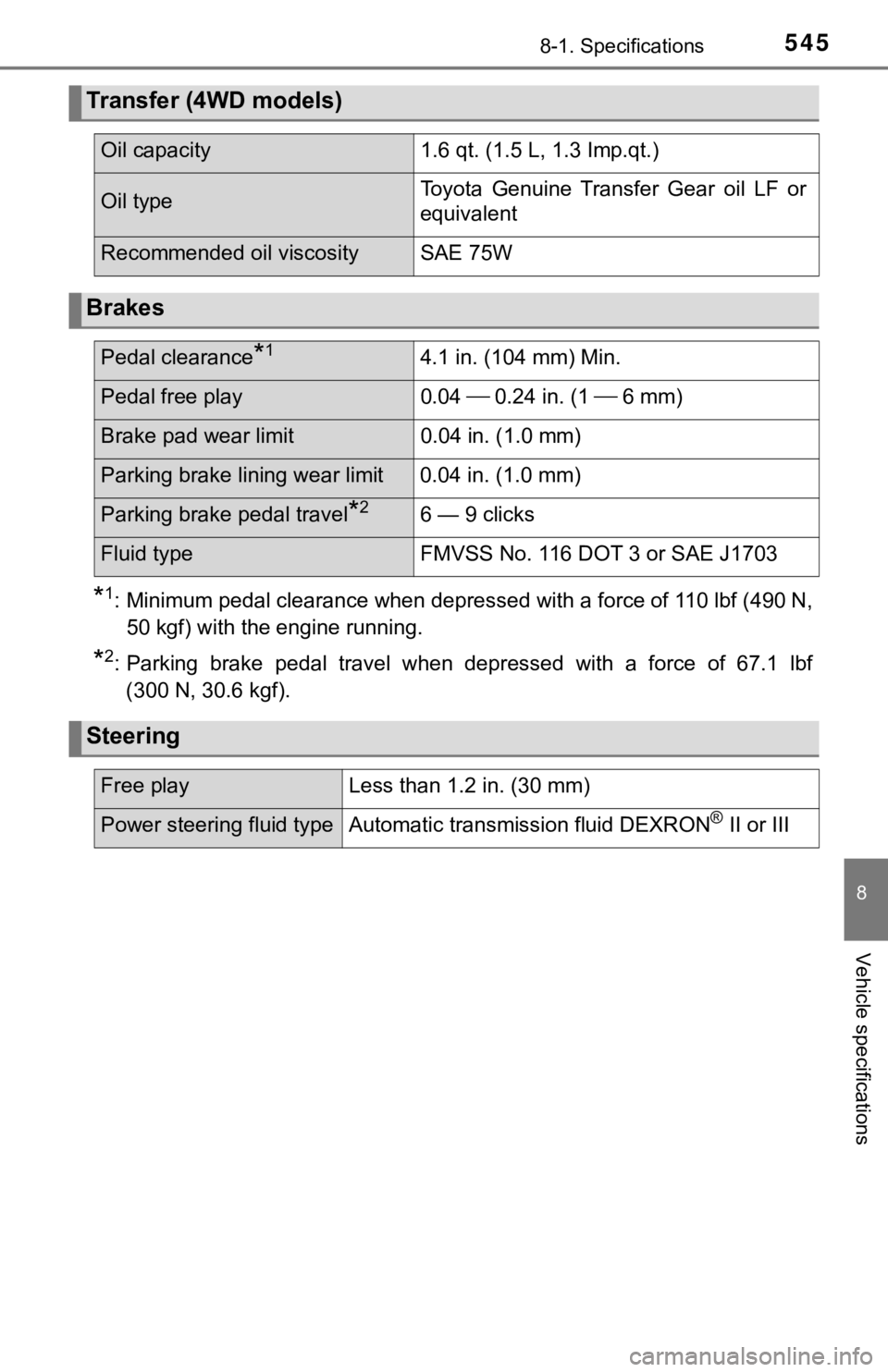
*1: Minimum pedal clearance when depressed with a force of 110 lbf (490 N,
50 kgf) with the engine running.
*2: Parking brake pedal travel when depressed with a force of 67.1 lbf
(300 N, 30.6 kgf).
Transfer (4WD models)
Oil capacity 1.6 qt. (1.5 L, 1.3 Imp.qt.)
Oil typeToyota Genuine Transfer Gear oil LF or
equivalent
Recommended oil viscosity SAE 75W
Brakes
Pedal clearance*14.1 in. (104 mm) Min.
Pedal free play
0.04 0.24 in. (1 6 mm)
Brake pad wear limit 0.04 in. (1.0 mm)
Parking brake lining wear limit 0.04 in. (1.0 mm)
Parking brake pedal travel*26 — 9 clicks
Fluid typeFMVSS No. 116 DOT 3 or SAE J1703
Steering
Free playLess than 1.2 in. (30 mm)
Power steering fluid typeAutomatic transmission fluid DEXRON® II or III
Page 557 of 608
5578-1. Specifications
8
Vehicle specifications
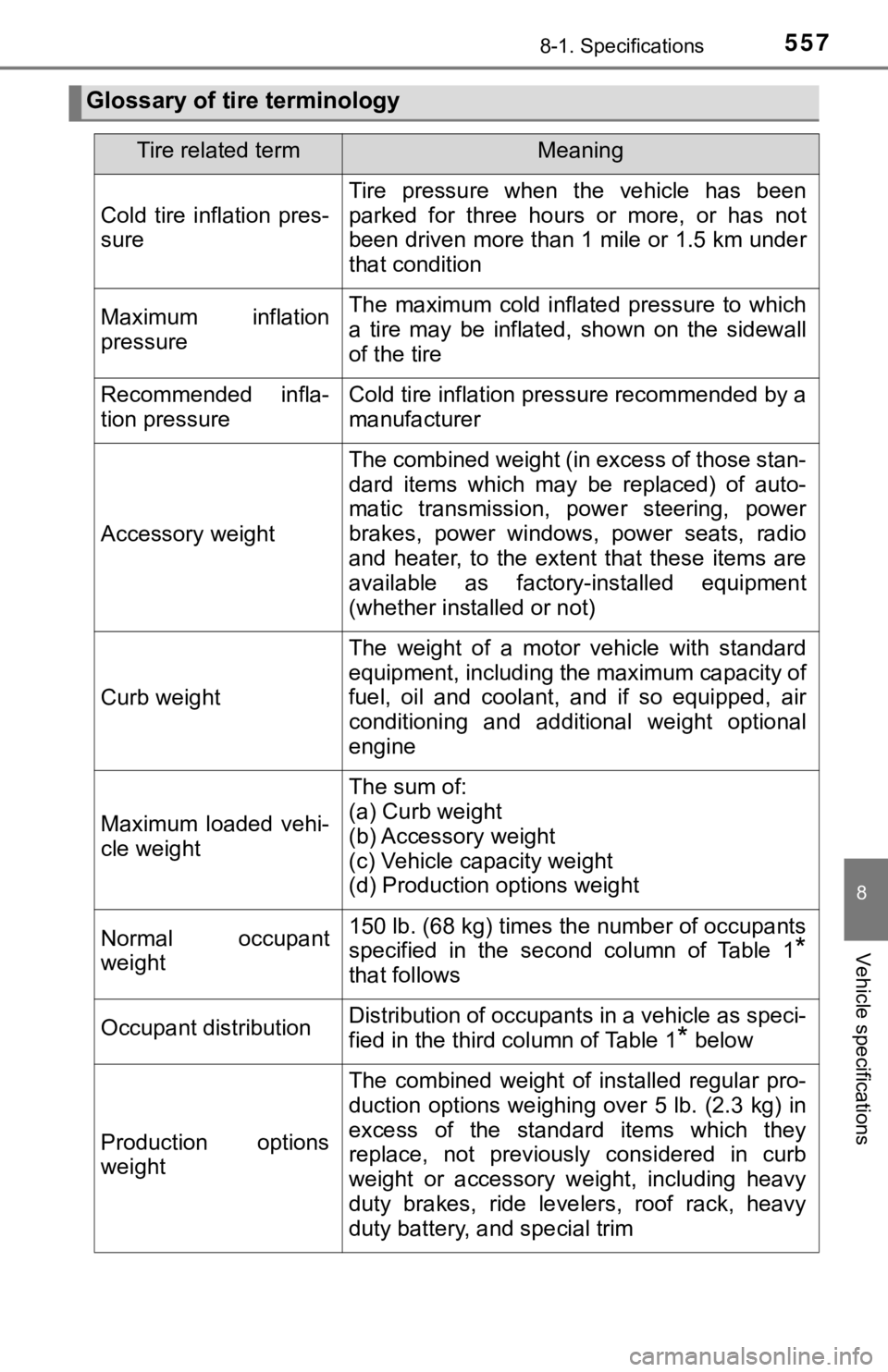
Glossary of tire terminology
Tire related termMeaning
Cold tire inflation pres-
sure
Tire pressure when the vehicle has been
parked for three hours or more, or has not
been driven more than 1 mile or 1.5 km under
that condition
Maximum inflation
pressureThe maximum cold inflated pressure to which
a tire may be inflated, shown on the sidewall
of the tire
Recommended infla-
tion pressureCold tire inflation pressure recommended by a
manufacturer
Accessory weight
The combined weight (in excess of those stan-
dard items which may be replaced) of auto-
matic transmission, power steering, power
brakes, power windows, power seats, radio
and heater, to the extent that these items are
available as factory-installed equipment
(whether installed or not)
Curb weight
The weight of a motor vehicle with standard
equipment, including the maximum capacity of
fuel, oil and coolant, and if so equipped, air
conditioning and additional weight optional
engine
Maximum loaded vehi-
cle weight
The sum of:
(a) Curb weight
(b) Accessory weight
(c) Vehicle capacity weight
(d) Production options weight
Normal occupant
weight150 lb. (68 kg) times the number of occupants
specified in the second column of Table 1
*
that follows
Occupant distributionDistribution of occupants in a vehicle as speci-
fied in the third column of Table 1
* below
Production options
weight
The combined weight of installed regular pro-
duction options weighing over 5 lb. (2.3 kg) in
excess of the standard items which they
replace, not previously considered in curb
weight or accessory weight, including heavy
duty brakes, ride levelers, roof rack, heavy
duty battery, and special trim