4WD TOYOTA TUNDRA 2020 Owners Manual (in English)
[x] Cancel search | Manufacturer: TOYOTA, Model Year: 2020, Model line: TUNDRA, Model: TOYOTA TUNDRA 2020Pages: 608, PDF Size: 13.19 MB
Page 103 of 608
1032. Instrument cluster
2
Instrument cluster
*6
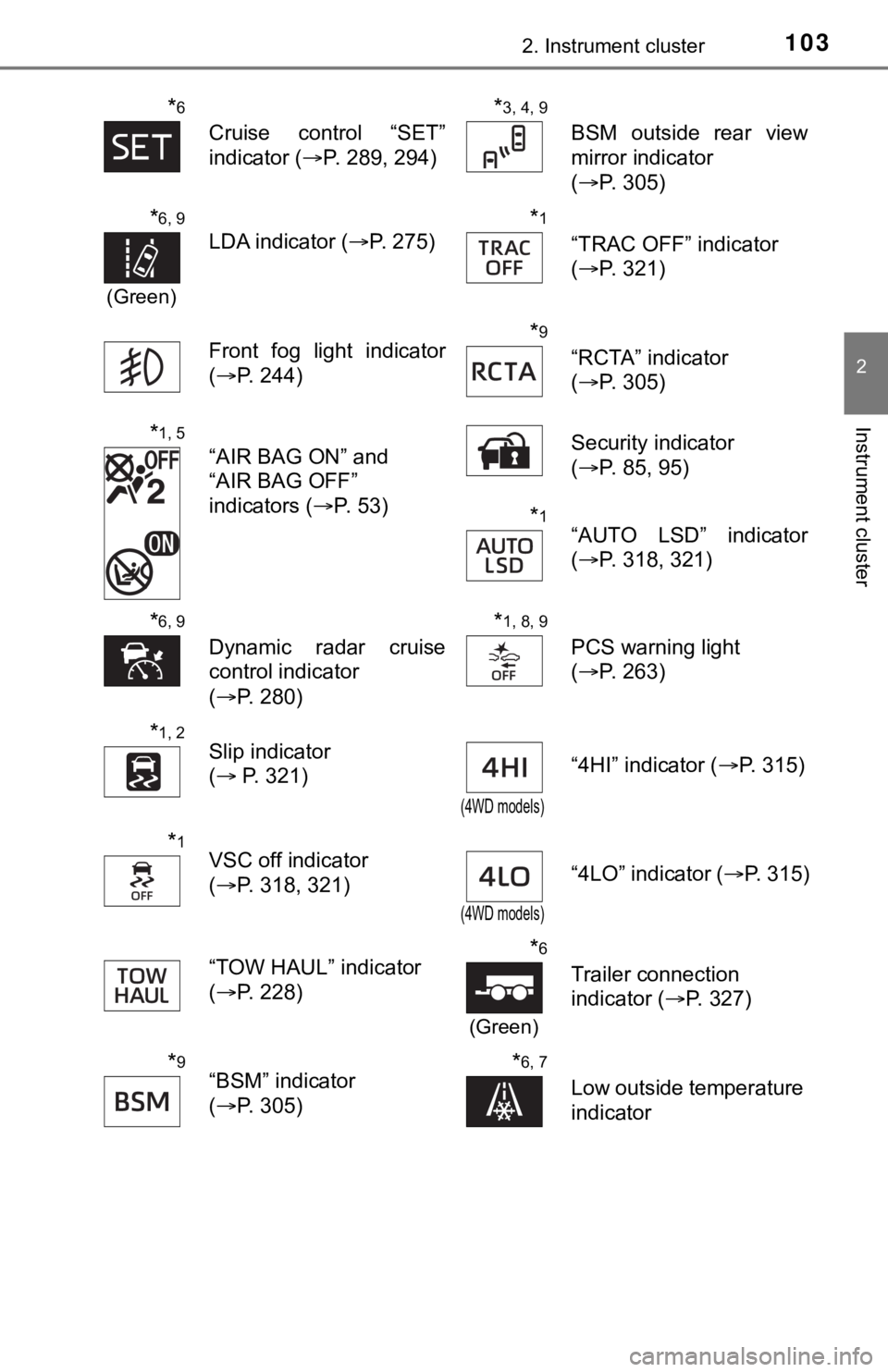
Cruise control “SET”
indicator (P. 289, 294)
*3, 4, 9
BSM outside rear view
mirror indicator
(P. 305)
*6, 9
(Green)
LDA indicator ( P. 275)
*1
“TRAC OFF” indicator
(P. 321)
Front fog light indicator
( P. 244)
*9
“RCTA” indicator
(P. 305)
*1, 5
“AIR BAG ON” and
“AIR BAG OFF”
indicators ( P. 53) Security indicator
(
P. 85, 95)
*1“AUTO LSD” indicator
(P. 318, 321)
*6, 9
Dynamic radar cruise
control indicator
(P. 280)
*1, 8, 9
PCS warning light
(P. 263)
*1, 2Slip indicator
( P. 321)
(4WD models)
“4HI” indicator ( P. 315)
*1VSC off indicator
(P. 318, 321)
(4WD models)
“4LO” indicator ( P. 315)
“TOW HAUL” indicator
( P. 228)
*6
(Green)
Trailer connection
indicator ( P. 327)
*9“BSM” indicator
(P. 305)*6, 7
Low outside temperature
indicator
Page 185 of 608

1854-1. Before driving
4
Driving
■Driving in the rain
●Drive carefully when it is raining, because visibility will be reduced, the win-
dows may become fogged-up, and the road will be slippery.
● Drive carefully when it starts to rain, because the road surface will be espe-
cially slippery.
● Refrain from high speeds when driving on an expressway in the r ain,
because there may be a layer of water between the tires and the road sur-
face, preventing the steering and brakes from operating properl y.
■ Engine speed while driving
In the following conditions, the engine speed may become high w hile driving.
This is due to automatic up-shifting control or down-shifting implementation to
meet driving conditions. It does not indicate sudden acceleration.
● The vehicle is judged to be driving uphill or downhill
● When the accelerator pedal is released
● When the brake pedal is depressed while TOW/HAUL mode is select ed (if
equipped)
■ Restraining the engine out put (Brake Override System)
● When the accelerator and brake pedals are depressed at the same time, the
engine output may be restrained.
● A warning message is displayed on the multi-information display while the
system is operating.
■ Restraining sudden start (Drive-Start Control)
● When the following unusual operation is performed, the engine o utput may
be restrained.
• When the shift lever is shifted from R to D, D to R, N to R, P to D, or P to
R (D includes S) with the accelerator pedal depressed, a warnin g mes-
sage appears on the multi-information display.
• When the accelerator pedal is depressed too much while the veh icle is in
reverse.
●
While Drive-Start Control is being activated, your vehicle may have trouble
escaping from the mud or fresh snow. In such case, perform the following
actions to cancel Drive-Start Co ntrol so that the vehicle may become able to
escape from the mud or fresh snow.
•Deactivate TRAC (P. 323)
• When the AUTO LSD system is turned on. (P. 318)
• 4WD models: The four-wheel drive control switch is in “4L” pos ition.
(P. 315)
Page 190 of 608

1904-1. Before driving
WARNING
●Do not leave a door or window open if the curved glass is coate d with a
metallized film such as a silver-colored one. Reflected sunligh t may cause
the glass to act as a lens, causing a fire.
● Always apply the parking brake, shift the shift lever to P, stop the engine
and lock the vehicle.
Do not leave the vehicle unattended while the engine is running .
If the vehicle is parked with the shift lever in P but the park ing brake is not
set, the vehicle may start to move, possibly leading to an acci dent.
● Do not touch the exhaust pipes while the engine is running or i mmediately
after turning the engine off.
Doing so may cause burns.
● 4WD models: If the shift lever is moved before the “4LO” indicator turns
on/off, the transfer mode may not be shifted completely. The tr ansfer mode
disengages both the front and rear driveshafts from the powertrain and
allows the vehicle to move regardless of the shift position. (A t this time, the
indicator blinks and the buzzer sounds.)
Therefore, the vehicle is free to roll even if the automatic transmission is in
P. You or someone else could be seriously injured. You must complete the
shifting of the transfer mode. ( P. 315)
■ When taking a nap in the vehicle
Always turn the engine off. Otherwise, if you accidentally move the shift
lever or depress the accelerator pedal, this could cause an acc ident or fire
due to engine overheating. Additionally, if the vehicle is park ed in a poorly
ventilated area, exhaust gases may collect and enter the vehicl e, leading to
death or a serious health hazard.
■ When braking
● When the brakes are wet, drive more cautiously.
Braking distance increases when the brakes are wet, and this ma y cause
one side of the vehicle to brake differently than the other sid e. Also, the
parking brake may not securely hold the vehicle.
● If the brake booster device does not operate, do not follow oth er vehicles
closely and avoid hills or shar p turns that require braking.
In this case, braking is still possible, but the brake pedal sh ould be
depressed more firmly than usual. Also, the braking distance wi ll increase.
Have your brakes fixed immediately.
● Do not pump the brake pedal if the engine stalls.
Each push on the brake pedal uses up the reserve for the power-assisted
brakes.
● The brake system consists of 2 individual hydraulic systems; if one of the
systems fails, the other will still operate. In this case, the brake pedal
should be depressed more firmly than usual and the braking dist ance will
increase. Have your brakes fixed immediately.
Page 191 of 608
1914-1. Before driving
4
Driving
NOTICE
■When driving the vehicle
● Do not depress the accelerator and brake pedals at the same tim e during
driving, as this may restrain the engine output.
● Do not use the accelerator pedal or depress the accelerator and brake
pedals at the same time to hold the vehicle on a hill.
■ When parking the vehicle
Always set the parking brake, and shift the shift lever to P. F ailure to do so
may cause the vehicle to move or the vehicle may move suddenly if the
accelerator pedal is accidentally depressed.
■ Avoiding damage to vehicle parts
● Do not turn the steering wheel fully in either direction and ho ld it there for
an extended period of time.
Doing so may damage the power steering pump.
● When driving over bumps in the road, drive as slowly as possibl e to avoid
damaging the wheels, underside of the vehicle, etc.
■ If you get a flat tire while driving
A flat or damaged tire may cause the following situations. Hold the steering
wheel firmly and gradually depress the brake pedal to slow down the vehi-
cle.
● It may be difficult to control your vehicle.
● The vehicle will make abnormal sounds or vibrations.
● The vehicle will lean abnormally.
Information on what to do in case of a flat tire ( P. 504)
■ When encountering flooded roads
Do not drive on a road that has flooded after heavy rain, etc. Doing so may
cause the following serious damage to the vehicle:
● Engine stalling
● Short in electrical components
● Engine damage caused by water immersion
In the event that you drive on a flooded road and the vehicle i s flooded, be
sure to have your Toyota dealer check the following:
● Brake function
● Changes in quantity and quality of oil and fluid used for the engine, trans-
mission, transfer (4WD models) differentials, etc.
● Lubricant condition for the propeller shaft, bearings and suspe nsion joints
(where possible), and the function of all joints, bearings, etc .
Page 202 of 608

2024-1. Before driving
*1: The model code is indicated on the Certification Label. (P. 539)
*2: Vehicles without towing package
*3: Vehicles with towing package
*4: Vehicles with towing package and large fuel tankUSK56L-
CRTSKA
3UR-FE engine 4WDStandard 14000 lb.
(6350 kg)
*28000 lb.
(3625 kg)
*2
16000 lb.
(7255 kg)
*39900 lb.
(4490 kg)
*3
15820 lb.
(7175 kg)
*49600 lb.
(4355 kg)
*4
USK56L- CRTLKA 14000 lb.
(6350 kg)
*27900 lb.
(3580 kg)
*2
16000 lb.
(7255 kg)
*39900 lb.
(4490 kg)
*3
15310 lb.
(6945 kg)
*49100 lb.
(4125 kg)
*4
USK57L-
CHTSKA Long14000 lb.
(6350 kg)
*27800 lb.
(3535 kg)
*2
16000 lb.
(7255 kg)
*39800 lb.
(4445 kg)
*3
15620 lb.
(7085 kg)
*49300 lb.
(4215 kg)
*4
Model code*1EngineDriving
systemBed typeGCWRTWR
Page 203 of 608

2034-1. Before driving
4
Driving
CrewMax models
Model code*1EngineDriving
systemBed typeGCWRTWR
USK51L- PSTSKA
3UR-FE engine 2WD
Short 14000 lb.
(6350 kg)
*28100 lb.
(3670 kg)
*2
16000 lb.
(7255 kg)
*310100 lb.
(4580 kg)
*3
15890 lb.
(7205 kg)
*49900 lb.
(4490 kg)
*4
USK51L- PSTLKA 14000 lb.
(6350 kg)
*28000 lb.
(3625 kg)
*2
16000 lb.
(7255 kg)
*310000 lb.
(4535 kg)
*3
15530 lb.
(7045 kg)
*49400 lb.
(4260 kg)
*4
USK51L-
PSTZKA 14000 lb.
(6350 kg)
*28000 lb.
(3625 kg)
*2
16000 lb.
(7255 kg)
*310000 lb.
(4535 kg)
*3
15520 lb.
(7040 kg)
*49400 lb.
(4260 kg)
*4
USK56L-
PSTSKA
4WD14000 lb.
(6350 kg)
*27800 lb.
(3535 kg)
*2
16000 lb.
(7255 kg)
*39800 lb.
(4445 kg)
*3
15510 lb.
(7035 kg)
*49200 lb.
(4170 kg)
*4
USK56L-
PSTLKA 14000 lb.
(6350 kg)
*27800 lb.
(3535 kg)
*2
16000 lb.
(7255 kg)
*39700 lb.
(4400 kg)
*3
15140 lb.
(6865 kg)
*48800 lb.
(3990 kg)
*4
Page 204 of 608
2044-1. Before driving
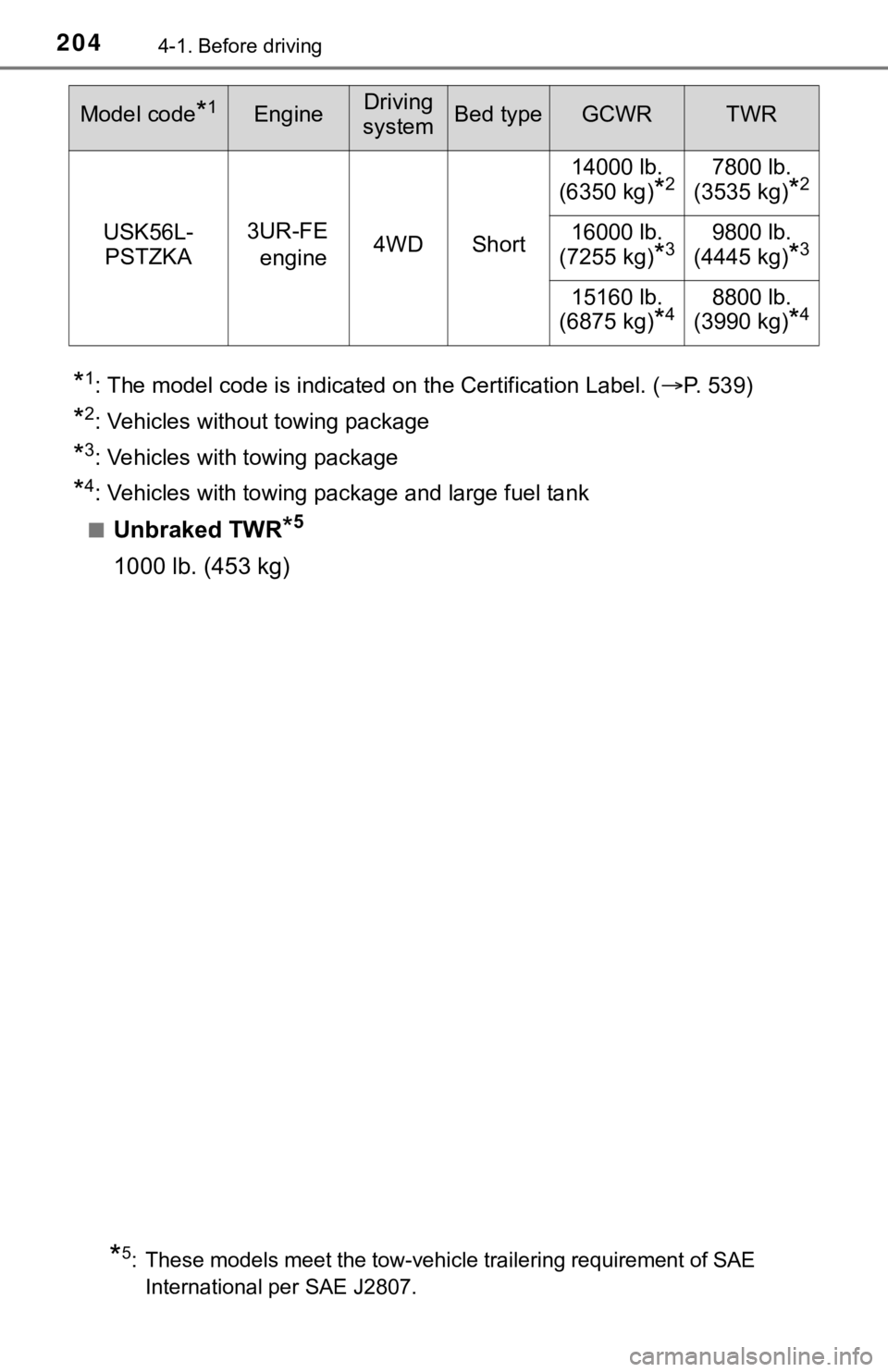
*1: The model code is indicated on the Certification Label. (P. 539)
*2: Vehicles without towing package
*3: Vehicles with towing package
*4: Vehicles with towing package and large fuel tank
■Unbraked TWR*5
1000 lb. (453 kg)
USK56L-
PSTZKA 3UR-FE
engine 4WD Short 14000 lb.
(6350 kg)
*27800 lb.
(3535 kg)
*2
16000 lb.
(7255 kg)
*39800 lb.
(4445 kg)
*3
15160 lb.
(6875 kg)
*48800 lb.
(3990 kg)
*4
*5: These models meet the tow-vehicle trailering requirement of SAE
International per SAE J2807.
Model code*1EngineDriving
systemBed typeGCWRTWR
Page 296 of 608

2964-5. Using the driving support systems
■Cruise control can be set when
●The shift lever is in D or range 4 or higher of S has been sele cted.
● Vehicle speed is above approximately 25 mph (40 km/h).
■ Accelerating after setting the vehicle speed
●The vehicle can be accelerated normally. After acceleration, th e set speed
resumes.
● Even without canceling the cruise control, the set speed can be increased
by first accelerating the vehicle to the desired speed and then pushing the
lever down to set the new speed.
■ Automatic cruise co ntrol cancelation
Cruise control will stop maintaining the vehicle speed in any o f the following
situations.
● Actual vehicle speed falls more than approximately 10 mph (16 k m/h) below
the preset vehicle speed.
At this time, the memorized set speed is not retained.
● Actual vehicle speed is below approximately 25 mph (40 km/h).
● VSC is activated.
● TRAC is activated for a period of time.
● When the VSC or TRAC system is turned off.
● 4WD models: The operation cannot be switched for 5 seconds or m ore after
operating the front-wheel drive control switch.
■ If “Cruise Control Malfunction Vi sit Your Dealer” is displayed on the
multi-information display
Press the “ON-OFF” button once to deactivate the system, and th en press
the button again to reactivate the system.
If the cruise control speed cannot be set or if the cruise cont rol cancels imme-
diately after being activated, there may be a malfunction in th e cruise control
system. Have the vehicle inspected by your Toyota dealer.
Page 318 of 608

3184-5. Using the driving support systems
AUTO LSD system
The system can be used on 2WD models and in 2WD mode on 4WD
models. The system is activated when driving at a speed under
62 mph (100 km/h). The AUTO LSD system will be activated with th e
following two procedures.
Press the briefly to turn on
the system.
The “AUTO LSD” indicator will
come on.
To turn off the system, press
again.
Stop the vehicle completely, and
press for more than 3 sec-
onds.
The “AUTO LSD” and VSC off
indicators will come on.
To turn off the system, press
again.
The AUTO LSD system aids trac tion by using the traction con-
trol system to control engine performance and braking when
one of the drive wheels begins to spin.
The system should be used only when one of the drive wheels
spinning occurs in a ditch or rough surface.
System operation
Page 320 of 608
3204-5. Using the driving support systems
Driving assist systems
◆ABS (Anti-lock Brake System)
Helps to prevent wheel lock when the brakes are applied suddenl y,
or if the brakes are applied while driving on a slippery road surface
◆Brake assist
Generates an increased level of braking force after the brake p edal
is depressed when the system de tects a panic stop situation
◆VSC (Vehicle Stability Control)
Helps the driver to control skidding when swerving suddenly or
turning on slippery road surfaces
◆Trailer Sway Control
Helps the driver to control trailer sway by selectively applying brake
pressure for individual wheels and reducing driving torque when
trailer sway is detected
◆TRAC (Traction Control) for 2WD models and 2WD mode on
4WD models
Helps to maintain drive power and prevent the drive wheels from
spinning when starting the vehicl e or accelerating on slippery roads
◆Hill-start assist control
Helps to reduce the backward movement of the vehicle when start -
ing on an uphill
To keep driving safety and perf ormance, the following systems
operate automatically in respon se to various driving situations.
Be aware, however, that these systems are supplementary and
should not be relied upon too heav ily when operating the vehi-
cle.