towing TOYOTA TUNDRA 2020 Owners Manual (in English)
[x] Cancel search | Manufacturer: TOYOTA, Model Year: 2020, Model line: TUNDRA, Model: TOYOTA TUNDRA 2020Pages: 608, PDF Size: 13.19 MB
Page 3 of 608
3
1
9 8
7 5 4
3
2
6
4-1. Before drivingDriving the vehicle ............. 184
Cargo and luggage............ 192
Vehicle load limits ............. 195
Trailer towing..................... 197
Dinghy towing.................... 216
4-2. Driving procedures Engine (ignition) switch (vehicles without
a smart key system) ........ 217
Engine (ignition) switch (vehicles with a smart
key system) ..................... 219
Automatic transmission ..... 225
Turn signal lever................ 232
Parking brake .................... 233
4-3. Operating the lights and wipers
Headlight switch ................ 234
Automatic High Beam ....... 239
Fog light switch ................. 244
Windshield wipers and washer ............................ 245
4-4. Refueling Opening the fuel tank cap .................................. 248 4-5. Using the driving support
systems
Toyota Safety Sense P ...... 252
PCS (Pre-Collision System) ........................... 259
LDA (Lane Departure Alert) ................................ 272
Dynamic radar cruise control.............................. 280
Cruise control .................... 294
Intuitive parking assist ....... 298
BSM (Blind Spot Monitor)......... 305
Four-wheel drive system ... 315
AUTO LSD system ............ 318
Driving assist systems ....... 320
Trailer brake controller....... 327
4-6. Driving tips Winter driving tips .............. 331
Off-road precautions .......... 335
4Driving
Page 18 of 608
18Pictorial index
■Instrument panel
Front separated type seats
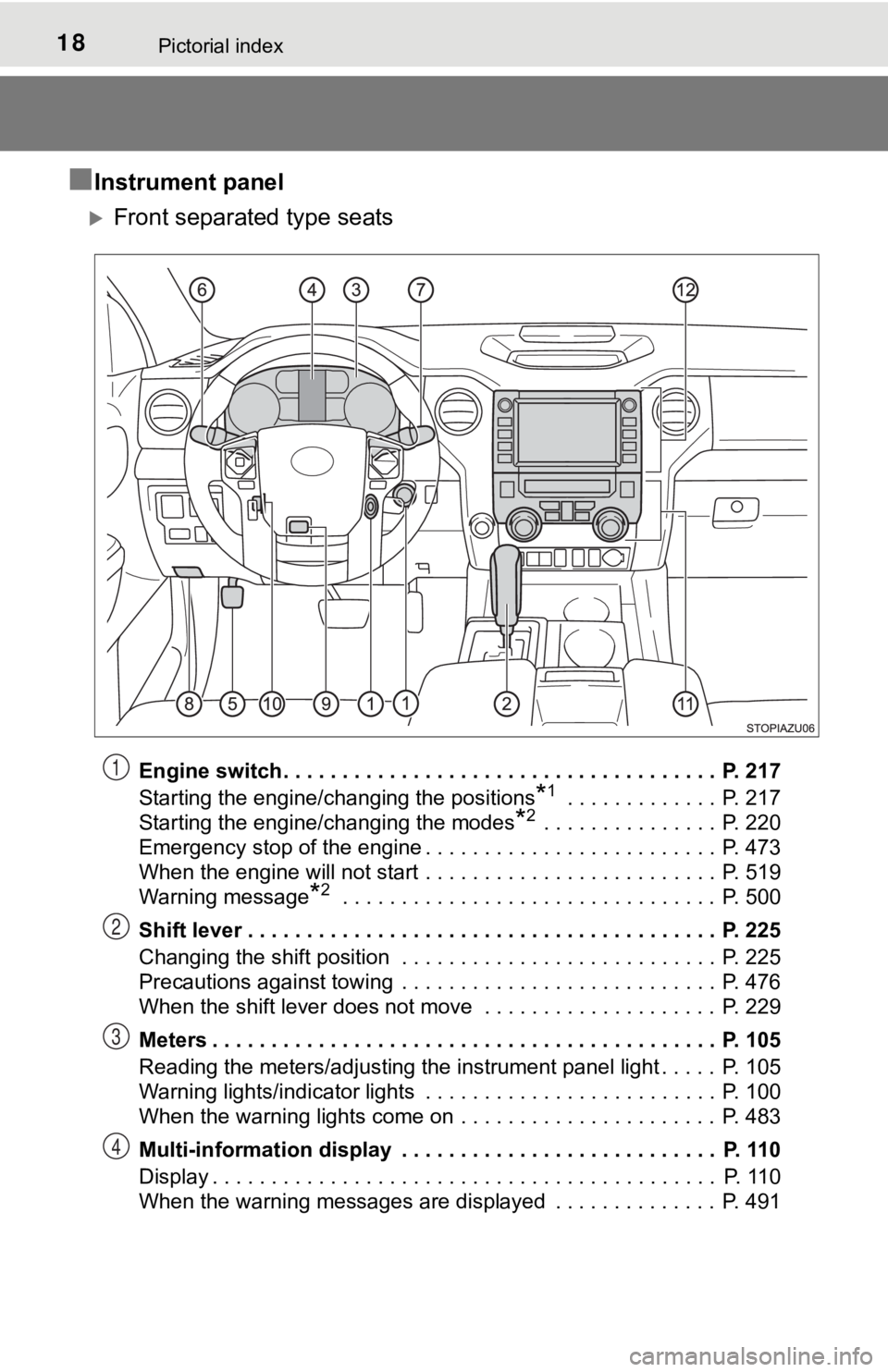
Engine switch . . . . . . . . . . . . . . . . . . . . . . . . . . . . . . . . . . . . . P. 217
Starting the engine/changing the positions
*1 . . . . . . . . . . . . . P. 217
Starting the engine/changing the modes
*2 . . . . . . . . . . . . . . . P. 220
Emergency stop of the engine . . . . . . . . . . . . . . . . . . . . . . . . . P. 473
When the engine will not start . . . . . . . . . . . . . . . . . . . . . . . . . P. 519
Warning message
*2 . . . . . . . . . . . . . . . . . . . . . . . . . . . . . . . . P. 500
Shift lever . . . . . . . . . . . . . . . . . . . . . . . . . . . . . . . . . . . . . . . . P. 225
Changing the shift position . . . . . . . . . . . . . . . . . . . . . . . . . . . P. 225
Precautions against towing . . . . . . . . . . . . . . . . . . . . . . . . . . . P. 476
When the shift lever does not move . . . . . . . . . . . . . . . . . . . . P. 229
Meters . . . . . . . . . . . . . . . . . . . . . . . . . . . . . . . . . . . . . . . . . . . P. 105
Reading the meters/adjusting the instrument panel light . . . . . P. 105
Warning lights/indicator lights . . . . . . . . . . . . . . . . . . . . . . . . . P. 100
When the warning lights come on . . . . . . . . . . . . . . . . . . . . . . P. 483
Multi-information display . . . . . . . . . . . . . . . . . . . . . . . . . . . P. 110
Display . . . . . . . . . . . . . . . . . . . . . . . . . . . . . . . . . . . . . . . . . . . P. 110
When the warning messages are displayed . . . . . . . . . . . . . . P. 491
1
2
3
4
Page 20 of 608
20Pictorial index
Front bench type seat
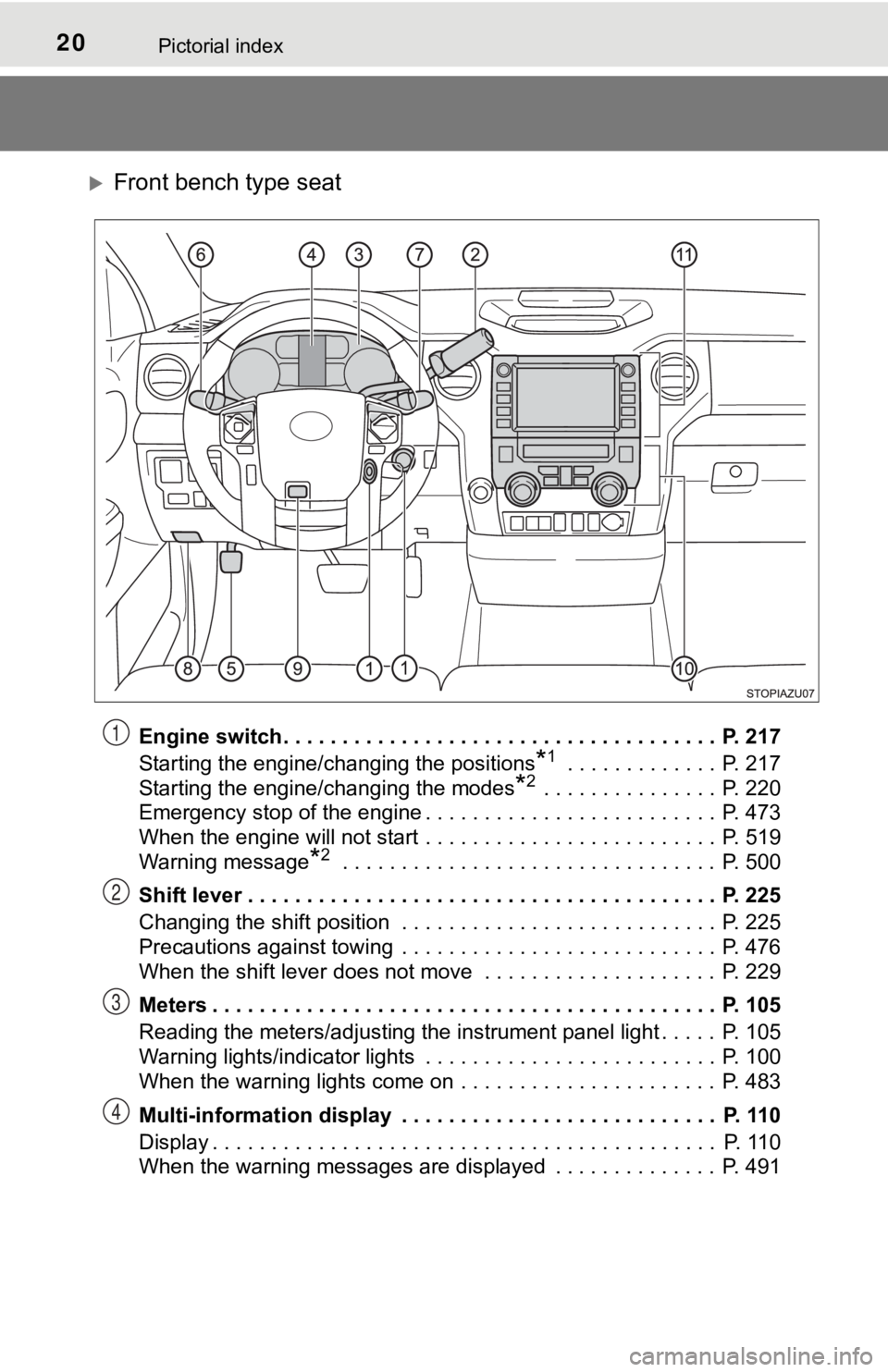
Engine switch . . . . . . . . . . . . . . . . . . . . . . . . . . . . . . . . . . . . . P. 217
Starting the engine/changing the positions
*1 . . . . . . . . . . . . . P. 217
Starting the engine/changing the modes
*2 . . . . . . . . . . . . . . . P. 220
Emergency stop of the engine . . . . . . . . . . . . . . . . . . . . . . . . . P. 473
When the engine will not start . . . . . . . . . . . . . . . . . . . . . . . . . P. 519
Warning message
*2 . . . . . . . . . . . . . . . . . . . . . . . . . . . . . . . . P. 500
Shift lever . . . . . . . . . . . . . . . . . . . . . . . . . . . . . . . . . . . . . . . . P. 225
Changing the shift position . . . . . . . . . . . . . . . . . . . . . . . . . . . P. 225
Precautions against towing . . . . . . . . . . . . . . . . . . . . . . . . . . . P. 476
When the shift lever does not move . . . . . . . . . . . . . . . . . . . . P. 229
Meters . . . . . . . . . . . . . . . . . . . . . . . . . . . . . . . . . . . . . . . . . . . P. 105
Reading the meters/adjusting the instrument panel light . . . . . P. 105
Warning lights/indicator lights . . . . . . . . . . . . . . . . . . . . . . . . . P. 100
When the warning lights come on . . . . . . . . . . . . . . . . . . . . . . P. 483
Multi-information display . . . . . . . . . . . . . . . . . . . . . . . . . . . P. 110
Display . . . . . . . . . . . . . . . . . . . . . . . . . . . . . . . . . . . . . . . . . . . P. 110
When the warning messages are displayed . . . . . . . . . . . . . . P. 491
1
2
3
4
Page 83 of 608
831-2. Emergency assistance
1
For safety and security
■Enhanced Roadside Assistance
Enhanced Roadside Assistance adds GPS data to the already
included warranty-based Toyota roadside service.
Subscribers can press the “SOS” button to reach a Safety Connec t
response-center agent, who can he lp with a wide range of needs,
such as: towing, flat tire, fuel delivery, etc. For a description of the
Enhanced Roadside Assistance se rvices and their limitations,
please see the Safety Connect Te rms and Conditions, which are
available at Toyota.com in the United States, Toyotapr.com in
Puerto Rico and Toyota.ca in Canada.
Important! Read this informatio n before using Safety Connect.
■Exposure to radio frequency signals
The Safety Connect system installed in your vehicle is a low-po wer
radio transmitter and receiver. I t receives and also sends out radio
frequency (RF) signals.
In August 1996, the Federal Communications Commission (FCC)
adopted RF exposure guidelines with safety levels for mobile wi re-
less phones. Those guidelines are consistent with the safety stan-
dards previously set by the following U.S. and international
standards bodies.
● ANSI (American National Stand ards Institute) C95.1 [1992]
● NCRP (National Council on Radi ation Protection and Measure-
ment) Report 86 [1986]
● ICNIRP (International Commission on Non-Ionizing Radiation
Protection) [1996]
Those standards were based on comprehensive and periodic eval-
uations of the relevant scienti fic literature. Over 120 scientists, engi-
neers, and physicians from unive rsities, and government health
agencies and industries reviewed the available body of research to
develop the ANSI Standard (C95.1).
The design of Safety Connect complies with the FCC guidelines i n
addition to those standards.
Safety information for Safety Connect
Page 183 of 608

183
4Driving
4-1. Before drivingDriving the vehicle ............. 184
Cargo and luggage ........... 192
Vehicle load limits ............. 195
Trailer towing..................... 197
Dinghy towing ................... 216
4-2. Driving procedures Engine (ignition) switch(vehicles without
a smart key system) ........ 217
Engine (ignition) switch (vehicles with
a smart key system) ........ 219
Automatic transmission ..... 225
Turn signal lever................ 232
Parking brake .................... 233
4-3. Operating the lights and wipers
Headlight switch ................ 234
Automatic High Beam ....... 239
Fog light switch ................. 244
Windshield wipers and washer ............................ 245
4-4. Refueling Opening the fuel tank cap .................................. 248 4-5. Using the driving support
systems
Toyota Safety Sense P ..... 252
PCS (Pre-Collision System)........................... 259
LDA (Lane Departure Alert) ............................... 272
Dynamic radar cruise control ............................. 280
Cruise control .................... 294
Intuitive parking assist....... 298
BSM (Blind Spot Monitor) ........ 305
Four-wheel drive system ... 315
AUTO LSD system............ 318
Driving assist systems ...... 320
Trailer brake controller ...... 327
4-6. Driving tips Winter driving tips ............. 331
Off-road precautions ......... 335
Page 192 of 608
1924-1. Before driving
Cargo and luggage
Cargo capacity depends on the total weight of the occupants.
(Cargo capacity) = (Total load capacity) (Total weight of occupants)
Steps for Determining Correct Load Limit —
(1) Locate the statement “The co mbined weight of occupants and
cargo should never exceed XXX kg or XXX lbs.” on your vehicle’s
placard.
(2) Determine the combined weight of the driver and passengers t hat
will be riding in your vehicle.
(3) Subtract the combined weight of the driver and passengers fr om
XXX kg or XXX lbs.
(4) The resulting figure equals the available amount of cargo an d lug-
gage load capacity.
For example, if the “XXX” amount equals 1400 lbs. and there wil l be
five 150 lb passengers in your vehicle, the amount of available
cargo and luggage load capacity is 650 lbs. (1400 750 (5150) =
650 lbs.)
(5) Determine the combined weight of luggage and cargo being loa ded
on the vehicle. That weight may n ot safely exceed the available
cargo and luggage load capac ity calculated in Step 4.
(6) If your vehicle will be towing a trailer, load from your tra iler will be
transferred to your vehicle. Consult this manual to determine h ow
this reduces the available cargo and luggage load capacity of y our
vehicle. ( P. 195)
Take notice of the following information about storage precau-
tions, cargo capacity and load:
Capacity and distribution
Page 197 of 608
1974-1. Before driving
4
Driving
Trailer towing
Contact your Toyota dealer for further information about additi onal
requirements such as a towing kit, etc.
Your vehicle is designed primarily as a passenger-and-load-car-
rying vehicle. Towing a trailer can have an adverse impact on
handling, performance, braking, durability, and fuel consump-
tion. For your safety and the safety of others, you must not ov er-
load your vehicle or trailer. You must also ensure that you are
using appropriate towing equipm ent, that the towing equipment
has been installed correctly a nd used properly, and that you
employ the requisite driving habits. (P. 214)
Vehicle-trailer stability and braking performance are affected by
trailer stability, brake performance and setting, trailer brake s,
the hitch and hitch systems (if equipped).
To tow a trailer safely, use extreme care and drive the vehicle in
accordance with your trailer’s characteristics and operating
conditions.
Toyota warranties do not apply to damage or malfunction
caused by towing a trailer for commercial purposes.
Page 198 of 608
1984-1. Before driving
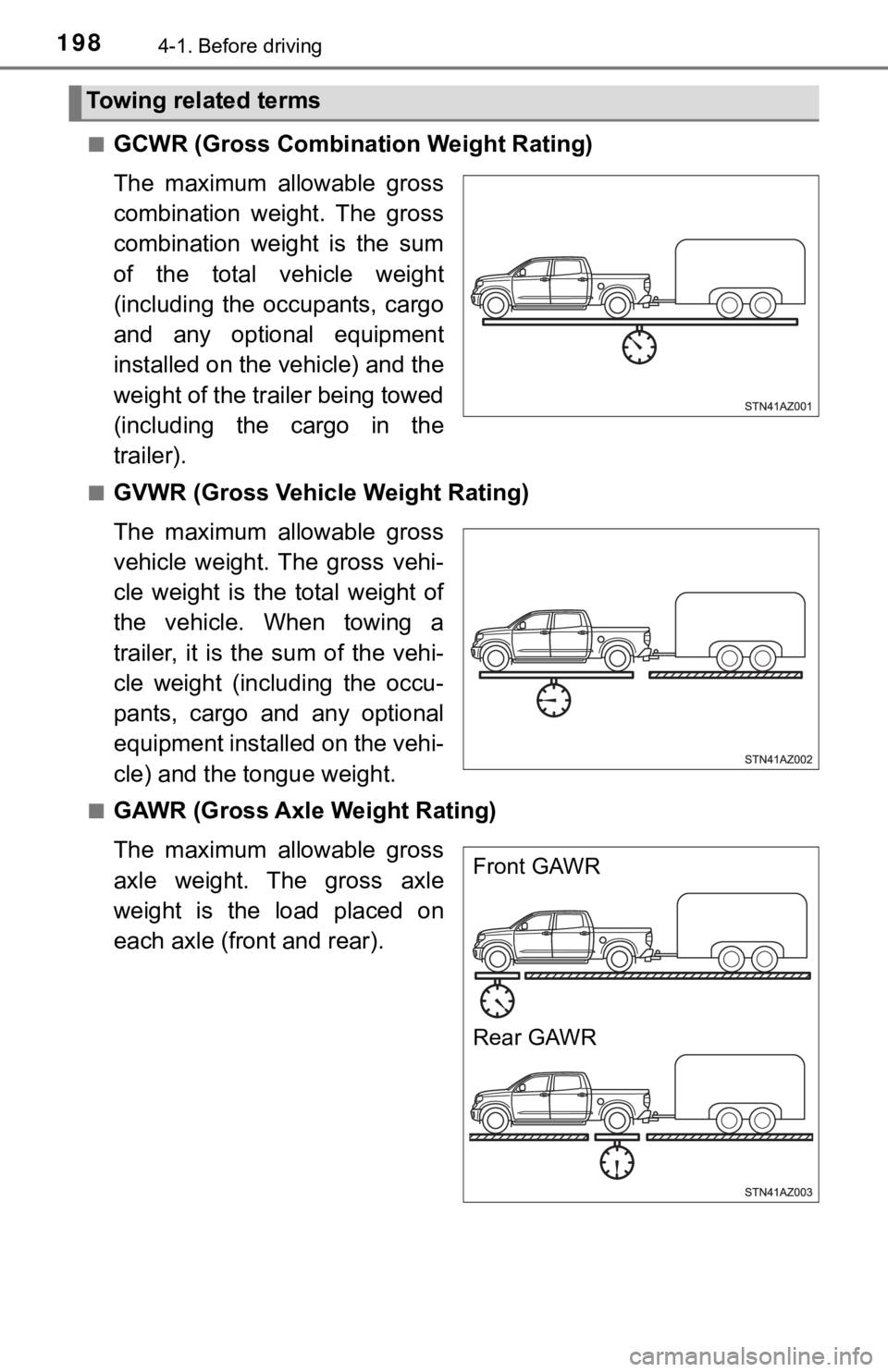
■GCWR (Gross Combination Weight Rating)
The maximum allowable gross
combination weight. The gross
combination weight is the sum
of the total vehicle weight
(including the occupants, cargo
and any optional equipment
installed on the vehicle) and the
weight of the trailer being towed
(including the cargo in the
trailer).
■GVWR (Gross Vehicle Weight Rating)
The maximum allowable gross
vehicle weight. The gross vehi-
cle weight is the total weight of
the vehicle. When towing a
trailer, it is the sum of the vehi-
cle weight (including the occu-
pants, cargo and any optional
equipment installed on the vehi-
cle) and the tongue weight.
■GAWR (Gross Axle Weight Rating)
The maximum allowable gross
axle weight. The gross axle
weight is the load placed on
each axle (front and rear).
Towing related terms
Front GAWR
Rear GAWR
Page 199 of 608
1994-1. Before driving
4
Driving
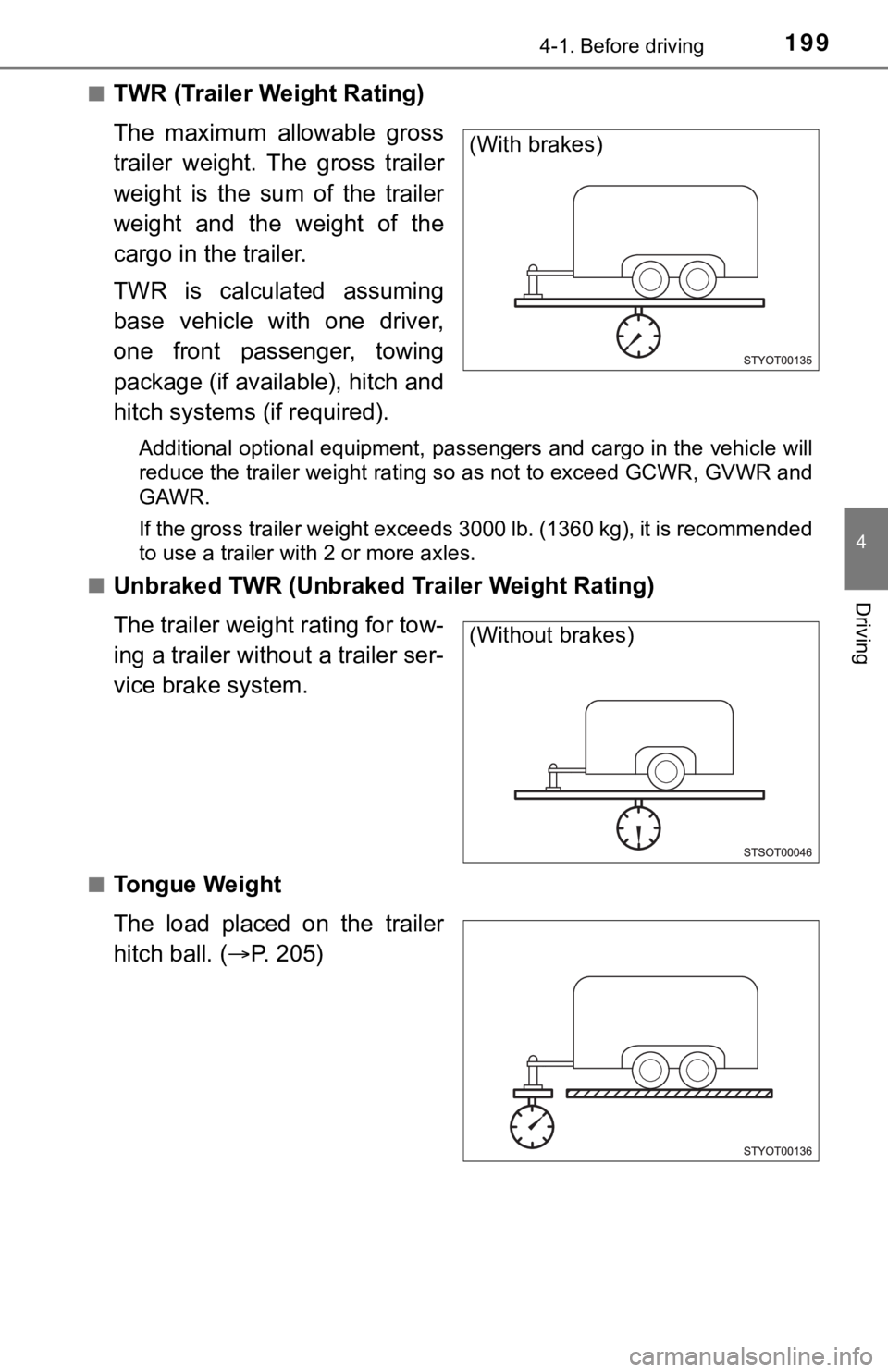
■TWR (Trailer Weight Rating)
The maximum allowable gross
trailer weight. The gross trailer
weight is the sum of the trailer
weight and the weight of the
cargo in the trailer.
TWR is calculated assuming
base vehicle with one driver,
one front passenger, towing
package (if available), hitch and
hitch systems (if required).
Additional optional equipment, passengers and cargo in the vehicle will
reduce the trailer weight rating so as not to exceed GCWR, GVWR and
GAWR.
If the gross trailer weight exceeds 3000 lb. (1360 kg), it is r ecommended
to use a trailer with 2 or more axles.
■
Unbraked TWR (Unbraked Trailer Weight Rating)
The trailer weight rating for tow-
ing a trailer without a trailer ser-
vice brake system.
■Tongue Weight
The load placed on the trailer
hitch ball. ( P. 205)
(With brakes)
(Without brakes)
Page 201 of 608
2014-1. Before driving
4
Driving
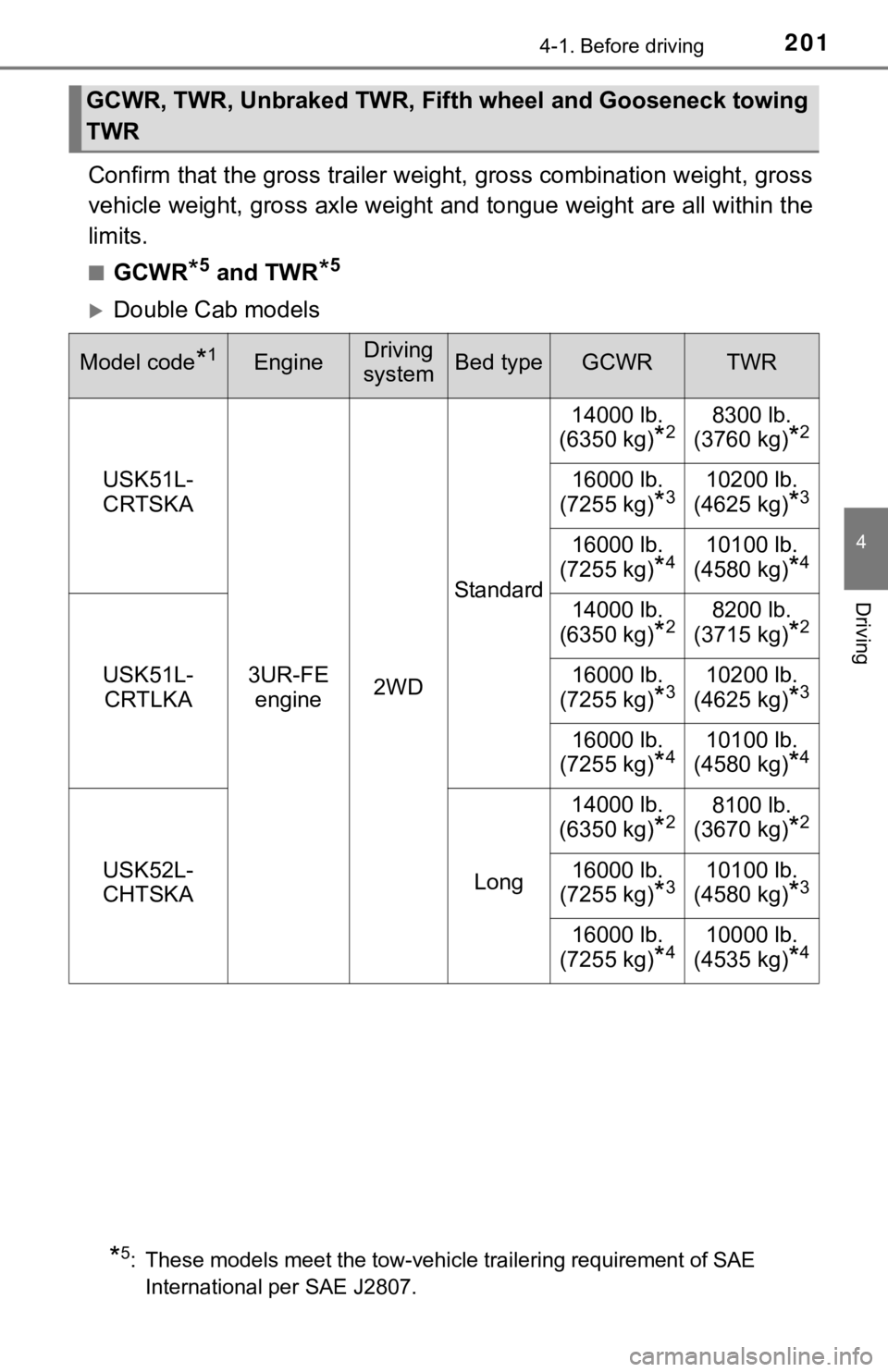
Confirm that the gross trailer weight, gross combination weight, gross
vehicle weight, gross axle weight and tongue weight are all within the
limits.
■GCWR*5 and TWR*5
Double Cab models
GCWR, TWR, Unbraked TWR, Fifth wheel and Gooseneck towing
TWR
*5: These models meet the tow-vehicle trailering requirement of SAE International per SAE J2807.
Model code*1EngineDriving
systemBed typeGCWRTWR
USK51L- CRTSKA
3UR-FE engine 2WDStandard 14000 lb.
(6350 kg)
*28300 lb.
(3760 kg)
*2
16000 lb.
(7255 kg)
*310200 lb.
(4625 kg)
*3
16000 lb.
(7255 kg)
*410100 lb.
(4580 kg)
*4
USK51L- CRTLKA 14000 lb.
(6350 kg)
*28200 lb.
(3715 kg)
*2
16000 lb.
(7255 kg)
*310200 lb.
(4625 kg)
*3
16000 lb.
(7255 kg)
*410100 lb.
(4580 kg)
*4
USK52L-
CHTSKA Long14000 lb.
(6350 kg)
*28100 lb.
(3670 kg)
*2
16000 lb.
(7255 kg)
*310100 lb.
(4580 kg)
*3
16000 lb.
(7255 kg)
*410000 lb.
(4535 kg)
*4