brake light TOYOTA VENZA 2009 Owners Manual (in English)
[x] Cancel search | Manufacturer: TOYOTA, Model Year: 2009, Model line: VENZA, Model: TOYOTA VENZA 2009Pages: 620, PDF Size: 11.43 MB
Page 14 of 620
14
VENZA_U (OM73004U)
Pictorial indexInstrument panel
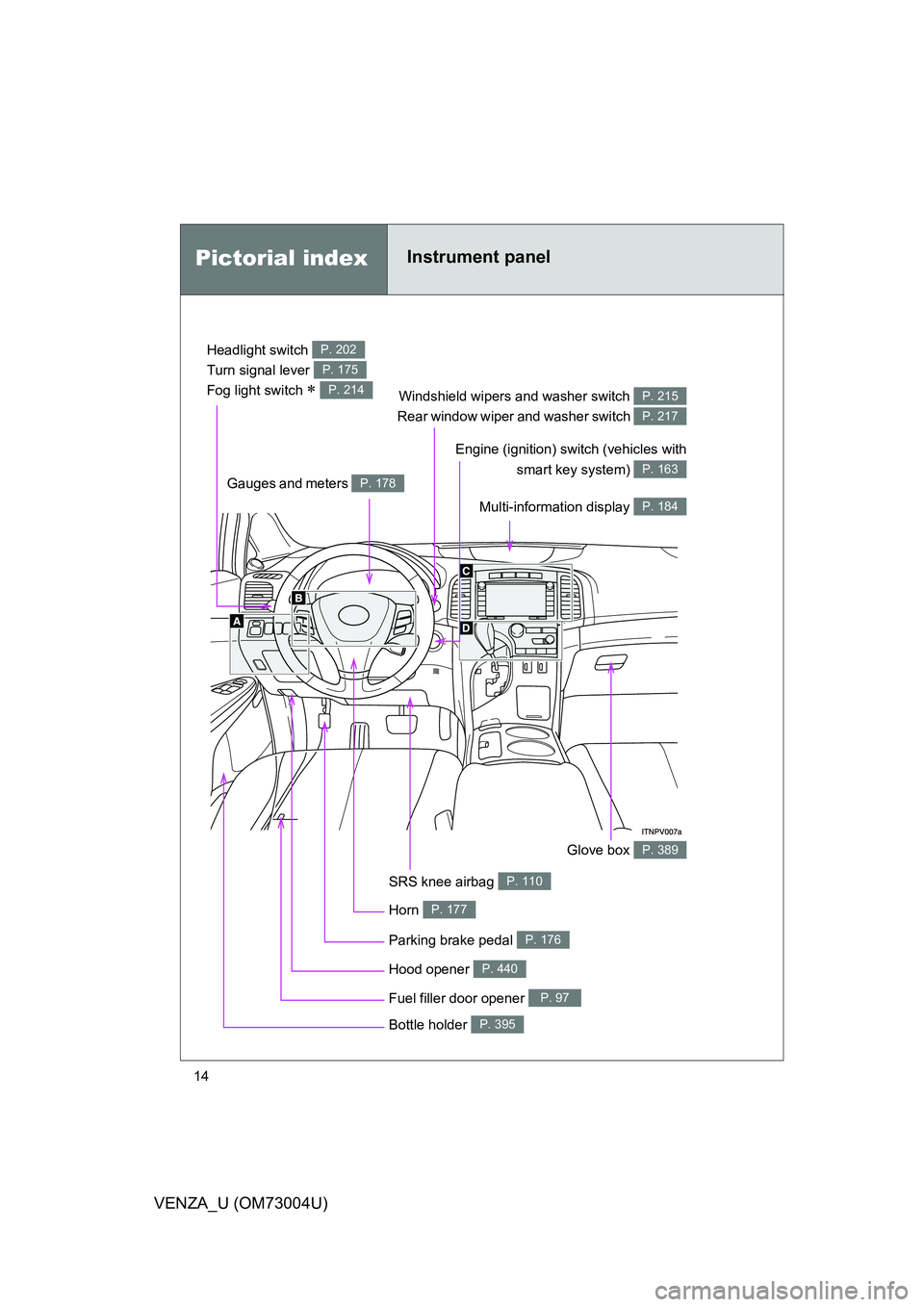
Headlight switch
Turn signal lever
Fog light switch
P. 202
P. 175
P. 214Windshield wipers and washer switch
Rear window wiper and washer switch P. 215
P. 217
Gauges and meters P. 178
Glove box P. 389
Fuel filler door opener P. 97
Hood opener P. 440
SRS knee airbag P. 110
Multi-information display P. 184
Bottle holder P. 395
Parking brake pedal P. 176
Horn P. 177
Engine (ignition) switch (vehicles with smart key system)
P. 163
Page 151 of 620
When driving2
151
VENZA_U (OM73004U)
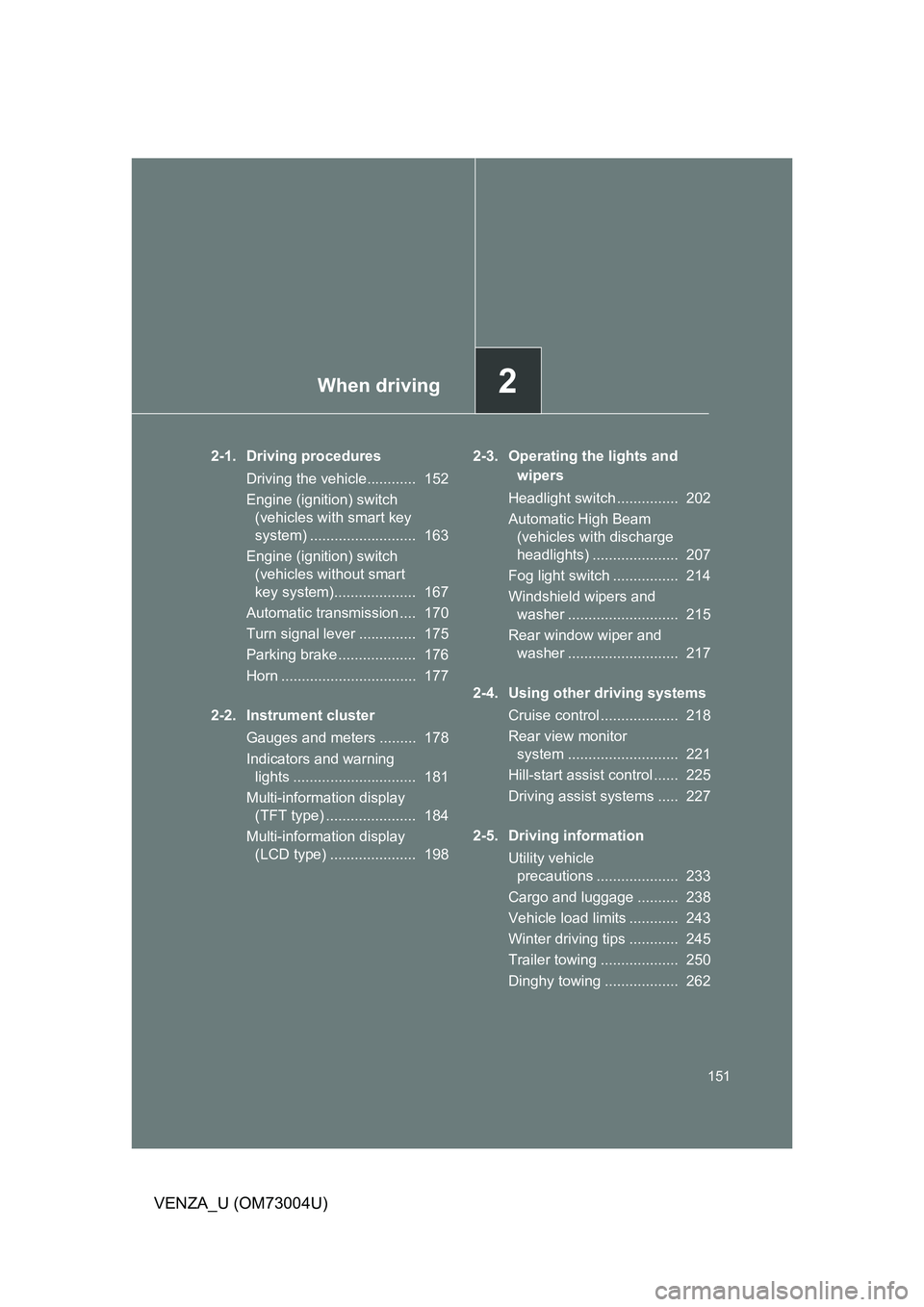
2-1. Driving proceduresDriving the vehicle............ 152
Engine (ignition) switch (vehicles with smart key
system) .......................... 163
Engine (ignition) switch (vehicles without smart
key system).................... 167
Automatic transmission .... 170
Turn signal lever .............. 175
Parking brake ................... 176
Horn ................................. 177
2-2. Instrument cluster Gauges and meters ......... 178
Indicators and warning lights .............................. 181
Multi-information display (TFT type) ...................... 184
Multi-information display (LCD type) ..................... 198 2-3. Operating the lights and
wipers
Headlight switch ............... 202
Automatic High Beam (vehicles with discharge
headlights) ..................... 207
Fog light switch ................ 214
Windshield wipers and washer ........................... 215
Rear window wiper and washer ........................... 217
2-4. Using other driving systems Cruise control ................... 218
Rear view monitor system ........................... 221
Hill-start assist control ...... 225
Driving assist systems ..... 227
2-5. Driving information Utility vehicle precautions .................... 233
Cargo and luggage .......... 238
Vehicle load limits ............ 243
Winter driving tips ............ 245
Trailer towing ................... 250
Dinghy towing .................. 262
Page 155 of 620
155
2-1. Driving procedures
2
When driving
VENZA_U (OM73004U)
CAUTION
■
When starting the vehicle
Always keep your foot on the brake pedal while stopped with the engine run-
ning. This prevents the vehicle from creeping.
■ When driving the vehicle
● Do not drive if you are unfamiliar with the location of the brake and accel-
erator pedals to avoid depressing the wrong pedal.
• Accidentally depressing the accelerator pedal instead of the brake
pedal will result in sudden acceleration that may lead to an accident
that could result in death or serious injury.
• When backing up, you may twist your body around, leading to a diffi- culty in operating the pedals. Make sure to operate the pedals properly.
• Make sure to keep a correct driving posture even when moving the vehicle only slightly, allowing you to depress the brake and accelerator
pedals properly.
• Depress the brake pedal using your right foot. Depressing the brake pedal using your left foot may delay response in an emergency, result-
ing in an accident.
● Do not drive the vehicle over or st op the vehicle near flammable materials.
The exhaust system and exhaust gases can be extremely hot. This may
cause a fire if there is any flammable material nearby.
● Do not let the vehicle roll backwards while the shift lever is in a driving
position, or roll forward while the shift lever is in “R”.
Doing so may result in an accident or damage to the vehicle.
● If the smell of exhaust is noticed inside the vehicle, open the windows and
check that the back door is closed. Large amounts of exhaust in the vehi-
cle can cause driver drowsiness and an accident, resulting in death or a
serious health hazard. Have the vehicle inspected by your Toyota dealer
immediately.
Page 157 of 620
157
2-1. Driving procedures
2
When driving
VENZA_U (OM73004U)
CAUTION
■
When driving on slippery road surfaces
● Sudden braking, acceleration and steering may cause tire slippage and
reduce your ability to control the vehicle, resulting in an accident.
● Sudden changes in engine speed, such as engine braking caused by up-
shifting or down-shifting, may cause the vehicle to skid, resulting in an
accident.
● After driving through a puddle, lightly depress the brake pedal to make
sure that the brakes are functioning properly. Wet brake pads may prevent
the brakes from functioning properly. If the brakes on only one side are wet
and not functioning properly, steering control may be affected, resulting in
an accident.
■ When shifting the shift lever
Be careful not to shift the shift lever with the accelerator pedal depressed.
This may lead to unexpected rapid acceleration of the vehicle that may
cause an accident and result in death or serious injury.
■ When the vehicle is stopped
● Do not race the engine.
If the vehicle is in any gear other than “P” or “N”, the vehicle may acceler-
ate suddenly and unexpectedly, and may cause an accident.
● Do not leave the vehicle with the engine running for a long time.
If such a situation cannot be avoided, park the vehicle in an open space
and check that exhaust fumes do not enter the vehicle interior.
● Always keep a foot on the brake pedal while the engine is running to pre-
vent an accident caused by the vehicle moving.
Page 158 of 620
158 2-1. Driving procedures
VENZA_U (OM73004U)
CAUTION
■When the vehicle is parked
● Do not leave glasses, cigarette lighters, spray cans, or soft drink cans in
the vehicle when it is in the sun.
Doing so may result in the following:
• Gas may leak from a cigarette lighter or spray can, and may lead to a
fire.
• The temperature inside the vehicle may cause the plastic lenses and plastic material of eye glasses to deform or crack.
• Soft drink cans may fracture, causing the contents to spray over the interior of the vehicle, and may also cause a short circuit in the vehi-
cle’s electrical components.
● Always apply the parking brake, shift the shift lever to “P”, stop the engine
and lock the vehicle.
Do not leave the vehicle unattended while the engine is running.
● Do not touch the exhaust pipe while the engine is running or immediately
after turning the engine off.
Doing so may cause burns.
● Do not leave the engine running in an area with snow build-up, or where it
is snowing. If snowbanks build up around the vehicle while the engine is
running, exhaust gases may collect and enter the vehicle. This may lead
to death or a serious health hazard.
Page 204 of 620
204 2-3. Operating the lights and wipers
VENZA_U (OM73004U)
■Daytime running light system
To make your vehicle more visible to other drivers, the headlights turn on
automatically (at a reduced intensity) whenever the engine is started and the
parking brake is released. Daytime running lights are not designed for use at
night.
Vehicles for U.S.A.: Daytime running lights can be turned off by operating
the switch.
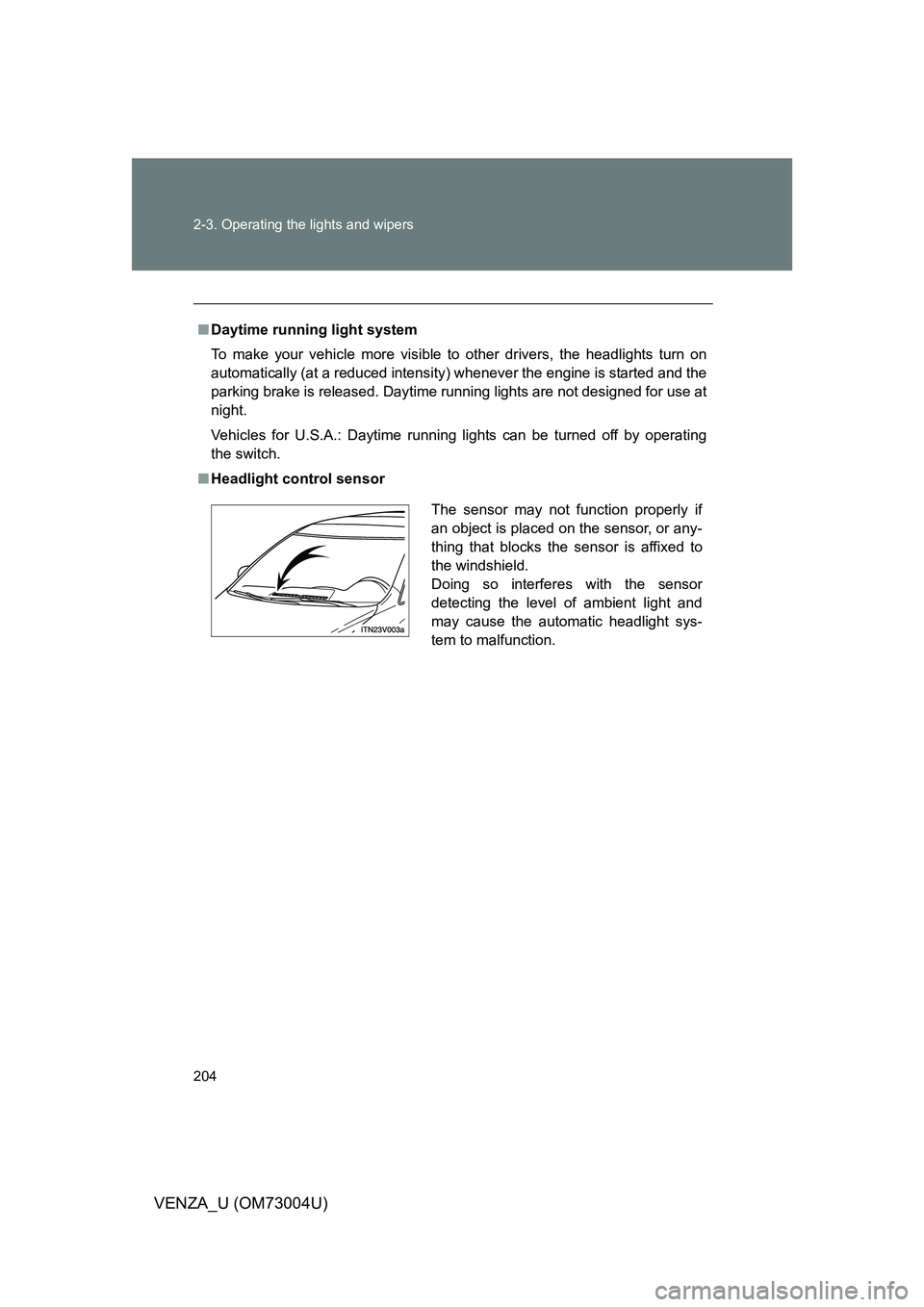
■ Headlight control sensor
The sensor may not function properly if
an object is placed on the sensor, or any-
thing that blocks the sensor is affixed to
the windshield.
Doing so interferes with the sensor
detecting the level of ambient light and
may cause the automatic headlight sys-
tem to malfunction.
Page 219 of 620
219 2-4. Using other driving systems
VENZA_U (OM73005U)
■Cruise control can be set when
● The shift lever is in the “D” or “4”, “5” or “6” range of “S”.
● Vehicle speed is more than approximately 25 mph (40 km/h).
■ Accelerating
The vehicle can be accelerated normally. After acceleration, the set speed
resumes.
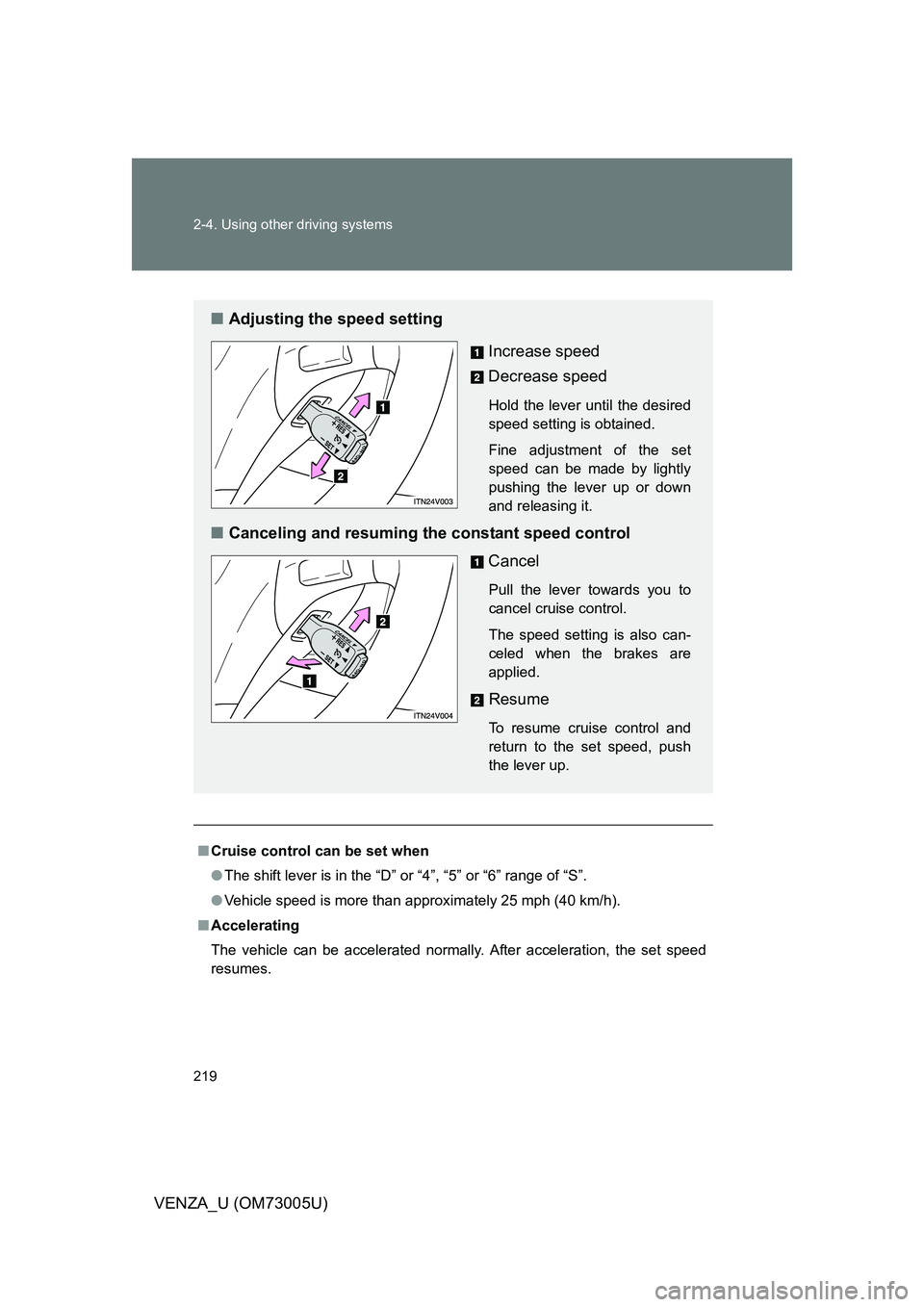
■ Adjusting the speed setting
Increase speed
Decrease speed
Hold the lever until the desired
speed setting is obtained.
Fine adjustment of the set
speed can be made by lightly
pushing the lever up or down
and releasing it.
■Canceling and resuming the constant speed control
Cancel
Pull the lever towards you to
cancel cruise control.
The speed setting is also can-
celed when the brakes are
applied.
Resume
To resume cruise control and
return to the set speed, push
the lever up.
Page 225 of 620
225
2-4. Using other driving systems
VENZA_U (OM73005U)
Hill-start assist control
■Hill-start assist control operating conditions
The system operates in the following situations:
• The shift lever is in a position other than “P”.
• The parking brake is not applied.
• The accelerator pedal is not depressed.
■ Hill-start assist control
● While hill-start assist control is operating, the brakes remain automati-
cally applied after the driver releases the brake pedal. The stop lights and
the high mounted stoplight turn on.
● Hill-start assist control operates for about 2 seconds after the brake pedal
is released.
● If the slip indicator does not flash and the buzzer does not sound when
the brake pedal is further depressed, slightly reduce the pressure on the
brake pedal (do not allow the vehicl e to roll backward) and then firmly
depress it again. If the system still does not operate, check that the oper-
ating conditions explained above have been met.
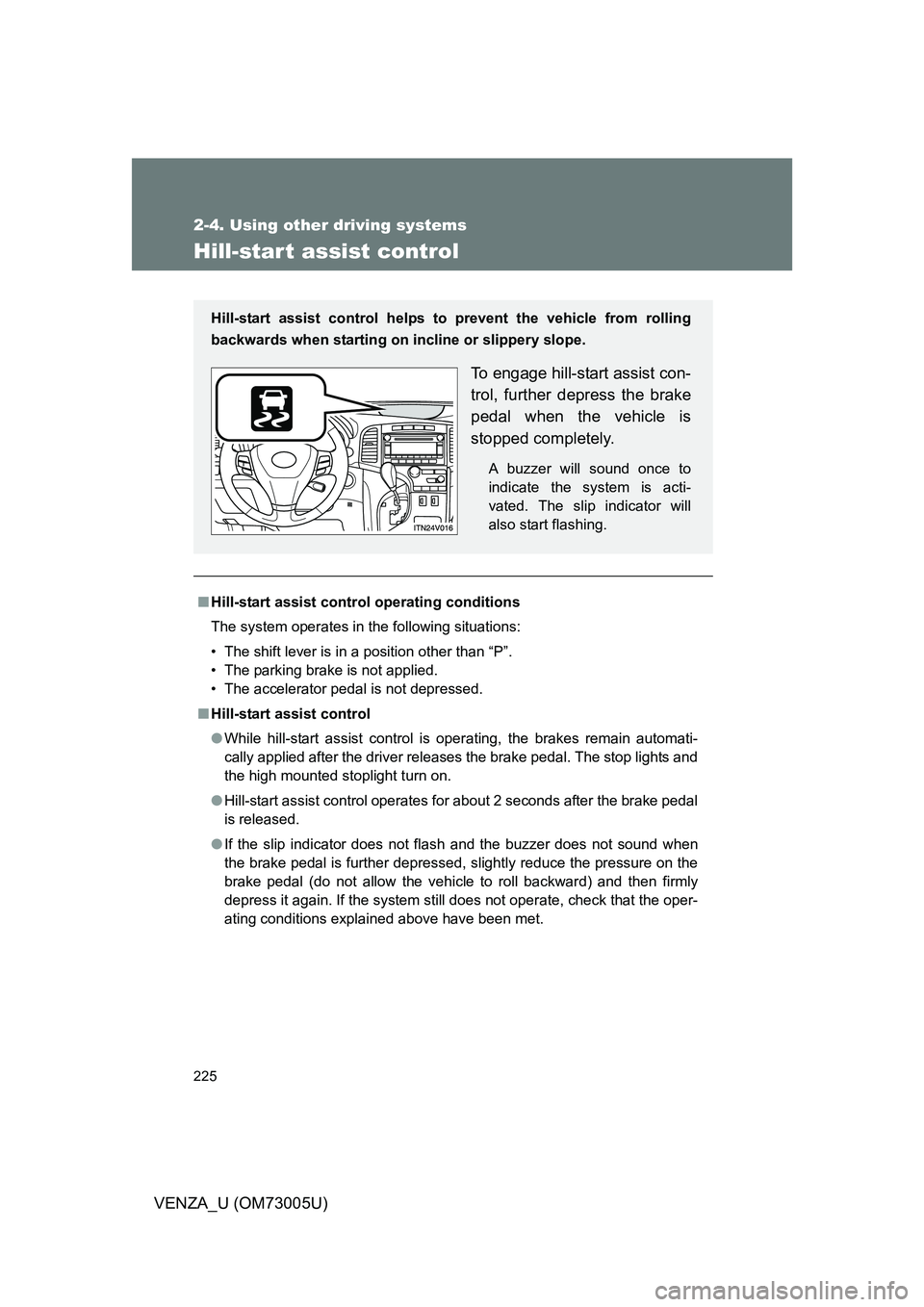
Hill-start assist control helps to prevent the vehicle from rolling
backwards when starting on incline or slippery slope.
To engage hill-start assist con-
trol, further depress the brake
pedal when the vehicle is
stopped completely.
A buzzer will sound once to
indicate the system is acti-
vated. The slip indicator will
also start flashing.
Page 230 of 620
230
2-4. Using other
driving systems
2
When driving
VENZA_U (OM73005U)
■Automatic reactivation of TRAC and VSC
Vehicles with smart key system
Turning the “ENGINE START STOP” switch off after turning off the TRAC
and VSC will automatically re-enable them.
Vehicles without smart key system
Turning the engine switch to the “LOCK” position after turning off the
TRAC and VSC will automatically re-enable them.
■ Automatic TRAC reactivation
If only the TRAC is turned off, the TRAC will turn on when vehicle speed
increases.
■ Automatic TRAC and VSC reactivation
If the TRAC and VSC are turned off, the systems will not turn on even when
vehicle speed increases.
■ Sounds and vibrations caused by the ABS, brake assist, TRAC and
VSC
● A sound may be heard from the engine compartment when the engine is
started or just after the vehicle begins to move. This sound does not indi-
cate that a malfunction has occurred in any of these systems.
● Any of the following conditions may occur when the above systems are
operating. None of these indicates that a malfunction has occurred.
• Vibrations may be felt through the vehicle body and steering.
• A motor sound may be heard after the vehicle comes to a stop.
• The brake pedal may pulsate slightly after the ABS is activated.
• The brake pedal may move down slightly after the ABS is activated.
Page 260 of 620
260 2-5. Driving information
VENZA_U (OM73004U)
CAUTION
■To avoid accident or injury
● Do not exceed the trailer hitch assembly weight, gross vehicle weight,
gross axle weight and trailer tongue load capacities.
● Never load more weight in the back than in the front of the trailer. About
60% of the load should be in the front half of the trailer, and the remaining
40% in the rear.
● Do not exceed 45 mph (72 km/h) or the posted towing speed limit, which-
ever is lower. As instability (swaying) of the towing vehicle-trailer combina-
tion increases as speed increases, exceeding 45 mph (72 km/h) may
cause loss of control.
● Do not use cruise control when you are towing.
● Slow down and downshift before descending steep or long downhill
grades. Do not make sudden downshifts.
● Avoid holding the brake pedal down too long or applying the brakes too
frequently. This could cause the brakes to overheat and result in reduced
braking efficiency.
● Do not tow the vehicle with the compact spare tire installed.
■ Hitches
● If you wish to install a trailer hitch, contact your Toyota dealer.
● Use only a hitch that conforms to the gross trailer weight requirement.
● Follow the directions supplied by the hitch manufacturer.
● Lubricate the hitch ball with a light coat of grease.
● Remove the trailer hitch whenever you are not towing a trailer. After
removing the hitch, seal any mounting hole in the vehicle body to prevent
entry of any substances into the vehicle.