load capacity TOYOTA VENZA 2009 Owners Manual (in English)
[x] Cancel search | Manufacturer: TOYOTA, Model Year: 2009, Model line: VENZA, Model: TOYOTA VENZA 2009Pages: 620, PDF Size: 11.43 MB
Page 232 of 620
232
2-4. Using other
driving systems
2
When driving
VENZA_U (OM73005U)
CAUTION
■When TRAC and VSC are off
Be especially careful and drive at a speed appropriate to the road condi-
tions. As there are systems to ensure vehicle stability and driving force, do
not turn off TRAC and VSC unless necessary.
■ When the VSC is activated
The slip indicator light flashes and a warning buzzer sounds. Always drive
carefully.
Reckless driving may cause an accident. Exercise particular care when the
indicator light flashes and a buzzer sounds.
■ Replacing tires
Make sure that all tires are of the same size, brand, tread pattern and total
load capacity. In addition, make sure that the tires are inflated to the speci-
fied tire pressure level.
The ABS and VSC will not function correctly if different tires are fitted on the
vehicle.
Contact your Toyota dealer for further information when replacing tires or
wheels.
■ Handling of tires and suspension
Using tires with any kind of problem or modifying the suspension will affect
the driving assist systems, and may cause the system to malfunction.
■ Active Torque Control 4WD system
● The AWD system of this vehicle is intended to ensure driving stability on
normal roads. It is not designed for use in demanding situations such as
rally driving.
● Take care when driving on slippery road surfaces.
Page 238 of 620
238
2-5. Driving information
VENZA_U (OM73004U)
Cargo and luggage
Take notice of the following information about storage precau-
tions, cargo capacity and load.
●Stow cargo and luggage in the luggage compartment when-
ever possible. Be sure all items are secured in place.
● Be careful to keep the vehicle le vel. Placing the weight as far
forward as possible helps maintain vehicle balance.
● For better fuel economy, do no t carry unnecessary weight.
Page 239 of 620
239
2-5. Driving information
2
When driving
VENZA_U (OM73004U)
Capacity and distribution
Cargo capacity depends on the total weight of the occupants.
(Cargo capacity) = (Total load capa city) — (Total weight of occupants)
Steps for Determining Correct Load Limit—
(1) Locate the statement “The co mbined weight of occupants and
cargo should never exceed XXX kg or XXX lbs.” on your vehi-
cle’s placard.
(2) Determine the combined weight of the driver and passengers that will be riding in your vehicle.
(3) Subtract the combined weight of the driver and passengers from
XXX kg or XXX lbs.
(4) The resulting figure equals the available amount of cargo and luggage load capacity.
For example, if the “XXX” amount equals 1400 lbs. and there will
be five 150 lb passengers in your vehicle, the amount of avail-
able cargo and luggage load capacity is 650 lbs. (1400 - 750 (5
150) = 650 lbs.)
(5) Determine the combined weight of luggage and cargo being loaded on the vehicle.
That weight may not safely ex ceed the available cargo and lug-
gage load capacity calculated in Step 4.
(6) If your vehicle will be towing a tr ailer, load from your trailer will
be transferred to your vehicle. Consult this manual to determine
how this reduces the available cargo and luggage load capacity
of your vehicle. ( P. 243)
Page 240 of 620
240 2-5. Driving information
VENZA_U (OM73004U)
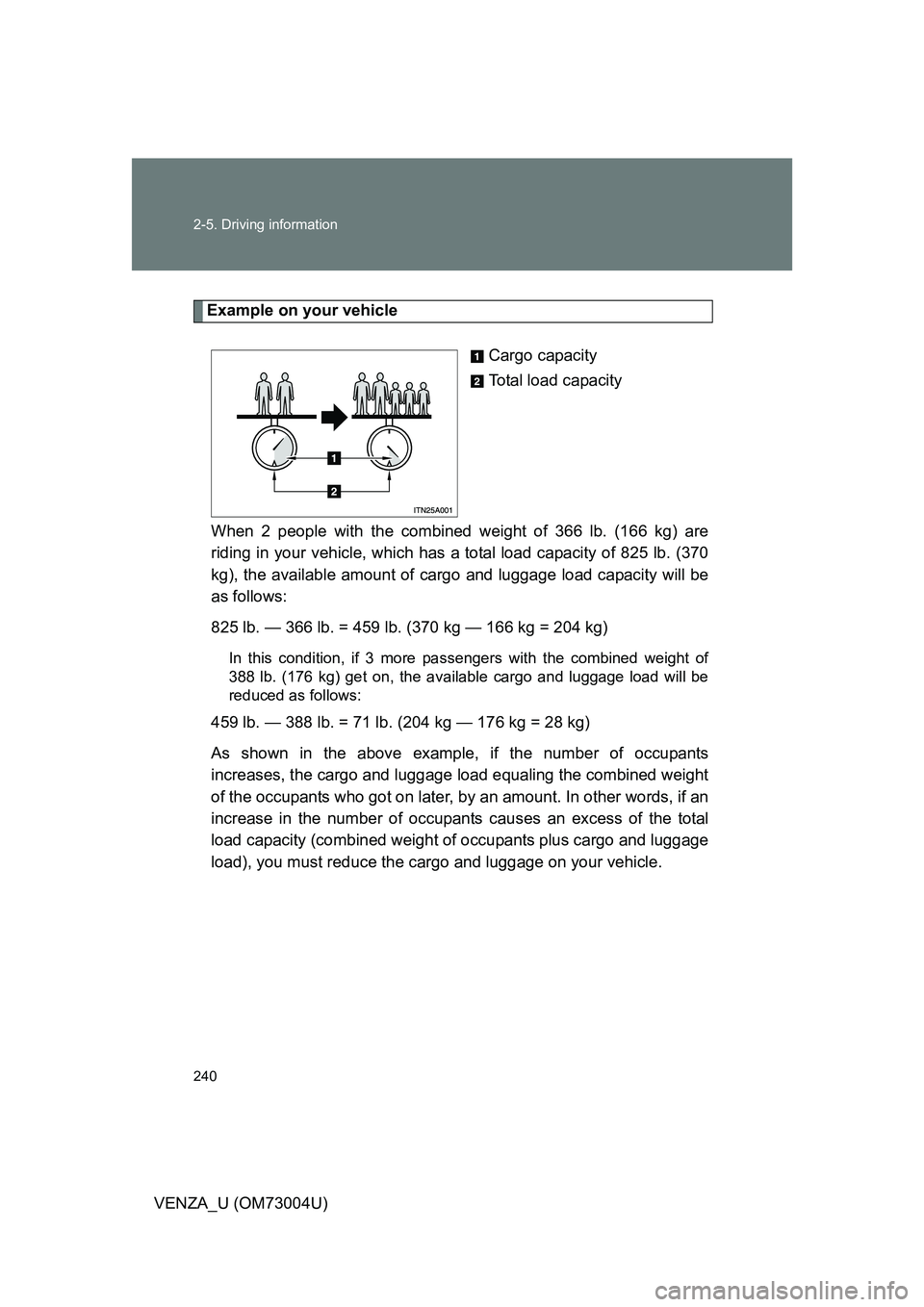
Example on your vehicleCargo capacity
Total load capacity
When 2 people with the combined weight of 366 lb. (166 kg) are
riding in your vehicle, which has a total load capacity of 825 lb. (370
kg), the available amount of cargo and luggage load capacity will be
as follows:
825 lb. — 366 lb. = 459 lb. (370 kg — 166 kg = 204 kg)
In this condition, if 3 more pa ssengers with the combined weight of
388 lb. (176 kg) get on , the available cargo and luggage load will be
reduced as follows:
459 lb. — 388 lb. = 71 lb. (204 kg — 176 kg = 28 kg)
As shown in the above example, if the number of occupants
increases, the cargo and luggage load equaling the combined weight
of the occupants who got on later, by an amount. In other words, if an
increase in the number of occupants causes an excess of the total
load capacity (combined weight of occupants plus cargo and luggage
load), you must reduce the ca rgo and luggage on your vehicle.
Page 242 of 620
242 2-5. Driving information
VENZA_U (OM73004U)
CAUTION
■Weight of the load
●Do not exceed the maximum axle weight rating or the total vehicle
weight rating.
●Even if the total load of occupant’s weight and the cargo load is less
than the total load capacity, do not apply the load unevenly. Improper
loading may cause deterioration of steering or braking control which
may cause death or serious injury.
Page 243 of 620
243
2-5. Driving information
2
When driving
VENZA_U (OM73004U)
Vehicle load limits
Vehicle load limits include total load capacity, seating capacity,
towing capacity and cargo capacity.
■Total load capacity: 825 lb. (370 kg)
Total load capacity means the combined weight of occupants,
cargo and luggage.
■ Seating capacity: 5 occupants (Front 2, Rear 3)
Seating capacity means the ma ximum number of occupants
whose estimated average weight is 150 lb. (68 kg) per person.
Even if the number of occupants is within the seating capacity,
do not exceed the total load capacity.
■ Towing capacity
With towing package:
2GR-FE engine
3500 lb. (1585 kg)
1AR-FE engine
2500 lb. (1130 kg)
Without towing package: 1000 lb. (450 kg)
Towing capacity means the maximum gross trailer weight (trailer
weight plus its cargo weight) that your vehicle is able to tow.
■ Cargo capacity
Cargo capacity may increase or decrease depending on the
weight and the number of occupants.
Page 244 of 620
244 2-5. Driving information
VENZA_U (OM73004U)
■Total load capacity and seating capacity
These details are also described on the tire and loading information
label. (P. 468)
CAUTION
■Overloading the vehicle
Do not overload the vehicle.
It may not only cause damage to the ti res, but also degrade steering and
braking ability, resulting in an accident.
Page 251 of 620
251
2-5. Driving information
2
When driving
VENZA_U (OM73004U)
Weight limits
Confirm that the gross trailer weig ht, gross vehicle weight, gross axle
weight and trailer tongue load are all within the limits.
● The gross trailer weight must never exceed towing capacity
described below.
With towing package:
2GR-FE engine
3500 lb. (1585 kg)
1AR-FE engine
2500 lb. (1130 kg)
Without towing package: 1000 lb. (450 kg)
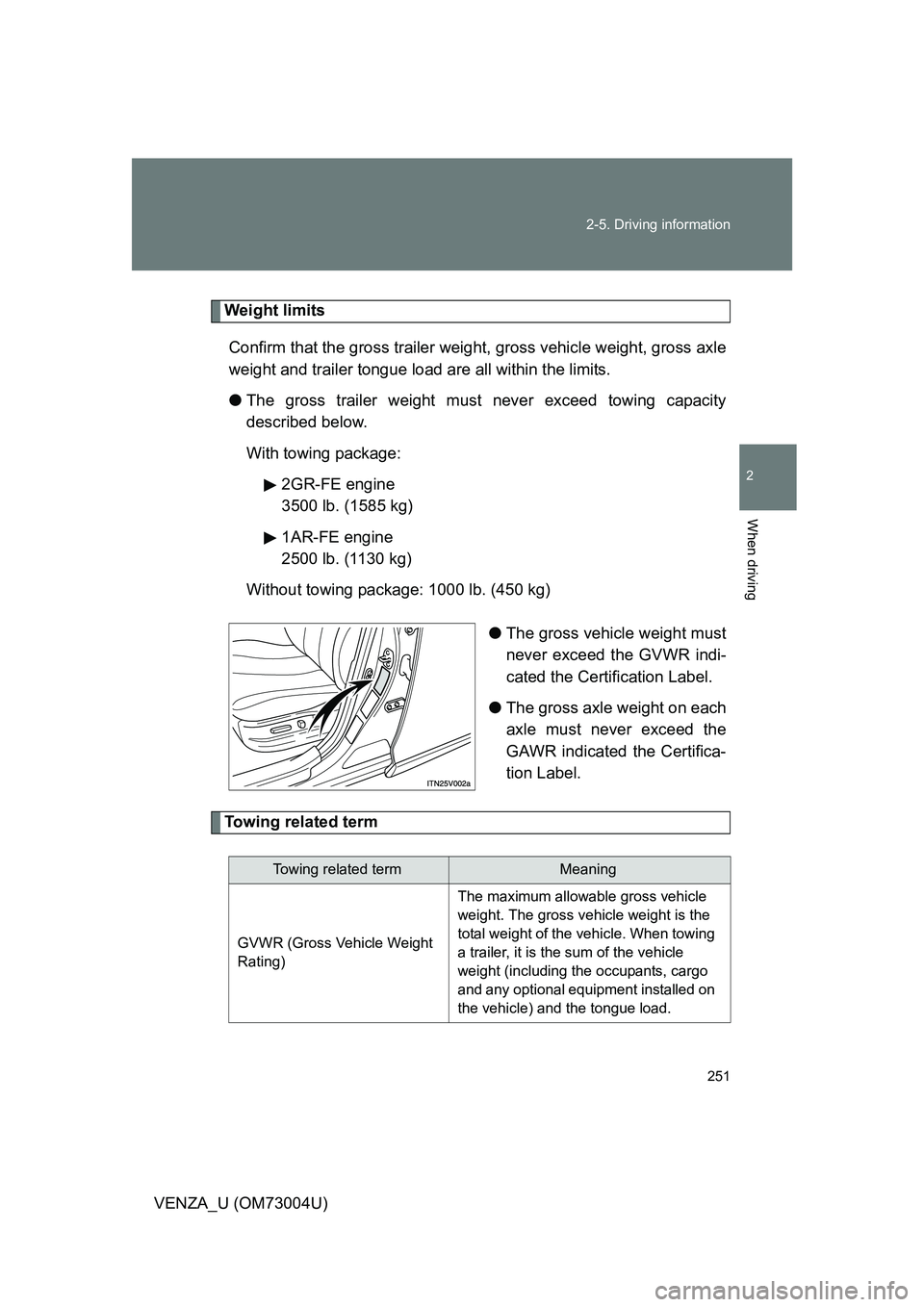
●The gross vehicle weight must
never exceed the GVWR indi-
cated the Certification Label.
● The gross axle weight on each
axle must never exceed the
GAWR indicated the Certifica-
tion Label.
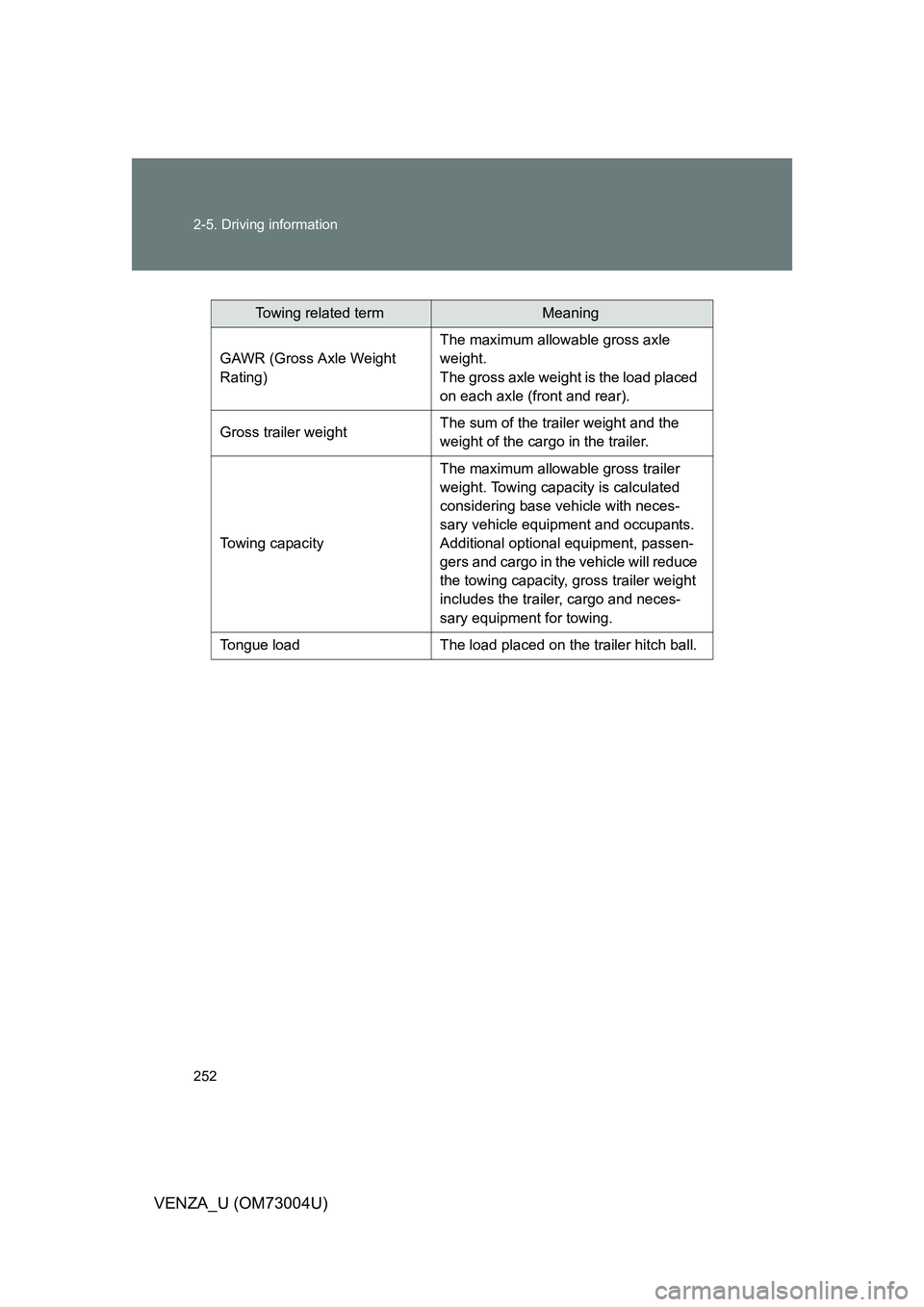
Towing related term
Towing related termMeaning
GVWR (Gross Vehicle Weight
Rating) The maximum allowable gross vehicle
weight. The gross vehicle weight is the
total weight of the vehicle. When towing
a trailer, it is the sum of the vehicle
weight (including the occupants, cargo
and any optional equipment installed on
the vehicle) and the tongue load.
Page 252 of 620
252 2-5. Driving information
VENZA_U (OM73004U)
Towing related termMeaning
GAWR (Gross Axle Weight
Rating) The maximum allowable gross axle
weight.
The gross axle weight is the load placed
on each axle (front and rear).
Gross trailer weight The sum of the trailer weight and the
weight of the cargo in the trailer.
Towing capacity The maximum allowable gross trailer
weight. Towing capacity is calculated
considering base vehicle with neces-
sary vehicle equipment and occupants.
Additional optional equipment, passen-
gers and cargo in the vehicle will reduce
the towing capacity, gross trailer weight
includes the trailer, cargo and neces-
sary equipment for towing.
Tongue load The load placed on the trailer hitch ball.
Page 253 of 620
253
2-5. Driving information
2
When driving
VENZA_U (OM73004U)
Trailer tongue load
● A recommended tongue load varies in accordance with the types
of trailers or towing as described below.
● In order to ensure the recommended values shown below, the
trailer must be loaded by referring to the following instructions.
The trailer cargo load should be di stributed so that the tongue load
is 9 to 11 % of the gross trailer weight.
(Tongue load / Gross trailer weight 100 = 9 to 11 %)
If the gross trailer weight is over 2000 lbs. (900 kg), it is necessary
to use a sway control device with sufficient capacity.
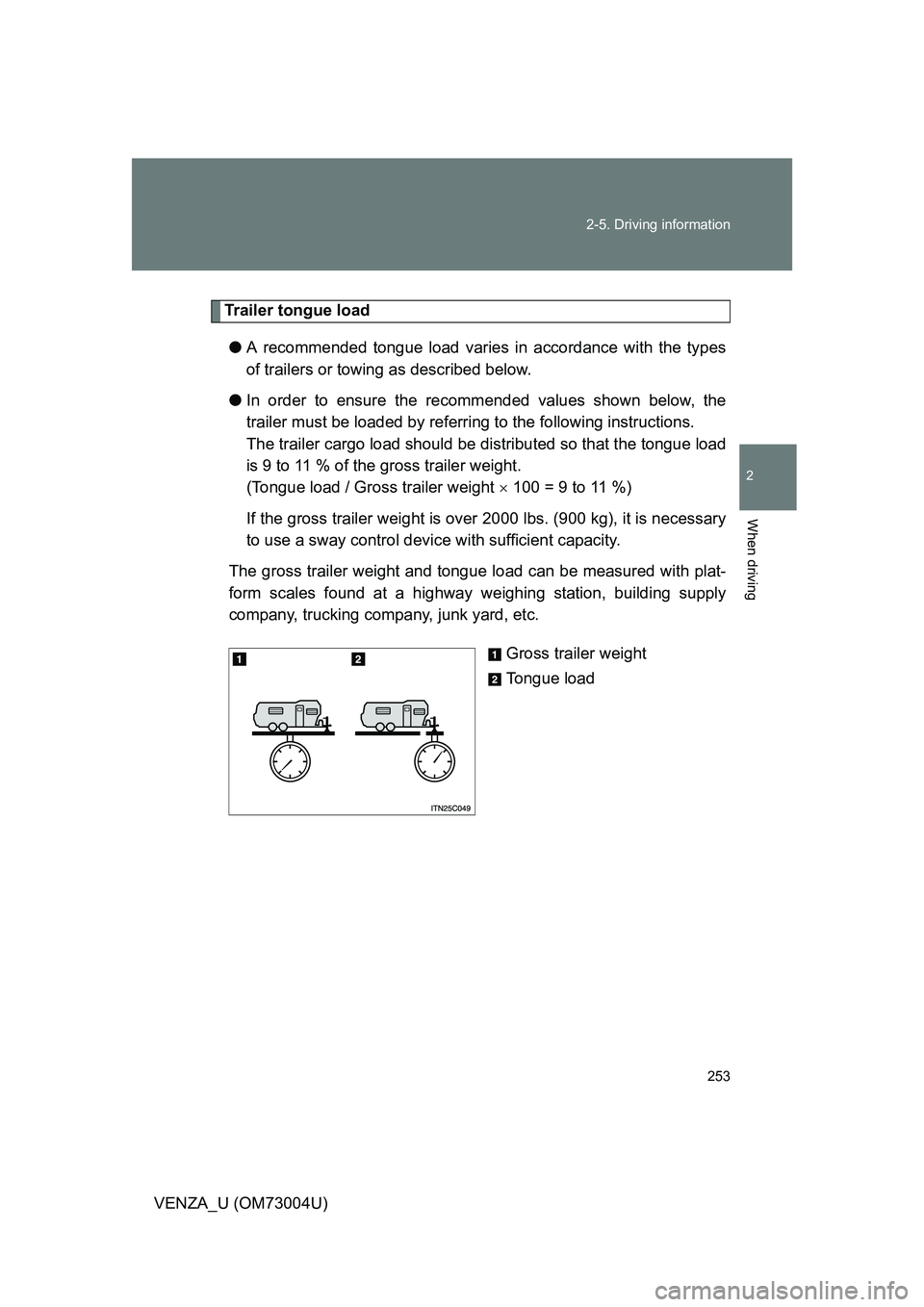
The gross trailer weight and tongue l oad can be measured with plat-
form scales found at a highway weighing station, building supply
company, trucking company, junk yard, etc.
Gross trailer weight
Tongue load