Rear TOYOTA VERSO 2011 Service Manual
[x] Cancel search | Manufacturer: TOYOTA, Model Year: 2011, Model line: VERSO, Model: TOYOTA VERSO 2011Pages: 588, PDF Size: 31.32 MB
Page 143 of 588
143 1-7. Safety information
1
Before driving
VERSO_WE_OM64524E
CAUTION
SRS airbag precautions
If the vinyl cover is put on the area where the SRS knee airbag will
deploys, be sure to remove it.
Do not use seat accessories which cover the parts where the SRS side
airbags inflate as they may interfere with inflation of the airbags.
Do not strike or apply significant levels of force to the area of the SRS air-
bag components. (P. 134)
Doing so can cause the SRS airbags to malfunction.
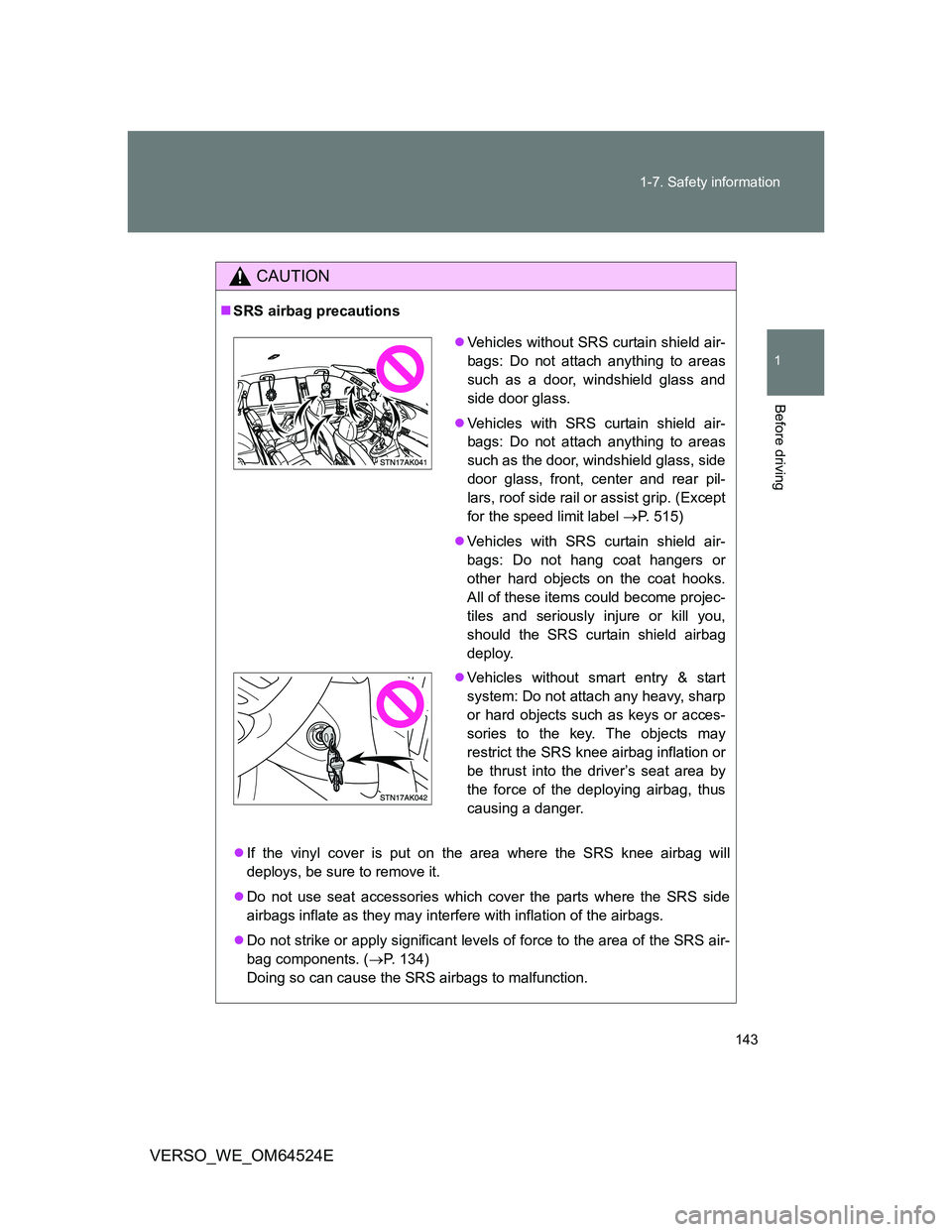
Vehicles without SRS curtain shield air-
bags: Do not attach anything to areas
such as a door, windshield glass and
side door glass.
Vehicles with SRS curtain shield air-
bags: Do not attach anything to areas
such as the door, windshield glass, side
door glass, front, center and rear pil-
lars, roof side rail or assist grip. (Except
for the speed limit label P. 515)
Vehicles with SRS curtain shield air-
bags: Do not hang coat hangers or
other hard objects on the coat hooks.
All of these items could become projec-
tiles and seriously injure or kill you,
should the SRS curtain shield airbag
deploy.
Vehicles without smart entry & start
system: Do not attach any heavy, sharp
or hard objects such as keys or acces-
sories to the key. The objects may
restrict the SRS knee airbag inflation or
be thrust into the driver’s seat area by
the force of the deploying airbag, thus
causing a danger.
Page 144 of 588
144 1-7. Safety information
VERSO_WE_OM64524E
CAUTION
SRS airbag precautions
Do not touch any of the component parts immediately after the SRS air-
bags have deployed (inflated) as they may be hot.
If breathing becomes difficult after the SRS airbag has deployed, open a
door or window to allow fresh air in, or leave the vehicle if it is safe to do
so. Wash off any residue as soon as possible to prevent skin irritation.
Vehicles without SRS curtain shield airbags: If the areas where the SRS
airbags are stored, such as the steering wheel pad, are damaged or
cracked, have them replaced by any authorized Toyota dealer or repairer,
or another duly qualified and equipped professional.
Vehicles with SRS curtain shield airbags: If the areas where the SRS
airbags are stored, such as the steering wheel pad and front and rear pillar
garnishes, are damaged or cracked, have them replaced by any
authorized Toyota dealer or repairer, or another duly qualified and
equipped professional.
Modification and disposal of SRS airbag system components
Do not dispose of your vehicle or perform any of the following modifications
without consulting any authorized Toyota dealer or repairer, or another duly
qualified and equipped professional.
The SRS airbags may malfunction or deploy (inflate) accidentally, causing
death or serious injury.
Installation, removal, disassembly and repair of the SRS airbags.
Repairs, modifications, removal or replacement of the steering wheel,
instrument panel, dashboard, seats or seat upholstery, front, center and
rear pillars or roof side rail.
Repairs or modifications of the front fender, front bumper, or side of the
occupant compartment.
Installation of snow plows, winches, etc. to the front grille (bull bars, kan-
garoo bar etc.).
Modifications to the vehicle’s suspension system.
Installation of electronic devices such as RF-transmitter radios or CD play-
ers.
Page 145 of 588
145
1
1-7. Safety information
Before driving
VERSO_WE_OM64524E
Child restraint systems
Points to remember
Studies have shown that installing a child restraint system on a rear
seat is much safer than installing one to the front passenger seat.
Choose a child restraint system appropriate to the age and size of
the child.
For installation details, follow the instructions provided with the
child restraint system.
General installation instructions are provided in this manual.
(P. 153)
Toyota recommends that you use a child restraint system which
conforms to the regulation “ECE No.44”.
Types of child restraints
Child restraint systems are classified into the following 5 groups
according to the regulation “ECE No.44”.
Group 0: Up to 10 kg (22 lb.) (0 - 9 months)
Group 0
+: Up to 13 kg (28 lb.) (0 - 2 years)
Group I: 9 to 18 kg (20 to 39 lb.) (9 months - 4 years)
Group II: 15 to 25 kg (34 to 55 lb.) (4 years - 7 years)
Group III: 22 to 36 kg (49 to 79 lb.) (6 years - 12 years)
In this owner’s manual, the following popular 3 types of child restraint
systems that can be secured with the seat belts are explained.
Toyota strongly urges the use of child restraint systems.
Page 150 of 588
150 1-7. Safety information
VERSO_WE_OM64524EKey of letters inserted in the above table:
IUF: Suitable for ISOFIX forward child restraint systems of universal
category approved for the use in this mass group.
X: ISOFIX position not suitable for ISOFIX child restraint systems
in the mass group and/or size class.
The child restraint systems mentioned in the table may not be avail-
able outside of the EU area.
NOTE:
Other child restraint system which is different from the system men-
tioned in the table can be used, but the suitability of the systems must
be carefully checked with the child restraint system manufacturer
concerned and the seller of those seats.
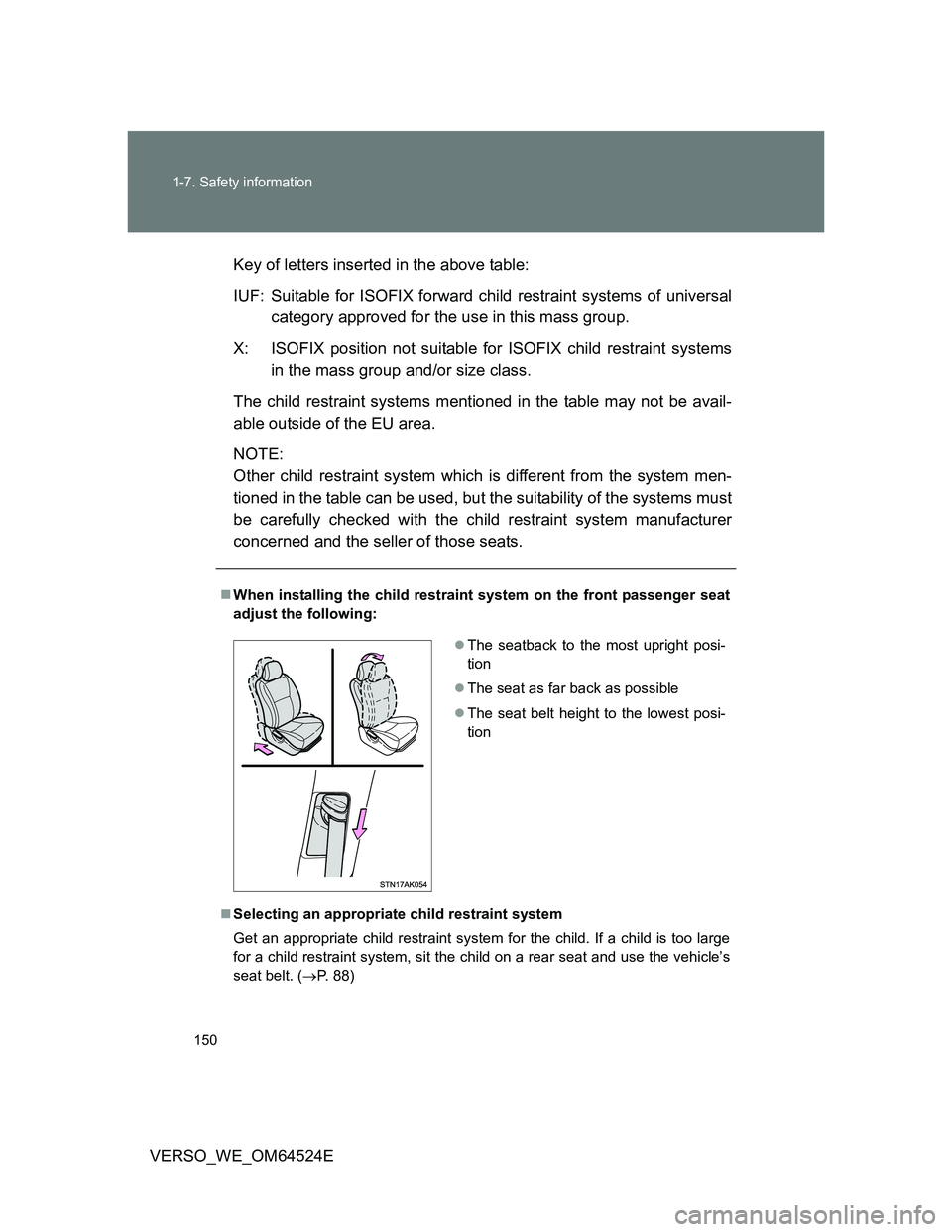
When installing the child restraint system on the front passenger seat
adjust the following:
Selecting an appropriate child restraint system
Get an appropriate child restraint system for the child. If a child is too large
for a child restraint system, sit the child on a rear seat and use the vehicle’s
seat belt. (P. 88)
The seatback to the most upright posi-
tion
The seat as far back as possible
The seat belt height to the lowest posi-
tion
Page 151 of 588
151 1-7. Safety information
1
Before driving
VERSO_WE_OM64524E
CAUTION
Using a child restraint system
The use of a child restraint system not suitable for the vehicle may not prop-
erly secure the infant or child, resulting in serious injury or even death.
Child restraint precautions
For effective protection in automobile accidents and sudden stops, a child
must be properly restrained, using a seat belt or child restraint system
depending on the age and size of the child. Holding a child in your arms is
not a substitute for a child restraint system. In an accident, the child can be
crushed against the windshield, or between you and the vehicle’s interior.
Toyota strongly urges the use of a proper child restraint system that con-
forms to the size of the child, installed on the rear seat. According to acci-
dent statistics, the child is safer when properly restrained in the rear seat
than in the front seat.
Never install a rear-facing child restraint system on the front passenger
seat when the airbag manual on-off switch is “ON”. (P. 167)
In the event of an accident, the force of the rapid inflation of the front pas-
senger airbag can cause death or serious injury to the child.
A forward-facing child restraint system should be allowed to be installed
on the front passenger seat only when it is unavoidable. Always move the
seat as far back as possible, because the front passenger airbag could
inflate with considerable speed and force. Otherwise, the child may be
killed or seriously injured.
Vehicles without SRS curtain shield airbags: Do not allow the child to lean
his/her head or any part of his/her body against the door or the area of the
seat from which the side airbags deploy even if the child is seated in the
child restraint system. It is dangerous if the side airbags inflate, and the
impact could cause death or serious injury to the child.
Vehicles with SRS curtain shield airbags: Do not allow the child to lean his/
her head or any part of his/her body against the door or the area of the
seat, front and rear pillars or roof side rail from which the side airbags or
curtain shield airbags deploy even if the child is seated in the child
restraint system. It is dangerous if the side airbags and curtain shield air-
bags inflate, and the impact could cause death or serious injury to the
child.
Page 154 of 588
154 1-7. Safety information
VERSO_WE_OM64524E
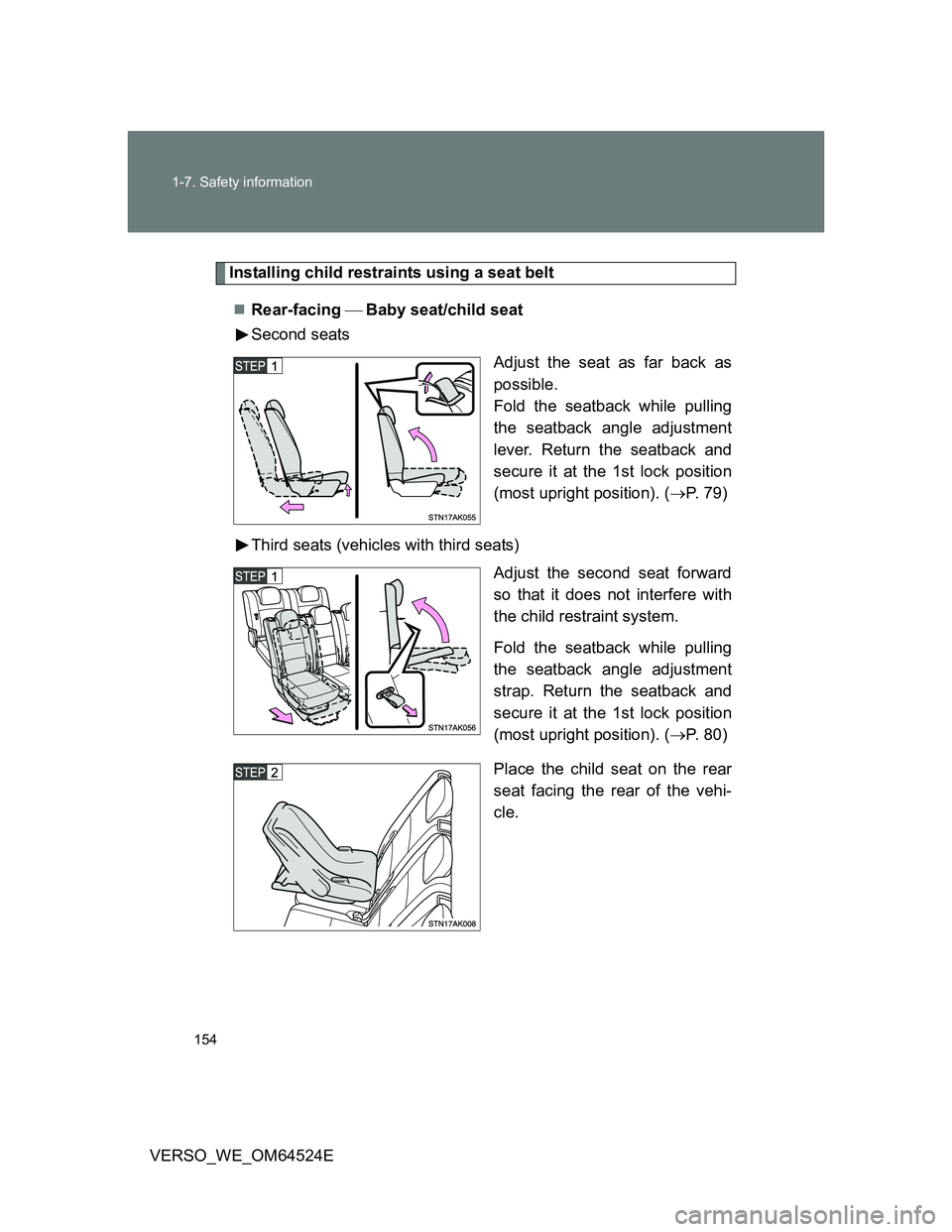
Installing child restraints using a seat belt
Rear-facing Baby seat/child seat
Second seats
Adjust the seat as far back as
possible.
Fold the seatback while pulling
the seatback angle adjustment
lever. Return the seatback and
secure it at the 1st lock position
(most upright position). (P. 7 9 )
Third seats (vehicles with third seats)
Adjust the second seat forward
so that it does not interfere with
the child restraint system.
Fold the seatback while pulling
the seatback angle adjustment
strap. Return the seatback and
secure it at the 1st lock position
(most upright position). (P. 8 0 )
Place the child seat on the rear
seat facing the rear of the vehi-
cle.
Page 162 of 588
162 1-7. Safety information
VERSO_WE_OM64524E
CAUTION
When installing a child restraint system
Follow the directions given in the child restraint system installation manual
and fix the child restraint system securely in place.
If the child restraint system is not correctly fixed in place, the child or other
passengers may be seriously injured or even killed in the event of sudden
braking, sudden swerving or an accident.
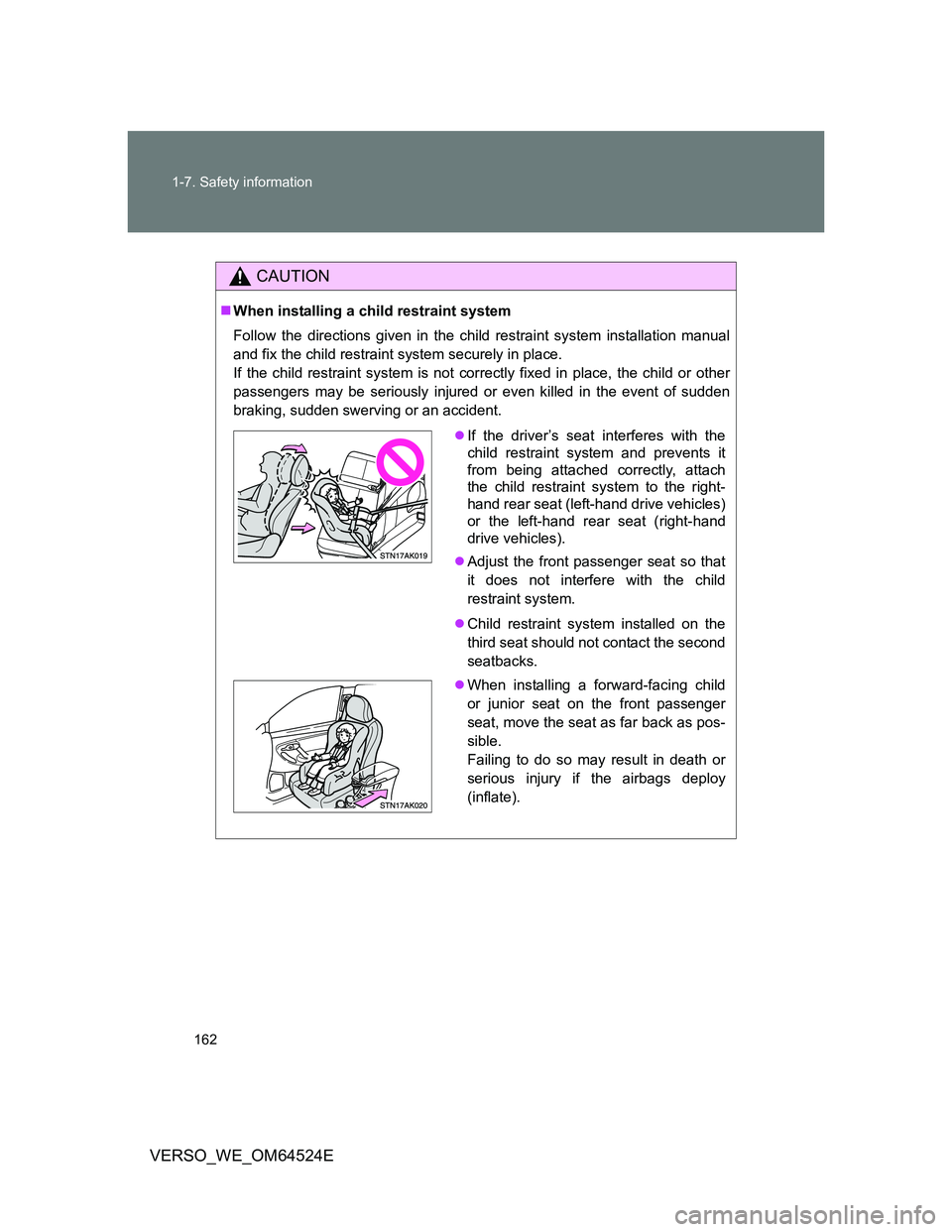
If the driver’s seat interferes with the
child restraint system and prevents it
from being attached correctly, attach
the child restraint system to the right-
hand rear seat (left-hand drive vehicles)
or the left-hand rear seat (right-hand
drive vehicles).
Adjust the front passenger seat so that
it does not interfere with the child
restraint system.
Child restraint system installed on the
third seat should not contact the second
seatbacks.
When installing a forward-facing child
or junior seat on the front passenger
seat, move the seat as far back as pos-
sible.
Failing to do so may result in death or
serious injury if the airbags deploy
(inflate).
Page 163 of 588
163 1-7. Safety information
1
Before driving
VERSO_WE_OM64524E
CAUTION
When installing a child restraint system
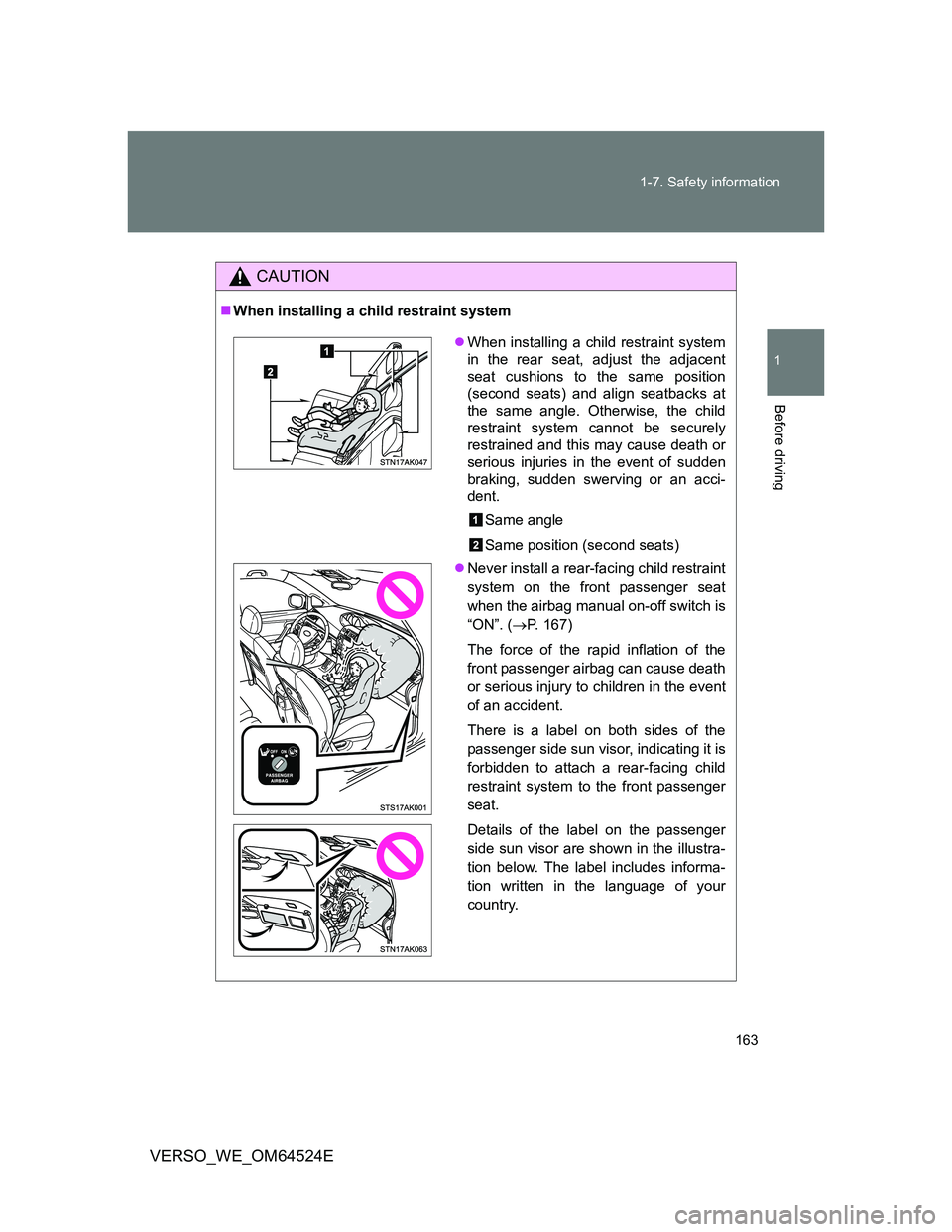
When installing a child restraint system
in the rear seat, adjust the adjacent
seat cushions to the same position
(second seats) and align seatbacks at
the same angle. Otherwise, the child
restraint system cannot be securely
restrained and this may cause death or
serious injuries in the event of sudden
braking, sudden swerving or an acci-
dent.
Same angle
Same position (second seats)
Never install a rear-facing child restraint
system on the front passenger seat
when the airbag manual on-off switch is
“ON”. (P. 167)
The force of the rapid inflation of the
front passenger airbag can cause death
or serious injury to children in the event
of an accident.
There is a label on both sides of the
passenger side sun visor, indicating it is
forbidden to attach a rear-facing child
restraint system to the front passenger
seat.
Details of the label on the passenger
side sun visor are shown in the illustra-
tion below. The label includes informa-
tion written in the language of your
country.
Page 170 of 588
170 1-7. Safety information
VERSO_WE_OM64524E
CAUTION
When installing a child restraint system
For safety reasons, always install the child restraint system in a rear seat. In
the event that the rear seat cannot be used, the front seat can be used as
long as the airbag manual on-off system is set to “OFF”.
If the airbag manual on-off system is left “ON”, the strong impact of the air-
bag deployment (inflation) may cause serious injury or even death.
When a child restraint system is not installed on the front passenger
seat
Ensure that the airbag manual on-off system is set to “ON”.
If it is left “OFF”, the airbag may not deploy in the event of an accident, which
may result in serious injury or even death.
Page 171 of 588
2When driving
171
VERSO_WE_OM64524E
2-1. Driving procedures
Driving the vehicle ............ 172
Engine (ignition) switch
(vehicles without smart
entry & start system)....... 186
Engine (ignition) switch
(vehicles with smart
entry & start system)....... 190
Multidrive .......................... 196
Automatic transmission .... 202
Manual transmission......... 209
Turn signal lever ............... 213
Parking brake ................... 214
Horn .................................. 216
2-2. Instrument cluster
Gauges and meters .......... 217
Indicators and warning
lights ............................... 222
Multi-information display ... 226
2-3. Operating the lights and
wipers
Headlight switch ............... 239
Fog light switch ................. 244
Windshield wipers and
washer ............................ 246
Rear window wiper and
washer ............................ 2512-4. Using other driving systems
Cruise control.................... 252
Speed limiter ..................... 256
Toyota parking
assist-sensor .................. 259
Driving assist systems ...... 267
Hill-start assist control....... 273
2-5. Driving information
Cargo and luggage ........... 275
Winter driving tips ............. 278
Trailer towing .................... 282