fuel TOYOTA VERSO 2012 User Guide
[x] Cancel search | Manufacturer: TOYOTA, Model Year: 2012, Model line: VERSO, Model: TOYOTA VERSO 2012Pages: 588, PDF Size: 31.32 MB
Page 109 of 588
109 1-5. Refueling
1
Before driving
VERSO_WE_OM64524E
*1: To distinguish the 1AD-FTV engine, ask any authorized Toyota dealer or
repairer, or another duly qualified and equipped professional.
*2: Fuel type can be identified by the fuel label. (P. 107)
Use of ethanol blended gasoline in a gasoline engine
Toyota allows the use of ethanol blended gasoline where the ethanol content
is up to 10%. Make sure that the ethanol blended gasoline to be used has a
Research Octane Number that follows the above.
Fuel tank capacity
Gasoline engine
Approximately 60 L (15.9 gal., 13.2 Imp. gal.)
Diesel engine
Approximately 55 L (14.5 gal., 12.1 Imp. gal.)
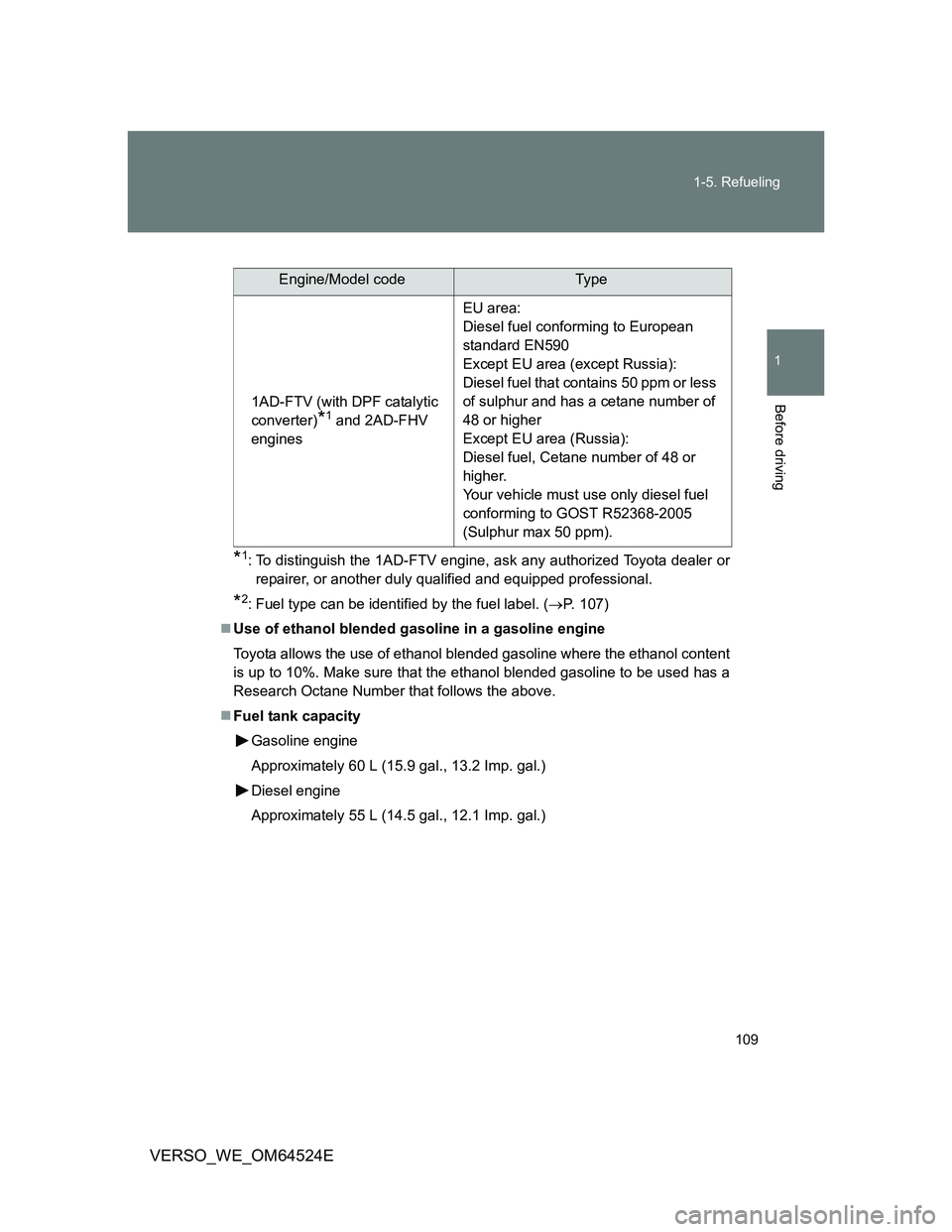
Engine/Model codeTy p e
1AD-FTV (with DPF catalytic
converter)
*1 and 2AD-FHV
enginesEU area:
Diesel fuel conforming to European
standard EN590
Except EU area (except Russia):
Diesel fuel that contains 50 ppm or less
of sulphur and has a cetane number of
48 or higher
Except EU area (Russia):
Diesel fuel, Cetane number of 48 or
higher.
Your vehicle must use only diesel fuel
conforming to GOST R52368-2005
(Sulphur max 50 ppm).
Page 110 of 588
110 1-5. Refueling
VERSO_WE_OM64524E
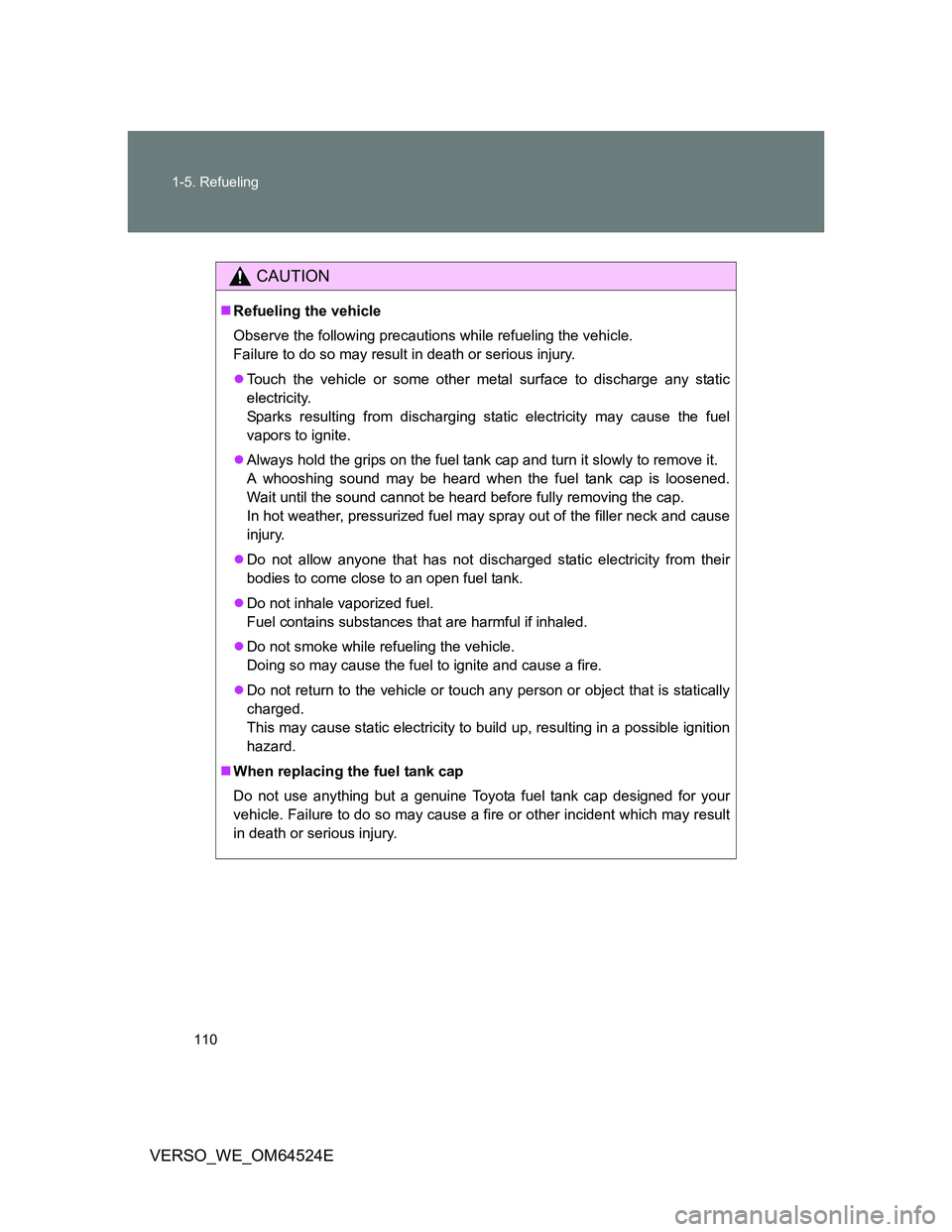
CAUTION
Refueling the vehicle
Observe the following precautions while refueling the vehicle.
Failure to do so may result in death or serious injury.
Touch the vehicle or some other metal surface to discharge any static
electricity.
Sparks resulting from discharging static electricity may cause the fuel
vapors to ignite.
Always hold the grips on the fuel tank cap and turn it slowly to remove it.
A whooshing sound may be heard when the fuel tank cap is loosened.
Wait until the sound cannot be heard before fully removing the cap.
In hot weather, pressurized fuel may spray out of the filler neck and cause
injury.
Do not allow anyone that has not discharged static electricity from their
bodies to come close to an open fuel tank.
Do not inhale vaporized fuel.
Fuel contains substances that are harmful if inhaled.
Do not smoke while refueling the vehicle.
Doing so may cause the fuel to ignite and cause a fire.
Do not return to the vehicle or touch any person or object that is statically
charged.
This may cause static electricity to build up, resulting in a possible ignition
hazard.
When replacing the fuel tank cap
Do not use anything but a genuine Toyota fuel tank cap designed for your
vehicle. Failure to do so may cause a fire or other incident which may result
in death or serious injury.
Page 111 of 588
111 1-5. Refueling
1
Before driving
VERSO_WE_OM64524E
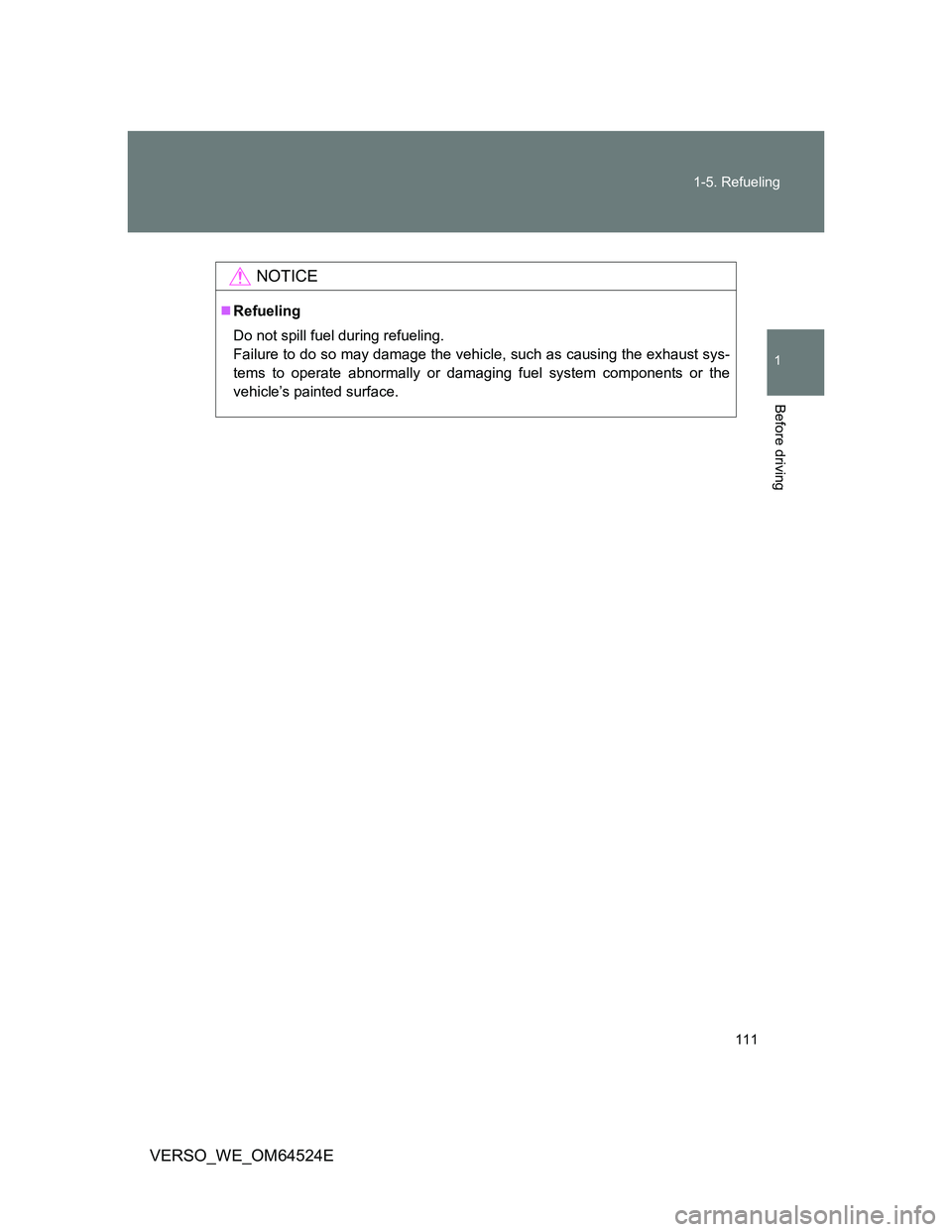
NOTICE
Refueling
Do not spill fuel during refueling.
Failure to do so may damage the vehicle, such as causing the exhaust sys-
tems to operate abnormally or damaging fuel system components or the
vehicle’s painted surface.
Page 176 of 588
176 2-1. Driving procedures
VERSO_WE_OM64524E
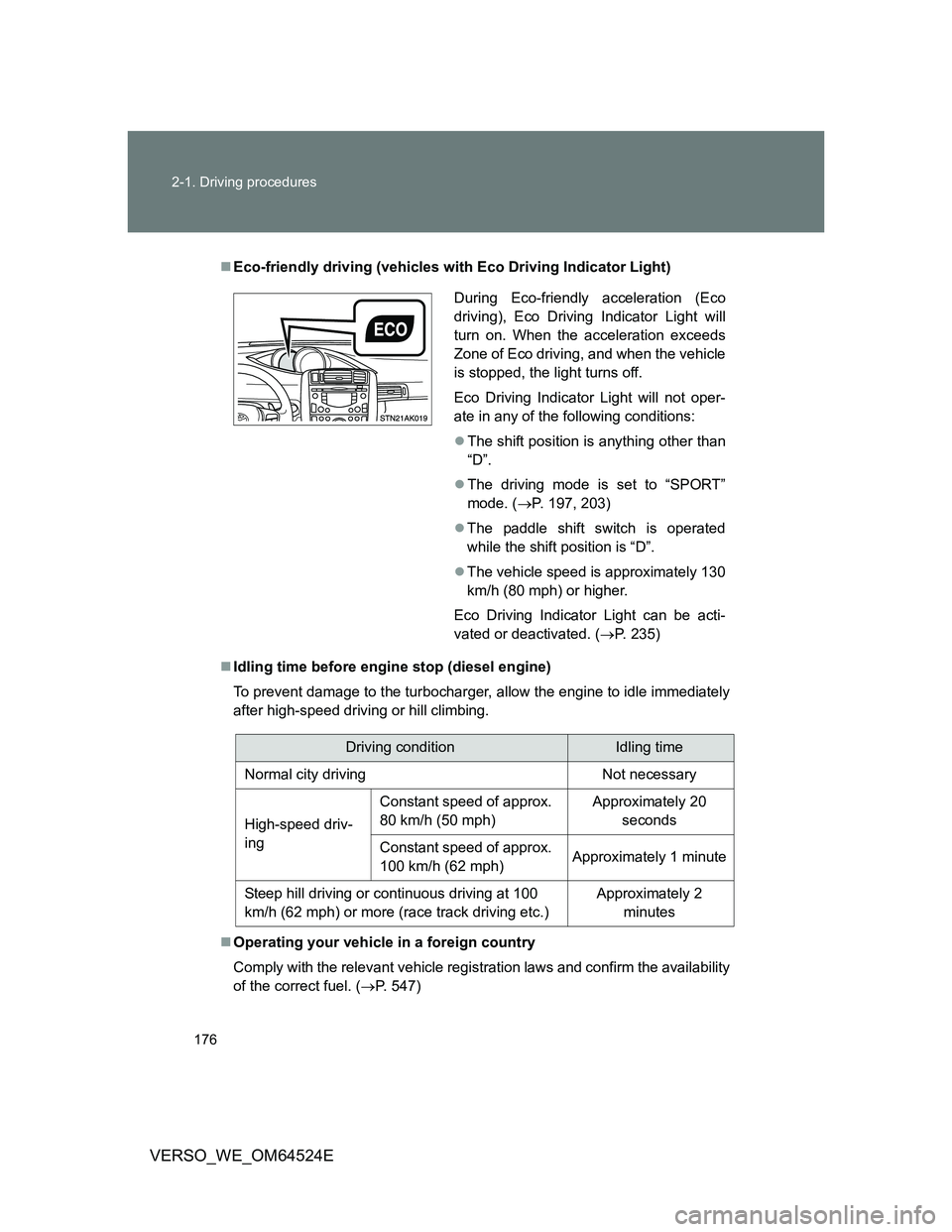
Eco-friendly driving (vehicles with Eco Driving Indicator Light)
Idling time before engine stop (diesel engine)
To prevent damage to the turbocharger, allow the engine to idle immediately
after high-speed driving or hill climbing.
Operating your vehicle in a foreign country
Comply with the relevant vehicle registration laws and confirm the availability
of the correct fuel. (P. 547)
During Eco-friendly acceleration (Eco
driving), Eco Driving Indicator Light will
turn on. When the acceleration exceeds
Zone of Eco driving, and when the vehicle
is stopped, the light turns off.
Eco Driving Indicator Light will not oper-
ate in any of the following conditions:
The shift position is anything other than
“D”.
The driving mode is set to “SPORT”
mode. (P. 197, 203)
The paddle shift switch is operated
while the shift position is “D”.
The vehicle speed is approximately 130
km/h (80 mph) or higher.
Eco Driving Indicator Light can be acti-
vated or deactivated. (P. 235)
Driving conditionIdling time
Normal city driving Not necessary
High-speed driv-
ingConstant speed of approx.
80 km/h (50 mph)Approximately 20
seconds
Constant speed of approx.
100 km/h (62 mph)Approximately 1 minute
Steep hill driving or continuous driving at 100
km/h (62 mph) or more (race track driving etc.)Approximately 2
minutes
Page 197 of 588
197 2-1. Driving procedures
2
When driving
VERSO_WE_OM64524E
Selecting a shift position
*1: To improve fuel consumption and reduce noises, set the shift lever in
the “D” position for normal driving.
*2: If equipped, by selecting gear step using paddle shift switches, you can
control engine braking forces.
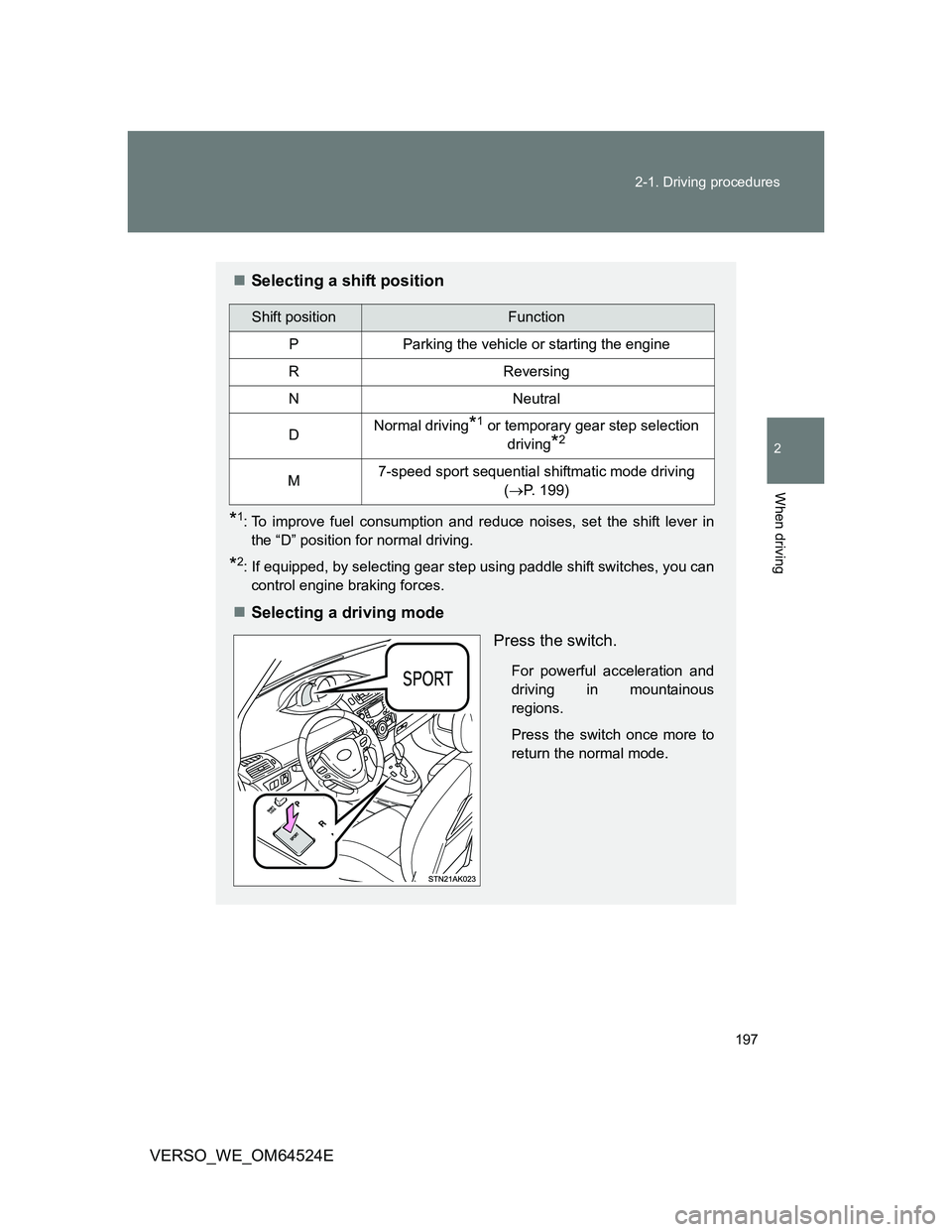
Selecting a driving mode
Press the switch.
For powerful acceleration and
driving in mountainous
regions.
Press the switch once more to
return the normal mode.
Shift positionFunction
PParking the vehicle or starting the engine
RReversing
NNeutral
DNormal driving*1 or temporary gear step selection
driving
*2
M7-speed sport sequential shiftmatic mode driving
(P. 199)
Page 203 of 588
203 2-1. Driving procedures
2
When driving
VERSO_WE_OM64524E
Selecting a shift position
*1: To improve fuel consumption and reduce noises, set the shift lever in
the “D” position for normal driving.
*2: If equipped, by selecting shift ranges using paddle shift switches, you
can control engine braking forces.
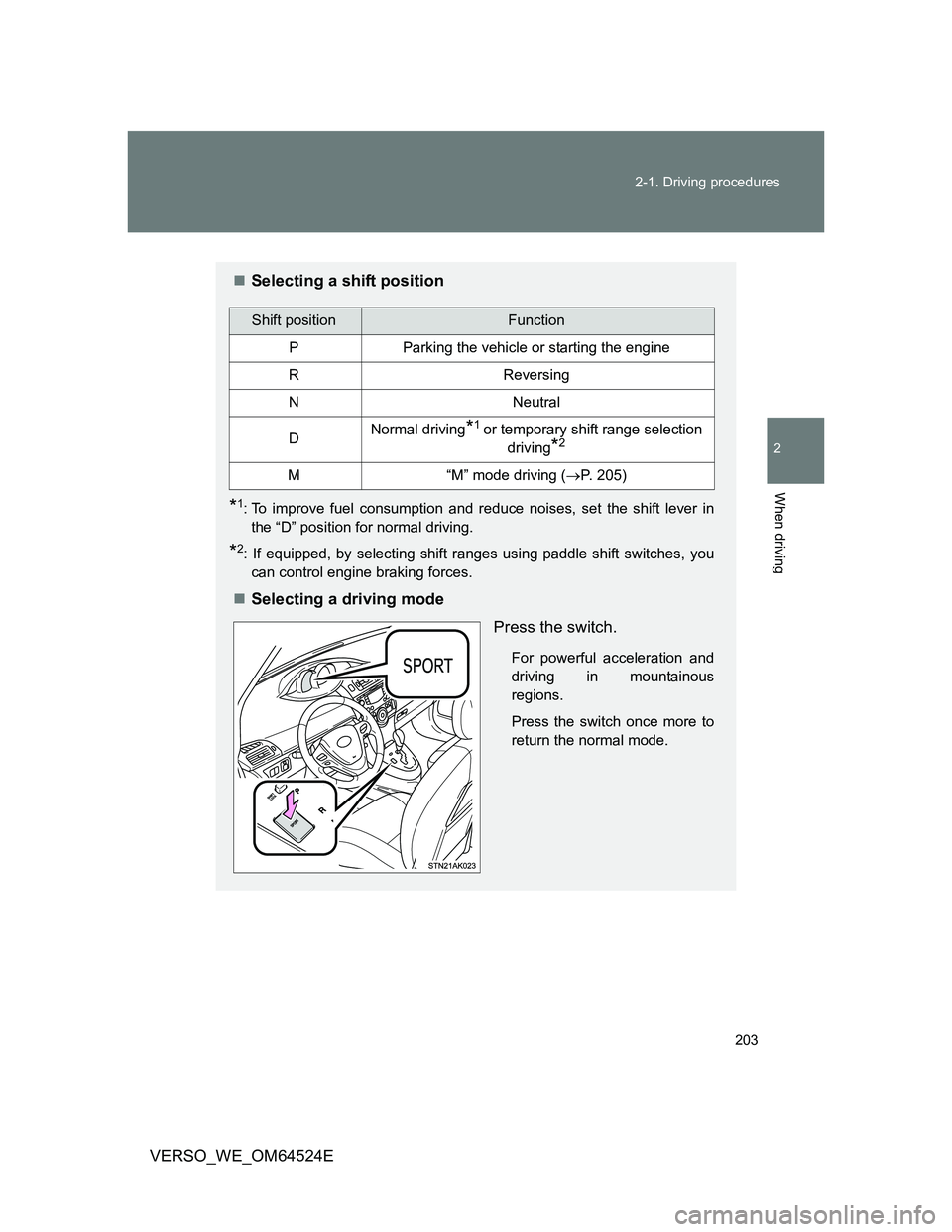
Selecting a driving mode
Press the switch.
For powerful acceleration and
driving in mountainous
regions.
Press the switch once more to
return the normal mode.
Shift positionFunction
PParking the vehicle or starting the engine
RReversing
NNeutral
DNormal driving*1 or temporary shift range selection
driving
*2
M“M” mode driving (P. 205)
Page 210 of 588
210 2-1. Driving procedures
VERSO_WE_OM64524E
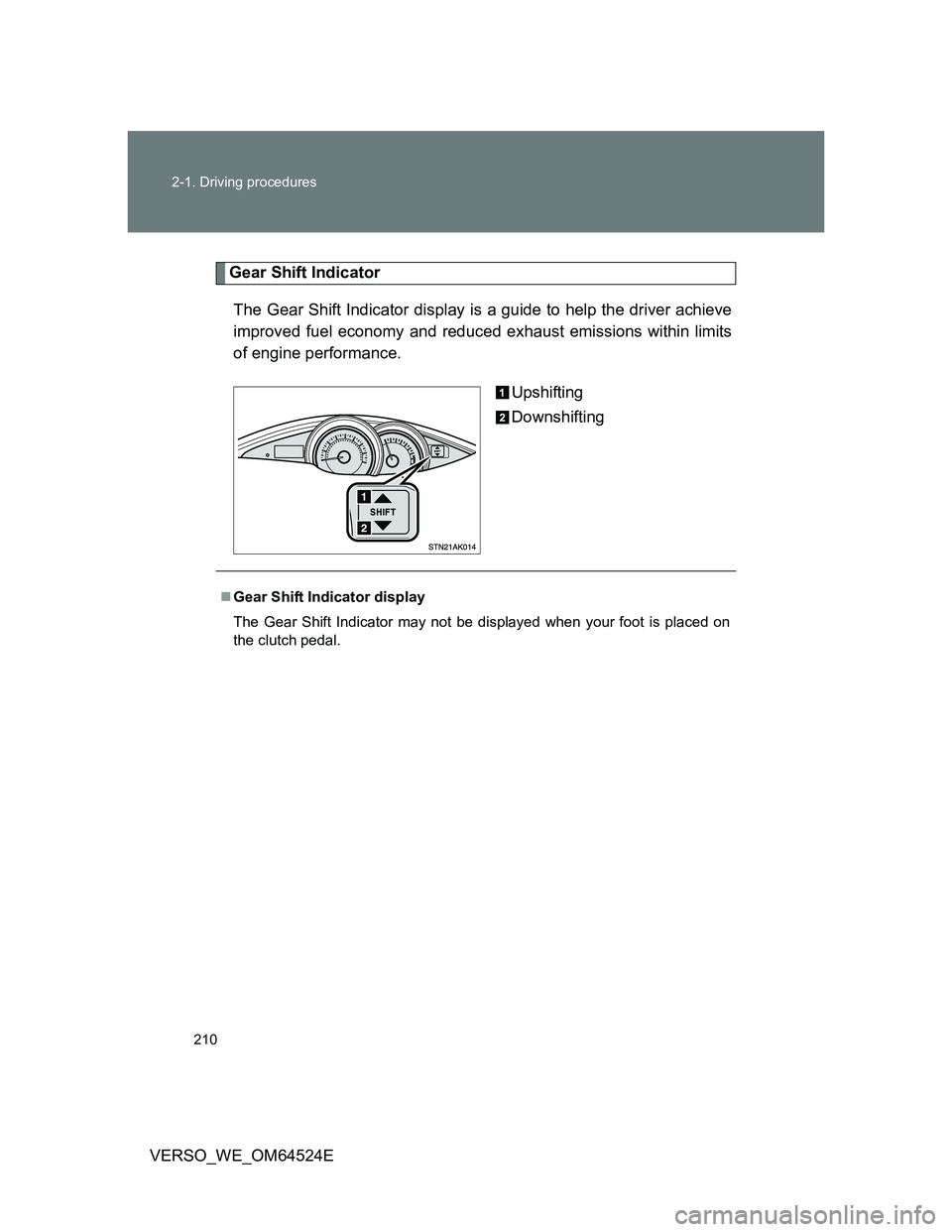
Gear Shift Indicator
The Gear Shift Indicator display is a guide to help the driver achieve
improved fuel economy and reduced exhaust emissions within limits
of engine performance.
Upshifting
Downshifting
Gear Shift Indicator display
The Gear Shift Indicator may not be displayed when your foot is placed on
the clutch pedal.
Page 217 of 588
217
2
When driving
VERSO_WE_OM64524E
2-2. Instrument cluster
Gauges and meters
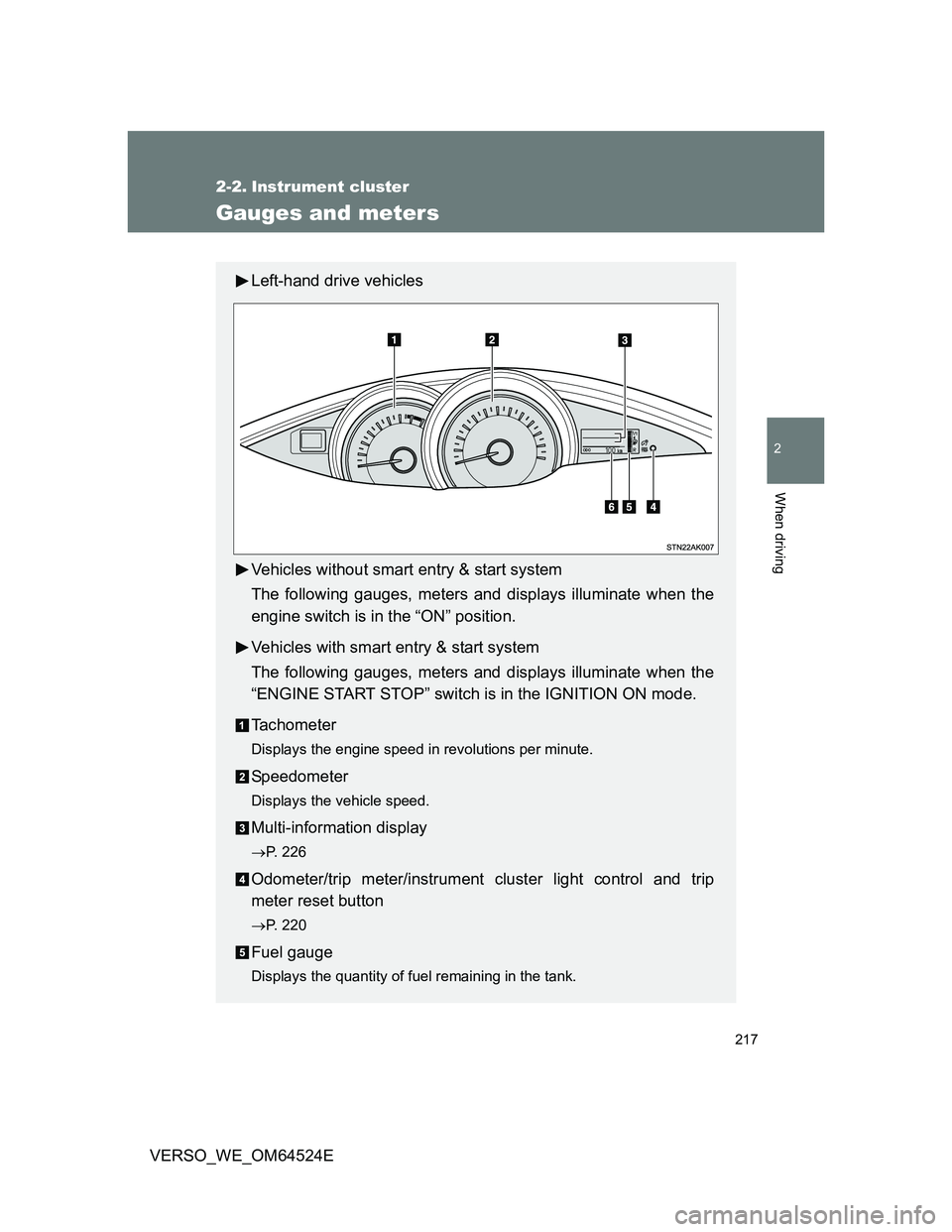
Left-hand drive vehicles
Vehicles without smart entry & start system
The following gauges, meters and displays illuminate when the
engine switch is in the “ON” position.
Vehicles with smart entry & start system
The following gauges, meters and displays illuminate when the
“ENGINE START STOP” switch is in the IGNITION ON mode.
Tachometer
Displays the engine speed in revolutions per minute.
Speedometer
Displays the vehicle speed.
Multi-information display
P. 226
Odometer/trip meter/instrument cluster light control and trip
meter reset button
P. 220
Fuel gauge
Displays the quantity of fuel remaining in the tank.
Page 220 of 588
220 2-2. Instrument cluster
VERSO_WE_OM64524E
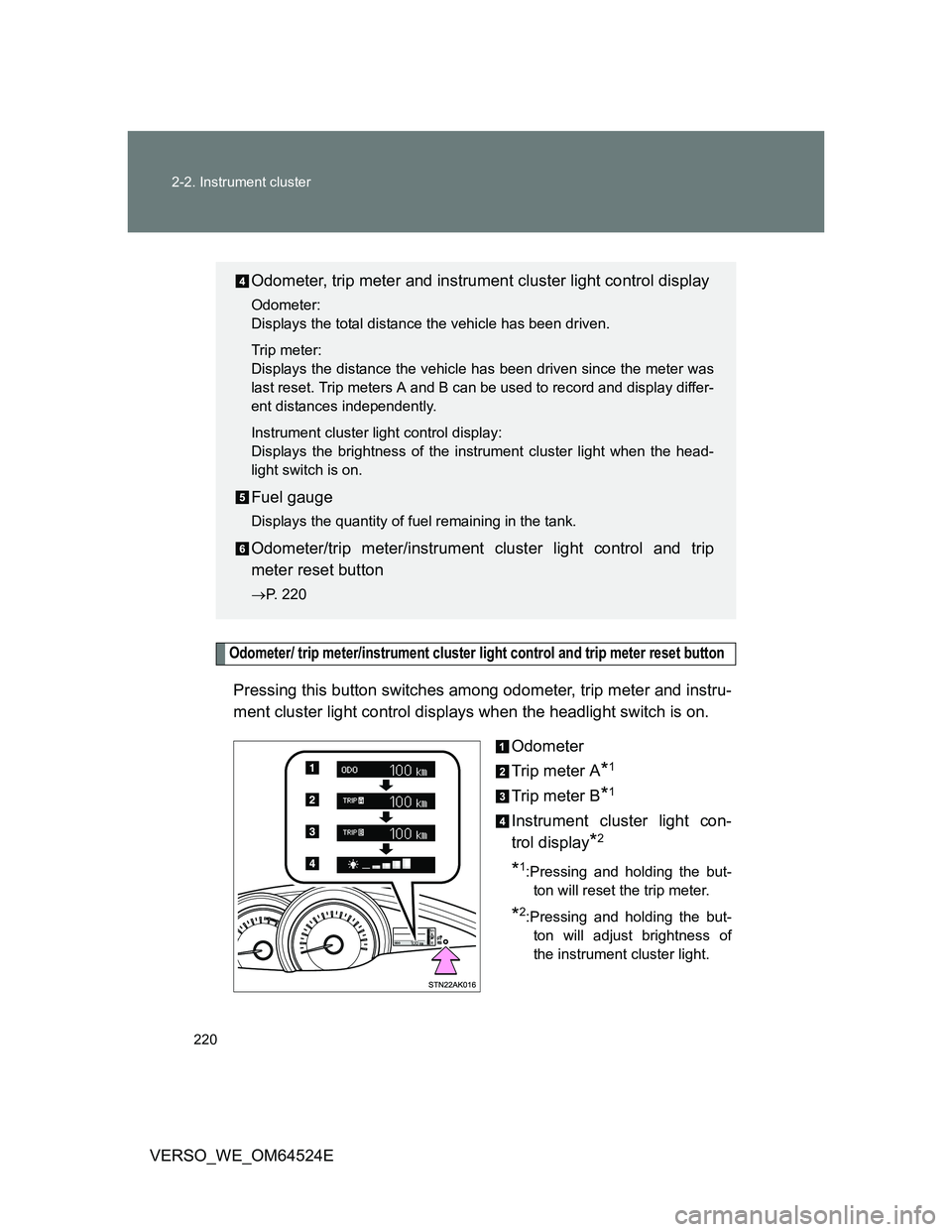
Odometer/ trip meter/instrument cluster light control and trip meter reset button
Pressing this button switches among odometer, trip meter and instru-
ment cluster light control displays when the headlight switch is on.
Odometer
Trip meter A
*1
Trip meter B*1
Instrument cluster light con-
trol display
*2
*1:Pressing and holding the but-
ton will reset the trip meter.
*2:Pressing and holding the but-
ton will adjust brightness of
the instrument cluster light.
Odometer, trip meter and instrument cluster light control display
Odometer:
Displays the total distance the vehicle has been driven.
Trip meter:
Displays the distance the vehicle has been driven since the meter was
last reset. Trip meters A and B can be used to record and display differ-
ent distances independently.
Instrument cluster light control display:
Displays the brightness of the instrument cluster light when the head-
light switch is on.
Fuel gauge
Displays the quantity of fuel remaining in the tank.
Odometer/trip meter/instrument cluster light control and trip
meter reset button
P. 220
Page 226 of 588
226
2-2. Instrument cluster
VERSO_WE_OM64524E
Multi-infor mation display
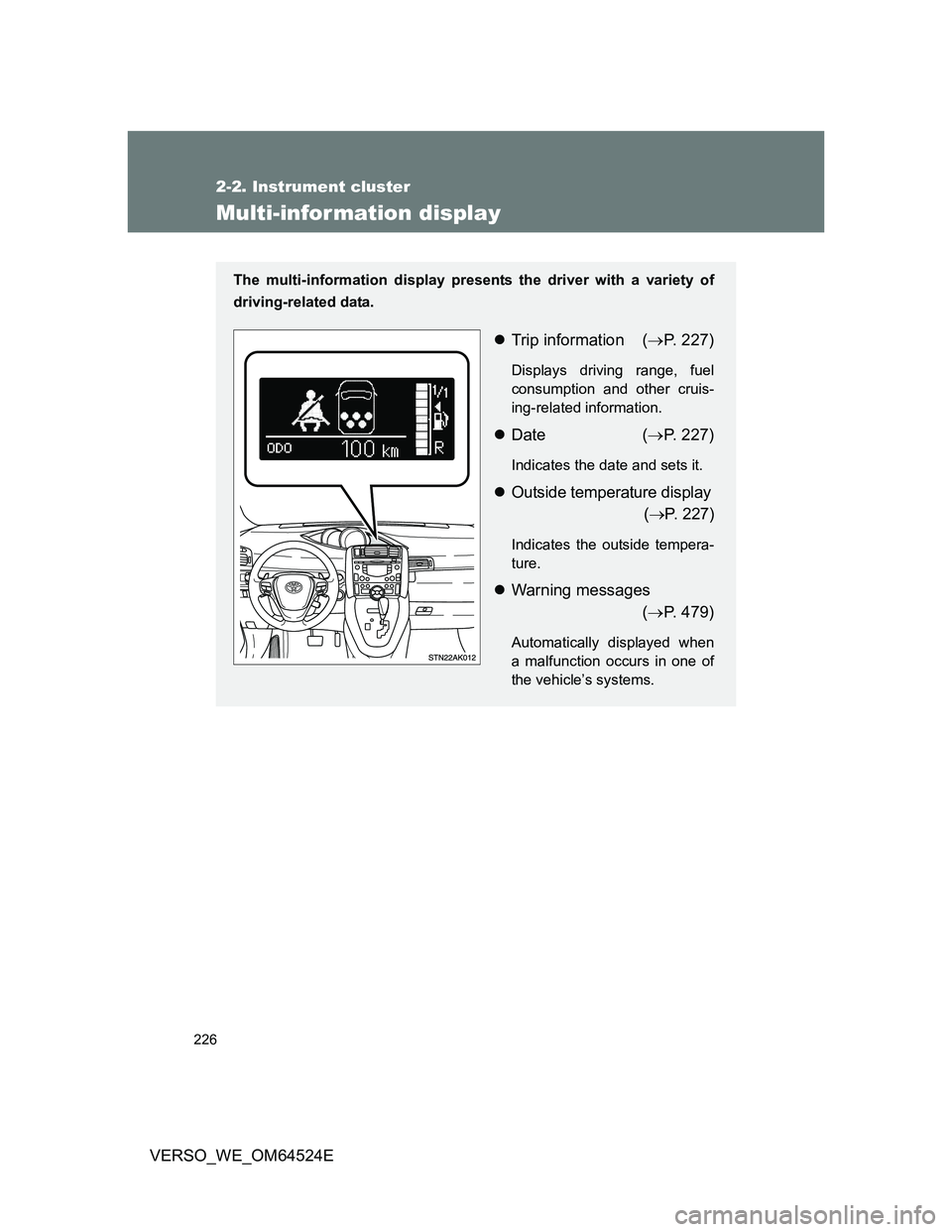
The multi-information display presents the driver with a variety of
driving-related data.
Trip information (P. 227)
Displays driving range, fuel
consumption and other cruis-
ing-related information.
Date (P. 227)
Indicates the date and sets it.
Outside temperature display
(P. 227)
Indicates the outside tempera-
ture.
Warning messages
(P. 479)
Automatically displayed when
a malfunction occurs in one of
the vehicle’s systems.