fuel TOYOTA VERSO 2012 Owner's Manual
[x] Cancel search | Manufacturer: TOYOTA, Model Year: 2012, Model line: VERSO, Model: TOYOTA VERSO 2012Pages: 588, PDF Size: 31.32 MB
Page 227 of 588
227 2-2. Instrument cluster
2
When driving
VERSO_WE_OM64524E
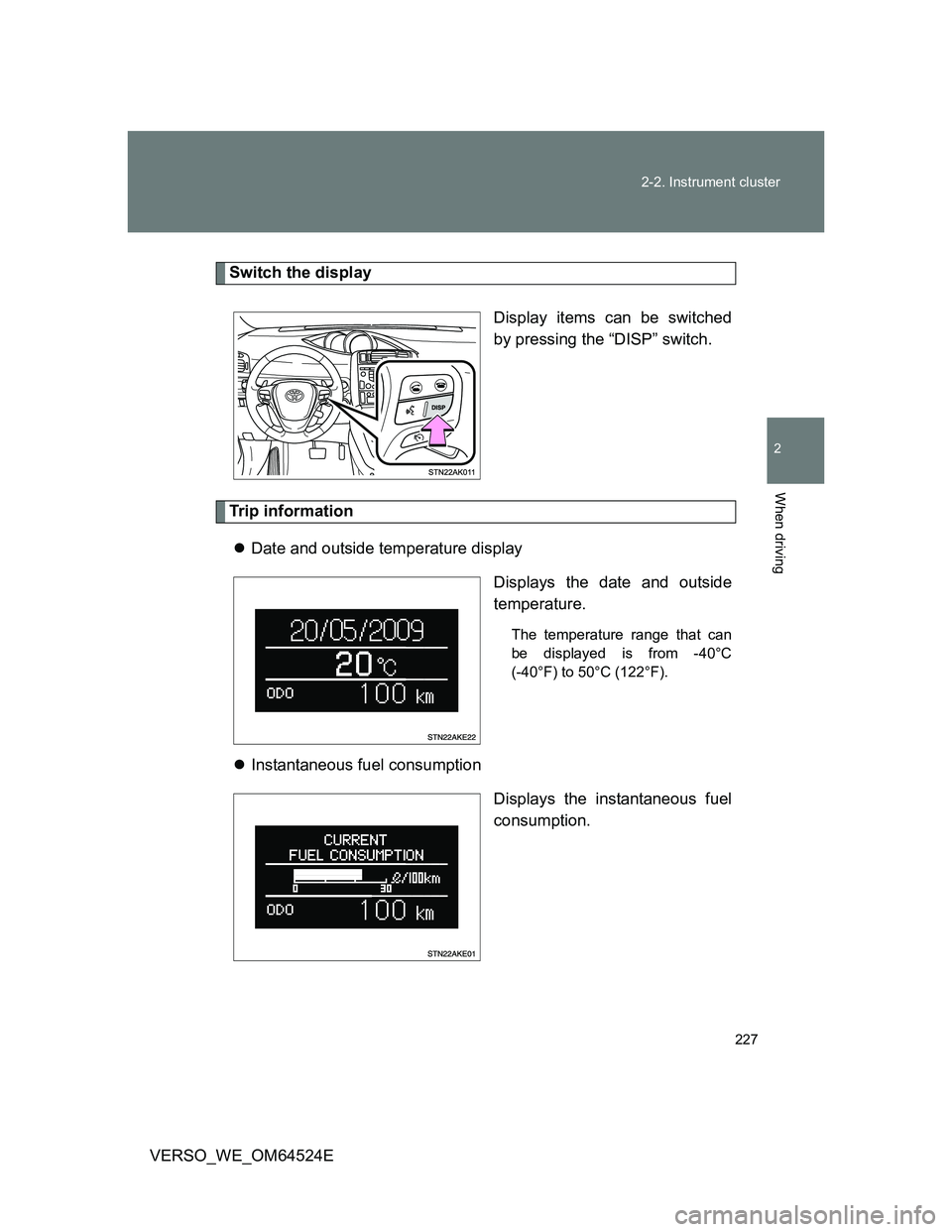
Switch the display
Display items can be switched
by pressing the “DISP” switch.
Trip information
Date and outside temperature display
Displays the date and outside
temperature.
The temperature range that can
be displayed is from -40°C
(-40°F) to 50°C (122°F).
Instantaneous fuel consumption
Displays the instantaneous fuel
consumption.
Page 228 of 588
228 2-2. Instrument cluster
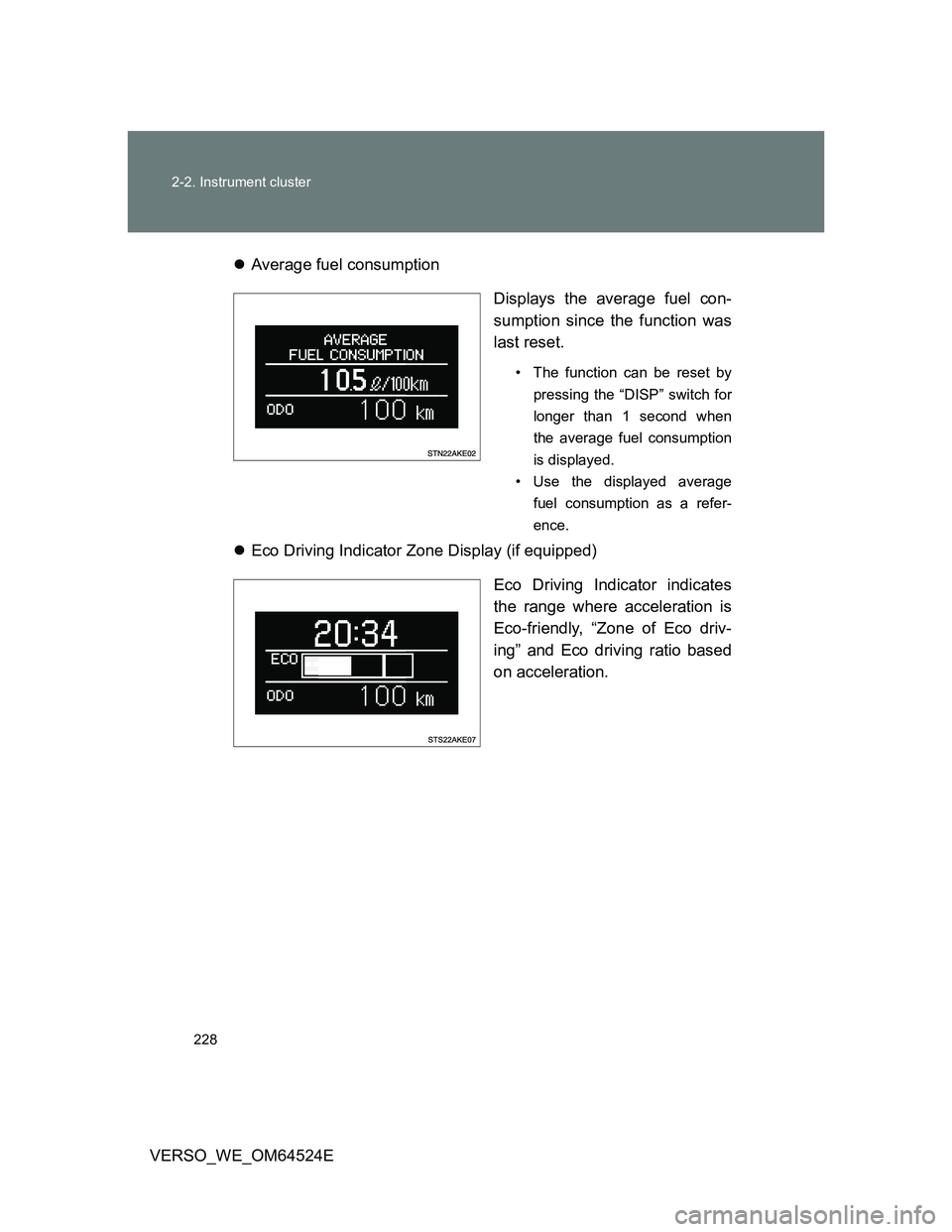
VERSO_WE_OM64524EAverage fuel consumption
Displays the average fuel con-
sumption since the function was
last reset.
• The function can be reset by
pressing the “DISP” switch for
longer than 1 second when
the average fuel consumption
is displayed.
• Use the displayed average
fuel consumption as a refer-
ence.
Eco Driving Indicator Zone Display (if equipped)
Eco Driving Indicator indicates
the range where acceleration is
Eco-friendly, “Zone of Eco driv-
ing” and Eco driving ratio based
on acceleration.
Page 229 of 588
229 2-2. Instrument cluster
2
When driving
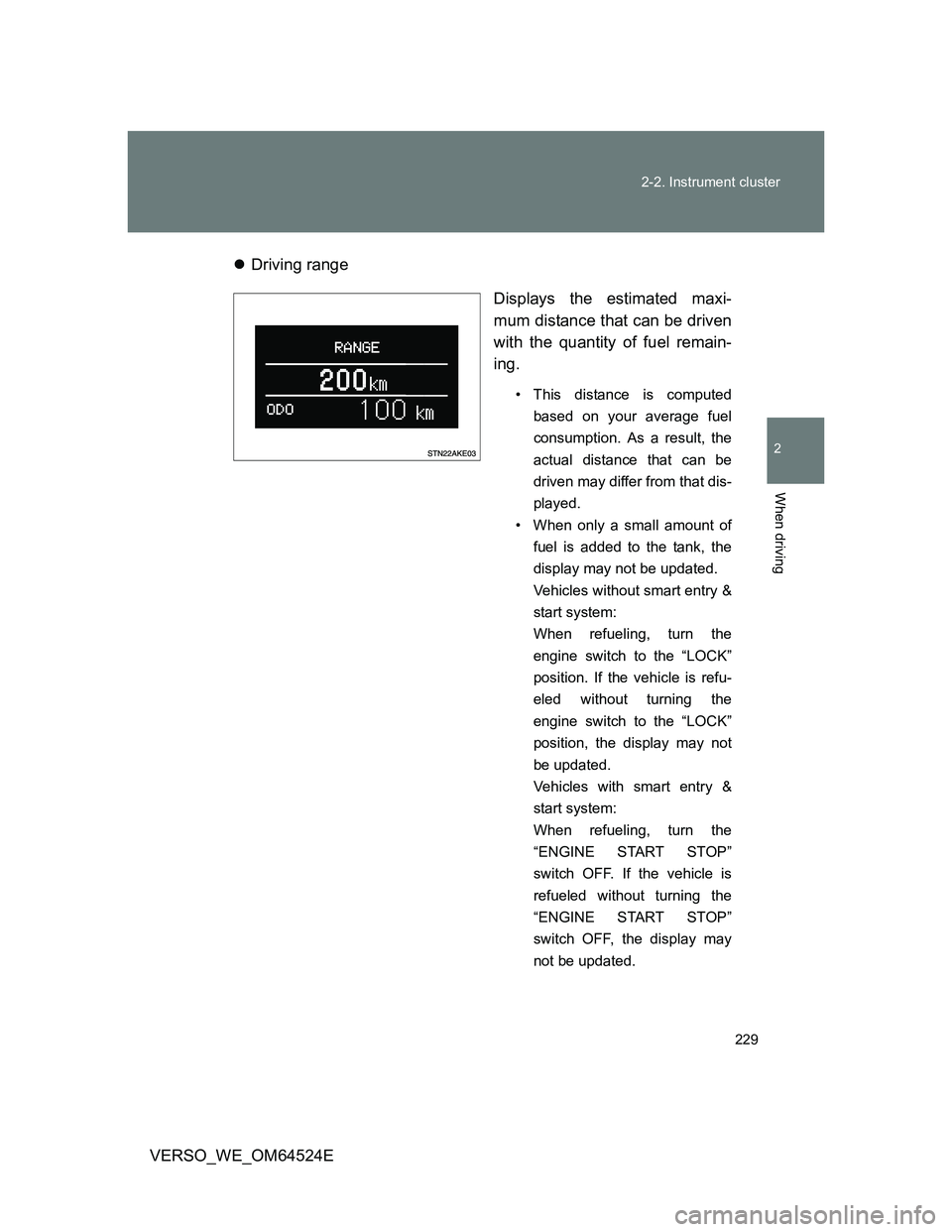
VERSO_WE_OM64524EDriving range
Displays the estimated maxi-
mum distance that can be driven
with the quantity of fuel remain-
ing.
• This distance is computed
based on your average fuel
consumption. As a result, the
actual distance that can be
driven may differ from that dis-
played.
• When only a small amount of
fuel is added to the tank, the
display may not be updated.
Vehicles without smart entry &
start system:
When refueling, turn the
engine switch to the “LOCK”
position. If the vehicle is refu-
eled without turning the
engine switch to the “LOCK”
position, the display may not
be updated.
Vehicles with smart entry &
start system:
When refueling, turn the
“ENGINE START STOP”
switch OFF. If the vehicle is
refueled without turning the
“ENGINE START STOP”
switch OFF, the display may
not be updated.
Page 275 of 588
275
2
When driving
VERSO_WE_OM64524E
2-5. Driving information
Cargo and luggage
CAUTION
Things that must not be carried in the luggage compartment
The following things may cause a fire if loaded in the luggage compartment.
Receptacles containing gasoline
Aerosol cans
Take notice of the following information about storage precautions,
cargo capacity and load.
Stow cargo and luggage in the luggage compartment whenever
possible.
Be sure all items are secured in place.
Be careful to keep the vehicle level. Placing the weight as far for-
ward as possible helps maintain vehicle balance.
For better fuel economy, do not carry unnecessary weight.
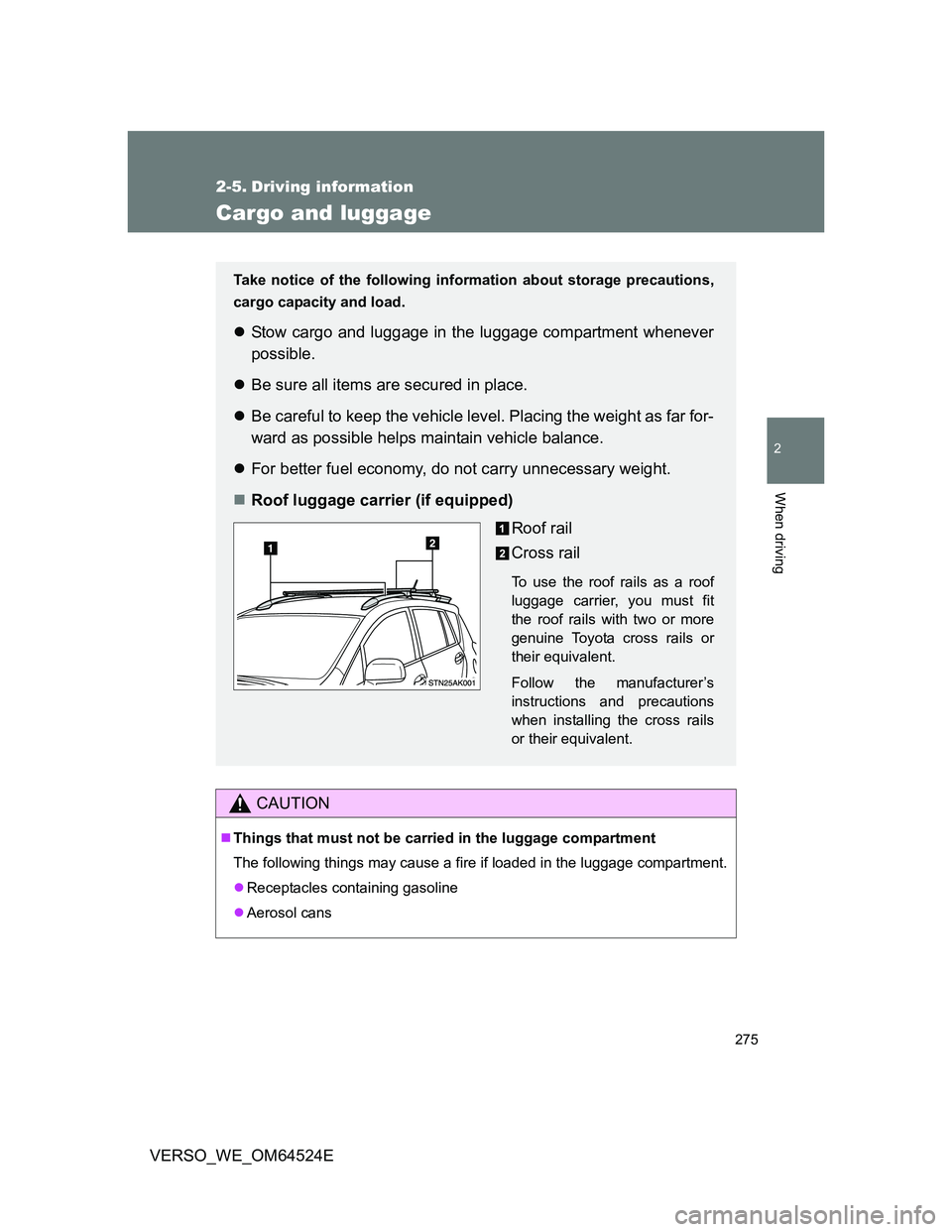
Roof luggage carrier (if equipped)
Roof rail
Cross rail
To use the roof rails as a roof
luggage carrier, you must fit
the roof rails with two or more
genuine Toyota cross rails or
their equivalent.
Follow the manufacturer’s
instructions and precautions
when installing the cross rails
or their equivalent.
Page 282 of 588
282
2-5. Driving information
VERSO_WE_OM64524E
Trailer towing
Your vehicle is designed primarily as a passenger carrying vehicle.
Towing a trailer will have an adverse effect on handling, perfor-
mance, braking, durability, and fuel consumption. Your safety and
satisfaction depend on the proper use of correct equipment and cau-
tious driving habits. For your safety and the safety of others, do not
overload the vehicle or trailer.
To tow a trailer safely, use extreme care and drive the vehicle in
accordance with the trailer’s characteristics and operating condi-
tions.
Toyota warranties do not apply to damage or malfunction caused by
towing a trailer for commercial purposes.
Ask your local authorized Toyota dealer or repairer, or another duly
qualified and equipped professional, for further details before tow-
ing, as there are additional legal requirements in some countries.
Weight limits
Check the allowable towing capacity, GVM (Gross Vehicle
Mass), MPAC (Maximum Permissible Axle Capacity), and per-
missible drawbar load before towing. (P. 542)
Towing hitch/bracket
Toyota recommends the use of the Toyota hitch/bracket for your
vehicle. Other products of a suitable nature and comparable
quality may also be used.
Page 304 of 588
304
3-1. Using the air conditioning system and defogger
VERSO_WE_OM64524E
Power heater
: If equipped
Power heater can be operated when
The engine is running.
The engine coolant temperature is low.
Normal characteristics of power heater operation
The following cases do not indicate a malfunction.
When the power heater is turned on or off, some white smoke and a
slight odor may be emitted from the power heater exhaust that is located
under the floor.
When the power heater is being used under extremely cold conditions,
vapor may be visible from its exhaust.
When the power heater is turned off, you may hear a sound in the engine
compartment for about 2 minutes until the power heater turns off com-
pletely.
After the heater is off
We recommend not restarting the heater for 10 minutes after you turn it off.
Otherwise, a noise may be heard as the heater ignites.
When refueling your vehicle
The engine must be turned off. Turning the engine off turns the power heater
off.
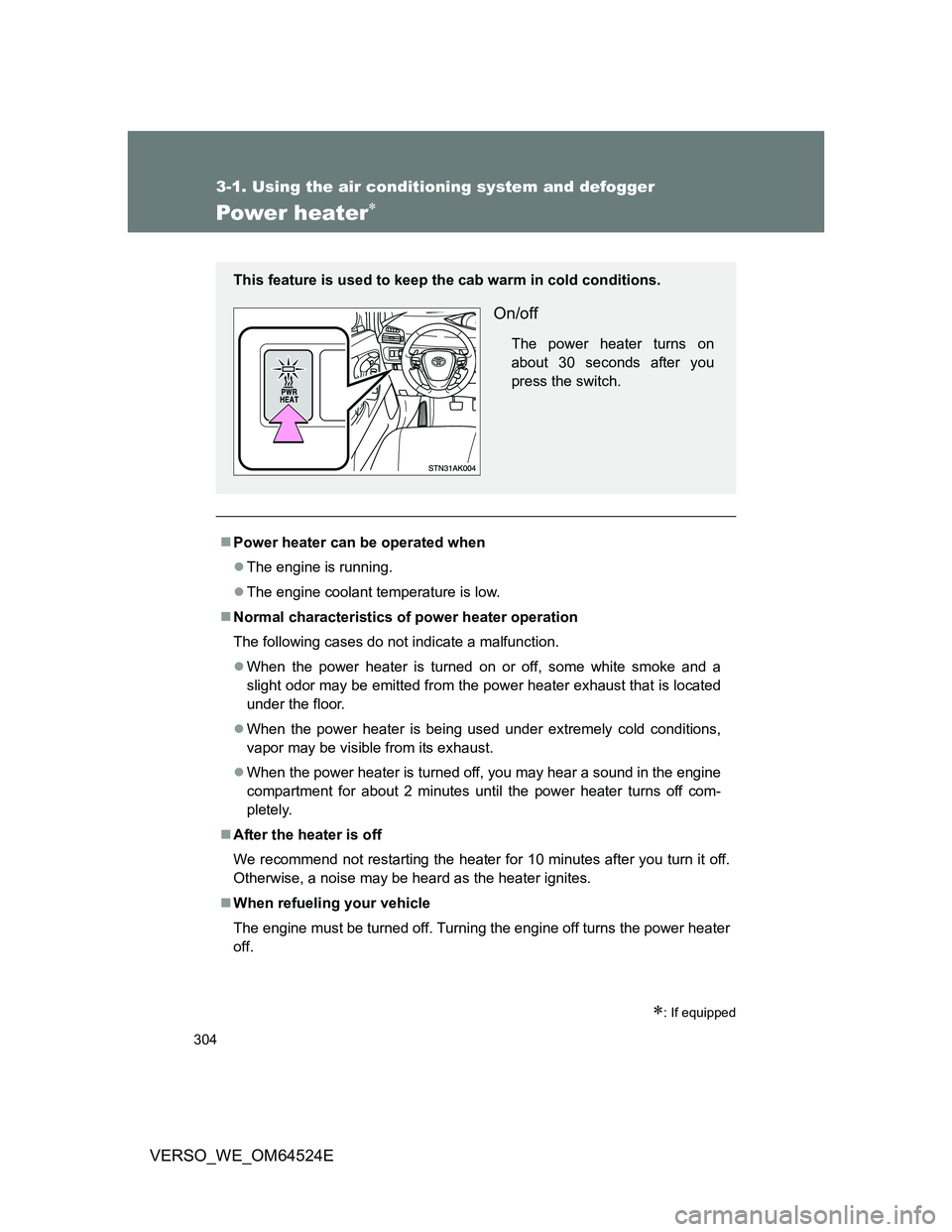
This feature is used to keep the cab warm in cold conditions.
On/off
The power heater turns on
about 30 seconds after you
press the switch.
Page 305 of 588
305 3-1. Using the air conditioning system and defogger
3
Interior features
VERSO_WE_OM64524E
CAUTION
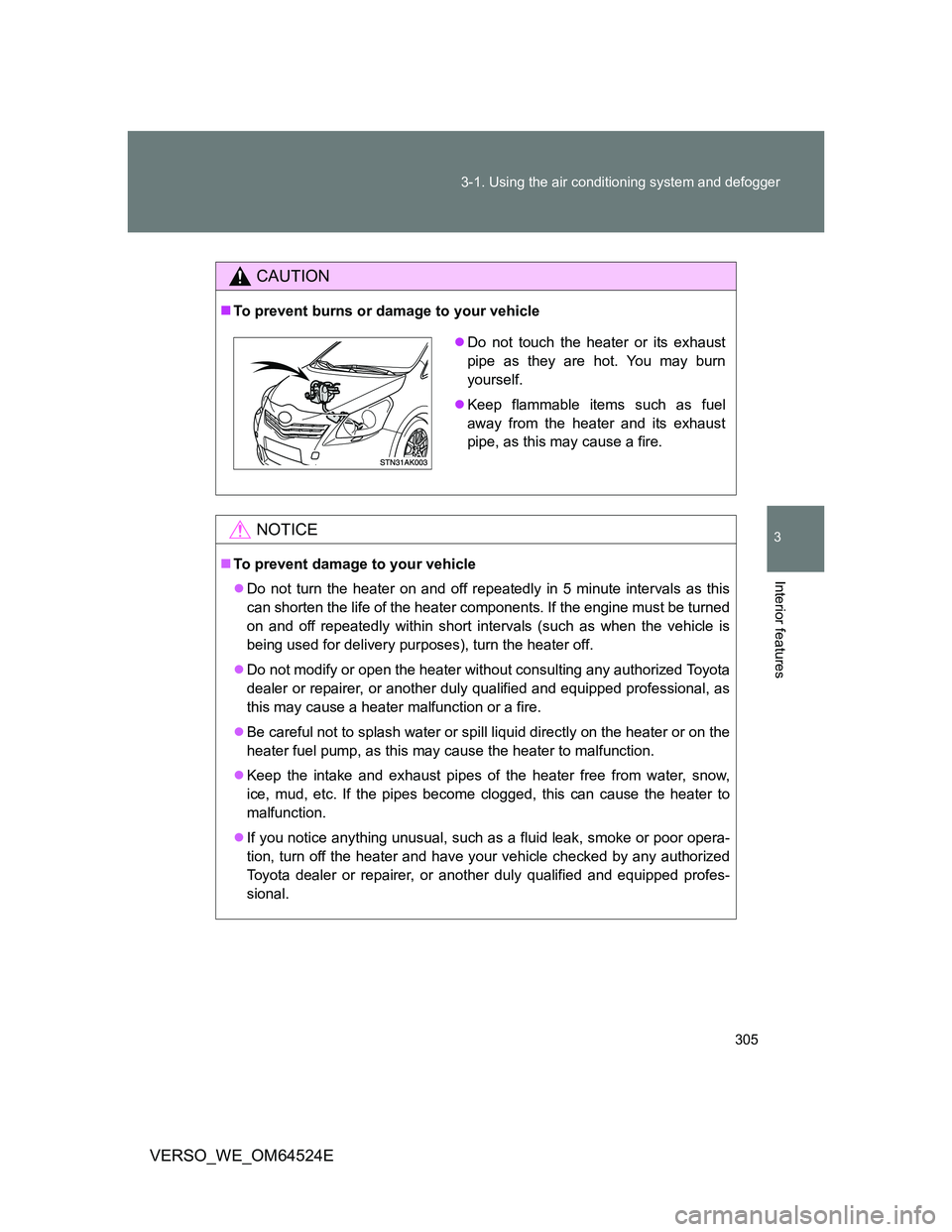
To prevent burns or damage to your vehicle
NOTICE
To prevent damage to your vehicle
Do not turn the heater on and off repeatedly in 5 minute intervals as this
can shorten the life of the heater components. If the engine must be turned
on and off repeatedly within short intervals (such as when the vehicle is
being used for delivery purposes), turn the heater off.
Do not modify or open the heater without consulting any authorized Toyota
dealer or repairer, or another duly qualified and equipped professional, as
this may cause a heater malfunction or a fire.
Be careful not to splash water or spill liquid directly on the heater or on the
heater fuel pump, as this may cause the heater to malfunction.
Keep the intake and exhaust pipes of the heater free from water, snow,
ice, mud, etc. If the pipes become clogged, this can cause the heater to
malfunction.
If you notice anything unusual, such as a fluid leak, smoke or poor opera-
tion, turn off the heater and have your vehicle checked by any authorized
Toyota dealer or repairer, or another duly qualified and equipped profes-
sional.
Do not touch the heater or its exhaust
pipe as they are hot. You may burn
yourself.
Keep flammable items such as fuel
away from the heater and its exhaust
pipe, as this may cause a fire.
Page 388 of 588
388
VERSO_WE_OM64524E
4-1. Maintenance and care
Cleaning and protecting the vehicle exterior
Automatic car washes
Fold the mirrors and remove the antenna before washing the vehicle.
Brushes used in automatic car washes may scratch the vehicle surface
and harm your vehicle’s paint.
Vehicles with rain-sensing windshield wipers: Turn the wipers off before
washing the vehicle. (P. 246)
High pressure car washes
Do not allow the nozzles of the car wash to come within close proximity
of the windows.
Before using car wash, check that the fuel filler door on your vehicle is
closed properly.
Perform the following to protect the vehicle and maintain it in prime
condition.
Working from top to bottom, liberally apply water to the vehicle
body, wheel wells and underside of the vehicle to remove any
dirt and dust.
Wash the vehicle body using a sponge or soft cloth, such as a
chamois.
For hard-to-remove marks, use car wash soap and rinse thor-
oughly with water.
Wipe away any water.
Wax the vehicle when the waterproof coating deteriorates.
If water does not bead on a clean surface, apply wax when the vehicle
body is cool.
Page 399 of 588
399 4-3. Do-it-yourself maintenance
4
Maintenance and care
VERSO_WE_OM64524E
CAUTION
The engine compartment contains many mechanisms and fluids that may
move suddenly, become hot, or become electrically energized. To avoid death
or serious injury, observe the following precautions.
When working on the engine compartment
Keep hands, clothing, and tools away from the moving fan and engine
drive belt.
Be careful not to touch the engine, radiator, exhaust manifold, etc. right
after driving as they may be hot. Oil and other fluids may also be hot.
Do not leave anything that may burn easily, such as paper or rags, in the
engine compartment.
Do not smoke, cause sparks or expose an open flame to fuel or the bat-
tery. Fuel and battery fumes are flammable.
Be extremely cautious when working on the battery. It contains poisonous
and corrosive sulphuric acid.
Take care because brake fluid can harm your hands or eyes and damage
painted surfaces.
If fluid gets on your hands or in your eyes, flush the affected area with
clean water immediately.
If you still experience discomfort, see a doctor.
When working near the electric cooling fan or radiator grille
Vehicles without smart entry & start system: Be sure the engine switch is
in the “LOCK” position.
With the engine switch in the “ON” position, the electric cooling fan may
automatically start to run if the air conditioning is on and/or the coolant
temperature is high. (P. 415)
Vehicles with smart entry & start system: Be sure the “ENGINE START
STOP” switch is OFF.
With the “ENGINE START STOP” switch in IGNITION ON mode, the elec-
tric cooling fan may automatically start to run if the air conditioning is on
and/or the coolant temperature is high. (P. 415)
Safety glasses
Wear safety glasses to prevent flying or falling material, fluid spray, etc. from
getting in the eyes.
Page 406 of 588
406 4-3. Do-it-yourself maintenance
VERSO_WE_OM64524E
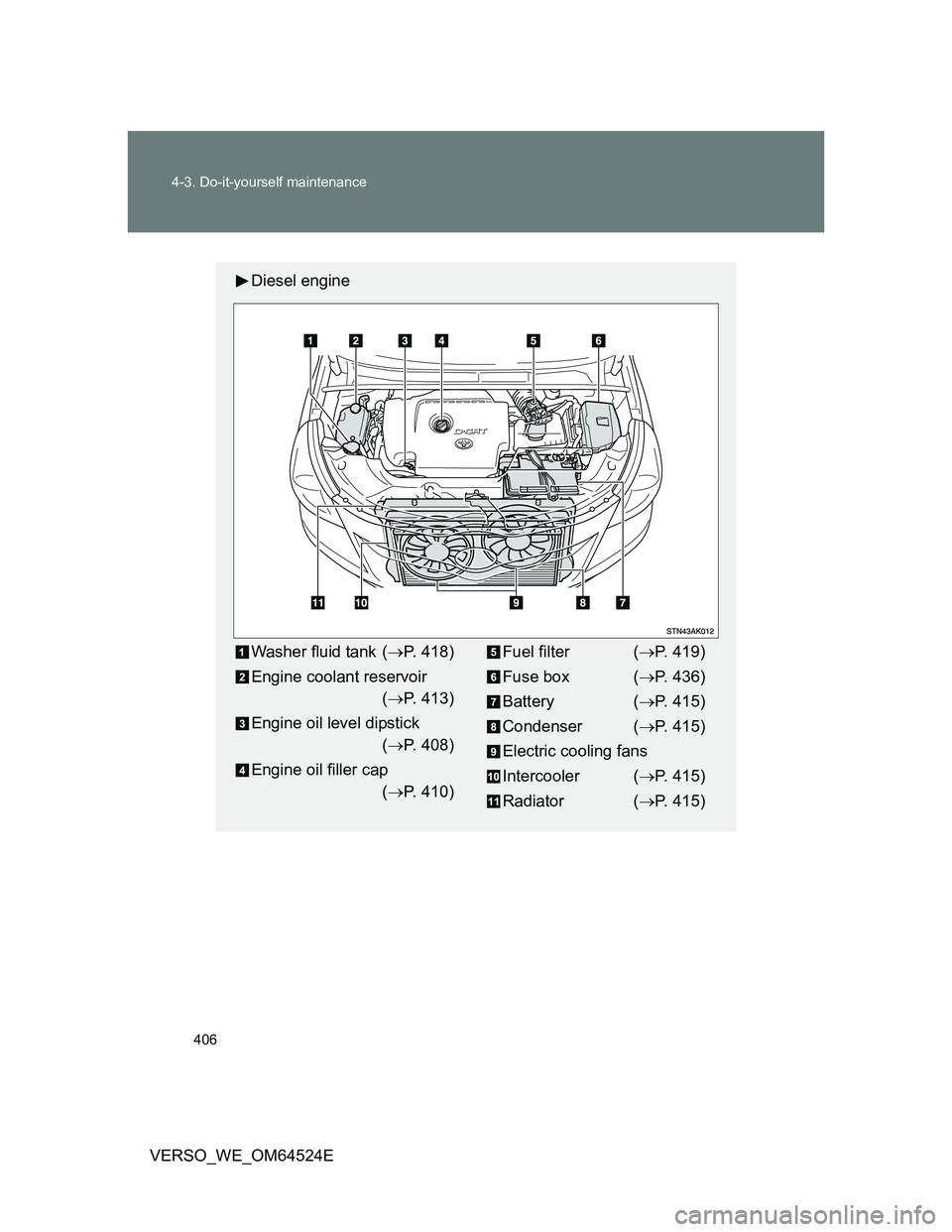
Diesel engine
Washer fluid tank (P. 418)
Engine coolant reservoir
(P. 413)
Engine oil level dipstick
(P. 408)
Engine oil filler cap
(P. 410)Fuel filter (P. 419)
Fuse box (P. 436)
Battery (P. 415)
Condenser (P. 415)
Electric cooling fans
Intercooler (P. 415)
Radiator (P. 415)