window TOYOTA VERSO 2012 Owner's Manual
[x] Cancel search | Manufacturer: TOYOTA, Model Year: 2012, Model line: VERSO, Model: TOYOTA VERSO 2012Pages: 588, PDF Size: 31.32 MB
Page 124 of 588
124 1-6. Theft deterrent system
VERSO_WE_OM64524E
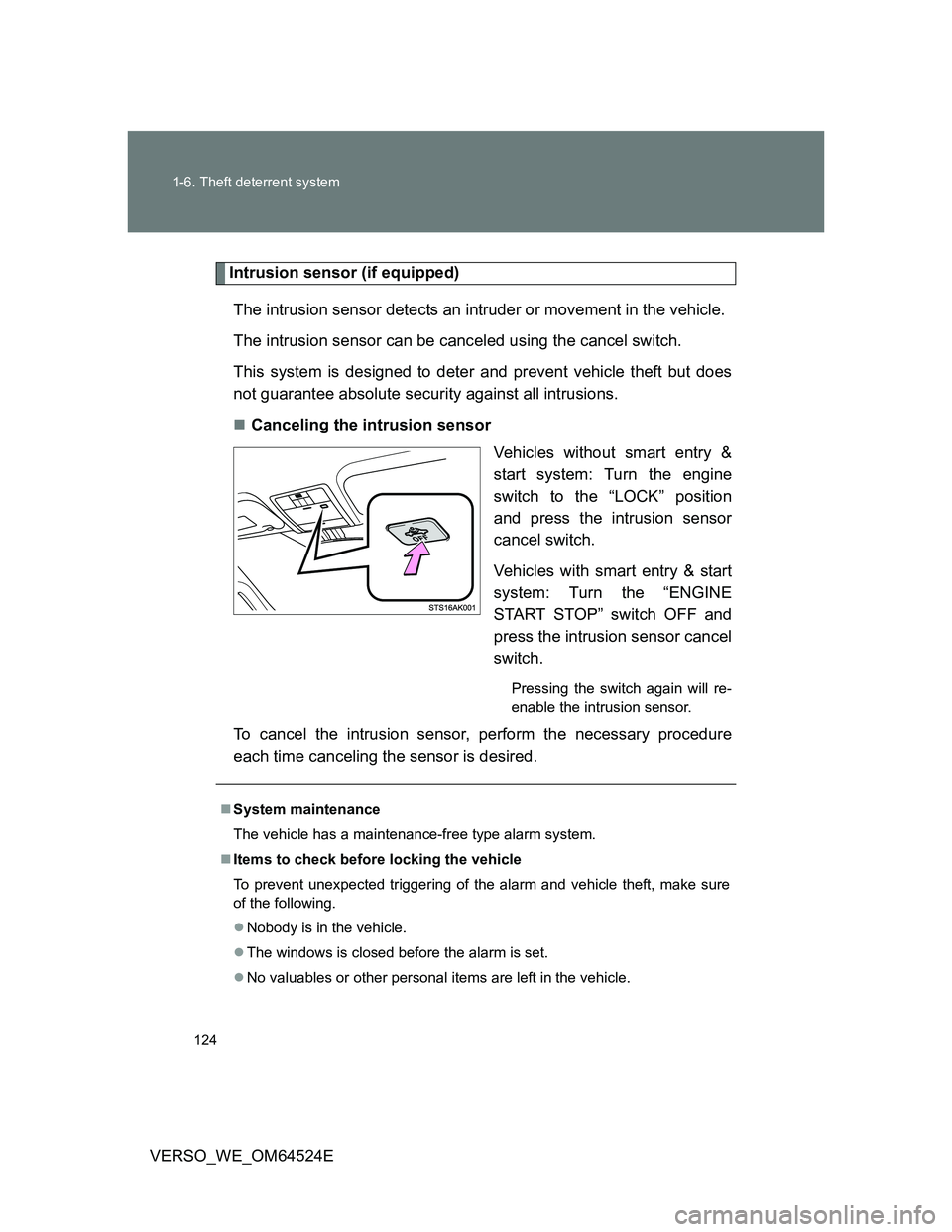
Intrusion sensor (if equipped)
The intrusion sensor detects an intruder or movement in the vehicle.
The intrusion sensor can be canceled using the cancel switch.
This system is designed to deter and prevent vehicle theft but does
not guarantee absolute security against all intrusions.
Canceling the intrusion sensor
Vehicles without smart entry &
start system: Turn the engine
switch to the “LOCK” position
and press the intrusion sensor
cancel switch.
Vehicles with smart entry & start
system: Turn the “ENGINE
START STOP” switch OFF and
press the intrusion sensor cancel
switch.
Pressing the switch again will re-
enable the intrusion sensor.
To cancel the intrusion sensor, perform the necessary procedure
each time canceling the sensor is desired.
System maintenance
The vehicle has a maintenance-free type alarm system.
Items to check before locking the vehicle
To prevent unexpected triggering of the alarm and vehicle theft, make sure
of the following.
Nobody is in the vehicle.
The windows is closed before the alarm is set.
No valuables or other personal items are left in the vehicle.
Page 127 of 588
127 1-6. Theft deterrent system
1
Before driving
VERSO_WE_OM64524E
Unstable items, such as dangling accessories or clothes hanging on the
coat hooks, are in the vehicle.
A window is open.
The vehicle is inside an automatic or high-pressure car washer.
The vehicle experiences impacts, such as hail, lightning strikes, or other
kinds of repeated impacts or vibrations.
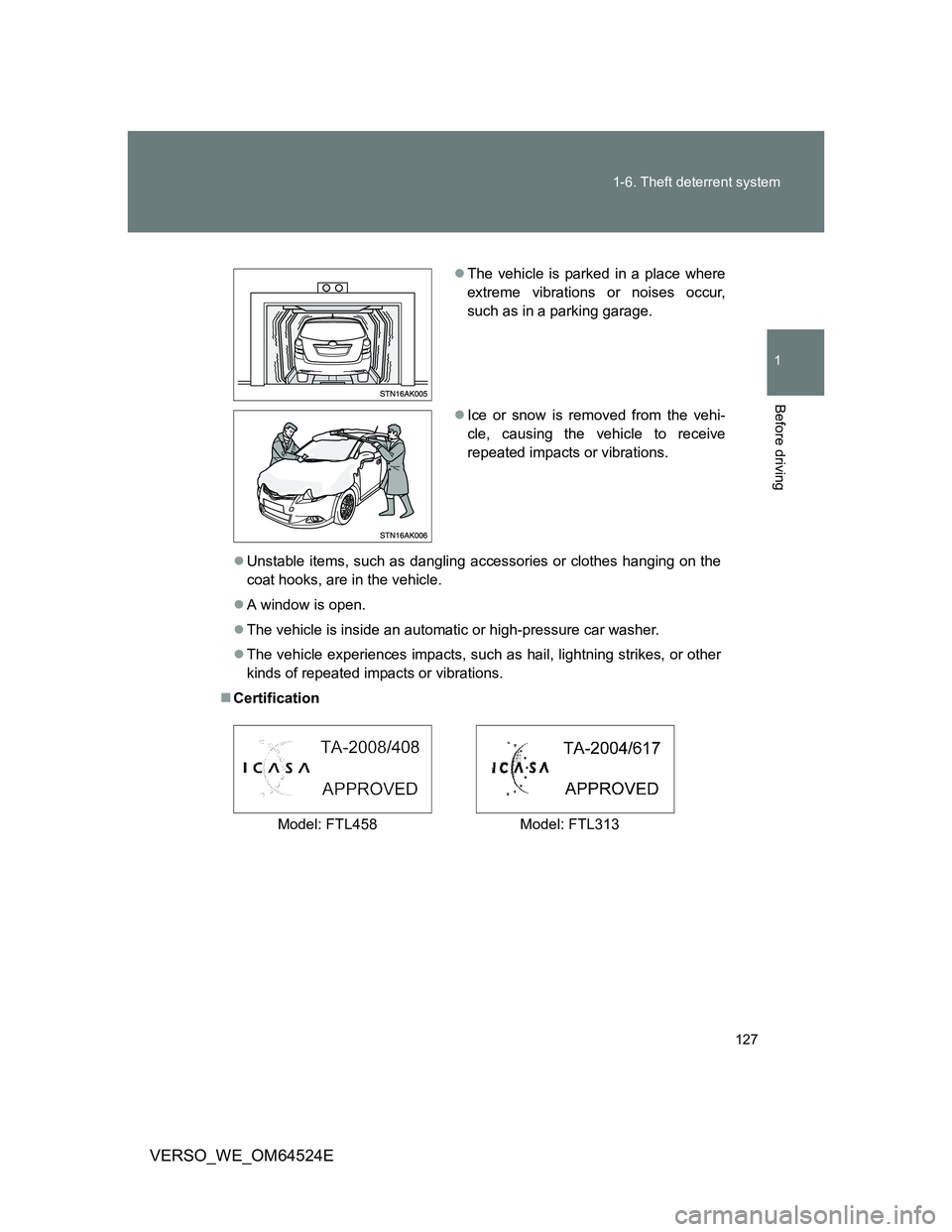
Certification
The vehicle is parked in a place where
extreme vibrations or noises occur,
such as in a parking garage.
Ice or snow is removed from the vehi-
cle, causing the vehicle to receive
repeated impacts or vibrations.
Model: FTL458 Model: FTL313
Page 144 of 588
144 1-7. Safety information
VERSO_WE_OM64524E
CAUTION
SRS airbag precautions
Do not touch any of the component parts immediately after the SRS air-
bags have deployed (inflated) as they may be hot.
If breathing becomes difficult after the SRS airbag has deployed, open a
door or window to allow fresh air in, or leave the vehicle if it is safe to do
so. Wash off any residue as soon as possible to prevent skin irritation.
Vehicles without SRS curtain shield airbags: If the areas where the SRS
airbags are stored, such as the steering wheel pad, are damaged or
cracked, have them replaced by any authorized Toyota dealer or repairer,
or another duly qualified and equipped professional.
Vehicles with SRS curtain shield airbags: If the areas where the SRS
airbags are stored, such as the steering wheel pad and front and rear pillar
garnishes, are damaged or cracked, have them replaced by any
authorized Toyota dealer or repairer, or another duly qualified and
equipped professional.
Modification and disposal of SRS airbag system components
Do not dispose of your vehicle or perform any of the following modifications
without consulting any authorized Toyota dealer or repairer, or another duly
qualified and equipped professional.
The SRS airbags may malfunction or deploy (inflate) accidentally, causing
death or serious injury.
Installation, removal, disassembly and repair of the SRS airbags.
Repairs, modifications, removal or replacement of the steering wheel,
instrument panel, dashboard, seats or seat upholstery, front, center and
rear pillars or roof side rail.
Repairs or modifications of the front fender, front bumper, or side of the
occupant compartment.
Installation of snow plows, winches, etc. to the front grille (bull bars, kan-
garoo bar etc.).
Modifications to the vehicle’s suspension system.
Installation of electronic devices such as RF-transmitter radios or CD play-
ers.
Page 171 of 588
2When driving
171
VERSO_WE_OM64524E
2-1. Driving procedures
Driving the vehicle ............ 172
Engine (ignition) switch
(vehicles without smart
entry & start system)....... 186
Engine (ignition) switch
(vehicles with smart
entry & start system)....... 190
Multidrive .......................... 196
Automatic transmission .... 202
Manual transmission......... 209
Turn signal lever ............... 213
Parking brake ................... 214
Horn .................................. 216
2-2. Instrument cluster
Gauges and meters .......... 217
Indicators and warning
lights ............................... 222
Multi-information display ... 226
2-3. Operating the lights and
wipers
Headlight switch ............... 239
Fog light switch ................. 244
Windshield wipers and
washer ............................ 246
Rear window wiper and
washer ............................ 2512-4. Using other driving systems
Cruise control.................... 252
Speed limiter ..................... 256
Toyota parking
assist-sensor .................. 259
Driving assist systems ...... 267
Hill-start assist control....... 273
2-5. Driving information
Cargo and luggage ........... 275
Winter driving tips ............. 278
Trailer towing .................... 282
Page 174 of 588
174 2-1. Driving procedures
VERSO_WE_OM64524E
Starting on a steep uphill
Multidrive or automatic transmission
Firmly set the parking brake and shift the shift lever to “D” or
“M”.
Gently depress the accelerator pedal.
Release the parking brake.
Manual transmission
With the parking brake set and the clutch pedal fully
depressed, shift the shift lever to “1”.
Lightly depress the accelerator pedal at the same time as
gradually releasing the clutch pedal.
Release the parking brake. (P. 214)
Hill-Start Assist Control (vehicles with VSC+)
The hill-start assist control allows you to smoothly start off the vehicle on a
steep or slippery uphill incline. (P. 273)
Driving in the rain
Drive carefully when it is raining, because visibility will be reduced, the
windows may become fogged-up, and the road will be slippery.
Drive carefully when it starts to rain, because the road surface will be
especially slippery.
Refrain from high speeds when driving on an expressway in the rain,
because there may be a layer of water between the tires and the road
surface, preventing the steering and brakes from operating properly.
Page 177 of 588
177 2-1. Driving procedures
2
When driving
VERSO_WE_OM64524E
CAUTION
When starting the vehicle (vehicles with a Multidrive or an automatic
transmission)
Always keep your foot on the brake pedal while stopped with the engine run-
ning. This prevents the vehicle from creeping.
When driving the vehicle
Do not drive if you are unfamiliar with the location of the brake and accel-
erator pedals to avoid depressing the wrong pedal.
• Accidentally depressing the accelerator pedal instead of the brake
pedal will result in sudden acceleration that may lead to an accident
that could result in death or serious injury.
• When backing up, you may twist your body around, leading to a diffi-
culty in operating the pedals. Make sure to operate the pedals properly.
• Make sure to keep a correct driving posture even when moving the
vehicle only slightly, allowing you to depress the brake and accelerator
pedals properly.
• Depress the brake pedal using your right foot. Depressing the brake
pedal using your left foot may delay response in an emergency, result-
ing in an accident.
Do not drive the vehicle over or stop the vehicle near flammable materials.
The exhaust system and exhaust gases can be extremely hot. This may
cause a fire if there is any flammable material nearby.
Vehicles with a Multidrive or an automatic transmission: Do not let the
vehicle roll backwards while the shift lever is in a driving position, or roll
forward while the shift lever is in “R”.
Doing so may cause the engine to stall or lead to poor brake performance,
resulting in an accident or damage to the vehicle.
If the smell of exhaust is noticed inside the vehicle, open the windows and
check that the back door is closed.
Large amounts of exhaust in the vehicle can cause driver drowsiness and
an accident, resulting in death or a serious health hazard. Have the vehi-
cle inspected by any authorized Toyota dealer or repairer, or another duly
qualified and equipped professional immediately.
Page 251 of 588
251
2-3. Operating the lights and wipers
2
When driving
VERSO_WE_OM64524E
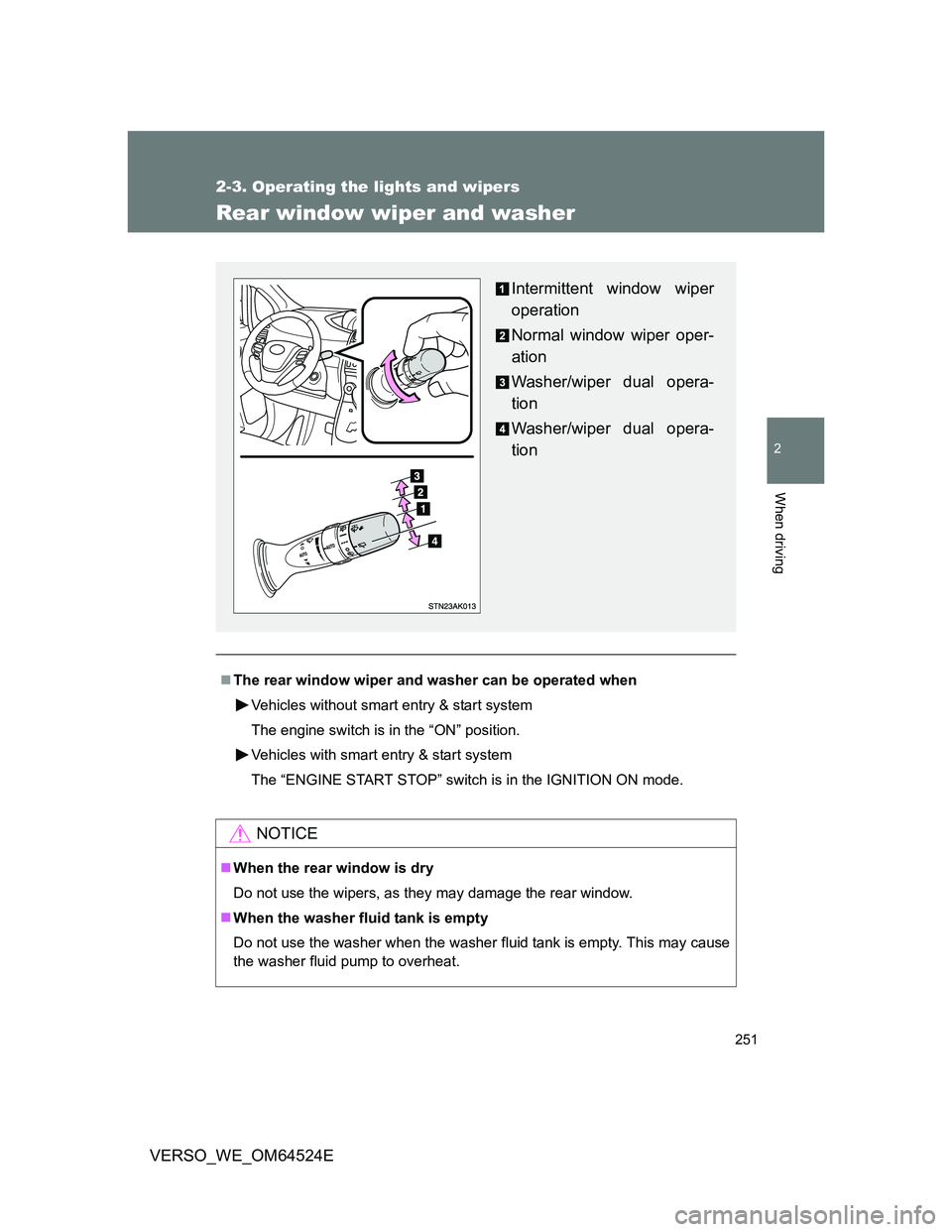
Rear window wiper and washer
The rear window wiper and washer can be operated when
Vehicles without smart entry & start system
The engine switch is in the “ON” position.
Vehicles with smart entry & start system
The “ENGINE START STOP” switch is in the IGNITION ON mode.
NOTICE
When the rear window is dry
Do not use the wipers, as they may damage the rear window.
When the washer fluid tank is empty
Do not use the washer when the washer fluid tank is empty. This may cause
the washer fluid pump to overheat.
Intermittent window wiper
operation
Normal window wiper oper-
ation
Washer/wiper dual opera-
tion
Washer/wiper dual opera-
tion
Page 279 of 588
279 2-5. Driving information
2
When driving
VERSO_WE_OM64524E
Before driving the vehicle
Perform the following according to the driving conditions:
Do not try to forcibly open a window or move a wiper that is
frozen. Pour warm water over the frozen area to melt the ice.
Wipe away the water immediately to prevent it from freezing.
To ensure proper operation of the climate control system fan,
remove any snow that has accumulated on the air inlet vents
in front of the windshield.
Remove any ice that has accumulated on the vehicle chassis.
Periodically check for and remove any excess ice or snow
that may have accumulated in the wheel well or on the
brakes.
When driving the vehicle
Accelerate the vehicle slowly and drive at a reduced speed suit-
able to road conditions.
When parking the vehicle
Park the vehicle and move the shift lever to “P” (Multidrive or
automatic transmission) or to “1” or “R” (manual transmission)
without setting the parking brake. The parking brake may freeze
up, preventing it from being released. If necessary, block the
wheels to prevent inadvertent sliding or creeping.
Page 291 of 588
3Interior features
291
VERSO_WE_OM64524E
3-1. Using the air conditioning
system and defogger
Manual air conditioning
system ............................ 292
Automatic air conditioning
system ............................ 297
Power heater .................... 304
Rear window and outside
rear view mirror
defoggers ....................... 306
3-2. Using the audio system
Audio system types .......... 308
Using the radio ................. 314
Using the CD player ......... 319
Playing back MP3 and
WMA discs...................... 324
Operating an iPod............. 330
Operating a USB
memory........................... 336
Optimal use of the audio
system ............................ 343
Using the AUX port ........... 345
Using the steering wheel
audio switches ................ 346
3-3. Using the interior lights
Interior lights list................ 349
• Personal/interior lights
main switch ..................... 350
• Personal/interior lights .... 3513-4. Using the storage features
List of storage features ..... 352
• Glove box ....................... 353
• Console box.................... 354
• Overhead console .......... 355
• Cup holders .................... 356
• Bottle holders.................. 357
• Auxiliary boxes ............... 358
3-5. Other interior features
Sun visors ......................... 361
Vanity mirror ..................... 362
Conversation mirror .......... 363
Portable ashtray................ 364
Cigarette lighter ................ 365
Power outlet ...................... 366
Seat heaters ..................... 368
Armrest ............................. 370
Front seatback table ......... 371
Panoramic roof shade....... 373
Rear side sunshades ........ 376
Floor mat........................... 377
Luggage compartment
features........................... 379
Page 294 of 588
294 3-1. Using the air conditioning system and defogger
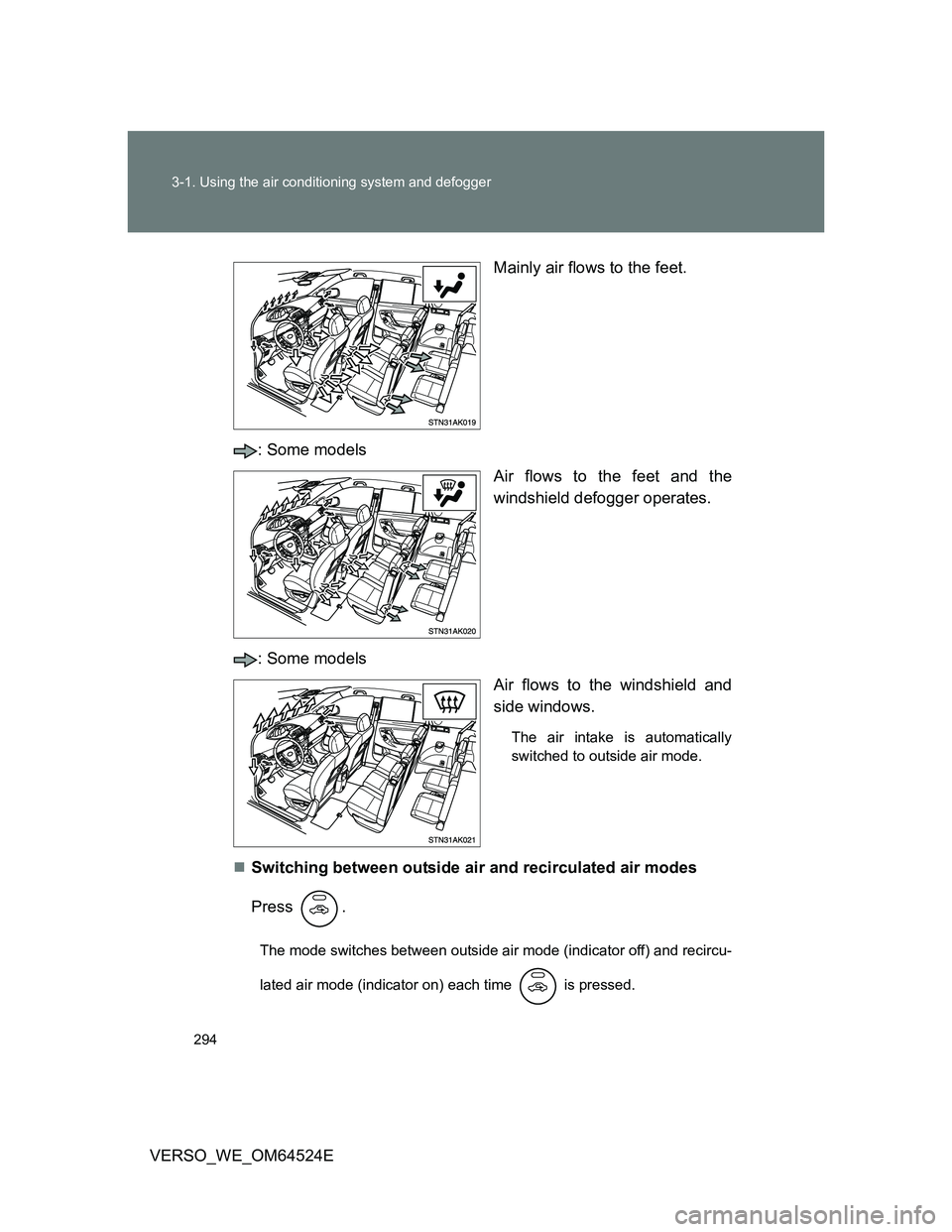
VERSO_WE_OM64524EMainly air flows to the feet.
: Some models
Air flows to the feet and the
windshield defogger operates.
: Some models
Air flows to the windshield and
side windows.
The air intake is automatically
switched to outside air mode.
Switching between outside air and recirculated air modes
Press .
The mode switches between outside air mode (indicator off) and recircu-
lated air mode (indicator on) each time is pressed.