stop start TOYOTA VERSO 2012 Workshop Manual
[x] Cancel search | Manufacturer: TOYOTA, Model Year: 2012, Model line: VERSO, Model: TOYOTA VERSO 2012Pages: 588, PDF Size: 31.32 MB
Page 267 of 588
267
2-4. Using other driving systems
2
When driving
VERSO_WE_OM64524E
Driving assist systems
To help enhance driving safety and performance, the following sys-
tems operate automatically in response to various driving situations.
Be aware, however, that these systems are supplementary and
should not be relied upon too heavily when operating the vehicle.
ABS (Anti-lock Brake System)
Helps to prevent wheel lock when the brakes are applied suddenly, or if
the brakes are applied while driving on a slippery road surface.
Brake assist
Generates an increased level of braking force after the brake pedal is
depressed, when the system detects a panic stop situation.
VSC+ (Vehicle Stability Control +) (if equipped)
Helps the driver to control skidding when swerving suddenly or turning
on slippery road surfaces.
TRC (Traction Control) (if equipped)
Maintains drive power and prevents the front wheels from spinning
when starting the vehicle or accelerating on slippery roads.
EPS (Electric Power Steering)
Employs an electric motor to reduce the amount of effort needed to turn
the steering wheel.
Page 269 of 588
269 2-4. Using other driving systems
2
When driving
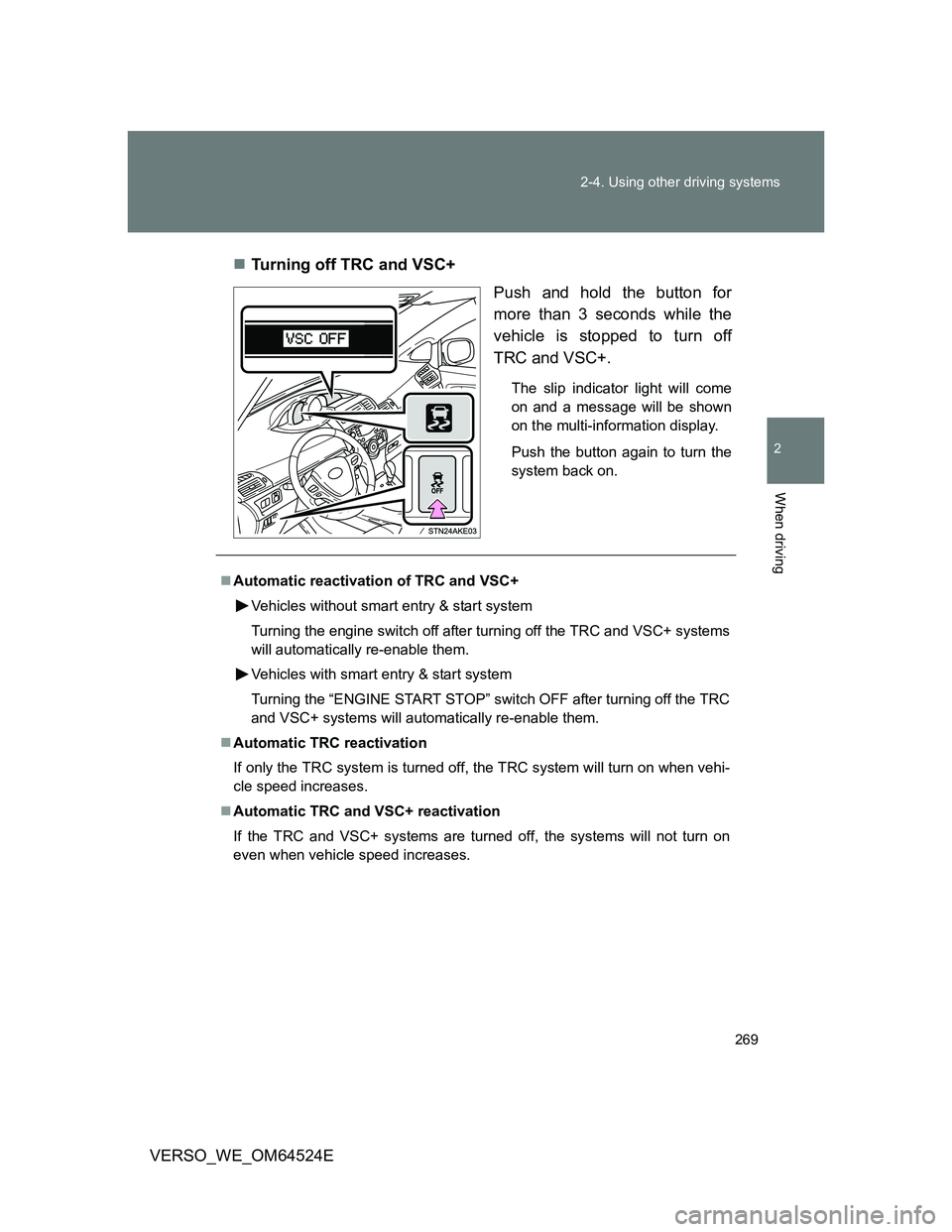
VERSO_WE_OM64524ETurning off TRC and VSC+
Push and hold the button for
more than 3 seconds while the
vehicle is stopped to turn off
TRC and VSC+.
The slip indicator light will come
on and a message will be shown
on the multi-information display.
Push the button again to turn the
system back on.
Automatic reactivation of TRC and VSC+
Vehicles without smart entry & start system
Turning the engine switch off after turning off the TRC and VSC+ systems
will automatically re-enable them.
Vehicles with smart entry & start system
Turning the “ENGINE START STOP” switch OFF after turning off the TRC
and VSC+ systems will automatically re-enable them.
Automatic TRC reactivation
If only the TRC system is turned off, the TRC system will turn on when vehi-
cle speed increases.
Automatic TRC and VSC+ reactivation
If the TRC and VSC+ systems are turned off, the systems will not turn on
even when vehicle speed increases.
Page 270 of 588
270 2-4. Using other driving systems
VERSO_WE_OM64524E
Sounds and vibrations caused by the ABS, brake assist, TRC and
VSC+
A sound may be heard from the engine compartment when the engine is
started or just after the vehicle begins to move. This sound does not indi-
cate that a malfunction has occurred in any of these systems.
Any of the following conditions may occur when the above systems are
operating. None of these indicates that a malfunction has occurred.
• Vibrations may be felt through the vehicle body and steering.
• A motor sound may be heard after the vehicle comes to a stop.
• The brake pedal may pulsate slightly after the ABS is activated.
• The brake pedal may move down slightly after the ABS is activated.
EPS operation sound
When the steering wheel operates, a motor sound (whirring sound) may be
heard. This does not indicate a malfunction.
Reduced effectiveness of EPS
The effectiveness of EPS is reduced to prevent the system from overheating
when there is frequent steering input over an extended period of time. The
steering wheel may feel heavy as a result. Should this occur, refrain from
excessive steering input or stop the vehicle and turn the engine off. The sys-
tem should return to normal after about 10 minutes.
Page 273 of 588
273
2-4. Using other driving systems
2
When driving
VERSO_WE_OM64524E
Hill-start assist control
: If equipped
Hill-start assist control operating conditions
The hill-start assist control system operates under the following condi-
tions.
• The shift lever is in a position other than “P”.
• The parking brake is not applied.
• The accelerator pedal is not depressed.
The hill-start assist control system does not operate when “CHECK VSC
SYSTEM” is displayed on the multi-information display.
Hill-start assist control
While hill-start assist control is operating, the brakes remain automati-
cally applied after the driver releases the brake pedal. The stop lights and
the high mounted stoplight turn on.
Hill-start assist control operates for about 2 seconds after the brake pedal
is released.
If the slip indicator does not flash and the buzzer does not sound when
the brake pedal is further depressed, slightly reduce the pressure on the
brake pedal (do not allow the vehicle to roll backward) and then firmly
depress it again. If the system still does not operate, check if the operat-
ing conditions explained above have been met.
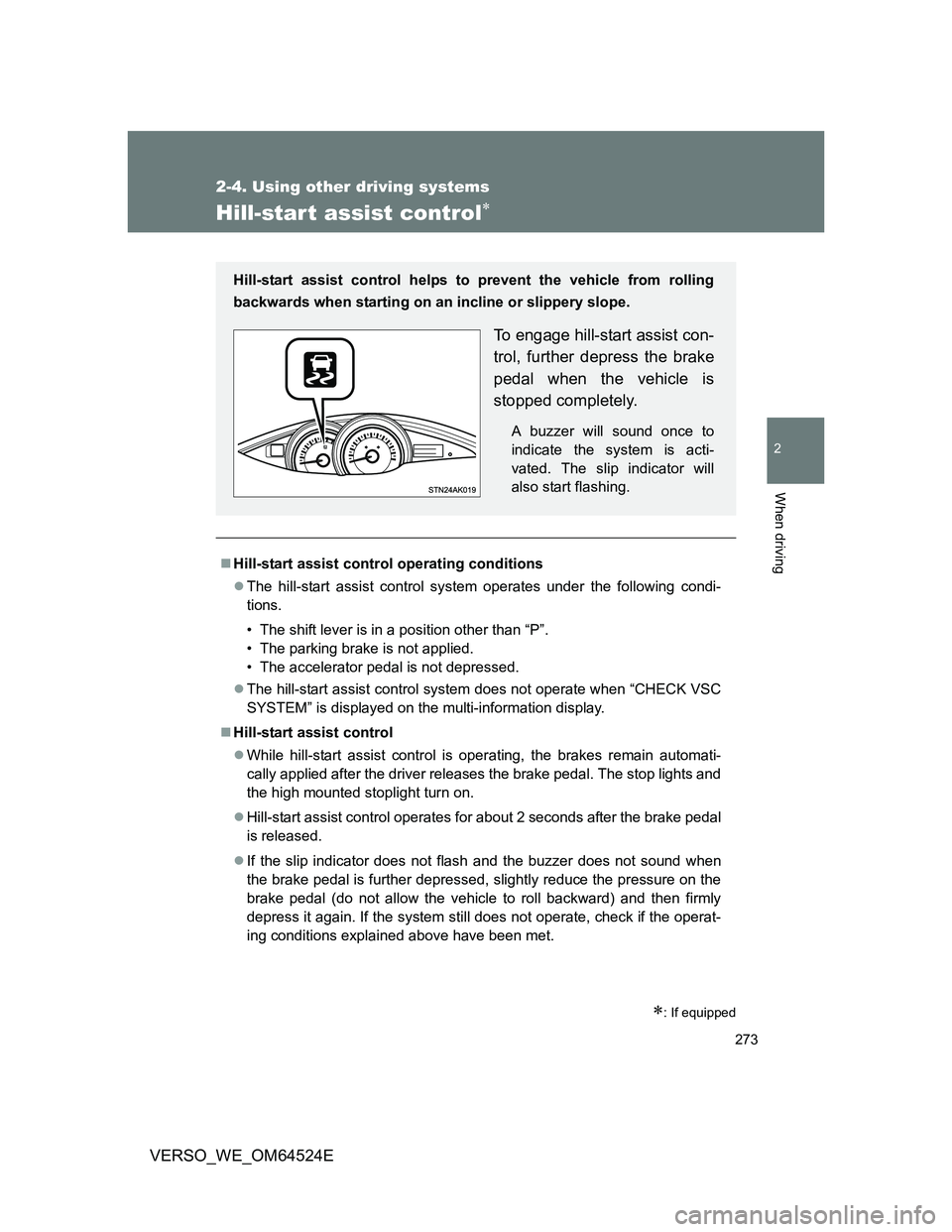
Hill-start assist control helps to prevent the vehicle from rolling
backwards when starting on an incline or slippery slope.
To engage hill-start assist con-
trol, further depress the brake
pedal when the vehicle is
stopped completely.
A buzzer will sound once to
indicate the system is acti-
vated. The slip indicator will
also start flashing.
Page 277 of 588
277 2-5. Driving information
2
When driving
VERSO_WE_OM64524E
CAUTION
Roof luggage carrier precautions (if equipped)
To use the roof rails as a roof luggage carrier, you must fit the roof rails with
two or more genuine Toyota cross rails or their equivalent.
Follow the manufacturer’s instructions and precautions when installing the
cross rails or their equivalent.
When you load cargo on the roof luggage carrier, observe the following:
Place the cargo so that its weight is distributed evenly between the front
and rear axles.
If loading long or wide cargo never exceed the vehicle overall length or
width.
Before driving, make sure the cargo is securely fastened on the roof lug-
gage carrier.
Loading cargo on the roof luggage carrier will make the center of the vehi-
cle gravity higher. Avoid high speeds, sudden starts, sharp turns, sudden
braking or abrupt maneuvers, otherwise it may result in loss of control or
vehicle rollover due to failure to operate this vehicle correctly and result in
death or serious injury.
If driving for a long distance, on rough roads, or at high speeds, stop the
vehicle now and then during the trip to make sure the cargo remains in its
place.
Do not exceed 100 kg (221 lb.) cargo weight on the roof rails. However, if
the allowable cargo weight of the cross rails is under 100 kg (221 lb.)
observe the load limit and other instructions for the cross rails.
Page 289 of 588
289 2-5. Driving information
2
When driving
VERSO_WE_OM64524EImportant points regarding turning
The wheels of the trailer will travel closer to the inside of the curve
than the wheels of the vehicle. To make allowance for this, take the
turns wider than you would normally.
Important points regarding stability
Vehicle movement resulting from uneven road surfaces and strong
crosswinds will affect handling. The vehicle may also be rocked by
passing buses or large trucks. Frequently check behind when mov-
ing alongside such vehicles. As soon as such vehicle movement
occurs, immediately start to decelerate smoothly by slowly apply-
ing the brakes. Always steer the vehicle straight ahead while brak-
ing.
Passing other vehicles
Consider the total combined length of your vehicle and trailer, and
ensure that the vehicle-to-vehicle distance is sufficient before exe-
cuting lane changes.
Transmission information
Multidrive or automatic transmission
To maintain engine braking efficiency, when using engine brak-
ing, do not use the transmission in “D”. Transmission shift gear
position must be in “4” in the 7-speed sport sequential shiftmatic
mode (Multidrive) (P. 196) or the “M” mode (automatic trans-
mission) (P. 202).
Manual transmission
To maintain engine braking efficiency, when using engine brak-
ing, do not use the transmission in “5” and “6” gear. (P. 209)
When towing a trailer, check the engine coolant temperature
warning light (Red)
Towing a loaded trailer up a long steep incline in temperatures
exceeding 30C (85F) may result in the engine overheating.
If the engine coolant temperature warning light (Red) flashes or
comes on, turn the air conditioning off immediately and stop the
vehicle in a safe place. (P. 532)
Page 303 of 588
303 3-1. Using the air conditioning system and defogger
3
Interior features
VERSO_WE_OM64524E
Air conditioning odors
During use, various odors from inside and outside the vehicle may enter
into and accumulate in the air conditioning system. This may then cause
odor to be emitted from the vents.
To reduce potential odors from occurring:
• It is recommended that the air conditioning system be set to outside air
mode prior to turning the vehicle off.
• The start timing of the blower may be delayed for a short period of time
immediately after the air conditioning system is started in AUTO mode.
CAUTION
To prevent the windshield from fogging up
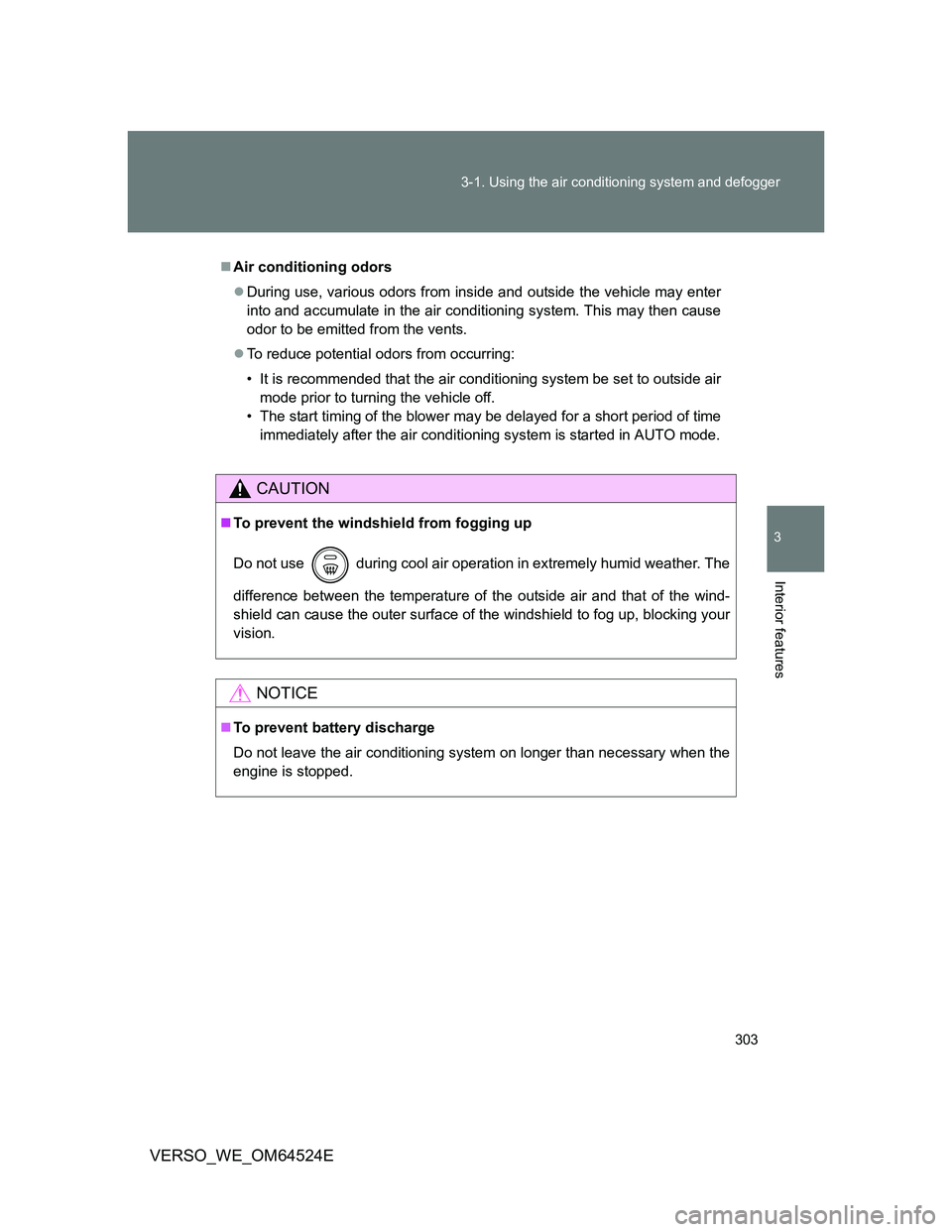
Do not use during cool air operation in extremely humid weather. The
difference between the temperature of the outside air and that of the wind-
shield can cause the outer surface of the windshield to fog up, blocking your
vision.
NOTICE
To prevent battery discharge
Do not leave the air conditioning system on longer than necessary when the
engine is stopped.
Page 307 of 588
307 3-1. Using the air conditioning system and defogger
3
Interior features
VERSO_WE_OM64524E
The rear window and outside rear view mirror defoggers can be oper-
ated when
Vehicles without smart entry & start system
The engine switch is in the “ON” position.
Vehicles with smart entry & start system
The “ENGINE START STOP” switch is in IGNITION ON mode.
CAUTION
When the outside rear view mirror defoggers are on (if equipped)
Do not touch the rear view mirror surfaces, as they can become very hot and
burn you.
Page 349 of 588
349
3
Interior features
VERSO_WE_OM64524E
3-3. Using the interior lights
Interior lights list
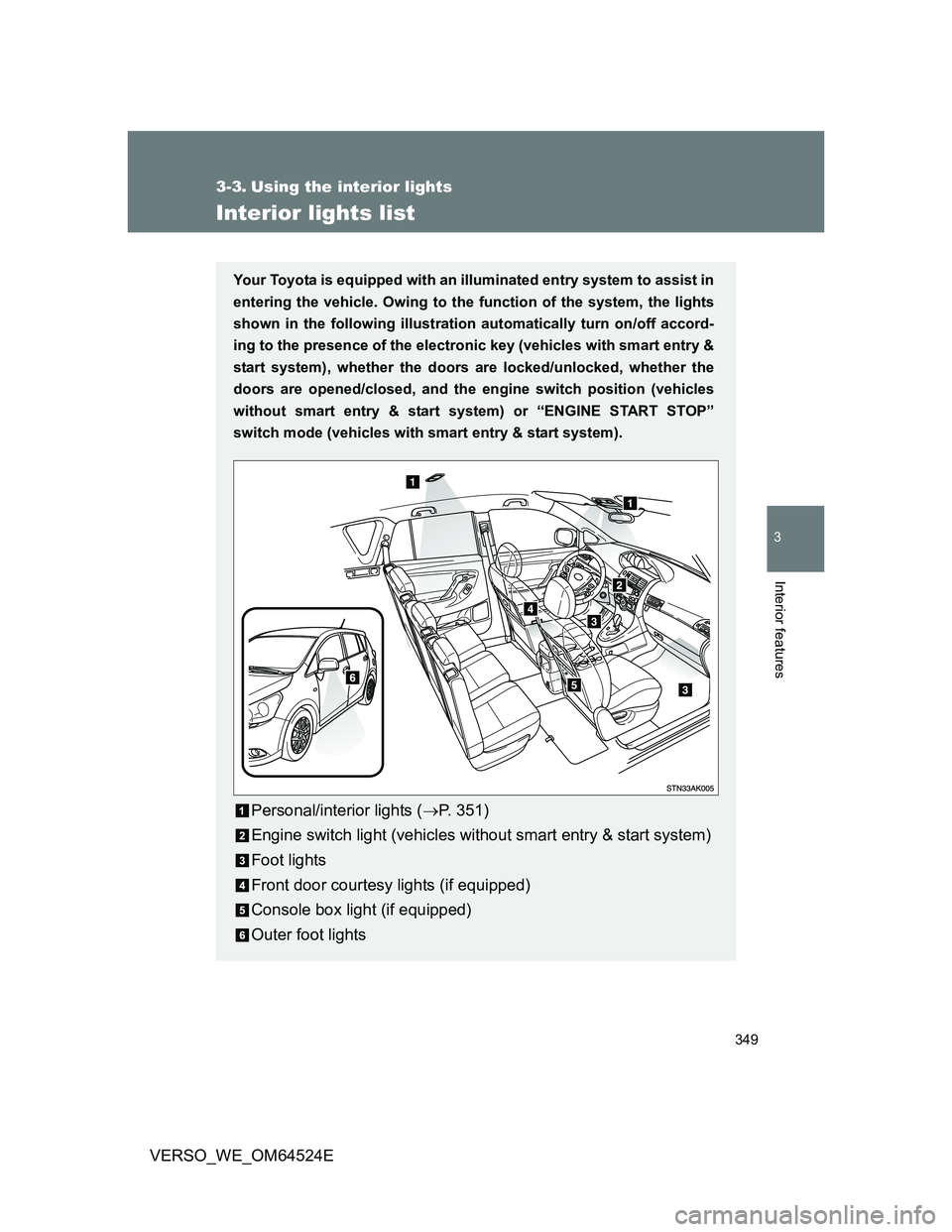
Your Toyota is equipped with an illuminated entry system to assist in
entering the vehicle. Owing to the function of the system, the lights
shown in the following illustration automatically turn on/off accord-
ing to the presence of the electronic key (vehicles with smart entry &
start system), whether the doors are locked/unlocked, whether the
doors are opened/closed, and the engine switch position (vehicles
without smart entry & start system) or “ENGINE START STOP”
switch mode (vehicles with smart entry & start system).
Personal/interior lights (P. 351)
Engine switch light (vehicles without smart entry & start system)
Foot lights
Front door courtesy lights (if equipped)
Console box light (if equipped)
Outer foot lights
Page 365 of 588
365
3-5. Other interior features
3
Interior features
VERSO_WE_OM64524E
Cigarette lighter
The cigarette lighter can be used when
Vehicles without smart entry & start system
The engine switch is in the “ACC” or “ON” position.
Vehicles with smart entry & start system
The “ENGINE START STOP” switch is in ACCESSORY or IGNITION ON
mode.
CAUTION
To avoid burns or fires
Do not touch the metal parts of the cigarette lighter.
Do not hold the cigarette lighter down. It could overheat and cause a fire.
Do not insert anything other than the cigarette lighter into the outlet.
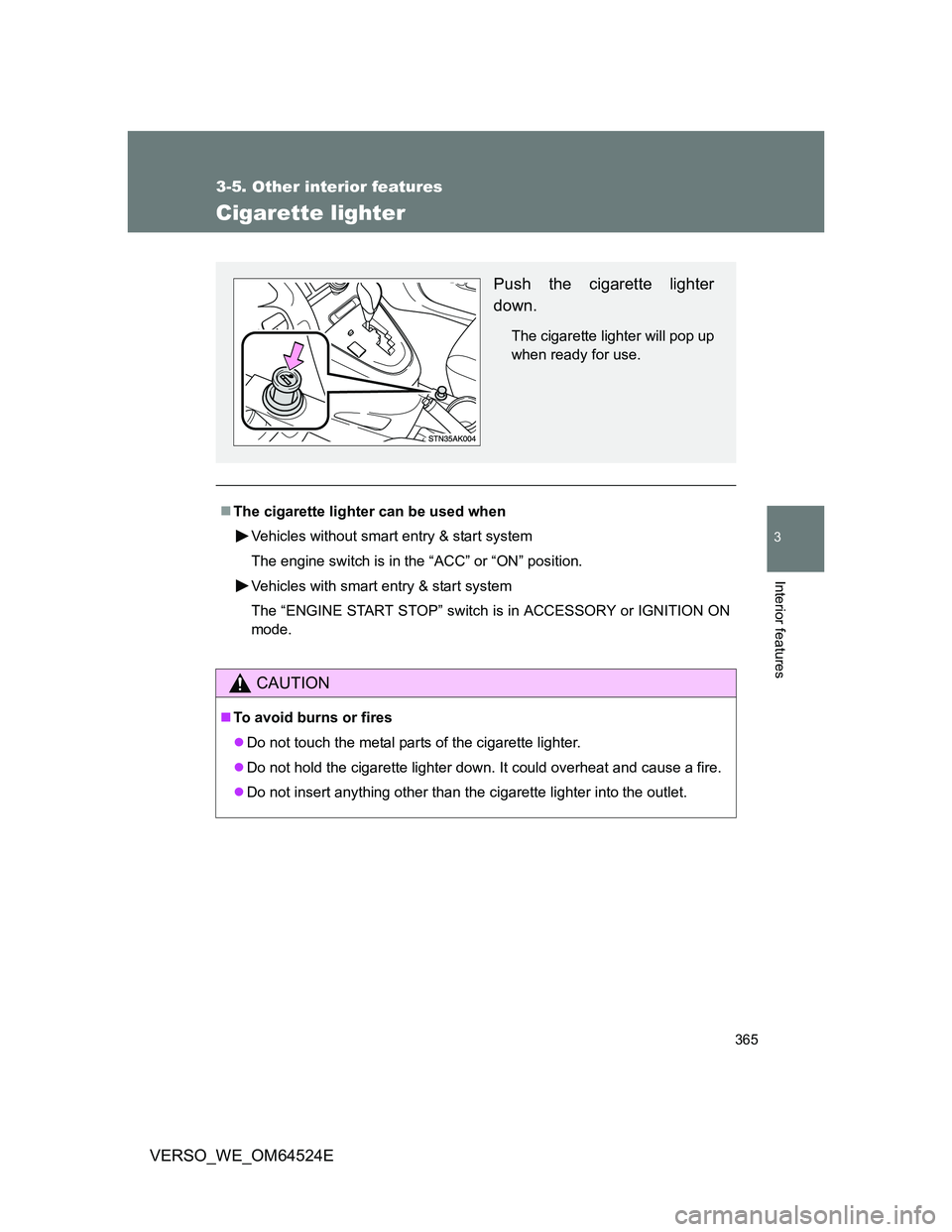
Push the cigarette lighter
down.
The cigarette lighter will pop up
when ready for use.