ESP TOYOTA VERSO 2016 User Guide
[x] Cancel search | Manufacturer: TOYOTA, Model Year: 2016, Model line: VERSO, Model: TOYOTA VERSO 2016Pages: 664, PDF Size: 62.24 MB
Page 154 of 664
154
1-7. Safety information
VERSO_EE_OM64590E
WARNING
■ SRS airbag precautions
Observe the following precautions regarding the SRS airbags.
Failure to do so may cause death or serious injury.
● The driver and all passengers in the vehicle must wear their seat belts
properly.
The SRS airbags are supplemental devices to be used with the seat belts.
● The SRS driver airbag deploys with considerable force, and can cause
death or serious injury especially if the driver is very close to the airbag.
Since the risk zone for the driver’s airbag is the first 50 - 75 mm (2 - 3 in.)
of inflation, placing yourself 250 mm ( 10 in.) from your driver airbag pro-
vides you with a clear margin of safety. This distance is measured from the
center of the steering wheel to your breastbone. If you sit less than
250 mm (10 in.) away now, you can change your driving position in several
ways:
• Move your seat to the rear as far as you can while still reaching the
pedals comfortably.
• Slightly recline the back of the seat.
Although vehicle designs vary, many drivers can achieve the 250 mm
(10 in.) distance, even with the driv er seat all the way forward, simply
by reclining the back of the seat somewhat. If reclining the back of your
seat makes it hard to see the road, raise yourself by using a firm, non-
slippery cushion, or raise the seat if your vehicle has that feature.
• If your steering wheel is adjustable, tilt it downward. This points the
airbag toward your chest instead of your head and neck.
The seat should be adjusted as recommended above, while still maintaining
control of the foot pedals, steering wheel, and your view of the instrument
panel controls.
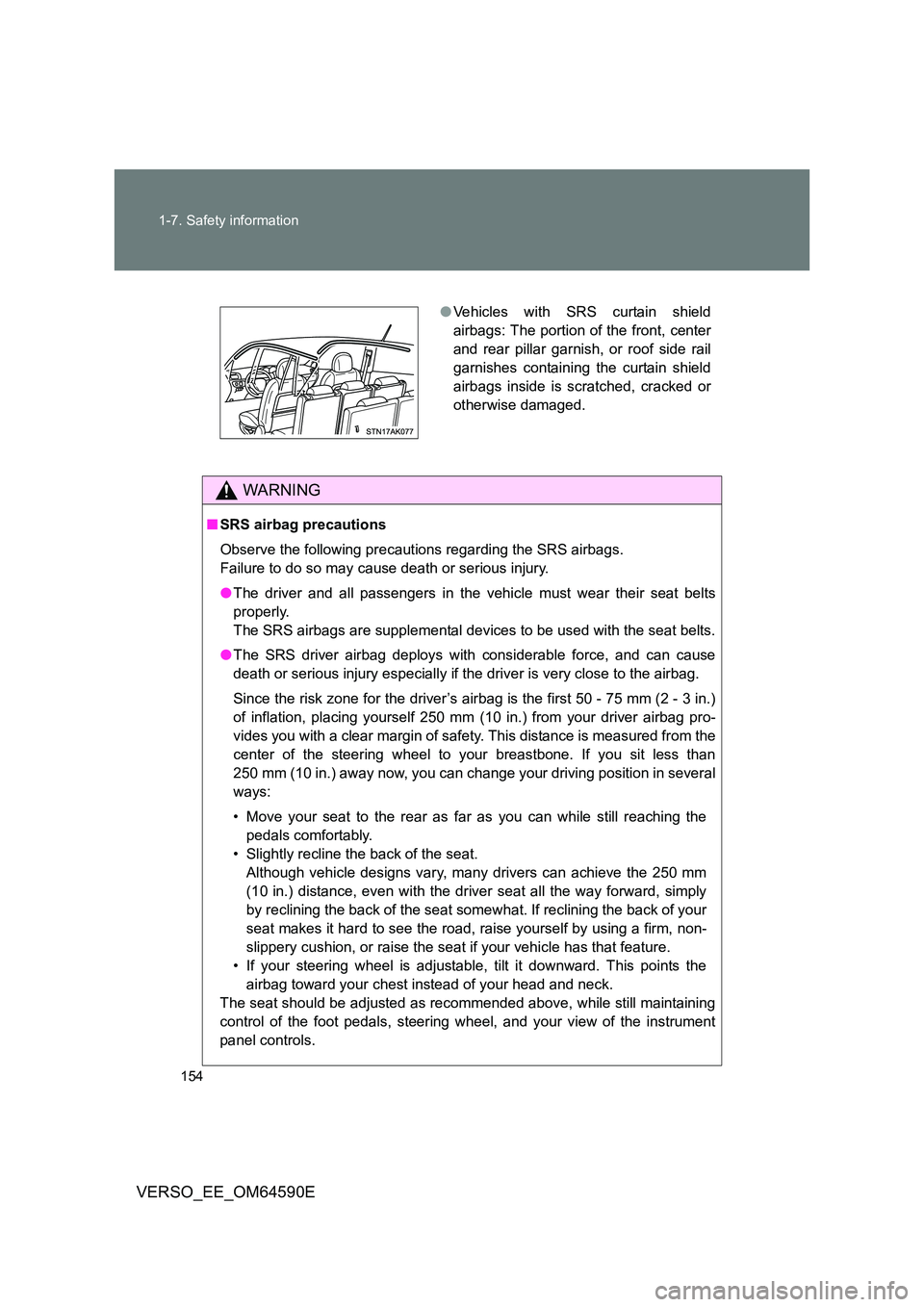
● Vehicles with SRS curtain shield
airbags: The portion of the front, center
and rear pillar garnish, or roof side rail
garnishes containing the curtain shield
airbags inside is scratched, cracked or
otherwise damaged.
Page 155 of 664
155
1-7. Safety information
1
Before driving
VERSO_EE_OM64590E
WARNING
■ SRS airbag precautions
● The SRS front passenger airbag also deploys with considerable force, and
can cause death or serious injury especially if the front passenger is very
close to the airbag. The front passenger seat should be as far from the
airbag as possible with the seatback adjusted, so the front passenger sits
upright.
● Improperly seated and/or restrained infants and children can be killed or
seriously injured by a deploying airbag. An infant or child who is too small
to use a seat belt should be properly secured using a child restraint sys-
tem. Toyota strongly recommends that all infants and children be placed in
the rear seats of the vehicle and proper ly restrained. The rear seats are
safest for infants and children than the front passenger seat. ( P. 159)
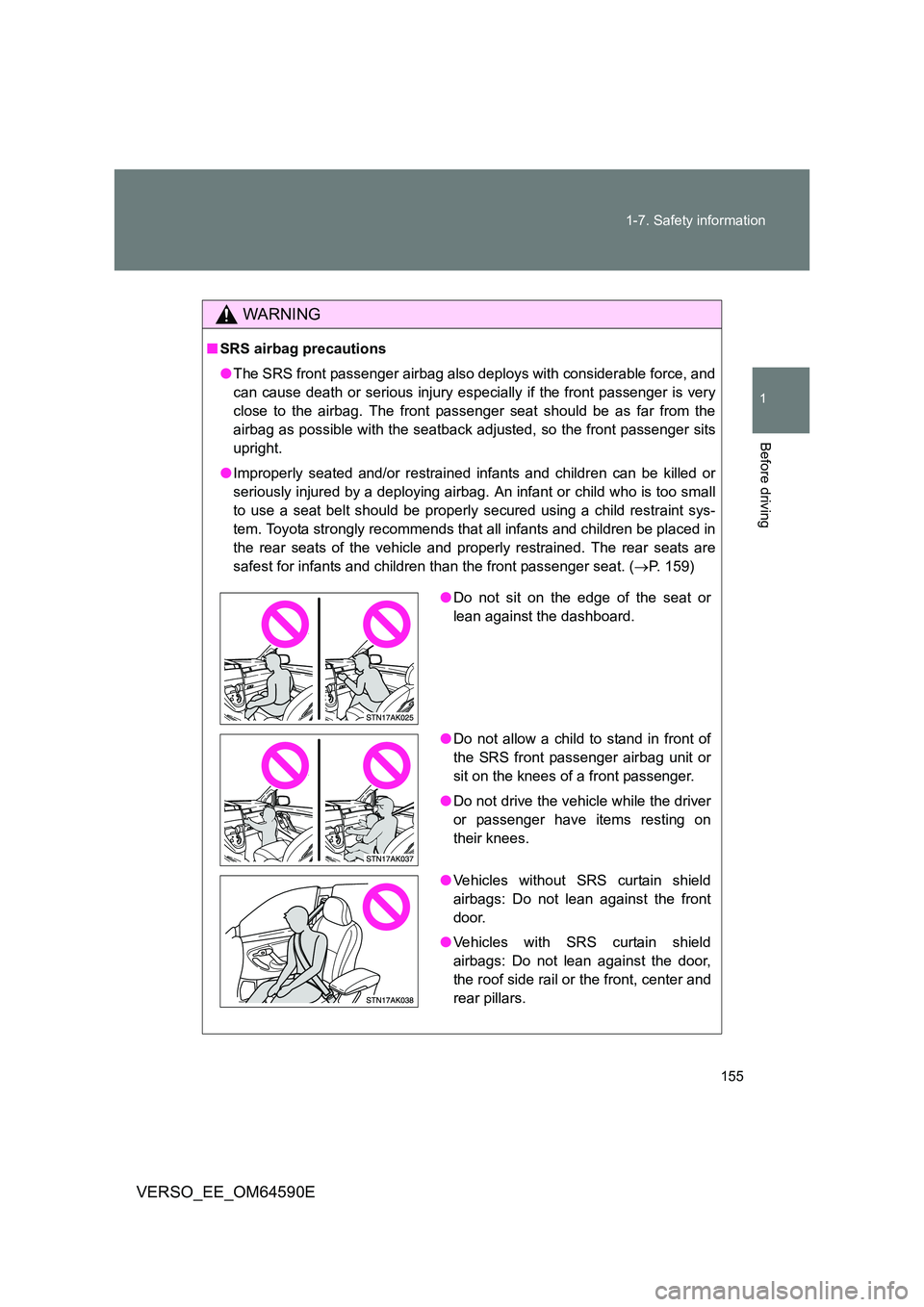
●Do not sit on the edge of the seat or
lean against the dashboard.
● Do not allow a child to stand in front of
the SRS front passenger airbag unit or
sit on the knees of a front passenger.
● Do not drive the vehicle while the driver
or passenger have items resting on
their knees.
● Vehicles without SRS curtain shield
airbags: Do not lean against the front
door.
● Vehicles with SRS curtain shield
airbags: Do not lean against the door,
the roof side rail or the front, center and
rear pillars.
Page 186 of 664
186
2-1. Driving procedures
VERSO_EE_OM64590E
Starting on a steep uphill
Multidrive
Firmly set the parking brake and shift the shift lever to “D” or
“M”.
Gently depress the accelerator pedal.
Release the parking brake.
Manual transmission
With the parking brake set and the clutch pedal fully
depressed, shift the shift lever to “1”.
Lightly depress the accelerator pedal at the same time as
gradually releasing the clutch pedal.
Release the parking brake.
■ Hill-start assist control
The hill-start assist control allows you to smoothly start off the vehicle on a
steep or slippery uphill incline. ( P. 311)
■ Driving in the rain
● Drive carefully when it is raining, because visibility will be reduced, the
windows may become fogged-up, and the road will be slippery.
● Drive carefully when it starts to rain, because the road surface will be
especially slippery.
● Refrain from high speeds when driving on an expressway in the rain,
because there may be a layer of water between the tires and the road
surface, preventing the steering and brakes from operating properly.
Page 189 of 664
189
2-1. Driving procedures
2
When driving
VERSO_EE_OM64590E
WARNING
■ When starting the vehicle (vehicles with a Multidrive)
Always keep your foot on the brake pedal while stopped with the engine run-
ning. This prevents the vehicle from creeping.
■ When driving the vehicle
● Do not drive if you are unfamiliar with the location of the brake and accel-
erator pedals to avoid depressing the wrong pedal.
• Accidentally depressing the accelerator pedal instead of the brake
pedal will result in sudden acceleration that may lead to an accident
that could result in death or serious injury.
• When backing up, you may twist your body around, leading to a diffi-
culty in operating the pedals. Make sure to operate the pedals properly.
• Make sure to keep a correct driving posture even when moving the
vehicle only slightly, allowing you to depress the brake and accelerator
pedals properly.
• Depress the brake pedal using your right foot. Depressing the brake
pedal using your left foot may delay response in an emergency, result-
ing in an accident.
● Do not drive the vehicle over or stop the vehicle near flammable materials.
The exhaust system and exhaust gases can be extremely hot. This may
cause a fire if there is any flammable material nearby.
● On vehicles with a Multidrive, do not let the vehicle roll backwards while
the shift lever is in a driving position, or roll forward while the shift lever is
in “R”.
Doing so may cause the engine to stall or lead to poor brake and steering
performance, resulting in an accident or damage to the vehicle.
● If the smell of exhaust is noticed inside the vehicle, open the windows and
check that the back door is closed.
Large amounts of exhaust in the vehicle can cause driver drowsiness and
an accident, resulting in death or a serious health hazard. Have the vehi-
cle inspected by any authorized Toyota dealer or repairer, or another duly
qualified and equipped professional immediately.
Page 243 of 664
243
2-2. Instrument cluster
2
When driving
VERSO_EE_OM64590E
■ Liquid crystal display
Small spots or light spots may appear on the display. This phenomenon is
characteristic of liquid crystal displays, and there is no problem to continue
using the display.
NOTICE
■ The multi-information display at low temperatures
Allow the interior of the vehicle to warm up before using the liquid crystal
information display. At extremely low temperatures, the information display
monitor may respond slowly, and display changes may be delayed.
Page 262 of 664
262
2-4. Toyota Safety Sense
VERSO_EE_OM64590E
Vehicle data recordings
The pre-collision system is equipped with a sophisticated computer
that will record certain data, such as:
• How far (if at all) the driver was depressing the accelerator and/or
brake pedal
• Vehicle speed
• Operation status of the pre-collision system functions
• Information (such as the distance and relative speed between your
vehicle and the vehicle ahead or another object)
The pre-collision system does not record conversations, sounds or
pictures.
● Data usage
Toyota may use the data recorded in these computers to diagnose
malfunctions, conduct research and development, and improve
quality.
Toyota will not disclose the recorded data to a third party except:
• With the consent of the vehicle owner or with the consent of the
lessee if the vehicle is leased
• In response to an official request by the police, a court of law or
a government agency
• For use by Toyota in a lawsuit
• For research purposes where the data is not tied to a specific
vehicle or vehicle owner
Page 275 of 664
275
2-4. Toyota Safety Sense
2
When driving
VERSO_EE_OM64590E
WARNING
■ Limitations of the pre-collision system
● The driver is solely responsible for safe driving. Always drive safely, taking
care to observe your surroundings.
Do not use the pre-collision system instead of normal braking operations
under any circumstances. This system will not prevent collisions or lessen
damage or injuries in every situation. Do not overly rely on this system.
Failure to do so may lead to an accident, resulting in death or serious
injury.
Although this system is designed to help avoid and reduce the impact of a
collision, its effectiveness may change according to various conditions
( P. 270). As a result, the system may not always provide the same level
of performance.
● The pre-collision braking function may not operate if certain operations are
performed by the driver. If the accelerator pedal is being depressed
strongly or the steering wheel is bei ng turned, the system may determine
that the driver is taking evasive action and possibly prevent the pre-colli-
sion braking function from operating.
● In some situations, while the pre-collision braking function is operating,
operation of the function may be canceled if the accelerator pedal is
depressed strongly or the steering w heel is turned and the system deter-
mines that the driver is taking evasive action.
● While driving, the system may recognize front obstacles, such as the
crossing gate of a railway crossing, as a collision objects and operate the
pre-collision brake.
In the event that the vehicle gets caught within the railroad crossing, move
the vehicle with the following actions and depending on the situation main-
tain safety.
• Depress the accelerator pedal after the vehicle has stopped
• Strongly depress the accelerator pedal when decelerating ( P. 271)
• Turn the pre-collision system OFF ( P. 269)
● A large amount of braking force is applied while the pre-collision braking
function is operating. Additionally, as the vehicle may creep after the pre-
collision braking function has operated, the driver should depress the
brake pedal as necessary.
Page 282 of 664
282
2-4. Toyota Safety Sense
VERSO_EE_OM64590E
■ When changing the tires
Depending on the tires used, sufficient performance may not be maintain-
able.
■ Warning messages for the LDA system
Warning messages are used to indicate a system malfunction or to inform
the driver of the need for caution while driving.
WARNING
■ Before using the LDA system
Do not rely solely on the LDA system. The LDA system does not drive the
vehicle automatically, nor does it reduce the amount of care you need to
take. As such, the driver must always assume full responsibility for under-
standing his/her surroundings, for operating the steering wheel to correct the
driving line, and for driving safely.
Inappropriate or negligent driving could lead to an accident.
■ To avoid operating the LDA by mistake
Switch the LDA system off using the LDA switch when not in use.
NOTICE
■ To prevent damage to or incorrect operation of the LDA system
● Do not modify the headlights or attach stickers to the surface of the lights.
● Do not modify the suspension. If your suspension needs repairs, contact
any authorized Toyota dealer or repairer, or another duly qualified and
equipped professional.
● Do not install or place anything on the hood or the grille. Also, do not install
a grille guard (bull bars, kangaroo bar etc.).
Page 299 of 664
299
2-5. Using other driving systems
2
When driving
VERSO_EE_OM64590E
■ Buzzer operation and distance to an obstacle
A buzzer sounds when the corner sensors and center sensors are
operating.
● The buzzer beeps faster as the vehicle approaches an obstacle.
When the vehicle comes within the following distance of the
obstacle, the buzzer sounds continuously.
• Front corner sensors: Approximately 30 cm (1.0 ft.)
• Front center sensors: Approximately 30 cm (1.0 ft.)
• Rear corner sensors: Approximately 30 cm (1.0 ft.)
• Rear center sensors: Approximately 35 cm (1.1 ft.)
● When obstacles are simultaneously detected in front and to the
rear:
• The buzzer sounds in response to the nearest obstacle.
• When an obstacle either in front or to the rear is extremely
close, the buzzer will alternate between sounding continu-
ously and sounding intermittently.
• When obstacles both in front and to the rear are extremely
close, the buzzer will alternate between sounding continu-
ously and sounding intermittently, with a shorter interval.
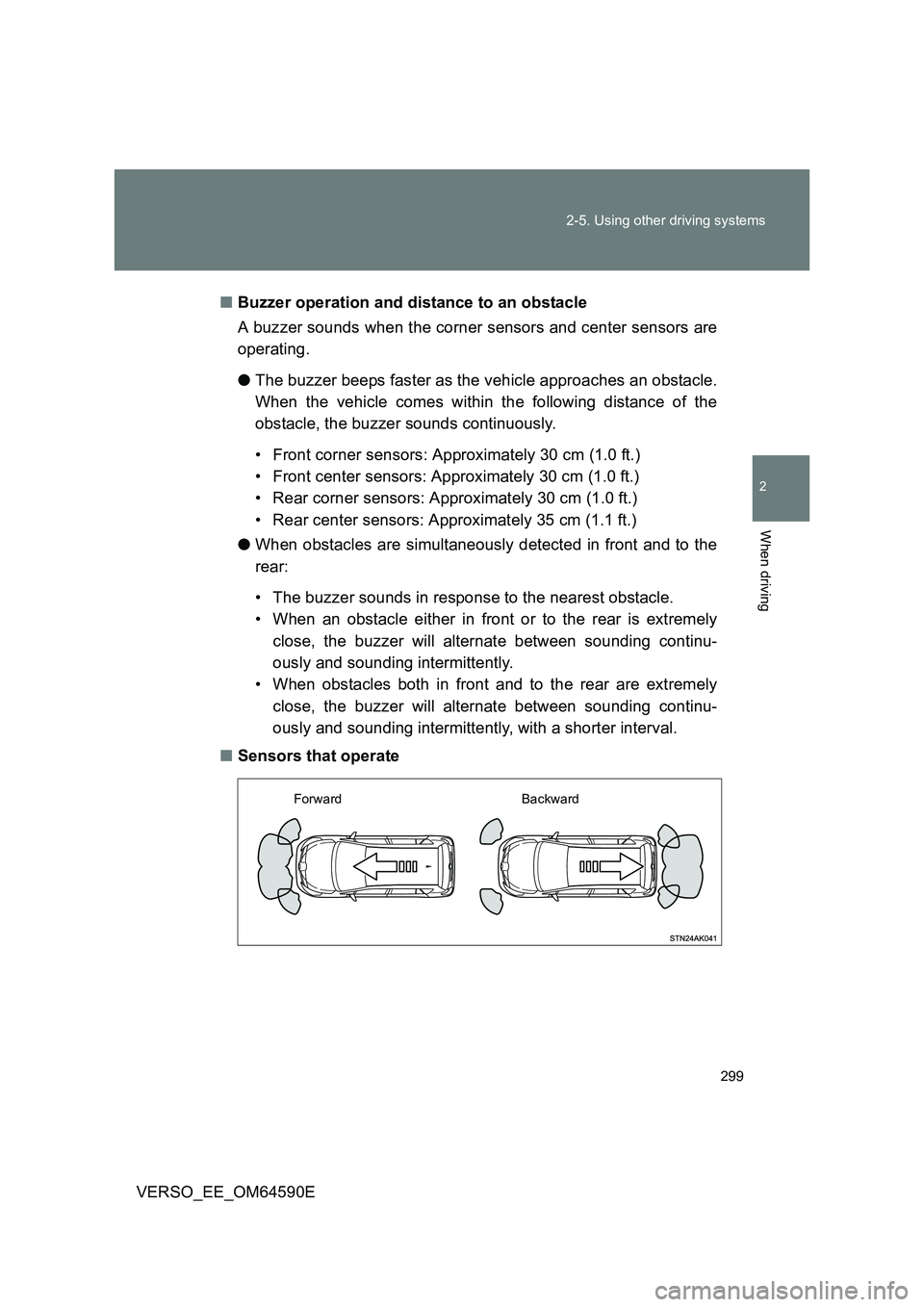
■ Sensors that operate
Forward Backward
Page 311 of 664
311
2-5. Using other driving systems
2
When driving
VERSO_EE_OM64590E
Driving assist systems
To help enhance driving safety and performance, the following sys-
tems operate automatically in resp onse to various driving situations.
Be aware, however, that these systems are supplementary and
should not be relied upon too heavily when operating the vehicle.
■ ABS (Anti-lock Brake System)
Helps to prevent wheel lock when the brakes are applied suddenly, or if
the brakes are applied while driving on a slippery road surface.
■ Brake assist
Generates an increased level of braking force after the brake pedal is
depressed, when the system detects a panic stop situation.
■ VSC+ (Vehicle Stability Control +)
Provides cooperative control of the ABS, TRC, VSC and EPS.
Helps to maintain directional stability when swerving on slippery road
surfaces by controlling steering performance.
■ TRC (Traction Control)
Helps to maintains drive power and prevents the front wheels from
spinning when starting the vehicle or accelerating on slippery roads.
■EPS (Electric Power Steering)
Employs an electric motor to reduce the amount of effort needed to turn
the steering wheel.
■ PCS (Pre-Collision System) (if equipped)
P. 267
■Hill-start assist control
Helps to prevent the vehicle from rolling backward when starting on an
incline or slippery slope.