fog light TOYOTA VERSO 2016 User Guide
[x] Cancel search | Manufacturer: TOYOTA, Model Year: 2016, Model line: VERSO, Model: TOYOTA VERSO 2016Pages: 664, PDF Size: 62.24 MB
Page 265 of 664
265
2-4. Toyota Safety Sense
2
When driving
VERSO_EE_OM64590E
NOTICE
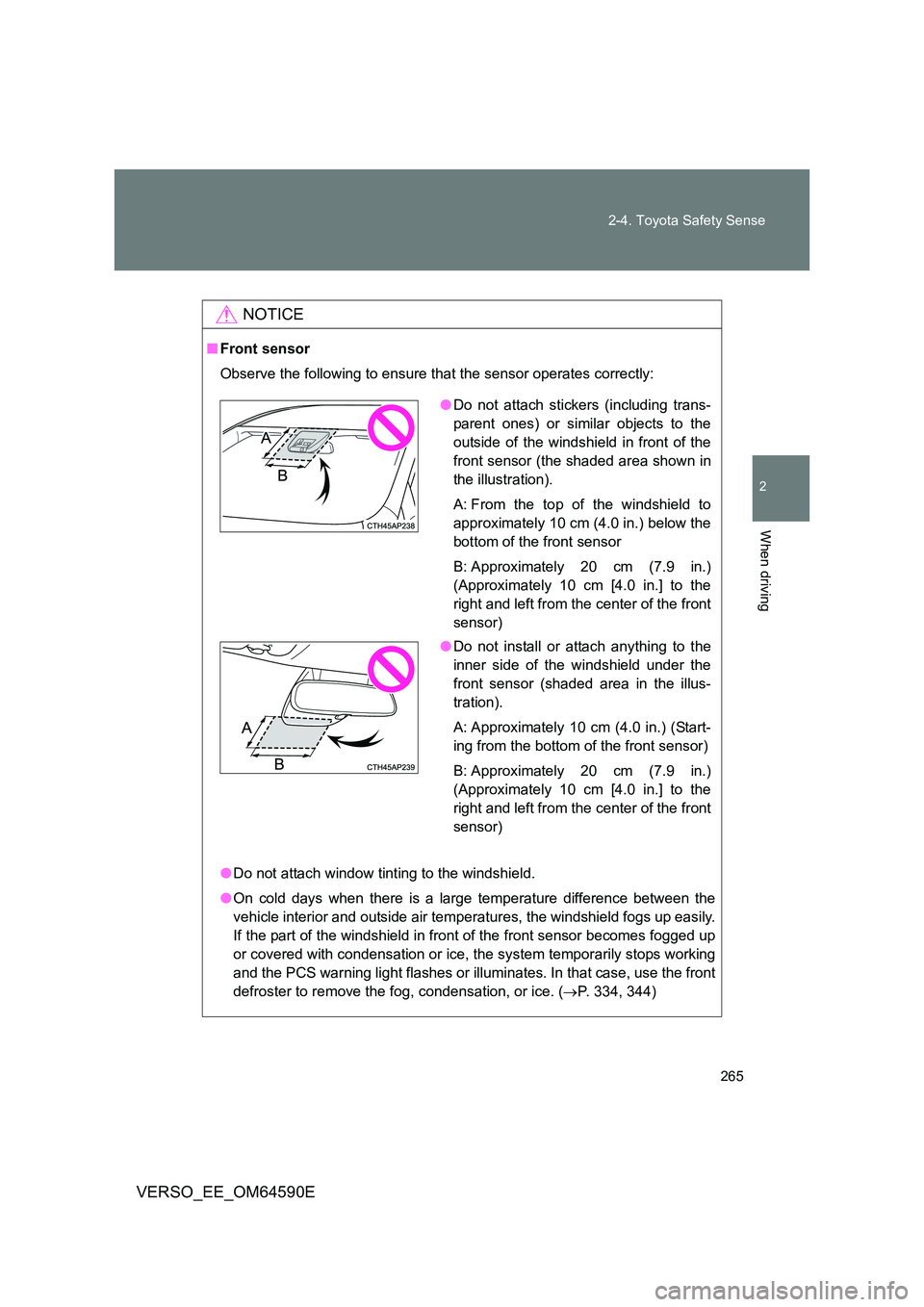
■ Front sensor
Observe the following to ensure that the sensor operates correctly:
● Do not attach window tinting to the windshield.
● On cold days when there is a large temperature difference between the
vehicle interior and outside air temperatures, the windshield fogs up easily.
If the part of the windshield in front of the front sensor becomes fogged up
or covered with condensation or ice, the system temporarily stops working
and the PCS warning light flashes or illuminates. In that case, use the front
defroster to remove the fog, condensation, or ice. ( P. 334, 344)
●Do not attach stickers (including trans-
parent ones) or similar objects to the
outside of the windshield in front of the
front sensor (the shaded area shown in
the illustration).
A: From the top of the windshield to
approximately 10 cm (4.0 in.) below the
bottom of the front sensor
B: Approximately 20 cm (7.9 in.)
(Approximately 10 cm [4.0 in.] to the
right and left from the center of the front
sensor)
● Do not install or attach anything to the
inner side of the windshield under the
front sensor (shaded area in the illus-
tration).
A: Approximately 10 cm (4.0 in.) (Start-
ing from the bottom of the front sensor)
B: Approximately 20 cm (7.9 in.)
(Approximately 10 cm [4.0 in.] to the
right and left from the center of the front
sensor)
Page 272 of 664
272
2-4. Toyota Safety Sense
VERSO_EE_OM64590E
When there is an object (traffic sign, guard rail, etc.) by the roadside at the
entrance of a curve
When passing an oncoming vehicle on a curve
When passing an oncoming vehicle while making a left or right turn
When rapidly closing on a preceding vehicle
When rapidly closing on an electric to ll gate barrier, parking area barrier,
or other barrier that opens and closes
When approaching an overpass, traffic sign, billboard, etc.
When the front part of the vehicle is raised or lowered
When the sensor is misaligned due to a strong impact being applied to the
sensor, etc.
When there is a structural object (billboard, street light, etc.) at the top of
an uphill road
When there is a metal object (manhole cove r, steel plate, etc.) at the bot-
tom of a downhill road
When approaching a low hanging object that may contact the vehicle,
such as a banner or tree branches
When driving through dense fog or smok e, or when a preceding vehicle is
kicking up water, snow, etc.
When there is a reflective object, bump, protrusion, etc. on the road sur-
face
When the vehicle is being parked in a place where there is a low hanging
object at the height of the front sensor
When passing extremely close to an object (stopped vehicle, guardrail,
etc.)
When the windshield is dirty or covered with raindrops, condensation, ice,
snow, etc.
Page 273 of 664
273
2-4. Toyota Safety Sense
2
When driving
VERSO_EE_OM64590E
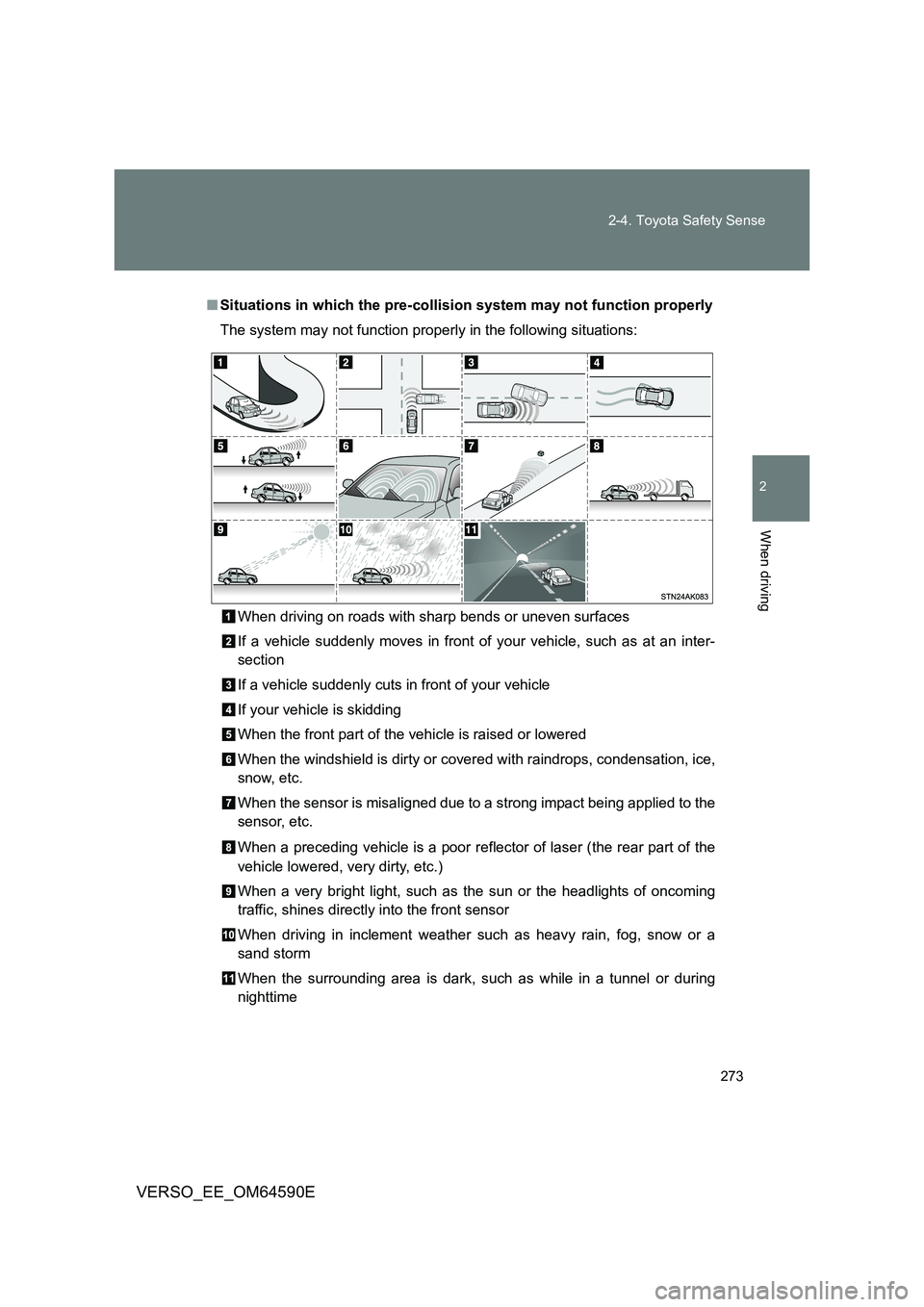
■ Situations in which the pre-collision system may not function properly
The system may not function properly in the following situations:
When driving on roads with sharp bends or uneven surfaces
If a vehicle suddenly moves in front of your vehicle, such as at an inter-
section
If a vehicle suddenly cuts in front of your vehicle
If your vehicle is skidding
When the front part of the vehicle is raised or lowered
When the windshield is dirty or covered with raindrops, condensation, ice,
snow, etc.
When the sensor is misaligned due to a strong impact being applied to the
sensor, etc.
When a preceding vehicle is a poor reflector of laser (the rear part of the
vehicle lowered, very dirty, etc.)
When a very bright light, such as the sun or the headlights of oncoming
traffic, shines directly into the front sensor
When driving in inclement weather such as heavy rain, fog, snow or a
sand storm
When the surrounding area is dark, such as while in a tunnel or during
nighttime
Page 274 of 664
274
2-4. Toyota Safety Sense
VERSO_EE_OM64590E
■ If the PCS warning light flashes or illuminates, and a warning message
is displayed on the multi-information display
The pre-collision system may be tempor arily unavailable or there may be a
malfunction in the system.
● In the following situations, the indicator and message will be cleared and
the system will become operational when normal operating conditions
return:
• When the area around the front sensor is hot, such as after the vehicle
has been parked in the sun
• When the windshield is fogged up or covered with condensation or ice
( P. 334, 344)
• If the area in front of the front sensor is obstructed, such as when the
hood is open
● If the PCS warning light continues to flash or illuminate, or the warning
message is not cleared, the system may be malfunctioning. Have the
vehicle inspected by any authorized Toyota dealer or repairer, or another
duly qualified and equipped professional immediately.
■ If the TRC and VSC+ are disabled
● If the TRC and VSC+ are disabled (P. 313), pre-collision brake assist
and pre-collision braking are also di sabled. However, the pre-collision
warning function will still operate.
● The PCS warning light will turn on and a warning message will be dis-
played on the multi-information display. ( P. 551)
Page 281 of 664
281
2-4. Toyota Safety Sense
2
When driving
VERSO_EE_OM64590E
● When the vehicle leans to one side an unusual amount due to a heavy
load or improper tire inflation pressure
● When the following distance between your vehicle and the vehicle ahead
is extremely short
● When the lane markers are yellow (These may be more difficult for the
system to recognize compared to white markers.)
● When the lane markers are broken, Botts’ dots (raised pavement mark-
ers) or stones
● When the lane markers are on a curb etc.
● When lane markers are obscured or partially obscured by sand, dirt, etc.
● When there are shadows on the road running parallel with lane markers,
or if a shadow covers the lane markers
● When driving on a particularly bright road surface, such as concrete
● When driving on a road surface that is bright due to reflected light
● When driving in a location where the light level changes rapidly, such as
the entrance to or exit from a tunnel
● When sunlight or the headlights of oncoming vehicles are shining directly
into the camera lens
● When driving on roads that are branching or merging
● When driving on a road surface that is wet due to rain, previous rainfall,
standing water, etc.
● When the vehicle experiences strong up-and-down motion such as when
driving on an extremely rough road or on a seam in the pavement
● When headlight brightness at nighttime is reduced due to dirt on the
lenses, or when the headlights are misaligned
● When driving on winding roads or roads that are uneven
● When driving on rough or unpaved roads
● When the windshield is dirty, or if raindrops, condensation or ice are
adhering to the windshield
● When the heater is blowing to the feet, the upper part of the windshield
may get fogged up and have a negative effect
● When cleaning the inside of the windshield, touching the lens or getting
glass cleaner on the lens may have a negative effect
Page 286 of 664
286
2-4. Toyota Safety Sense
VERSO_EE_OM64590E
■ The Automatic High Beam can be operated when
Vehicles without smart entry & start system
The engine switch is in the “ON” position.
Vehicles with smart entry & start system
The “ENGINE START STOP” switch is in IGNITION ON mode.
■ Front sensor detection information
● High beam may not be automatically turned off in the following situations:
• When oncoming vehicles suddenly appear from a curve
• When the vehicle is cut in front of by another
• When oncoming or preceding vehicles are hidden from sight due to
repeated curves, road dividers or roadside trees
● High beam may be turned off if an oncoming vehicle that is using fog
lights without using the headlights is detected.
● House lights, street lights, red traffic signals, and illuminated billboards or
signs may cause the high beam to turn off.
● The following factors may affect the amount of time taken to turn high
beam on or off:
• The brightness of headlights, fog lights, and tail lights of oncoming and
preceding vehicles
• The movement and direction of oncoming and preceding vehicles
• When a oncoming or preceding vehicle only has operational lights on
one side
• When a oncoming or preceding vehicle is a two-wheeled vehicle
• The condition of the road (gradient, curve, condition of the road sur-
face, etc.)
• The number of passengers and amount of luggage
Page 287 of 664
287
2-4. Toyota Safety Sense
2
When driving
VERSO_EE_OM64590E
● High beam may be turned on or off when unexpected by the driver.
● In the situations below, the system may not be able to correctly detect the
surrounding brightness levels, and may flash or expose nearby pedestri-
ans to the high beam. Therefore, you should consider turning the high
beams on or off manually rather than relying on the Automatic High
Beam system.
• In bad weather (rain, snow, fog, sandstorms, etc.)
• The windshield is obscured by fog, mist, ice, dirt, etc.
• The windshield is cracked or damaged.
• The front sensor is deformed or dirty.
• The front sensor temperature is extremely high.
• Surrounding brightness levels are equal to those of headlights, tail
lights or fog lights.
• Vehicles ahead have headlights or tail lights that are either switched
off, dirty, are changing color, or are not aimed properly.
• When driving through an area of intermittently changing brightness and
darkness.
• When frequently and repeatedly driving ascending/descending roads,
or roads with rough, bumpy or uneven surfaces (such as stone-paved
roads, gravel tracks, etc.).
• When frequently and repeatedly taking curves or driving on a winding
road.
• There is a highly reflective object ahead of the vehicle, such as a sign
or a mirror.
• The back of a vehicle ahead is highly reflective, such as a container on
a truck.
• The vehicle’s headlights are damaged or dirty.
• The vehicle is listing or tilting, due to a flat tire, a trailer being towed,
etc.
• The driver believes that the high beam may be causing problems or
distress to other drivers or pedestrians nearby.
■ If a warning message of the Automatic High Beam is displayed...
It may indicate a malfunction in the system. Contact any authorized Toyota
dealer or repairer, or another duly qualified and equipped professional.
Page 333 of 664
3Interior features
333
VERSO_EE_OM64590E
3-1. Using the air conditioning
system and defogger
Manual air conditioning
system ............................ 334
Automatic air conditioning
system ............................ 340
Power heater .................... 347
Rear window and outside
rear view mirror
defoggers ....................... 349
3-2. Using the audio system
Audio system types .......... 351
Using the radio ................. 353
Using the CD player ......... 357
Playing back MP3 and
WMA discs...................... 362
Operating an iPod............. 368
Operating
a USB memory ............... 375
Optimal use of the audio
system ............................ 382
Using the AUX port ........... 384
Using the steering
wheel audio switches...... 385
3-3. Using the interior lights
Interior lights list................ 388
• Personal/interior
lights main switch ........... 389
• Personal/interior lights .... 390
3-4. Using the storage features
List of storage features ..... 392
• Glove box ....................... 394
• Console box.................... 395
• Overhead console .......... 397
• Cup holders .................... 397
• Bottle holders.................. 399
• Auxiliary boxes ............... 400
3-5. Other interior features
Sun visors ......................... 402
Vanity mirrors.................... 403
Power outlets .................... 404
Seat heaters ..................... 406
Armrests ........................... 408
Front seatback tables ....... 409
Rear side sunshades ........ 411
Assist grips ....................... 412
Floor mat........................... 413
Luggage compartment
features........................... 415
Page 347 of 664
347
3-1. Using the air conditioning system and defogger
3
Interior features
VERSO_EE_OM64590E
Power heater
: If equipped
■Power heater can be operated when
● The engine is running.
● The engine coolant temperature is low.
■ Normal characteristics of power heater operation
The following cases do not indicate a malfunction.
● When the power heater is turned on or off, some white smoke and a
slight odor may be emitted from the power heater exhaust that is located
under the floor.
● When the power heater is used under extremely cold conditions, vapor
may be visible from its exhaust.
● When the power heater is turned off, you may hear a sound in the engine
compartment for about 2 minutes until the power heater turns off com-
pletely.
■ After the heater is turned off
We recommend not restarting the heater for 10 minutes after you turn it off.
Otherwise, a noise may be heard as the heater ignites.
■ When refueling your vehicle
The engine must be turned off. Turning the engine off turns the power heater
off.
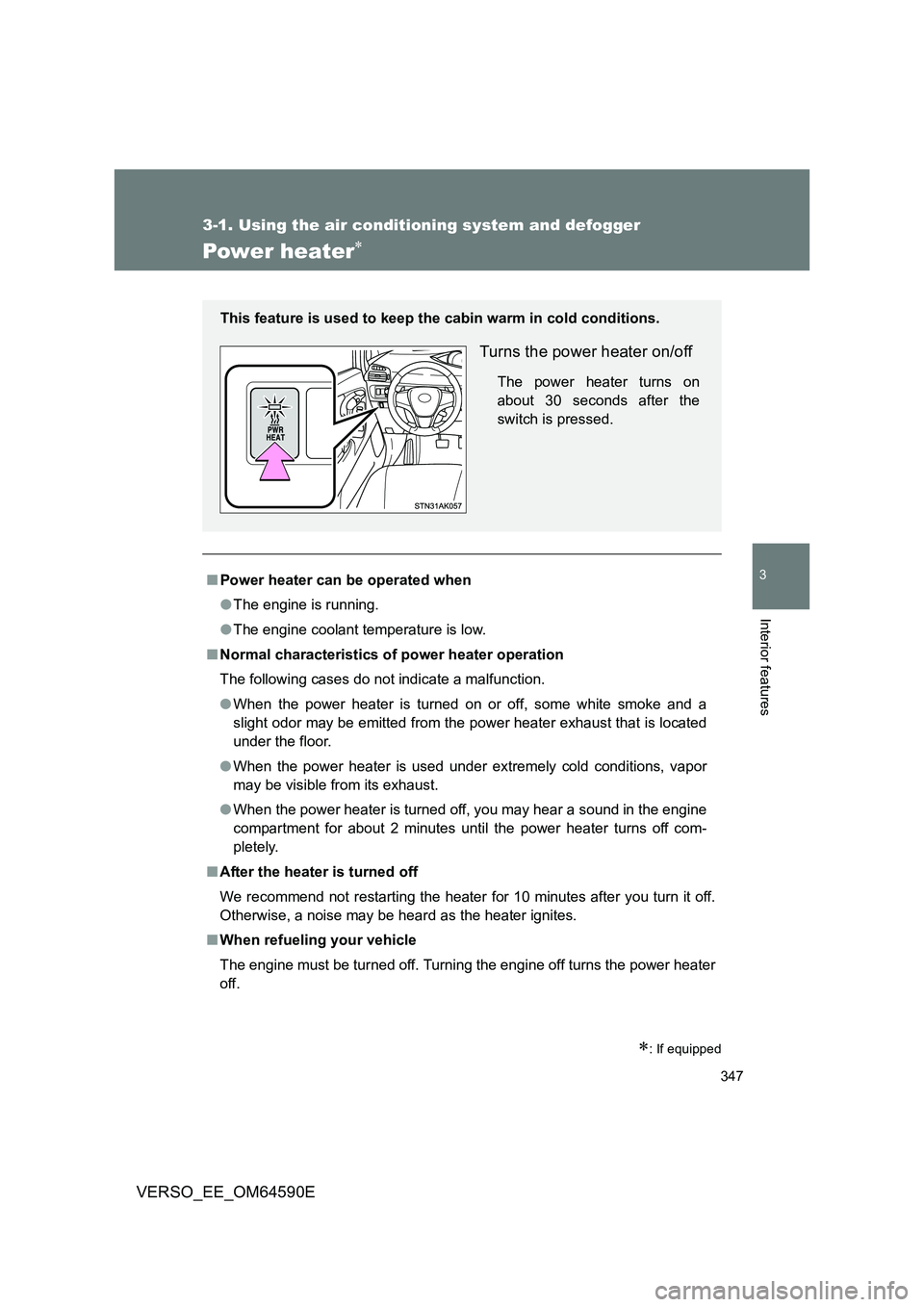
This feature is used to keep the cabin warm in cold conditions.
Turns the power heater on/off
The power heater turns on
about 30 seconds after the
switch is pressed.
Page 432 of 664
432
4-1. Maintenance and care
VERSO_EE_OM64590E
NOTICE
■ Cleaning detergents
● Do not use organic substances such as benzene or gasoline, acidic or
alkaline solutions, dye, bleach or other detergent. Doing so may discolor
the vehicle interior or cause streaks or damage to painted surfaces.
● Do not use polish wax or polish cleaner. The instrument panel’s or other
interior part’s painted surface may be damaged.
■ Preventing damage to leather surfaces
Observe the following precautions to avoid damage to and deterioration of
leather surfaces.
● Remove any dust or dirt on leather surfaces immediately.
● Do not expose the vehicle to direct sunlight for extended periods of time.
Park the vehicle in the shade, especially during summer.
● Do not place items made of vinyl, plastic, or that contain wax on the uphol-
stery, as they may stick to the leather surface if the vehicle interior heats
up significantly.
■ Water on the floor
Do not wash the vehicle floor with water.
Vehicle systems such as the audio system may be damaged if water comes
into contact with electrical components under the floor of the vehicle, and
may also cause the body to rust.
■ When cleaning the inside of the windshield (vehicles with front sensor)
Be careful not to touch the front sensor ( P. 263, 266). If the camera is acci-
dentally scratched or hit, PCS (Pre-Collision System), LDA (Lane Departure
Alert) and Automatic High Beam may not operate properly or may cause a
malfunction.
■ Cleaning the inside of the rear window
● Do not use glass cleaner to clean the rear window, as this may cause
damage to the rear window defogger heater wires. Use a cloth dampened
with lukewarm water to gently wipe the window clean. Wipe the window in
strokes running parallel to the heater wires.
● Be careful not to scratch or damage the heater wires.