tire pressure TOYOTA VERSO 2016 Owner's Manual
[x] Cancel search | Manufacturer: TOYOTA, Model Year: 2016, Model line: VERSO, Model: TOYOTA VERSO 2016Pages: 664, PDF Size: 62.24 MB
Page 472 of 664
472
4-3. Do-it-yourself maintenance
VERSO_EE_OM64590E
NOTICE
■ Repairing or replacing tires, wheels, tire pressure warning valves,
transmitters and tire valve caps (vehicles with the tire pressure warn-
ing system)
● When removing or fitting the wheels, tires or the tire pressure warning
valves and transmitters, contact any authorized Toyota dealer or repairer,
or another duly qualified and equipped professional as the tire pressure
warning valves and transmitters may be damaged if not handled correctly.
● Make sure to install the tire valve caps. If the tire valve caps are not
installed, water could enter the tire pressure warning valves and the tire
pressure warning valves could be bound.
● When replacing tire valve caps, do not use tire valve caps other than those
specified. The cap may become stuck.
■ To avoid damage to the tire pressure warning valves and transmitters
(vehicles with the tire pressure warning system)
When a tire is repaired with liquid seal ants, the tire pressure warning valve
and transmitter may not oper ate properly. If a liquid sealant is used, contact
any authorized Toyota dealer or re pairer, or another duly qualified and
equipped professional or other qualified service shop as soon as possible.
After use of liquid sealant, make sure to replace the tire pressure warning
valve and transmitter when repairing or replacing the tire. ( P. 462)
■ Driving on rough roads
Take particular care when driving on roads with loose surfaces or pot holes.
These conditions may cause losses in tire inflation pressure, reducing the
cushioning ability of the tires. In addition driving on rough roads may cause
damage to the tires themselves, as well as the vehicle’s wheels and body.
■ If tire inflation pressures become low while driving
Do not continue driving, or your tires and/or wheels may be ruined.
Page 473 of 664
473
4-3. Do-it-yourself maintenance
4
Maintenance and care
VERSO_EE_OM64590E
Tire inflation pressure
■Effects of incorrect tire inflation pressure
Driving with incorrect tire inflation pressure may result in the following:
● Reduced fuel economy
● Reduced driving comfort and poor handling
● Reduced tire life due to wear
● Reduced safety
● Damage to the drive train
If a tire needs frequent refilling, have it checked by any authorized Toyota
dealer or repairer, or another duly qualified and equipped professional.
■ Instructions for checking tire inflation pressure
When checking tire inflation pressure, observe the following:
● Check only when the tires are cold.
If your vehicle has been parked for at least 3 hours and has not been
driven for more than 1.5 km or 1 mile, you will get an accurate cold tire
inflation pressure reading.
● Always use a tire pressure gauge.
It is difficult to judge if a tire is properly inflated based only on its appear-
ance.
● It is normal for the tire inflation pressure to be higher after driving as heat
is generated in the tire. Do not reduce tire inflation pressure after driving.
● Passengers and luggage weight should be placed so that the vehicle is
balanced.
Make sure to maintain the proper ti re inflation pressure. Tire inflation
pressure should be checked at least once per month. However,
Toyota recommends that tire inflation pressure be checked once
every two weeks. ( P. 633)
Page 474 of 664
474
4-3. Do-it-yourself maintenance
VERSO_EE_OM64590E
WARNING
■ Proper inflation is critical to save tire performance
Keep your tires properly inflated.
If the tires are not properly inflated, the following conditions may occur which
could lead to an accident resulting in death or serious injury:
● Excessive wear
● Uneven wear
● Poor handling
● Possibility of blowouts resulting from overheated tires
● Air leaking from between tire and wheel
● Wheel deformation and/or tire damage
● Greater possibility of tire damage while driving (due to road hazards,
expansion joints, sharp edges in the road, etc.)
NOTICE
■ When inspecting and adjusting tire inflation pressure
Be sure to reinstall the tire valve caps.
If a valve cap is not installed, dirt or moisture may get into the valve and
cause an air leak, resulting in decreased tire inflation pressure.
Page 476 of 664
476
4-3. Do-it-yourself maintenance
VERSO_EE_OM64590E
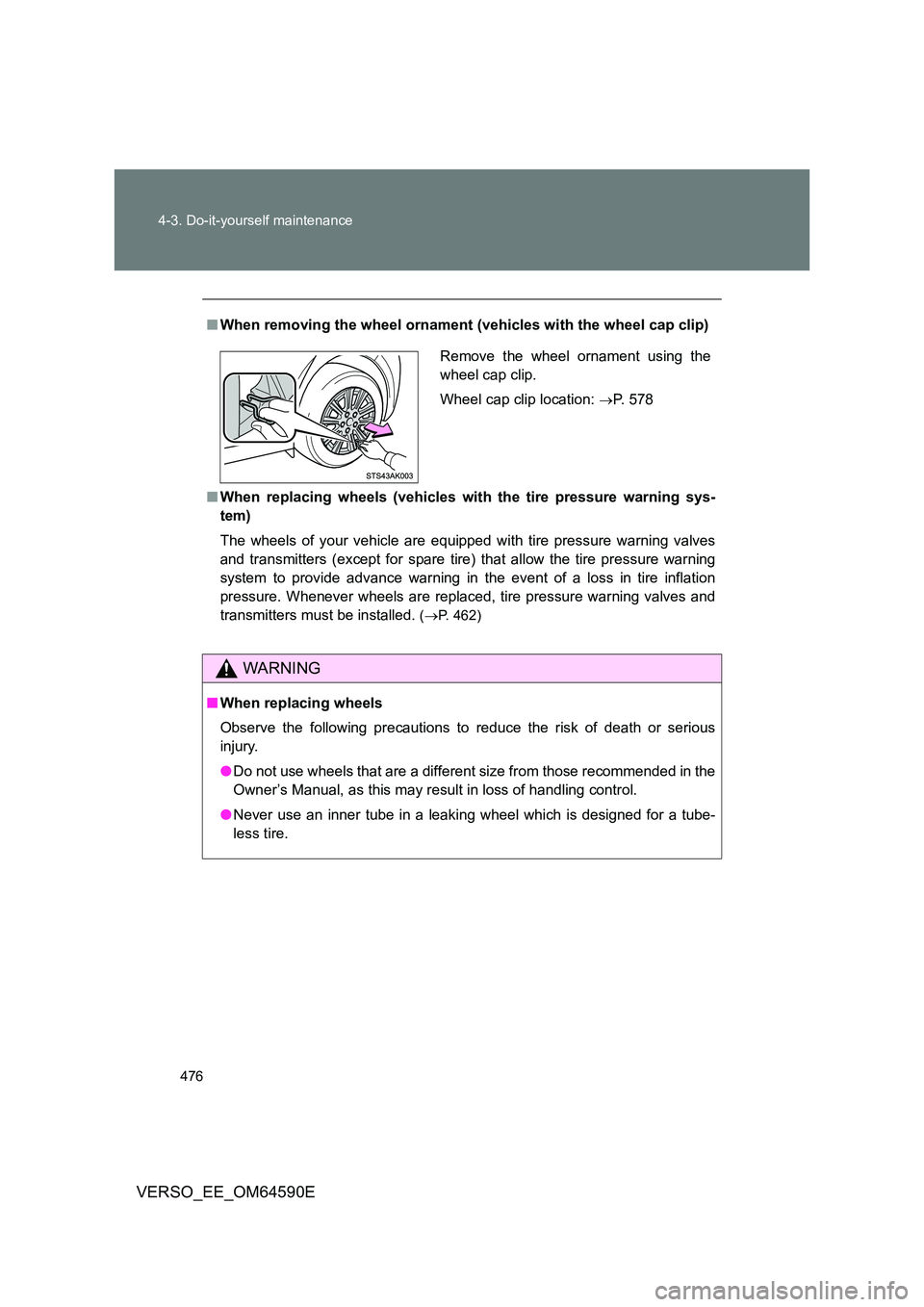
■ When removing the wheel ornament (vehicles with the wheel cap clip)
■ When replacing wheels (vehicles with the tire pressure warning sys-
tem)
The wheels of your vehicle are equipped with tire pressure warning valves
and transmitters (except for spare tire) that allow the tire pressure warning
system to provide advance warning in the event of a loss in tire inflation
pressure. Whenever wheels are replaced, tire pressure warning valves and
transmitters must be installed. ( P. 462)
WARNING
■When replacing wheels
Observe the following precautions to reduce the risk of death or serious
injury.
● Do not use wheels that are a different size from those recommended in the
Owner’s Manual, as this may result in loss of handling control.
● Never use an inner tube in a leaking wheel which is designed for a tube-
less tire.
Remove the wheel ornament using the
wheel cap clip.
Wheel cap clip location: P. 578
Page 477 of 664
477
4-3. Do-it-yourself maintenance
4
Maintenance and care
VERSO_EE_OM64590E
WARNING
■ When installing the wheel nuts
● Never use oil or grease on the wheel bolts or wheel nuts.
Oil and grease may cause the wheel nuts to be excessively tightened,
leading to bolt or disc wheel damage. In addition, the oil or grease can
cause the wheel nuts to loosen and the wheel may fall off, causing an acci-
dent and resulting in death or serious injury. Remove any oil or grease
from the wheel bolts or wheel nuts.
NOTICE
■ Replacing tire pressure warning valves and transmitters (vehicles with
the tire pressure warning system)
● Because tire repair or replacement may affect the tire pressure warning
valves and transmitters, make sure to have tires serviced by any autho-
rized Toyota dealer or repairer, or another duly qualified and equipped pro-
fessional or other qualified service shop. In addition, make sure to
purchase your tire pressure warning valves and transmitters at any autho-
rized Toyota dealer or repairer, or another duly qualified and equipped pro-
fessional.
● Ensure that only genuine Toyota wheels are used on your vehicle.
Tire pressure warning valves and transmitters may not work properly with
non-genuine wheels.
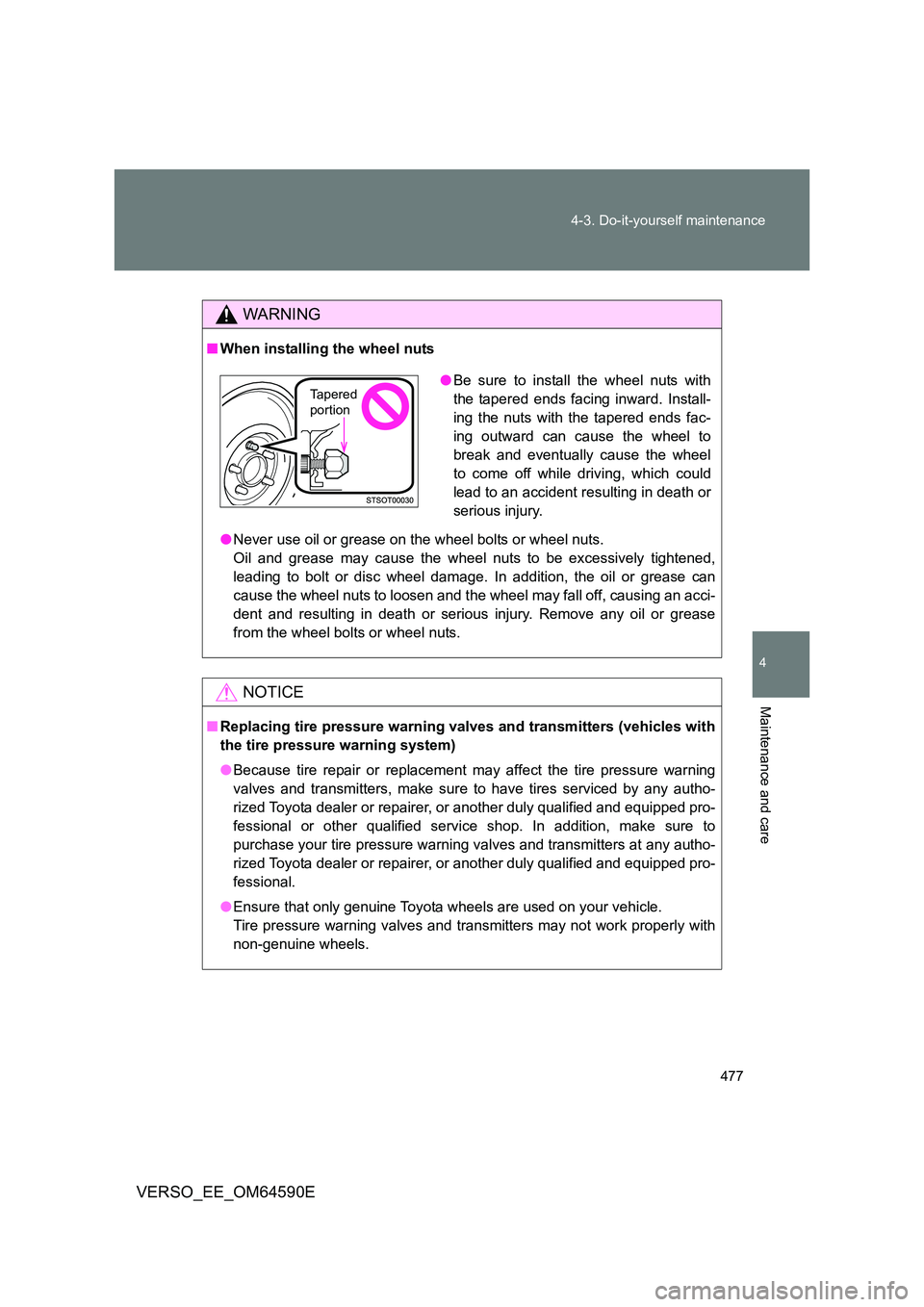
● Be sure to install the wheel nuts with
the tapered ends facing inward. Install-
ing the nuts with the tapered ends fac-
ing outward can cause the wheel to
break and eventually cause the wheel
to come off while driving, which could
lead to an accident resulting in death or
serious injury.
Tapered portion
Page 496 of 664
496
4-3. Do-it-yourself maintenance
VERSO_EE_OM64590E
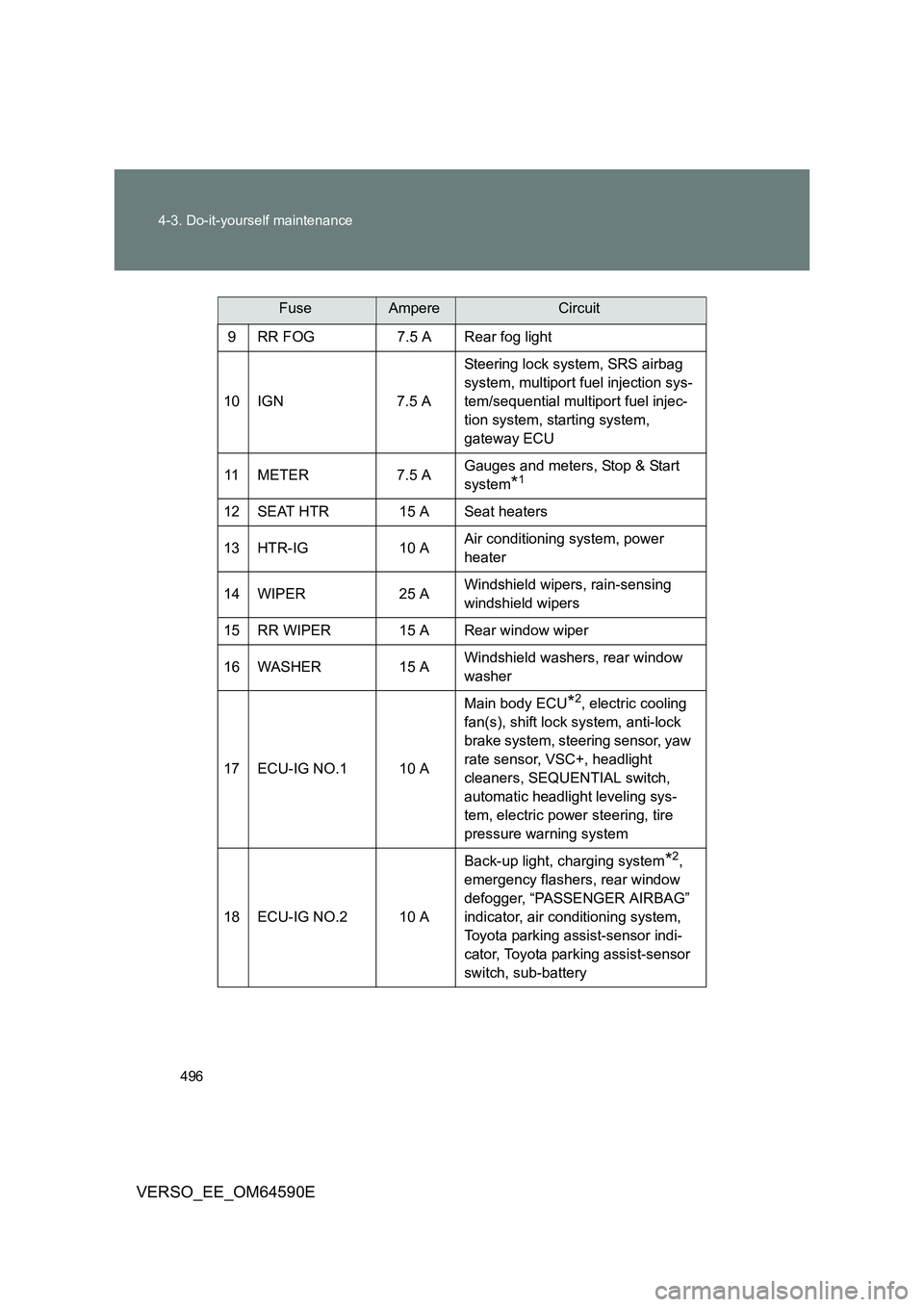
9 RR FOG 7.5 A Rear fog light
10 IGN 7.5 A
Steering lock system, SRS airbag
system, multiport fuel injection sys-
tem/sequential multiport fuel injec-
tion system, starting system,
gateway ECU
11 M E T E R 7 . 5 A Gauges and meters, Stop & Start
system*1
12 SEAT HTR 15 A Seat heaters
13 HTR-IG 10 A Air conditioning system, power
heater
14 WIPER 25 A Windshield wipers, rain-sensing
windshield wipers
15 RR WIPER 15 A Rear window wiper
16 WASHER 15 A Windshield washers, rear window
washer
17 ECU-IG NO.1 10 A
Main body ECU*2, electric cooling
fan(s), shift lock system, anti-lock
brake system, steering sensor, yaw
rate sensor, VSC+, headlight
cleaners, SEQUENTIAL switch,
automatic headlight leveling sys-
tem, electric power steering, tire
pressure warning system
18 ECU-IG NO.2 10 A
Back-up light, charging system*2,
emergency flashers, rear window
defogger, “PASSENGER AIRBAG”
indicator, air conditioning system,
Toyota parking assist-sensor indi-
cator, Toyota parking assist-sensor
switch, sub-battery
FuseAmpereCircuit
Page 540 of 664
540
5-2. Steps to take in an emergency
VERSO_EE_OM64590E
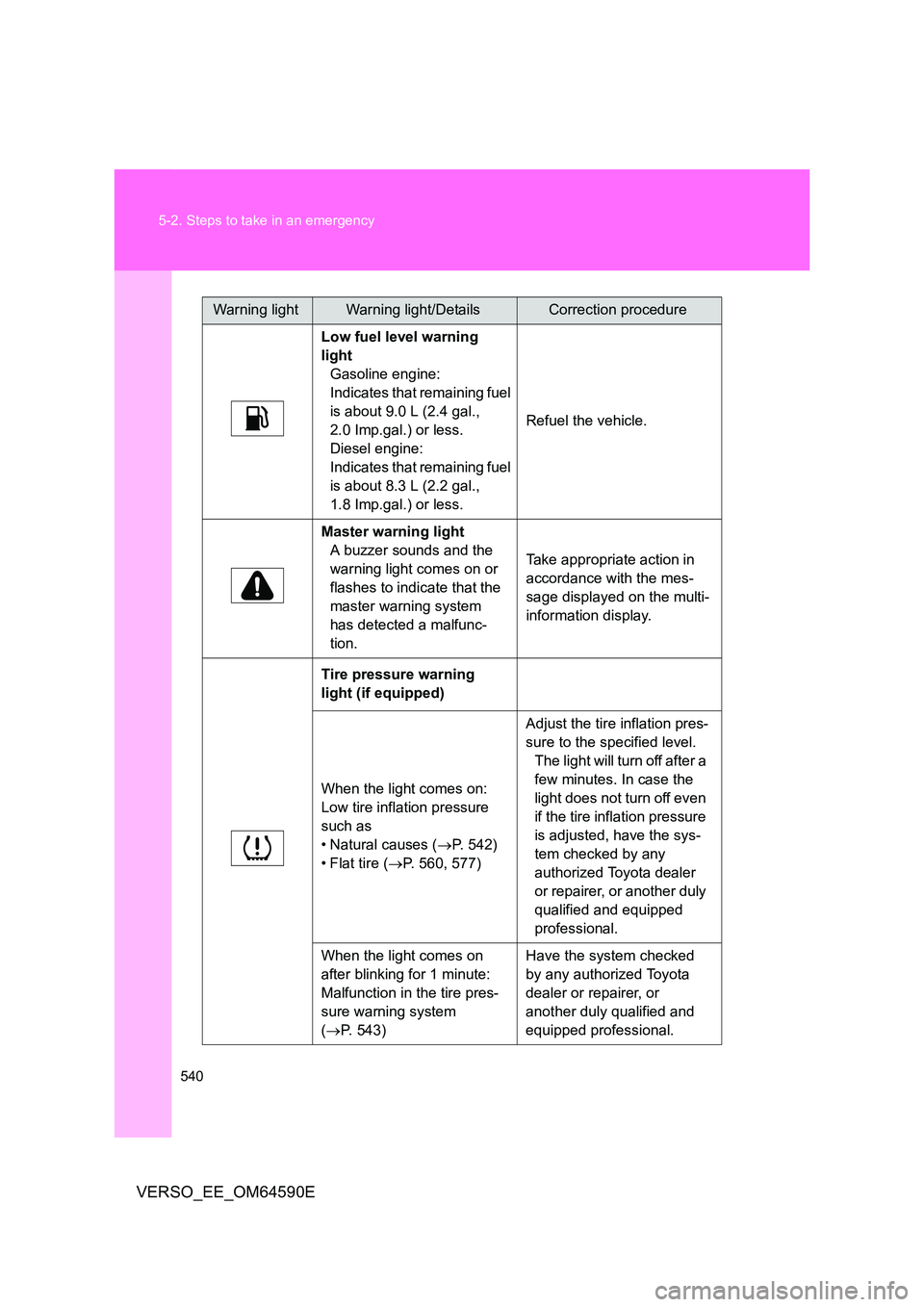
Low fuel level warning
light
Gasoline engine:
Indicates that remaining fuel
is about 9.0 L (2.4 gal.,
2.0 Imp.gal.) or less.
Diesel engine:
Indicates that remaining fuel
is about 8.3 L (2.2 gal.,
1.8 Imp.gal.) or less.
Refuel the vehicle.
Master warning light
A buzzer sounds and the
warning light comes on or
flashes to indicate that the
master warning system
has detected a malfunc-
tion.
Take appropriate action in
accordance with the mes-
sage displayed on the multi-
information display.
Tire pressure warning
light (if equipped)
When the light comes on:
Low tire inflation pressure
such as
• Natural causes ( P. 542)
• Flat tire ( P. 560, 577)
Adjust the tire inflation pres-
sure to the specified level.
The light will turn off after a
few minutes. In case the
light does not turn off even
if the tire inflation pressure
is adjusted, have the sys-
tem checked by any
authorized Toyota dealer
or repairer, or another duly
qualified and equipped
professional.
When the light comes on
after blinking for 1 minute:
Malfunction in the tire pres-
sure warning system
( P. 543)
Have the system checked
by any authorized Toyota
dealer or repairer, or
another duly qualified and
equipped professional.
Warning lightWarning light/DetailsCorrection procedure
Page 542 of 664
542
5-2. Steps to take in an emergency
VERSO_EE_OM64590E
■ Front passenger detection sensor and passenger seat belt reminder
● If luggage is placed on the front passenger seat, the front passenger
detection sensor may cause the warning light to flash, even if a passen-
ger is not sitting in the seat.
● If a cushion is placed on the seat, the sensor may not detect a passen-
ger, and the warning light may not operate properly.
■ When the tire pressure warning light comes on (vehicles with a tire
pressure warning light system)
Inspect the appearance of the tire to check that the tire is not punctured.
If the tire is punctured: P. 560, 577
If the tire is not punctured:
Carry out the following procedure after the tire temperature has lowered suffi-
ciently.
● Check the tire inflation pressure and adjust to the appropriate level.
● If the warning light does not go out even after several minutes, check that
the tire inflation pressure is at the specified level and carry out initialization.
The warning light may come on again if the above operations are conducted
without first allowing the tire temperature to lower sufficiently.
■The tire pressure warning light may come on due to natural causes
(vehicles with a tire pr essure warning light system)
The tire pressure warning light may come on due to natural causes such as
natural air leaks and tire inflation pressure changes caused by temperature.
In this case, adjusting the tire inflation pressure will turn off the warning light
(after a few minutes).
■ When a tire is replaced with a spare tire (vehicles with a tire pressure
warning light system)
The spare tire is not equipped with a tire pressure warning valve and trans-
mitter. If a tire goes flat, the tire pressure warning light will not turn off even
though the flat tire has been replaced wi th the spare tire. Replace the spare
tire with the repaired tire and adjust the tire inflation pressure. The tire pres-
sure warning light will go off after a few minutes.
Page 543 of 664
5
543
5-2. Steps to take in an emergency
When trouble arises
VERSO_EE_OM64590E
■ If the tire pressure warning system is not functioning (vehicles with a
tire pressure warning light system)
The tire pressure warning system will be disabled in the following conditions:
(When the condition becomes normal, the system will work properly.)
● If tires not equipped with tire pressure warning valves and transmitters
are used
● If the ID code on the tire pressure warning valves and transmitters is not
registered in the tire pressure warning computer
● If the tire inflation pressure is 380 kPa (3.9 kgf/cm2 or bar, 55 psi) or
higher
The tire pressure warning system may be disabled in the following condi-
tions:
(When the condition becomes normal, the system will work properly.)
● If electronic devices or facilities using similar radio wave frequencies are
nearby
● If a radio set at a similar frequency is in use in the vehicle
● If a window tint that affects the radio wave signals is installed
● If there is a lot of snow or ice on the vehicle, particularly around the
wheels or wheel housings
● If non-genuine Toyota wheels are used (Even if you use Toyota wheels,
the tire pressure warning system may not work properly with some types
of tires.)
● If tire chains are used
■ If the tire pressure warning light frequently comes on after blinking for
1 minute (vehicles with a tire pressure warning light system)
If the tire pressure warning light frequently comes on after blinking for 1
minute when the engine switch (vehicles without smart entry & start system)
or the “ENGINE START STOP” switch (vehicles with smart entry & start sys-
tem) is turned on, have it checked by any authorized Toyota dealer or
repairer, or another duly qualified and equipped professional.
Page 544 of 664
544
5-2. Steps to take in an emergency
VERSO_EE_OM64590E
WARNING
■ If the tire pressure warning light comes on (vehicles with a tire pres-
sure warning light system)
Be sure to observe the following precautions. Failure to do so could cause a
loss of vehicle control and result in death or serious injury.
● Stop your vehicle in a safe place as soon as possible. Adjust the tire infla-
tion pressure immediately.
● If the tire pressure warning light comes on even after tire inflation pressure
adjustment, it is probable that you have a flat tire. Check the tires. If a tire
is flat, change it with the spare tire and have the flat tire repaired by the
nearest any authorized Toyota dealer or repairer, or another duly qualified
and equipped professional.
● Avoid abrupt maneuvering and braking. If the vehicle tires deteriorate, you
could lose control of the steering wheel or the brakes.
■ If a blowout or sudden air leakage should occur (vehicles with a tire
pressure warning light system)
The tire pressure warning system may not activate immediately.
NOTICE
■ To ensure the tire pressure warning system operates properly (vehi-
cles with a tire pressure warning light system)
Do not install tires with different specifications or makers, as the tire pres-
sure warning system may not operate properly.