weight TOYOTA VERSO 2016 Owners Manual
[x] Cancel search | Manufacturer: TOYOTA, Model Year: 2016, Model line: VERSO, Model: TOYOTA VERSO 2016Pages: 664, PDF Size: 62.24 MB
Page 317 of 664
317
2
When driving
VERSO_EE_OM64590E
2-6. Driving information
Cargo and luggage
WARNING
■Things that must not be carried in the luggage compartment
The following things may cause a fi re if loaded in the luggage compartment.
● Receptacles containing gasoline
● Aerosol cans
Take notice of the following information about storage precautions,
cargo capacity and load.
● Stow cargo and luggage in the luggage compartment whenever
possible.
● Be sure all items are secured in place.
● Be careful to keep the vehicle level. Placing the weight as far for-
ward as possible helps maintain vehicle balance.
● For better fuel economy, do not carry unnecessary weight.
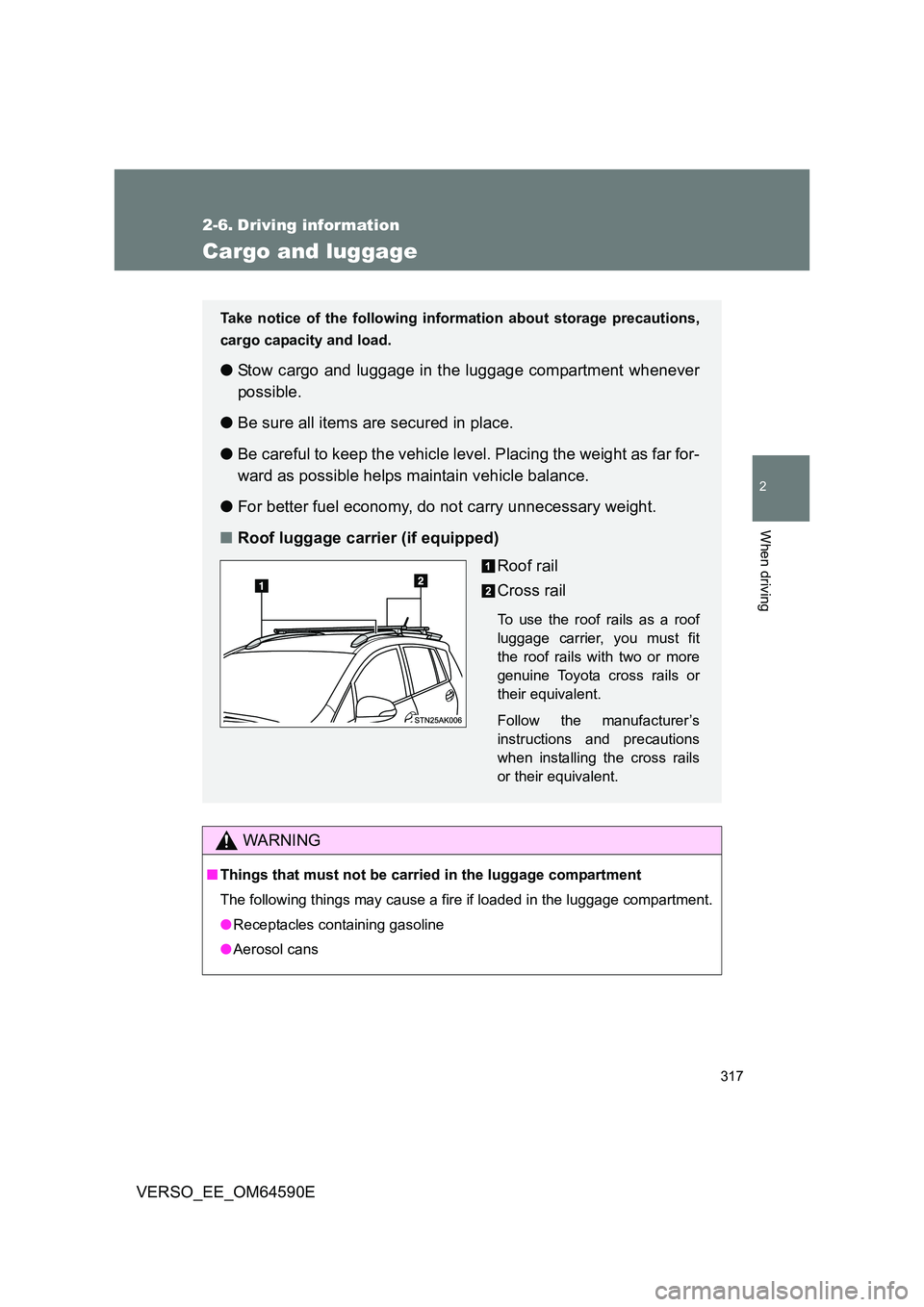
■ Roof luggage carrier (if equipped)
Roof rail
Cross rail
To use the roof rails as a roof
luggage carrier, you must fit
the roof rails with two or more
genuine Toyota cross rails or
their equivalent.
Follow the manufacturer’s
instructions and precautions
when installing the cross rails
or their equivalent.
Page 319 of 664
319
2-6. Driving information
2
When driving
VERSO_EE_OM64590E
WARNING
■ Roof luggage carrier precautions (if equipped)
To use the roof rails as a roof luggage carrier, you must fit the roof rails with
two or more genuine Toyota cross rails or their equivalent.
Follow the manufacturer’s instructions and precautions when installing the
cross rails or their equivalent.
When you load cargo on the roof luggage carrier, observe the following:
● Place the cargo so that its weight is distributed evenly between the front
and rear axles.
● If loading long or wide cargo never exceed the vehicle overall length or
width.
● Before driving, make sure the cargo is securely fastened on the roof lug-
gage carrier.
● Loading cargo on the roof luggage carrier will make the center of the vehi-
cle gravity higher. Avoid high speeds, sudden starts, sharp turns, sudden
braking or abrupt maneuvers, otherwise it may result in loss of control or
vehicle rollover due to failure to operate this vehicle correctly and result in
death or serious injury.
● If driving for a long distance, on rough roads, or at high speeds, stop the
vehicle now and then during the trip to make sure the cargo remains in its
place.
● Do not exceed 100 kg (221 lb.) cargo weight on the roof rails. However, if
the allowable cargo weight of the cross rails is under 100 kg (221 lb.)
observe the load limit and other instructions for the cross rails.
Page 324 of 664
324
2-6. Driving information
VERSO_EE_OM64590E
Trailer towing
Your vehicle is designed primarily as a passenger carrying vehicle.
Towing a trailer will have an adverse effect on handling, perfor-
mance, braking, durability, and fuel consumption. Your safety and
satisfaction depend on the proper use of correct equipment and cau-
tious driving habits. For your safety and the safety of others, do not
overload the vehicle or trailer.
To tow a trailer safely, use extreme care and drive the vehicle in
accordance with the trailer’s characteristics and operating condi-
tions.
Toyota warranties do not apply to damage or malfunction caused by
towing a trailer for commercial purposes.
Ask your local authorized Toyota d ealer or repairer, or another duly
qualified and equipped professional, for further details before tow-
ing, as there are additional legal requirements in some countries.
■ Weight limits
Check the allowable towing capacity, GVM (Gross Vehicle
Mass), MPAC (Maximum Permissible Axle Capacity), and per-
missible drawbar load before towing. ( P. 616)
■ Towing hitch/bracket
Toyota recommends the use of the Toyota hitch/bracket for your
vehicle. Other products of a suitable nature and comparable
quality may also be used.
Page 325 of 664
325
2-6. Driving information
2
When driving
VERSO_EE_OM64590E
Important points regarding trailer loads
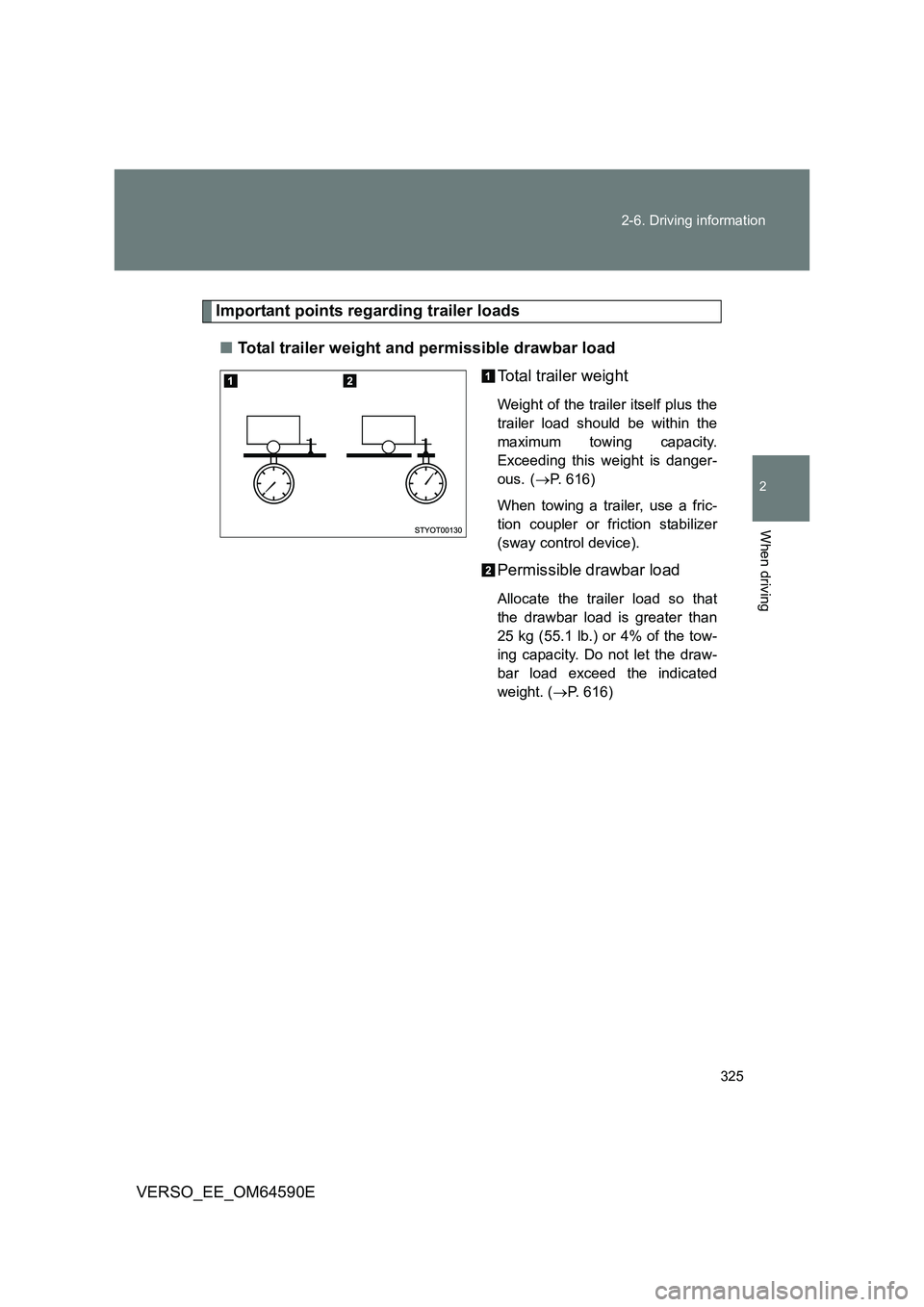
■ Total trailer weight and permissible drawbar load
Total trailer weight
Weight of the trailer itself plus the
trailer load should be within the
maximum towing capacity.
Exceeding this weight is danger-
ous. ( P. 616)
When towing a trailer, use a fric-
tion coupler or friction stabilizer
(sway control device).
Permissible drawbar load
Allocate the trailer load so that
the drawbar load is greater than
25 kg (55.1 lb.) or 4% of the tow-
ing capacity. Do not let the draw-
bar load exceed the indicated
weight. ( P. 616)
Page 326 of 664
326
2-6. Driving information
VERSO_EE_OM64590E
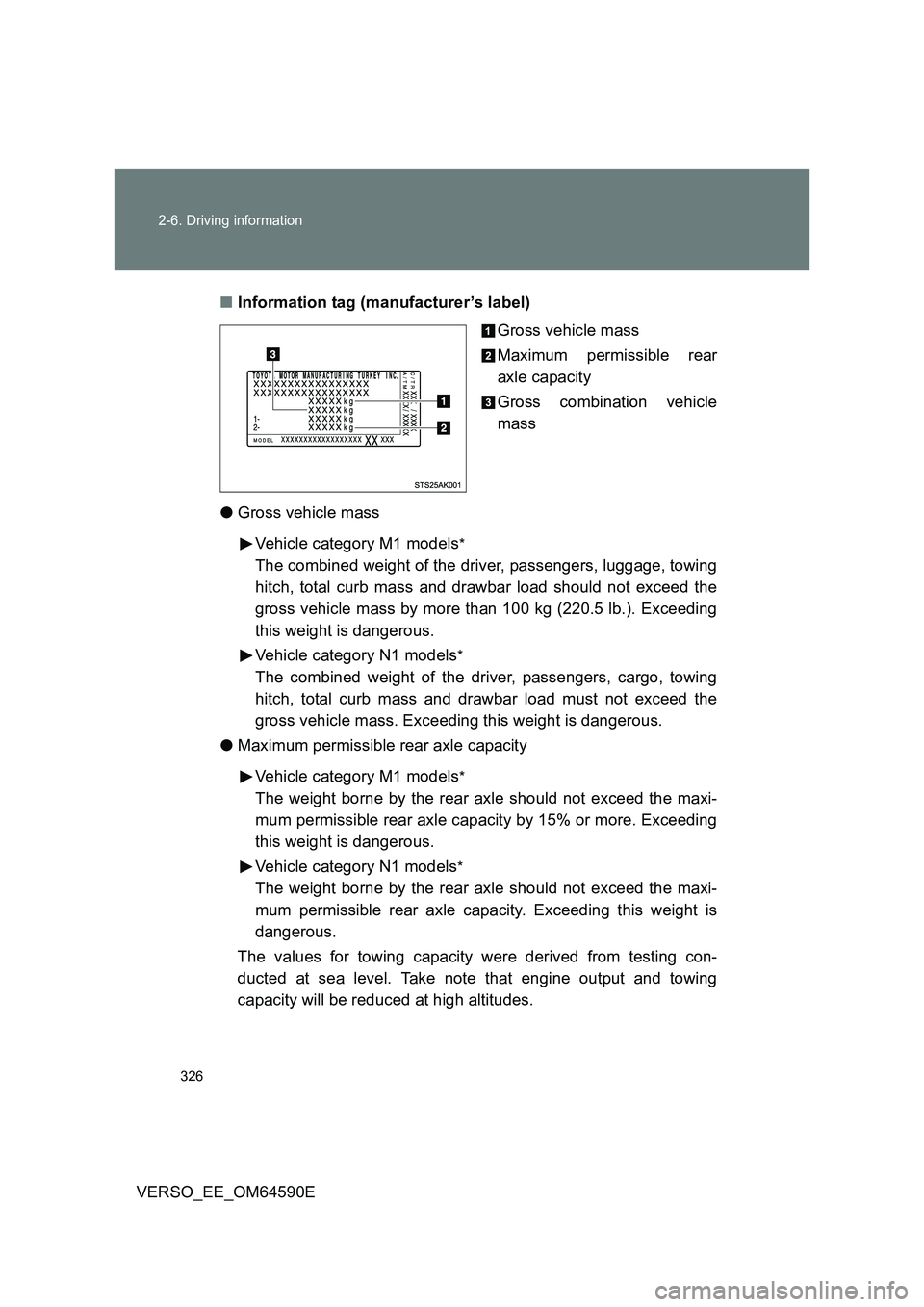
■ Information tag (manufacturer’s label)
Gross vehicle mass
Maximum permissible rear
axle capacity
Gross combination vehicle
mass
● Gross vehicle mass
Vehicle category M1 models*
The combined weight of the driver, passengers, luggage, towing
hitch, total curb mass and drawbar load should not exceed the
gross vehicle mass by more than 100 kg (220.5 lb.). Exceeding
this weight is dangerous.
Vehicle category N1 models*
The combined weight of the driver, passengers, cargo, towing
hitch, total curb mass and drawbar load must not exceed the
gross vehicle mass. Exceeding this weight is dangerous.
● Maximum permissible rear axle capacity
Vehicle category M1 models*
The weight borne by the rear axle should not exceed the maxi-
mum permissible rear axle capacity by 15% or more. Exceeding
this weight is dangerous.
Vehicle category N1 models*
The weight borne by the rear axle should not exceed the maxi-
mum permissible rear axle capacity. Exceeding this weight is
dangerous.
The values for towing capacity were derived from testing con-
ducted at sea level. Take note that engine output and towing
capacity will be reduced at high altitudes.
Page 327 of 664
327
2-6. Driving information
2
When driving
VERSO_EE_OM64590E
● Gross combination vehicle mass
The sum of the total vehicle weight and the weight of the trailer
being towed.
*: To distinguish the vehicle category, ask any authorized Toyota dealer or
repairer, or another duly qualified and equipped professional.
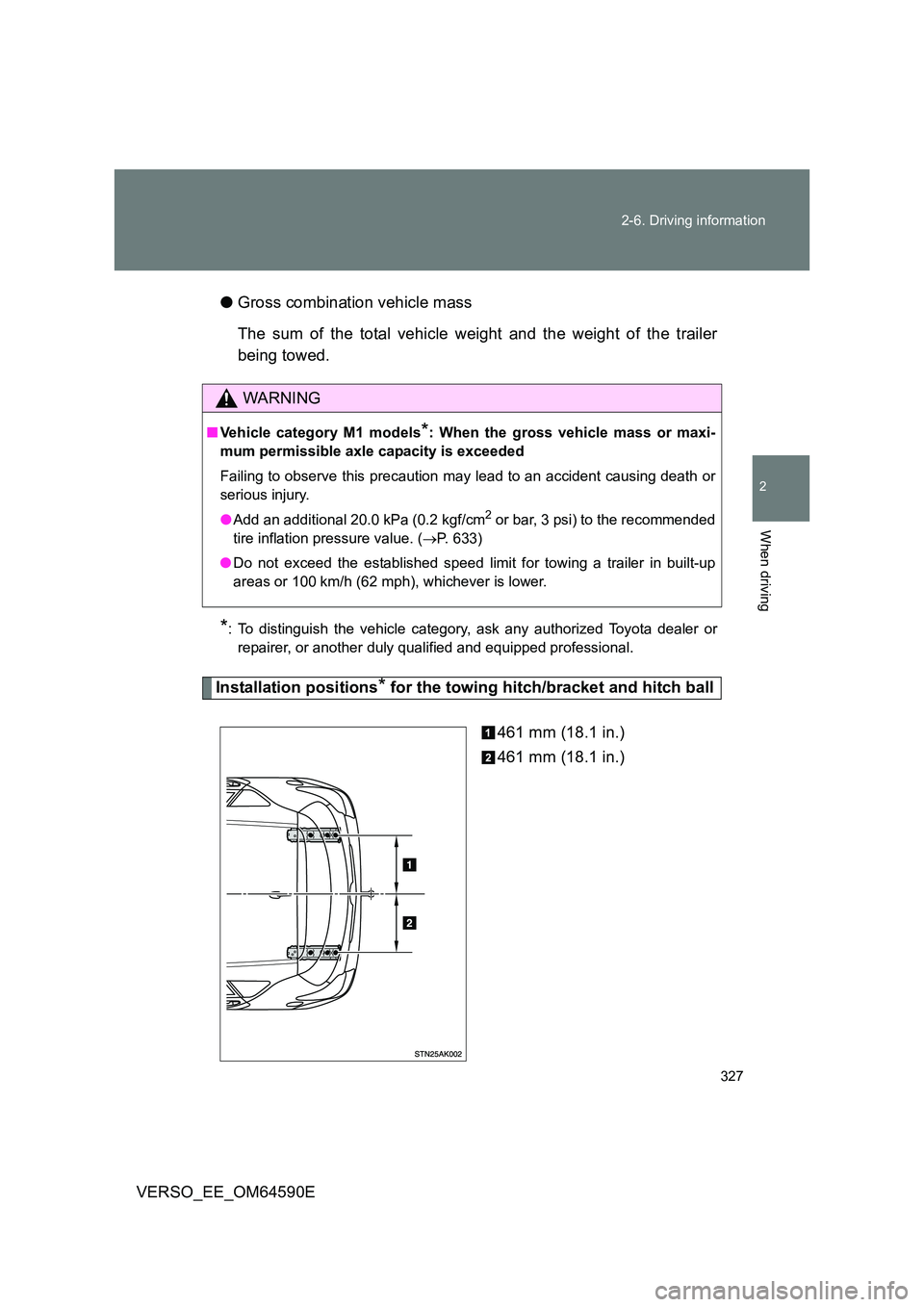
Installation positions* for the towing hitch/bracket and hitch ball
461 mm (18.1 in.)
461 mm (18.1 in.)
WARNING
■ Vehicle category M1 models*: When the gross vehicle mass or maxi-
mum permissible axle capacity is exceeded
Failing to observe this precaution may lead to an accident causing death or
serious injury.
● Add an additional 20.0 kPa (0.2 kgf/cm2 or bar, 3 psi) to the recommended
tire inflation pressure value. ( P. 633)
● Do not exceed the established speed limit for towing a trailer in built-up
areas or 100 km/h (62 mph), whichever is lower.
Page 328 of 664
328
2-6. Driving information
VERSO_EE_OM64590E
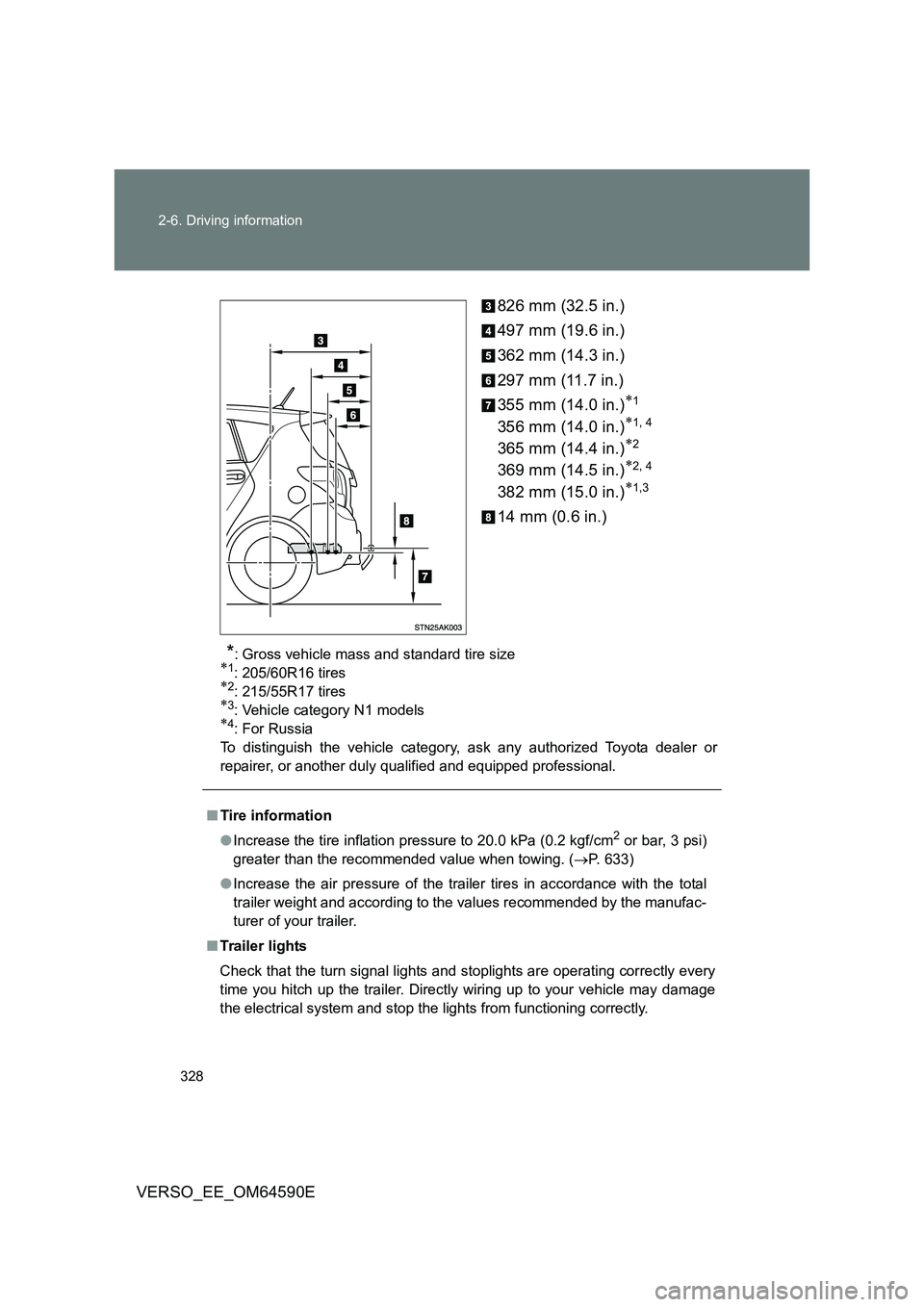
826 mm (32.5 in.)
497 mm (19.6 in.)
362 mm (14.3 in.)
297 mm (11.7 in.)
355 mm (14.0 in.)1
356 mm (14.0 in.)1, 4
365 mm (14.4 in.)2
369 mm (14.5 in.)2, 4
382 mm (15.0 in.)1,3
14 mm (0.6 in.)
*: Gross vehicle mass and standard tire size1: 205/60R16 tires2: 215/55R17 tires3: Vehicle category N1 models4: For Russia
To distinguish the vehicle category, ask any authorized Toyota dealer or
repairer, or another duly qualified and equipped professional.
■ Tire information
● Increase the tire inflation pressure to 20.0 kPa (0.2 kgf/cm2 or bar, 3 psi)
greater than the recommended value when towing. ( P. 633)
● Increase the air pressure of the trailer tires in accordance with the total
trailer weight and according to the values recommended by the manufac-
turer of your trailer.
■ Trailer lights
Check that the turn signal lights and stoplights are operating correctly every
time you hitch up the trailer. Directly wiring up to your vehicle may damage
the electrical system and stop the lights from functioning correctly.
Page 329 of 664
329
2-6. Driving information
2
When driving
VERSO_EE_OM64590E
■ Break-in schedule
Toyota recommends that vehicles fitted with new power train components
should not be used for towing trailers for the first 800 km (500 miles).
■ Maintenance
● Maintenance must be performed more frequently when using the vehicle
for towing due to the greater weight burden placed on the vehicle com-
pared to normal driving.
● Retighten all bolts securing the hitching ball and bracket after towing for
approximately 1000 km (600 miles).
■ Safety checks before towing
● Check that the maximum load limit for the towing hitch/bracket and hitch
ball is not exceeded. Bear in mind that the coupling weight of the trailer
will add to the load exerted on the vehicle. Also make sure that the total
load exerted on the vehicle is within the range of the weight limits.
( P. 325)
● Ensure that the trailer load is secure.
● Supplementary outside rear view mirrors should be added to the vehicle
if the traffic behind cannot be clearly seen with standard mirrors. Adjust
the extending arms of these mirrors on both sides of the vehicle so that
they always provide maximum visibility of the road behind.
NOTICE
■ When the rear bumper strengthening material is aluminum
Ensure the steel bracket part does not come directly in contact with that
area.
When steel and aluminum come into contact, there is a reaction similar to
corrosion, which will weaken the section concerned which may result in
damage. Apply a rust inhibitor to parts that will come in contact when attach-
ing a steel bracket.
Page 332 of 664
332
2-6. Driving information
VERSO_EE_OM64590E
■ When parking the vehicle
Always place wheel chocks under the wheels of both the vehicle
and trailer. Firmly set the parking brake and shift the shift lever to
“P” (Multidrive), and “1” or “R” (manual transmission).
WARNING
Follow all the instructions described in this section.
Failure to do so could cause an accident resulting in death or serious injury.
■ Trailer towing precautions
When towing, make sure that none of the weight limits are exceeded.
( P. 325)
■ Before descending hills or long declines
Reduce speed and downshift. However, never downshift suddenly while
descending steep or long downhill grades.
■ Operation of the brake
Do not hold the brake pedal depressed often or for long periods.
Doing so may result in the brake overheating or reduce braking effects.
■ To avoid accident or injury
● Do not exceed 100 km/h (62 mph) or the posted towing speed limit, which-
ever is lower.
● Do not use cruise control when you are towing.
● Vehicles with a compact spare tire: Do not tow a trailer when the compact
spare tire is installed on your vehicle.
● Vehicles with an emergency tire puncture repair kit: Do not tow a trailer
when the tire installed is repaired with the emergency tire puncture repair
kit.
Page 410 of 664
410
3-5. Other interior features
VERSO_EE_OM64590E
WARNING
■ Front seatback table precautions
Failure to follow the precautions below may cause death or serious injury.
● Be careful not to get your hands caught in the front seatback table.
● Do not use the front seatback table while the vehicle is moving.
● Make sure the front seatback table is folded down and locked securely
when not in use.
● Do not use the front seatback table while using a child restraint system on
the second seat.
● Do not move the front seats.
● Do not lean on the front seatback table or put your hands or elbow on it.
NOTICE
■To prevent damage to the front seatback table
Do not place more than 2 kg (4.4 lb.) of weight on the front seatback table.
The table could retract unexpectedly, possibly damaging the front seatback
table.