tow TOYOTA VERSO 2017 Owner's Manual
[x] Cancel search | Manufacturer: TOYOTA, Model Year: 2017, Model line: VERSO, Model: TOYOTA VERSO 2017Pages: 668, PDF Size: 49.7 MB
Page 295 of 668
295
2-5. Using other driving systems
2
When driving
VERSO_EE_OM64517E
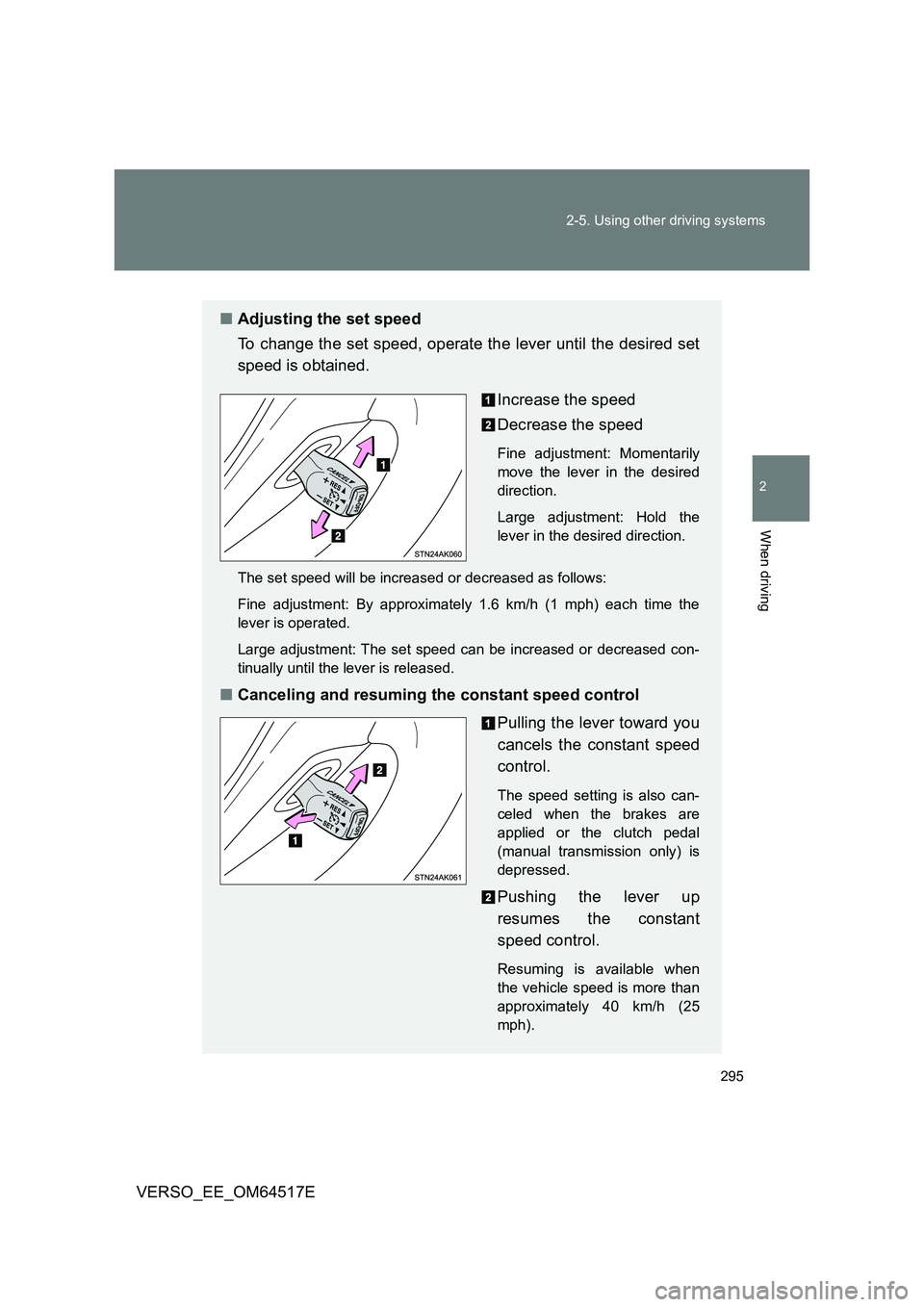
■ Adjusting the set speed
To change the set speed, operate the lever until the desired set
speed is obtained.
Increase the speed
Decrease the speed
Fine adjustment: Momentarily
move the lever in the desired
direction.
Large adjustment: Hold the
lever in the desired direction.
The set speed will be increased or decreased as follows:
Fine adjustment: By approximately 1.6 km/h (1 mph) each time the
lever is operated.
Large adjustment: The set speed can be increased or decreased con-
tinually until the lever is released.
■ Canceling and resuming the constant speed control
Pulling the lever toward you
cancels the constant speed
control.
The speed setting is also can-
celed when the brakes are
applied or the clutch pedal
(manual transmission only) is
depressed.
Pushing the lever up
resumes the constant
speed control.
Resuming is available when
the vehicle speed is more than
approximately 40 km/h (25
mph).
Page 297 of 668
297
2-5. Using other driving systems
2
When driving
VERSO_EE_OM64517E
WARNING
■ To avoid operating the cruise control by mistake
Switch the cruise control off using the “ON-OFF” button when not in use.
■ Situations unsuitable for cruise control
Do not use cruise control in any of the following situations.
Doing so may result in loss of control and could cause an accident resulting
in death or serious injury.
● In heavy traffic
● On roads with sharp bends
● On winding roads
● On slippery roads, such as those covered with rain, ice or snow
● On steep hills
Vehicle speed may exceed the set speed when driving down a steep hill.
● When your vehicle is towing a trailer
Page 299 of 668
299
2-5. Using other driving systems
2
When driving
VERSO_EE_OM64517E
■ Speed limiter can be set when
The vehicle speed is more than approximately 30 km/h (18 mph).
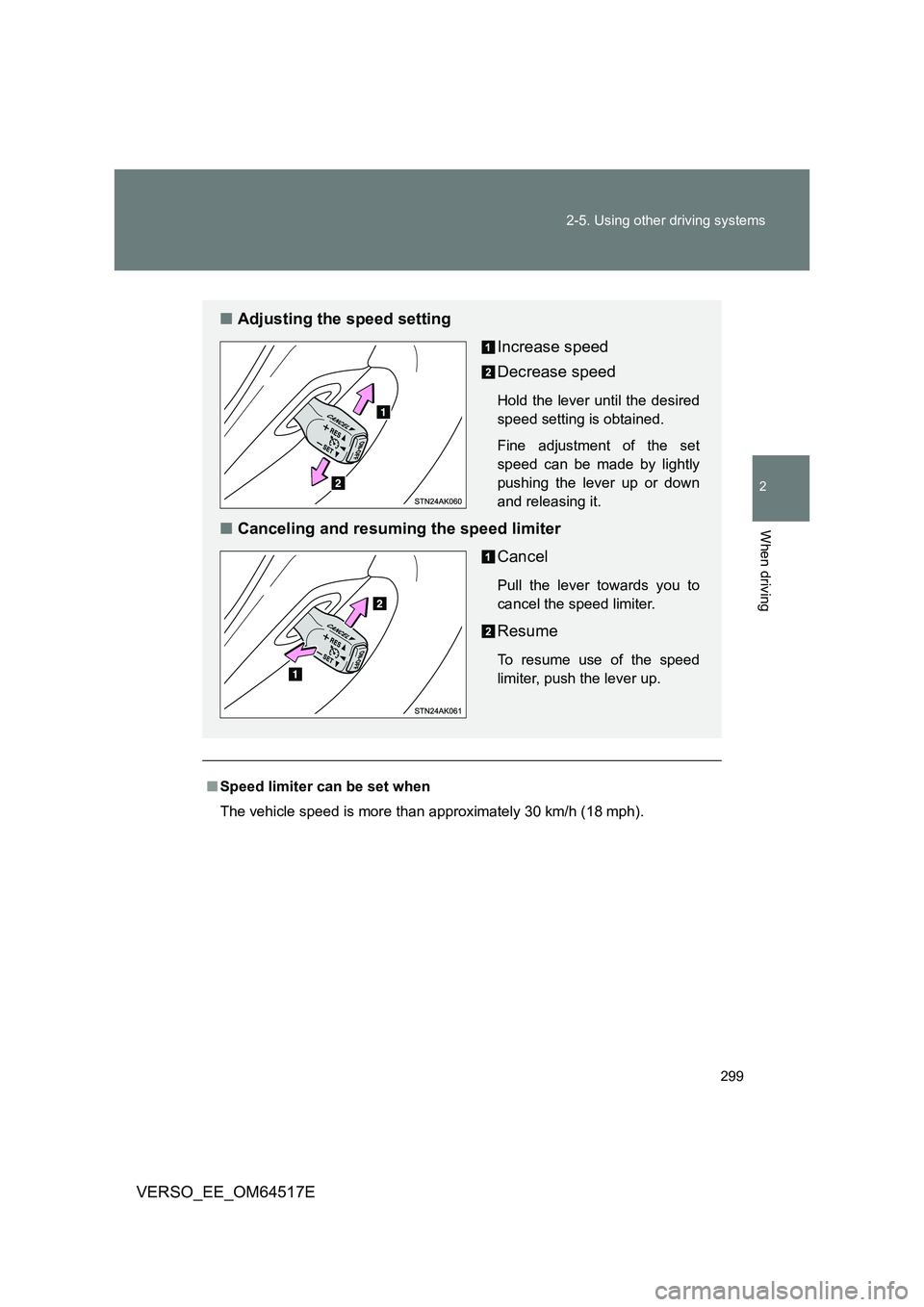
■ Adjusting the speed setting
Increase speed
Decrease speed
Hold the lever until the desired
speed setting is obtained.
Fine adjustment of the set
speed can be made by lightly
pushing the lever up or down
and releasing it.
■ Canceling and resuming the speed limiter
Cancel
Pull the lever towards you to
cancel the speed limiter.
Resume
To resume use of the speed
limiter, push the lever up.
Page 300 of 668
300
2-5. Using other driving systems
VERSO_EE_OM64517E
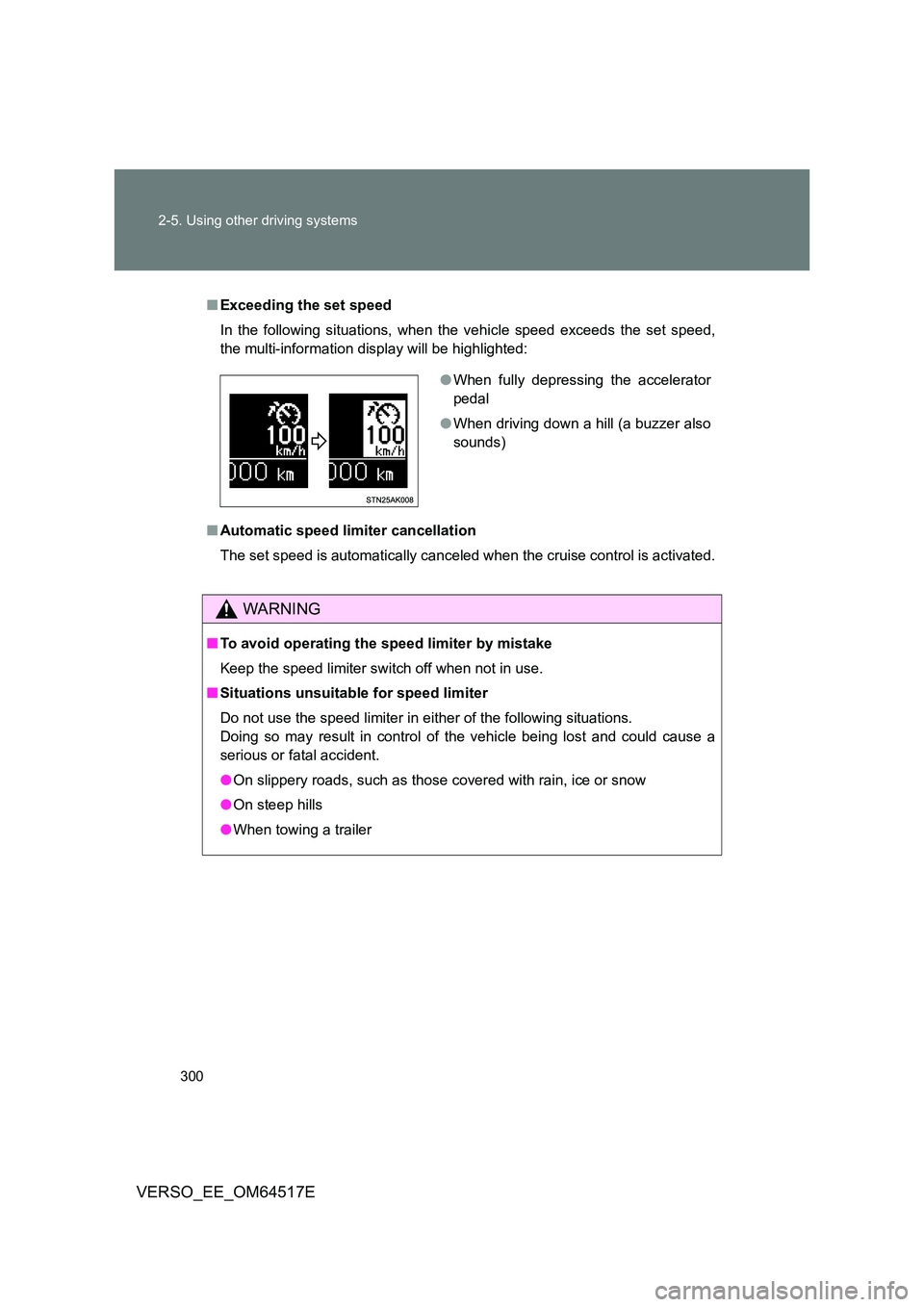
■ Exceeding the set speed
In the following situations, when the vehicle speed exceeds the set speed,
the multi-information display will be highlighted:
■ Automatic speed limiter cancellation
The set speed is automatically canceled when the cruise control is activated.
WARNING
■ To avoid operating the speed limiter by mistake
Keep the speed limiter switch off when not in use.
■ Situations unsuitable for speed limiter
Do not use the speed limiter in either of the following situations.
Doing so may result in control of the vehicle being lost and could cause a
serious or fatal accident.
● On slippery roads, such as those covered with rain, ice or snow
● On steep hills
● When towing a trailer
●When fully depressing the accelerator
pedal
● When driving down a hill (a buzzer also
sounds)
Page 306 of 668
306
2-5. Using other driving systems
VERSO_EE_OM64517E
■ Sensor detection information
● Certain vehicle conditions and the surrounding environment may affect
the ability of a sensor to correctly detect an obstacle. Particular instances
where this may occur are listed below.
• There is dirt, snow or ice on a sensor.
• A sensor is frozen.
• A sensor is covered in any way.
• The vehicle is leaning considerably to one side.
• On an extremely bumpy road, on an incline, on gravel, or on grass.
• The vicinity of the vehicle is noisy due to vehicle horns, motorcycle
engines, air brakes of large vehicl es, or other loud noises producing
ultrasonic waves.
• There is another vehicle equipped with parking assist sensors in the
vicinity.
• A sensor is coated with a sheet of spray or heavy rain.
• The vehicle is equipped with a fender pole or radio antenna.
• Towing eyelet is installed.
• A bumper or sensor receives a strong impact.
• The vehicle is approaching a tall or right-angled curb.
• In harsh sunlight or intense cold weather.
• A non-genuine Toyota suspension (lowered suspension etc.) is
installed.
In addition to the examples above, there are instances in which, because of
their shape, signs and other objects may be judged by a sensor to be closer
than they are.
● The shape of the obstacle may prevent a sensor from detecting it. Pay
particular attention to the following obstacles:
• Wires, fences, ropes, etc.
• Cotton, snow and other materials that absorb sound waves
• Sharply-angles objects
• Low obstacles
• Tall obstacles with upper sections projecting outwards in the direction
of your vehicle
Page 322 of 668
322
VERSO_EE_OM64517E
2-6. Driving information
Cargo and luggage
WARNING
■Things that must not be carried in the luggage compartment
The following things may cause a fi re if loaded in the luggage compartment.
● Receptacles containing gasoline
● Aerosol cans
Take notice of the following information about storage precautions,
cargo capacity and load.
● Stow cargo and luggage in the luggage compartment whenever
possible.
● Be sure all items are secured in place.
● Be careful to keep the vehicle level. Placing the weight as far for-
ward as possible helps maintain vehicle balance.
● For better fuel economy, do not carry unnecessary weight.
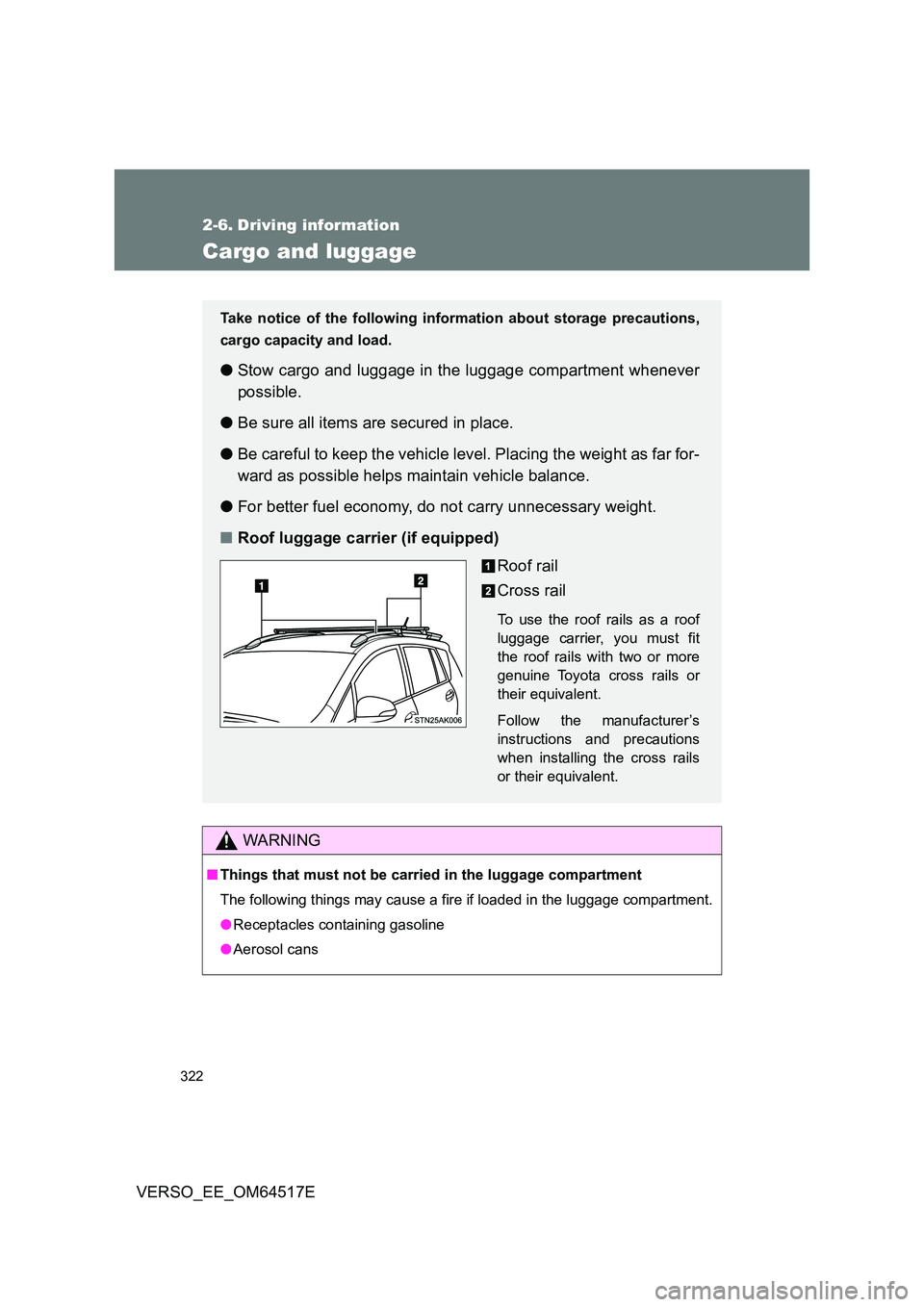
■ Roof luggage carrier (if equipped)
Roof rail
Cross rail
To use the roof rails as a roof
luggage carrier, you must fit
the roof rails with two or more
genuine Toyota cross rails or
their equivalent.
Follow the manufacturer’s
instructions and precautions
when installing the cross rails
or their equivalent.
Page 329 of 668
329
2-6. Driving information
2
When driving
VERSO_EE_OM64517E
Trailer towing
Your vehicle is designed primarily as a passenger carrying vehicle.
Towing a trailer will have an adverse effect on handling, perfor-
mance, braking, durability, and fuel consumption. Your safety and
satisfaction depend on the proper use of correct equipment and cau-
tious driving habits. For your safety and the safety of others, do not
overload the vehicle or trailer.
To tow a trailer safely, use extreme care and drive the vehicle in
accordance with the trailer’s characteristics and operating condi-
tions.
Toyota warranties do not apply to damage or malfunction caused by
towing a trailer for commercial purposes.
Ask your local authorized Toyota dealer or repairer, or another duly
qualified and equipped professional , for further details before tow-
ing, as there are additional legal requirements in some countries.
■ Weight limits
Check the allowable towing capacity, GVM (Gross Vehicle
Mass), MPAC (Maximum Permissible Axle Capacity), and per-
missible drawbar load before towing. ( P. 622)
■ Towing hitch/bracket
Toyota recommends the use of the Toyota hitch/bracket for your
vehicle. Other products of a suitable nature and comparable
quality may also be used.
Page 330 of 668
330
2-6. Driving information
VERSO_EE_OM64517E
Important points regarding trailer loads
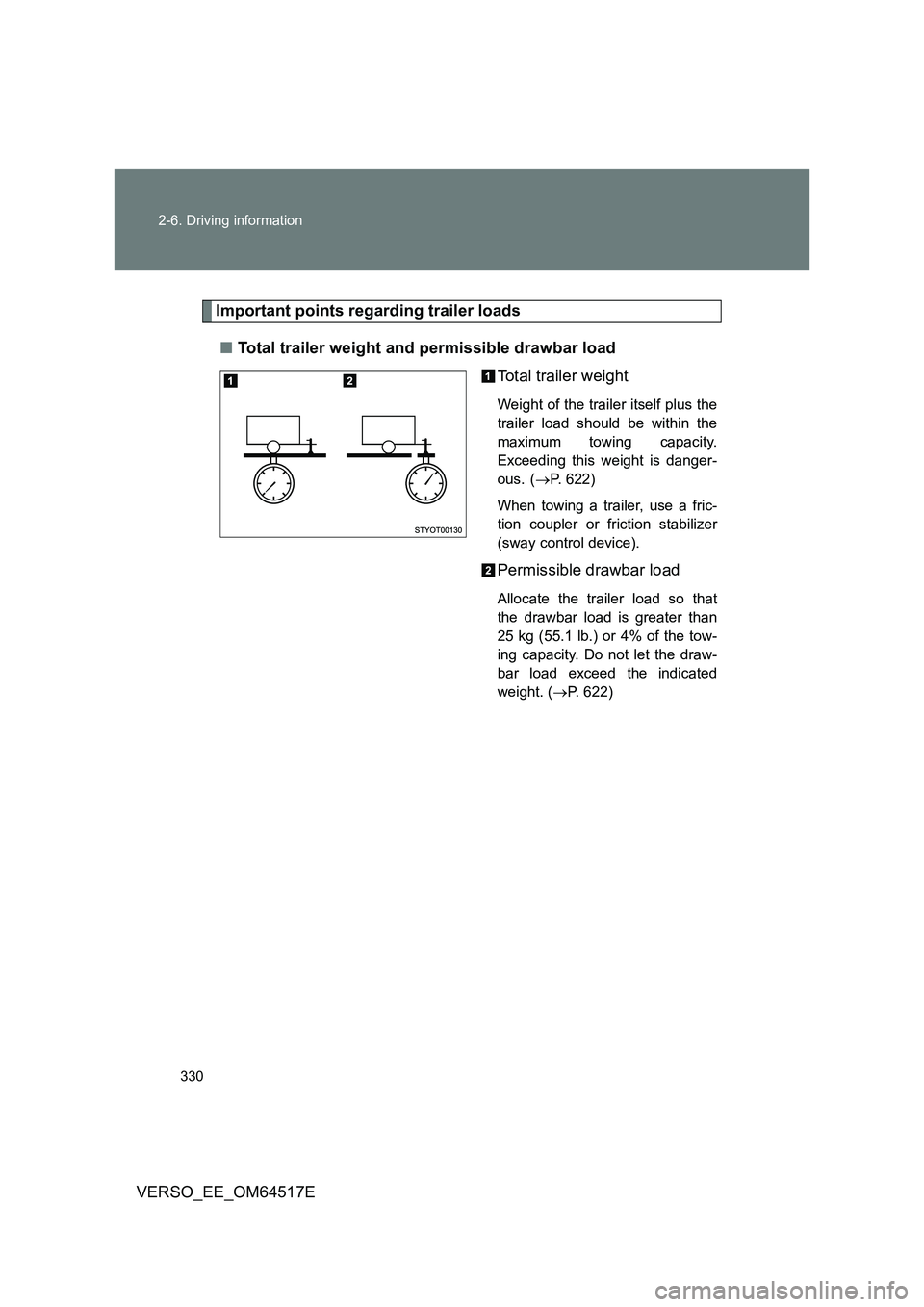
■ Total trailer weight and permissible drawbar load
Total trailer weight
Weight of the trailer itself plus the
trailer load should be within the
maximum towing capacity.
Exceeding this weight is danger-
ous. ( P. 622)
When towing a trailer, use a fric-
tion coupler or friction stabilizer
(sway control device).
Permissible drawbar load
Allocate the trailer load so that
the drawbar load is greater than
25 kg (55.1 lb.) or 4% of the tow-
ing capacity. Do not let the draw-
bar load exceed the indicated
weight. ( P. 622)
Page 331 of 668
331
2-6. Driving information
2
When driving
VERSO_EE_OM64517E
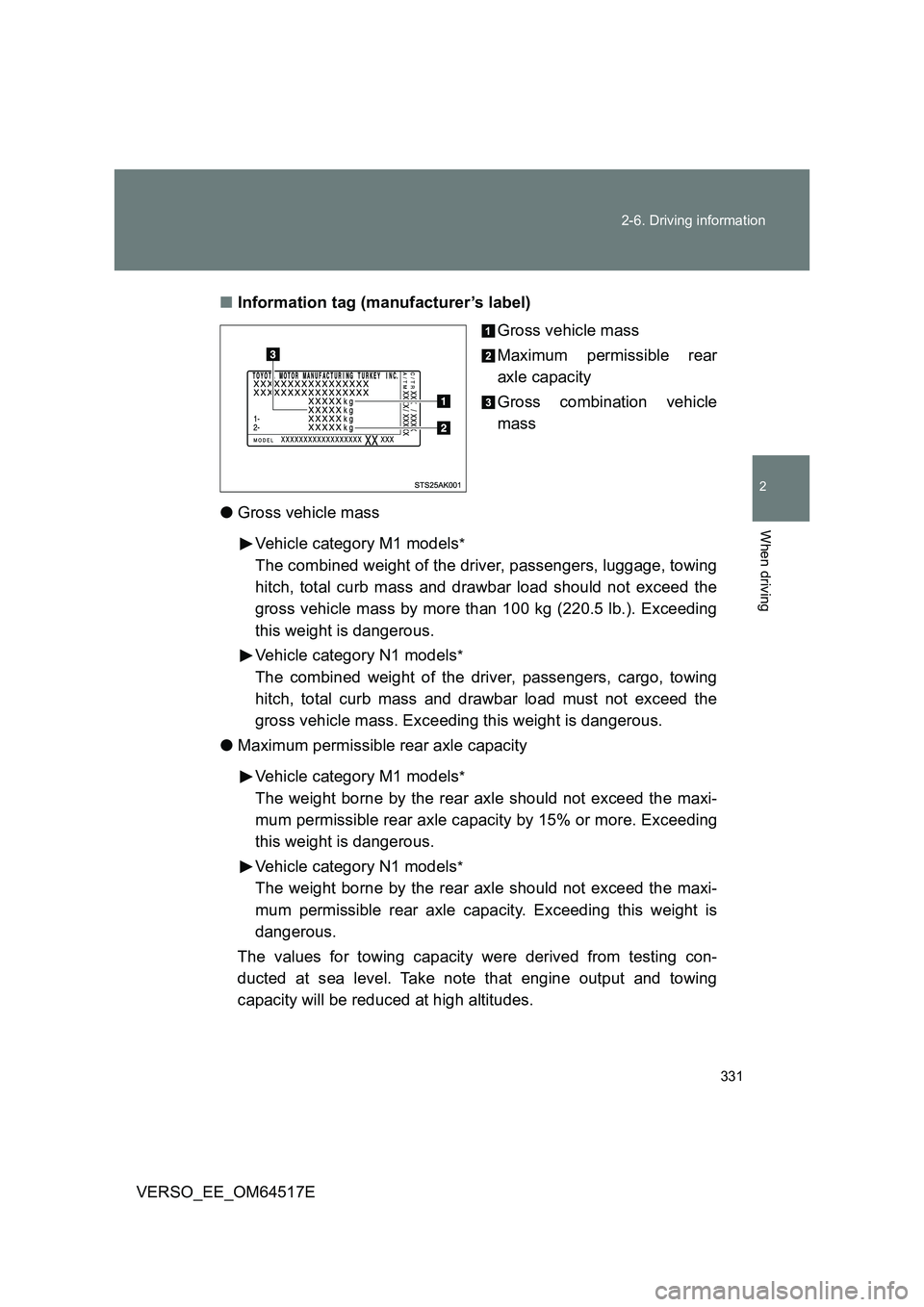
■ Information tag (manufacturer’s label)
Gross vehicle mass
Maximum permissible rear
axle capacity
Gross combination vehicle
mass
● Gross vehicle mass
Vehicle category M1 models*
The combined weight of the driver, passengers, luggage, towing
hitch, total curb mass and drawbar load should not exceed the
gross vehicle mass by more than 100 kg (220.5 lb.). Exceeding
this weight is dangerous.
Vehicle category N1 models*
The combined weight of the driver, passengers, cargo, towing
hitch, total curb mass and drawbar load must not exceed the
gross vehicle mass. Exceeding this weight is dangerous.
● Maximum permissible rear axle capacity
Vehicle category M1 models*
The weight borne by the rear axle should not exceed the maxi-
mum permissible rear axle capacity by 15% or more. Exceeding
this weight is dangerous.
Vehicle category N1 models*
The weight borne by the rear axle should not exceed the maxi-
mum permissible rear axle capacity. Exceeding this weight is
dangerous.
The values for towing capacity were derived from testing con-
ducted at sea level. Take note that engine output and towing
capacity will be reduced at high altitudes.
Page 332 of 668
332
2-6. Driving information
VERSO_EE_OM64517E
● Gross combination vehicle mass
The sum of the total vehicle weight and the weight of the trailer
being towed.
*: To distinguish the vehicle category, ask any authorized Toyota dealer or
repairer, or another duly qualified and equipped professional.
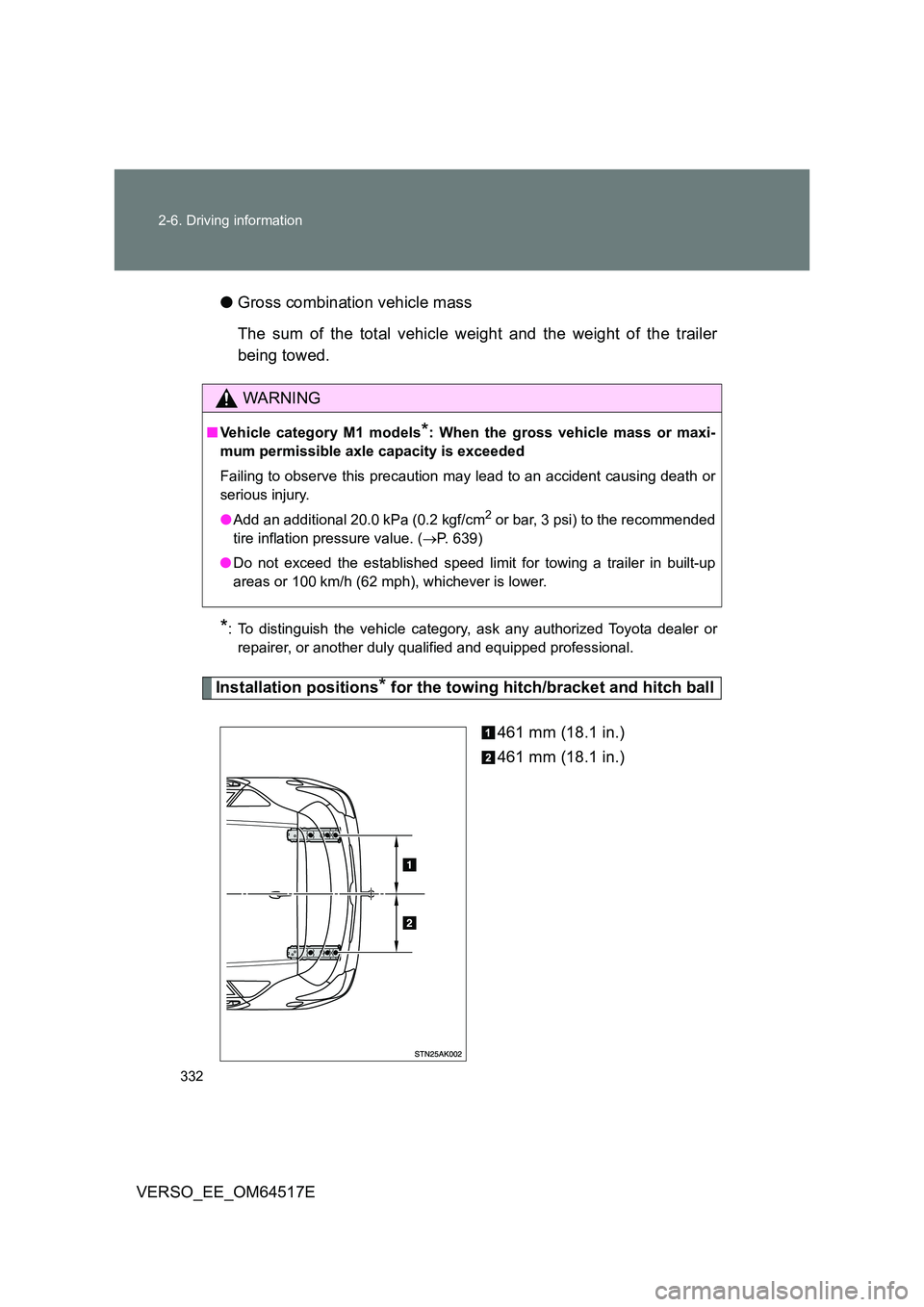
Installation positions* for the towing hitch/bracket and hitch ball
461 mm (18.1 in.)
461 mm (18.1 in.)
WARNING
■ Vehicle category M1 models*: When the gross vehicle mass or maxi-
mum permissible axle capacity is exceeded
Failing to observe this precaution may lead to an accident causing death or
serious injury.
● Add an additional 20.0 kPa (0.2 kgf/cm2 or bar, 3 psi) to the recommended
tire inflation pressure value. ( P. 639)
● Do not exceed the established speed limit for towing a trailer in built-up
areas or 100 km/h (62 mph), whichever is lower.