lock TOYOTA VERSO S 2011 User Guide
[x] Cancel search | Manufacturer: TOYOTA, Model Year: 2011, Model line: VERSO S, Model: TOYOTA VERSO S 2011Pages: 664, PDF Size: 160.56 MB
Page 33 of 664
33
1
1-1. For safe use
For safety and security
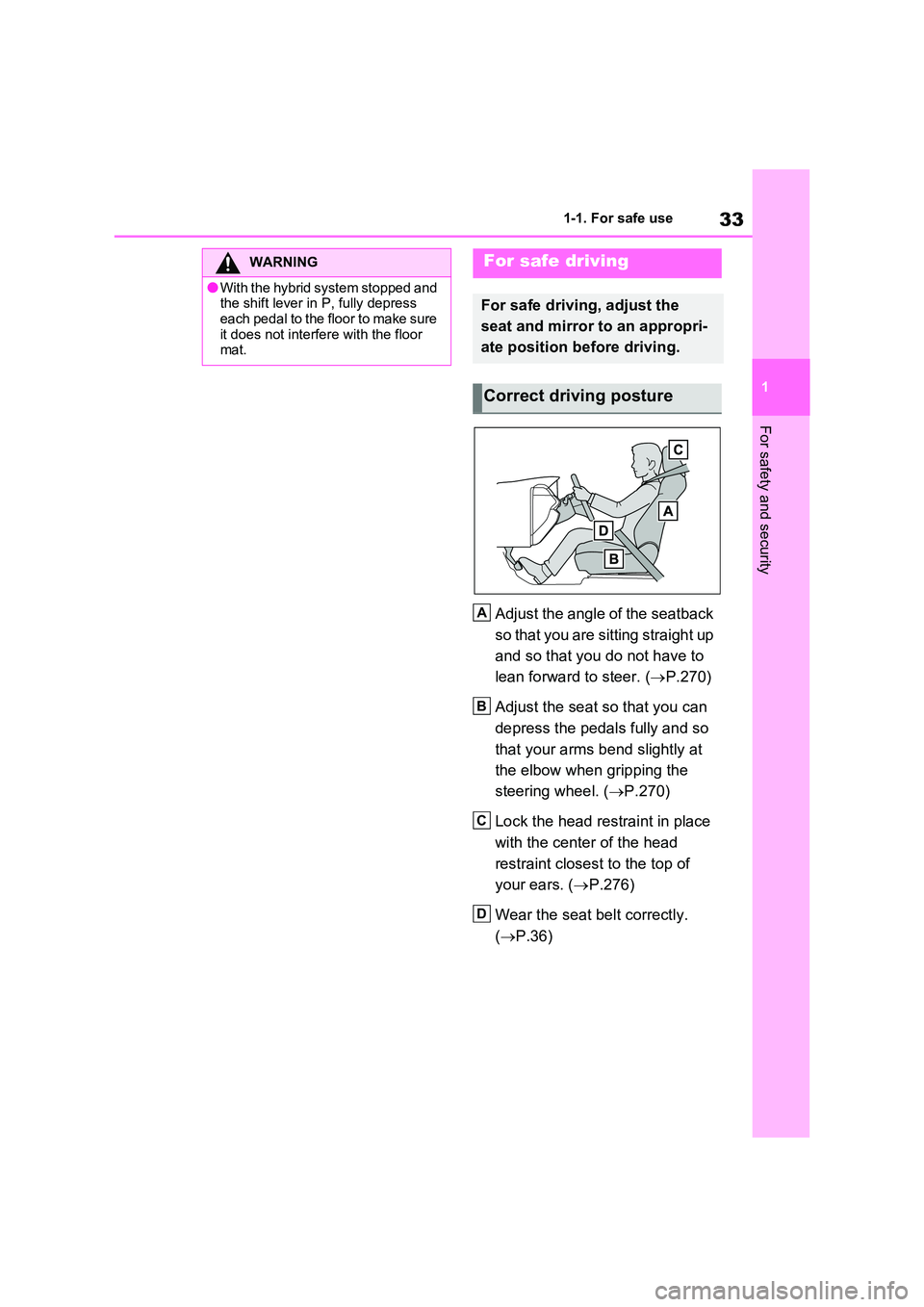
Adjust the angle of the seatback
so that you are sitting straight up
and so that you do not have to
lean forward to steer. ( P.270)
Adjust the seat so that you can
depress the pedals fully and so
that your arms bend slightly at
the elbow when gripping the
steering wheel. ( P.270)
Lock the head restraint in place
with the center of the head
restraint closest to the top of
your ears. ( P.276)
Wear the seat belt correctly.
( P.36)
WARNING
●With the hybrid system stopped and the shift lever in P, fully depress
each pedal to the floor to make sure it does not interfere with the floor mat.
For safe driving
For safe driving, adjust the
seat and mirror to an appropri-
ate position before driving.
Correct driving posture
A
B
C
D
Page 34 of 664
341-1. For safe use
Make sure that all occupants are
wearing their seat belts before driv-
ing the vehicle. ( P.36)
Use a child restraint system appro-
priate for the child until the child
becomes large enough to properly
wear the vehicle’s seat belt.
( P.50)
Make sure that you can see back-
ward clearly by adjusting the inside
rear view mirror (if equipped), Digi-
tal Rear-view Mirror (if equipped)
and outside rear view mirrors prop-
erly. ( P.279, 280, 289)
WARNING
Observe the following precautions. Failure to do so may result in death or
serious injury.
●Do not adjust the position of the driver’s seat while driving.
Doing so could cause the driver to lose control of the vehicle.
●Do not place a cushion between the driver or passenger and the seat-back. A cushion may prevent cor-
rect posture from being achieved, and reduce the effectiveness of the seat belt and head restraint.
●Do not place anything under the front seats.
Objects placed under the front seats may become jammed in the seat tracks and stop the seat from
locking in place. This may lead to an accident and the adjustment mechanism may also be damaged.
●Always observe the legal speed limit when driving on public roads.
●When driving over long distances, take regular breaks before you start
to feel tired. Also, if you feel tired or sleepy while driving, do not force yourself to con-
tinue driving and take a break immediately.
Correct use of the seat belts
Adjusting the mirrors
Page 36 of 664
361-1. For safe use
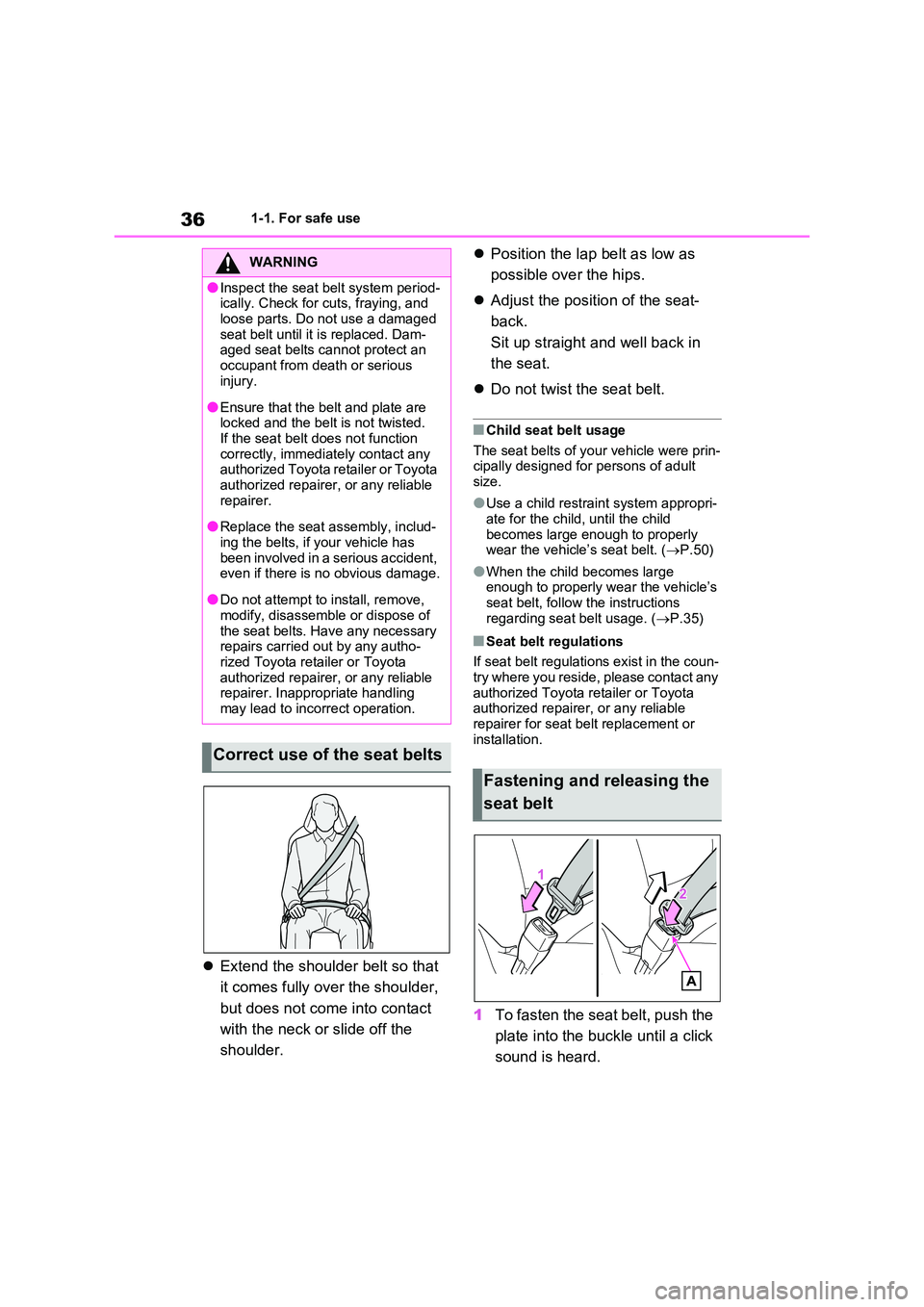
Extend the shoulder belt so that
it comes fully over the shoulder,
but does not come into contact
with the neck or slide off the
shoulder.
Position the lap belt as low as
possible over the hips.
Adjust the position of the seat-
back.
Sit up straight and well back in
the seat.
Do not twist the seat belt.
■Child seat belt usage
The seat belts of your vehicle were prin- cipally designed for persons of adult size.
●Use a child restraint system appropri-ate for the child, until the child
becomes large enough to properly wear the vehicle’s seat belt. ( P.50)
●When the child becomes large enough to properly wear the vehicle’s seat belt, follow the instructions
regarding seat belt usage. ( P.35)
■Seat belt regulations
If seat belt regulations exist in the coun- try where you reside, please contact any
authorized Toyota retailer or Toyota authorized repairer, or any reliable repairer for seat belt replacement or
installation.
1 To fasten the seat belt, push the
plate into the buckle until a click
sound is heard.
WARNING
●Inspect the seat belt system period- ically. Check for cuts, fraying, and
loose parts. Do not use a damaged seat belt until it is replaced. Dam-aged seat belts cannot protect an
occupant from death or serious injury.
●Ensure that the belt and plate are locked and the belt is not twisted.If the seat belt does not function
correctly, immediately contact any authorized Toyota retailer or Toyota authorized repairer, or any reliable
repairer.
●Replace the seat assembly, includ-
ing the belts, if your vehicle has been involved in a serious accident, even if there is no obvious damage.
●Do not attempt to install, remove, modify, disassemble or dispose of
the seat belts. Have any necessary repairs carried out by any autho-rized Toyota retailer or Toyota
authorized repairer, or any reliable repairer. Inappropriate handling may lead to incorrect operation.
Correct use of the seat belts
Fastening and releasing the
seat belt
Page 37 of 664
37
1
1-1. For safe use
For safety and security
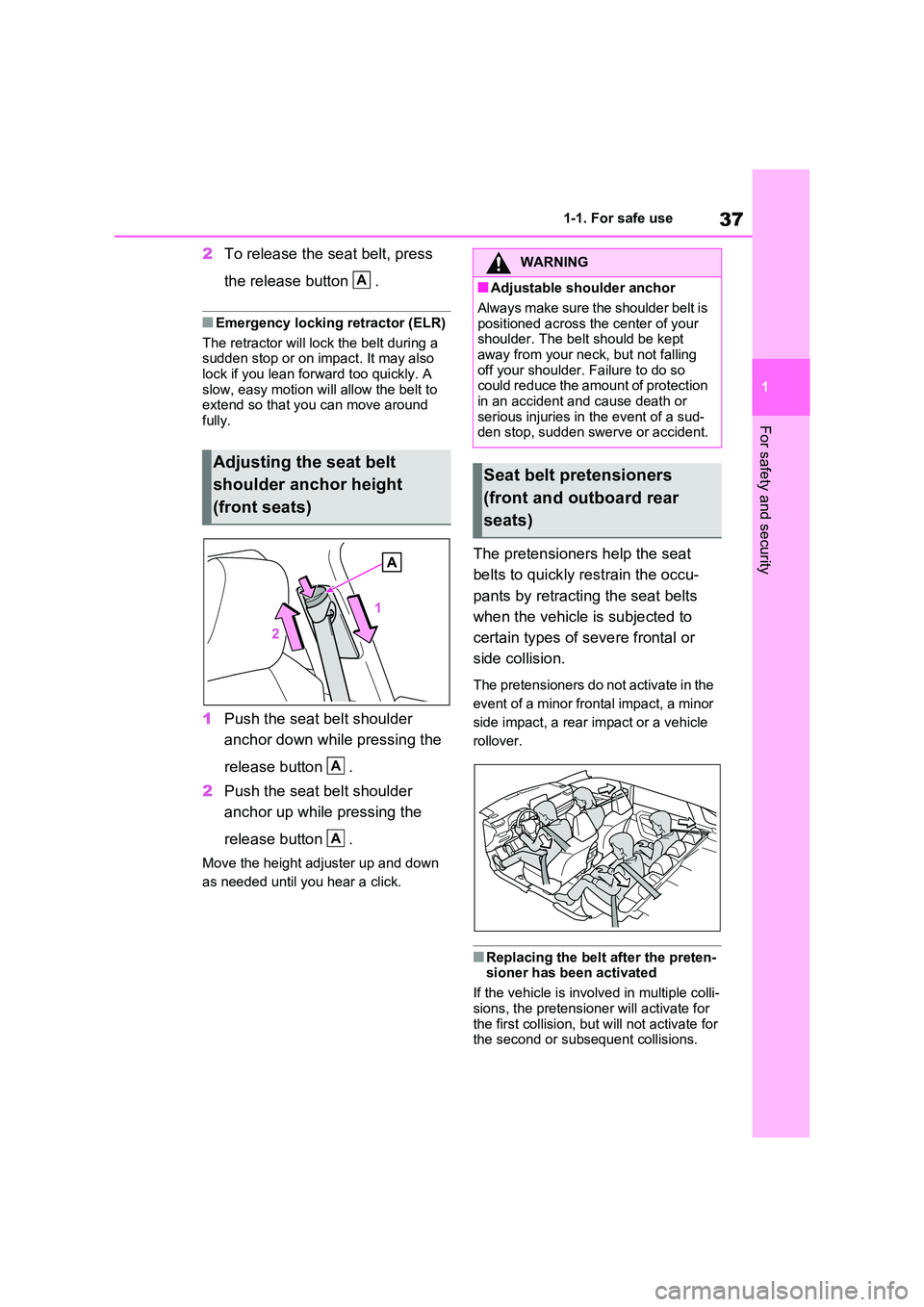
2 To release the seat belt, press
the release button .
■Emergency locking retractor (ELR)
The retractor will lock the belt during a sudden stop or on impact. It may also
lock if you lean forward too quickly. A slow, easy motion will allow the belt to extend so that you can move around
fully.
1 Push the seat belt shoulder
anchor down while pressing the
release button .
2 Push the seat belt shoulder
anchor up while pressing the
release button .
Move the height adjuster up and down
as needed until you hear a click.
The pretensioners help the seat
belts to quickly restrain the occu-
pants by retracting the seat belts
when the vehicle is subjected to
certain types of severe frontal or
side collision.
The pretensioners do not activate in the
event of a minor frontal impact, a minor
side impact, a rear impact or a vehicle
rollover.
■Replacing the belt after the preten- sioner has been activated
If the vehicle is involved in multiple colli-
sions, the pretensioner will activate for the first collision, but will not activate for the second or subsequent collisions.
Adjusting the seat belt
shoulder anchor height
(front seats)
A
A
A
WARNING
■Adjustable shoulder anchor
Always make sure the shoulder belt is
positioned across the center of your shoulder. The belt should be kept away from your neck, but not falling
off your shoulder. Failure to do so could reduce the amount of protection in an accident and cause death or
serious injuries in the event of a sud- den stop, sudden swerve or accident.
Seat belt pretensioners
(front and outboard rear
seats)
Page 41 of 664
41
1
1-1. For safe use
For safety and security
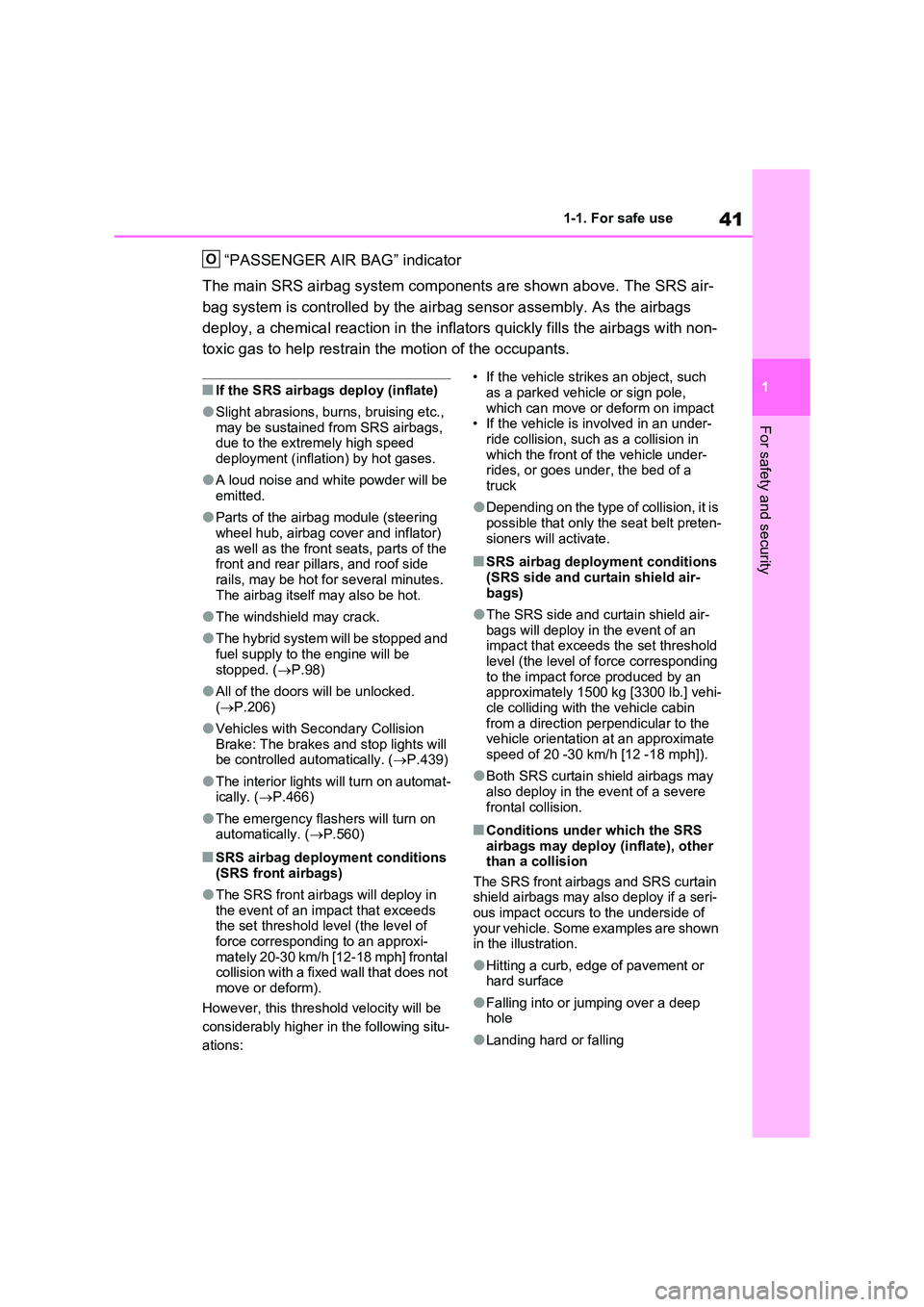
“PASSENGER AIR BAG” indicator
The main SRS airbag system components are shown above. The SRS air-
bag system is controlled by the airbag sensor assembly. As the airbags
deploy, a chemical reaction in the inflators quickly fills the airbags with non-
toxic gas to help restrain the motion of the occupants.
■If the SRS airbags deploy (inflate)
●Slight abrasions, burns, bruising etc., may be sustained from SRS airbags, due to the extremely high speed
deployment (inflation) by hot gases.
●A loud noise and white powder will be
emitted.
●Parts of the airbag module (steering
wheel hub, airbag cover and inflator) as well as the front seats, parts of the front and rear pillars, and roof side
rails, may be hot for several minutes. The airbag itself may also be hot.
●The windshield may crack.
●The hybrid system will be stopped and
fuel supply to the engine will be stopped. ( P.98)
●All of the doors will be unlocked. ( P.206)
●Vehicles with Secondary Collision Brake: The brakes and stop lights will be controlled automatically. ( P.439)
●The interior lights will turn on automat- ically. ( P.466)
●The emergency flashers will turn on automatically. ( P.560)
■SRS airbag deployment conditions
(SRS front airbags)
●The SRS front airbags will deploy in
the event of an impact that exceeds the set threshold level (the level of force corresponding to an approxi-
mately 20-30 km/h [12-18 mph] frontal collision with a fixed wall that does not move or deform).
However, this threshold velocity will be
considerably higher in the following situ-
ations:
• If the vehicle strikes an object, such as a parked vehicle or sign pole,
which can move or deform on impact • If the vehicle is involved in an under-
ride collision, such as a collision in which the front of the vehicle under-rides, or goes under, the bed of a
truck
●Depending on the type of collision, it is
possible that only the seat belt preten- sioners will activate.
■SRS airbag deployment conditions (SRS side and curtain shield air-
bags)
●The SRS side and curtain shield air-
bags will deploy in the event of an impact that exceeds the set threshold level (the level of force corresponding
to the impact force produced by an approximately 1500 kg [3300 lb.] vehi-cle colliding with the vehicle cabin
from a direction perpendicular to the vehicle orientation at an approximate speed of 20 -30 km/h [12 -18 mph]).
●Both SRS curtain shield airbags may also deploy in the event of a severe
frontal collision.
■Conditions under which the SRS airbags may deploy (inflate), other than a collision
The SRS front airbags and SRS curtain shield airbags may also deploy if a seri-ous impact occurs to the underside of
your vehicle. Some examples are shown in the illustration.
●Hitting a curb, edge of pavement or hard surface
●Falling into or jumping over a deep hole
●Landing hard or falling
O
Page 49 of 664
49
1
1-2. Child safety
For safety and security
WARNING
■When installing a child restraint system
For safety reasons, always install a child restraint system in a rear seat. In the event that the rear seat cannot be
used, the front seat can be used as long as the airbag manual on-off sys-tem is set to “OFF”.
If the airbag manual on-off system is left on, the strong impact of the airbag deployment (inflation) may cause
serious injury or even death.
■When a child restraint system is
not installed on the front passen- ger seat
Ensure that the airbag manual on-off
system is set to “ON”. If it is left off, the airbag may not deploy in the event of an accident,
which may result in serious injury or even death.
Riding with children
Observe the following precau-
tions when children are in the
vehicle.
Use a child restraint system
appropriate for the child, until
the child becomes large
enough to properly wear the
vehicle’s seat belt.
It is recommended that chil-
dren sit in the rear seats to
avoid accidental contact with
the shift lever, wiper switch,
etc.
Use the rear door child-protec-
tor lock or the window lock
switch to avoid children open-
ing the door while driving or
operating the power window
accidentally. ( P.209, 293)
Do not let small children oper-
ate equipment which may
catch or pinch body parts,
such as the power window,
hood, back door, seats, etc.
Page 61 of 664
61
1
1-2. Child safety
For safety and security
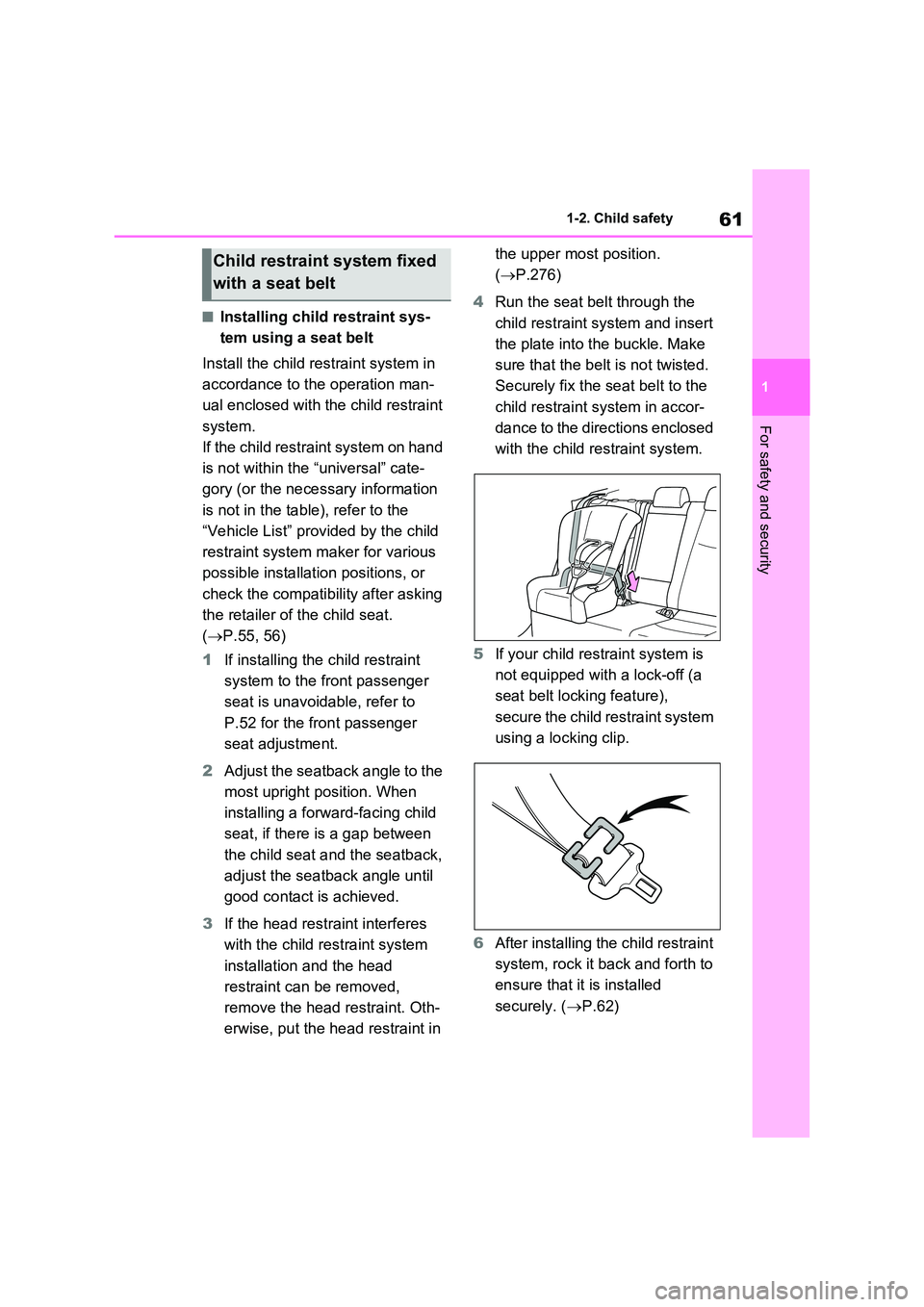
■Installing child restraint sys-
tem using a seat belt
Install the child restraint system in
accordance to the operation man-
ual enclosed with the child restraint
system.
If the child restraint system on hand
is not within the “universal” cate-
gory (or the necessary information
is not in the table), refer to the
“Vehicle List” provided by the child
restraint system maker for various
possible installation positions, or
check the compatibility after asking
the retailer of the child seat.
( P.55, 56)
1 If installing the child restraint
system to the front passenger
seat is unavoidable, refer to
P.52 for the front passenger
seat adjustment.
2 Adjust the seatback angle to the
most upright position. When
installing a forward-facing child
seat, if there is a gap between
the child seat and the seatback,
adjust the seatback angle until
good contact is achieved.
3 If the head restraint interferes
with the child restraint system
installation and the head
restraint can be removed,
remove the head restraint. Oth-
erwise, put the head restraint in
the upper most position.
( P.276)
4 Run the seat belt through the
child restraint system and insert
the plate into the buckle. Make
sure that the belt is not twisted.
Securely fix the seat belt to the
child restraint system in accor-
dance to the directions enclosed
with the child restraint system.
5 If your child restraint system is
not equipped with a lock-off (a
seat belt locking feature),
secure the child restraint system
using a locking clip.
6 After installing the child restraint
system, rock it back and forth to
ensure that it is installed
securely. ( P.62)
Child restraint system fixed
with a seat belt
Page 62 of 664
621-2. Child safety
■Removing a child restraint
system installed with a seat
belt
Press the buckle release button
and fully retract the seat belt.
When releasing the buckle, the child
restraint system may spring up due to
the rebound of the seat cushion.
Release the buckle while holding down
the child restraint system.
Since the seat belt automatically reels
itself, slowly return it to the stowing
position.
■When installing a child restraint system
You may need a locking clip to install the child restraint system. Follow the instructions provided by the manufac-
turer of the system. If your child restraint system does not provide a locking clip, you can purchase the following item
from any authorized Toyota retailer or Toyota authorized repairer, or any reli-able repairer: Locking clip for child
restraint system (Part No. 73119-22010)
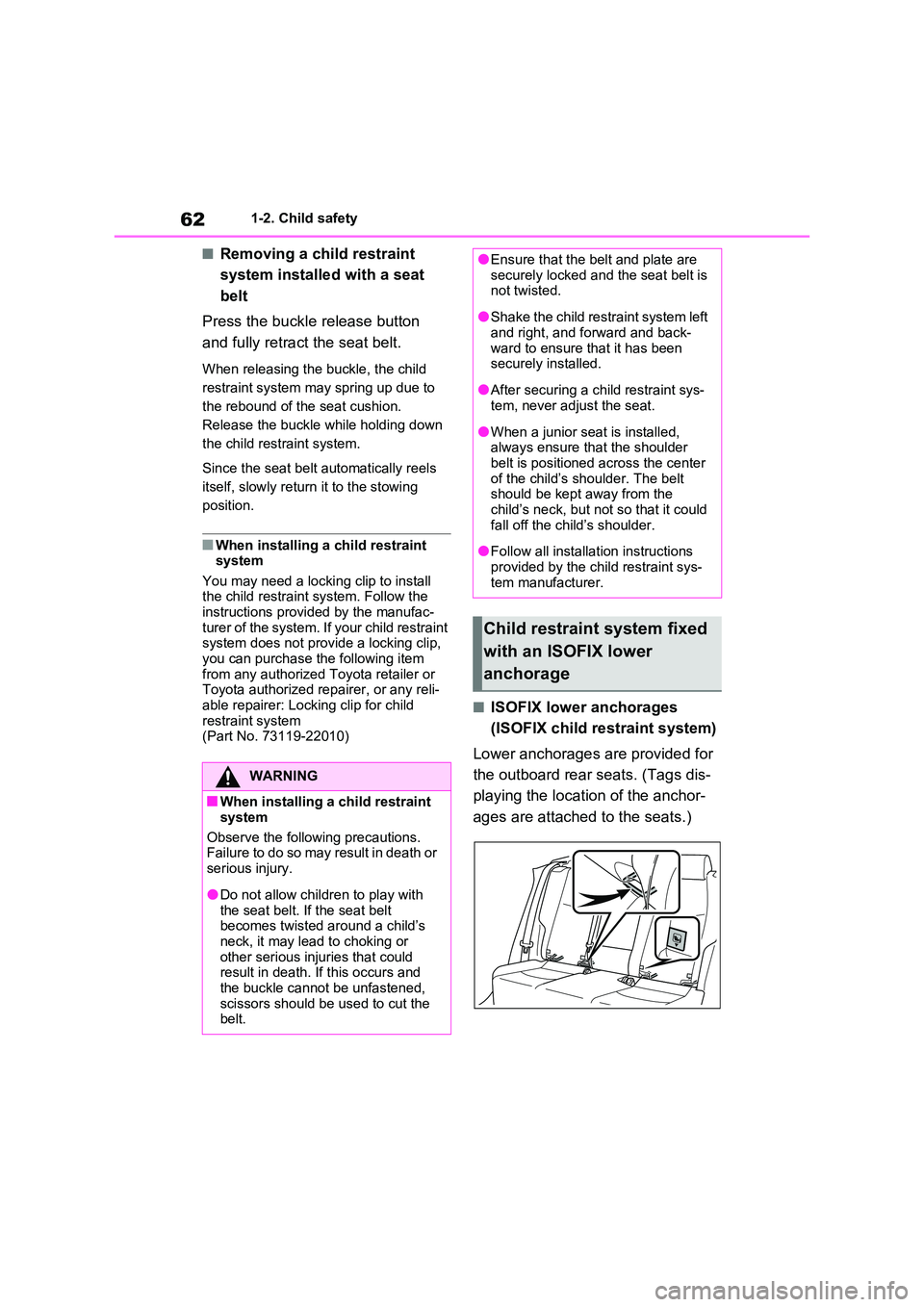
■ISOFIX lower anchorages
(ISOFIX child restraint system)
Lower anchorages are provided for
the outboard rear seats. (Tags dis-
playing the location of the anchor-
ages are attached to the seats.)
WARNING
■When installing a child restraint
system
Observe the following precautions. Failure to do so may result in death or
serious injury.
●Do not allow children to play with
the seat belt. If the seat belt becomes twisted around a child’s neck, it may lead to choking or
other serious injuries that could result in death. If this occurs and the buckle cannot be unfastened,
scissors should be used to cut the belt.
●Ensure that the belt and plate are securely locked and the seat belt is not twisted.
●Shake the child restraint system left and right, and forward and back-
ward to ensure that it has been securely installed.
●After securing a child restraint sys-tem, never adjust the seat.
●When a junior seat is installed, always ensure that the shoulder belt is positioned across the center
of the child’s shoulder. The belt should be kept away from the child’s neck, but not so that it could
fall off the child’s shoulder.
●Follow all installation instructions
provided by the child restraint sys- tem manufacturer.
Child restraint system fixed
with an ISOFIX lower
anchorage
Page 72 of 664
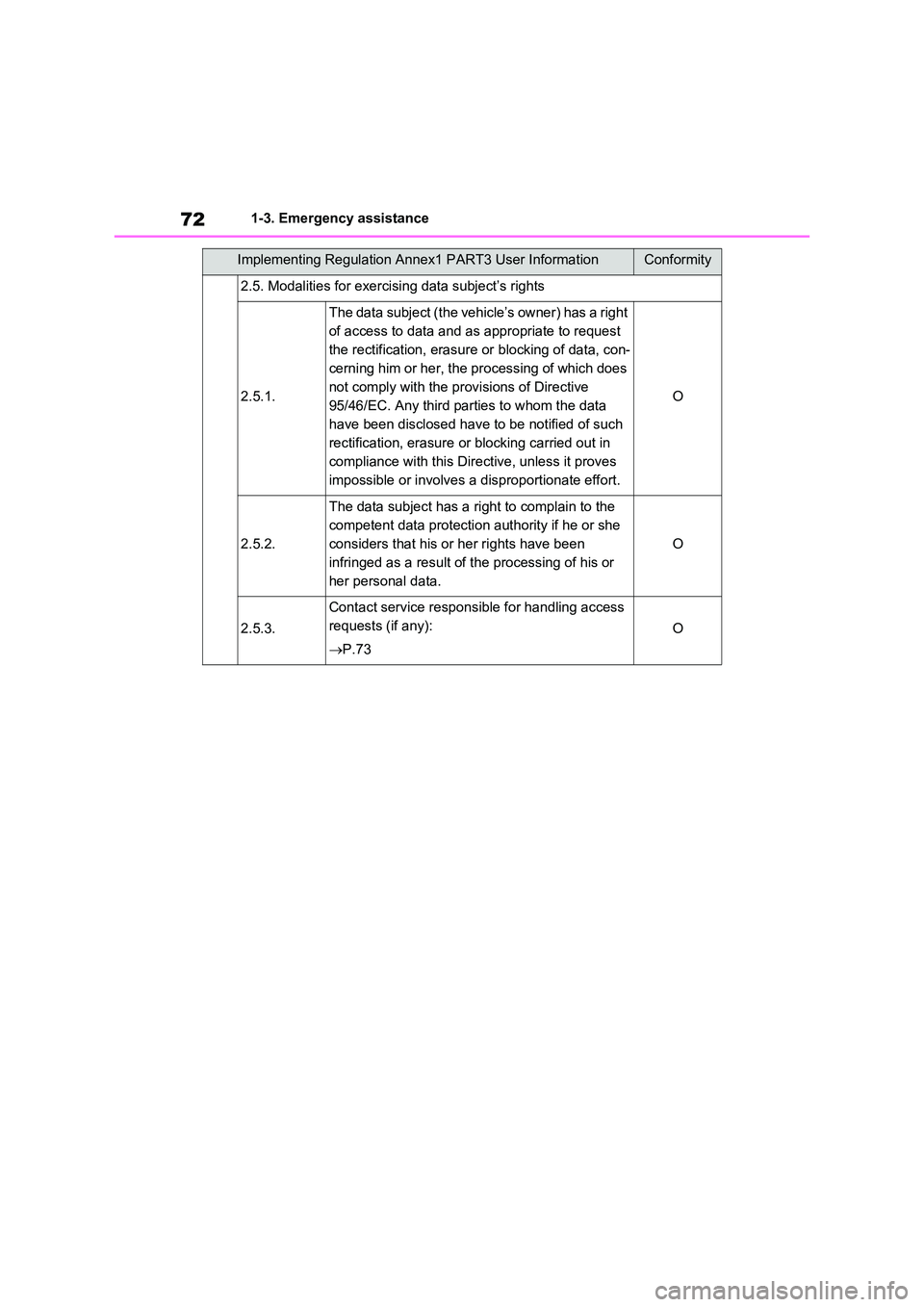
721-3. Emergency assistance
2.5. Modalities for exercising data subject’s rights
2.5.1.
The data subject (the vehicle’s owner) has a right
of access to data and as appropriate to request
the rectification, erasure or blocking of data, con-
cerning him or her, the processing of which does
not comply with the provisions of Directive
95/46/EC. Any third parties to whom the data
have been disclosed have to be notified of such
rectification, erasure or blocking carried out in
compliance with this Directive, unless it proves
impossible or involves a disproportionate effort.
O
2.5.2.
The data subject has a right to complain to the
competent data protection authority if he or she
considers that his or her rights have been
infringed as a result of the processing of his or
her personal data.
O
2.5.3.
Contact service responsible for handling access
requests (if any):
P.73
O
Implementing Regulation Annex1 PART3 User InformationConformity
Page 77 of 664
77
1
1-4. Theft deterrent system
For safety and security
*: If equipped
■Setting
Turn the power switch to OFF, have
all the passengers exit the vehicle
and ensure that all the doors are
closed.
Using the entry function:
Touch the sensor area on the front
outside door handle twice within 5
seconds.
Using the wireless remote control:
Press twice within 5 sec-
onds.
■Canceling
Using the entry function:
Hold the front outside door handle.
Using the wireless remote control:
Press .
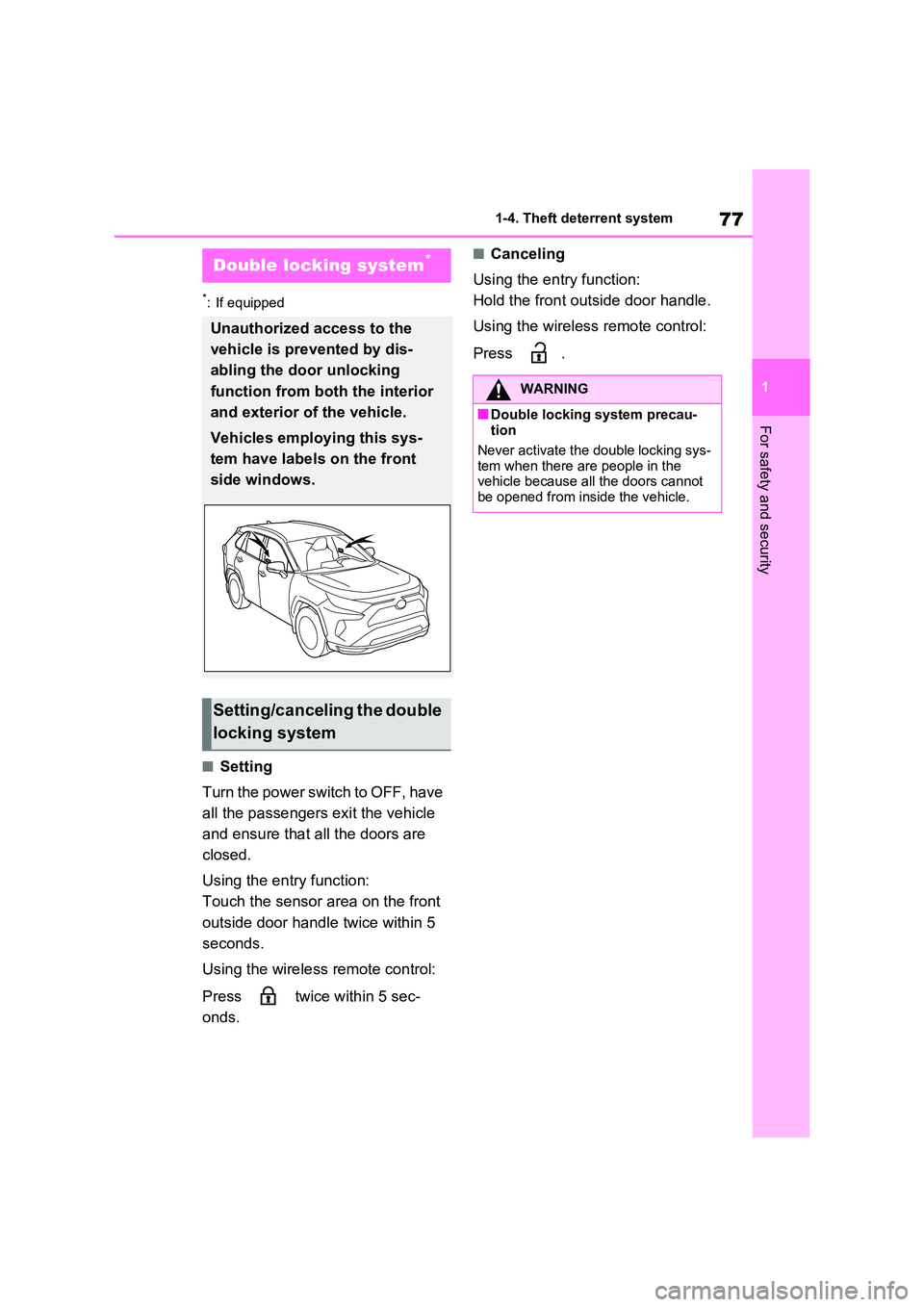
Double locking system*
Unauthorized access to the
vehicle is prevented by dis-
abling the door unlocking
function from both the interior
and exterior of the vehicle.
Vehicles employing this sys-
tem have labels on the front
side windows.
Setting/canceling the double
locking system
WARNING
■Double locking system precau- tion
Never activate the double locking sys-
tem when there are people in the vehicle because all the doors cannot be opened from inside the vehicle.