tires TOYOTA VERSO S 2011 Service Manual
[x] Cancel search | Manufacturer: TOYOTA, Model Year: 2011, Model line: VERSO S, Model: TOYOTA VERSO S 2011Pages: 664, PDF Size: 160.56 MB
Page 566 of 664
5668-2. Steps to take in an emergency
5Securely attach cables or chains
to the towing eyelet.
Take care not to damage the vehicle
body.
6 Enter the vehicle being towed
and start the hybrid system.
Turn off the Parking Support Brake
function. (if equipped): P.420
If the hybrid system does not start, turn the power switch to ON.
7 Shift the shift lever to N and
release the parking brake.
Turn automatic mode off. ( P.327)
When the shift lever cannot be shifted:
P.323
■While towing
If the hybrid system is not running, the power assist for the brakes and steering will not function, making steering and
braking more difficult.
■Wheel nut wrench (if equipped)
Wheel nut wrench is installed in the deck under tray. ( P.583, 594)
Fluid leaks under the vehicle
(Water dripping from the air con-
ditioning after use is normal.)
Flat-looking tires or uneven tire
wear
High coolant temperature warn-
ing light flashes or come on
Changes in exhaust sound
Excessive tire squeal when cor-
nering
Strange noises related to the
suspension system
Pinging or other noises related to
the hybrid system
Engine missing, stumbling or
running roughly
Appreciable loss of power
If you think something is
wrong
If you notice any of the follow-
ing symptoms, your vehicle
probably needs adjustment or
repair. Contact any authorized
Toyota retailer or Toyota
authorized repairer, or any reli-
able repairer as soon as possi-
ble.
Visible symptoms
Audible symptoms
Operational symptoms
Page 576 of 664
5768-2. Steps to take in an emergency
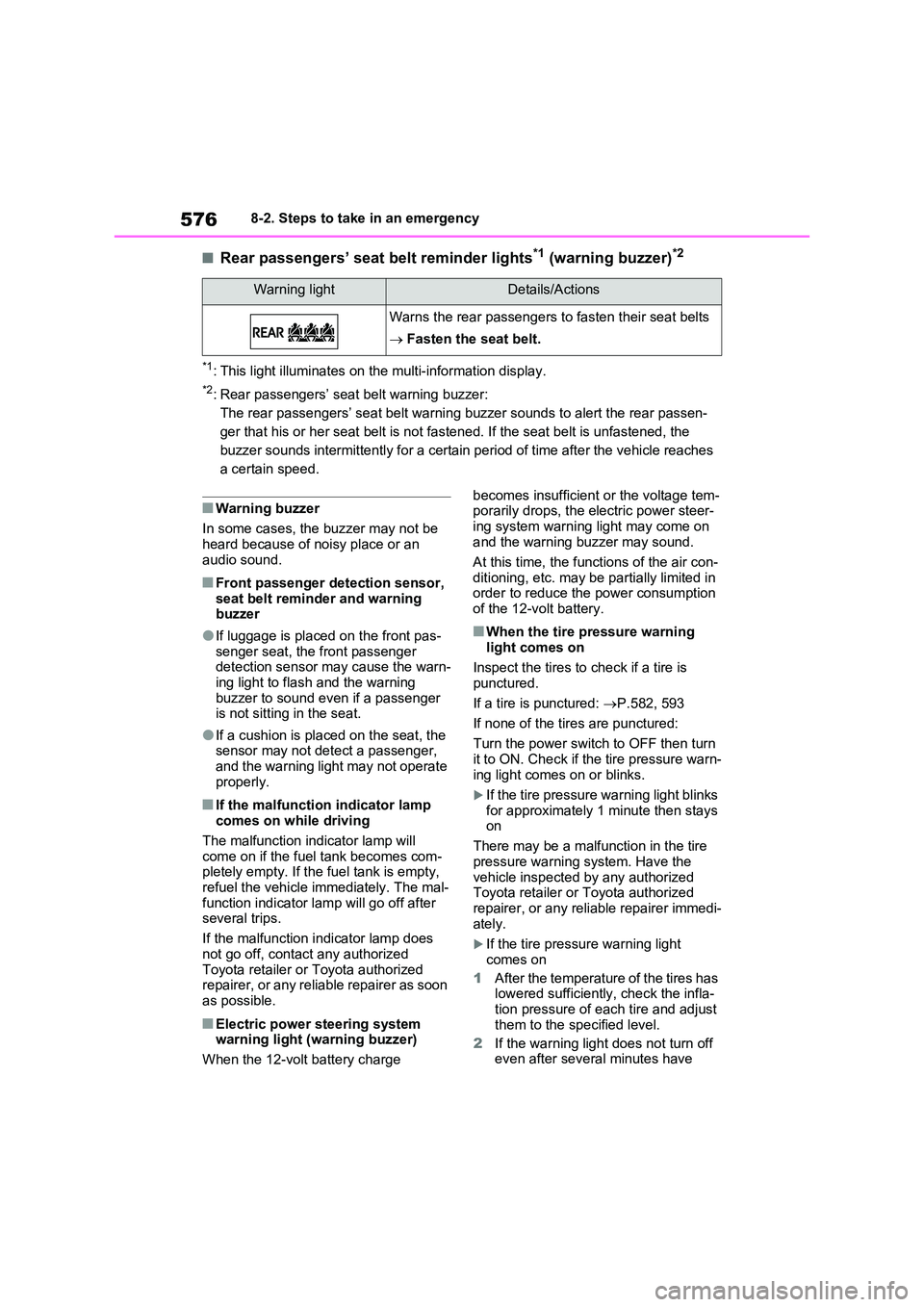
■Rear passengers’ seat belt reminder lights*1 (warning buzzer)*2
*1: This light illuminates on the multi-information display.
*2: Rear passengers’ seat belt warning buzzer:
The rear passengers’ seat belt warning buzzer sounds to alert the rear passen-
ger that his or her seat belt is not fastened. If the seat belt is unfastened, the
buzzer sounds intermittently for a certain period of time after the vehicle reaches
a certain speed.
■Warning buzzer
In some cases, the buzzer may not be heard because of noisy place or an
audio sound.
■Front passenger detection sensor, seat belt reminder and warning buzzer
●If luggage is placed on the front pas-
senger seat, the front passenger detection sensor may cause the warn-ing light to flash and the warning
buzzer to sound even if a passenger is not sitting in the seat.
●If a cushion is placed on the seat, the sensor may not detect a passenger, and the warning light may not operate
properly.
■If the malfunction indicator lamp comes on while driving
The malfunction indicator lamp will
come on if the fuel tank becomes com- pletely empty. If the fuel tank is empty, refuel the vehicle immediately. The mal-
function indicator lamp will go off after several trips.
If the malfunction indicator lamp does
not go off, contact any authorized Toyota retailer or Toyota authorized repairer, or any reliable repairer as soon
as possible.
■Electric power steering system warning light (warning buzzer)
When the 12-volt battery charge
becomes insufficient or the voltage tem- porarily drops, the electric power steer-
ing system warning light may come on and the warning buzzer may sound.
At this time, the functions of the air con-
ditioning, etc. may be partially limited in order to reduce the power consumption of the 12-volt battery.
■When the tire pressure warning
light comes on
Inspect the tires to check if a tire is punctured.
If a tire is punctured: P.582, 593
If none of the tires are punctured:
Turn the power switch to OFF then turn
it to ON. Check if the tire pressure warn- ing light comes on or blinks.
If the tire pressure warning light blinks
for approximately 1 minute then stays on
There may be a malfunction in the tire
pressure warning system. Have the vehicle inspected by any authorized Toyota retailer or Toyota authorized
repairer, or any reliable repairer immedi- ately.
If the tire pressure warning light
comes on
1 After the temperature of the tires has lowered sufficiently, check the infla-tion pressure of each tire and adjust
them to the specified level.
2 If the warning light does not turn off even after several minutes have
Warning lightDetails/Actions
Warns the rear passengers to fasten their seat belts
Fasten the seat belt.
Page 577 of 664
577
8
8-2. Steps to take in an emergency
When trouble arises
elapsed, check that the inflation
pressure of each tire is at the speci- fied level and perform initialization. ( P.523)
■The tire pressure warning light may
come on due to natural causes
The tire pressure warning light may come on due to natural causes such as
natural air leaks and tire inflation pres- sure changes caused by temperature. In this case, adjusting the tire inflation
pressure will turn off the warning light (after a few minutes).
■When a tire is replaced with a com-pact spare tire (vehicles with com-
pact spare tire)
The compact spare tire is not equipped with a tire pressure warning valve and
transmitter. If a tire goes flat, the tire pressure warning light will not turn off even though the flat tire has been
replaced with the spare tire. Replace the spare tire with the standard tire and adjust the tire inflation pressure. The tire
pressure warning light will go off after a few minutes.
■Conditions that the tire pressure warning system may not function
properly
P.512
WARNING
■If a warning light comes on or a
warning buzzer sounds when a warning message is shown on
the multi-information display*
Check and follow the message shown on the multi-information display.
Failure to do so may result in death or serious injury.*: Warning lights illuminate in red or
yellow and the warning buzzer
beeps once or sounds continu-
ously.
■When the electric power steer- ing system warning light comes on
When the light comes on yellow, the assist to the power steering is restricted. When the light comes on
red, the assist to the power steering is lost and handling operations of the steering wheel become extremely
heavy. If the steering wheel becomes heavier than usual when operating, hold firmly
and operate using more force than usual.
■If the tire pressure warning light comes on
Be sure to observe the following pre-
cautions. Failure to do so could cause a loss of vehicle control and result in death or serious injury.
●Stop your vehicle in a safe place as soon as possible. Adjust the tire inflation pressure immediately.
●If the tire pressure warning light comes on even after tire inflation
pressure adjustment, it is probable that you have a flat tire. Check the tires. If a tire is flat, change it with
the spare tire and have the flat tire repaired by the nearest authorized Toyota retailer or Toyota authorized
repairer, or any reliable repairer.
●Avoid abrupt maneuvering and
braking. If the vehicle tires deterio- rate, you could lose control of the steering wheel or the brakes.
■If a blowout or sudden air leak-age should occur
The tire pressure warning system may not activate immediately.
Page 578 of 664

5788-2. Steps to take in an emergency
■Warning messages
The warning messages explained below may differ from the actual messages
according to operation conditions and vehicle specifications.
■If a message about an operation is
shown
●If a message about an operation of
the accelerator pedal or brake pedal is shown
NOTICE
■To ensure the tire pressure warn-ing system operates properly
Do not install tires with different speci- fications or manufacturers, as the tire pressure warning system may not
operate properly.
If a warning message is
displayed
The multi-information display
shows warnings of system
malfunctions, incorrectly per-
formed operations, and mes-
sages that indicate a need for
maintenance. When a message
is shown, perform the correc-
tion procedure appropriate to
the message.
If a warning message is dis-
played again after the appropri-
ate actions have been performed,
contact any authorized Toyota
retailer or Toyota authorized
repairer, or any reliable repairer.
When a message about charging
is displayed, refer to P.160.
Page 583 of 664
583
8
8-2. Steps to take in an emergency
When trouble arises
■A flat tire that cannot be repaired with the emergency tire puncture
repair kit
In the following cases, the tire cannot be repaired with the emergency tire punc-
ture repair kit. Contact any authorized Toyota retailer or Toyota authorized
repairer, or any reliable repairer.
●When the tire is damaged due to driv- ing without sufficient air pressure
●When the tire lost air pressure due to a crack or damage in the tire sidewall
●When the tire is visibly separated from the wheel
●When the cut or damage to the tread is 4 mm (0.16 in.) long or more
●When the wheel is damaged
●When two or more tires have been punctured
●When there is more than one hole or cut in the damaged tire
●When the sealant has expired
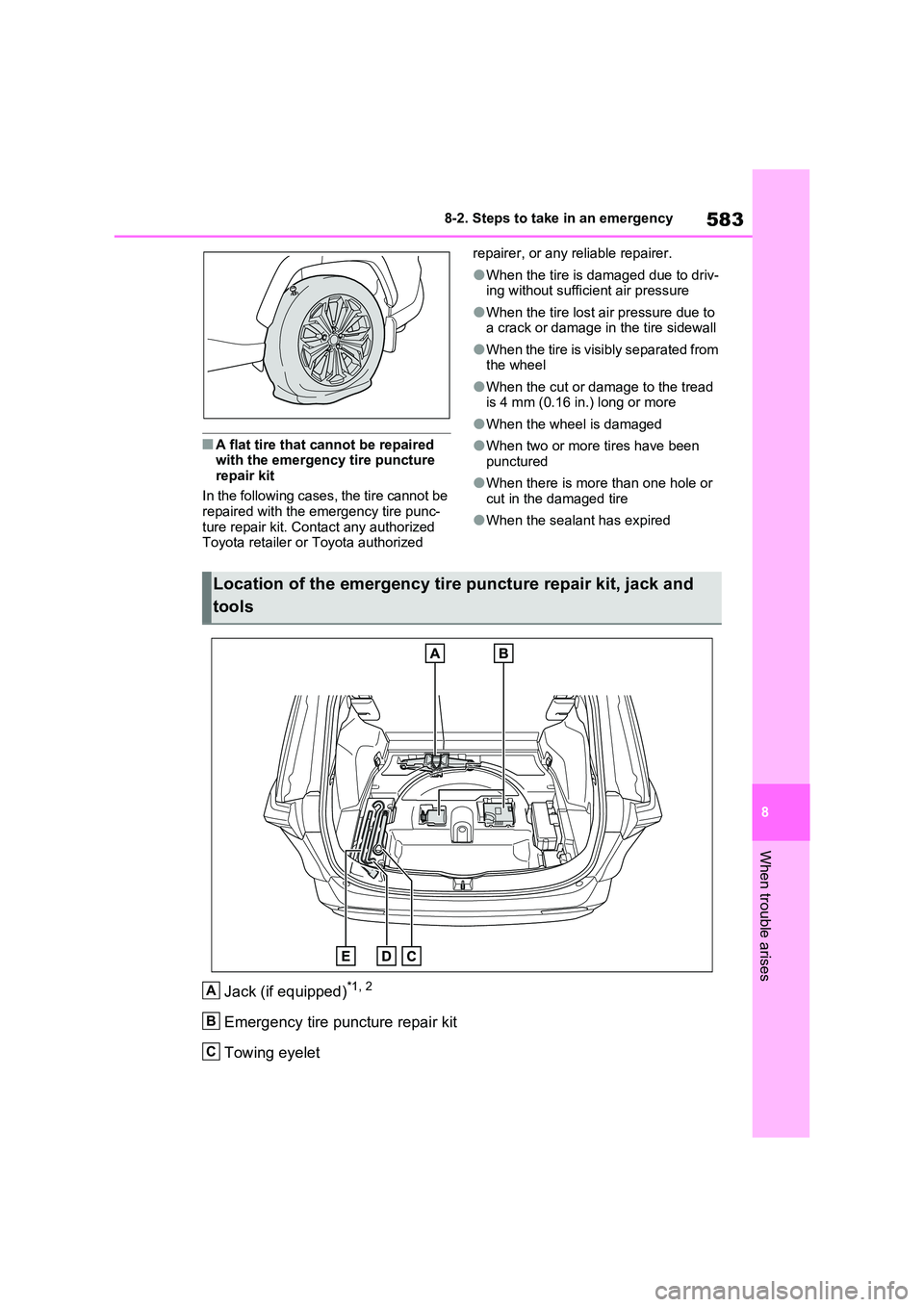
Jack (if equipped)*1, 2
Emergency tire puncture repair kit
Towing eyelet
Location of the emergency tire puncture repair kit, jack and
tools
A
B
C
Page 585 of 664
585
8
8-2. Steps to take in an emergency
When trouble arises
●The kit is exclusively designed for size
and type of tires originally installed on your vehicle. Do not use it for tires that a different size than the original ones,
or for any other purposes.
●If the sealant gets on your clothes, it
may stain.
●If the sealant adheres to a wheel or
the surface of the vehicle body, the stain may not be removable if it is not cleaned at once. Immediately wipe
away the sealant with a wet cloth.
●During operation of the repair kit, a
loud operation noise is produced. This does not indicate a malfunction.
●Do not use to check or to adjust the tire pressure.
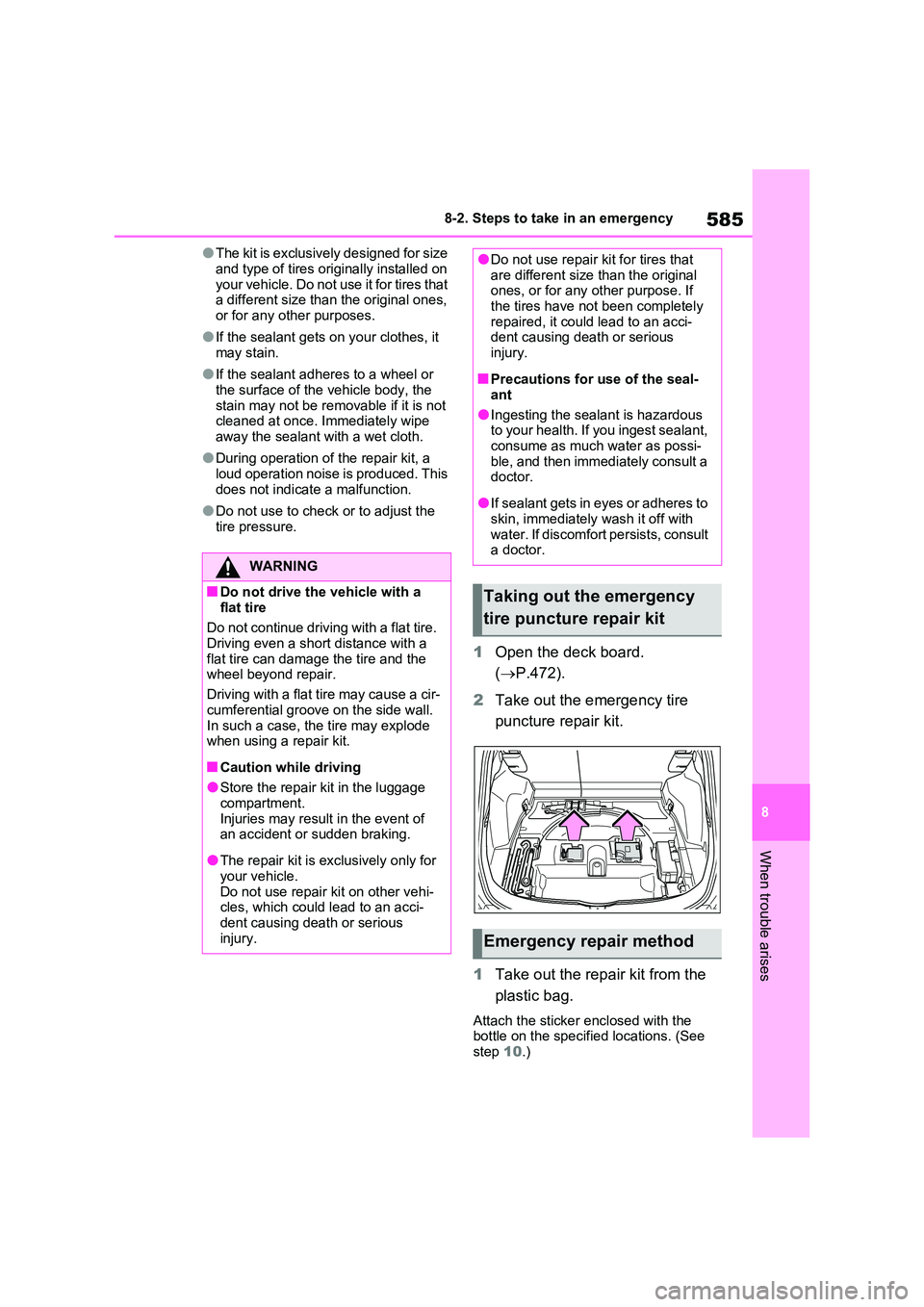
1 Open the deck board.
( P.472).
2 Take out the emergency tire
puncture repair kit.
1 Take out the repair kit from the
plastic bag.
Attach the sticker enclosed with the bottle on the specified locations. (See step 10.)
WARNING
■Do not drive the vehicle with a
flat tire
Do not continue driving with a flat tire. Driving even a short distance with a
flat tire can damage the tire and the wheel beyond repair.
Driving with a flat tire may cause a cir-
cumferential groove on the side wall. In such a case, the tire may explode when using a repair kit.
■Caution while driving
●Store the repair kit in the luggage
compartment. Injuries may result in the event of an accident or sudden braking.
●The repair kit is exclusively only for your vehicle.
Do not use repair kit on other vehi- cles, which could lead to an acci-dent causing death or serious
injury.
●Do not use repair kit for tires that are different size than the original ones, or for any other purpose. If
the tires have not been completely repaired, it could lead to an acci-dent causing death or serious
injury.
■Precautions for use of the seal-
ant
●Ingesting the sealant is hazardous to your health. If you ingest sealant,
consume as much water as possi- ble, and then immediately consult a doctor.
●If sealant gets in eyes or adheres to skin, immediately wash it off with
water. If discomfort persists, consult a doctor.
Taking out the emergency
tire puncture repair kit
Emergency repair method
Page 593 of 664
593
8
8-2. Steps to take in an emergency
When trouble arises
Stop the vehicle in a safe place on a hard, flat surface.
Set the parking brake.
Shift the shift lever to P.
Turn off the intrusion sensor and tilt sensor (if equipped) (P.79)
Stop the hybrid system.
Turn on the emergency flashers. (P.560)
For vehicles with power back door: Turn off the power back door system.
( P.222)
If you have a flat tire (vehicles with spare tire)
Your vehicle is equipped with a spare tire. The flat tire can be
replaced with the spare tire.
For details about tires: P.509
WARNING
■If you have a flat tire
Do not continue driving with a flat tire.
Driving even a short distance with a flat tire can damage the tire and the wheel beyond repair, which could result in an accident.
Before jacking up the vehicle
Page 594 of 664
5948-2. Steps to take in an emergency
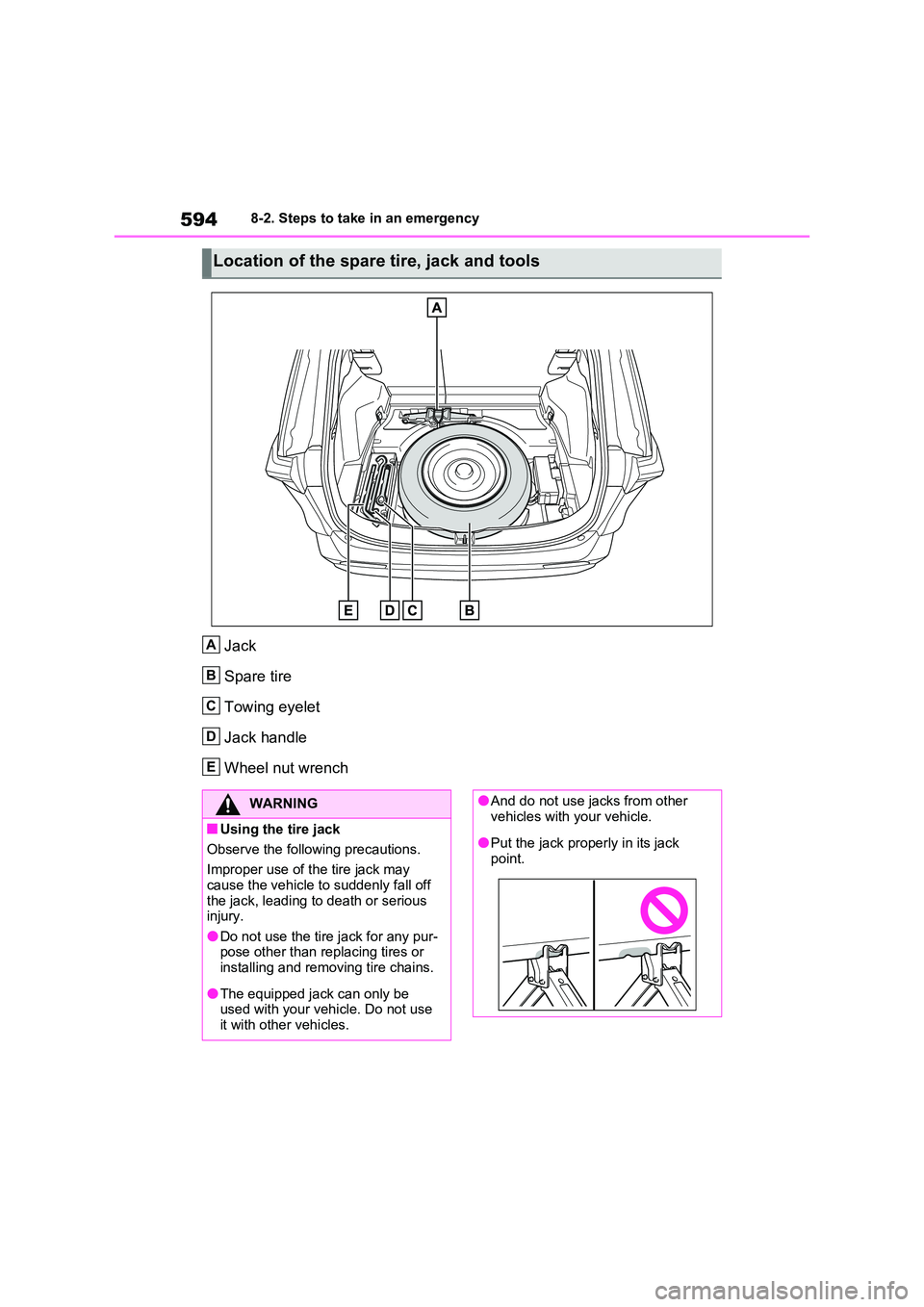
Jack
Spare tire
Towing eyelet
Jack handle
Wheel nut wrench
Location of the spare tire, jack and tools
A
B
C
D
E
WARNING
■Using the tire jack
Observe the following precautions.
Improper use of the tire jack may
cause the vehicle to suddenly fall off the jack, leading to death or serious injury.
●Do not use the tire jack for any pur-pose other than replacing tires or installing and removing tire chains.
●The equipped jack can only be used with your vehicle. Do not use
it with other vehicles.
●And do not use jacks from other
vehicles with your vehicle.
●Put the jack properly in its jack
point.
Page 596 of 664
5968-2. Steps to take in an emergency
2Loosen the center fastener that
secures the spare tire, and then
take out the spare tire.
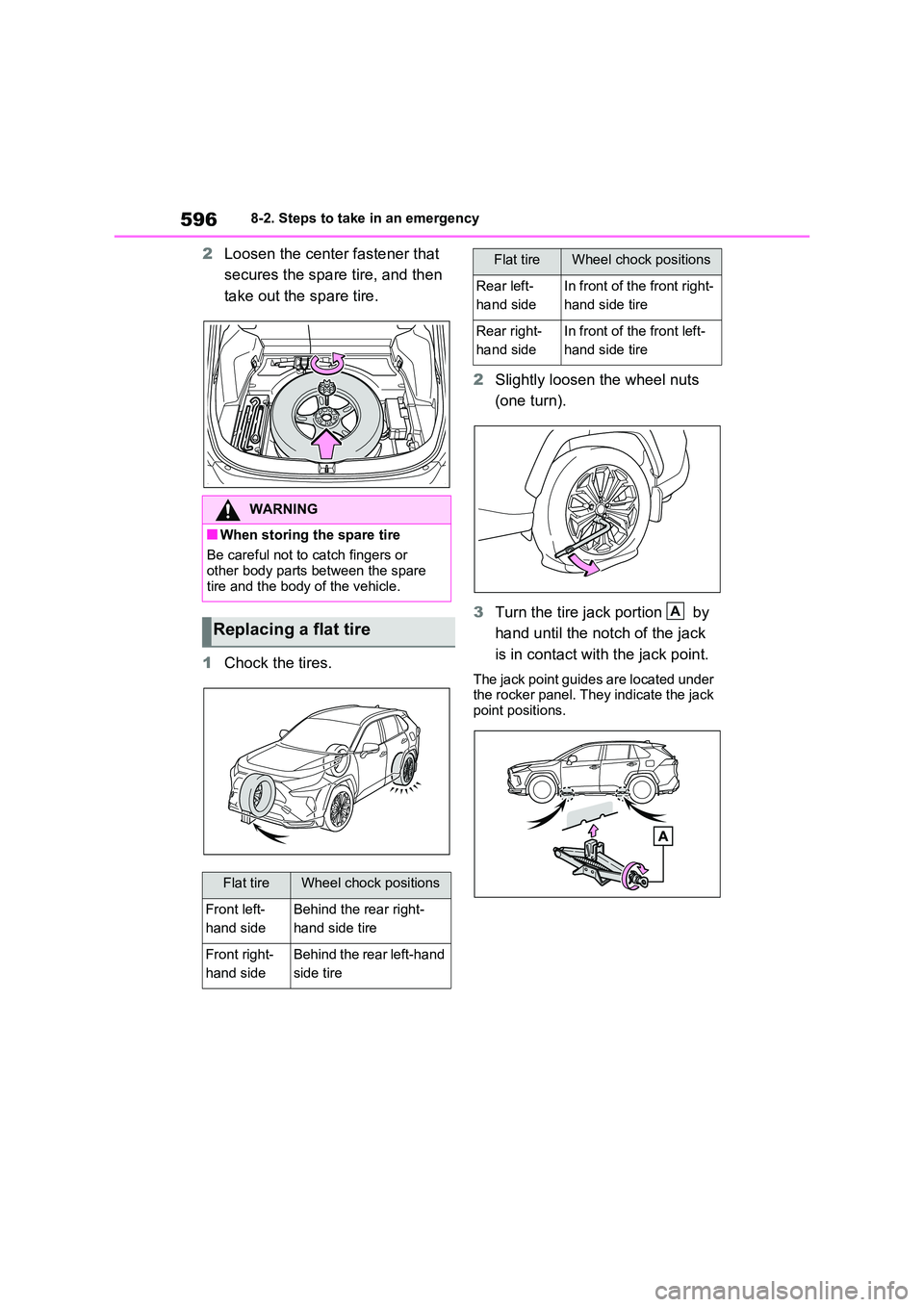
1 Chock the tires.
2 Slightly loosen the wheel nuts
(one turn).
3 Turn the tire jack portion by
hand until the notch of the jack
is in contact with the jack point.
The jack point guides are located under the rocker panel. They indicate the jack
point positions.
WARNING
■When storing the spare tire
Be careful not to catch fingers or
other body parts between the spare tire and the body of the vehicle.
Replacing a flat tire
Flat tireWheel chock positions
Front left-
hand side
Behind the rear right-
hand side tire
Front right-
hand side
Behind the rear left-hand
side tire
Rear left-
hand side
In front of the front right-
hand side tire
Rear right-
hand side
In front of the front left-
hand side tire
Flat tireWheel chock positions
A
Page 597 of 664
597
8
8-2. Steps to take in an emergency
When trouble arises
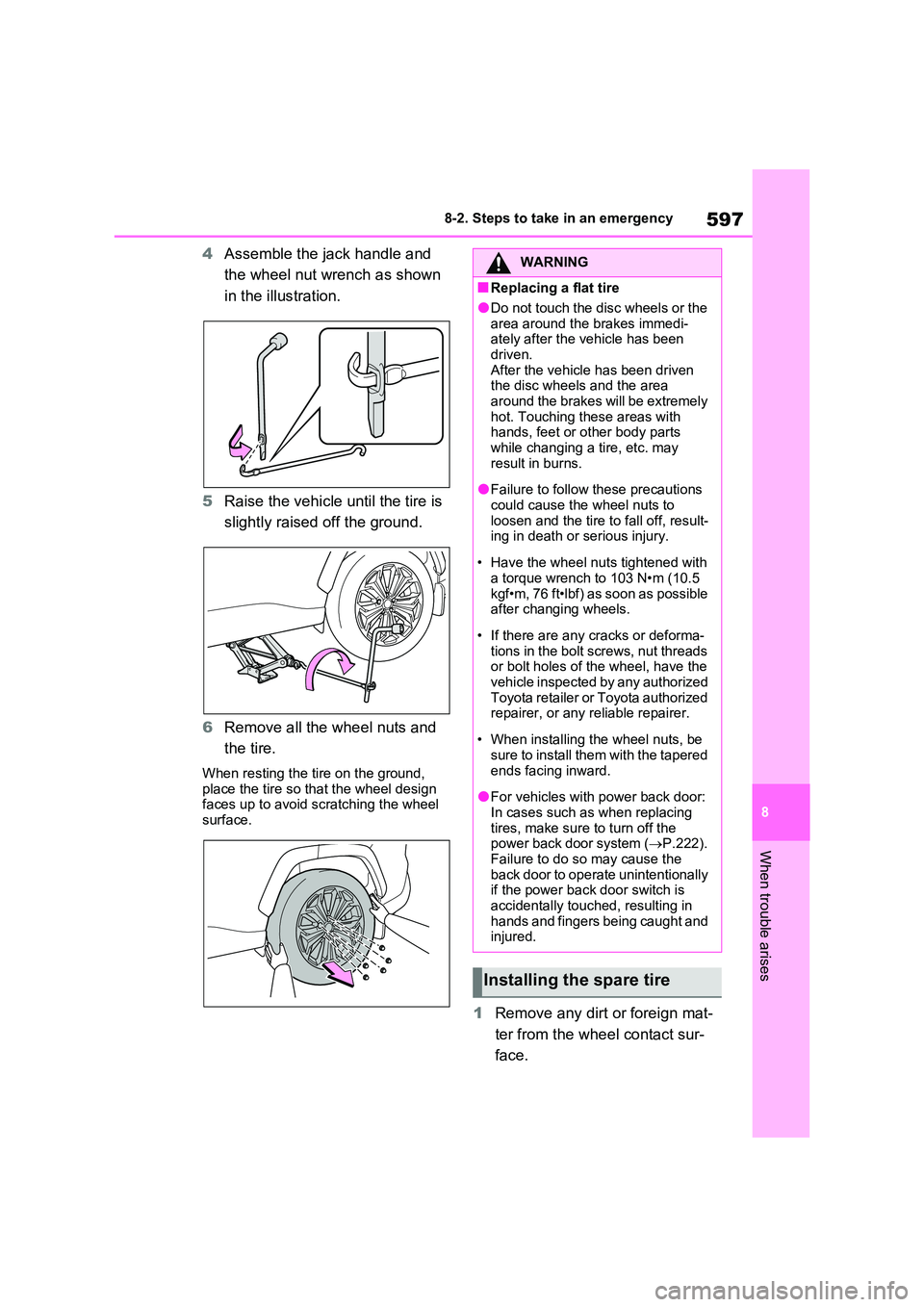
4 Assemble the jack handle and
the wheel nut wrench as shown
in the illustration.
5 Raise the vehicle until the tire is
slightly raised off the ground.
6 Remove all the wheel nuts and
the tire.
When resting the tire on the ground,
place the tire so that the wheel design faces up to avoid scratching the wheel surface.
1 Remove any dirt or foreign mat-
ter from the wheel contact sur-
face.
WARNING
■Replacing a flat tire
●Do not touch the disc wheels or the
area around the brakes immedi- ately after the vehicle has been driven.
After the vehicle has been driven the disc wheels and the area around the brakes will be extremely
hot. Touching these areas with hands, feet or other body parts while changing a tire, etc. may
result in burns.
●Failure to follow these precautions
could cause the wheel nuts to loosen and the tire to fall off, result-ing in death or serious injury.
• Have the wheel nuts tightened with a torque wrench to 103 N•m (10.5
kgf•m, 76 ft•lbf) as soon as possible after changing wheels.
• If there are any cracks or deforma- tions in the bolt screws, nut threads or bolt holes of the wheel, have the
vehicle inspected by any authorized Toyota retailer or Toyota authorized repairer, or any reliable repairer.
• When installing the wheel nuts, be sure to install them with the tapered
ends facing inward.
●For vehicles with power back door:
In cases such as when replacing tires, make sure to turn off the power back door system ( P.222).
Failure to do so may cause the back door to operate unintentionally if the power back door switch is
accidentally touched, resulting in hands and fingers being caught and injured.
Installing the spare tire