roof TOYOTA VERSO S 2011 Owners Manual
[x] Cancel search | Manufacturer: TOYOTA, Model Year: 2011, Model line: VERSO S, Model: TOYOTA VERSO S 2011Pages: 664, PDF Size: 160.56 MB
Page 3 of 664
3TABLE OF CONTENTS
1
6
5
4
3
2
8
7
9
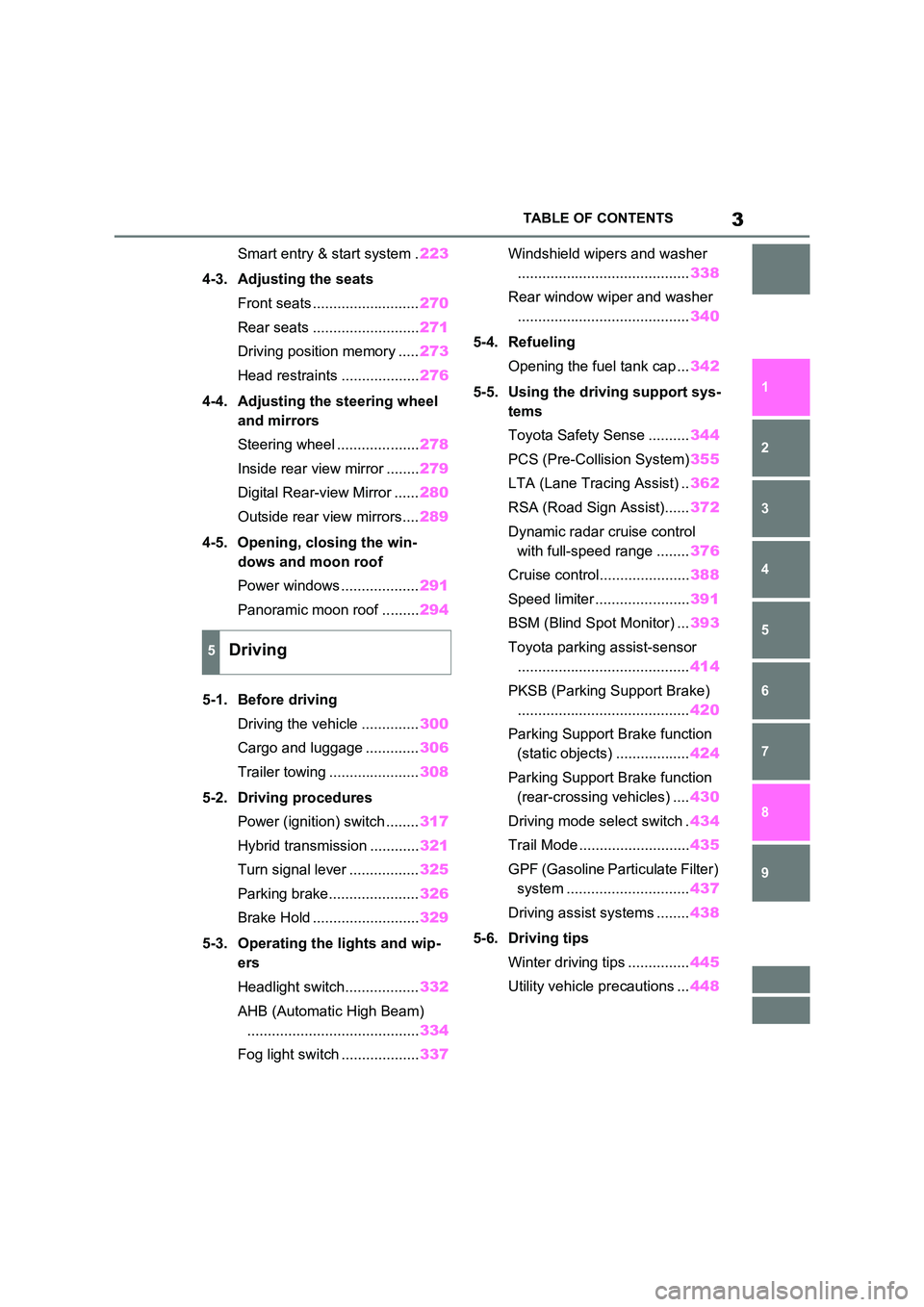
Smart entry & start system . 223
4-3. Adjusting the seats
Front seats .......................... 270
Rear seats .......................... 271
Driving position memory ..... 273
Head restraints ................... 276
4-4. Adjusting the steering wheel
and mirrors
Steering wheel .................... 278
Inside rear view mirror ........ 279
Digital Rear-view Mirror ...... 280
Outside rear view mirrors.... 289
4-5. Opening, closing the win-
dows and moon roof
Power windows ................... 291
Panoramic moon roof ......... 294
5-1. Before driving
Driving the vehicle .............. 300
Cargo and luggage ............. 306
Trailer towing ...................... 308
5-2. Driving procedures
Power (ignition) switch ........ 317
Hybrid transmission ............ 321
Turn signal lever ................. 325
Parking brake...................... 326
Brake Hold .......................... 329
5-3. Operating the lights and wip-
ers
Headlight switch.................. 332
AHB (Automatic High Beam)
.......................................... 334
Fog light switch ................... 337
Windshield wipers and washer
.......................................... 338
Rear window wiper and washer
.......................................... 340
5-4. Refueling
Opening the fuel tank cap ... 342
5-5. Using the driving support sys-
tems
Toyota Safety Sense .......... 344
PCS (Pre-Collision System) 355
LTA (Lane Tracing Assist) .. 362
RSA (Road Sign Assist)...... 372
Dynamic radar cruise control
with full-speed range ........ 376
Cruise control...................... 388
Speed limiter ....................... 391
BSM (Blind Spot Monitor) ... 393
Toyota parking assist-sensor
.......................................... 414
PKSB (Parking Support Brake)
.......................................... 420
Parking Support Brake function
(static objects) .................. 424
Parking Support Brake function
(rear-crossing vehicles) .... 430
Driving mode select switch . 434
Trail Mode ........................... 435
GPF (Gasoline Particulate Filter)
system .............................. 437
Driving assist systems ........438
5-6. Driving tips
Winter driving tips ............... 445
Utility vehicle precautions ... 448
5Driving
Page 8 of 664
8
WARNING
■General precautions while driv- ing
Driving under the influence: Never drive your vehicle when under the influence of alcohol or drugs that have
impaired your ability to operate your vehicle. Alcohol and certain drugs delay reaction time, impair judgment
and reduce coordination, which could lead to an accident that could result in death or serious injury.
Defensive driving: Always drive defensively. Anticipate mistakes that other drivers or pedestrians might
make and be ready to avoid acci- dents.
Driver distraction: Always give your
full attention to driving. Anything that distracts the driver, such as adjusting controls, talking on a cellular phone or
reading can result in a collision with resulting death or serious injury to you, your occupants or others.
■General precaution regarding children’s safety
Never leave children unattended in the vehicle, and never allow children to have or use the key.
Children may be able to start the vehi- cle or shift the vehicle into neutral. There is also a danger that children
may injure themselves by playing with the side windows, the panoramic moon roof, or other features of the
vehicle. In addition, heat build-up or extremely cold temperatures inside the vehicle can be fatal to children.
Page 21 of 664
21Pictorial index
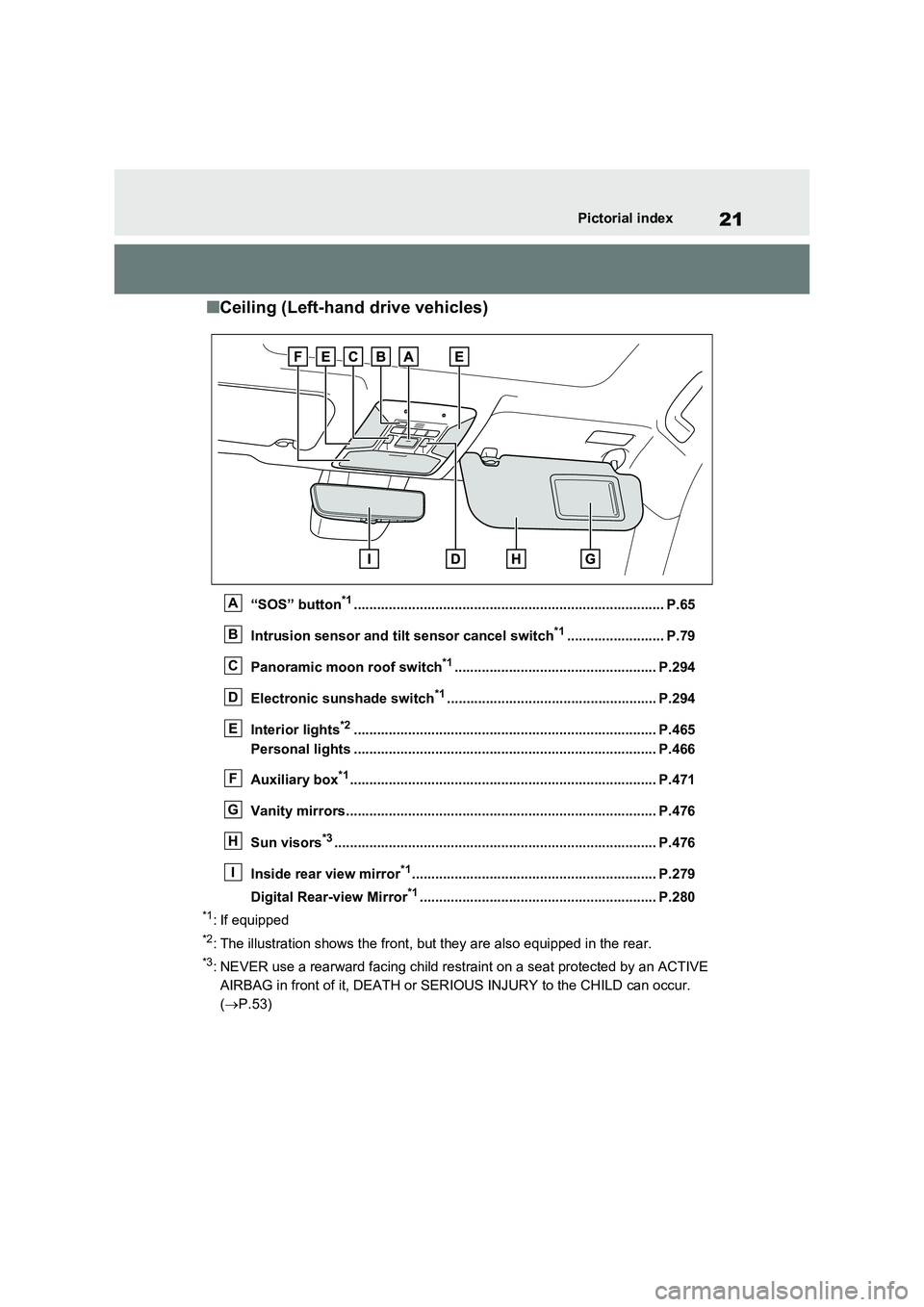
■Ceiling (Left-hand drive vehicles)
“SOS” button*1................................................................................ P.65
Intrusion sensor and tilt sensor cancel switch*1......................... P.79
Panoramic moon roof switch*1.................................................... P.294
Electronic sunshade switch*1...................................................... P.294
Interior lights*2.............................................................................. P.465
Personal lights .............................................................................. P.466
Auxiliary box*1............................................................................... P.471
Vanity mirrors................................................................................ P.476
Sun visors*3................................................................................... P.476
Inside rear view mirror*1............................................................... P.279
Digital Rear-view Mirror*1............................................................. P.280
*1: If equipped
*2: The illustration shows the front, but they are also equipped in the rear.
*3: NEVER use a rearward facing child restraint on a seat protected by an ACTIVE
AIRBAG in front of it, DEATH or SERIOUS INJURY to the CHILD can occur.
( P.53)
A
B
C
D
E
F
G
H
I
Page 29 of 664
29Pictorial index
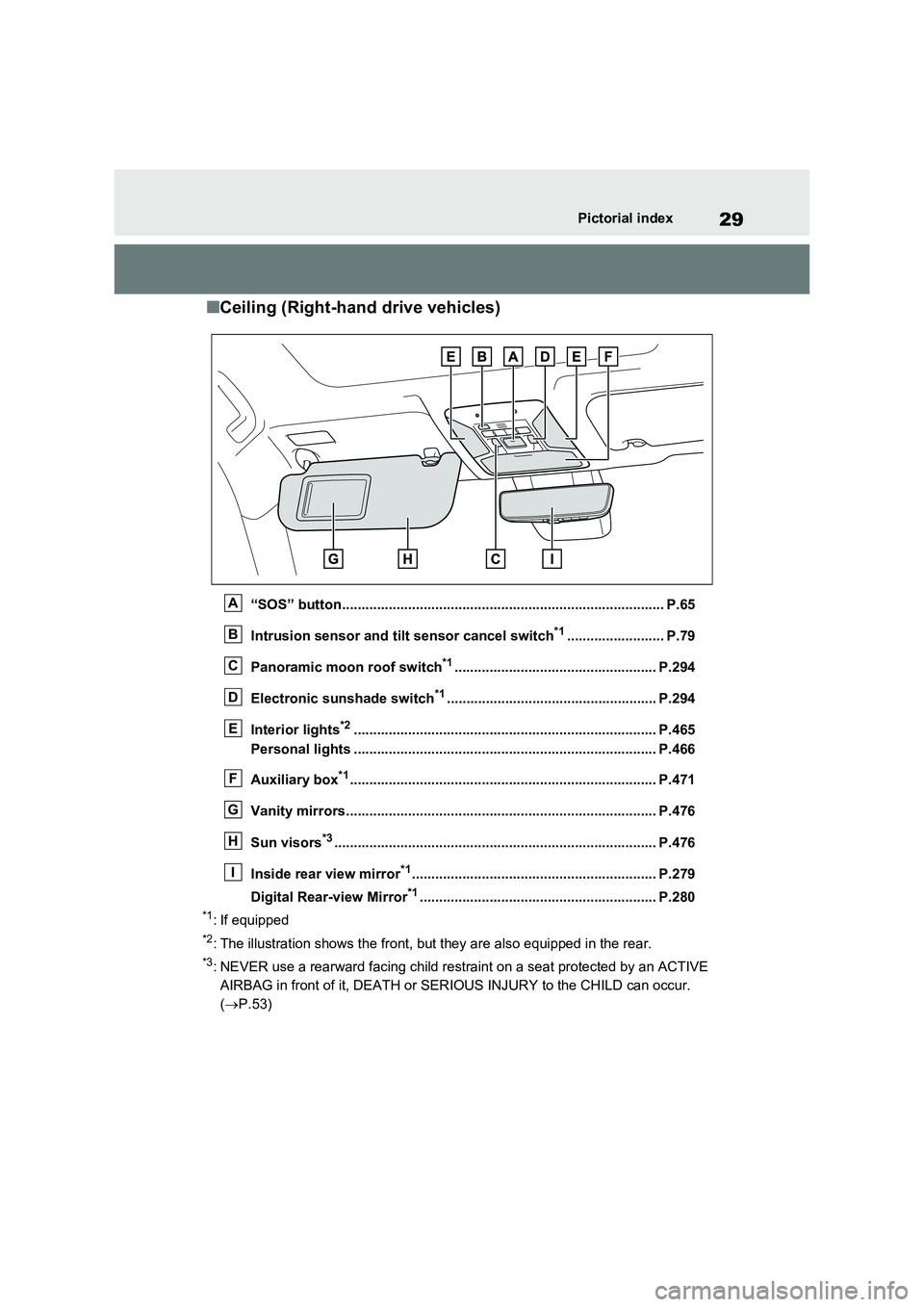
■Ceiling (Right-hand drive vehicles)
“SOS” button................................................................................... P.65
Intrusion sensor and tilt sensor cancel switch*1......................... P.79
Panoramic moon roof switch*1.................................................... P.294
Electronic sunshade switch*1...................................................... P.294
Interior lights*2.............................................................................. P.465
Personal lights .............................................................................. P.466
Auxiliary box*1............................................................................... P.471
Vanity mirrors................................................................................ P.476
Sun visors*3................................................................................... P.476
Inside rear view mirror*1............................................................... P.279
Digital Rear-view Mirror*1............................................................. P.280
*1: If equipped
*2: The illustration shows the front, but they are also equipped in the rear.
*3: NEVER use a rearward facing child restraint on a seat protected by an ACTIVE
AIRBAG in front of it, DEATH or SERIOUS INJURY to the CHILD can occur.
( P.53)
A
B
C
D
E
F
G
H
I
Page 41 of 664
41
1
1-1. For safe use
For safety and security
“PASSENGER AIR BAG” indicator
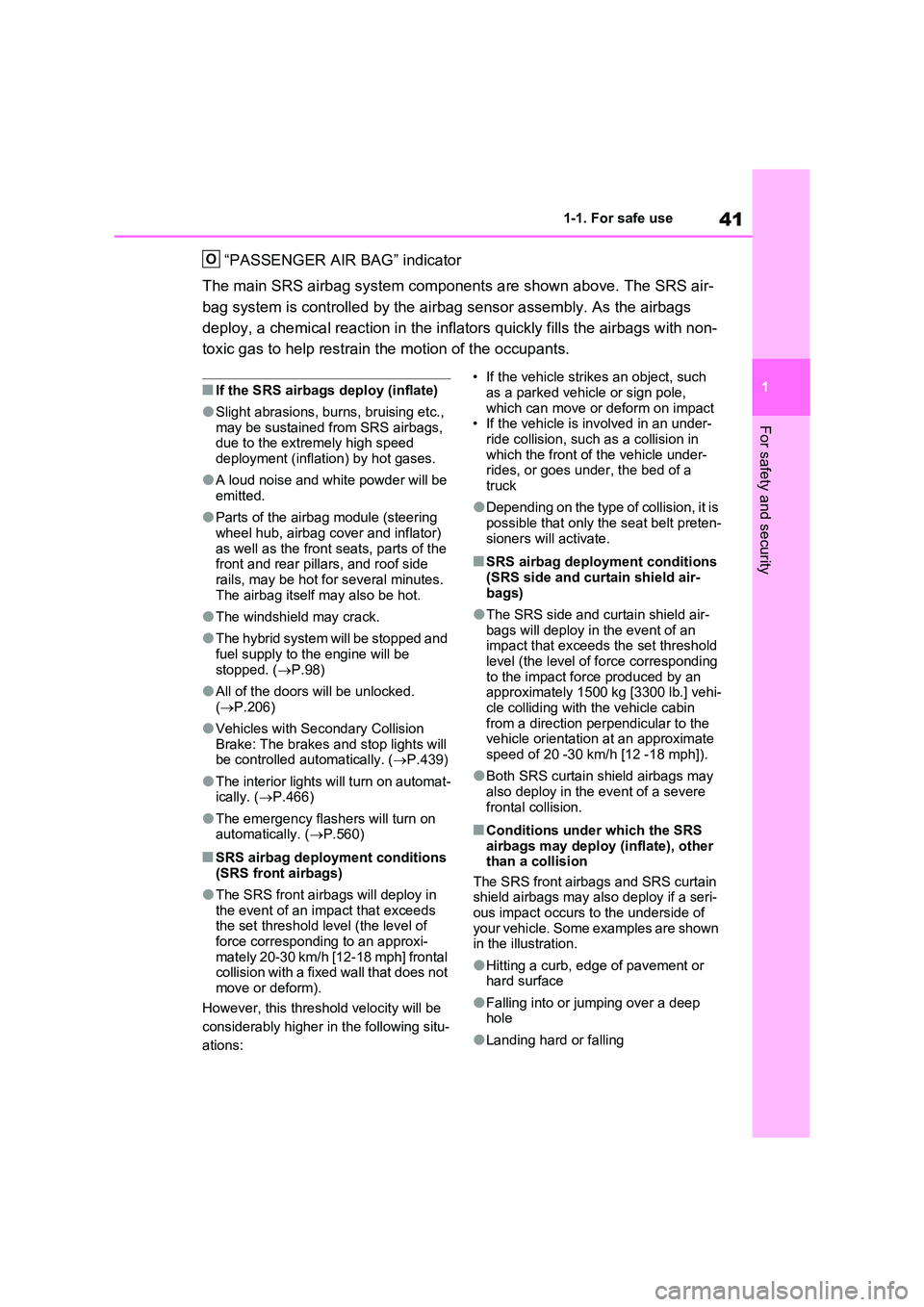
The main SRS airbag system components are shown above. The SRS air-
bag system is controlled by the airbag sensor assembly. As the airbags
deploy, a chemical reaction in the inflators quickly fills the airbags with non-
toxic gas to help restrain the motion of the occupants.
■If the SRS airbags deploy (inflate)
●Slight abrasions, burns, bruising etc., may be sustained from SRS airbags, due to the extremely high speed
deployment (inflation) by hot gases.
●A loud noise and white powder will be
emitted.
●Parts of the airbag module (steering
wheel hub, airbag cover and inflator) as well as the front seats, parts of the front and rear pillars, and roof side
rails, may be hot for several minutes. The airbag itself may also be hot.
●The windshield may crack.
●The hybrid system will be stopped and
fuel supply to the engine will be stopped. ( P.98)
●All of the doors will be unlocked. ( P.206)
●Vehicles with Secondary Collision Brake: The brakes and stop lights will be controlled automatically. ( P.439)
●The interior lights will turn on automat- ically. ( P.466)
●The emergency flashers will turn on automatically. ( P.560)
■SRS airbag deployment conditions
(SRS front airbags)
●The SRS front airbags will deploy in
the event of an impact that exceeds the set threshold level (the level of force corresponding to an approxi-
mately 20-30 km/h [12-18 mph] frontal collision with a fixed wall that does not move or deform).
However, this threshold velocity will be
considerably higher in the following situ-
ations:
• If the vehicle strikes an object, such as a parked vehicle or sign pole,
which can move or deform on impact • If the vehicle is involved in an under-
ride collision, such as a collision in which the front of the vehicle under-rides, or goes under, the bed of a
truck
●Depending on the type of collision, it is
possible that only the seat belt preten- sioners will activate.
■SRS airbag deployment conditions (SRS side and curtain shield air-
bags)
●The SRS side and curtain shield air-
bags will deploy in the event of an impact that exceeds the set threshold level (the level of force corresponding
to the impact force produced by an approximately 1500 kg [3300 lb.] vehi-cle colliding with the vehicle cabin
from a direction perpendicular to the vehicle orientation at an approximate speed of 20 -30 km/h [12 -18 mph]).
●Both SRS curtain shield airbags may also deploy in the event of a severe
frontal collision.
■Conditions under which the SRS airbags may deploy (inflate), other than a collision
The SRS front airbags and SRS curtain shield airbags may also deploy if a seri-ous impact occurs to the underside of
your vehicle. Some examples are shown in the illustration.
●Hitting a curb, edge of pavement or hard surface
●Falling into or jumping over a deep hole
●Landing hard or falling
O
Page 43 of 664
43
1
1-1. For safe use
For safety and security
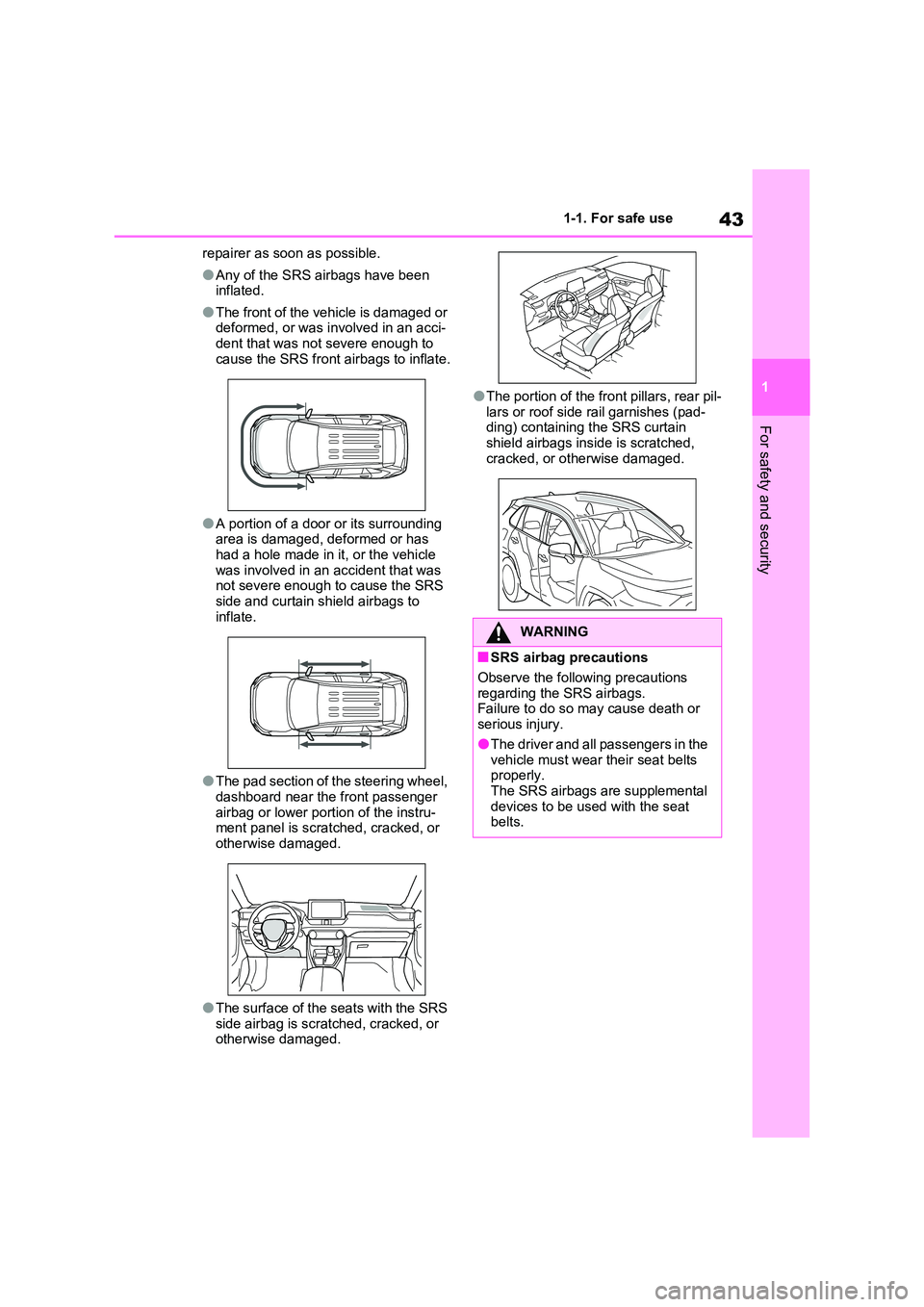
repairer as soon as possible.
●Any of the SRS airbags have been inflated.
●The front of the vehicle is damaged or deformed, or was involved in an acci-
dent that was not severe enough to cause the SRS front airbags to inflate.
●A portion of a door or its surrounding area is damaged, deformed or has had a hole made in it, or the vehicle
was involved in an accident that was not severe enough to cause the SRS side and curtain shield airbags to
inflate.
●The pad section of the steering wheel,
dashboard near the front passenger airbag or lower portion of the instru-ment panel is scratched, cracked, or
otherwise damaged.
●The surface of the seats with the SRS
side airbag is scratched, cracked, or otherwise damaged.
●The portion of the front pillars, rear pil-
lars or roof side rail garnishes (pad- ding) containing the SRS curtain shield airbags inside is scratched,
cracked, or otherwise damaged.
WARNING
■SRS airbag precautions
Observe the following precautions
regarding the SRS airbags. Failure to do so may cause death or serious injury.
●The driver and all passengers in the vehicle must wear their seat belts properly.
The SRS airbags are supplemental devices to be used with the seat belts.
Page 45 of 664
45
1
1-1. For safe use
For safety and security
WARNING
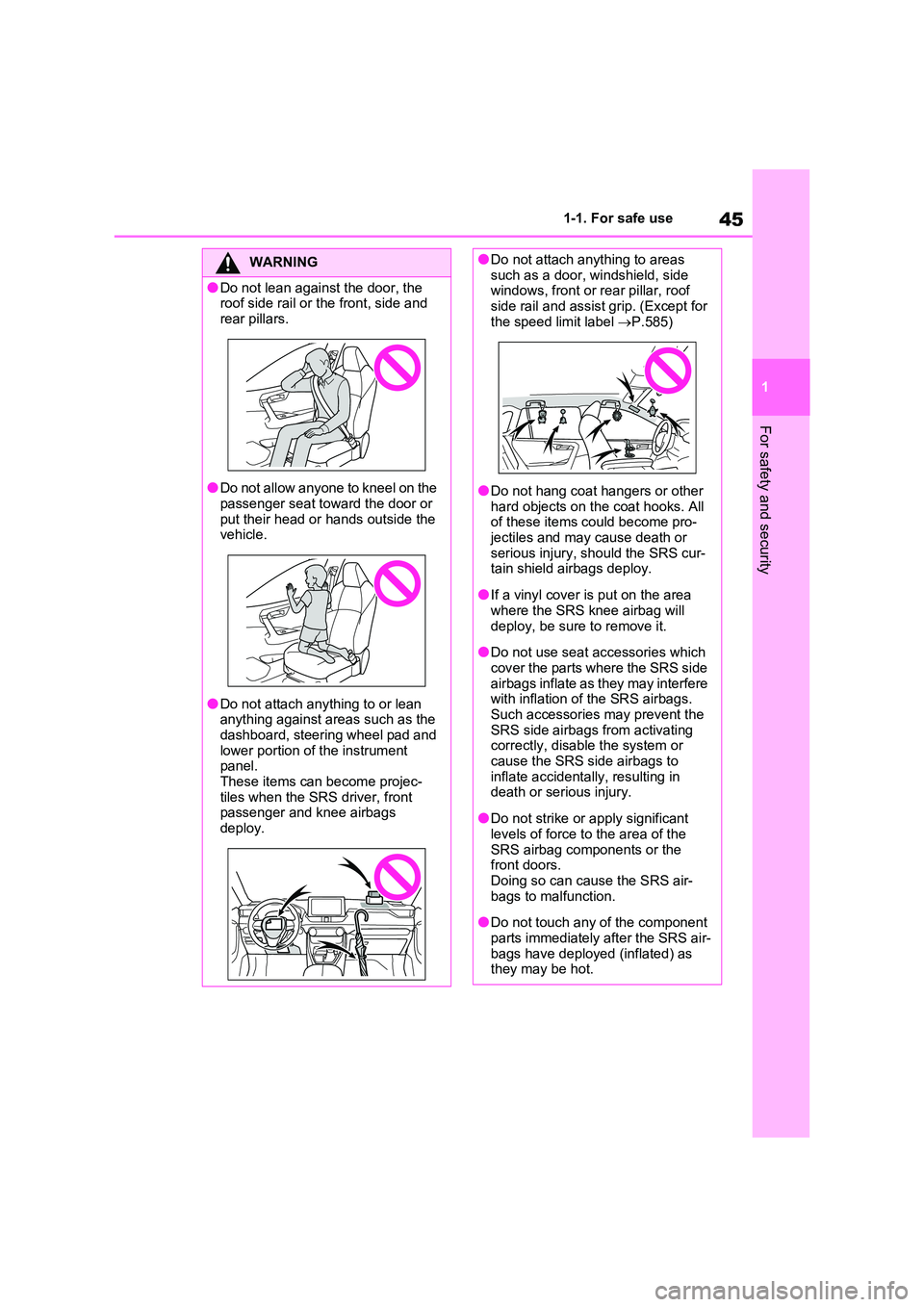
●Do not lean against the door, the roof side rail or the front, side and
rear pillars.
●Do not allow anyone to kneel on the
passenger seat toward the door or put their head or hands outside the vehicle.
●Do not attach anything to or lean anything against areas such as the
dashboard, steering wheel pad and lower portion of the instrument panel.
These items can become projec- tiles when the SRS driver, front passenger and knee airbags
deploy.
●Do not attach anything to areas such as a door, windshield, side windows, front or rear pillar, roof
side rail and assist grip. (Except for the speed limit label P.585)
●Do not hang coat hangers or other hard objects on the coat hooks. All of these items could become pro-
jectiles and may cause death or serious injury, should the SRS cur-tain shield airbags deploy.
●If a vinyl cover is put on the area where the SRS knee airbag will
deploy, be sure to remove it.
●Do not use seat accessories which
cover the parts where the SRS side airbags inflate as they may interfere with inflation of the SRS airbags.
Such accessories may prevent the SRS side airbags from activating correctly, disable the system or
cause the SRS side airbags to inflate accidentally, resulting in death or serious injury.
●Do not strike or apply significant levels of force to the area of the
SRS airbag components or the front doors.Doing so can cause the SRS air-
bags to malfunction.
●Do not touch any of the component
parts immediately after the SRS air- bags have deployed (inflated) as they may be hot.
Page 46 of 664
461-1. For safe use
WARNING
●If breathing becomes difficult after the SRS airbags have deployed,
open a door or side window to allow fresh air in, or leave the vehicle if it is safe to do so. Wash off any resi-
due as soon as possible to prevent skin irritation.
●If the areas where the SRS airbags are stored, such as the steering wheel pad and front and rear pillar
garnishes, are damaged or cracked, have them replaced by any authorized Toyota retailer or
Toyota authorized repairer, or any reliable repairer.
■Modification and disposal of SRS airbag system components
Do not dispose of your vehicle or per-
form any of the following modifica- tions without consulting any authorized Toyota retailer or Toyota
authorized repairer, or any reliable repairer. The SRS airbags may mal-function or deploy (inflate) acciden-
tally, causing death or serious injury.
●Installation, removal, disassembly and repair of the SRS airbags
●Repairs, modifications, removal or replacement of the steering wheel,
instrument panel, dashboard, seats or seat upholstery, front, side and rear pillars, roof side rails, front
door panels, front door trims or front door speakers
●Modifications to the front door panel (such as making a hole in it)
●Repairs or modifications of the front fender, front bumper, or side of the occupant compartment
●Installation of a grille guard (bull bars, kangaroo bar, etc.), snow
plows or winches
●Modifications to the vehicle’s sus-
pension system
●Installation of electronic devices such as mobile two-way radios (RF-transmitter) and CD players
Page 50 of 664
501-2. Child safety
Points to remember: P.51
When using a child restraint sys-
tem: P.52
Child restraint system compatibility
for each seating position: P.54
Child restraint system installation
method: P.60
• Fixed with a seat belt: P.61
WARNING
■When children are in the vehicle
Never leave children unattended in
the vehicle, and never allow children to have or use the key.
Children may be able to start the vehi-
cle or shift the vehicle into neutral. There is also a danger that children may injure themselves by playing with
the side windows, panoramic moon roof (if equipped) or other features of the vehicle. In addition, heat build-up
or extremely cold temperatures inside the vehicle can be fatal to children.
Child restraint systems
Before installing a child
restraint system in the vehicle,
there are precautions that need
to be observed, different types
of child restraint systems, as
well as installation methods,
etc., written in this manual.
Use a child restraint system
when riding with a small child
that cannot properly use a seat
belt. For the child’s safety,
install the child restraint sys-
tem to a rear seat. Be sure to
follow the installation method
that is in the operation manual
enclosed with the restraint sys-
tem.
The use of a Toyota genuine
child restraint system is rec-
ommended, as it is safer to
use in this vehicle. Toyota gen-
uine child restraint systems
are made specifically for
Toyota vehicles. They can be
purchased at a Toyota dealer.
Table of contents
Page 54 of 664
541-2. Child safety
■Child restraint system compat-
ibility for each seating posi-
tion
Compatibility of each seating posi-
tion with child restraint systems
( P.56) displays the type of child
restraint systems that can be used
and possible seating positions for
installation using symbols. Also, the
recommended child restraint sys-
tem that is suitable for your child
can be selected.
Otherwise, check [Recommended
child restraint systems and Com-
patibility table] for recommended
WARNING
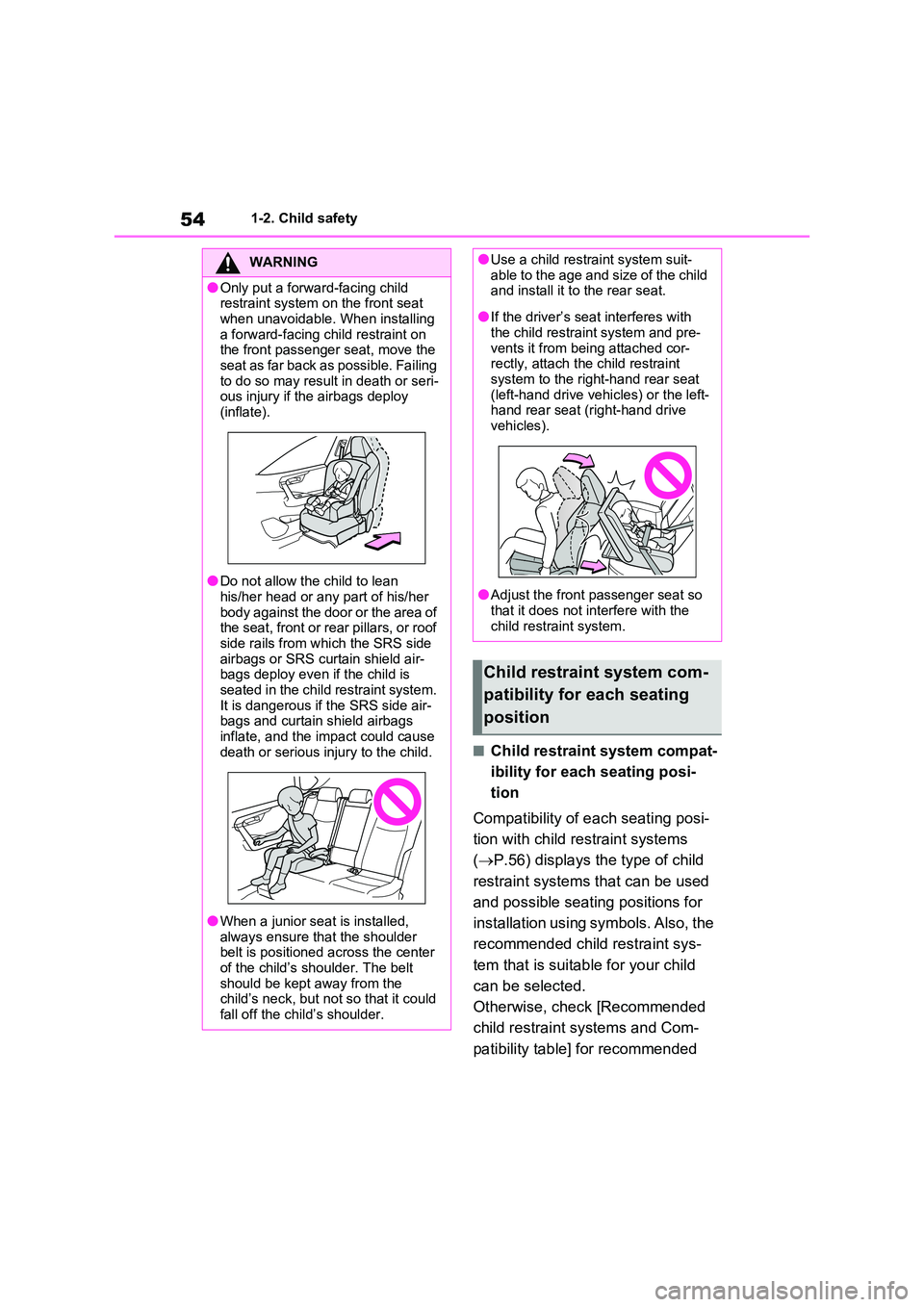
●Only put a forward-facing child restraint system on the front seat
when unavoidable. When installing a forward-facing child restraint on the front passenger seat, move the
seat as far back as possible. Failing to do so may result in death or seri-ous injury if the airbags deploy
(inflate).
●Do not allow the child to lean
his/her head or any part of his/her body against the door or the area of the seat, front or rear pillars, or roof
side rails from which the SRS side airbags or SRS curtain shield air-bags deploy even if the child is
seated in the child restraint system. It is dangerous if the SRS side air-bags and curtain shield airbags
inflate, and the impact could cause death or serious injury to the child.
●When a junior seat is installed, always ensure that the shoulder belt is positioned across the center
of the child’s shoulder. The belt should be kept away from the child’s neck, but not so that it could
fall off the child’s shoulder.
●Use a child restraint system suit- able to the age and size of the child and install it to the rear seat.
●If the driver’s seat interferes with the child restraint system and pre-
vents it from being attached cor- rectly, attach the child restraint system to the right-hand rear seat
(left-hand drive vehicles) or the left- hand rear seat (right-hand drive vehicles).
●Adjust the front passenger seat so that it does not interfere with the
child restraint system.
Child restraint system com-
patibility for each seating
position