Vin TOYOTA VERSO S 2012 Owners Manual
[x] Cancel search | Manufacturer: TOYOTA, Model Year: 2012, Model line: VERSO S, Model: TOYOTA VERSO S 2012Pages: 540, PDF Size: 17.43 MB
Page 234 of 540
234 2-4. Using other driving systems
VERSO-S_EE
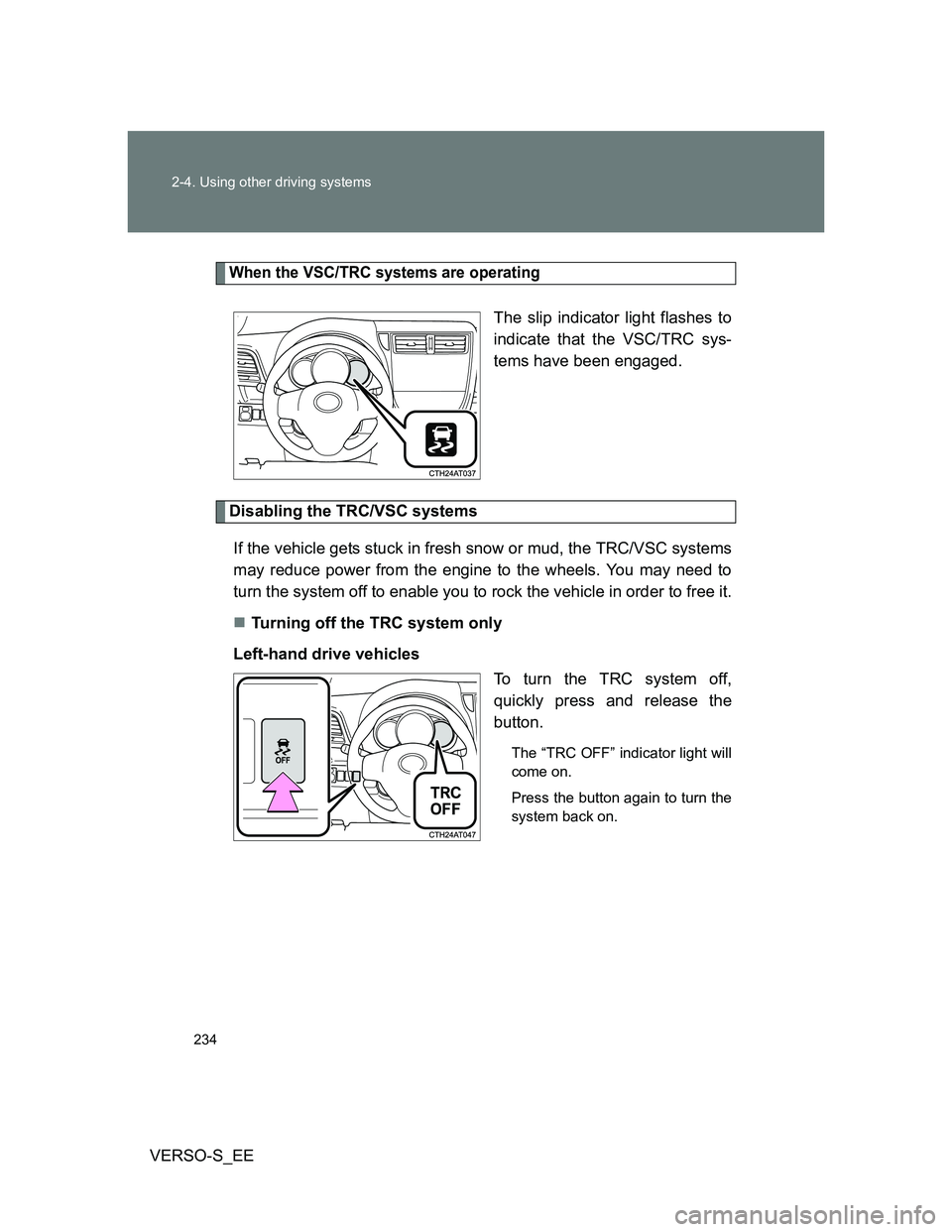
When the VSC/TRC systems are operating
The slip indicator light flashes to
indicate that the VSC/TRC sys-
tems have been engaged.
Disabling the TRC/VSC systems
If the vehicle gets stuck in fresh snow or mud, the TRC/VSC systems
may reduce power from the engine to the wheels. You may need to
turn the system off to enable you to rock the vehicle in order to free it.
Turning off the TRC system only
Left-hand drive vehicles
To turn the TRC system off,
quickly press and release the
button.
The “TRC OFF” indicator light will
come on.
Press the button again to turn the
system back on.
Page 235 of 540
235 2-4. Using other driving systems
2
When driving
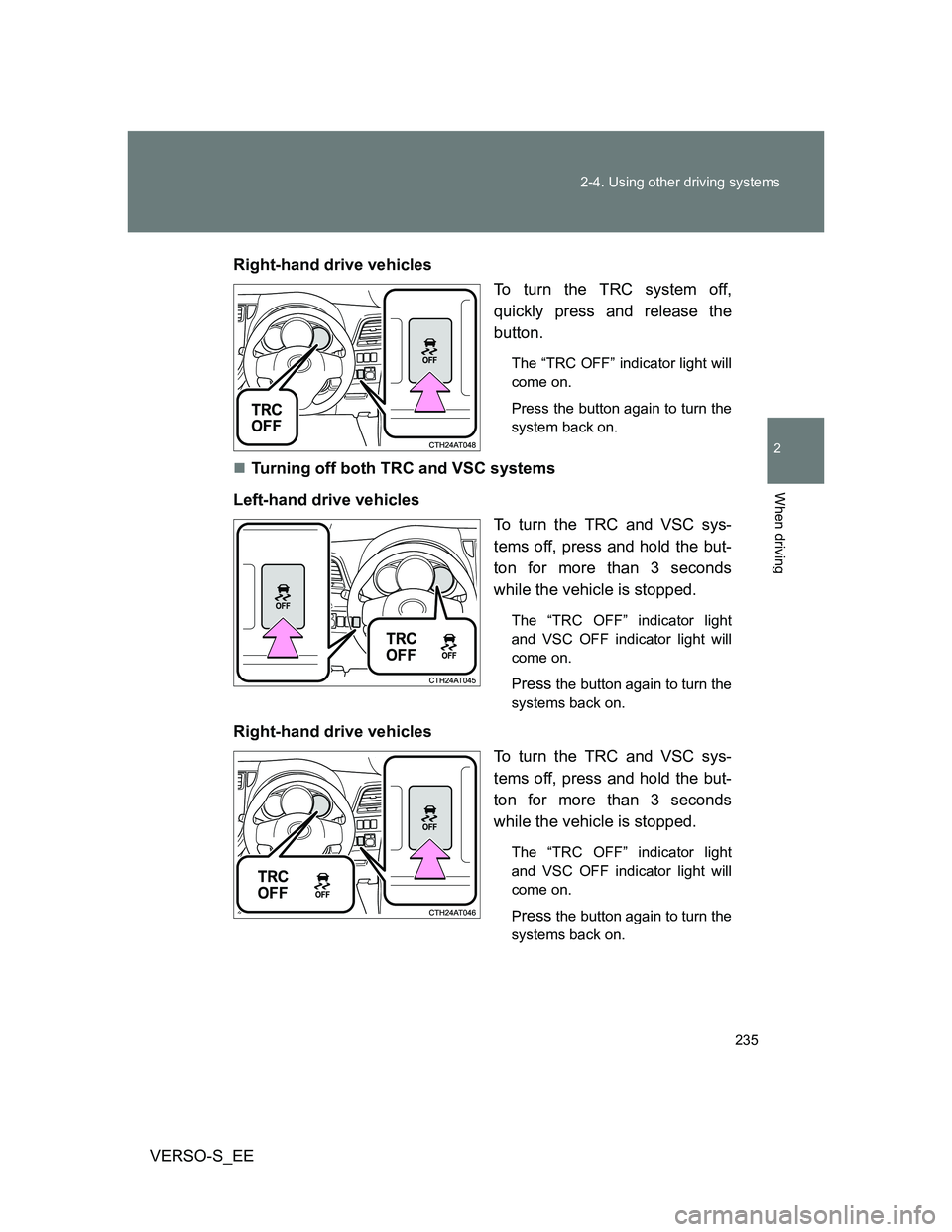
VERSO-S_EERight-hand drive vehicles
To turn the TRC system off,
quickly press and release the
button.
The “TRC OFF” indicator light will
come on.
Press the button again to turn the
system back on.
Turning off both TRC and VSC systems
Left-hand drive vehicles
To turn the TRC and VSC sys-
tems off, press and hold the but-
ton for more than 3 seconds
while the vehicle is stopped.
The “TRC OFF” indicator light
and VSC OFF indicator light will
come on.
P
ress the button again to turn the
systems back on.
Right-hand drive vehicles
To turn the TRC and VSC sys-
tems off, press and hold the but-
ton for more than 3 seconds
while the vehicle is stopped.
The “TRC OFF” indicator light
and VSC OFF indicator light will
come on.
P
ress the button again to turn the
systems back on.
Page 236 of 540
236 2-4. Using other driving systems
VERSO-S_EE
Hill-start assist control operation conditions
The shift lever is in D or M.
The brake pedal is not depressed.
Sounds and vibrations caused by the ABS, brake assist, VSC, TRC and
hill-start assist control systems
A sound may be heard from the engine compartment when the engine is
started or just after the vehicle begins to move. This sound does not indi-
cate that a malfunction has occurred in any of these systems.
Any of the following conditions may occur when the above systems are
operating. None of these indicates that a malfunction has occurred.
• Vibrations may be felt through the vehicle body and steering.
• A motor sound may be heard after the vehicle comes to a stop.
• The brake pedal may pulsate slightly after the ABS is activated.
• The brake pedal may move down slightly after the ABS is activated.
EPS operation sound
When the steering wheel is operated, a motor sound (whirring sound) may
be heard. This does not indicate a malfunction.
Reactivation of the TRC/VSC systems after turning off the engine
If the TRC/VSC systems are turned off, re-starting the engine will automati-
cally reactivate them.
Reactivation of the TRC system linked to vehicle speed
When the TRC system is turned off, it will turn on when vehicle speed
increases. However, when the TRC and VSC systems are turned off, the
systems will not turn on even when vehicle speed increases.
Reduced effectiveness of the EPS system
The effectiveness of the EPS system is reduced to prevent the system from
overheating when there is frequent steering input over an extended period of
time. The steering wheel may feel heavy as a result. Should this occur,
refrain from excessive steering input or stop the vehicle and turn the engine
off. The EPS system should return to normal within 10 minutes.
If the slip indicator comes on...
It may indicate a malfunction in the driving assist systems. Contact any
authorized Toyota dealer or repairer, or another duly qualified and equipped
professional.
Page 237 of 540
237 2-4. Using other driving systems
2
When driving
VERSO-S_EE
CAUTION
The ABS does not operate effectively when
Tires with inadequate gripping ability are used (such as excessively worn
tires on a snow covered road).
The vehicle hydroplanes while driving at high speed on wet or slick roads.
Stopping distance when the ABS is operating may exceed that of nor-
mal conditions
The ABS is not designed to shorten the vehicle’s stopping distance. Always
maintain a safe distance from the vehicle in front of you in the following situ-
ations:
When driving on dirt, gravel or snow-covered roads
When driving with tire chains
When driving over bumps in the road
When driving over roads with potholes or roads with uneven surfaces
TRC may not operate effectively when
Directional control and power may not be achievable while driving on slip-
pery road surfaces, even if the TRC system is operating.
Be especially careful and drive the vehicle in conditions where stability and
power may be lost.
Hill-start assist control does not operate effectively when
Do not overly rely on the hill-start assist control. The hill-start assist control
may not operate effectively on steep inclines and roads covered with ice.
When the VSC is activated
The slip indicator light flashes. Always drive carefully. Reckless driving may
cause an accident. Exercise particular care when the indicator light flashes.
When the TRC/VSC systems are turned off
Be especially careful and drive at a speed appropriate to the road condi-
tions. Do not turn the TRC/VSC systems off unless necessary, as these are
the systems to ensure vehicle stability and driving force by automatically
controlling braking and engine outputs.
Page 238 of 540
238 2-4. Using other driving systems
VERSO-S_EE
CAUTION
Replacing tires
Observe the following precautions.
Failure to do so may cause the ABS, VSC and TRC systems not to function
correctly.
Make sure that all tires are of the specified size, brand, tread pattern and
total load capacity.
Do not use tires of noticeably different wear level.
Make sure that the tires are inflated to the recommended tire inflation
pressure level. (P. 513)
Contact any authorized Toyota dealer or repairer, or another duly qualified
and equipped professional for further information when replacing tires or
wheels.
Handling of tires and the suspension
Using tires with any kind of problem or modifying the suspension will affect
the driving assist systems, and may cause a system to malfunction.
Page 239 of 540
239
2-4. Using other driving systems
2
When driving
VERSO-S_EE
Diesel particulate filter system (diesel engine only)
Replacing the engine oil
P. 364
CAUTION
Exhaust pipe
Do not touch the exhaust pipe during regeneration, as the exhaust pipe and
exhaust gases will become particularly hot. Also, make sure that there are
no people or flammable materials near the exhaust pipe while the vehicle is
stopped.
Failure to do so may cause injury by burning or a fire.
When the deposit collected by the filter reaches a predetermined
amount, it is automatically cleaned.
Cleaning the DPF catalytic converter
Cleaning the DPF catalytic converter is performed as necessary
in accordance with driving conditions.
Equipment characteristics
The DPF system has the following characteristics:
Idle speed increases during cleaning
The smell of the exhaust gas changes
When starting the engine, white-colored steam (water vapor)
may be expelled during cleaning
Acceleration performance may degrade during cleaning
Page 240 of 540
240 2-4. Using other driving systems
VERSO-S_EE
NOTICE
To prevent the DPF system from failing
Do not use fuel other than the specified type
Do not use engine oil other than the recommended type
Do not modify the exhaust pipe
Page 241 of 540
241
2
When driving
VERSO-S_EE
2-5. Driving information
Cargo and luggage
CAUTION
Things that must not be carried in the luggage compartment
The following things may cause a fire if loaded in the luggage compartment:
Receptacles containing gasoline
Aerosol cans
Storage precautions
Observe the following precautions.
Failure to do so may result in death or serious injury.
Stow cargo and luggage in the luggage compartment whenever possible.
Do not stack anything in the luggage compartment higher than the seat-
backs.
Such items may be thrown about and possibly injure people in the vehicle
in the event of sudden braking or in an accident.
Do not place cargo or luggage in or on the following locations as the item
may get under the clutch, brake or accelerator pedal and prevent the ped-
als from being depressed properly, block the driver’s vision, or hit the
driver or passengers, causing an accident:
• At the feet of the driver
• On the front passenger or rear seats (when stacking items)
• On the luggage cover
• On the instrument panel
• On the dashboard
Take notice of the following information about storage precautions,
cargo capacity and load:
Stow cargo and luggage in the luggage compartment whenever
possible.
Be sure all items are secured in place.
To maintain vehicle balance while driving, position luggage
evenly within the luggage compartment.
For better fuel economy, do not carry unnecessary weight.
Page 242 of 540
242 2-5. Driving information
VERSO-S_EE
CAUTION
Secure all items in the occupant compartment, as they may shift and injure
someone during sudden braking, sudden swerving or an accident.
When you fold down the rear seats, long items should not be place directly
behind the front seats.
Never allow anyone to ride in the luggage compartment. It is not designed
for passengers. They should ride in their seats with their seat belts prop-
erly fastened. Otherwise, they are much more likely to suffer death or seri-
ous bodily injury, in the event of sudden braking, sudden swerving or an
accident.
Load and distribution
Do not overload your vehicle.
Do not apply loads unevenly.
Improper loading may cause deterioration of steering or braking control
which may cause death or serious injury.
Page 243 of 540
243
2-5. Driving information
2
When driving
VERSO-S_EE
Winter driving tips
Carry out the necessary preparations and inspections before driving
the vehicle in winter. Always drive the vehicle in a manner appropri-
ate to the prevailing weather conditions.
Pre-winter preparations
Use fluids that are appropriate to the prevailing outside tem-
peratures.
• Engine oil
• Engine coolant
• Washer fluid
Have a service technician inspect the level and specific grav-
ity of battery electrolyte.
Have the vehicle fitted with four snow tires or purchase a set
of tire chains for the front tires.
Ensure that all tires are the same size and brand and that their wear
level is not noticeably different with each other. Also make sure that
chains match the size of the tires.
Before driving the vehicle
Perform the following according to the driving conditions:
Do not try to forcibly open a window or move a wiper that is
frozen. Pour warm water over the frozen area to melt the ice.
Wipe away the water immediately to prevent it from freezing.
To ensure proper operation of the climate control system fan,
remove any snow that has accumulated on the air inlet vents
in front of the windshield.
Remove any ice that has accumulated on the vehicle chassis.
Periodically check for and remove any excess ice or snow
that may have accumulated in the wheel well or on the
brakes.