Vin TOYOTA VERSO S 2012 Owners Manual
[x] Cancel search | Manufacturer: TOYOTA, Model Year: 2012, Model line: VERSO S, Model: TOYOTA VERSO S 2012Pages: 540, PDF Size: 17.43 MB
Page 353 of 540
353
4
Maintenance and care
VERSO-S_EE
4-2. Maintenance
Maintenance requirements
To ensure safe and economical driving, day-to-day care and regular
maintenance are essential. Toyota recommends performing the fol-
lowing maintenance:
Scheduled maintenance
Scheduled maintenance should be performed at specified inter-
vals according to the maintenance schedule.
For full details of your maintenance schedule, refer to the “Toyota
Service Booklet” or “Toyota Warranty Booklet”.
Do-it-yourself maintenance
What about do-it-yourself maintenance?
Many maintenance items are easy to do yourself if you have a little
mechanical ability and a few basic automotive tools.
Note, however, that some maintenance tasks require special tools
and skills. These are best performed by qualified technicians. Even if
you're an experienced do-it-yourself mechanic, we recommend that
repairs and maintenance be conducted by any authorized Toyota
dealer or repairer, or another duly qualified and equipped profes-
sional. Any authorized Toyota dealer or repairer will keep a record of
maintenance, which could be useful should you ever require Warranty
Service. Should you choose to select a qualified and equipped profes-
sional other than an authorized Toyota repairer to service or maintain
your vehicle, we recommend that you request that a record of mainte-
nance be kept.
Page 357 of 540
357 4-3. Do-it-yourself maintenance
4
Maintenance and care
VERSO-S_EE
CAUTION
The engine compartment contains many mechanisms and fluids that may
move suddenly, become hot, or become electrically energized. To avoid death
or serious injury, observe the following precautions:
When working on the engine compartment:
Keep hands, clothing and tools away from the moving fan and engine
drive belt.
Be careful not to touch the engine, radiator, exhaust manifold, etc. right
after driving as they may be hot. Oil and other fluids may also be hot.
Do not leave anything that may burn easily, such as paper and rags, in the
engine compartment.
Do not smoke, cause sparks or expose an open flame to fuel or the bat-
tery. Fuel and battery fumes are flammable.
Be extremely cautious when working on the battery. It contains poisonous
and corrosive sulfuric acid.
Take care because brake fluid can harm your hands or eyes and damage
painted surfaces. If fluid gets on your hands or in your eyes, flush the
affected area with clean water immediately.
If you still experience discomfort, consult a doctor.
ItemsParts and tools
Tire inflation pressure (P. 380)• Tire pressure gauge
• Compressed air source
Washer fluid (P. 375)• Water or washer fluid containing
antifreeze (for winter use)
• Funnel (used only for adding
water or washer fluid)
Page 358 of 540
358 4-3. Do-it-yourself maintenance
VERSO-S_EE
CAUTION
When working near the electric cooling fans or radiator grille
Vehicles without a smart entry & start system: Be sure the engine switch is
off. With the engine switch in the “ON” position, the electric cooling fans may
automatically start to run if the air conditioning is on and/or the coolant tem-
perature is high. (P. 371)
Vehicles with a smart entry & start system: Be sure the “ENGINE START
STOP” switch is off. With the “ENGINE START STOP” switch in IGNITION
ON mode, the electric cooling fans may automatically start to run if the air
conditioning is on and/or the coolant temperature is high. (P. 371)
Safety glasses
Wear safety glasses to prevent flying or falling material, fluid spray, etc. from
getting in your eyes.
NOTICE
If you remove the air cleaner filter
Driving with the air cleaner filter removed may cause excessive engine wear
due to dirt in the air. Also, a backfire could cause a fire in the engine com-
partment.
If the fluid level is low or high
It is normal for the brake fluid level to go down slightly as the brake pads
wear or when the fluid level in the accumulator is high.
If the reservoir needs frequent refilling, it may indicate a serious problem.
Page 359 of 540
359
4-3. Do-it-yourself maintenance
4
Maintenance and care
VERSO-S_EE
Hood
CAUTION
Pre-driving check
Check that the hood is fully closed and locked.
If the hood is not locked properly, it may open while the vehicle is in motion
and cause an accident, which may result in death or serious injury.
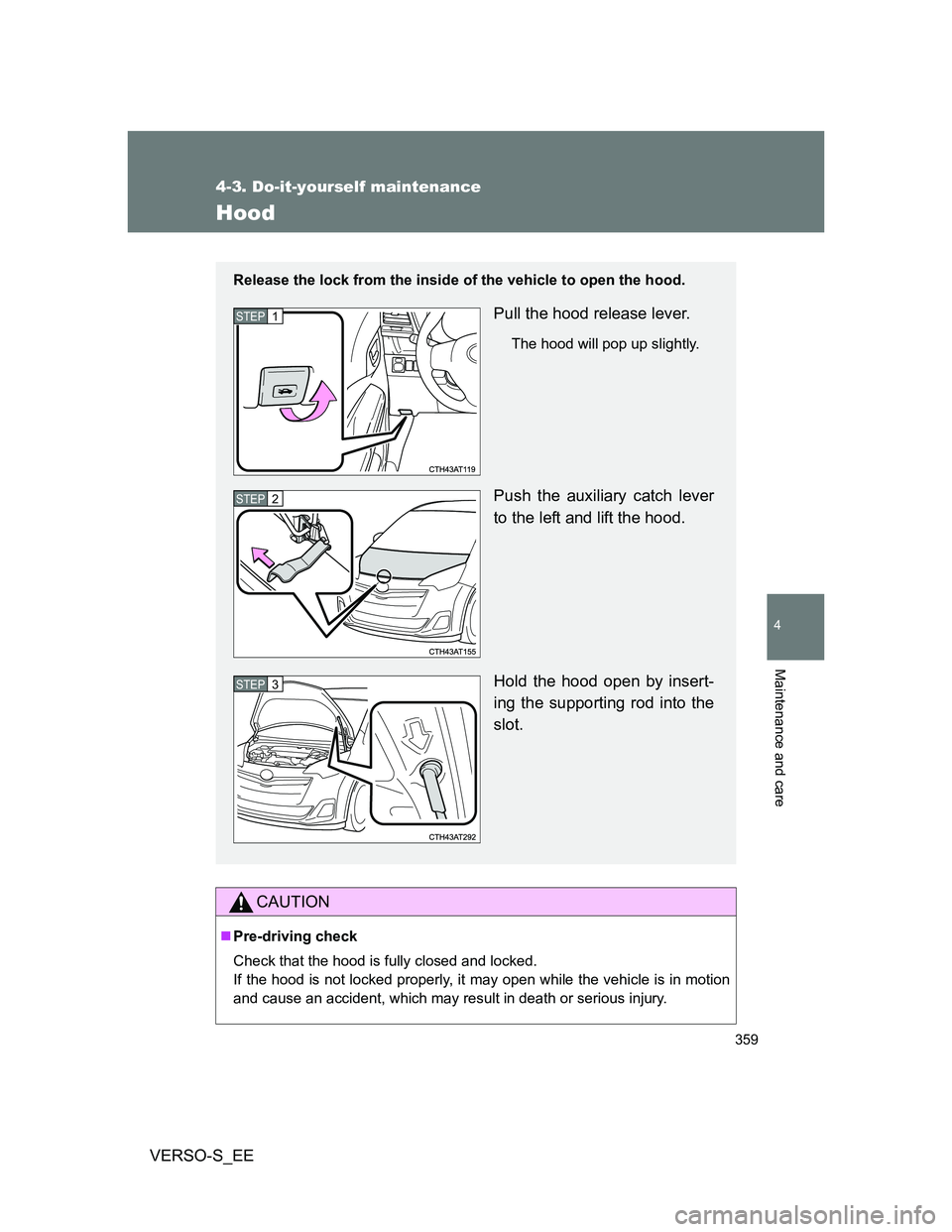
Release the lock from the inside of the vehicle to open the hood.
Pull the hood release lever.
The hood will pop up slightly.
Push the auxiliary catch lever
to the left and lift the hood.
Hold the hood open by insert-
ing the supporting rod into the
slot.
STEP1
STEP2
STEP3
Page 366 of 540
366 4-3. Do-it-yourself maintenance
VERSO-S_EE
Engine oil consumption
The amount of engine oil consumed depends on the oil viscosity, the
quality of the oil and the way the vehicle is driven.
More oil is consumed under driving conditions such as high speeds and
frequent acceleration and deceleration.
A new engine consumes more oil.
When judging the amount of oil consumption, keep in mind that the oil
may have become diluted, making it difficult to judge the true level accu-
rately.
Oil consumption: Max. 1.0 L/1000 km (1.1 qt./600 miles, 0.9 Imp. qt./600
miles)
If your vehicle consumes more than 1.0 L (1.1 qt., 0.9 Imp. qt.) every
1000 km (600 miles), contact any authorized Toyota dealer or repairer, or
another duly qualified and equipped professional.
Page 379 of 540
379 4-3. Do-it-yourself maintenance
4
Maintenance and care
VERSO-S_EE
NOTICE
Driving on rough roads
Take particular care when driving on roads with loose surfaces or potholes.
These conditions may cause losses in tire inflation pressure, reducing the
cushioning ability of the tires. In addition, driving on rough roads may cause
damage to the tires themselves, as well as the vehicle’s wheels and body.
If tire inflation pressure of each tire becomes low while driving
Do not continue driving, or your tires and/or wheels may be ruined.
Page 380 of 540
380
4-3. Do-it-yourself maintenance
VERSO-S_EE
Tire inflation pressure
Effects of incorrect tire inflation pressure
Driving with incorrect tire inflation pressure may result in the following:
Reduced fuel efficiency
Reduced driving comfort and tire life
Reduced safety
Damage to the drive train
If a tire needs frequent inflating, have it checked by any authorized Toyota
dealer or repairer, or another duly qualified and equipped professional.
Instructions for checking tire inflation pressure
When checking tire inflation pressure, observe the following:
Check only when the tires are cold.
If your vehicle has been parked for at least 3 hours or has not been
driven for more than 1.5 km or 1 mile, you will get an accurate cold tire
inflation pressure reading.
Always use a tire pressure gauge.
The appearance of the tire can be misleading. In addition, tire inflation
pressure that is even just a few pounds off can affect ride quality and
handling.
Do not reduce tire inflation pressure after driving. It is normal for tire infla-
tion pressure to be higher after driving.
Never exceed the vehicle capacity weight.
Passengers and luggage weight should be placed so that the vehicle is
balanced.
Make sure to maintain proper tire inflation pressure. Tire inflation
pressure should be checked at least once per month. However,
Toyota recommends that tire inflation pressure be checked once
every two weeks. (P. 513)
Page 382 of 540
382
4-3. Do-it-yourself maintenance
VERSO-S_EE
Wheels
If a wheel is bent, cracked or heavily corroded, it should be replaced.
Otherwise, the tire may separate from the wheel or cause a loss of
handling control.
Wheel selection
When replacing wheels, care should be taken to ensure that
they are equivalent to those removed in load capacity, diameter,
rim width and inset*.
Replacement wheels are available at any authorized Toyota
dealer or repairer, or another duly qualified and equipped profes-
sional.
*: Conventionally referred to as “offset”.
Toyota does not recommend using the following:
Wheels of different sizes or types
Used wheels
Bent wheels that have been straightened
Aluminum wheel precautions (if equipped)
Use only Toyota wheel nuts and wrenches designed for use
with your aluminum wheels.
When rotating, repairing or changing your tires, check that the
wheel nuts are still tight after driving 1600 km (1000 miles).
Be careful not to damage the aluminum wheels when using
tire chains.
Use only Toyota genuine balance weights or equivalent and a
plastic or rubber hammer when balancing your wheels.
Page 383 of 540
383 4-3. Do-it-yourself maintenance
4
Maintenance and care
VERSO-S_EE
CAUTION
When replacing wheels
Do not use wheels that are a different size from those recommended in the
Owner’s Manual, as this may result in a loss of handling control.
Never use an inner tube in a leaking wheel which is designed for a tube-
less tire. Doing so may result in an accident, causing death or serious
injury.
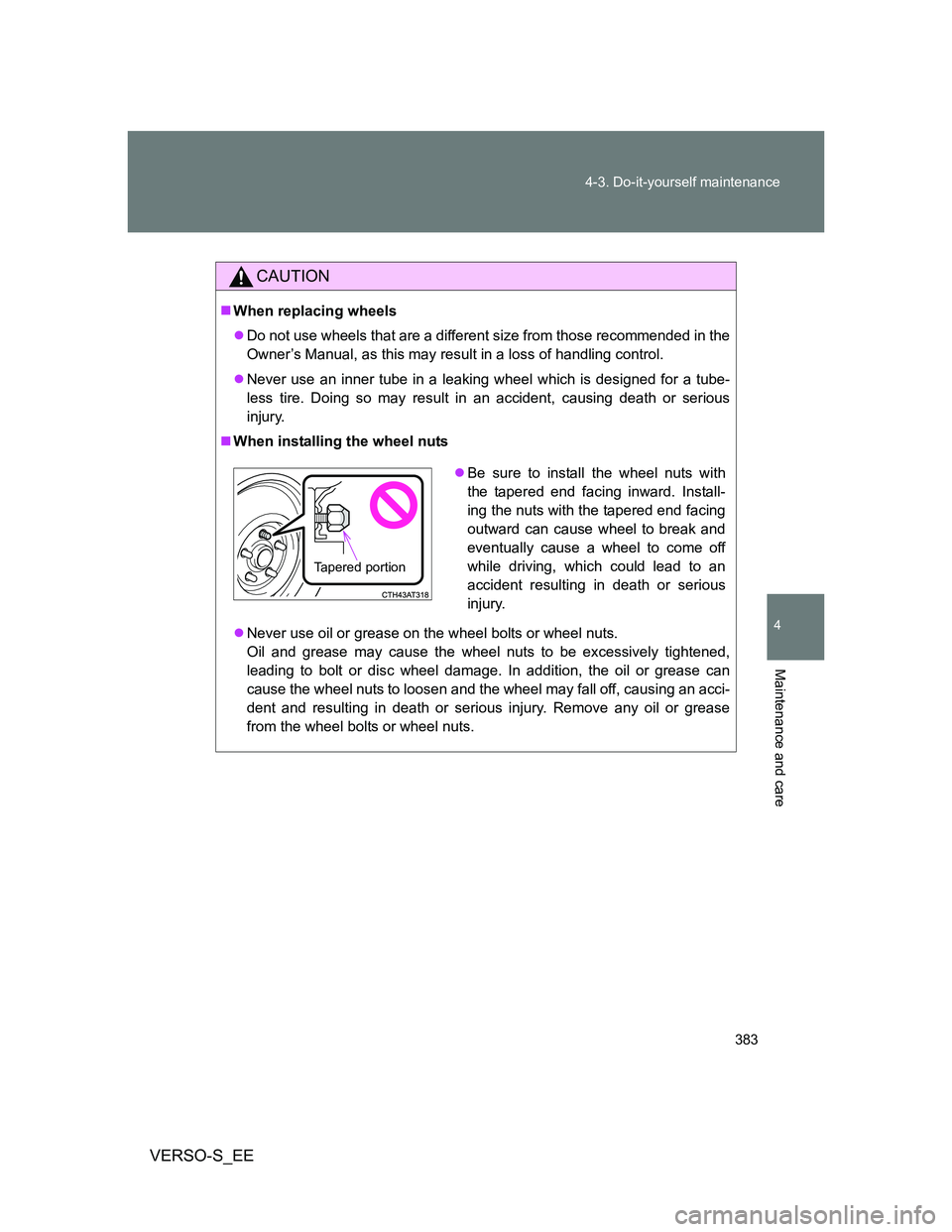
When installing the wheel nuts
Never use oil or grease on the wheel bolts or wheel nuts.
Oil and grease may cause the wheel nuts to be excessively tightened,
leading to bolt or disc wheel damage. In addition, the oil or grease can
cause the wheel nuts to loosen and the wheel may fall off, causing an acci-
dent and resulting in death or serious injury. Remove any oil or grease
from the wheel bolts or wheel nuts.
Be sure to install the wheel nuts with
the tapered end facing inward. Install-
ing the nuts with the tapered end facing
outward can cause wheel to break and
eventually cause a wheel to come off
while driving, which could lead to an
accident resulting in death or serious
injury.
Tapered portion
Page 419 of 540
5
419
5-1. Essential information
When trouble arises
VERSO-S_EE
If your vehicle needs to be towed
Before towing
The following may indicate a problem with your transmission. Contact
any authorized Toyota dealer or repairer, or another duly qualified
and equipped professional before towing.
The engine is running but the vehicle will not move.
The vehicle makes an abnormal sound.
If towing is necessary, we recommend having your vehicle towed by
any authorized Toyota dealer or repairer, or another duly qualified
and equipped professional, such as a commercial towing service,
using a lift-type truck or flatbed truck.
Use a safety chain system for all towing, and abide by all state/pro-
vincial and local laws.