battery TOYOTA VERSO S 2012 Owner's Guide
[x] Cancel search | Manufacturer: TOYOTA, Model Year: 2012, Model line: VERSO S, Model: TOYOTA VERSO S 2012Pages: 540, PDF Size: 17.43 MB
Page 345 of 540
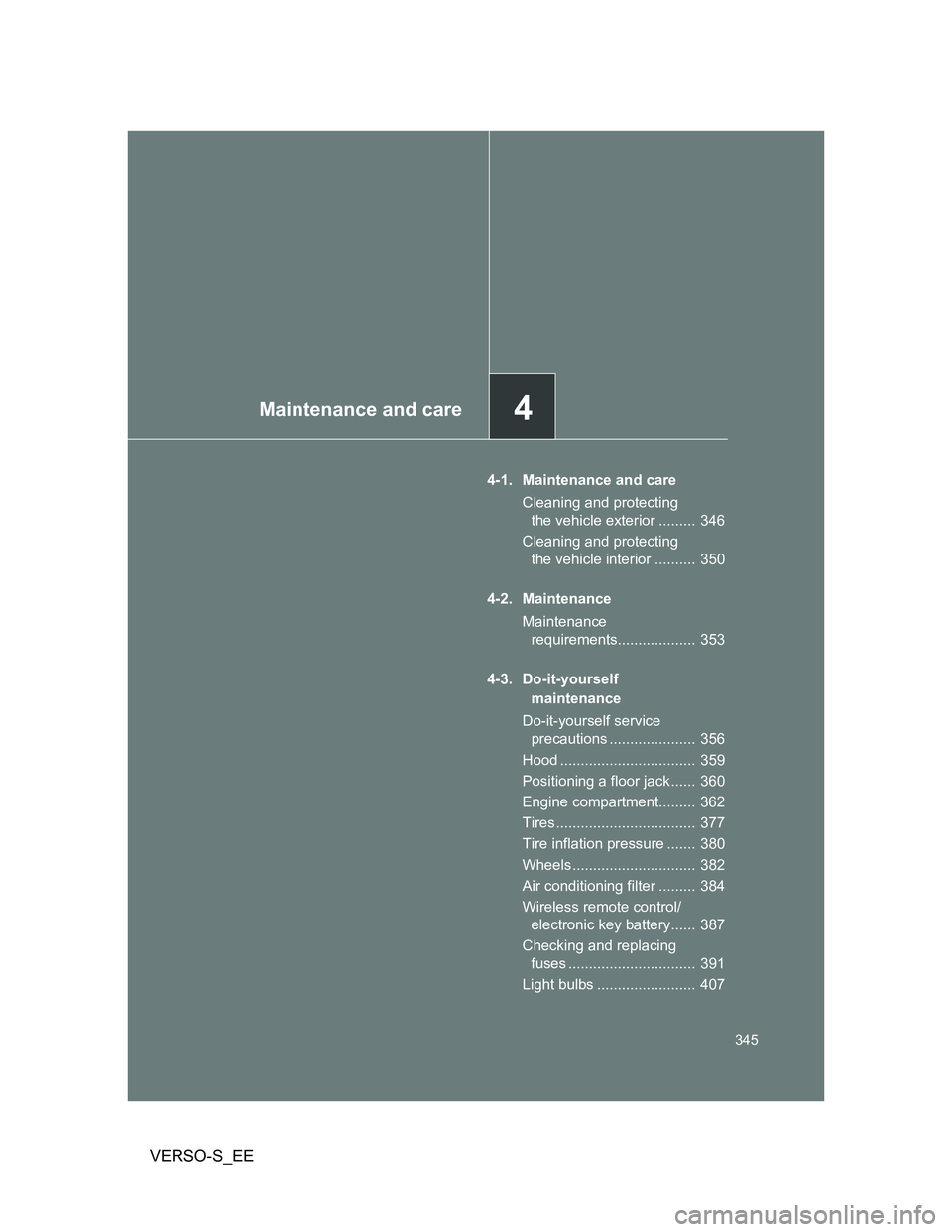
4Maintenance and care
345
VERSO-S_EE
4-1. Maintenance and care
Cleaning and protecting
the vehicle exterior ......... 346
Cleaning and protecting
the vehicle interior .......... 350
4-2. Maintenance
Maintenance
requirements................... 353
4-3. Do-it-yourself
maintenance
Do-it-yourself service
precautions ..................... 356
Hood ................................. 359
Positioning a floor jack ...... 360
Engine compartment......... 362
Tires .................................. 377
Tire inflation pressure ....... 380
Wheels .............................. 382
Air conditioning filter ......... 384
Wireless remote control/
electronic key battery...... 387
Checking and replacing
fuses ............................... 391
Light bulbs ........................ 407
Page 355 of 540
355 4-2. Maintenance
4
Maintenance and care
VERSO-S_EE
CAUTION
If your vehicle is not properly maintained
Improper maintenance could result in serious damage to the vehicle and
possible serious injury or death.
Handling of the battery
Battery posts, terminals and related accessories contain lead and lead com-
pounds which are known to cause brain damage. Wash your hands after
handling. (P. 371)
Page 356 of 540
356
VERSO-S_EE
4-3. Do-it-yourself maintenance
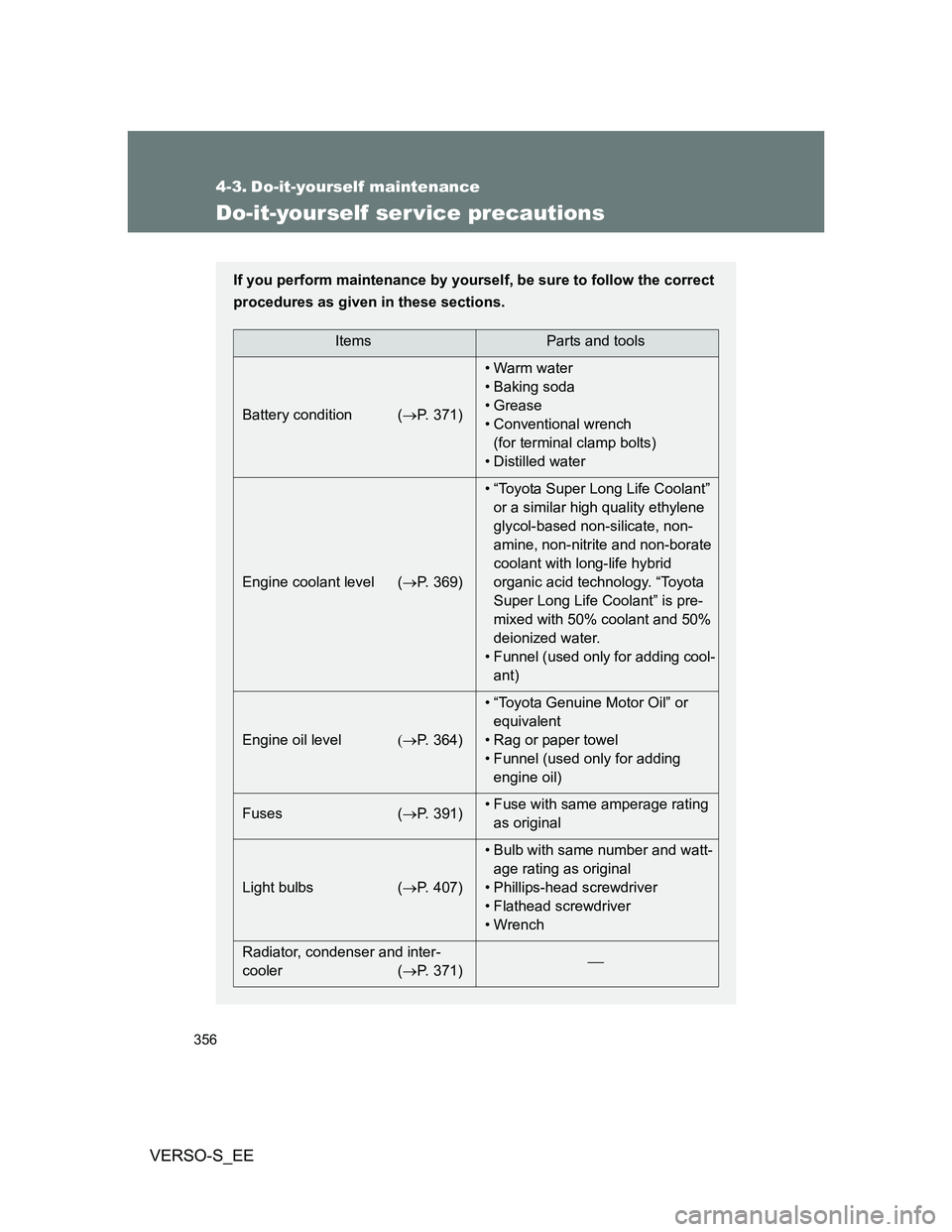
Do-it-yourself ser vice precautions
If you perform maintenance by yourself, be sure to follow the correct
procedures as given in these sections.
ItemsParts and tools
Battery condition (P. 371)•Warm water
• Baking soda
• Grease
• Conventional wrench
(for terminal clamp bolts)
• Distilled water
Engine coolant level (P. 369)• “Toyota Super Long Life Coolant”
or a similar high quality ethylene
glycol-based non-silicate, non-
amine, non-nitrite and non-borate
coolant with long-life hybrid
organic acid technology. “Toyota
Super Long Life Coolant” is pre-
mixed with 50% coolant and 50%
deionized water.
• Funnel (used only for adding cool-
ant)
Engine oil levelP. 364)• “Toyota Genuine Motor Oil” or
equivalent
• Rag or paper towel
• Funnel (used only for adding
engine oil)
Fuses (P. 391)• Fuse with same amperage rating
as original
Light bulbs (P. 407)• Bulb with same number and watt-
age rating as original
• Phillips-head screwdriver
• Flathead screwdriver
• Wrench
Radiator, condenser and inter-
cooler (P. 371)
Page 357 of 540
357 4-3. Do-it-yourself maintenance
4
Maintenance and care
VERSO-S_EE
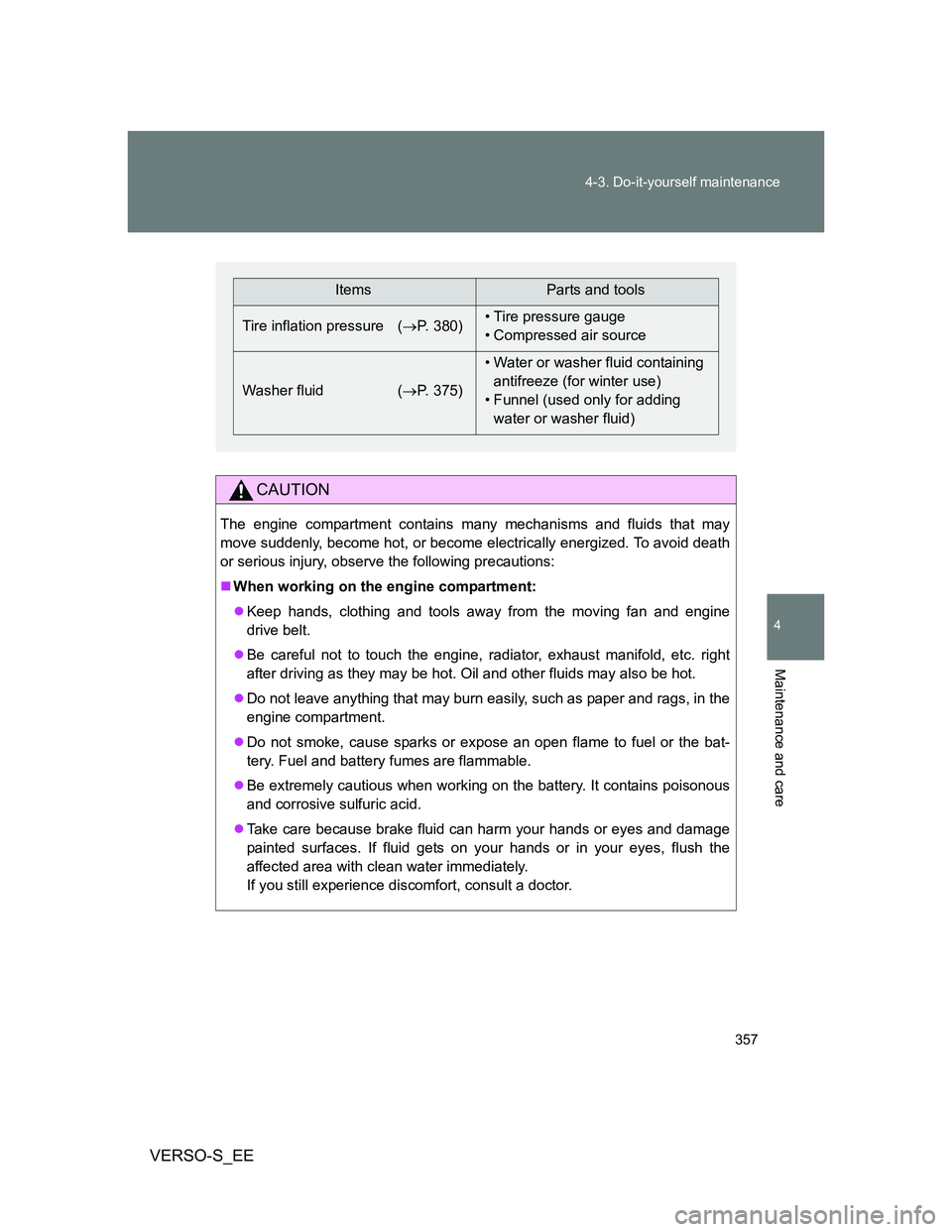
CAUTION
The engine compartment contains many mechanisms and fluids that may
move suddenly, become hot, or become electrically energized. To avoid death
or serious injury, observe the following precautions:
When working on the engine compartment:
Keep hands, clothing and tools away from the moving fan and engine
drive belt.
Be careful not to touch the engine, radiator, exhaust manifold, etc. right
after driving as they may be hot. Oil and other fluids may also be hot.
Do not leave anything that may burn easily, such as paper and rags, in the
engine compartment.
Do not smoke, cause sparks or expose an open flame to fuel or the bat-
tery. Fuel and battery fumes are flammable.
Be extremely cautious when working on the battery. It contains poisonous
and corrosive sulfuric acid.
Take care because brake fluid can harm your hands or eyes and damage
painted surfaces. If fluid gets on your hands or in your eyes, flush the
affected area with clean water immediately.
If you still experience discomfort, consult a doctor.
ItemsParts and tools
Tire inflation pressure (P. 380)• Tire pressure gauge
• Compressed air source
Washer fluid (P. 375)• Water or washer fluid containing
antifreeze (for winter use)
• Funnel (used only for adding
water or washer fluid)
Page 362 of 540
362
4-3. Do-it-yourself maintenance
VERSO-S_EE
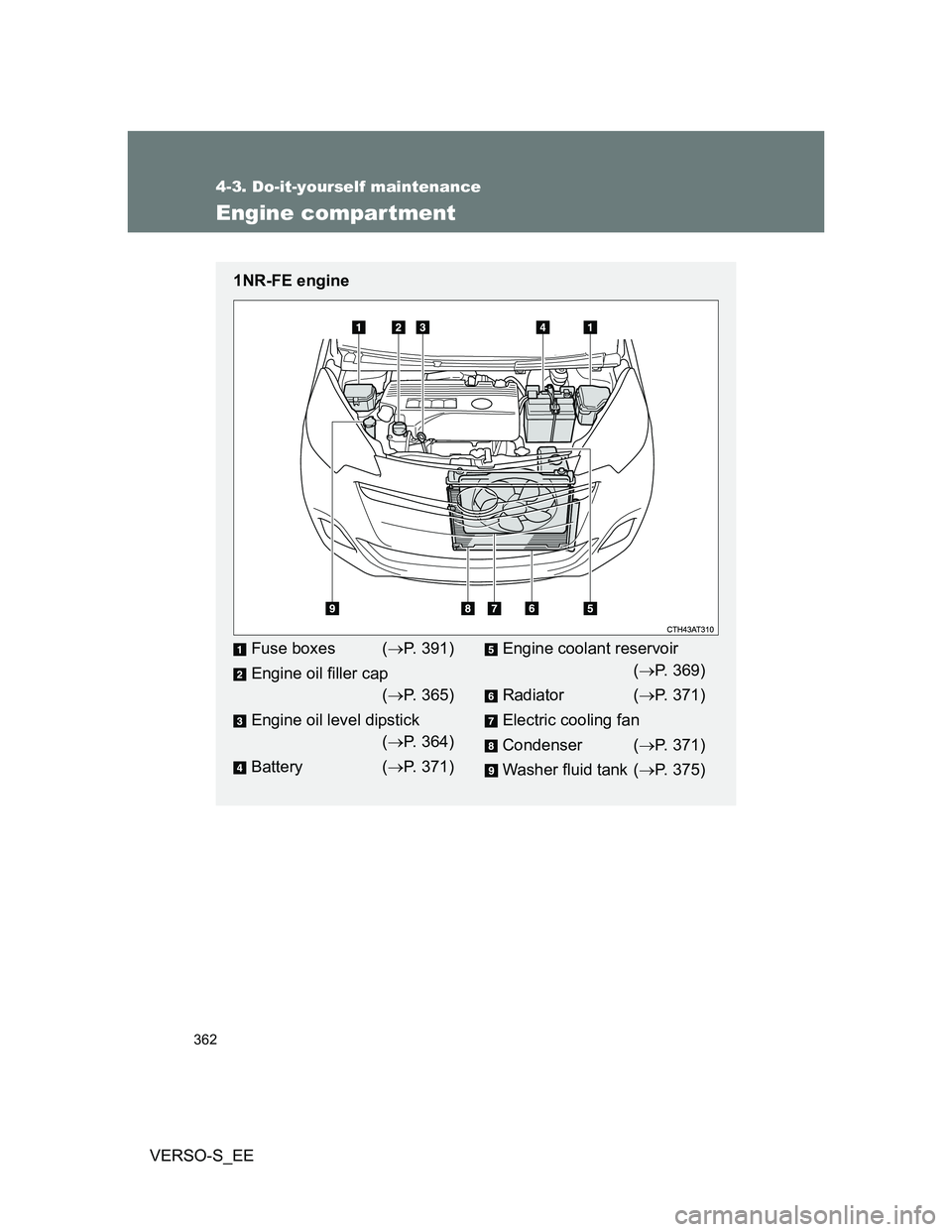
Engine compartment
1NR-FE engine
Fuse boxes (P. 391)
Engine oil filler cap
(P. 365)
Engine oil level dipstick
(P. 364)
Battery (P. 371)Engine coolant reservoir
(P. 369)
Radiator (P. 371)
Electric cooling fan
Condenser (P. 371)
Washer fluid tank (P. 375)
Page 363 of 540
363 4-3. Do-it-yourself maintenance
4
Maintenance and care
VERSO-S_EE
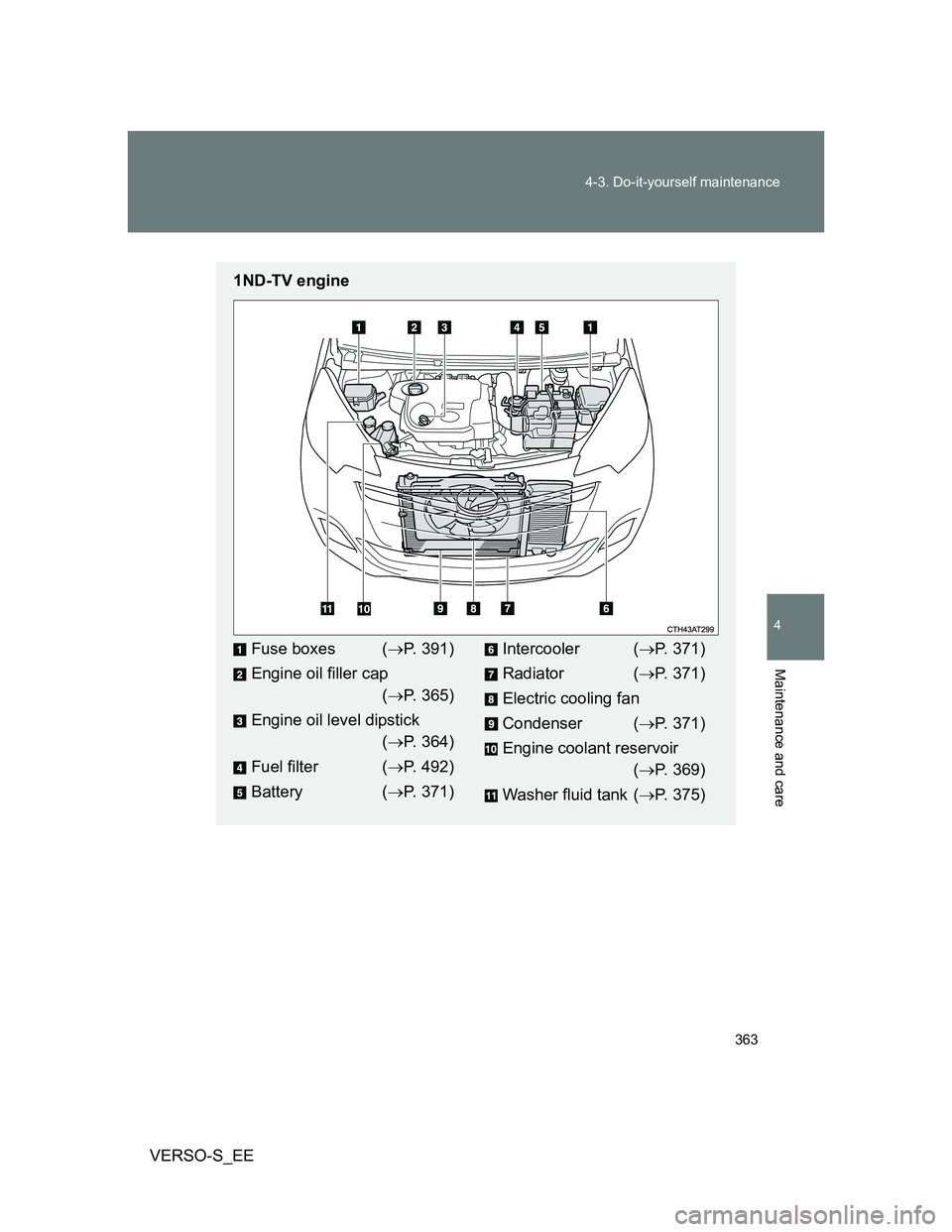
1ND-TV engine
Fuse boxes (P. 391)
Engine oil filler cap
(P. 365)
Engine oil level dipstick
(P. 364)
Fuel filter (P. 492)
Battery (P. 371)Intercooler (P. 371)
Radiator (P. 371)
Electric cooling fan
Condenser (P. 371)
Engine coolant reservoir
(P. 369)
Washer fluid tank (P. 375)
Page 371 of 540
371 4-3. Do-it-yourself maintenance
4
Maintenance and care
VERSO-S_EE
Radiator, condenser and intercooler
Check the radiator, condenser and intercooler and clear away any
foreign objects.
If any of the above parts are extremely dirty or you are not sure of
their condition, have your vehicle inspected by any authorized Toyota
dealer or repairer, or another duly qualified and equipped profes-
sional.
Battery
Check the battery as follows.
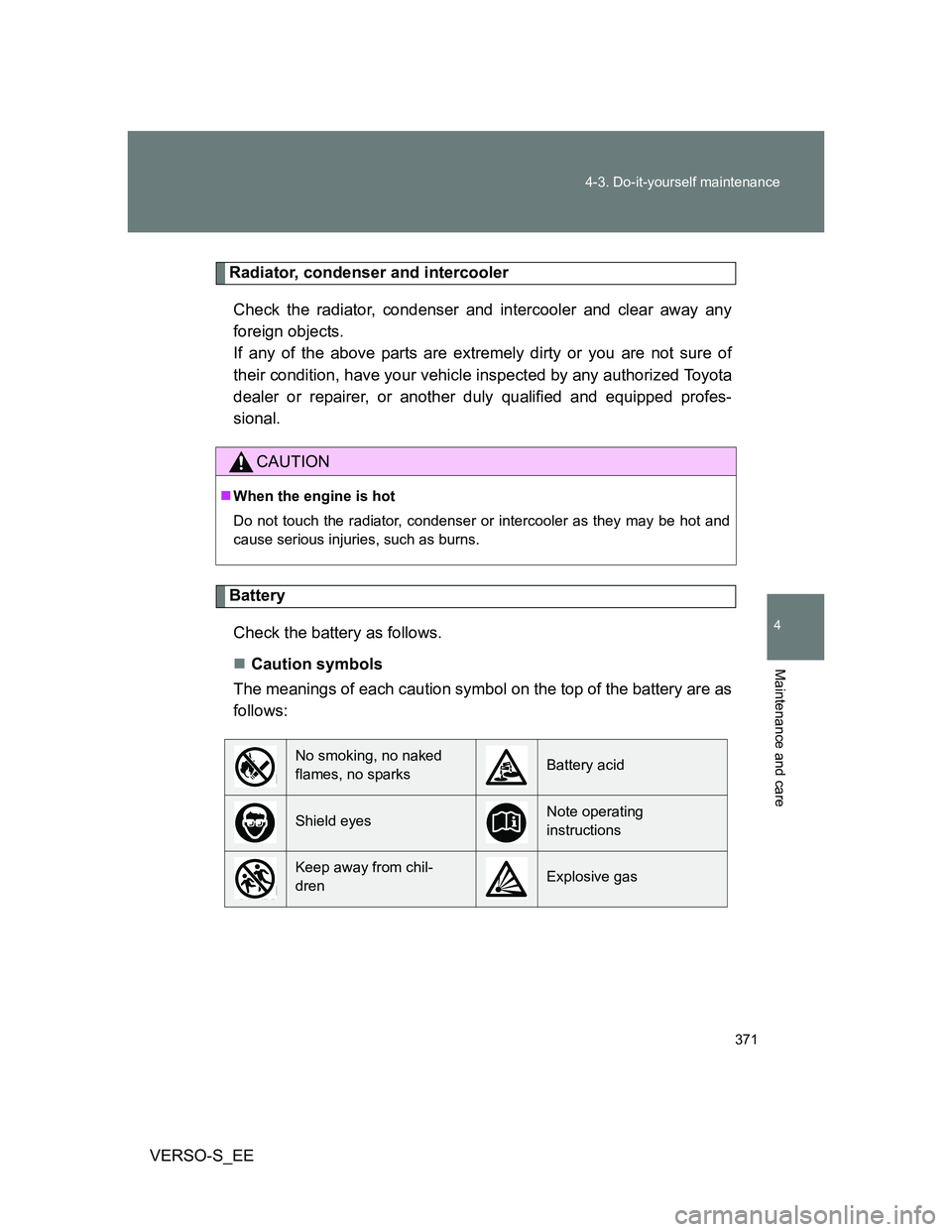
Caution symbols
The meanings of each caution symbol on the top of the battery are as
follows:
CAUTION
When the engine is hot
Do not touch the radiator, condenser or intercooler as they may be hot and
cause serious injuries, such as burns.
No smoking, no naked
flames, no sparksBattery acid
Shield eyesNote operating
instructions
Keep away from chil-
drenExplosive gas
Page 372 of 540
372 4-3. Do-it-yourself maintenance
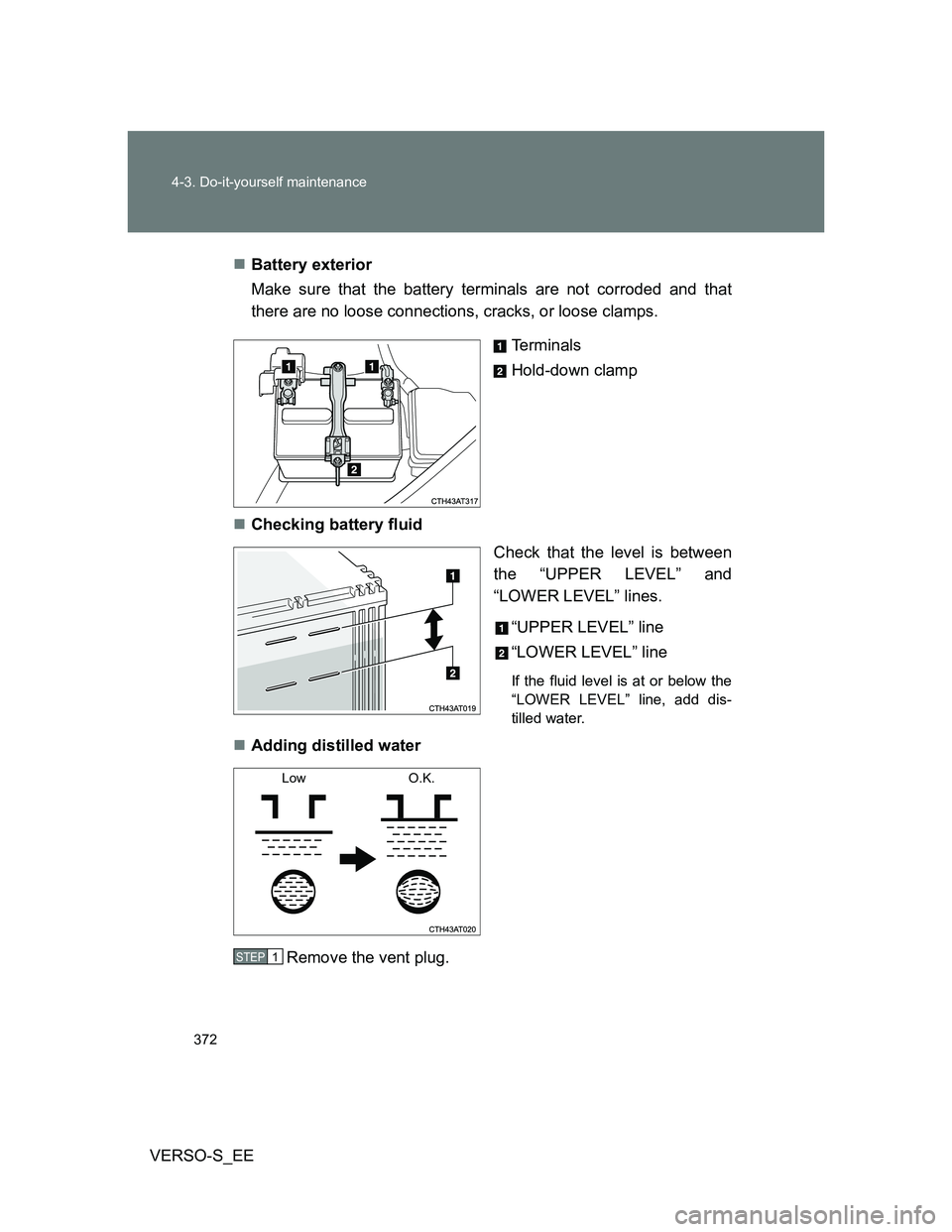
VERSO-S_EEBattery exterior
Make sure that the battery terminals are not corroded and that
there are no loose connections, cracks, or loose clamps.
Terminals
Hold-down clamp
Checking battery fluid
Check that the level is between
the “UPPER LEVEL” and
“LOWER LEVEL” lines.
“UPPER LEVEL” line
“LOWER LEVEL” line
If the fluid level is at or below the
“LOWER LEVEL” line, add dis-
tilled water.
Adding distilled water
Remove the vent plug.
Low O.K.
STEP1
Page 373 of 540
373 4-3. Do-it-yourself maintenance
4
Maintenance and care
VERSO-S_EEAdd distilled water.
If the “UPPER LEVEL” line cannot be seen, check the fluid level by
looking directly at the cell.
Put the vent plug back on and close it securely.
Before recharging
When recharging, the battery produces hydrogen gas which is flammable
and explosive. Therefore, observe the following before recharging:
If recharging with the battery installed on the vehicle, be sure to discon-
nect the ground cable.
Make sure the power switch on the charger is off when connecting and
disconnecting the charger cables to the battery.
After recharging/reconnecting the battery (vehicles with a smart entry
& start system)
Unlocking the doors using the smart entry & start system may not be
possible immediately after reconnecting the battery. If this happens, use
the wireless remote control or the mechanical key to lock/unlock the
doors.
Start the engine with the “ENGINE START STOP” switch in ACCES-
SORY mode. The engine may not start with the “ENGINE START STOP”
switch turned OFF. However, the engine will operate normally from the
second attempt.
The “ENGINE START STOP” switch mode is recorded by the vehicle. If
the battery is reconnected, the vehicle will return the “ENGINE START
STOP” switch mode to the status it was in before the battery was discon-
nected. Make sure to turn off the engine before disconnect the battery.
Take extra care when connecting the battery if the “ENGINE START
STOP” switch mode prior to discharge is unknown.
If the engine will not start even after multiple attempts, contact any autho-
rized Toyota dealer or repairer, or another duly qualified and equipped pro-
fessional.
STEP2
STEP3
Page 374 of 540
374 4-3. Do-it-yourself maintenance
VERSO-S_EE
CAUTION
Chemicals in the battery
Batteries contain poisonous and corrosive sulfuric acid and may produce
hydrogen gas which is flammable and explosive. To reduce the risk of death
or serious injury, take the following precautions while working on or near the
battery:
Do not cause sparks by touching the battery terminals with tools.
Do not smoke or light a match near the battery.
Avoid contact with eyes, skin and clothes.
Never inhale or swallow electrolyte.
Wear protective safety glasses when working near the battery.
Keep children away from the battery.
Where to safely charge the battery
Always charge the battery in an open area. Do not charge the battery in a
garage or closed room where there is insufficient ventilation.
Emergency measures regarding electrolyte
If electrolyte gets in your eyes
Flush your eyes with clean water for at least 15 minutes and get immedi-
ate medical attention. If possible, continue to apply water with a sponge or
cloth while traveling to the nearest medical facility.
If electrolyte gets on your skin
Wash the affected area thoroughly. If you feel pain or burning, get medical
attention immediately.
If electrolyte gets on your clothes
It can soak through clothing on to your skin. Immediately take off the cloth-
ing and follow the procedure above if necessary.
If you accidentally swallow electrolyte
Drink a large quantity of water or milk. Follow with milk of magnesia,
beaten raw egg or vegetable oil. Get emergency medical attention immedi-
ately.