wheel TOYOTA VERSO S 2012 Repair Manual
[x] Cancel search | Manufacturer: TOYOTA, Model Year: 2012, Model line: VERSO S, Model: TOYOTA VERSO S 2012Pages: 540, PDF Size: 17.43 MB
Page 379 of 540
379 4-3. Do-it-yourself maintenance
4
Maintenance and care
VERSO-S_EE
NOTICE
Driving on rough roads
Take particular care when driving on roads with loose surfaces or potholes.
These conditions may cause losses in tire inflation pressure, reducing the
cushioning ability of the tires. In addition, driving on rough roads may cause
damage to the tires themselves, as well as the vehicle’s wheels and body.
If tire inflation pressure of each tire becomes low while driving
Do not continue driving, or your tires and/or wheels may be ruined.
Page 381 of 540
381 4-3. Do-it-yourself maintenance
4
Maintenance and care
VERSO-S_EE
CAUTION
Proper inflation is critical to save tire performance
Keep your tires properly inflated. Otherwise, the following conditions may
occur and result in an accident causing death or serious injury:
Excessive wear
Uneven wear
Poor handling
Possibility of blowouts resulting from overheated tires
Poor sealing of the tire bead
Wheel deformation and/or tire separation
A greater possibility of tire damage from road hazards
NOTICE
When inspecting and adjusting tire inflation pressure
Be sure to put the tire valve caps back on.
Without the valve caps, dirt or moisture could get into the valve and cause
air leakage, which could result in an accident. If the caps are lost, replace
them as soon as possible.
Page 382 of 540
382
4-3. Do-it-yourself maintenance
VERSO-S_EE
Wheels
If a wheel is bent, cracked or heavily corroded, it should be replaced.
Otherwise, the tire may separate from the wheel or cause a loss of
handling control.
Wheel selection
When replacing wheels, care should be taken to ensure that
they are equivalent to those removed in load capacity, diameter,
rim width and inset*.
Replacement wheels are available at any authorized Toyota
dealer or repairer, or another duly qualified and equipped profes-
sional.
*: Conventionally referred to as “offset”.
Toyota does not recommend using the following:
Wheels of different sizes or types
Used wheels
Bent wheels that have been straightened
Aluminum wheel precautions (if equipped)
Use only Toyota wheel nuts and wrenches designed for use
with your aluminum wheels.
When rotating, repairing or changing your tires, check that the
wheel nuts are still tight after driving 1600 km (1000 miles).
Be careful not to damage the aluminum wheels when using
tire chains.
Use only Toyota genuine balance weights or equivalent and a
plastic or rubber hammer when balancing your wheels.
Page 383 of 540
383 4-3. Do-it-yourself maintenance
4
Maintenance and care
VERSO-S_EE
CAUTION
When replacing wheels
Do not use wheels that are a different size from those recommended in the
Owner’s Manual, as this may result in a loss of handling control.
Never use an inner tube in a leaking wheel which is designed for a tube-
less tire. Doing so may result in an accident, causing death or serious
injury.
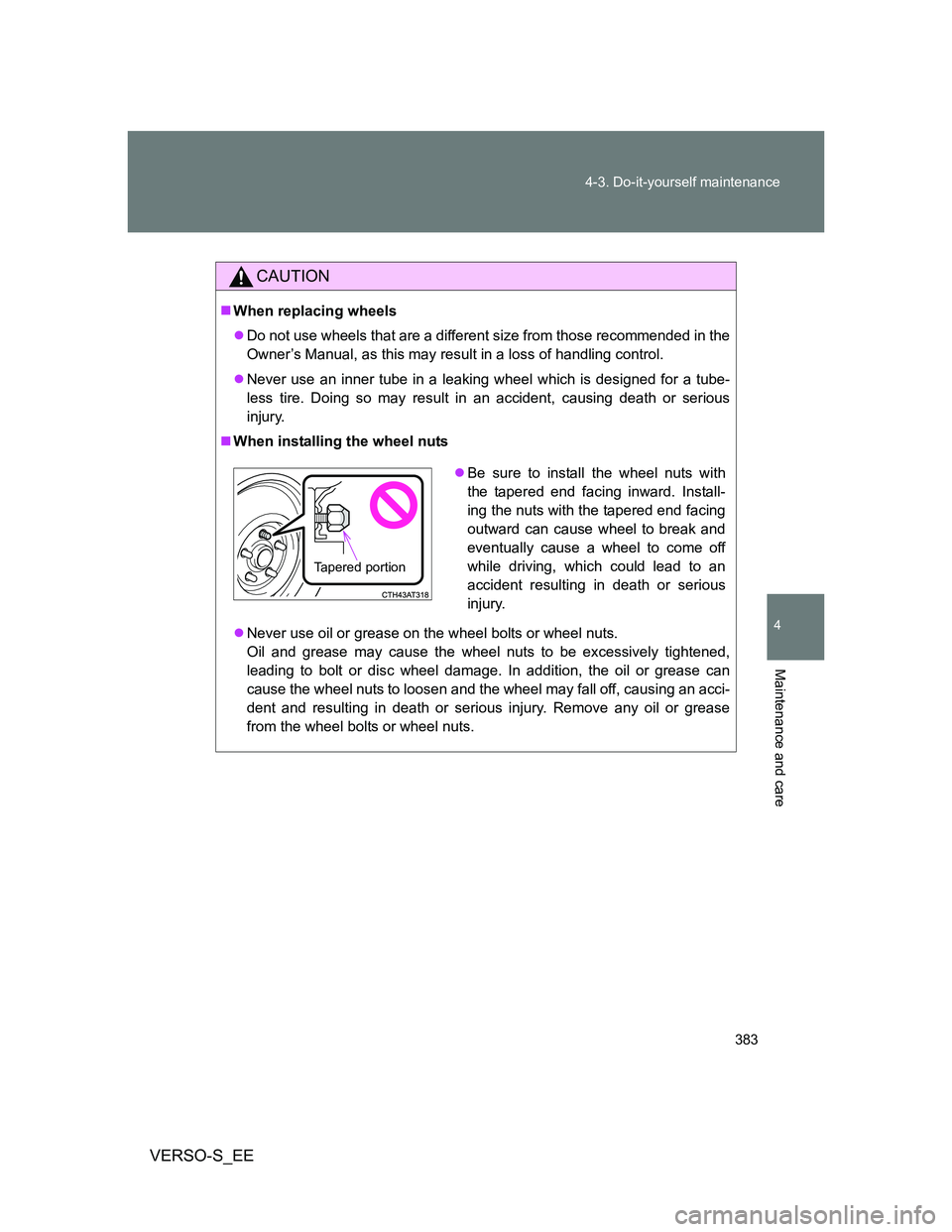
When installing the wheel nuts
Never use oil or grease on the wheel bolts or wheel nuts.
Oil and grease may cause the wheel nuts to be excessively tightened,
leading to bolt or disc wheel damage. In addition, the oil or grease can
cause the wheel nuts to loosen and the wheel may fall off, causing an acci-
dent and resulting in death or serious injury. Remove any oil or grease
from the wheel bolts or wheel nuts.
Be sure to install the wheel nuts with
the tapered end facing inward. Install-
ing the nuts with the tapered end facing
outward can cause wheel to break and
eventually cause a wheel to come off
while driving, which could lead to an
accident resulting in death or serious
injury.
Tapered portion
Page 420 of 540
420 5-1. Essential information
VERSO-S_EE
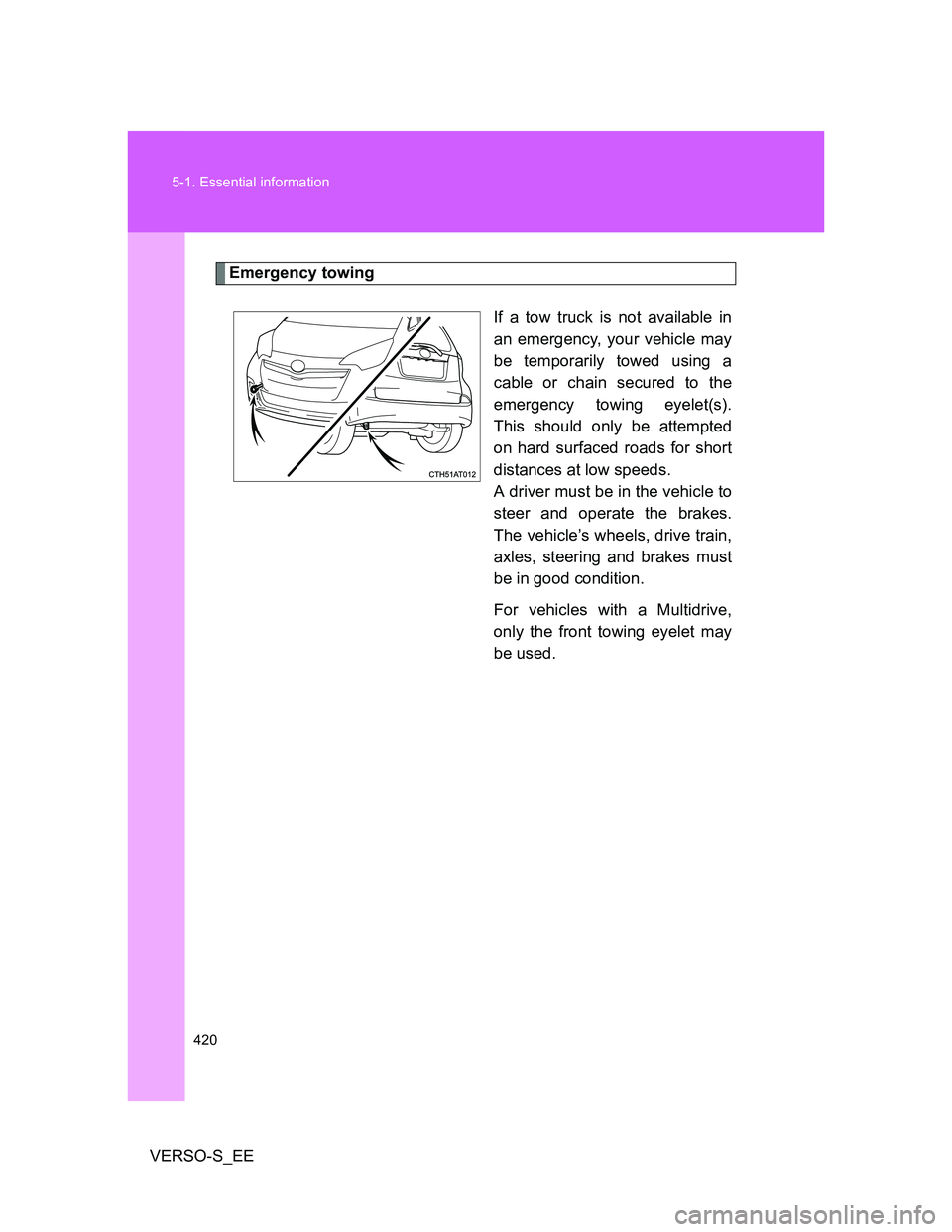
Emergency towing
If a tow truck is not available in
an emergency, your vehicle may
be temporarily towed using a
cable or chain secured to the
emergency towing eyelet(s).
This should only be attempted
on hard surfaced roads for short
distances at low speeds.
A driver must be in the vehicle to
steer and operate the brakes.
The vehicle’s wheels, drive train,
axles, steering and brakes must
be in good condition.
For vehicles with a Multidrive,
only the front towing eyelet may
be used.
Page 421 of 540
5
421 5-1. Essential information
When trouble arises
VERSO-S_EE
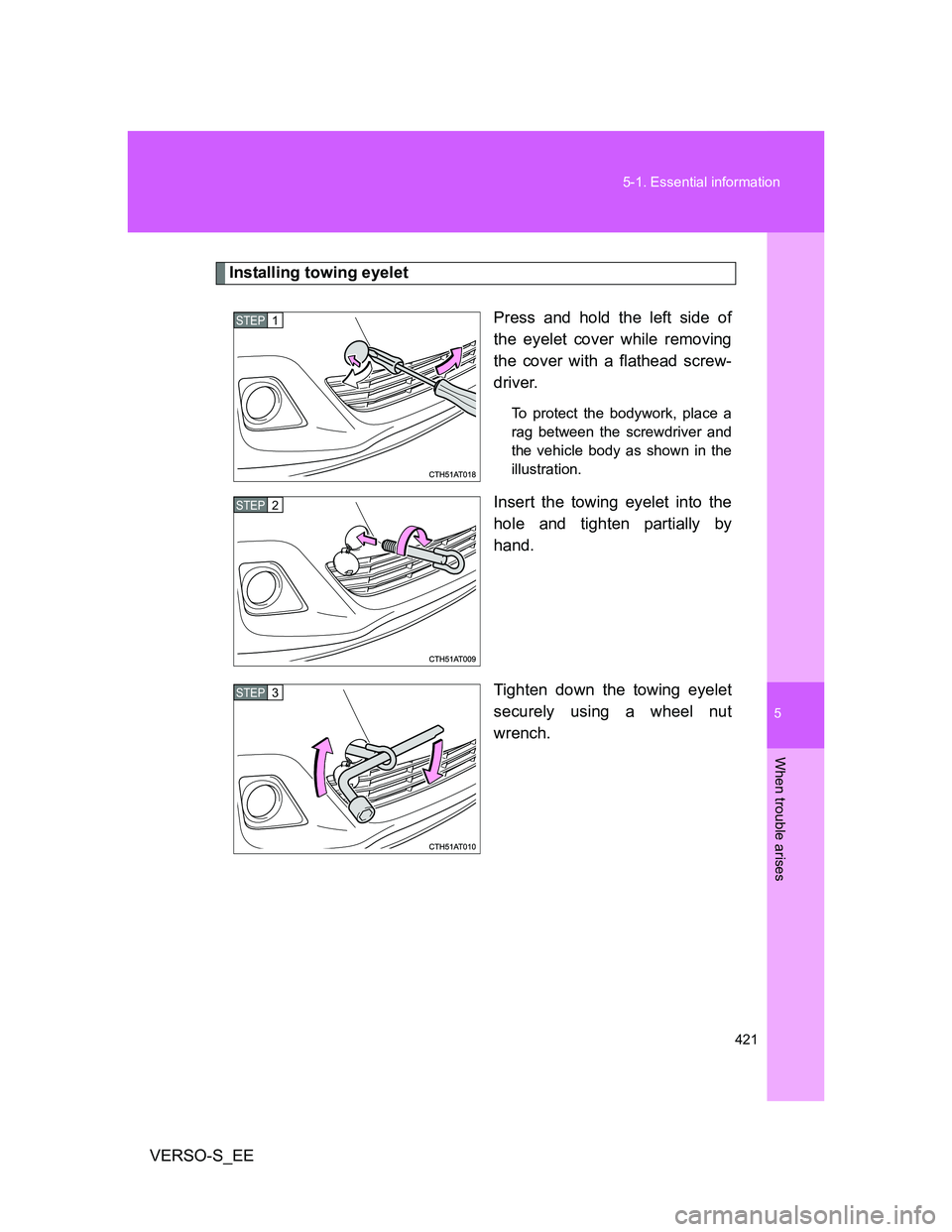
Installing towing eyelet
Press and hold the left side of
the eyelet cover while removing
the cover with a flathead screw-
driver.
To protect the bodywork, place a
rag between the screwdriver and
the vehicle body as shown in the
illustration.
Insert the towing eyelet into the
hole and tighten partially by
hand.
Tighten down the towing eyelet
securely using a wheel nut
wrench.
STEP1
STEP2
STEP3
Page 422 of 540
422 5-1. Essential information
VERSO-S_EE
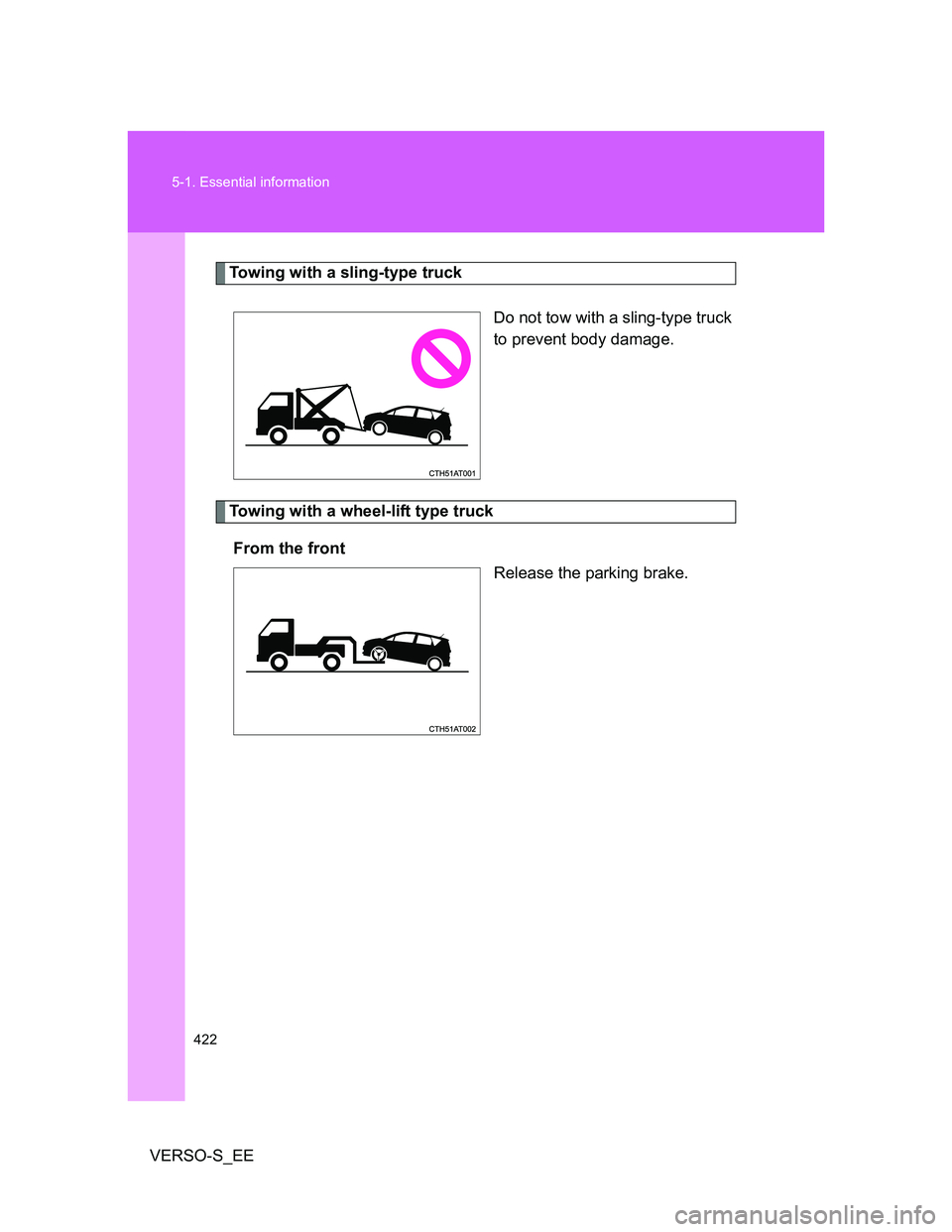
Towing with a sling-type truck
Do not tow with a sling-type truck
to prevent body damage.
Towing with a wheel-lift type truck
From the front
Release the parking brake.
Page 423 of 540
5
423 5-1. Essential information
When trouble arises
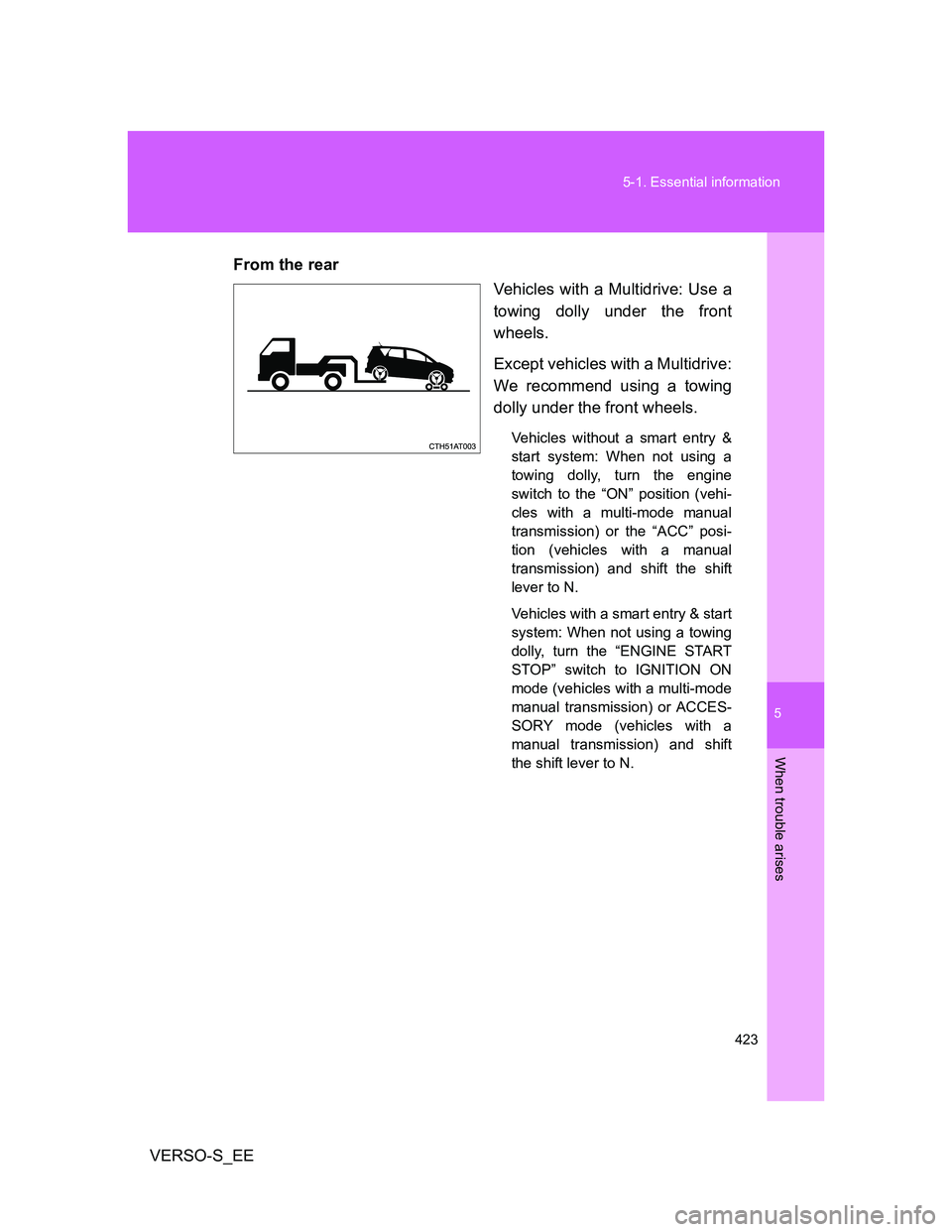
VERSO-S_EEFrom the rear
Vehicles with a Multidrive: Use a
towing dolly under the front
wheels.
Except vehicles with a Multidrive:
We recommend using a towing
dolly under the front wheels.
Vehicles without a smart entry &
start system: When not using a
towing dolly, turn the engine
switch to the “ON” position (vehi-
cles with a multi-mode manual
transmission) or the “ACC” posi-
tion (vehicles with a manual
transmission) and shift the shift
lever to N.
Vehicles with a smart entry & start
system: When not using a towing
dolly, turn the “ENGINE START
STOP” switch to IGNITION ON
mode (vehicles with a multi-mode
manual transmission) or ACCES-
SORY mode (vehicles with a
manual transmission) and shift
the shift lever to N.
Page 425 of 540
5
425 5-1. Essential information
When trouble arises
VERSO-S_EE
CAUTION
Caution while towing
Use extreme caution when towing the vehicle.
Avoid sudden starts or erratic driving maneuvers which place excessive
stress on the emergency towing eyelets and the cables or chains. Always
be cautious of the surroundings and other vehicles while towing.
Vehicles with a smart entry & start system: Do not turn the “ENGINE
START STOP” switch off.
Doing so will lock the steering wheel and prevent operation, possibly caus-
ing an accident and resulting in death or serious injury.
If the engine is not running, the power assist for the brakes and steering
will not function, making steering and braking more difficult.
Installing towing eyelet to the vehicle
Make sure that towing eyelet is installed securely.
If not securely installed, towing eyelet may come loose during towing. This
may lead to accidents that cause serious injury or even death.
Page 426 of 540
426 5-1. Essential information
VERSO-S_EE
NOTICE
To prevent causing serious damage to the transmission when towing
using a wheel-lift type truck (vehicles with a Multidrive)
Never tow this vehicle from the rear with the front wheels on the ground.
To prevent causing serious damage to the Stop & Start system when
towing (vehicles with Stop & Start system)
Never tow this vehicle with four wheels on the ground. Use a flatbed truck, or
lift up front or rear of the vehicle by using a wheel-lift type truck.
To prevent damage to the vehicle when towing using a wheel-lift type
truck (vehicles with a Multidrive)
When raising the vehicle, ensure adequate ground clearance for towing at
the opposite end of the raised vehicle. Without adequate clearance, the
vehicle could be damaged while being towed.
To prevent damage to the vehicle when towing using a wheel-lift type
truck (except vehicles with a Multidrive)
Vehicles without a smart entry & start system: Do not tow the vehicle from
the rear when the engine switch is in the “LOCK” position or the key is
removed. The steering lock mechanism is not strong enough to hold the
front wheels straight.
Vehicles with a smart entry & start system: Do not tow the vehicle from the
rear when the “ENGINE START STOP” switch is off. The steering lock
mechanism is not strong enough to hold the front wheels straight.
When raising the vehicle, ensure adequate ground clearance for towing at
the opposite end of the raised vehicle. Without adequate clearance, the
vehicle could be damaged while being towed.
To prevent body damage when towing with a sling-type truck
Do not tow with a sling-type truck, either from the front or rear.
To prevent causing serious damage to the transmission in emergency
towing
Vehicles with a Multidrive, never tow a vehicle from the rear with four wheels
on the ground. This may cause serious damage to the transmission.