stop start TOYOTA VERSO S 2014 Owners Manual
[x] Cancel search | Manufacturer: TOYOTA, Model Year: 2014, Model line: VERSO S, Model: TOYOTA VERSO S 2014Pages: 560, PDF Size: 16.94 MB
Page 495 of 560
5
495 5-2. Steps to take in an emergency
When trouble arises
VERSO-S_EEVehicles with a manual transmission
Ensure that the shift lever is in N and depress the clutch
pedal.
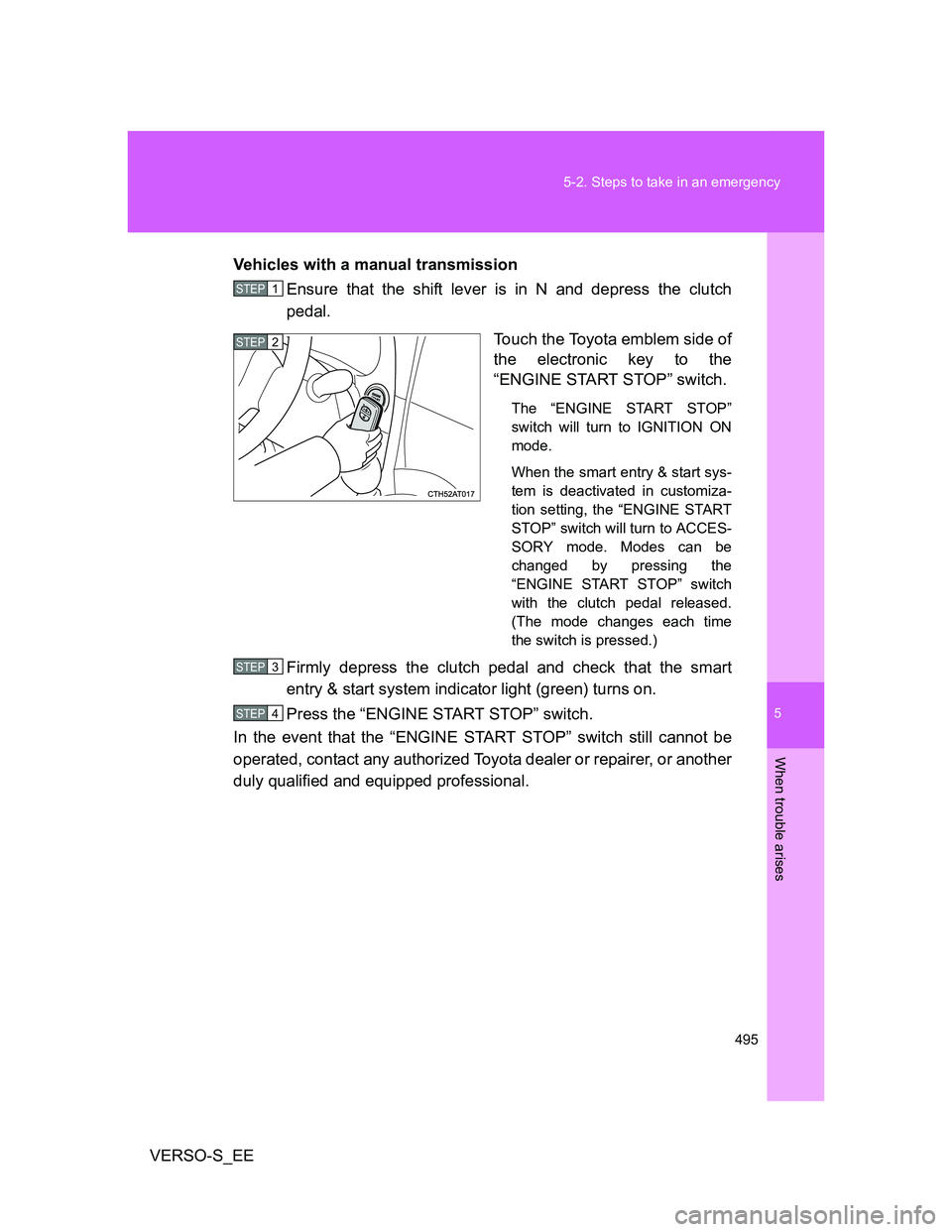
Touch the Toyota emblem side of
the electronic key to the
“ENGINE START STOP” switch.
The “ENGINE START STOP”
switch will turn to IGNITION ON
mode.
When the smart entry & start sys-
tem is deactivated in customiza-
tion setting, the “ENGINE START
STOP” switch will turn to ACCES-
SORY mode. Modes can be
changed by pressing the
“ENGINE START STOP” switch
with the clutch pedal released.
(The mode changes each time
the switch is pressed.)
Firmly depress the clutch pedal and check that the smart
entry & start system indicator light (green) turns on.
Press the “ENGINE START STOP” switch.
In the event that the “ENGINE START STOP” switch still cannot be
operated, contact any authorized Toyota dealer or repairer, or another
duly qualified and equipped professional.
STEP1
STEP2
STEP3
STEP4
Page 496 of 560
496 5-2. Steps to take in an emergency
VERSO-S_EE
Stopping the engine
Vehicles with a Multidrive: Shift the shift lever to P and press the “ENGINE
START STOP” switch as you normally do when stopping the engine.
Except vehicles with a Multidrive: Shift the shift lever to N and press the
“ENGINE START STOP” switch as you normally do when stopping the
engine.
Replacing the key battery
As the above procedure is a temporary measure, it is recommended that the
electronic key battery be replaced immediately when the battery is depleted.
(P. 402)
Alarm (if equipped)
Using the mechanical key to lock the doors will not set the alarm system.
If a door is unlocked using the mechanical key when the alarm system is set,
the alarm may be triggered. (P. 119)
If the doors cannot be locked or unlocked by the smart entry & start
system
Lock and unlock the doors by the mechanical key or wireless remote control.
When the electronic key does not work properly
Make sure that the smart entry & start system has not been deactivated in
the customization setting. If it is off, turn the function on.
(Customizable features P. 536)
Changing “ENGINE START STOP” switch modes (if the smart entry &
start system has been deactivated in a customized setting)
Release the brake pedal (except for manual transmission) or clutch pedal
(for manual transmission) and press the “ENGINE START STOP” switch in
above.
The engine does not start and modes will be changed each time the switch
is pressed. (P. 180)
STEP3
Page 499 of 560
5
499 5-2. Steps to take in an emergency
When trouble arises
VERSO-S_EE
Diesel engine
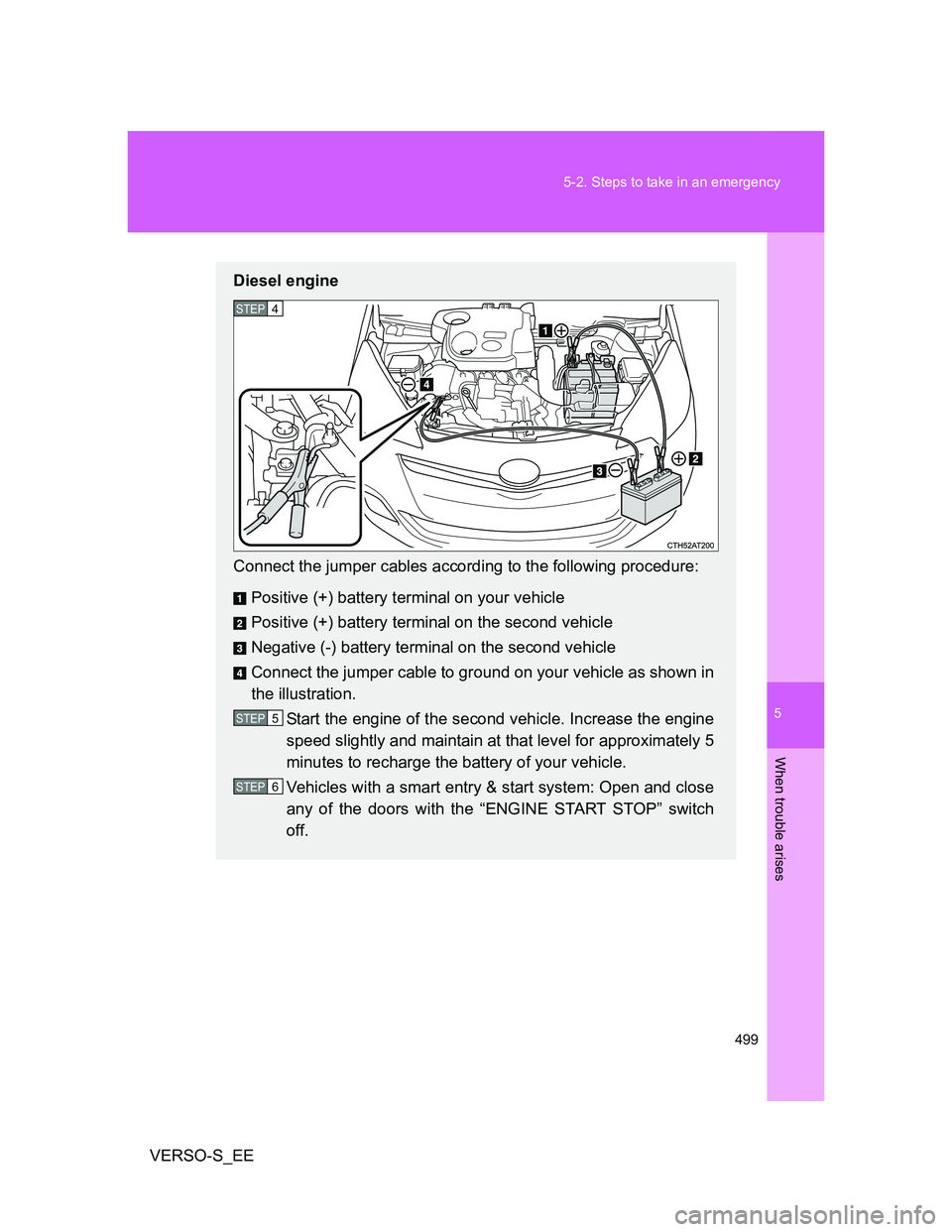
Connect the jumper cables according to the following procedure:
Positive (+) battery terminal on your vehicle
Positive (+) battery terminal on the second vehicle
Negative (-) battery terminal on the second vehicle
Connect the jumper cable to ground on your vehicle as shown in
the illustration.
Start the engine of the second vehicle. Increase the engine
speed slightly and maintain at that level for approximately 5
minutes to recharge the battery of your vehicle.
Vehicles with a smart entry & start system: Open and close
any of the doors with the “ENGINE START STOP” switch
off.
STEP4
STEP5
STEP6
Page 500 of 560
500 5-2. Steps to take in an emergency
VERSO-S_EE
Vehicles without a smart entry & start system: Maintain the
engine speed of the second vehicle and turn the engine
switch to the “ON” position, then start the vehicle's engine.
Vehicles with a smart entry & start system: Maintain the
engine speed of the second vehicle and turn the “ENGINE
START STOP” switch to IGNITION ON mode, then start the
vehicle's engine.
Once the vehicle’s engine has started, remove the jumper
cables in the exact reverse order in which they were con-
nected.
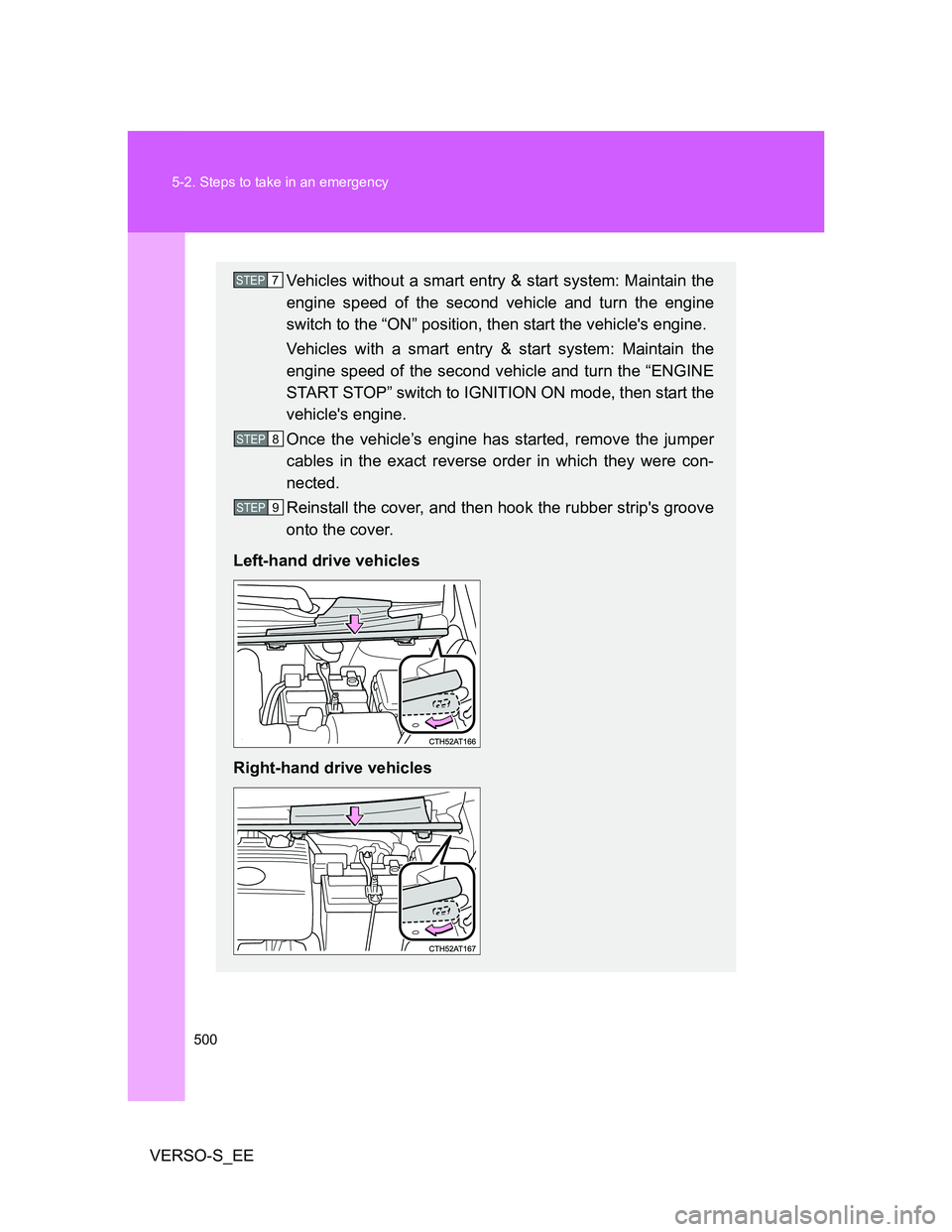
Reinstall the cover, and then hook the rubber strip's groove
onto the cover.
Left-hand drive vehicles
Right-hand drive vehiclesSTEP7
STEP8
STEP9
Page 502 of 560
502 5-2. Steps to take in an emergency
VERSO-S_EE
Precautions when the battery is discharged (vehicles with a smart
entry & start system)
In some cases, it may not be possible to unlock the doors using the smart
entry & start system when the battery is discharged. Use the wireless
remote control or the mechanical key to lock or unlock the doors.
The engine may not start on the first attempt after the battery has
recharged but will start normally after the second attempt. This is not a
malfunction.
The “ENGINE START STOP” switch mode is memorized by the vehicle.
When the battery is reconnected, the system will return to the mode it
was in before the battery was discharged. Before disconnecting the bat-
tery, turn the “ENGINE START STOP” switch off.
If you are unsure what mode the “ENGINE START STOP” switch was in
before the battery discharged, be especially careful when reconnecting
the battery.
When the battery is removed or discharged (vehicle with an alarm)
Make sure that the key is not inside the vehicle when recharging or replacing
the battery. The key may be locked in the vehicle if the alarm is activated.
(P. 120)
Page 508 of 560
508 5-2. Steps to take in an emergency
VERSO-S_EEStart the engine and turn the air conditioning system on to
check that the radiator cooling fan operates and to check for
coolant leaks from the radiator or hoses.
The fan operates when the air conditioning system is turned on
immediately after a cold start. Confirm that the fan is operating by
checking the fan sound and air flow. If it is difficult to check these,
turn the air conditioning system on and off repeatedly.
(The fan may not operate in freezing temperatures.)
If the fan is not operating:
Stop the engine immediately and contact any authorized
Toyota dealer or repairer, or another duly qualified and
equipped professional.
If the fan is operating:
Have the vehicle inspected at the nearest authorized
Toyota dealer or repairer, or another duly qualified and
equipped professional.
CAUTION
To prevent an accident or injury when inspecting under the hood of
your vehicle
If steam is seen coming from under the hood, do not open the hood until
the steam has subsided. The engine compartment may be very hot, caus-
ing serious injuries such as burns.
Keep hands and clothing (especially a tie, a scarf or a muffler) away from
the fans and belts. Failure to do so may cause the hands or clothing to be
caught, resulting in serious injury.
Gasoline engine
STEP6
STEP7
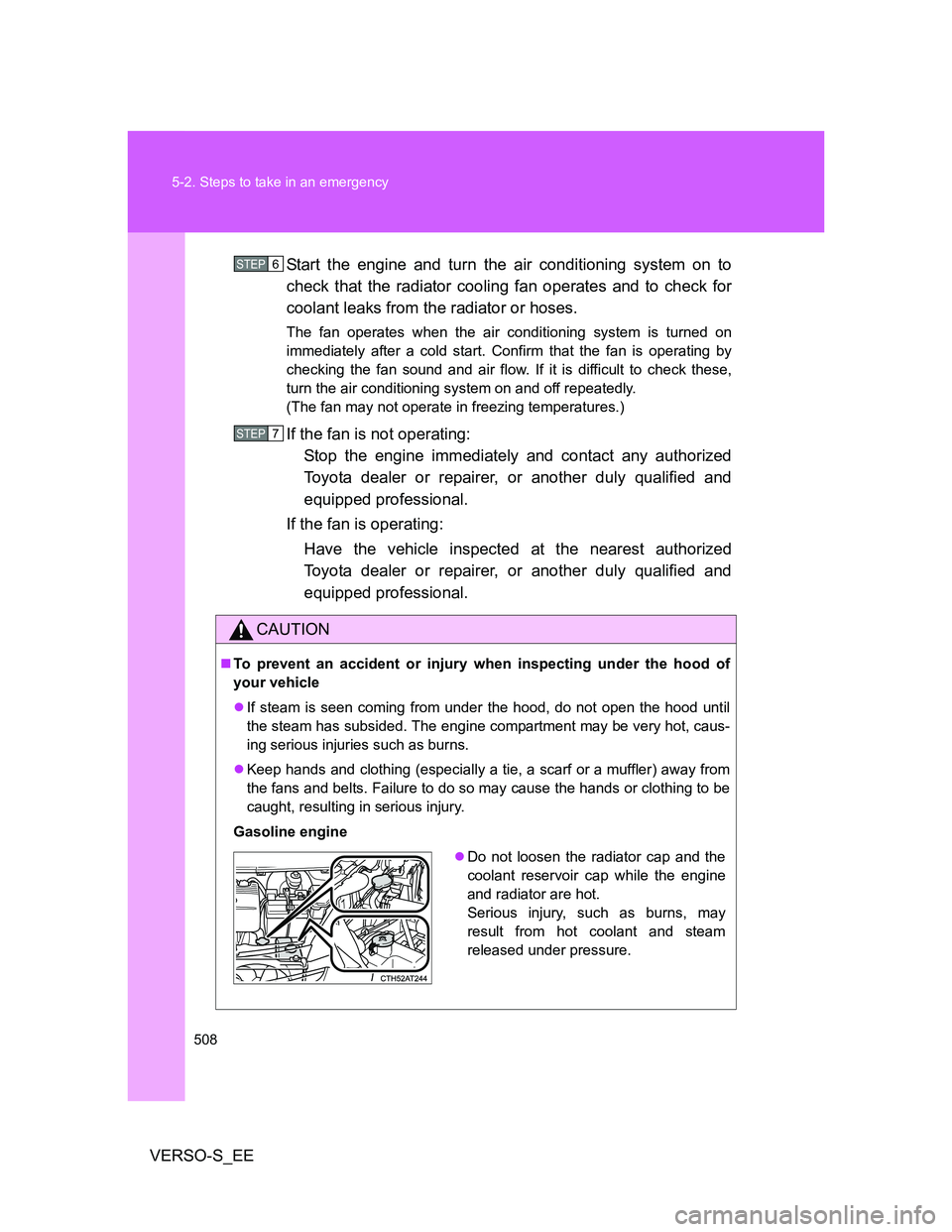
Do not loosen the radiator cap and the
coolant reservoir cap while the engine
and radiator are hot.
Serious injury, such as burns, may
result from hot coolant and steam
released under pressure.
Page 512 of 560
512
5-2. Steps to take in an emergency
VERSO-S_EE
If the vehicle becomes stuck
Carry out the following procedures if the tires spin or the vehicle
becomes stuck in mud, dirt or snow:
Vehicles with a Multidrive: Stop the engine. Set the parking
brake and shift the shift lever in P.
Except vehicles with a Multidrive: Stop the engine. Set the
parking brake and shift the shift lever in N.
Remove the mud, snow or sand from around the stuck tire.
Place wood, stones or some other material under the tires
to help provide traction.
Restart the engine.
Vehicles with a Multidrive: Shift the shift lever to the D or R
and carefully apply the accelerator to free the vehicle.
Vehicles with a multi-mode manual transmission: Shift the
shift lever to the E, M or R and carefully apply the accelera-
tor to free the vehicle.
Vehicles with a manual transmission: Shift the shift lever to
1 or R and carefully apply the accelerator to free the vehi-
cle.
Turn off TRC and VSC if these functions are hampering your
attempts to free the vehicle. (P. 250)
STEP1
STEP2
STEP3
STEP4
STEP5
Page 514 of 560
514
5-2. Steps to take in an emergency
VERSO-S_EE
If your vehicle has to be stopped in an emergency
Only in an emergency, such as if it becomes impossible to stop the
vehicle in the normal way, stop the vehicle using the following pro-
cedure:
Steadily step on the brake pedal with both feet and firmly
depress it.
Do not pump the brake pedal repeatedly as this will increase the
effort required to slow the vehicle.
Shift the shift lever to N.
If the shift lever is shifted to N
After slowing down, stop the vehicle in a safe place by the
road.
Stop the engine.
If the shift lever cannot be shifted to N
Keep depressing the brake pedal with both feet to reduce
vehicle speed as much as possible.
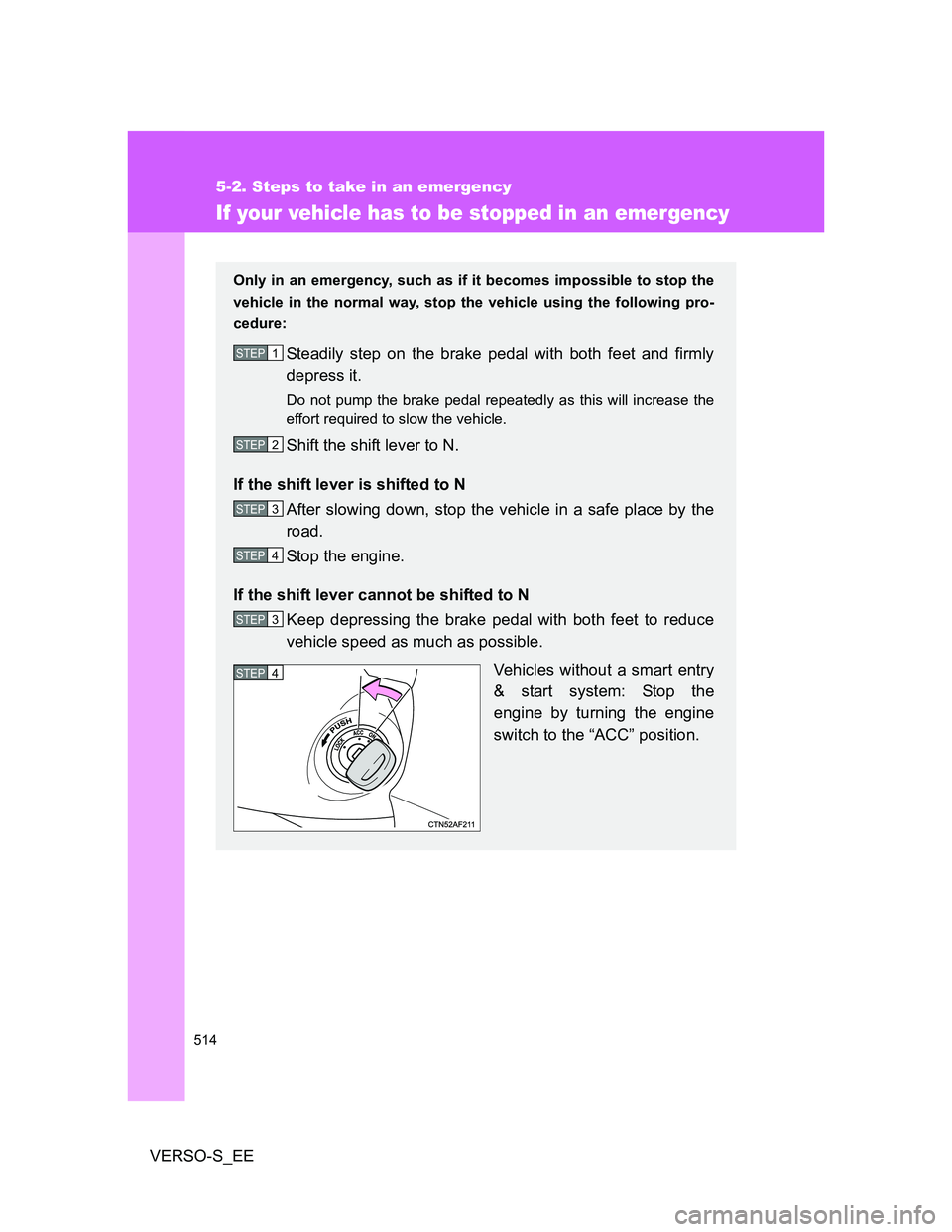
Vehicles without a smart entry
& start system: Stop the
engine by turning the engine
switch to the “ACC” position.
STEP1
STEP2
STEP3
STEP4
STEP3
STEP4
Page 515 of 560
5
515 5-2. Steps to take in an emergency
When trouble arises
VERSO-S_EE
CAUTION
If the engine has to be turned off while driving
Power assist for the brakes and steering wheel will be lost, making the
brake pedal harder to depress and the steering wheel heavier to turn.
Decelerate as much as possible before turning off the engine.
Vehicles without a smart entry & start system: Never attempt to remove
the key, as doing so will lock the steering wheel.
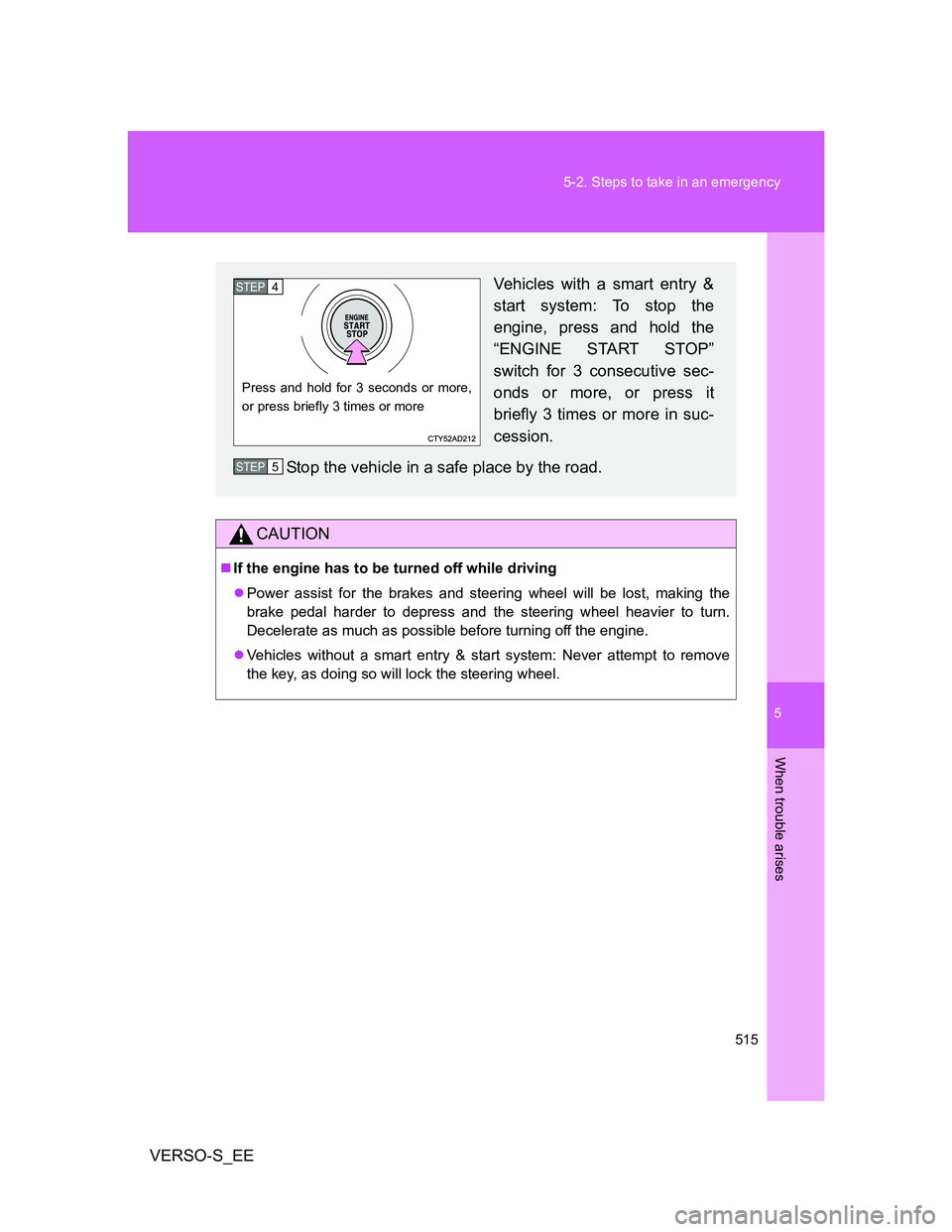
Vehicles with a smart entry &
start system: To stop the
engine, press and hold the
“ENGINE START STOP”
switch for 3 consecutive sec-
onds or more, or press it
briefly 3 times or more in suc-
cession.
Stop the vehicle in a safe place by the road.
Press and hold for 3 seconds or more,
or press briefly 3 times or more
STEP4
STEP5
Page 519 of 560
519 6-1. Specifications
6
Vehicle specifications
VERSO-S_EE
*1: Unladen vehicles
*2: Vehicles without Stop & Start system
*3: Vehicles with Stop & Start system
*4: Except vehicles with leather wrapped steering wheel
*5: Vehicles with leather wrapped steering wheel
Vehicle identification
Vehicle identification number
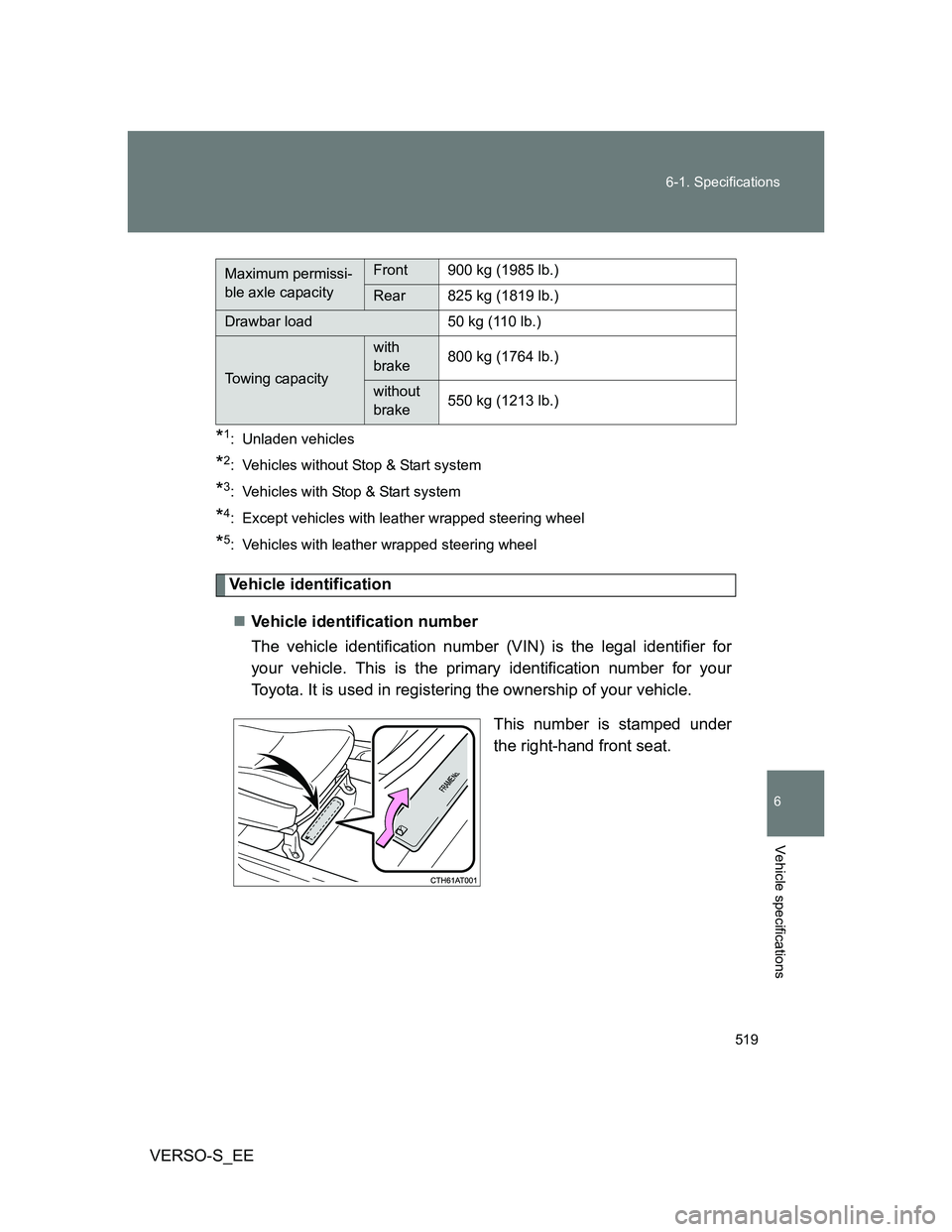
The vehicle identification number (VIN) is the legal identifier for
your vehicle. This is the primary identification number for your
Toyota. It is used in registering the ownership of your vehicle.
This number is stamped under
the right-hand front seat.
Maximum permissi-
ble axle capacityFront 900 kg (1985 lb.)
Rear 825 kg (1819 lb.)
Drawbar load 50 kg (110 lb.)
Towing capacity
with
brake800 kg (1764 lb.)
without
brake550 kg (1213 lb.)