tow TOYOTA VERSO S 2014 User Guide
[x] Cancel search | Manufacturer: TOYOTA, Model Year: 2014, Model line: VERSO S, Model: TOYOTA VERSO S 2014Pages: 560, PDF Size: 16.94 MB
Page 130 of 560
130 1-7. Safety information
VERSO-S_EE
CAUTION
SRS airbag precautions
Observe the following precautions regarding the SRS airbags.
Failure to do so may cause death or serious injury.
The driver and all passengers in the vehicle must wear their seat belts
properly.
The SRS airbags are supplemental devices to be used with the seat belts.
The SRS driver airbag deploys with considerable force, and can cause
death or serious injury especially if the driver is very close to the airbag.
Since the risk zone for the driver’s airbag is the first 50 - 75 mm (2 - 3 in.)
of inflation, placing yourself 250 mm (10 in.) from your driver airbag pro-
vides you with a clear margin of safety. This distance is measured from the
center of the steering wheel to your breastbone. If you sit less than 250
mm (10 in.) away now, you can change your driving position in several
ways:
• Move your seat to the rear as far as you can while still reaching the
pedals comfortably.
• Slightly recline the back of the seat. Although vehicle designs vary,
many drivers can achieve the 250 mm (10 in.) distance, even with the
driver seat all the way forward, simply by reclining the back of the seat
somewhat. If reclining the back of your seat makes it hard to see the
road, raise yourself by using a firm, non-slippery cushion, or raise the
seat if your vehicle has that feature.
• If your steering wheel is adjustable, tilt it downward. This points the air-
bag toward your chest instead of your head and neck.
The seat should be adjusted as recommended above, while still maintain-
ing control of the foot pedals, steering wheel, and your view of the instru-
ment panel controls.
Page 132 of 560
132 1-7. Safety information
VERSO-S_EE
CAUTION
SRS airbag precautions
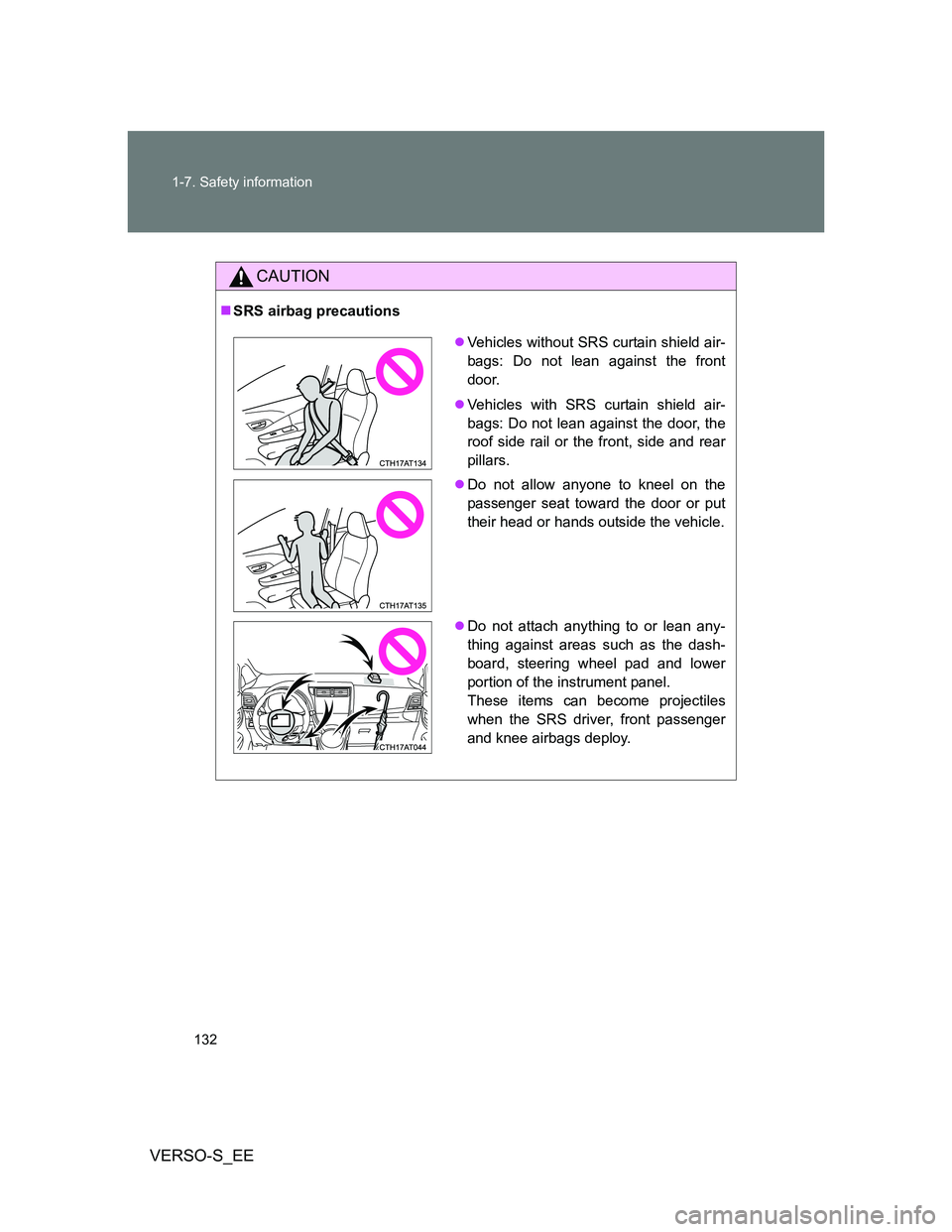
Vehicles without SRS curtain shield air-
bags: Do not lean against the front
door.
Vehicles with SRS curtain shield air-
bags: Do not lean against the door, the
roof side rail or the front, side and rear
pillars.
Do not allow anyone to kneel on the
passenger seat toward the door or put
their head or hands outside the vehicle.
Do not attach anything to or lean any-
thing against areas such as the dash-
board, steering wheel pad and lower
portion of the instrument panel.
These items can become projectiles
when the SRS driver, front passenger
and knee airbags deploy.
Page 159 of 560
2When driving
159
VERSO-S_EE
2-1. Driving procedures
Driving the vehicle ............ 160
Engine (ignition) switch
(vehicles with a smart
entry & start system)....... 176
Engine (ignition) switch
(vehicles without a smart
entry & start system)....... 186
Multidrive .......................... 190
Multi-mode Manual
Transmission .................. 196
Manual Transmission ....... 201
Turn signal lever ............... 204
Parking brake ................... 205
Horn .................................. 206
2-2. Instrument cluster
Gauges and meters .......... 207
Indicators and warning
lights ............................... 213
Multi-information display ... 2192-3. Operating the lights and
wipers
Headlight switch................ 222
Fog light switch ................. 228
Windshield wiper and
washer ............................ 230
Rear window wiper and
washer ............................ 236
2-4. Using other driving
systems
Stop & Start system .......... 238
Cruise control.................... 245
Driving assist systems ...... 249
Diesel particulate filter
system ............................ 255
2-5. Driving information
Cargo and luggage ........... 257
Winter driving tips ............. 259
Trailer towing .................... 263
Page 165 of 560
165 2-1. Driving procedures
2
When driving
VERSO-S_EE
Engine speed while driving (vehicles with a Multidrive)
In the following conditions, the engine speed may become high while driving.
This is due to automatic up-shifting control or down-shifting implementation
to meet driving conditions. It does not indicate sudden acceleration.
The vehicle is judged to be driving uphill or downhill
When the accelerator pedal is released
When the brake pedal is depressed while the SPORT mode is selected
Breaking in your new Toyota
To extend the life of the vehicle, observing the following precautions is rec-
ommended:
For the first 300 km (186 miles):
Avoid sudden stops.
For the first 800 km (500 miles):
Do not tow a trailer.
For the first 1000 km (621 miles):
• Do not drive at extremely high speeds.
• Avoid sudden acceleration.
• Do not drive continuously in low gears.
• Do not drive at a constant speed for extended periods.
Idling time before stopping the engine (diesel engine)
To prevent damage to the turbocharger, allow the engine to idle immediately
after high-speed driving or driving up a hill.
Driving conditionIdling time
Normal city driving Not necessary
High-speed driv-
ingConstant speed of approx.
80 km/h (50 mph)Approximately 20
seconds
Constant speed of approx.
100 km/h (63 mph)Approximately 1 minute
Steep hill driving or continuous driving at 100
km/h (63 mph) or more (race track driving etc.)Approximately 2
minutes
Page 223 of 560
223 2-3. Operating the lights and wipers
2
When driving
VERSO-S_EE
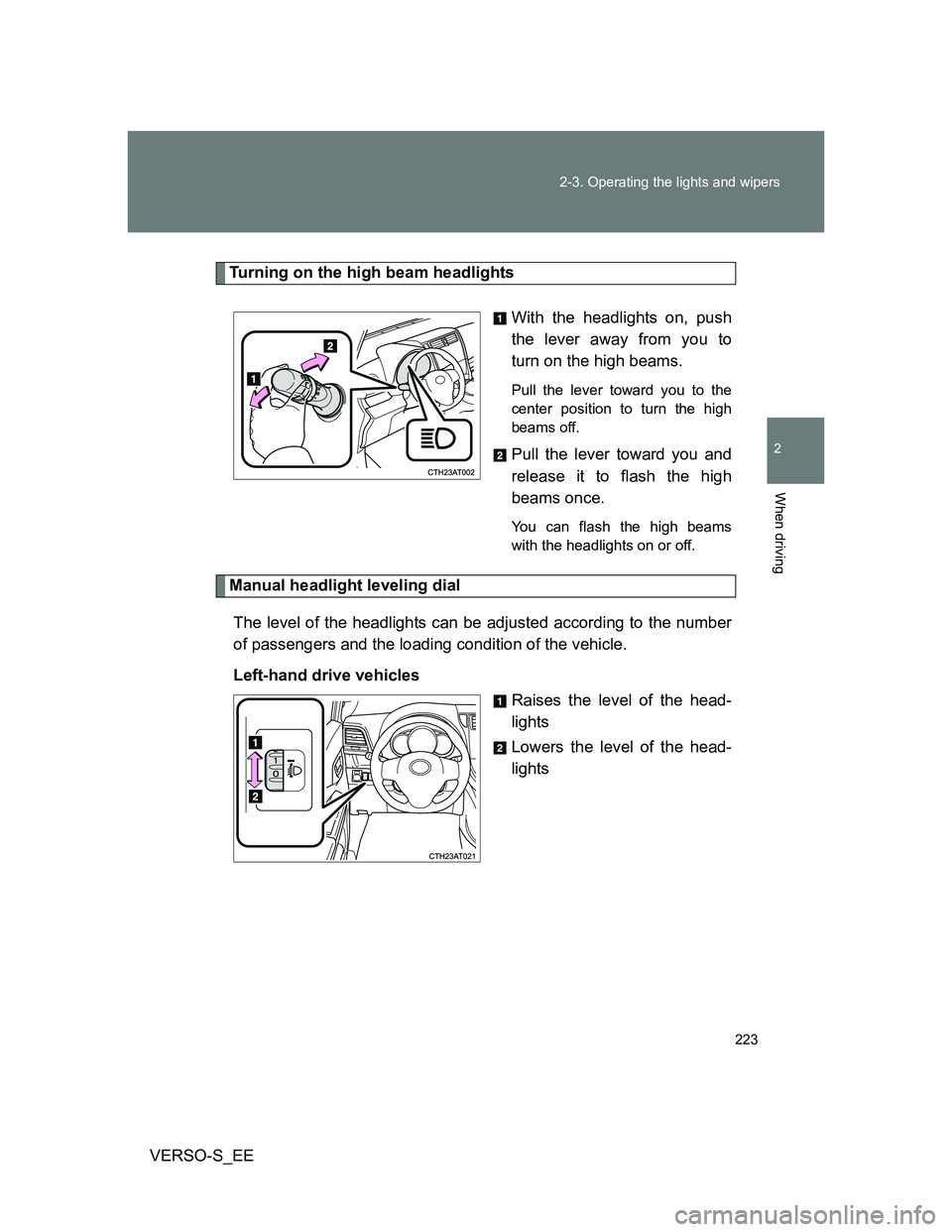
Turning on the high beam headlights
With the headlights on, push
the lever away from you to
turn on the high beams.
Pull the lever toward you to the
center position to turn the high
beams off.
Pull the lever toward you and
release it to flash the high
beams once.
You can flash the high beams
with the headlights on or off.
Manual headlight leveling dial
The level of the headlights can be adjusted according to the number
of passengers and the loading condition of the vehicle.
Left-hand drive vehicles
Raises the level of the head-
lights
Lowers the level of the head-
lights
Page 227 of 560
227 2-3. Operating the lights and wipers
2
When driving
VERSO-S_EE
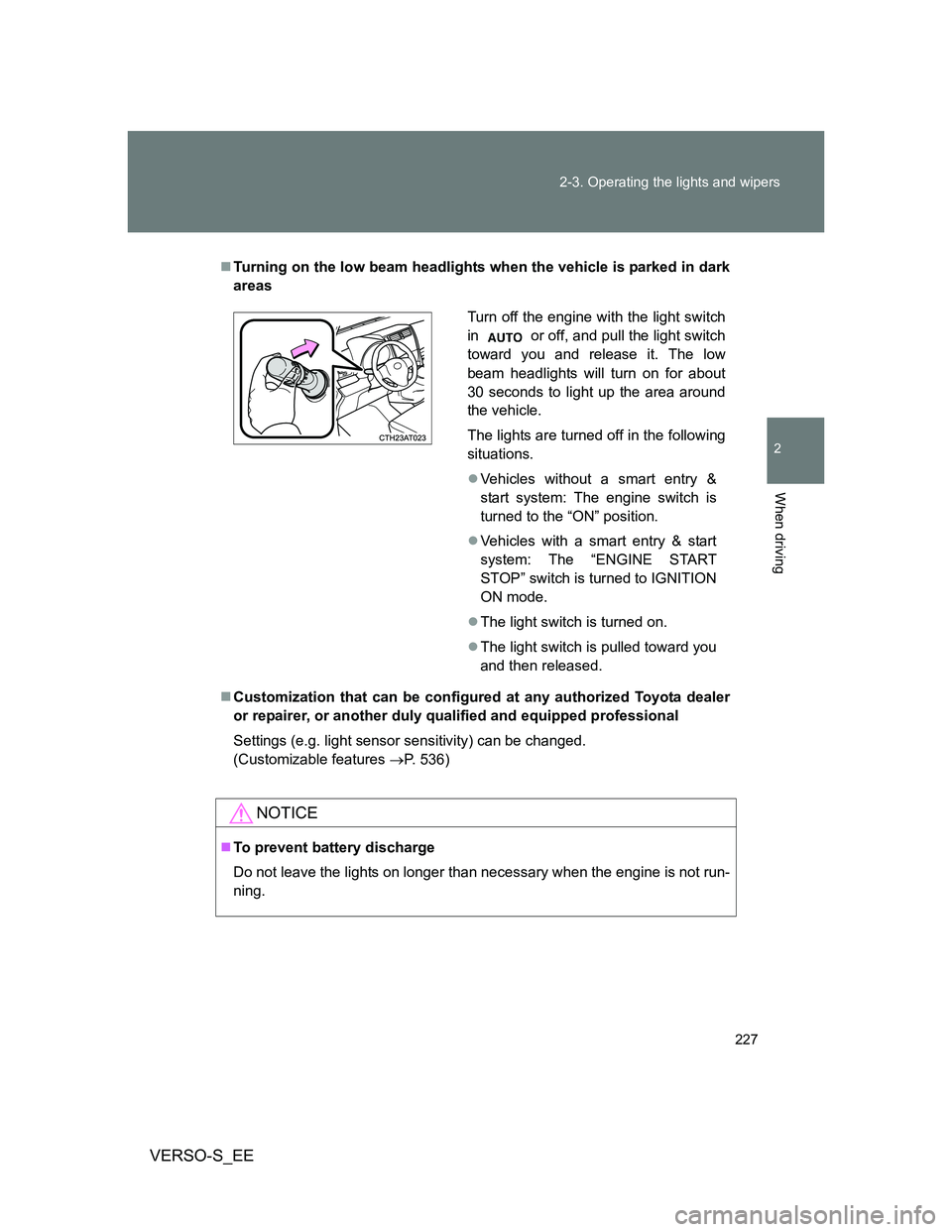
Turning on the low beam headlights when the vehicle is parked in dark
areas
Customization that can be configured at any authorized Toyota dealer
or repairer, or another duly qualified and equipped professional
Settings (e.g. light sensor sensitivity) can be changed.
(Customizable features P. 536)
NOTICE
To prevent battery discharge
Do not leave the lights on longer than necessary when the engine is not run-
ning.
Turn off the engine with the light switch
in or off, and pull the light switch
toward you and release it. The low
beam headlights will turn on for about
30 seconds to light up the area around
the vehicle.
The lights are turned off in the following
situations.
Vehicles without a smart entry &
start system: The engine switch is
turned to the “ON” position.
Vehicles with a smart entry & start
system: The “ENGINE START
STOP” switch is turned to IGNITION
ON mode.
The light switch is turned on.
The light switch is pulled toward you
and then released.
Page 233 of 560
233 2-3. Operating the lights and wipers
2
When driving
VERSO-S_EE
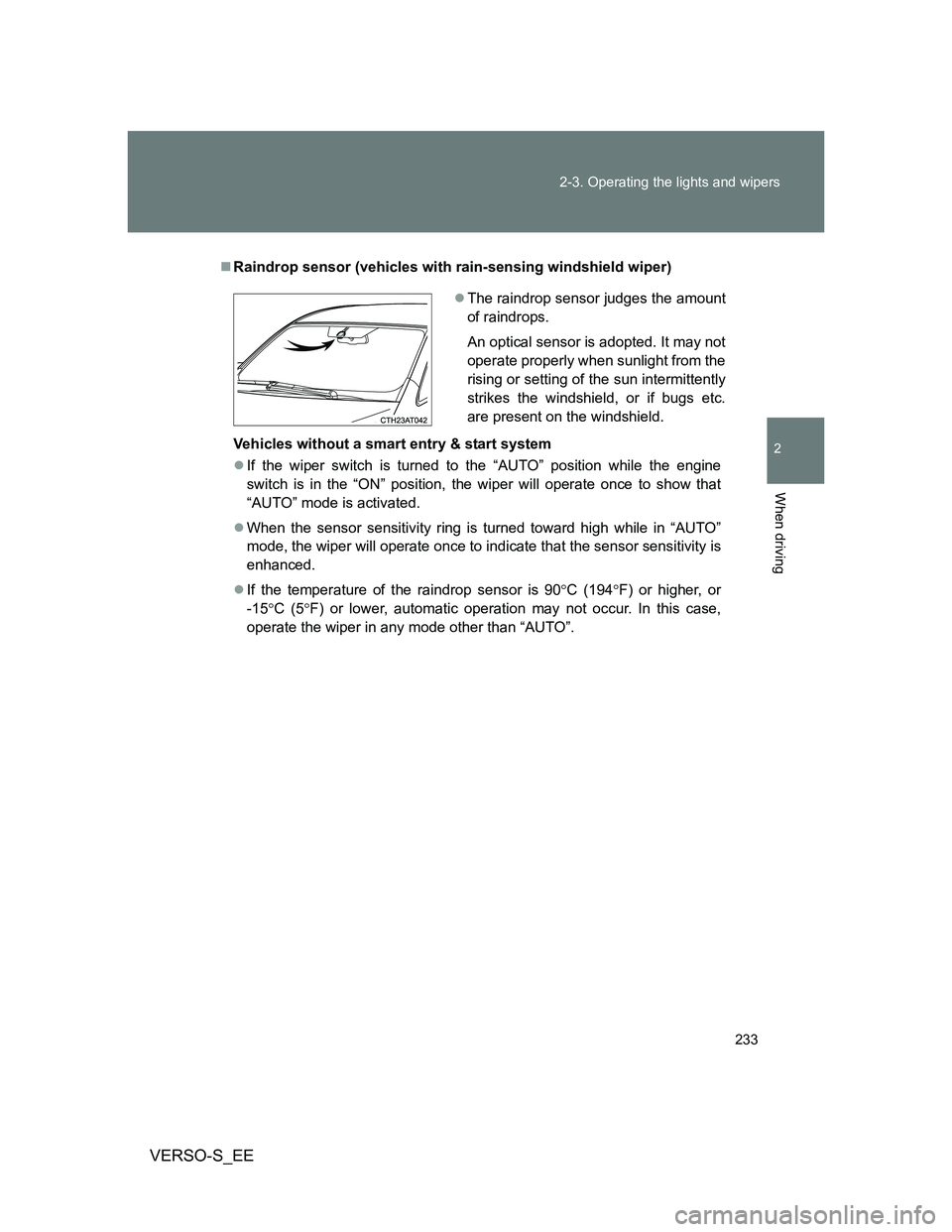
Raindrop sensor (vehicles with rain-sensing windshield wiper)
Vehicles without a smart entry & start system
If the wiper switch is turned to the “AUTO” position while the engine
switch is in the “ON” position, the wiper will operate once to show that
“AUTO” mode is activated.
When the sensor sensitivity ring is turned toward high while in “AUTO”
mode, the wiper will operate once to indicate that the sensor sensitivity is
enhanced.
If the temperature of the raindrop sensor is 90C (194F) or higher, or
-15C (5F) or lower, automatic operation may not occur. In this case,
operate the wiper in any mode other than “AUTO”.
The raindrop sensor judges the amount
of raindrops.
An optical sensor is adopted. It may not
operate properly when sunlight from the
rising or setting of the sun intermittently
strikes the windshield, or if bugs etc.
are present on the windshield.
Page 234 of 560
234 2-3. Operating the lights and wipers
VERSO-S_EE
Vehicles with a smart entry & start system
If the wiper switch is turned to the “AUTO” position while the “ENGINE
START STOP” switch is in IGNITION ON mode, the wiper will operate
once to show that “AUTO” mode is activated.
When the sensor sensitivity ring is turned toward high while in “AUTO”
mode, the wiper will operate once to indicate that the sensor sensitivity is
enhanced.
If the temperature of the raindrop sensor is 90C (194F) or higher, or
-15C (5F) or lower, automatic operation may not occur. In this case,
operate the wiper in any mode other than “AUTO”.
If no windshield washer fluid sprays
Check that the washer nozzles are not blocked if there is washer fluid in the
windshield washer fluid reservoir.
CAUTION
Caution regarding the use of windshield wiper in “AUTO” mode (vehi-
cles with rain-sensing windshield wiper)
The windshield wiper may operate unexpectedly if the sensor is touched or
the windshield is subject to vibration in “AUTO” mode. Take care that your
fingers etc. do not become caught in the windshield wiper.
Page 246 of 560
246 2-4. Using other driving systems
VERSO-S_EE
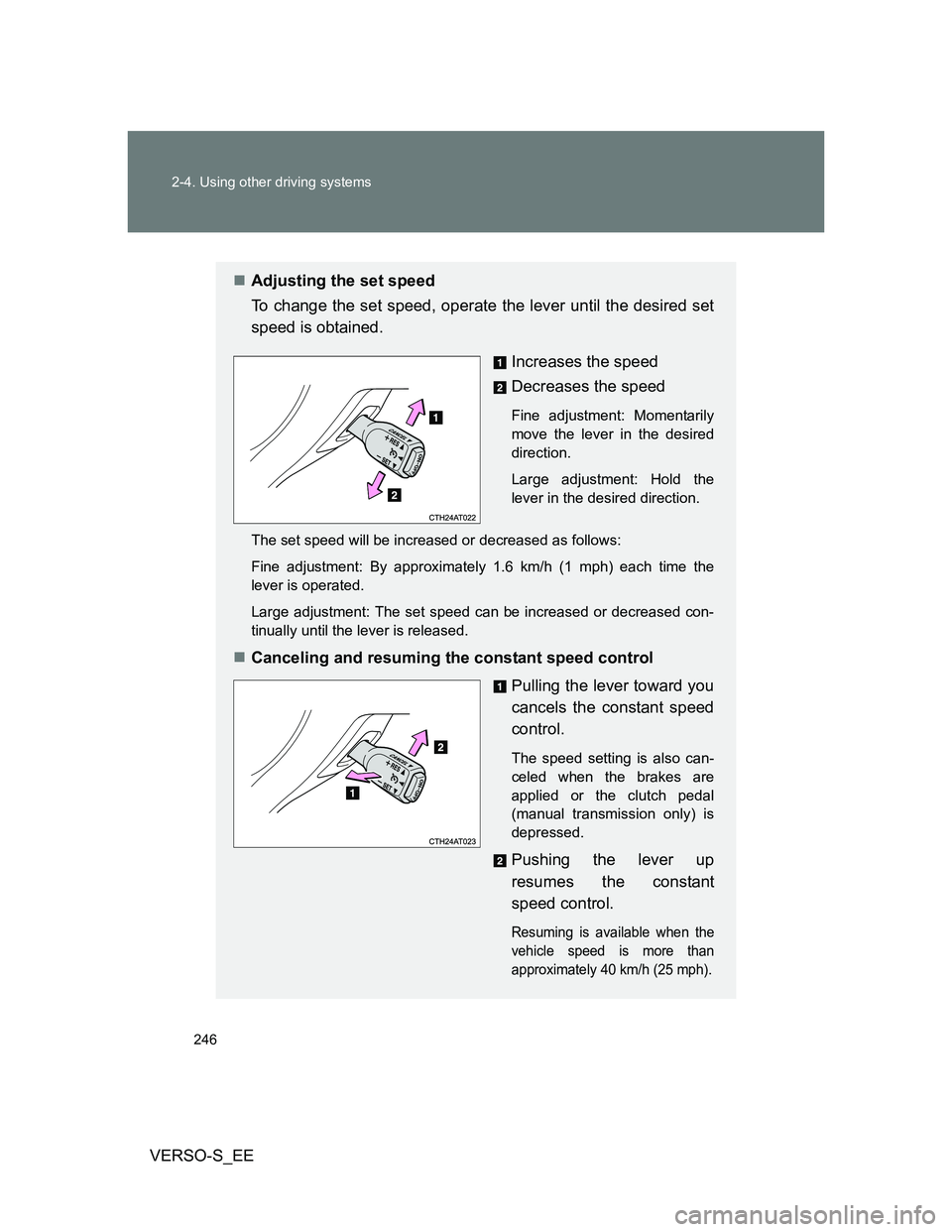
Adjusting the set speed
To change the set speed, operate the lever until the desired set
speed is obtained.
Increases the speed
Decreases the speed
Fine adjustment: Momentarily
move the lever in the desired
direction.
Large adjustment: Hold the
lever in the desired direction.
The set speed will be increased or decreased as follows:
Fine adjustment: By approximately 1.6 km/h (1 mph) each time the
lever is operated.
Large adjustment: The set speed can be increased or decreased con-
tinually until the lever is released.
Canceling and resuming the constant speed control
Pulling the lever toward you
cancels the constant speed
control.
The speed setting is also can-
celed when the brakes are
applied or the clutch pedal
(manual transmission only) is
depressed.
Pushing the lever up
resumes the constant
speed control.
Resuming is available when the
vehicle speed is more than
approximately 40 km/h (25 mph).
Page 248 of 560
248 2-4. Using other driving systems
VERSO-S_EE
CAUTION
To avoid operating the cruise control by mistake
Switch the cruise control off using the “ON-OFF” button when not in use.
Situations unsuitable for cruise control
Do not use cruise control in any of the following situations.
Doing so may result in loss of control and could cause an accident resulting
in death or serious injury.
In heavy traffic
On roads with sharp bends
On winding roads
On slippery roads, such as those covered with rain, ice or snow
On steep hills
Vehicle speed may exceed the set speed when driving down a steep hill.
When your vehicle is towing a trailer or during emergency towing