light TOYOTA VERSO S 2015 Owners Manual
[x] Cancel search | Manufacturer: TOYOTA, Model Year: 2015, Model line: VERSO S, Model: TOYOTA VERSO S 2015Pages: 564, PDF Size: 18.47 MB
Page 459 of 564
5
459 5-2. Steps to take in an emergency
When trouble arises
If the tire pressure warning system is not functioning
The tire pressure warning system will be disabled in the following conditions:
(When the condition becomes normal, the system will work properly.)
If tires not equipped with tire pressure warning valves and transmitters
are used
If the ID code on the tire pressure warning valves and transmitters is not
registered in the tire pressure warning computer
If the tire inflation pressure is 500 kPa (5.1 kgf/cm
2 or bar, 73 psi) or
higher
The tire pressure warning system may be disabled in the following condi-
tions:
(When the condition becomes normal, the system will work properly.)
If electronic devices or facilities using similar radio wave frequencies are
nearby
If a radio set at a similar frequency is in use in the vehicle
If a window tint that affects the radio wave signals is installed
If there is a lot of snow or ice on the vehicle, particularly around the
wheels or wheel housings
If non-genuine Toyota wheels are used (Even if you use Toyota wheels,
the tire pressure warning system may not work properly with some types
of tires.)
If tire chains are used
If the tire pressure warning light frequently comes on after blinking for
1 minute
If the tire pressure warning light frequently comes on after blinking for 1 min-
ute when the “ENGINE START STOP” switch (vehicles with a smart entry &
start system) or the engine switch (vehicles without a smart entry & start sys-
tem) is turned on, have it checked by any authorized Toyota dealer or
repairer, or another duly qualified and equipped professional.
If the engine oil change reminder light flashes (diesel engine only)
Repeated short trips and/or low-speed driving may cause the oil to degrade
sooner than usual, regardless of the actual distance driven. If this happens,
the engine oil change reminder light will flash.
Page 460 of 564
460 5-2. Steps to take in an emergency
Engine oil change reminder light comes on (diesel engine only)
Replace the engine oil and oil filter when the engine oil change reminder
light does not come on even if you have driven over 15000 km (9300 miles)
after the engine oil was changed.
There is a possibility that the engine oil change reminder light has been illu-
minated when you have driven less than 15000 km (9300 miles) based on a
usage or driving condition.
Electric power steering system warning light (warning buzzer)
When the battery charge becomes insufficient or the voltage temporarily
drops, the electric power steering system warning light may come on and the
warning buzzer may sound.
CAUTION
When the electric power steering system warning light comes on
The steering wheel may become extremely heavy.
If the steering wheel becomes heavier than usual when operating, hold
firmly and operate using more force than usual.
When driving to clean the DPF catalytic converter (diesel engine only)
When driving, pay sufficient attention to weather, road conditions, terrain and
traffic conditions, and be sure to observe traffic laws and/or regulations. Fail-
ure to do so may cause an unexpected accident, resulting in death or seri-
ous injury.
If the tire pressure warning light comes on
Be sure to observe the following precautions. Failure to do so could cause a
loss of vehicle control and result in death or serious injury.
Stop your vehicle in a safe place as soon as possible. Adjust the tire infla-
tion pressure immediately.
If the tire pressure warning light comes on even after tire inflation pressure
adjustment, it is probable that you have a flat tire. Check the tires. If a tire
is flat, change it with the spare tire and have the flat tire repaired by the
nearest any authorized Toyota dealer or repairer, or another duly qualified
and equipped professional.
Avoid abrupt maneuvering and braking. If the vehicle tires deteriorate, you
could lose control of the steering wheel or the brakes.
Page 461 of 564
5
461 5-2. Steps to take in an emergency
When trouble arises
CAUTION
If a blowout or sudden air leakage should occur
The tire pressure warning system may not activate immediately.
NOTICE
To ensure the tire pressure warning system operates properly
Do not install tires with different specifications or makers, as the tire pres-
sure warning system may not operate properly.
If the fuel filter warning light comes on (diesel engine only)
Never drive the vehicle with the warning light on. Continued driving with
water accumulated in the fuel filter will damage the fuel injection pump.
When the DPF system warning light comes on (diesel engine only)
If the DPF system warning light is left on without performing cleaning, after
an additional 100 to 300 km (62 to 187 miles), the malfunction indicator lamp
may come on. If this happens, have the vehicle inspected by any authorized
Toyota dealer or repairer, or another duly qualified and equipped profes-
sional immediately.
Page 467 of 564
5
467 5-2. Steps to take in an emergency
When trouble arises
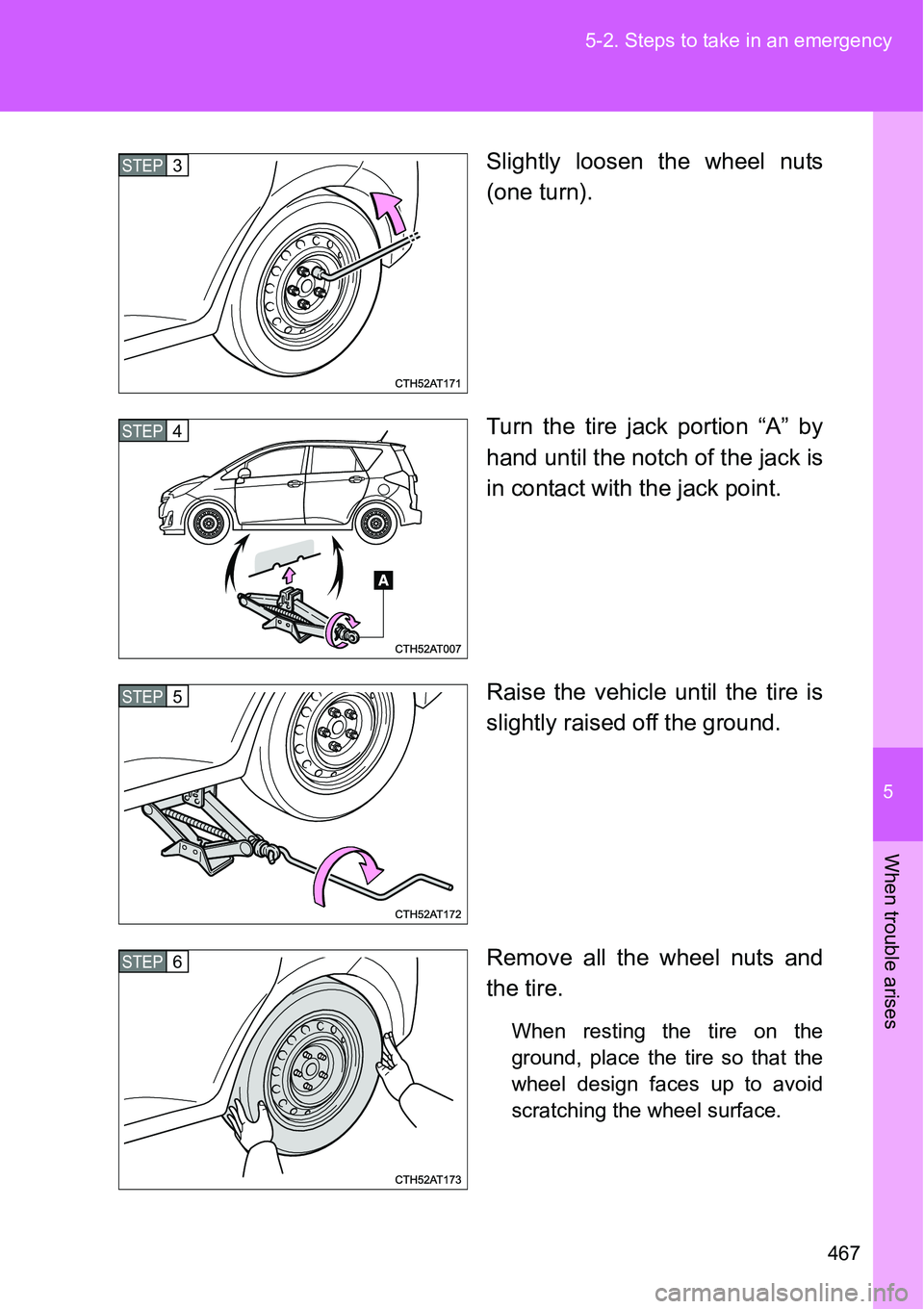
Slightly loosen the wheel nuts
(one turn).
Turn the tire jack portion “A” by
hand until the notch of the jack is
in contact with the jack point.
Raise the vehicle until the tire is
slightly raised off the ground.
Remove all the wheel nuts and
the tire.
When resting the tire on the
ground, place the tire so that the
wheel design faces up to avoid
scratching the wheel surface.
STEP3
STEP4
STEP5
STEP6
Page 470 of 564
470 5-2. Steps to take in an emergency
The compact spare tire
The compact spare tire is identified by the label “TEMPORARY USE
ONLY” on the tire sidewall.
Use the compact spare tire temporarily, and only in an emergency.
Make sure to check the tire inflation pressure of the compact spare tire.
(P. 535)
After completing the tire change
The tire pressure warning system must be reset. (P. 386)
When using the compact spare tire
As the compact spare tire is not equipped with a tire pressure warning valve
and transmitter, low inflation pressure of the spare tire will not be indicated
by the tire pressure warning system. Also, if you replace the compact spare
tire after the tire pressure warning light comes on, the light remains on.
If you have a flat front tire on a road covered with snow or ice
Install the compact spare tire on one of the rear wheels of the vehicle. Per-
form the following steps and fit tire chains to the front tires:
Replace a rear tire with the compact spare tire.
Replace the flat front tire with the tire removed from the rear of the
vehicle.
Fit tire chains to the front tires.
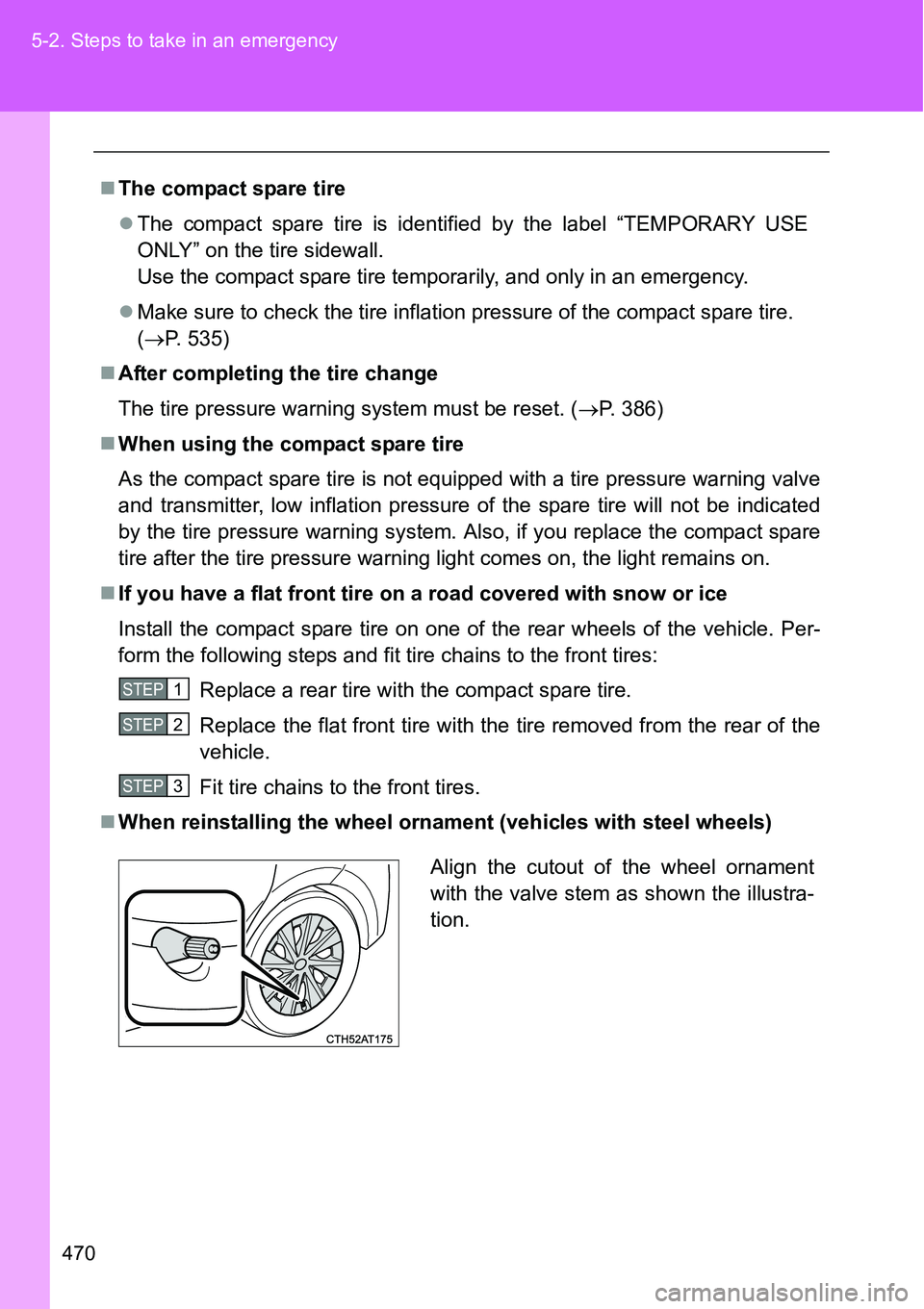
When reinstalling the wheel ornament (vehicles with steel wheels)
STEP1
STEP2
STEP3
Align the cutout of the wheel ornament
with the valve stem as shown the illustra-
tion.
Page 492 of 564
492
5-2. Steps to take in an emergency
If the engine will not start
If the engine will not start even though correct starting procedures
are being followed (P. 173, 182), consider each of the following
points:
The engine will not start even though the starter motor
operates normally.
One of the following may be the cause of the problem:
There may not be sufficient fuel in the vehicle’s tank.
Gasoline engine: Refuel the vehicle.
Diesel engine: (P. 514)
The engine may be flooded. (gasoline engine)
Try to restart the engine again following correct starting proce-
dures. (P. 173, 182)
There may be a malfunction in the engine immobilizer system.
(P. 105)
The starter motor turns over slowly, the interior lights and
headlights are dim, or the horn does not sound or sounds at
a low volume.
One of the following may be the cause of the problem:
The battery may be discharged. (P. 501)
The battery terminal connections may be loose or corroded.
The starter motor does not turn over. (vehicles with a smart
entry & start system)
The engine starting system may be malfunctioning due to an
electrical problem such as an open circuit or a blown fuse. How-
ever, an interim measure is available to start the engine.
(P. 493)
Page 493 of 564
5
493 5-2. Steps to take in an emergency
When trouble arises
Emergency start function (vehicles with a smart entry & start system)
When the engine does not start, the following steps can be used as
an interim measure to start the engine if the “ENGINE START STOP”
switch is functioning normally:
Vehicles with a Multidrive
Set the parking brake.
Shift the shift lever to P.
Turn the “ENGINE START STOP” switch to ACCESSORY
mode.
Push and hold the “ENGINE START STOP” switch for about
15 seconds while depressing the brake pedal firmly.
Even if the engine can be started using the above steps, the system
may be malfunctioning. Have the vehicle inspected by any authorized
Toyota dealer or repairer, or another duly qualified and equipped pro-
fessional.
The starter motor does not turn over, the interior lights and
headlights do not turn on, or the horn does not sound.
One of the following may be the cause of the problem:
One or both of the battery terminals may be disconnected.
The battery may be discharged. (P. 501)
There may be a malfunction in the steering lock system (vehi-
cles with a smart entry & start system).
Contact any authorized Toyota dealer or repairer, or another duly
qualified and equipped professional if the problem cannot be
repaired, or if repair procedures are unknown.
STEP1
STEP2
STEP3
STEP4
Page 498 of 564
498 5-2. Steps to take in an emergency
Starting the engine
Vehicles with a Multidrive
Ensure that the shift lever is in P and firmly depress the brake
pedal.
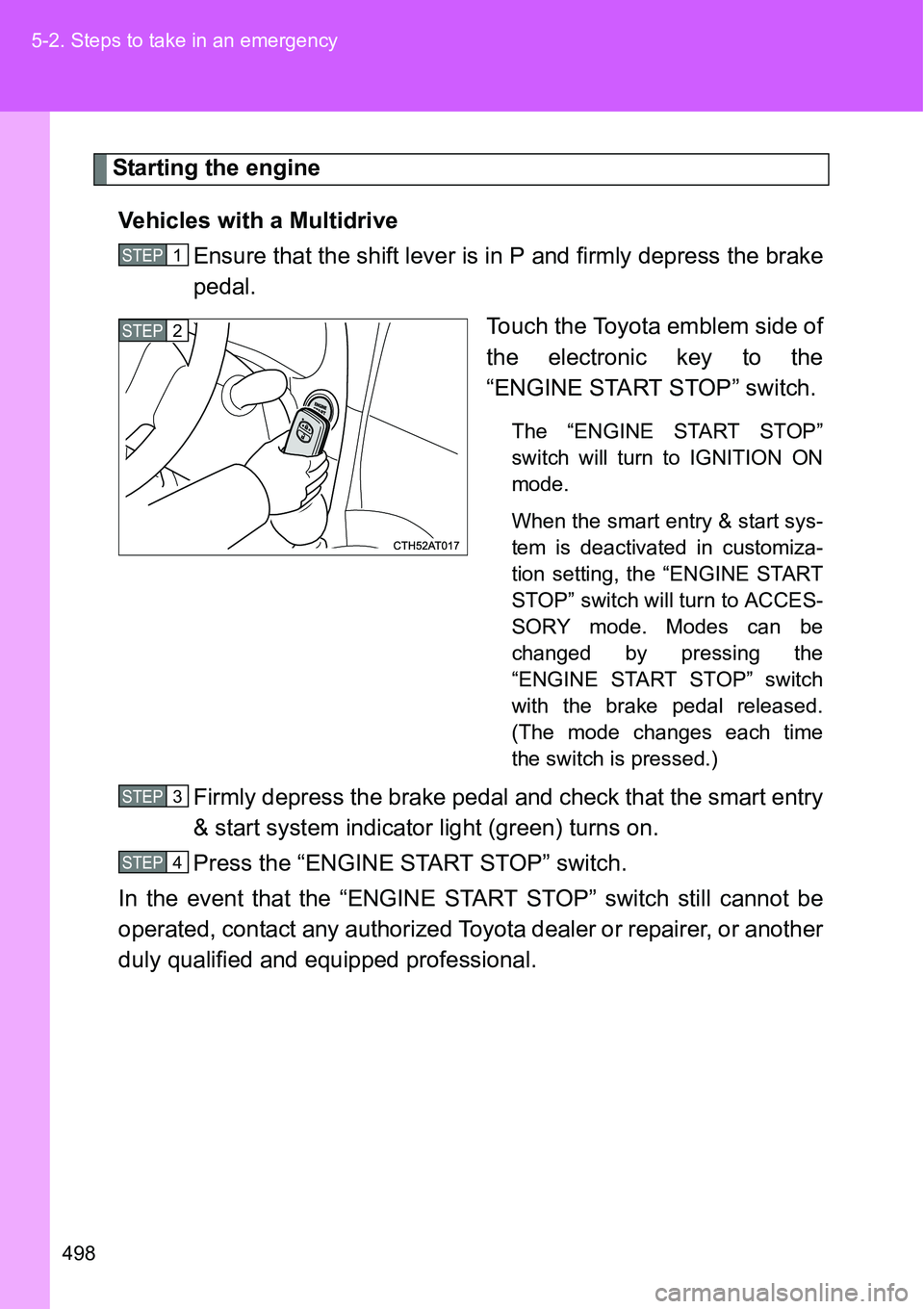
Touch the Toyota emblem side of
the electronic key to the
“ENGINE START STOP” switch.
The “ENGINE START STOP”
switch will turn to IGNITION ON
mode.
When the smart entry & start sys-
tem is deactivated in customiza-
tion setting, the “ENGINE START
STOP” switch will turn to ACCES-
SORY mode. Modes can be
changed by pressing the
“ENGINE START STOP” switch
with the brake pedal released.
(The mode changes each time
the switch is pressed.)
Firmly depress the brake pedal and check that the smart entry
& start system indicator light (green) turns on.
Press the “ENGINE START STOP” switch.
In the event that the “ENGINE START STOP” switch still cannot be
operated, contact any authorized Toyota dealer or repairer, or another
duly qualified and equipped professional.
STEP1
STEP2
STEP3
STEP4
Page 499 of 564
5
499 5-2. Steps to take in an emergency
When trouble arises
Vehicles with a manual transmission
Ensure that the shift lever is in N and depress the clutch
pedal.
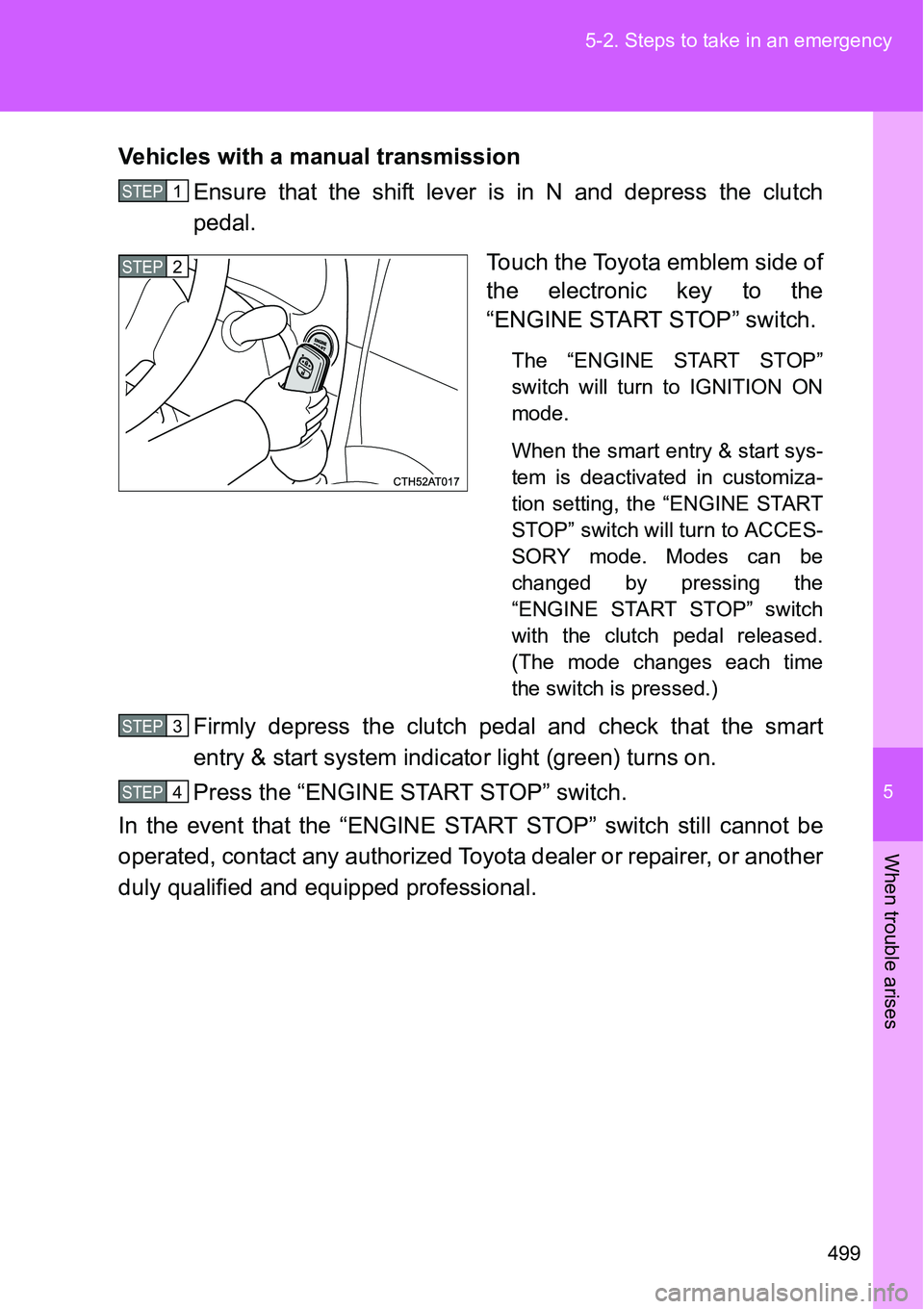
Touch the Toyota emblem side of
the electronic key to the
“ENGINE START STOP” switch.
The “ENGINE START STOP”
switch will turn to IGNITION ON
mode.
When the smart entry & start sys-
tem is deactivated in customiza-
tion setting, the “ENGINE START
STOP” switch will turn to ACCES-
SORY mode. Modes can be
changed by pressing the
“ENGINE START STOP” switch
with the clutch pedal released.
(The mode changes each time
the switch is pressed.)
Firmly depress the clutch pedal and check that the smart
entry & start system indicator light (green) turns on.
Press the “ENGINE START STOP” switch.
In the event that the “ENGINE START STOP” switch still cannot be
operated, contact any authorized Toyota dealer or repairer, or another
duly qualified and equipped professional.
STEP1
STEP2
STEP3
STEP4
Page 503 of 564
5
503 5-2. Steps to take in an emergency
When trouble arises
Diesel engine
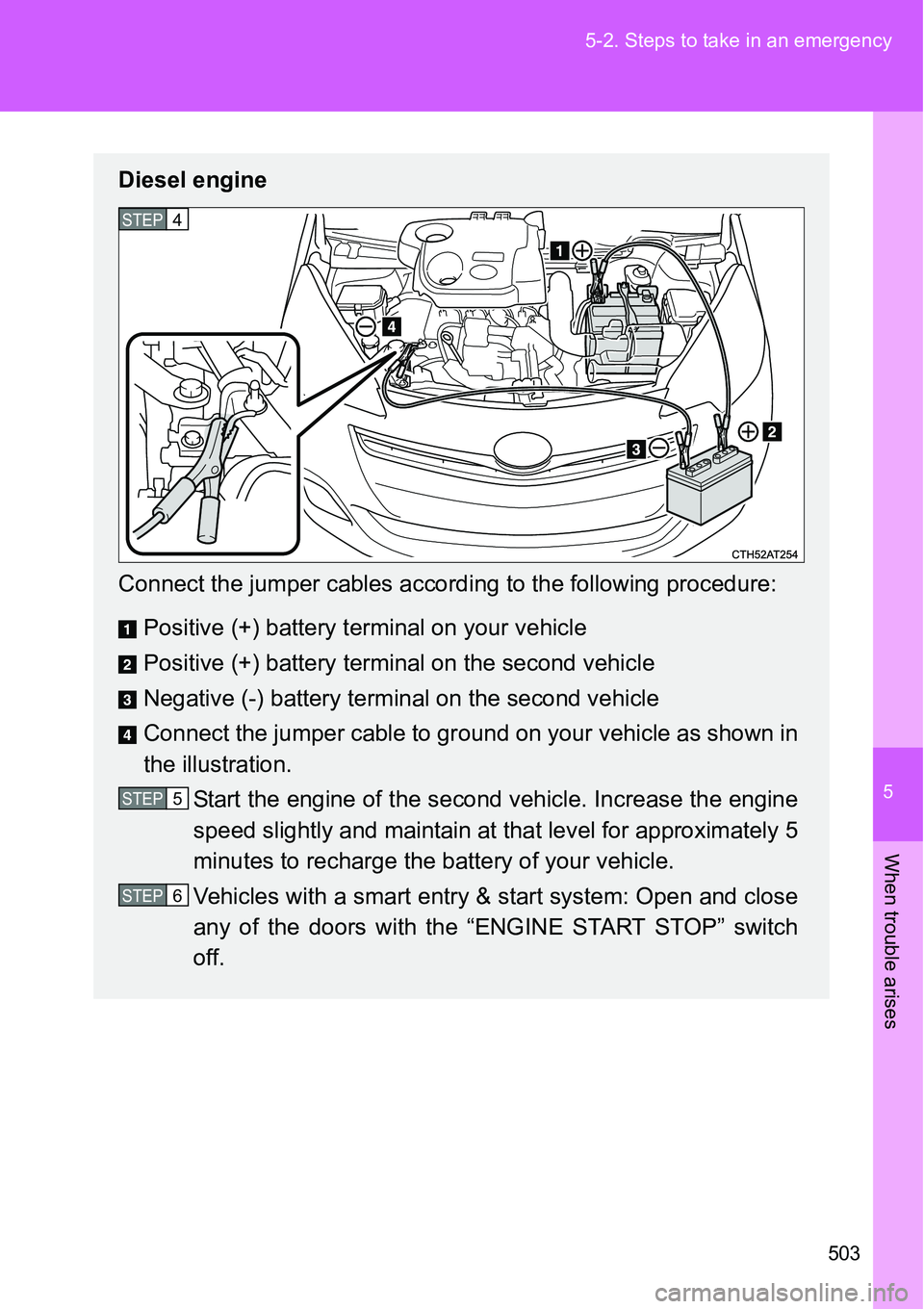
Connect the jumper cables according to the following procedure:
Positive (+) battery terminal on your vehicle
Positive (+) battery terminal on the second vehicle
Negative (-) battery terminal on the second vehicle
Connect the jumper cable to ground on your vehicle as shown in
the illustration.
Start the engine of the second vehicle. Increase the engine
speed slightly and maintain at that level for approximately 5
minutes to recharge the battery of your vehicle.
Vehicles with a smart entry & start system: Open and close
any of the doors with the “ENGINE START STOP” switch
off.
STEP4
STEP5
STEP6