engine TOYOTA VERSO S 2015 Owners Manual
[x] Cancel search | Manufacturer: TOYOTA, Model Year: 2015, Model line: VERSO S, Model: TOYOTA VERSO S 2015Pages: 564, PDF Size: 18.47 MB
Page 501 of 564
5
501
5-2. Steps to take in an emergency
When trouble arises
If the batter y is discharged
The following procedures may be used to start the engine if the vehi-
cle's battery is discharged.
You can also call any authorized Toyota dealer or repairer, or another
duly qualified and equipped professional.
If you have a set of jumper (or booster) cables and a second vehi-
cle with a 12-volt battery, you can jump start your vehicle by follow-
ing the steps below.
Open the hood. (P. 367)
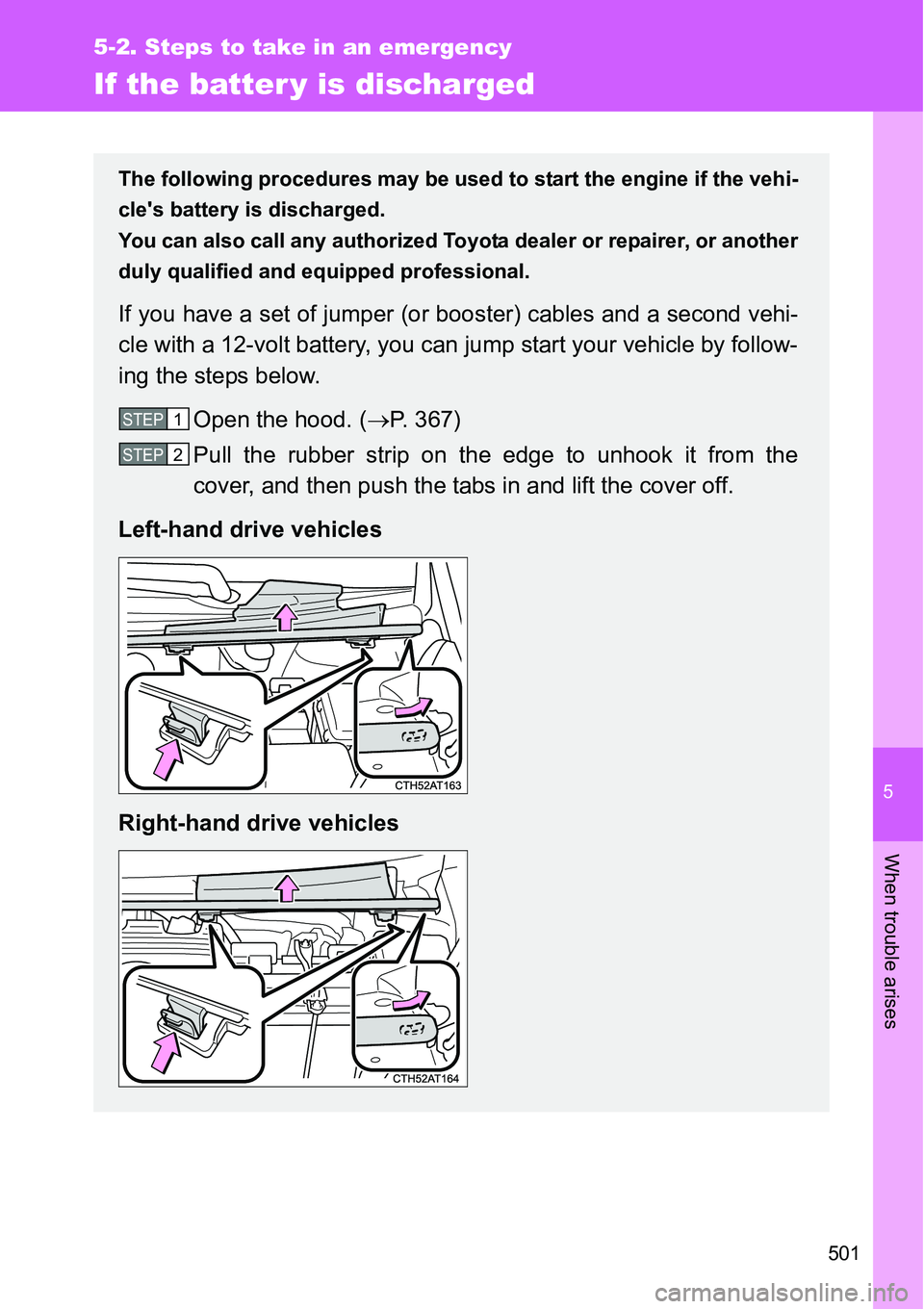
Pull the rubber strip on the edge to unhook it from the
cover, and then push the tabs in and lift the cover off.
Left-hand drive vehicles
Right-hand drive vehicles
STEP1
STEP2
Page 502 of 564
502 5-2. Steps to take in an emergency
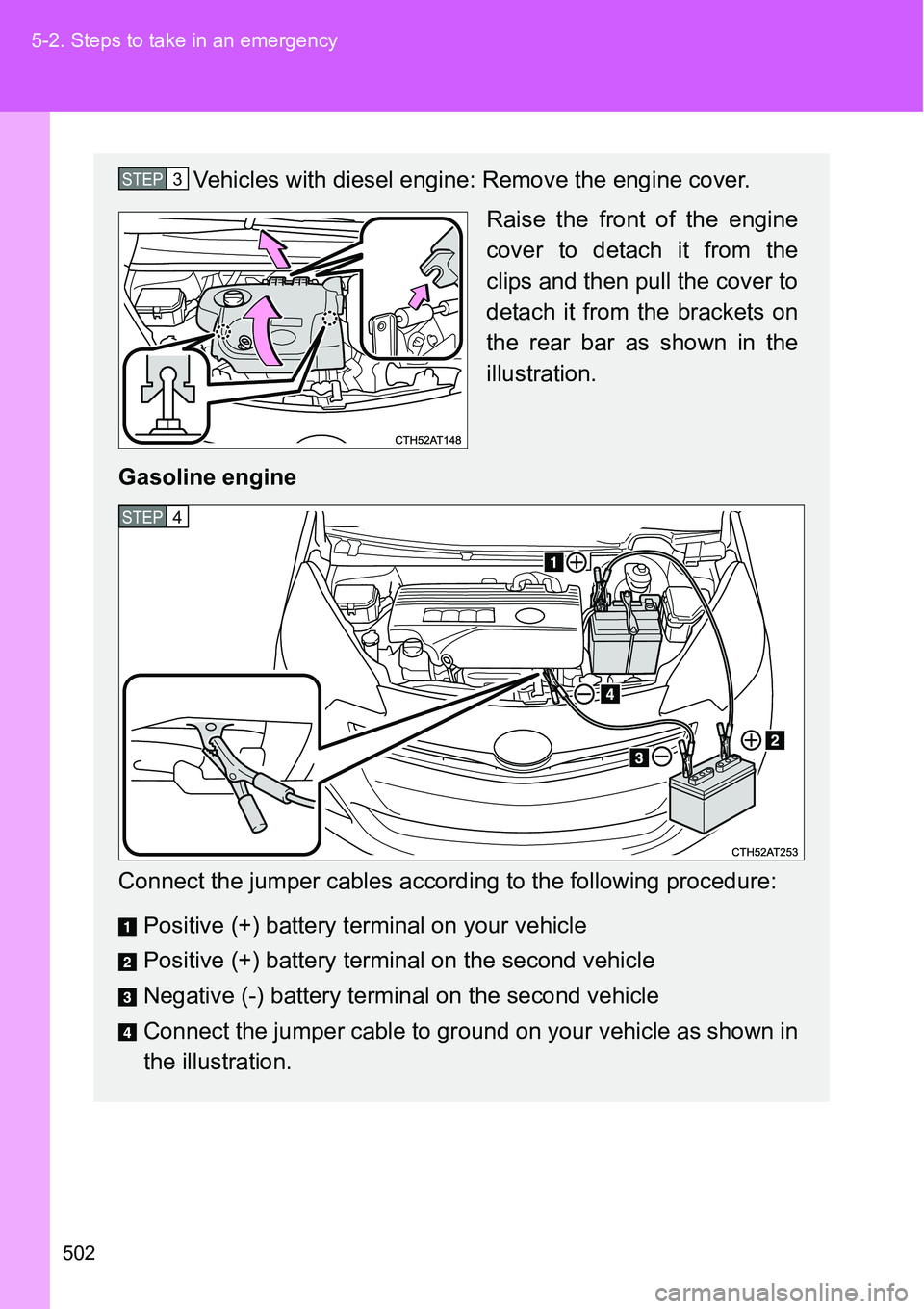
Vehicles with diesel engine: Remove the engine cover.
Raise the front of the engine
cover to detach it from the
clips and then pull the cover to
detach it from the brackets on
the rear bar as shown in the
illustration.
Gasoline engine
Connect the jumper cables according to the following procedure:
Positive (+) battery terminal on your vehicle
Positive (+) battery terminal on the second vehicle
Negative (-) battery terminal on the second vehicle
Connect the jumper cable to ground on your vehicle as shown in
the illustration.STEP3
STEP4
Page 503 of 564
5
503 5-2. Steps to take in an emergency
When trouble arises
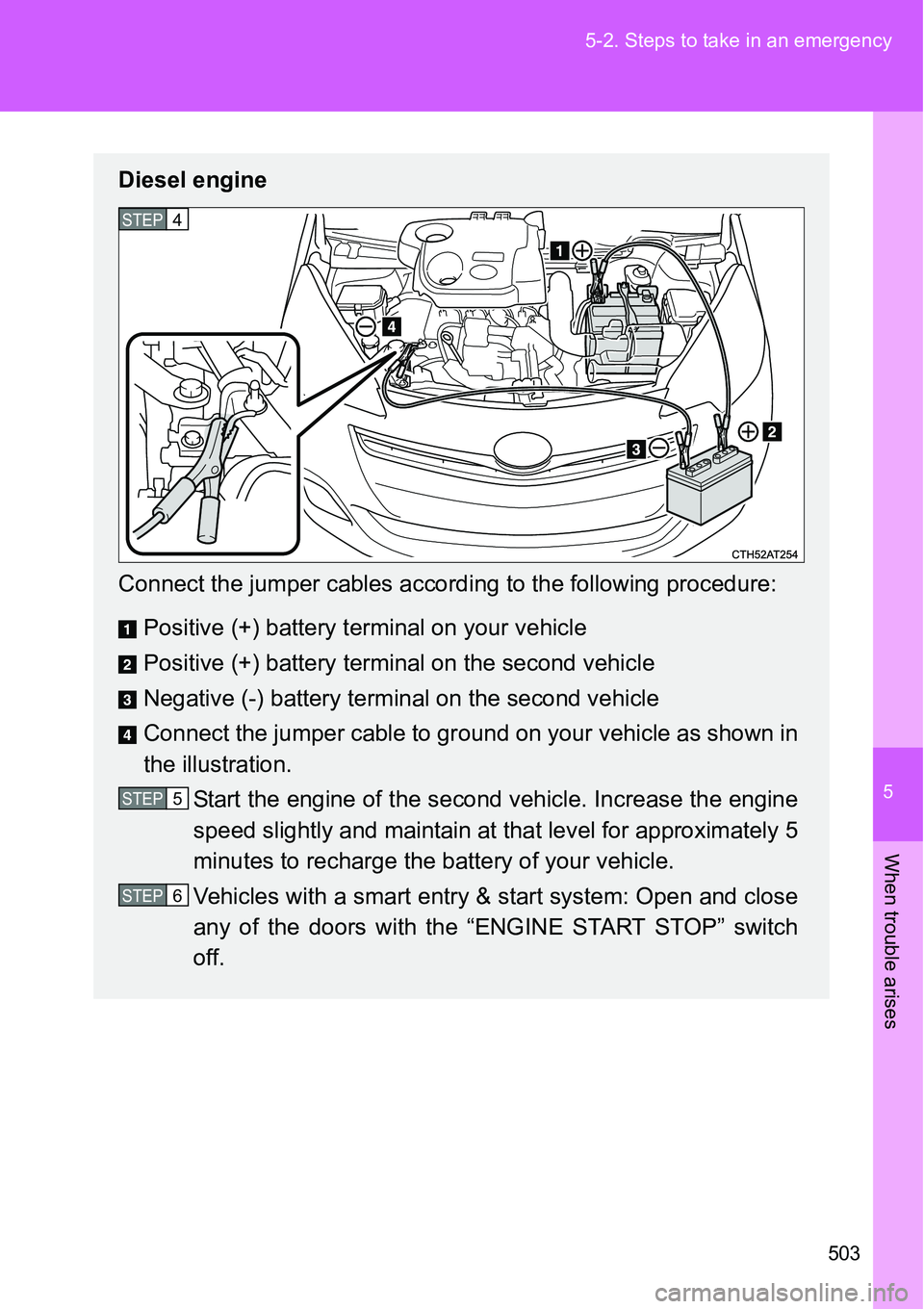
Diesel engine
Connect the jumper cables according to the following procedure:
Positive (+) battery terminal on your vehicle
Positive (+) battery terminal on the second vehicle
Negative (-) battery terminal on the second vehicle
Connect the jumper cable to ground on your vehicle as shown in
the illustration.
Start the engine of the second vehicle. Increase the engine
speed slightly and maintain at that level for approximately 5
minutes to recharge the battery of your vehicle.
Vehicles with a smart entry & start system: Open and close
any of the doors with the “ENGINE START STOP” switch
off.
STEP4
STEP5
STEP6
Page 504 of 564
504 5-2. Steps to take in an emergency
Vehicles without a smart entry & start system: Maintain the
engine speed of the second vehicle and turn the engine
switch to the “ON” position, then start the vehicle's engine.
Vehicles with a smart entry & start system: Maintain the
engine speed of the second vehicle and turn the “ENGINE
START STOP” switch to IGNITION ON mode, then start the
vehicle's engine.
Once the vehicle’s engine has started, remove the jumper
cables in the exact reverse order in which they were con-
nected.
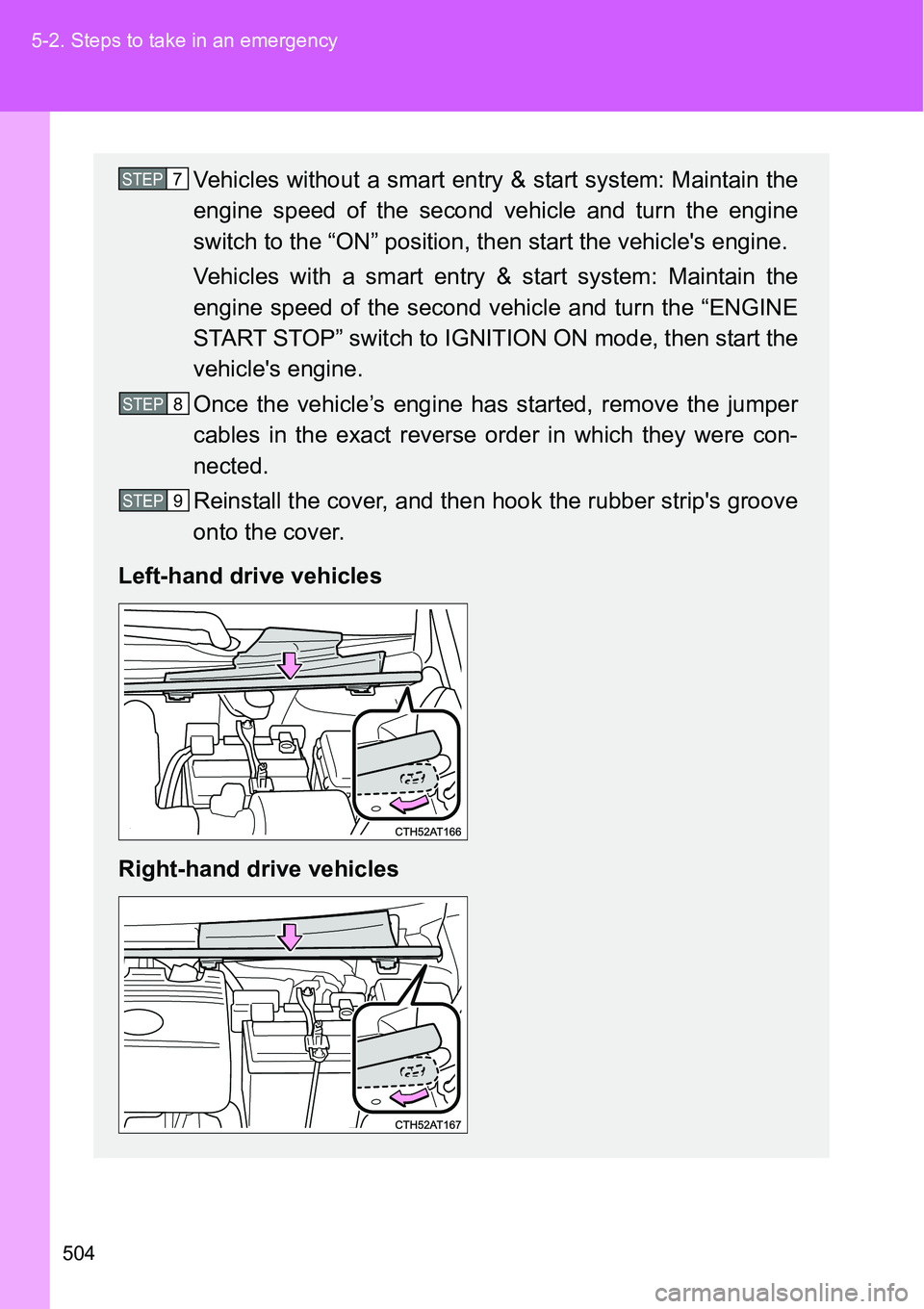
Reinstall the cover, and then hook the rubber strip's groove
onto the cover.
Left-hand drive vehicles
Right-hand drive vehiclesSTEP7
STEP8
STEP9
Page 505 of 564
5
505 5-2. Steps to take in an emergency
When trouble arises
Starting the engine when the battery is discharged (vehicles with a
Multidrive)
The engine cannot be started by push-starting.
To prevent battery discharge
Turn off the headlights and the audio system while the engine is off.
Turn off any unnecessary electrical components when the vehicle is run-
ning at a low speed for an extended period, such as in heavy traffic.
Charging the battery
The electricity stored in the battery will discharge gradually even when the
vehicle is not in use, due to natural discharge and the draining effects of cer-
tain electrical appliances. If the vehicle is left for a long time, the battery may
discharge, and the engine may be unable to start. (The battery recharges
automatically during driving.)
Once the engine starts, have the vehicle checked at any autho-
rized Toyota dealer or repairer, or another duly qualified and
equipped professional, as soon as possible.
Page 506 of 564
506 5-2. Steps to take in an emergency
Precautions when the battery is discharged (vehicles with a smart
entry & start system)
In some cases, it may not be possible to unlock the doors using the smart
entry & start system when the battery is discharged. Use the wireless
remote control or the mechanical key to lock or unlock the doors.
The engine may not start on the first attempt after the battery has
recharged but will start normally after the second attempt. This is not a
malfunction.
The “ENGINE START STOP” switch mode is memorized by the vehicle.
When the battery is reconnected, the system will return to the mode it
was in before the battery was discharged. Before disconnecting the bat-
tery, turn the “ENGINE START STOP” switch off.
If you are unsure what mode the “ENGINE START STOP” switch was in
before the battery discharged, be especially careful when reconnecting
the battery.
When the battery is removed or discharged (vehicle with an alarm)
Make sure that the key is not inside the vehicle when recharging or replacing
the battery. The key may be locked in the vehicle if the alarm is activated.
(P. 1 1 8 )
Page 509 of 564
5
509
5-2. Steps to take in an emergency
When trouble arises
If your vehicle overheats
Correction procedures
Stop the vehicle in a safe place and turn off the air condition-
ing system, and then stop the engine.
If you see steam:
Carefully lift the hood after the steam subsides.
If you do not see steam:
Carefully lift the hood.
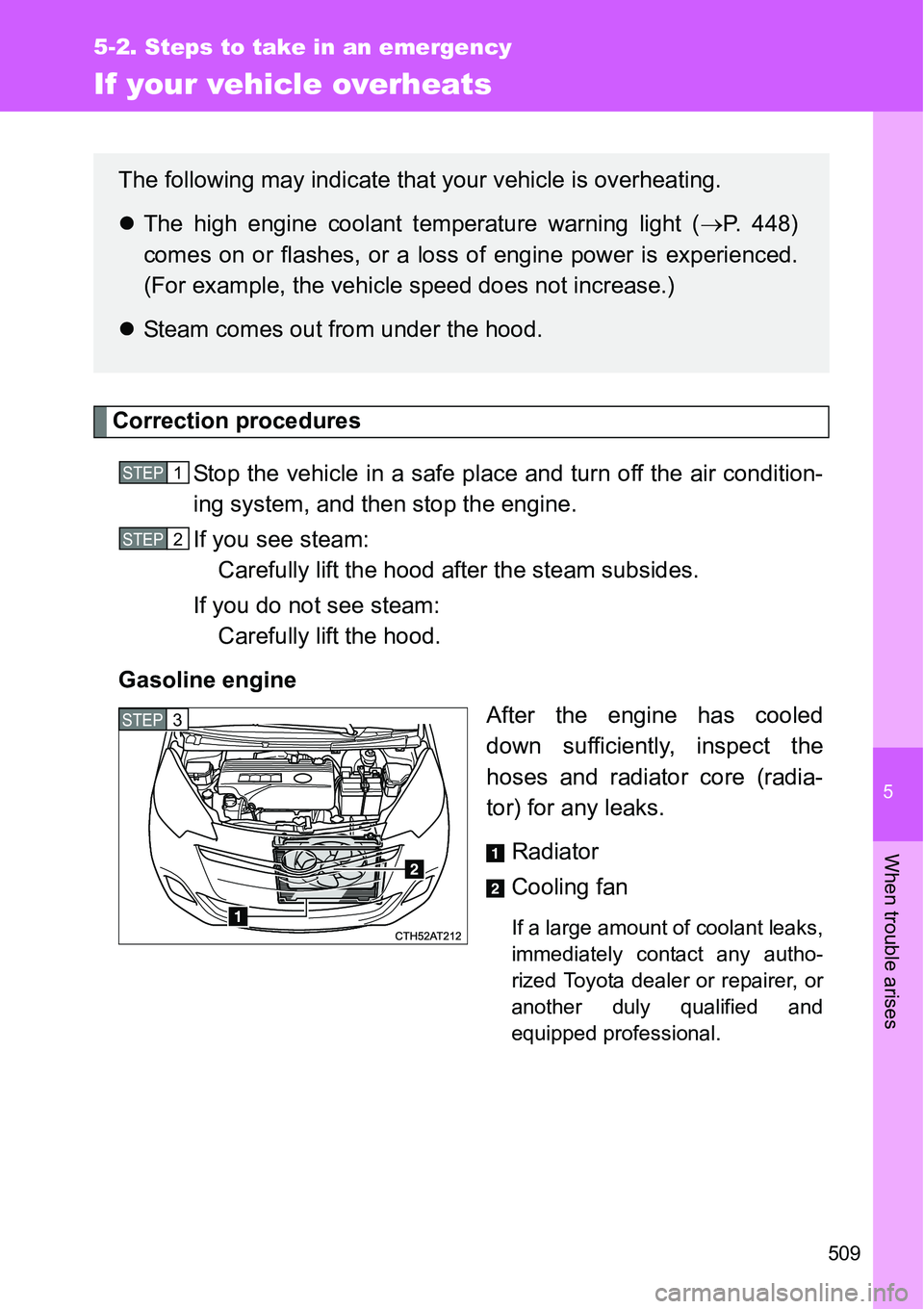
Gasoline engine
After the engine has cooled
down sufficiently, inspect the
hoses and radiator core (radia-
tor) for any leaks.
Radiator
Cooling fan
If a large amount of coolant leaks,
immediately contact any autho-
rized Toyota dealer or repairer, or
another duly qualified and
equipped professional.
The following may indicate that your vehicle is overheating.
The high engine coolant temperature warning light (P. 448)
comes on or flashes, or a loss of engine power is experienced.
(For example, the vehicle speed does not increase.)
Steam comes out from under the hood.
STEP1
STEP2
STEP3
Page 510 of 564
510 5-2. Steps to take in an emergency
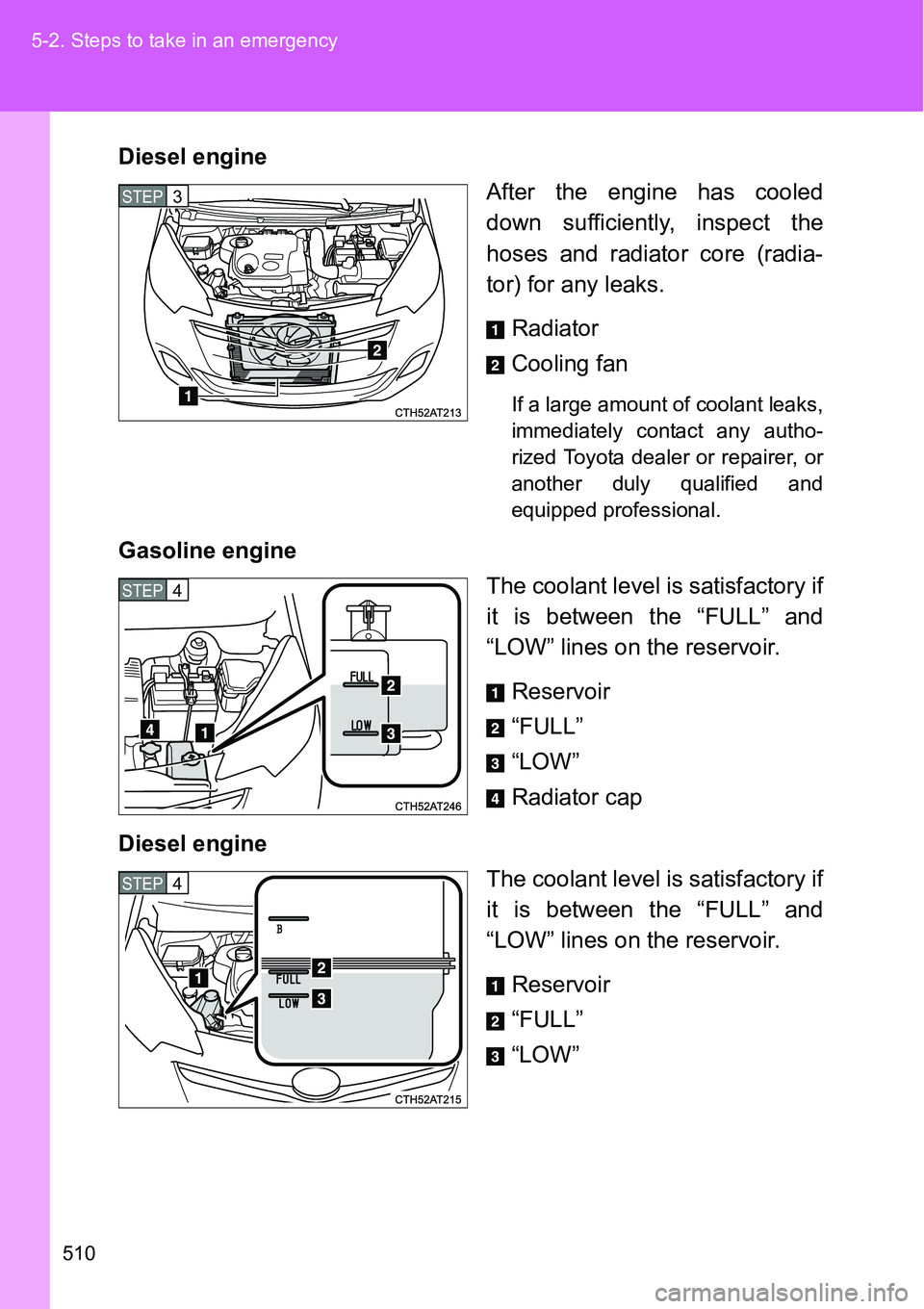
Diesel engine
After the engine has cooled
down sufficiently, inspect the
hoses and radiator core (radia-
tor) for any leaks.
Radiator
Cooling fan
If a large amount of coolant leaks,
immediately contact any autho-
rized Toyota dealer or repairer, or
another duly qualified and
equipped professional.
Gasoline engine
The coolant level is satisfactory if
it is between the “FULL” and
“LOW” lines on the reservoir.
Reservoir
“FULL”
“LOW”
Radiator cap
Diesel engine
The coolant level is satisfactory if
it is between the “FULL” and
“LOW” lines on the reservoir.
Reservoir
“FULL”
“LOW”
STEP3
STEP4
STEP4
Page 511 of 564
5
511 5-2. Steps to take in an emergency
When trouble arises
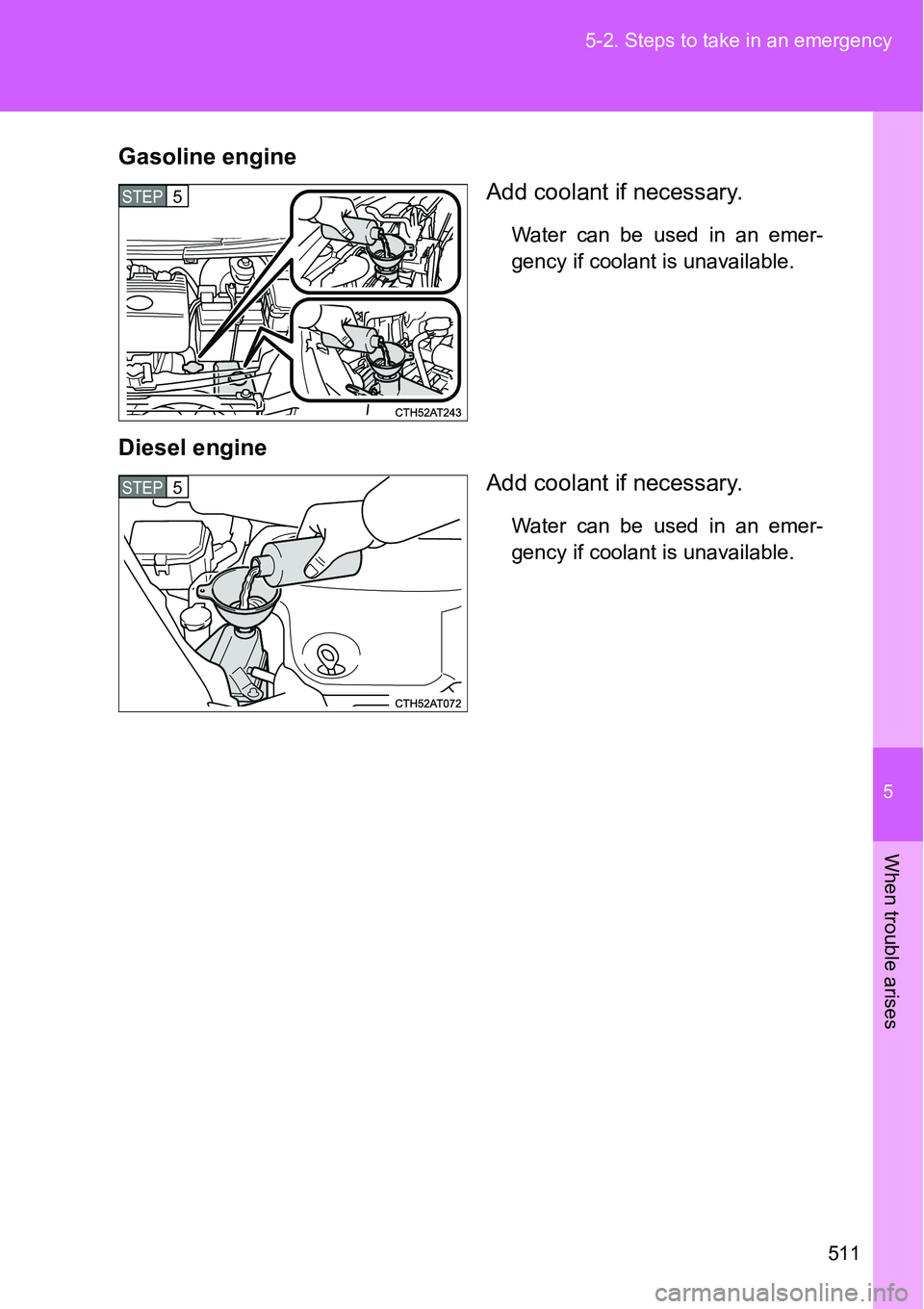
Gasoline engine
Add coolant if necessary.
Water can be used in an emer-
gency if coolant is unavailable.
Diesel engine
Add coolant if necessary.
Water can be used in an emer-
gency if coolant is unavailable.
STEP5
STEP5
Page 512 of 564
512 5-2. Steps to take in an emergency
Start the engine and turn the air conditioning system on to
check that the radiator cooling fan operates and to check for
coolant leaks from the radiator or hoses.
The fan operates when the air conditioning system is turned on
immediately after a cold start. Confirm that the fan is operating by
checking the fan sound and air flow. If it is difficult to check these,
turn the air conditioning system on and off repeatedly.
(The fan may not operate in freezing temperatures.)
If the fan is not operating:
Stop the engine immediately and contact any authorized
Toyota dealer or repairer, or another duly qualified and
equipped professional.
If the fan is operating:
Have the vehicle inspected at the nearest authorized
Toyota dealer or repairer, or another duly qualified and
equipped professional.
CAUTION
To prevent an accident or injury when inspecting under the hood of
your vehicle
If steam is seen coming from under the hood, do not open the hood until
the steam has subsided. The engine compartment may be very hot, caus-
ing serious injuries such as burns.
Keep hands and clothing (especially a tie, a scarf or a muffler) away from
the fans and belts. Failure to do so may cause the hands or clothing to be
caught, resulting in serious injury.
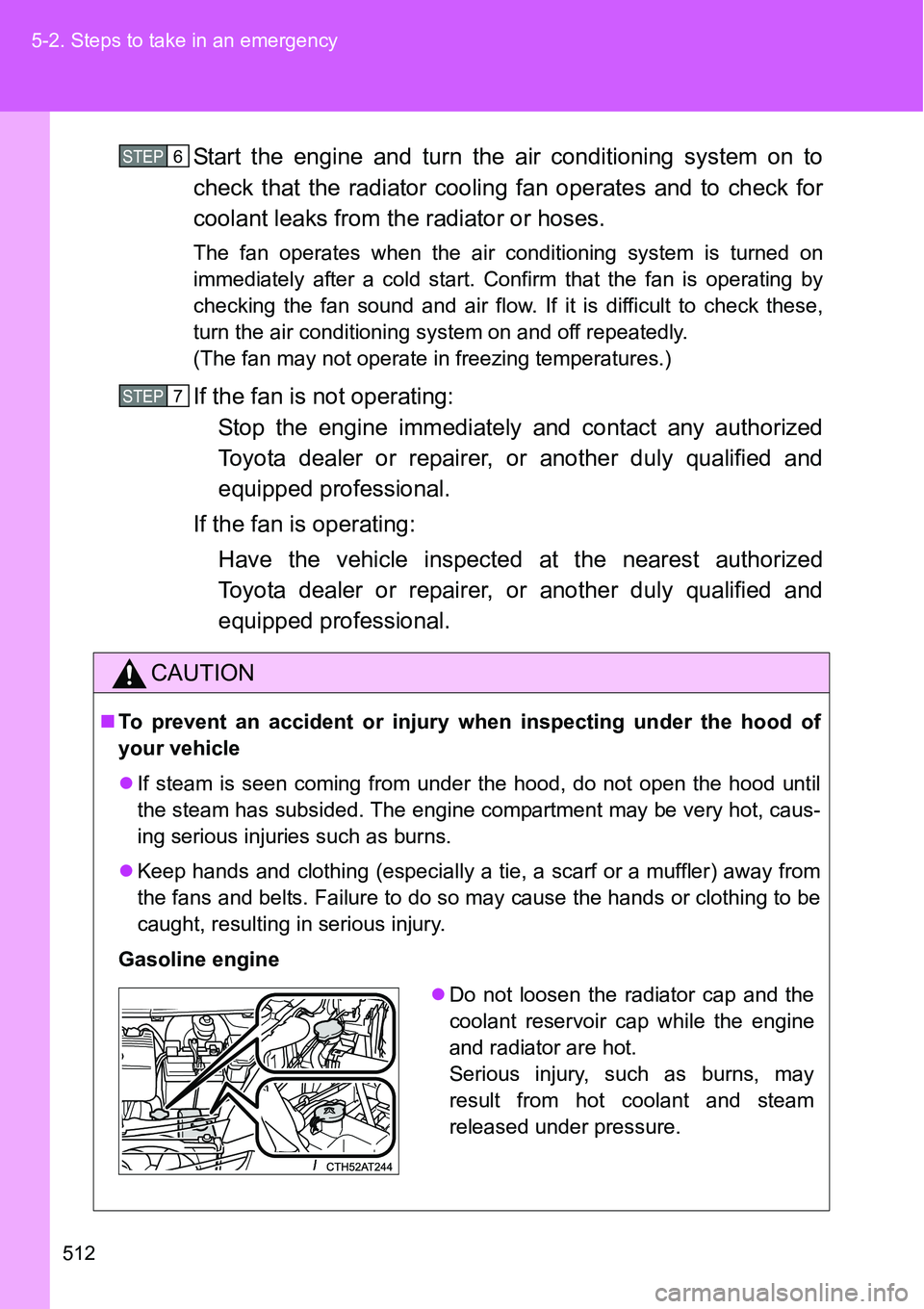
Gasoline engine
STEP6
STEP7
Do not loosen the radiator cap and the
coolant reservoir cap while the engine
and radiator are hot.
Serious injury, such as burns, may
result from hot coolant and steam
released under pressure.