ECU TOYOTA VERSO S 2015 Owner's Manual
[x] Cancel search | Manufacturer: TOYOTA, Model Year: 2015, Model line: VERSO S, Model: TOYOTA VERSO S 2015Pages: 564, PDF Size: 18.47 MB
Page 155 of 564
155 1-7. Safety information
1
Before driving
CAUTION
When installing a child restraint system
If child restraint system regulations exist in the country where you reside,
please contact any authorized Toyota dealer or repairer, or another duly
qualified and equipped professional for the child restraint system installa-
tion.
When installing a child restraint system on the rear center seat, adjust both
seatbacks at the same angle. The seatbacks must be adjusted to the
same angle. Otherwise, the child restraint system cannot be securely
restrained and this may cause death or serious injuries in the event of sud-
den braking, sudden swerving or an accident.
When a junior seat is installed, always ensure that the shoulder belt is
positioned across the center of the child's shoulder. The belt should be
kept away from the child's neck, but not so that it could fall off the child's
shoulder. Failure to do so may result in death or serious injury in the event
of sudden braking, sudden swerving or an accident.
Ensure that the belt and plate are securely locked and the seat belt is not
twisted.
Push and pull the child restraint system from side to side and forward to be
sure it is secure.
After securing a child restraint system, never adjust the seat.
Follow all installation instructions provided by the child restraint system
manufacturer.
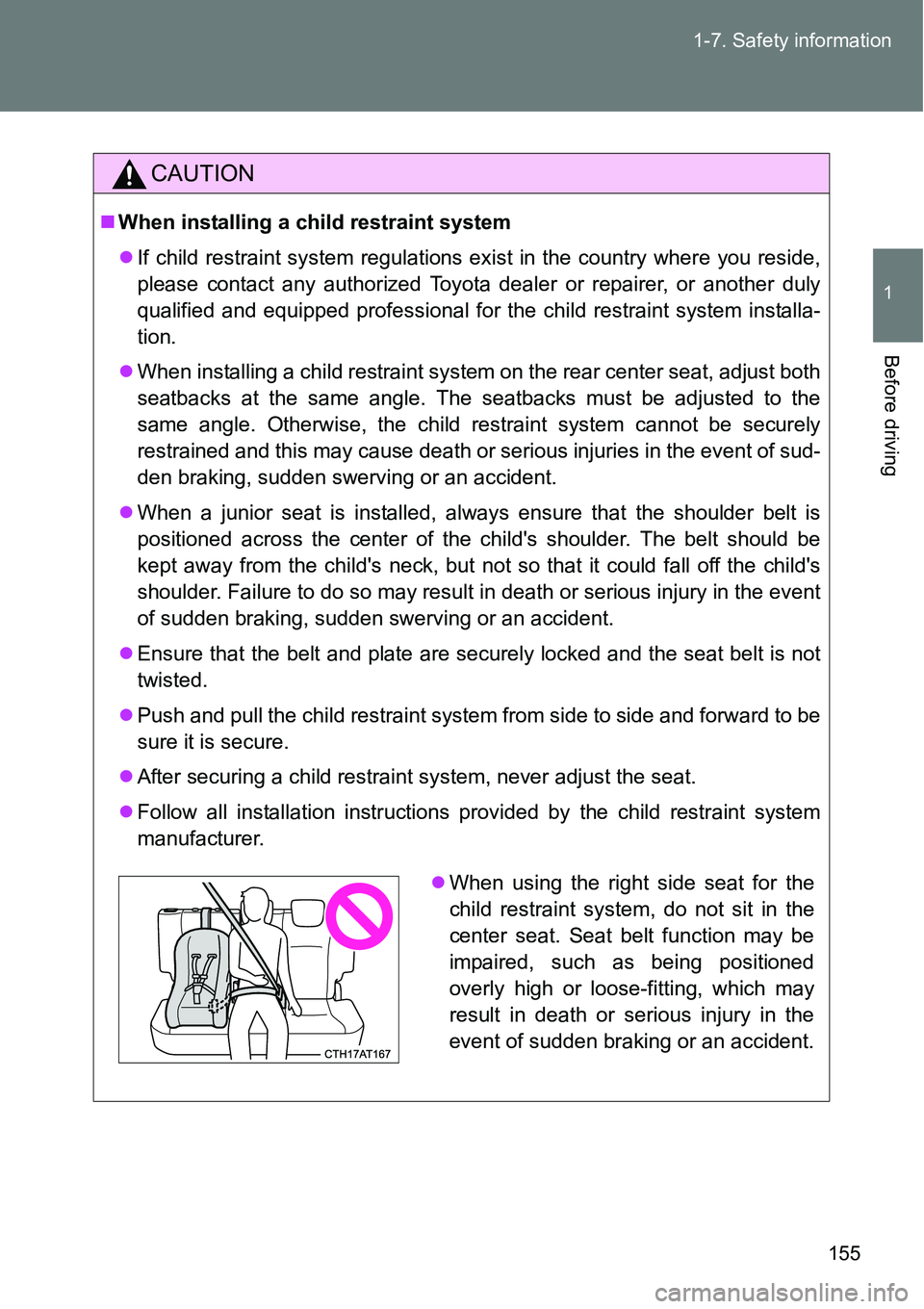
When using the right side seat for the
child restraint system, do not sit in the
center seat. Seat belt function may be
impaired, such as being positioned
overly high or loose-fitting, which may
result in death or serious injury in the
event of sudden braking or an accident.
Page 156 of 564
156 1-7. Safety information
CAUTION
To correctly attach a child restraint system to the anchors
When using the lower anchors, be sure that there are no foreign objects
around the anchors and that the seat belt is not caught behind the child
restraint system. Make sure the child restraint system is securely attached,
or it may cause death or serious injury to the child or other passengers in the
event of sudden braking, sudden swerve or an accident.
Page 166 of 564
166 2-1. Driving procedures
CAUTION
After driving through a puddle, lightly depress the brake pedal to make
sure that the brakes are functioning properly. Wet brake pads may prevent
the brakes from functioning properly. If the brakes on only one side are wet
and not functioning properly, steering control may be affected, resulting in
an accident.
When shifting the shift lever (except vehicles with a manual transmis-
sion)
Be careful not to shift the shift lever with the accelerator pedal depressed.
Shifting the shift lever to a gear other than P (vehicles with a Multidrive only)
or N may lead to unexpected rapid acceleration of the vehicle that may
cause an accident and result in death or serious injury.
If you hear a squealing or scraping noise (brake pad wear indicators)
Have the brake pads checked and replaced by any authorized Toyota dealer
or repairer, or another duly qualified and equipped professional as soon as
possible.
Rotor damage may result if the pads are not replaced when needed.
It is dangerous to drive the vehicle when the wear limits of the brake pads
and/or those of the brake discs are exceeded.
When the vehicle is stopped
Do not race the engine.
If the vehicle is in any gear other than P (vehicles with a Multidrive only) or
N, the vehicle may accelerate suddenly and unexpectedly, causing an
accident.
Do not leave the vehicle with the engine running for a long time.
If such a situation cannot be avoided, park the vehicle in an open space
and check that exhaust fumes do not enter the vehicle interior.
Except vehicles with a manual transmission: In order to prevent accidents
due to the vehicle rolling away, always keep depressing the brake pedal
while the engine is running, and apply the parking brake as necessary.
If the vehicle is stopped on an incline, in order to prevent accidents caused
by the vehicle rolling forward or backward, always depress the brake pedal
and securely apply the parking brake as needed.
Page 169 of 564
169 2-1. Driving procedures
2
When driving
CAUTION
When braking
When the brakes are wet, drive more cautiously.
Braking distance increases when the brakes are wet, and this may cause
one side of the vehicle to brake differently than the other side. Also, the
parking brake may not securely hold the vehicle.
If the power brake assist function does not operate, do not follow other
vehicles closely and avoid hills or sharp turns that require braking.
In this case, braking is still possible, but the brake pedal should be
depressed more firmly than usual. Also, the braking distance will increase.
Have your brakes fixed immediately.
Do not pump the brake pedal if the engine stalls.
Each push on the brake pedal uses up the reserve for the power-assisted
brakes.
The brake system consists of 2 individual hydraulic systems; if one of the
systems fails, the other will still operate. In this case, the brake pedal
should be depressed more firmly than usual and the braking distance will
increase. Have your brakes fixed immediately.
Page 178 of 564
178 2-1. Driving procedures
Operation of the “ENGINE START STOP” switch
When operating the “ENGINE START STOP” switch, one short, firm press is
enough. If the switch is pressed improperly, the engine may not start or the
“ENGINE START STOP” switch mode may not change. It is not necessary to
press and hold the switch.
Electronic key battery depletion
P. 4 4
Conditions affecting operation
P. 4 1
Notes for the entry function
P. 4 2
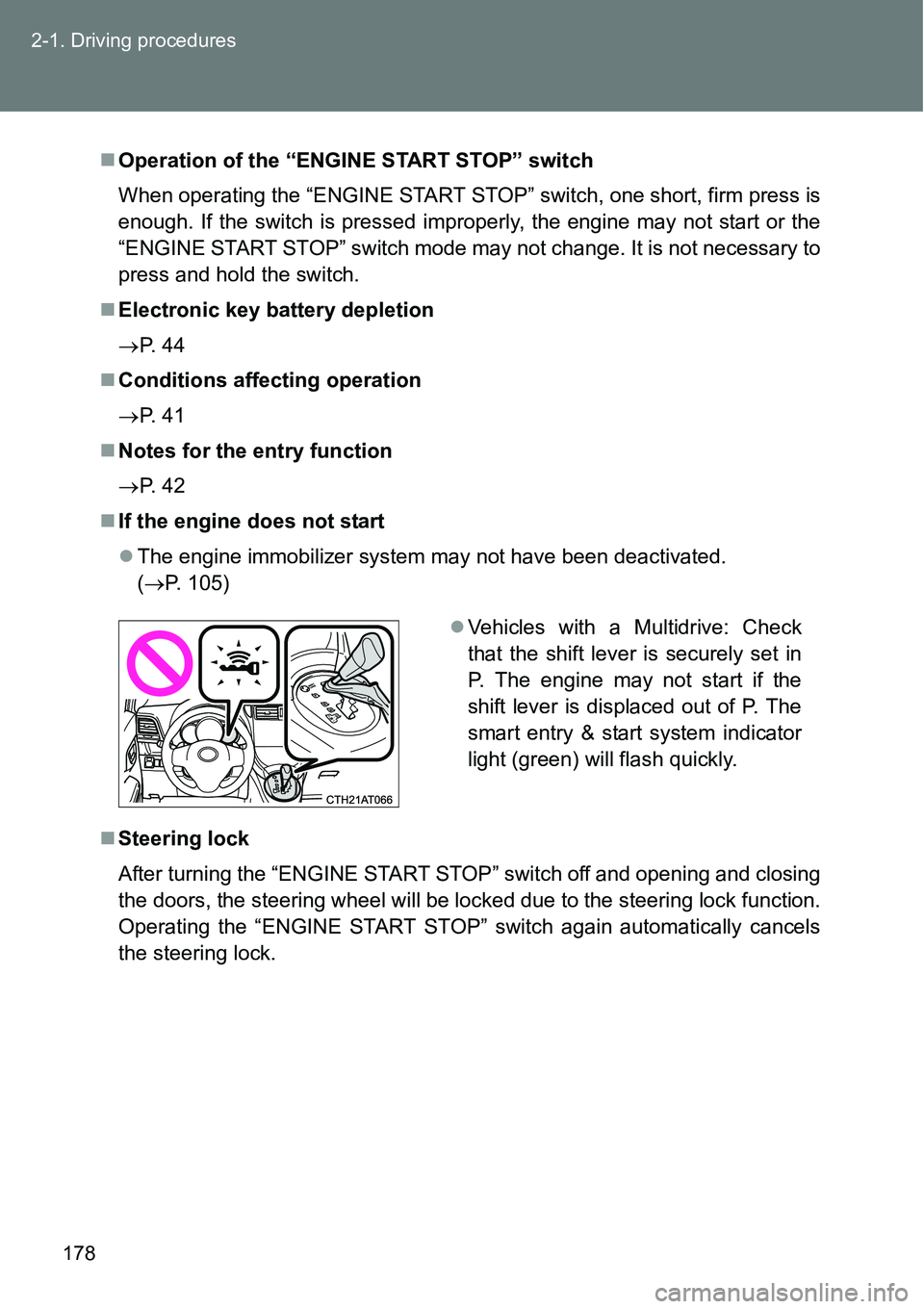
If the engine does not start
The engine immobilizer system may not have been deactivated.
(P. 105)
Steering lock
After turning the “ENGINE START STOP” switch off and opening and closing
the doors, the steering wheel will be locked due to the steering lock function.
Operating the “ENGINE START STOP” switch again automatically cancels
the steering lock.
Vehicles with a Multidrive: Check
that the shift lever is securely set in
P. The engine may not start if the
shift lever is displaced out of P. The
smart entry & start system indicator
light (green) will flash quickly.
Page 197 of 564
197
2-1. Driving procedures
2
When driving
Horn
After adjusting the steering wheel
Make sure that the steering wheel is securely locked.
The horn may not sound if the steering wheel is not securely locked.
(P. 92)
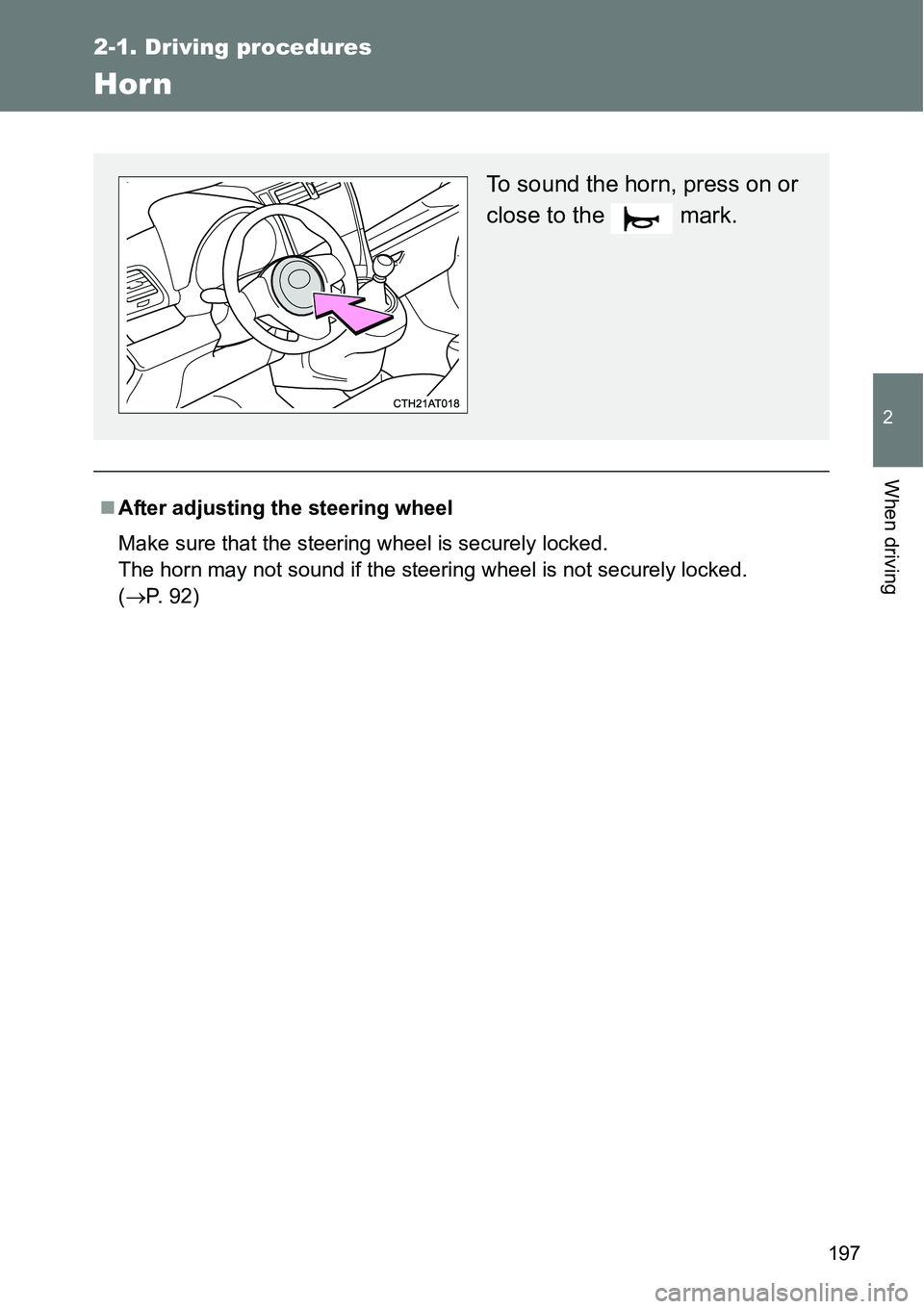
To sound the horn, press on or
close to the mark.
Page 219 of 564
219
2-3. Operating the lights and wipers
2
When driving
Fog light switch
The fog lights secure excellent visibility in difficult driving condi-
tions, such as in rain and fog.
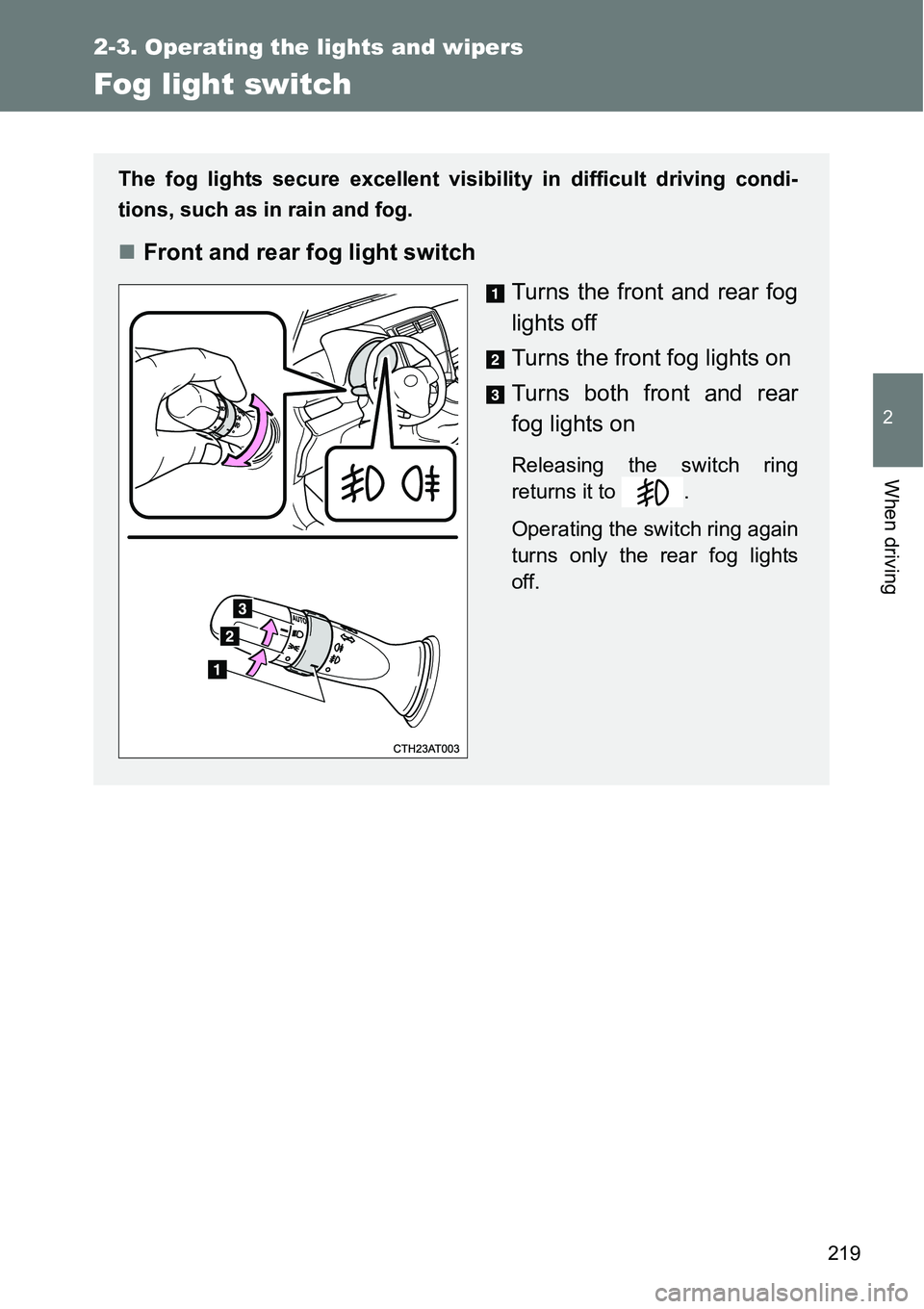
Front and rear fog light switch
Turns the front and rear fog
lights off
Turns the front fog lights on
Turns both front and rear
fog lights on
Releasing the switch ring
returns it to .
Operating the switch ring again
turns only the rear fog lights
off.
Page 248 of 564
248
2-5. Driving information
Cargo and luggage
CAUTION
Things that must not be carried in the luggage compartment
The following things may cause a fire if loaded in the luggage compartment:
Receptacles containing gasoline
Aerosol cans
Storage precautions
Observe the following precautions.
Failure to do so may result in death or serious injury.
Stow cargo and luggage in the luggage compartment whenever possible.
Do not stack anything in the luggage compartment higher than the seat-
backs.
Such items may be thrown about and possibly injure people in the vehicle
in the event of sudden braking or in an accident.
Do not place cargo or luggage in or on the following locations as the item
may get under the clutch, brake or accelerator pedal and prevent the ped-
als from being depressed properly, block the driver’s vision, or hit the
driver or passengers, causing an accident:
• At the feet of the driver
• On the front passenger or rear seats (when stacking items)
• On the luggage cover
• On the instrument panel
• On the dashboard
Take notice of the following information about storage precautions,
cargo capacity and load:
Stow cargo and luggage in the luggage compartment whenever
possible.
Be sure all items are secured in place.
To maintain vehicle balance while driving, position luggage
evenly within the luggage compartment.
For better fuel economy, do not carry unnecessary weight.
Page 249 of 564
249 2-5. Driving information
2
When driving
CAUTION
Secure all items in the occupant compartment, as they may shift and injure
someone during sudden braking, sudden swerving or an accident.
When you fold down the rear seats, long items should not be place directly
behind the front seats.
Never allow anyone to ride in the luggage compartment. It is not designed
for passengers. They should ride in their seats with their seat belts prop-
erly fastened. Otherwise, they are much more likely to suffer death or seri-
ous bodily injury, in the event of sudden braking, sudden swerving or an
accident.
Load and distribution
Do not overload your vehicle.
Do not apply loads unevenly.
Improper loading may cause deterioration of steering or braking control
which may cause death or serious injury.
Page 259 of 564
259 2-5. Driving information
2
When driving
Tire information
Ensure that your vehicle's tires are properly inflated. Adjust the tire pres-
sure to the recommended pressure. (P. 535)
Increase the air pressure of the trailer tires in accordance with the total
trailer weight and according to the values recommended by the manufac-
turer of your trailer.
Trailer lights
Check that the turn signal lights and stoplights are operating correctly every
time you hitch up the trailer. Directly wiring up to your vehicle may damage
the electrical system and stop the lights from functioning correctly.
Break-in schedule
Toyota recommends that vehicles fitted with new power train components
should not be used for towing trailers for the first 800 km (500 miles).
Safety checks before towing
Check that the maximum load limit for the towing hitch/bracket and hitch
ball is not exceeded. Bear in mind that the coupling weight of the trailer
will add to the load exerted on the vehicle. Also make sure that the total
load exerted on the vehicle is within the range of the weight limits.
(P. 255)
Ensure that the trailer load is secure.
Supplementary outside rear view mirrors should be added to the vehicle
if the traffic behind cannot be clearly seen with standard mirrors. Adjust
the extending arms of these mirrors on both sides of the vehicle so that
they always provide maximum visibility of the road behind.
Maintenance
Maintenance must be performed more frequently when using the vehicle
for towing due to the greater weight burden placed on the vehicle com-
pared to normal driving.
Retighten all bolts securing the hitching ball and bracket after towing for
approximately 1000 km (600 miles).