warning TOYOTA VERSO S 2015 Owner's Manual
[x] Cancel search | Manufacturer: TOYOTA, Model Year: 2015, Model line: VERSO S, Model: TOYOTA VERSO S 2015Pages: 564, PDF Size: 18.47 MB
Page 389 of 564
389 4-3. Do-it-yourself maintenance
4
Maintenance and care
When the initialization of the tire pressure warning system has failed
Initialization can be completed in a few minutes. However, in the following
cases, the settings have not been recorded and the system will not operate
properly. If repeated attempts to record tire inflation pressure settings are
unsuccessful, have the vehicle inspected by any authorized Toyota dealer or
repairer, or another duly qualified and equipped professional.
When operating the tire pressure warning reset switch, the tire pressure
warning light does not blink 3 times.
After driving for a certain period of time since the initialization has been
completed, the warning light comes on after blinking for 1 minute.
Page 390 of 564
390 4-3. Do-it-yourself maintenance
Tire pressure warning system certification
Page 393 of 564
393 4-3. Do-it-yourself maintenance
4
Maintenance and care
CAUTION
When inspecting or replacing tires
Observe the following precautions to prevent accidents.
Failure to do so may cause damage to parts of the drive train as well as dan-
gerous handling characteristics, which may lead to an accident resulting in
death or serious injury.
Do not mix tires of different makes, models or tread patterns.
Also, do not mix tires of remarkably different treadwear.
Do not use tire sizes other than those recommended by Toyota.
Do not mix differently constructed tires (radial, bias-belted or bias-ply
tires).
Do not mix summer, all season and snow tires.
Do not use tires that have been used on another vehicle.
Do not use tires if you do not know how they were used previously.
Vehicles with a compact spare tire: Do not tow if your vehicle has a com-
pact spare tire installed.
When initializing the tire pressure warning system
Do not operate the tire pressure warning reset switch without first adjusting
the tire inflation pressure to the specified level. Otherwise, the tire pressure
warning light may not come on even if the tire inflation pressure is low, or it
may come on when the tire inflation pressure is actually normal.
Page 394 of 564
394 4-3. Do-it-yourself maintenance
NOTICE
Repairing or replacing tires, wheels, tire pressure warning valves,
transmitters and tire valve caps
When removing or fitting the wheels, tires or the tire pressure warning
valves and transmitters, contact any authorized Toyota dealer or repairer,
or another duly qualified and equipped professional as the tire pressure
warning valves and transmitters may be damaged if not handled correctly.
When replacing tire valve caps, do not use tire valve caps other than those
specified. The cap may become stuck.
To avoid damage to the tire pressure warning valves and transmitters
When a tire is repaired with liquid sealants, the tire pressure warning valve
and transmitter may not operate properly. If a liquid sealant is used, contact
any authorized Toyota dealer or repairer, or another duly qualified and
equipped professional or other qualified service shop as soon as possible.
Make sure to replace the tire pressure warning valve and transmitter when
replacing the tire. (P. 384)
Driving on rough roads
Take particular care when driving on roads with loose surfaces or potholes.
These conditions may cause losses in tire inflation pressure, reducing the
cushioning ability of the tires. In addition, driving on rough roads may cause
damage to the tires themselves, as well as the vehicle’s wheels and body.
If tire inflation pressure of each tire becomes low while driving
Do not continue driving, or your tires and/or wheels may be ruined.
Page 398 of 564
398 4-3. Do-it-yourself maintenance
When replacing wheels
The wheels of your vehicle are equipped with tire pressure warning valves
and transmitters that allow the tire pressure warning system to provide
advance warning in the event of a loss in tire inflation pressure. Whenever
wheels are replaced, tire pressure warning valves and transmitters must be
installed. (P. 385)
CAUTION
When replacing wheels
Do not use wheels that are a different size from those recommended in the
Owner’s Manual, as this may result in a loss of handling control.
Never use an inner tube in a leaking wheel which is designed for a tube-
less tire. Doing so may result in an accident, causing death or serious
injury.
When installing the wheel nuts
Never use oil or grease on the wheel bolts or wheel nuts.
Oil and grease may cause the wheel nuts to be excessively tightened,
leading to bolt or disc wheel damage. In addition, the oil or grease can
cause the wheel nuts to loosen and the wheel may fall off, causing an acci-
dent and resulting in death or serious injury. Remove any oil or grease
from the wheel bolts or wheel nuts.
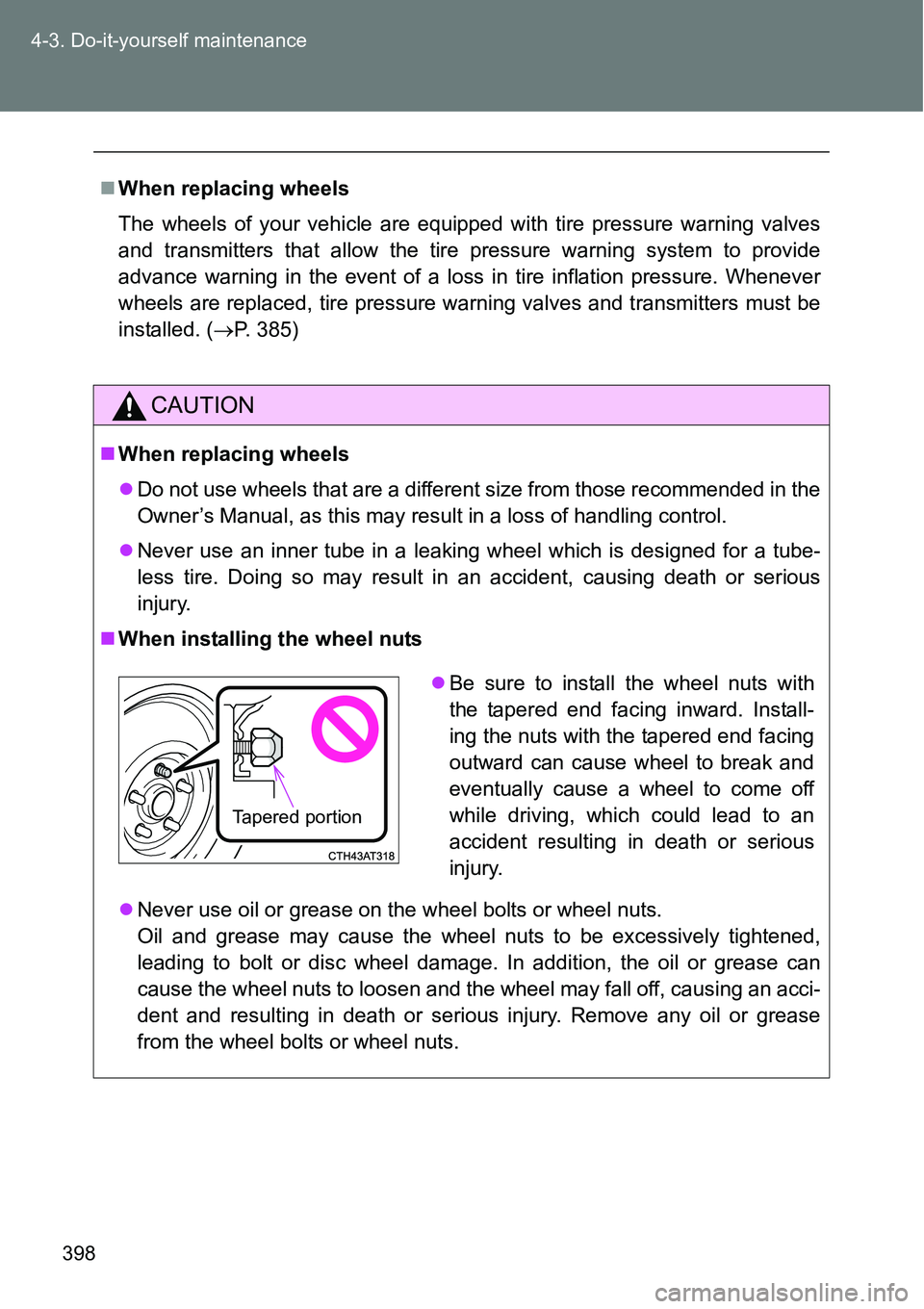
Be sure to install the wheel nuts with
the tapered end facing inward. Install-
ing the nuts with the tapered end facing
outward can cause wheel to break and
eventually cause a wheel to come off
while driving, which could lead to an
accident resulting in death or serious
injury.
Tapered portion
Page 399 of 564
399 4-3. Do-it-yourself maintenance
4
Maintenance and care
NOTICE
Replacing tire pressure warning valves and transmitters
Because tire repair or replacement may affect the tire pressure warning
valves and transmitters, make sure to have tires serviced by any autho-
rized Toyota dealer or repairer, or another duly qualified and equipped pro-
fessional or other qualified service shop. In addition, make sure to
purchase your tire pressure warning valves and transmitters at any autho-
rized Toyota dealer or repairer, or another duly qualified and equipped pro-
fessional.
Ensure that only genuine Toyota wheels are used on your vehicle.
Tire pressure warning valves and transmitters may not work properly with
non-genuine wheels.
Page 416 of 564
416 4-3. Do-it-yourself maintenance
*1: Vehicles with a gasoline engine
*2: Vehicles with a diesel engine
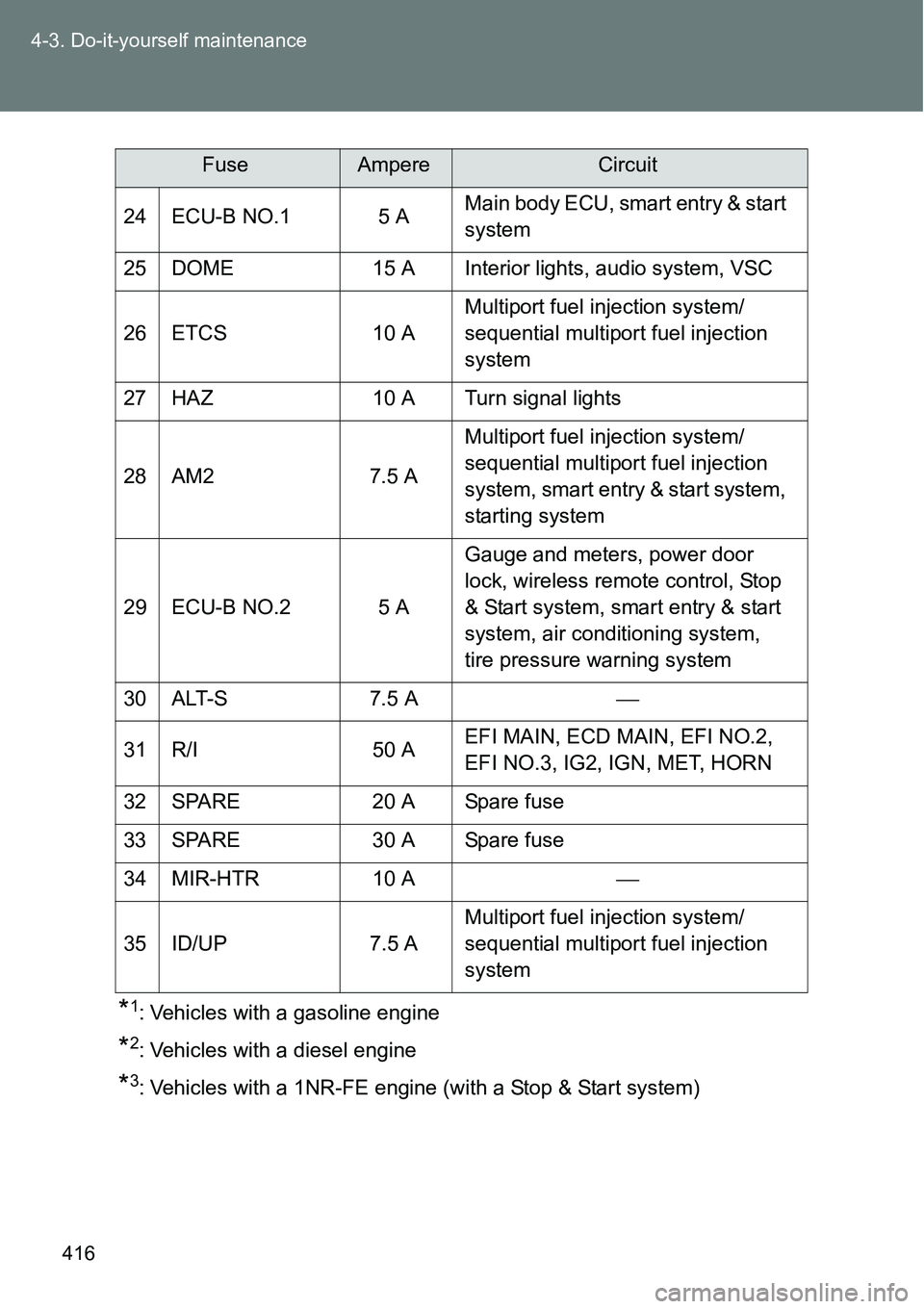
*3: Vehicles with a 1NR-FE engine (with a Stop & Start system) 24 ECU-B NO.1 5 AMain body ECU, smart entry & start
system
25 DOME 15 A Interior lights, audio system, VSC
26 ETCS 10 AMultiport fuel injection system/
sequential multiport fuel injection
system
27 HAZ 10 A Turn signal lights
28 AM2 7.5 AMultiport fuel injection system/
sequential multiport fuel injection
system, smart entry & start system,
starting system
29 ECU-B NO.2 5 AGauge and meters, power door
lock, wireless remote control, Stop
& Start system, smart entry & start
system, air conditioning system,
tire pressure warning system
30 ALT-S 7.5 A
31 R/I 50 AEFI MAIN, ECD MAIN, EFI NO.2,
EFI NO.3, IG2, IGN, MET, HORN
32 SPARE 20 A Spare fuse
33 SPARE 30 A Spare fuse
34 MIR-HTR 10 A
35 ID/UP 7.5 AMultiport fuel injection system/
sequential multiport fuel injection
system
FuseAmpereCircuit
Page 420 of 564
420 4-3. Do-it-yourself maintenance
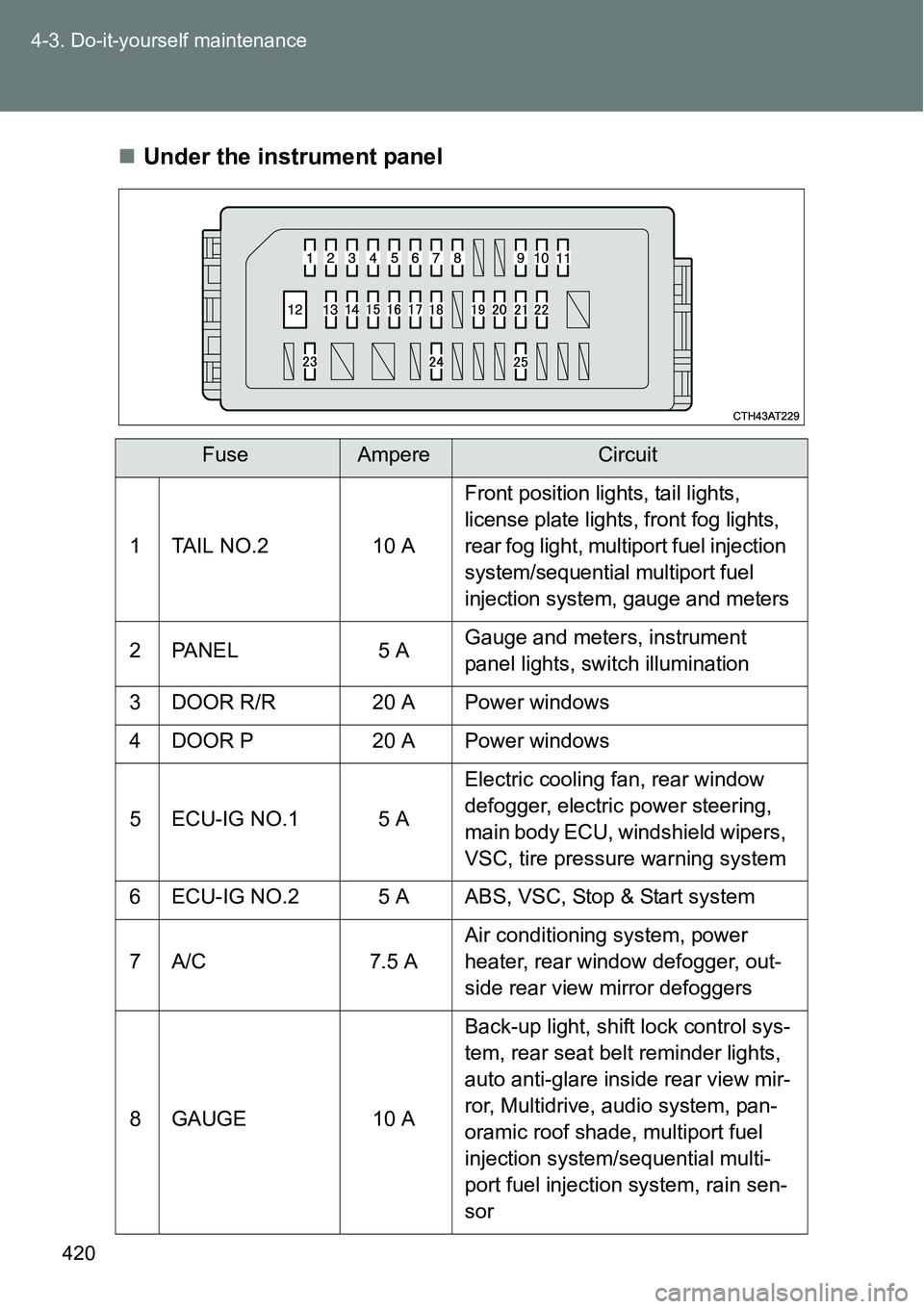
Under the instrument panel
FuseAmpereCircuit
1 TAIL NO.2 10 A
Front position lights, tail lights,
license plate lights, front fog lights,
rear fog light, multiport fuel injection
system/sequential multiport fuel
injection system, gauge and meters
2 PANEL 5 AGauge and meters, instrument
panel lights, switch illumination
3 DOOR R/R 20 A Power windows
4 DOOR P 20 A Power windows
5 ECU-IG NO.1 5 AElectric cooling fan, rear window
defogger, electric power steering,
main body ECU, windshield wipers,
VSC, tire pressure warning system
6 ECU-IG NO.2 5 A ABS, VSC, Stop & Start system
7A/C 7.5 AAir conditioning system, power
heater, rear window defogger, out-
side rear view mirror defoggers
8 GAUGE 10 ABack-up light, shift lock control sys-
tem, rear seat belt reminder lights,
auto anti-glare inside rear view mir-
ror, Multidrive, audio system, pan-
oramic roof shade, multiport fuel
injection system/sequential multi-
port fuel injection system, rain sen-
sor
Page 435 of 564
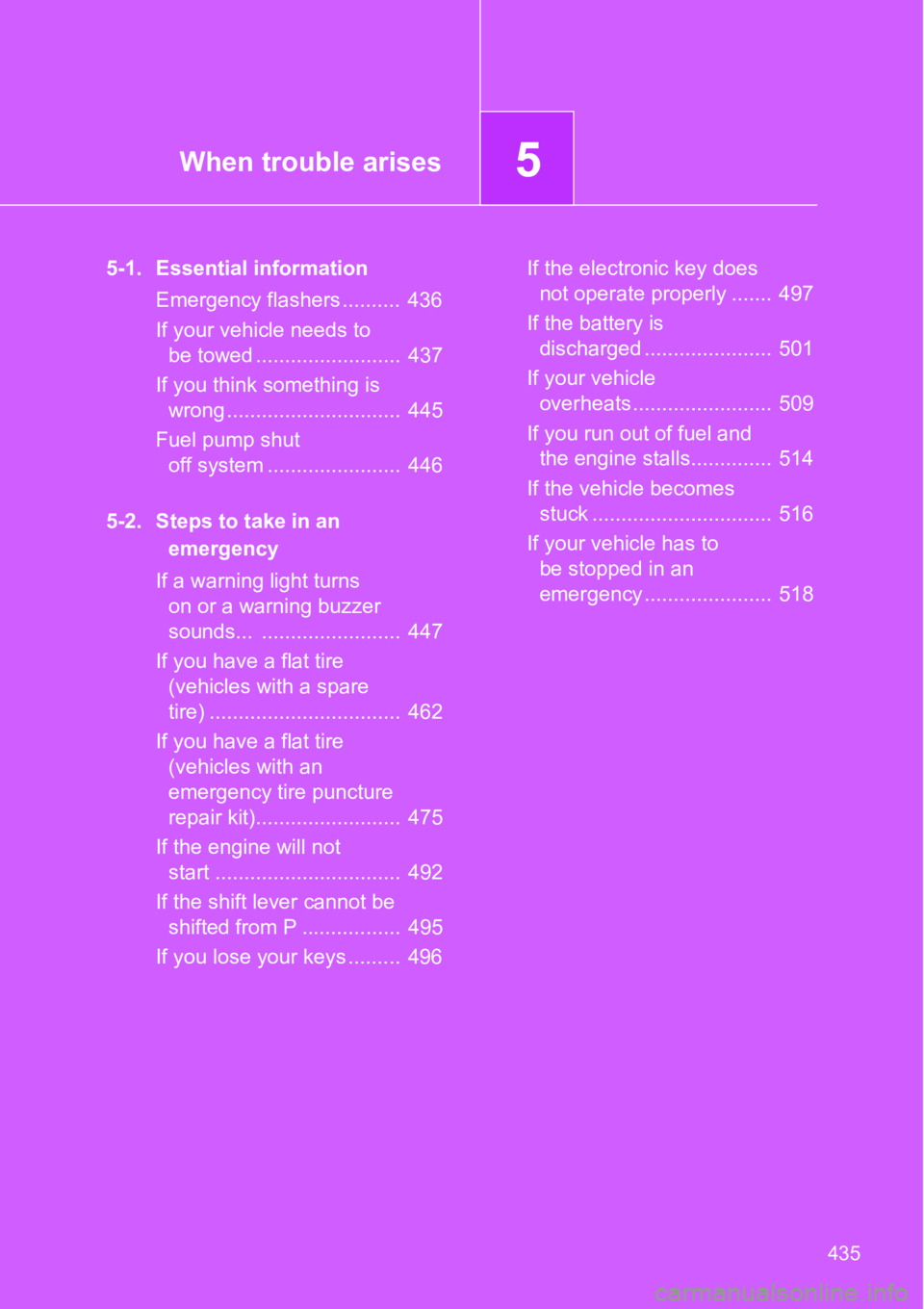
5When trouble arises
435
5-1. Essential information
Emergency flashers .......... 436
If your vehicle needs to
be towed ......................... 437
If you think something is
wrong .............................. 445
Fuel pump shut
off system ....................... 446
5-2. Steps to take in an
emergency
If a warning light turns
on or a warning buzzer
sounds... ........................ 447
If you have a flat tire
(vehicles with a spare
tire) ................................. 462
If you have a flat tire
(vehicles with an
emergency tire puncture
repair kit)......................... 475
If the engine will not
start ................................ 492
If the shift lever cannot be
shifted from P ................. 495
If you lose your keys ......... 496If the electronic key does
not operate properly ....... 497
If the battery is
discharged ...................... 501
If your vehicle
overheats ........................ 509
If you run out of fuel and
the engine stalls.............. 514
If the vehicle becomes
stuck ............................... 516
If your vehicle has to
be stopped in an
emergency ...................... 518
Page 445 of 564
5
445
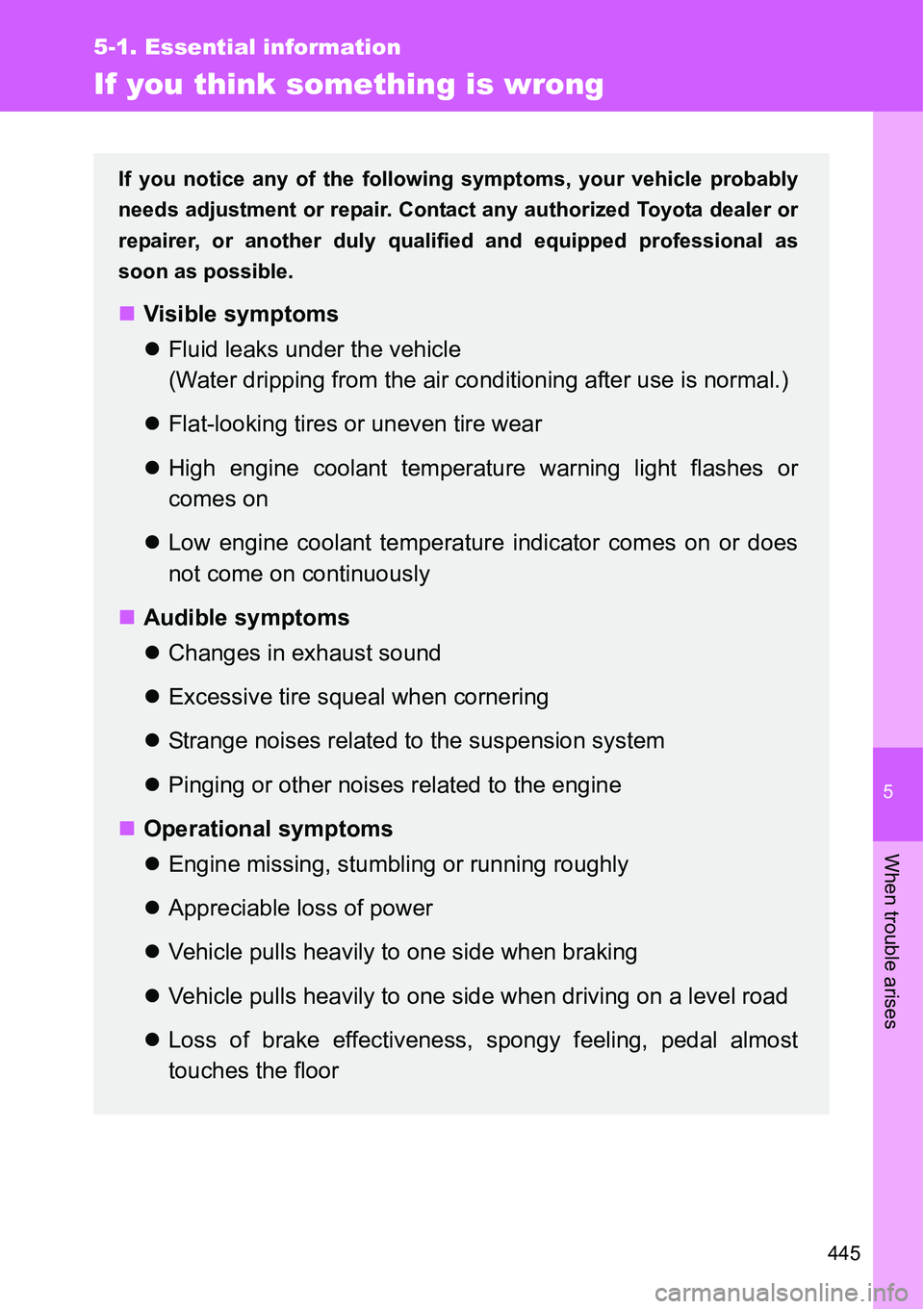
5-1. Essential information
When trouble arises
If you think something is wrong
If you notice any of the following symptoms, your vehicle probably
needs adjustment or repair. Contact any authorized Toyota dealer or
repairer, or another duly qualified and equipped professional as
soon as possible.
Visible symptoms
Fluid leaks under the vehicle
(Water dripping from the air conditioning after use is normal.)
Flat-looking tires or uneven tire wear
High engine coolant temperature warning light flashes or
comes on
Low engine coolant temperature indicator comes on or does
not come on continuously
Audible symptoms
Changes in exhaust sound
Excessive tire squeal when cornering
Strange noises related to the suspension system
Pinging or other noises related to the engine
Operational symptoms
Engine missing, stumbling or running roughly
Appreciable loss of power
Vehicle pulls heavily to one side when braking
Vehicle pulls heavily to one side when driving on a level road
Loss of brake effectiveness, spongy feeling, pedal almost
touches the floor