mirror TOYOTA VERSO S 2015 Owner's Guide
[x] Cancel search | Manufacturer: TOYOTA, Model Year: 2015, Model line: VERSO S, Model: TOYOTA VERSO S 2015Pages: 564, PDF Size: 18.47 MB
Page 97 of 564
97 1-3. Adjustable components (seats, mirrors, steering wheel)
1
Before driving
Mirror angle can be adjusted when
Vehicles without a smart entry & start system
The engine switch is in the “ACC” or “ON” position.
Vehicles with a smart entry & start system
The “ENGINE START STOP” switch is in ACCESSORY or IGNITION ON
mode.
When the mirrors are fogged up (vehicles with outside rear view mirror
defoggers)
Turn on the mirror defoggers to defog the mirrors. (P. 281)
CAUTION
When driving the vehicle
Observe the following precautions while driving.
Failure to do so may result in loss of control of the vehicle and cause an
accident, resulting in death or serious injury.
Do not adjust the mirrors while driving.
Do not drive with the mirrors folded.
Both the driver and passenger side mirrors must be extended and properly
adjusted before driving.
When a mirror is moving
To avoid personal injury and mirror malfunction, be careful not to get your
hand caught by the moving mirror.
When the mirror defoggers are operating (vehicles with outside rear
view mirror defoggers)
Do not touch the rear view mirror surfaces, as they can become very hot and
burn you.
Page 165 of 564
165 2-1. Driving procedures
2
When driving
CAUTION
Do not shift the shift lever to D (vehicles with a Multidrive) or 1 (vehicles
with a manual transmission) while the vehicle is moving backward.
Doing so can damage the transmission and may result in a loss of vehicle
control.
Moving the shift lever to N while the vehicle is moving will disengage the
engine from the transmission. Engine braking is not available when N is
selected.
During normal driving, do not turn off the engine. Turning the engine off
while driving will not cause loss of steering or braking control, but the
power assist to these systems will be lost. This will make it more difficult to
steer and brake, so you should pull over and stop the vehicle as soon as it
is safe to do so.
However, in the event of an emergency, such as if it becomes impossible
to stop the vehicle in the normal way: P. 518
Use engine braking (downshift) to maintain a safe speed when driving
down a steep hill.
Using the brakes continuously may cause the brakes to overheat and lose
effectiveness. (P. 187)
When stopped on an inclined surface, use the brake pedal and parking
brake to prevent the vehicle from rolling backward or forward and causing
an accident.
Do not adjust the positions of the steering wheel, the seat, or the inside or
outside rear view mirrors while driving.
Doing so may result in a loss of vehicle control that can cause accidents,
resulting in death or serious injury.
Always check that all passengers' arms, heads or other parts of their body
are not outside the vehicle, as this may result in death or serious injury.
When driving on slippery road surfaces
Sudden braking, acceleration and steering may cause tire slippage and
reduce your ability to control the vehicle, resulting in an accident.
Sudden changes in engine speed, such as engine braking caused by up-
shifting and down-shifting, may cause the vehicle to skid, resulting in an
accident.
Page 259 of 564
259 2-5. Driving information
2
When driving
Tire information
Ensure that your vehicle's tires are properly inflated. Adjust the tire pres-
sure to the recommended pressure. (P. 535)
Increase the air pressure of the trailer tires in accordance with the total
trailer weight and according to the values recommended by the manufac-
turer of your trailer.
Trailer lights
Check that the turn signal lights and stoplights are operating correctly every
time you hitch up the trailer. Directly wiring up to your vehicle may damage
the electrical system and stop the lights from functioning correctly.
Break-in schedule
Toyota recommends that vehicles fitted with new power train components
should not be used for towing trailers for the first 800 km (500 miles).
Safety checks before towing
Check that the maximum load limit for the towing hitch/bracket and hitch
ball is not exceeded. Bear in mind that the coupling weight of the trailer
will add to the load exerted on the vehicle. Also make sure that the total
load exerted on the vehicle is within the range of the weight limits.
(P. 255)
Ensure that the trailer load is secure.
Supplementary outside rear view mirrors should be added to the vehicle
if the traffic behind cannot be clearly seen with standard mirrors. Adjust
the extending arms of these mirrors on both sides of the vehicle so that
they always provide maximum visibility of the road behind.
Maintenance
Maintenance must be performed more frequently when using the vehicle
for towing due to the greater weight burden placed on the vehicle com-
pared to normal driving.
Retighten all bolts securing the hitching ball and bracket after towing for
approximately 1000 km (600 miles).
Page 265 of 564

3Interior features
265
3-1. Using the air
conditioning system
and defogger
Manual air conditioning
system ............................ 266
Automatic air conditioning
system ............................ 272
Power heater .................... 279
Rear window and
outside rear view
mirror defoggers ............. 281
3-2. Using the audio system
Audio system types .......... 283
Using the radio ................. 285
Using the CD player ......... 289
Playing back MP3 and
WMA discs...................... 294
Operating an iPod............. 301
Operating a USB
memory........................... 309
Optimal use of the audio
system ............................ 317
Using the AUX port ........... 319
Using the steering wheel
audio switches ................ 320
3-3. Using the interior lights
Interior lights list................ 323
• Personal lights ................ 324
• Personal/interior
lights ............................... 324
• Interior light ..................... 3253-4. Using the storage
features
List of storage features ..... 326
• Auxiliary box ................... 327
• Glove box ....................... 327
• Bottle holders.................. 329
• Tray ................................ 330
• Cup holders .................... 331
3-5. Other interior features
Sun visors ......................... 332
Vanity mirrors.................... 333
Clock ................................. 334
Outside temperature
display ............................ 335
Power outlets .................... 336
Seat heaters ..................... 338
Armrests ........................... 340
Panoramic roof shade....... 341
Assist grips ....................... 344
Floor mat........................... 345
Luggage compartment
features........................... 347
Page 281 of 564
281
3-1. Using the air conditioning system and defogger
3
Interior features
Rear window and outside rear view mirror defoggers
The defoggers can be operated when
Vehicles without a smart entry & start system
The engine switch is in the “ON” position.
Vehicles with a smart entry & start system
The “ENGINE START STOP” switch is in IGNITION ON mode.
Outside rear view mirror defoggers (if equipped)
Turning the rear window defogger on will turn the outside rear view mirror
defoggers on.
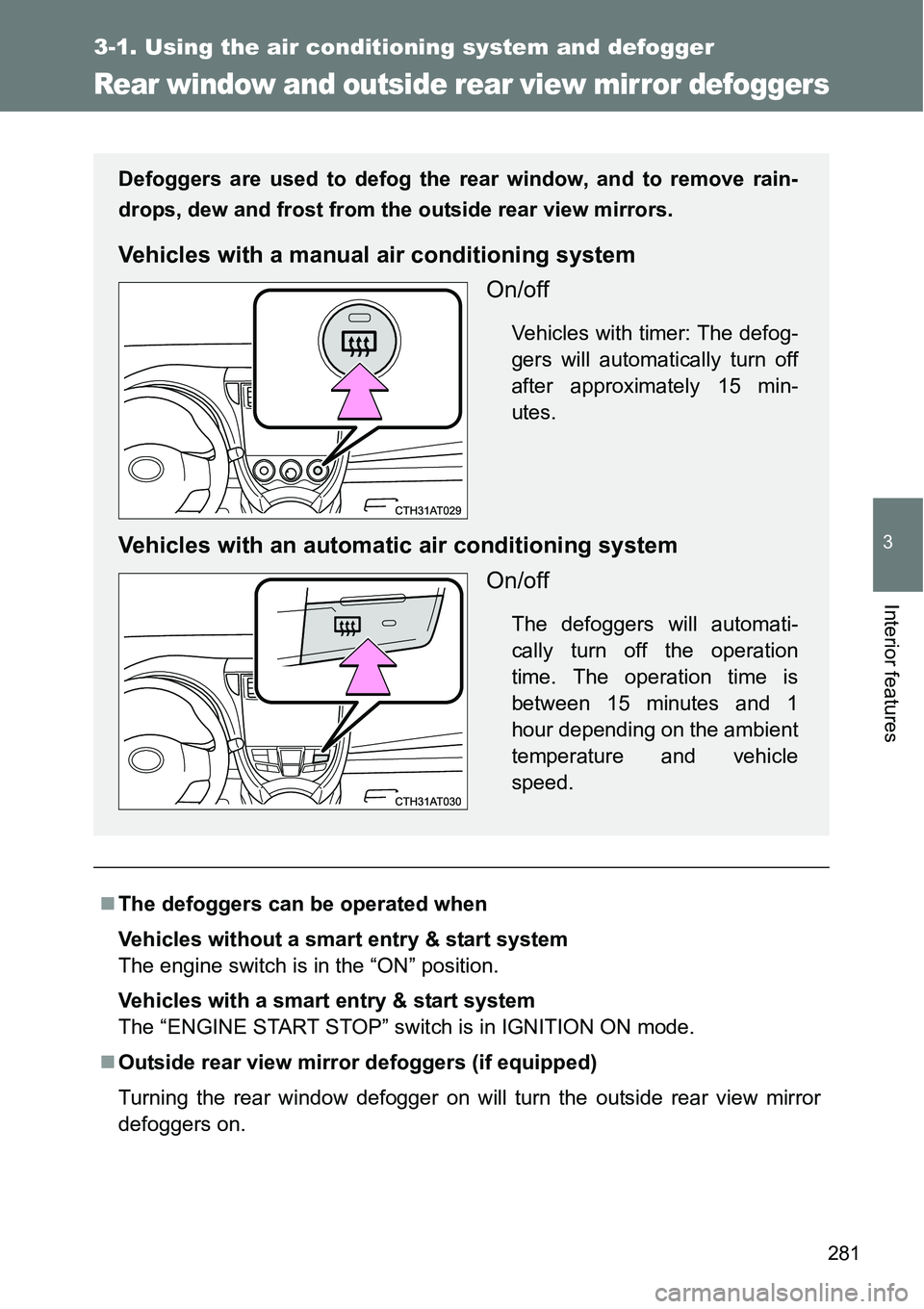
Defoggers are used to defog the rear window, and to remove rain-
drops, dew and frost from the outside rear view mirrors.
Vehicles with a manual air conditioning system
On/off
Vehicles with timer: The defog-
gers will automatically turn off
after approximately 15 min-
utes.
Vehicles with an automatic air conditioning system
On/off
The defoggers will automati-
cally turn off the operation
time. The operation time is
between 15 minutes and 1
hour depending on the ambient
temperature and vehicle
speed.
Page 282 of 564
282 3-1. Using the air conditioning system and defogger
CAUTION
Outside rear view mirror defoggers (if equipped)
The surfaces of the outside rear view mirrors may become hot. To prevent
burns do not touch the mirrors.
NOTICE
To prevent battery discharge (vehicles without timer)
Do not leave the rear window defogger on longer than necessary when the
engine is stopped.
Page 333 of 564
333
3-5. Other interior features
3
Interior features
Vanity mirrors
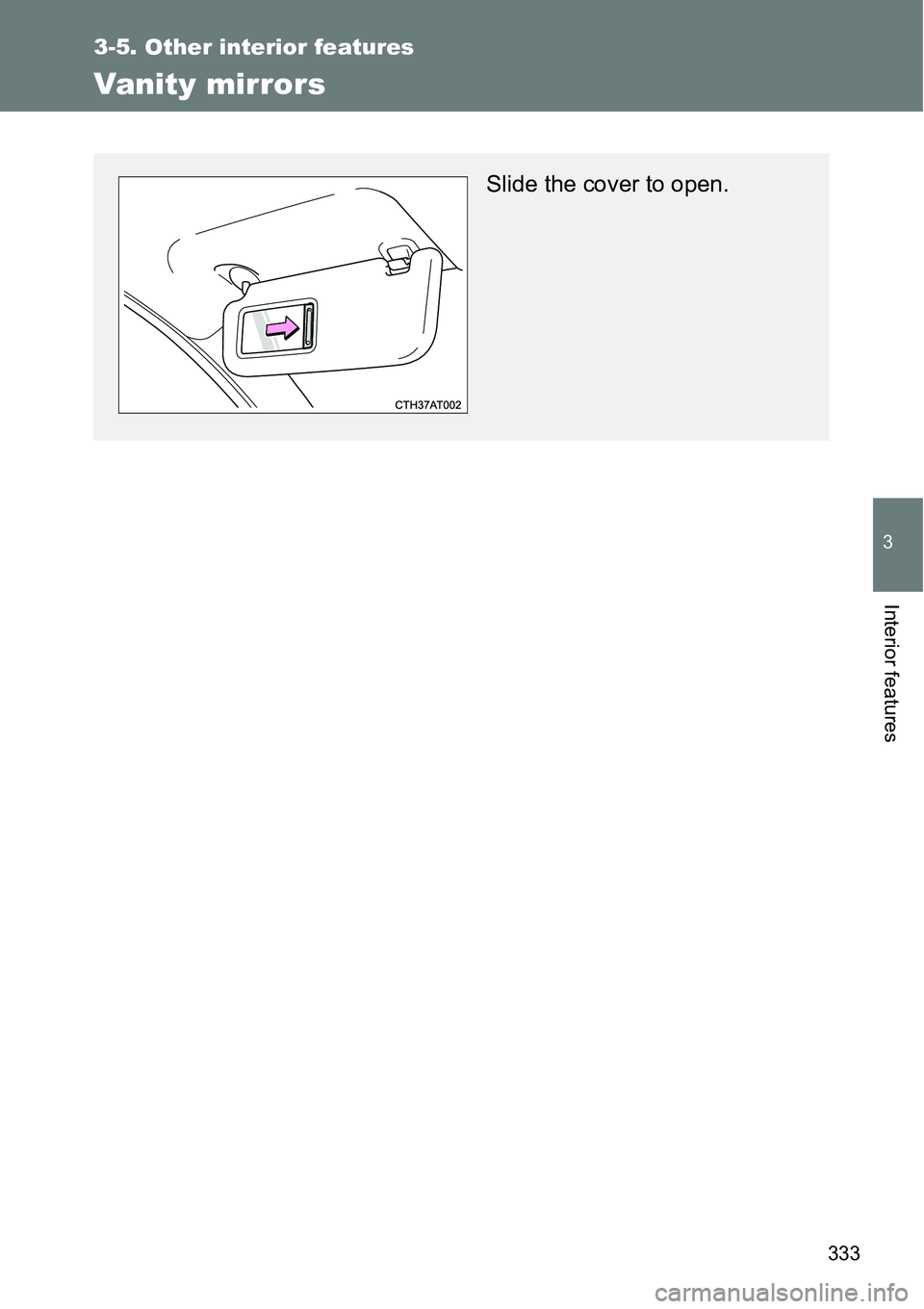
Slide the cover to open.
Page 354 of 564
354
4-1. Maintenance and care
Cleaning and protecting the vehicle exterior
Automatic car washes
Fold the mirrors and remove the antenna before washing the vehicle.
Start washing from the front of the vehicle. Make sure to re-install the
antenna and extend the mirrors before driving.
Brushes used in automatic car washes may scratch the vehicle surface
and harm your vehicle’s paint.
In certain automatic car washes, the rear spoiler may interfere with
machine operation. This may prevent the vehicle from being cleaned
properly or result in damage to the rear spoiler.
High pressure car washes
Do not allow the nozzles of the car wash to come within close proximity
of the windows.
Before using the car wash, check that the fuel filler door on your vehicle
is closed properly.
Perform the following to protect the vehicle and maintain it in prime
condition:
Working from top to bottom, liberally apply water to the vehicle
body, wheel wells and underside of the vehicle to remove any
dirt and dust.
Wash the vehicle body using a sponge or soft cloth, such as a
chamois.
For hard-to-remove marks, use car wash soap and rinse thor-
oughly with water.
Wipe away any water.
Wax the vehicle when the waterproof coating deteriorates.
If water does not bead on a clean surface, apply wax when the vehicle
body is cool.
Page 420 of 564
420 4-3. Do-it-yourself maintenance
Under the instrument panel
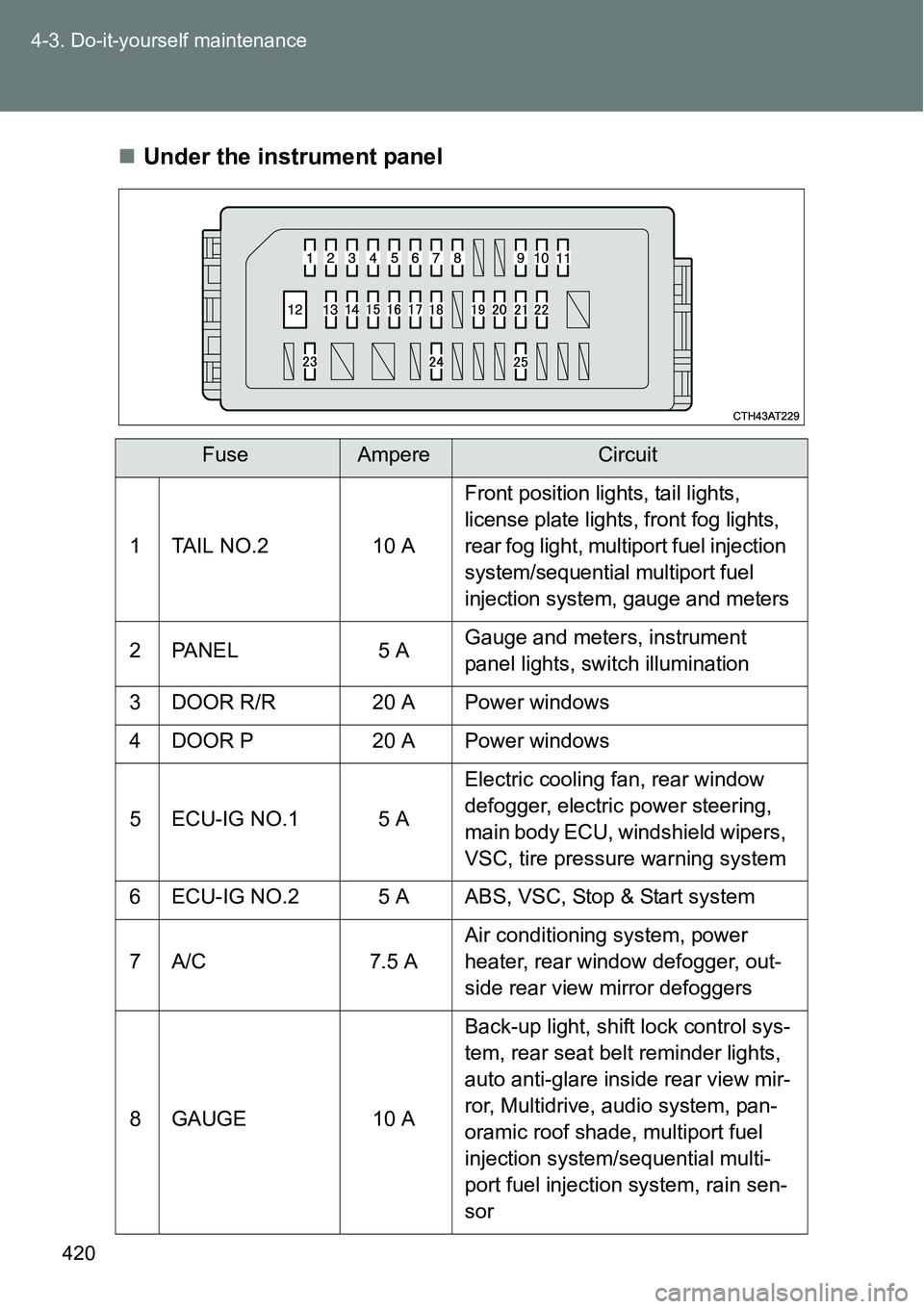
FuseAmpereCircuit
1 TAIL NO.2 10 A
Front position lights, tail lights,
license plate lights, front fog lights,
rear fog light, multiport fuel injection
system/sequential multiport fuel
injection system, gauge and meters
2 PANEL 5 AGauge and meters, instrument
panel lights, switch illumination
3 DOOR R/R 20 A Power windows
4 DOOR P 20 A Power windows
5 ECU-IG NO.1 5 AElectric cooling fan, rear window
defogger, electric power steering,
main body ECU, windshield wipers,
VSC, tire pressure warning system
6 ECU-IG NO.2 5 A ABS, VSC, Stop & Start system
7A/C 7.5 AAir conditioning system, power
heater, rear window defogger, out-
side rear view mirror defoggers
8 GAUGE 10 ABack-up light, shift lock control sys-
tem, rear seat belt reminder lights,
auto anti-glare inside rear view mir-
ror, Multidrive, audio system, pan-
oramic roof shade, multiport fuel
injection system/sequential multi-
port fuel injection system, rain sen-
sor
Page 421 of 564
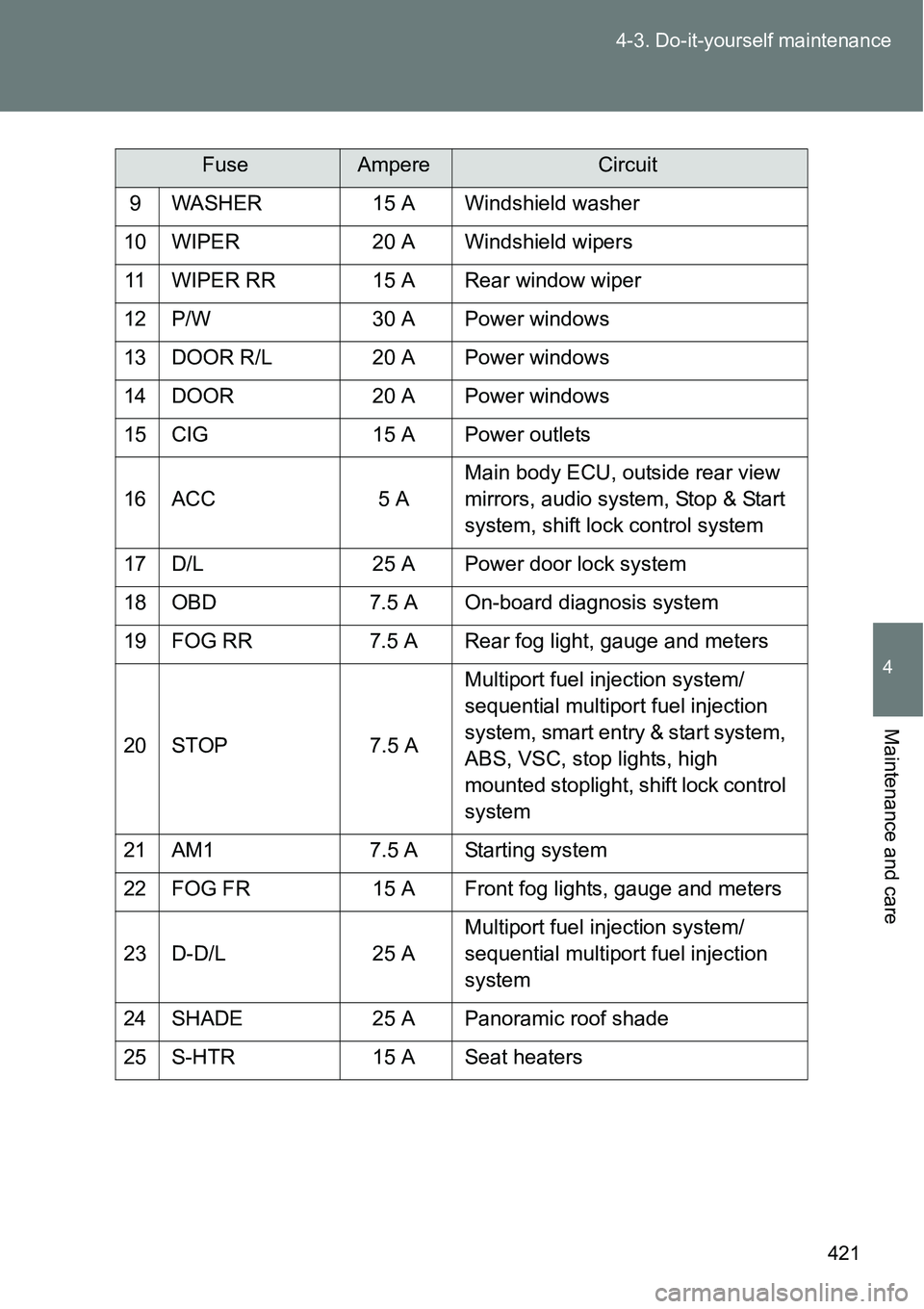
421 4-3. Do-it-yourself maintenance
4
Maintenance and care
9 WASHER 15 A Windshield washer
10 WIPER 20 A Windshield wipers
11 WIPER RR 15 A Rear window wiper
12 P/W 30 A Power windows
13 DOOR R/L 20 A Power windows
14 DOOR 20 A Power windows
15 CIG 15 A Power outlets
16 ACC 5 AMain body ECU, outside rear view
mirrors, audio system, Stop & Start
system, shift lock control system
17 D/L 25 A Power door lock system
18 OBD 7.5 A On-board diagnosis system
19 FOG RR 7.5 A Rear fog light, gauge and meters
20 STOP 7.5 AMultiport fuel injection system/
sequential multiport fuel injection
system, smart entry & start system,
ABS, VSC, stop lights, high
mounted stoplight, shift lock control
system
21 AM1 7.5 A Starting system
22 FOG FR 15 A Front fog lights, gauge and meters
23 D-D/L 25 AMultiport fuel injection system/
sequential multiport fuel injection
system
24 SHADE 25 A Panoramic roof shade
25 S-HTR 15 A Seat heaters
FuseAmpereCircuit