steering TOYOTA VERSO S 2015 Repair Manual
[x] Cancel search | Manufacturer: TOYOTA, Model Year: 2015, Model line: VERSO S, Model: TOYOTA VERSO S 2015Pages: 564, PDF Size: 18.47 MB
Page 443 of 564
5
443 5-1. Essential information
When trouble arises
CAUTION
Observe the following precautions.
Failure to do so may result in death or serious injury.
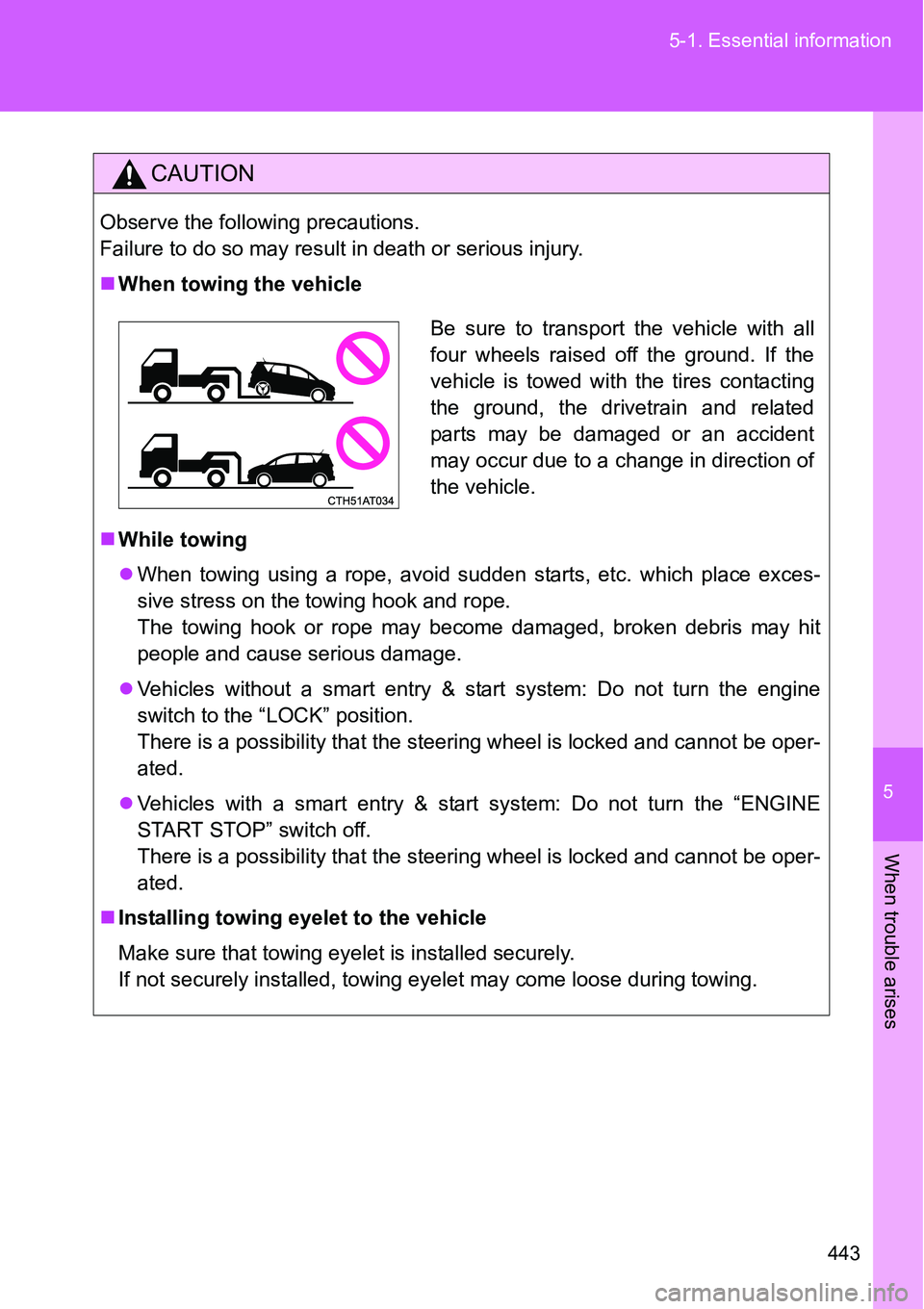
When towing the vehicle
While towing
When towing using a rope, avoid sudden starts, etc. which place exces-
sive stress on the towing hook and rope.
The towing hook or rope may become damaged, broken debris may hit
people and cause serious damage.
Vehicles without a smart entry & start system: Do not turn the engine
switch to the “LOCK” position.
There is a possibility that the steering wheel is locked and cannot be oper-
ated.
Vehicles with a smart entry & start system: Do not turn the “ENGINE
START STOP” switch off.
There is a possibility that the steering wheel is locked and cannot be oper-
ated.
Installing towing eyelet to the vehicle
Make sure that towing eyelet is installed securely.
If not securely installed, towing eyelet may come loose during towing.
Be sure to transport the vehicle with all
four wheels raised off the ground. If the
vehicle is towed with the tires contacting
the ground, the drivetrain and related
parts may be damaged or an accident
may occur due to a change in direction of
the vehicle.
Page 449 of 564
5
449 5-2. Steps to take in an emergency
When trouble arises
Have the vehicle inspected immediately.
Failure to investigate the cause of the following warnings may lead to
the system operating abnormally and possibly cause an accident.
Have the vehicle inspected by any authorized Toyota dealer or
repairer, or another duly qualified and equipped professional immedi-
ately.
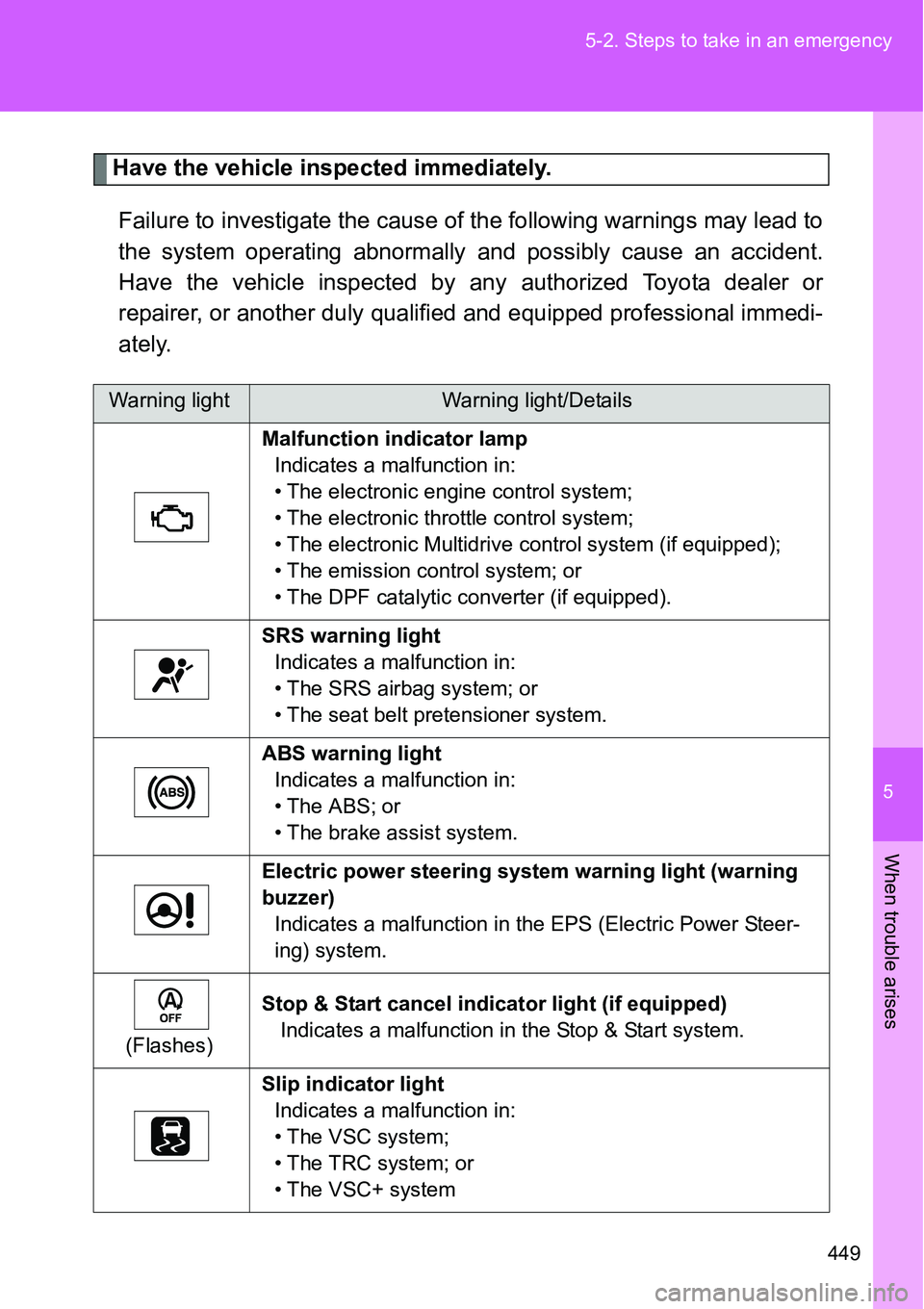
Warning lightWarning light/Details
Malfunction indicator lamp
Indicates a malfunction in:
• The electronic engine control system;
• The electronic throttle control system;
• The electronic Multidrive control system (if equipped);
• The emission control system; or
• The DPF catalytic converter (if equipped).
SRS warning light
Indicates a malfunction in:
• The SRS airbag system; or
• The seat belt pretensioner system.
ABS warning light
Indicates a malfunction in:
• The ABS; or
• The brake assist system.
Electric power steering system warning light (warning
buzzer)
Indicates a malfunction in the EPS (Electric Power Steer-
ing) system.
(Flashes)Stop & Start cancel indicator light (if equipped)
Indicates a malfunction in the Stop & Start system.
Slip indicator light
Indicates a malfunction in:
• The VSC system;
• The TRC system; or
• The VSC+ system
Page 457 of 564
5
457 5-2. Steps to take in an emergency
When trouble arises
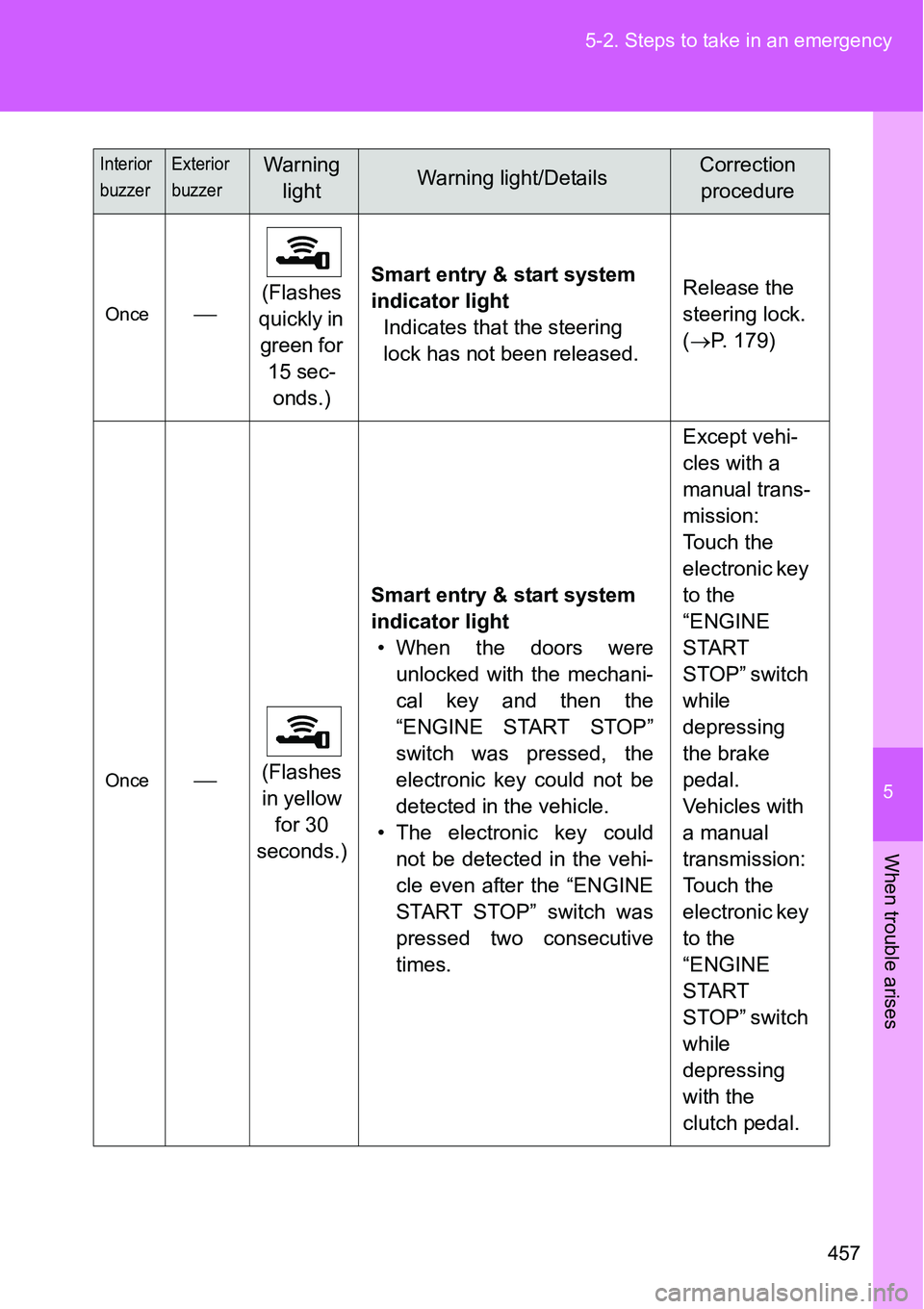
Once(Flashes
quickly in
green for
15 sec-
onds.)Smart entry & start system
indicator light
Indicates that the steering
lock has not been released.Release the
steering lock.
(P. 179)
Once(Flashes
in yellow
for 30
seconds.)Smart entry & start system
indicator light
• When the doors were
unlocked with the mechani-
cal key and then the
“ENGINE START STOP”
switch was pressed, the
electronic key could not be
detected in the vehicle.
• The electronic key could
not be detected in the vehi-
cle even after the “ENGINE
START STOP” switch was
pressed two consecutive
times.Except vehi-
cles with a
manual trans-
mission:
Touch the
electronic key
to the
“ENGINE
START
STOP” switch
while
depressing
the brake
pedal.
Vehicles with
a manual
transmission:
Touch the
electronic key
to the
“ENGINE
START
STOP” switch
while
depressing
with the
clutch pedal.
Interior
buzzerExterior
buzzerWarning
lightWarning light/DetailsCorrection
procedure
Page 460 of 564
460 5-2. Steps to take in an emergency
Engine oil change reminder light comes on (diesel engine only)
Replace the engine oil and oil filter when the engine oil change reminder
light does not come on even if you have driven over 15000 km (9300 miles)
after the engine oil was changed.
There is a possibility that the engine oil change reminder light has been illu-
minated when you have driven less than 15000 km (9300 miles) based on a
usage or driving condition.
Electric power steering system warning light (warning buzzer)
When the battery charge becomes insufficient or the voltage temporarily
drops, the electric power steering system warning light may come on and the
warning buzzer may sound.
CAUTION
When the electric power steering system warning light comes on
The steering wheel may become extremely heavy.
If the steering wheel becomes heavier than usual when operating, hold
firmly and operate using more force than usual.
When driving to clean the DPF catalytic converter (diesel engine only)
When driving, pay sufficient attention to weather, road conditions, terrain and
traffic conditions, and be sure to observe traffic laws and/or regulations. Fail-
ure to do so may cause an unexpected accident, resulting in death or seri-
ous injury.
If the tire pressure warning light comes on
Be sure to observe the following precautions. Failure to do so could cause a
loss of vehicle control and result in death or serious injury.
Stop your vehicle in a safe place as soon as possible. Adjust the tire infla-
tion pressure immediately.
If the tire pressure warning light comes on even after tire inflation pressure
adjustment, it is probable that you have a flat tire. Check the tires. If a tire
is flat, change it with the spare tire and have the flat tire repaired by the
nearest any authorized Toyota dealer or repairer, or another duly qualified
and equipped professional.
Avoid abrupt maneuvering and braking. If the vehicle tires deteriorate, you
could lose control of the steering wheel or the brakes.
Page 490 of 564
490 5-2. Steps to take in an emergency
CAUTION
When fixing the flat tire
After inflation of the tire has completed, the sealant may splatter when the
hose is disconnected or some air is let out of the tire.
Follow the operation procedure to repair the tire. If the procedures not fol-
lowed, the sealant may spray out.
Keep back from the tire while it is being repaired, as there is a chance of it
bursting while the repair operation is being performed. If you notice any
cracks or deformation of the tire, turn off the compressor switch and stop
the repair operation immediately.
The repair kit may overheat if operated for a long period of time. Do not
operate the repair kit continuously for more than 40 minutes.
Parts of the repair kit become hot during operation. Be careful when han-
dling the repair kit during and after operation. Do not touch the metal part
around the connecting area between the bottle and compressor. It will be
extremely hot.
Do not attach the vehicle speed warning sticker to an area other than the
one indicated. If the sticker is attached to an area where an SRS airbag is
located, such as the pad of the steering wheel, it may prevent the SRS air-
bag from operating properly.
Driving to spread the liquid sealant evenly
Observe the following precautions to reduce the risk of accidents.
Failing to do so may result in a loss of vehicle control and cause death or
serious injury.
Drive the vehicle carefully at a low speed. Be especially careful when turn-
ing and cornering.
If the vehicle does not drive straight or you feel a pull through the steering
wheel, stop the vehicle and check the following.
• Tire condition. The tire may have separated from the wheel.
• Tire inflation pressure. If the tire inflation pressure is 130 kPa (1.3
kgf/cm
2 or bar, 19 psi) or less, the tire may be severely damaged.
Page 493 of 564
5
493 5-2. Steps to take in an emergency
When trouble arises
Emergency start function (vehicles with a smart entry & start system)
When the engine does not start, the following steps can be used as
an interim measure to start the engine if the “ENGINE START STOP”
switch is functioning normally:
Vehicles with a Multidrive
Set the parking brake.
Shift the shift lever to P.
Turn the “ENGINE START STOP” switch to ACCESSORY
mode.
Push and hold the “ENGINE START STOP” switch for about
15 seconds while depressing the brake pedal firmly.
Even if the engine can be started using the above steps, the system
may be malfunctioning. Have the vehicle inspected by any authorized
Toyota dealer or repairer, or another duly qualified and equipped pro-
fessional.
The starter motor does not turn over, the interior lights and
headlights do not turn on, or the horn does not sound.
One of the following may be the cause of the problem:
One or both of the battery terminals may be disconnected.
The battery may be discharged. (P. 501)
There may be a malfunction in the steering lock system (vehi-
cles with a smart entry & start system).
Contact any authorized Toyota dealer or repairer, or another duly
qualified and equipped professional if the problem cannot be
repaired, or if repair procedures are unknown.
STEP1
STEP2
STEP3
STEP4
Page 519 of 564
5
519 5-2. Steps to take in an emergency
When trouble arises
CAUTION
If the engine has to be turned off while driving
Power assist for the brakes and steering wheel will be lost, making the
brake pedal harder to depress and the steering wheel heavier to turn.
Decelerate as much as possible before turning off the engine.
Vehicles without a smart entry & start system: Never attempt to remove
the key, as doing so will lock the steering wheel.
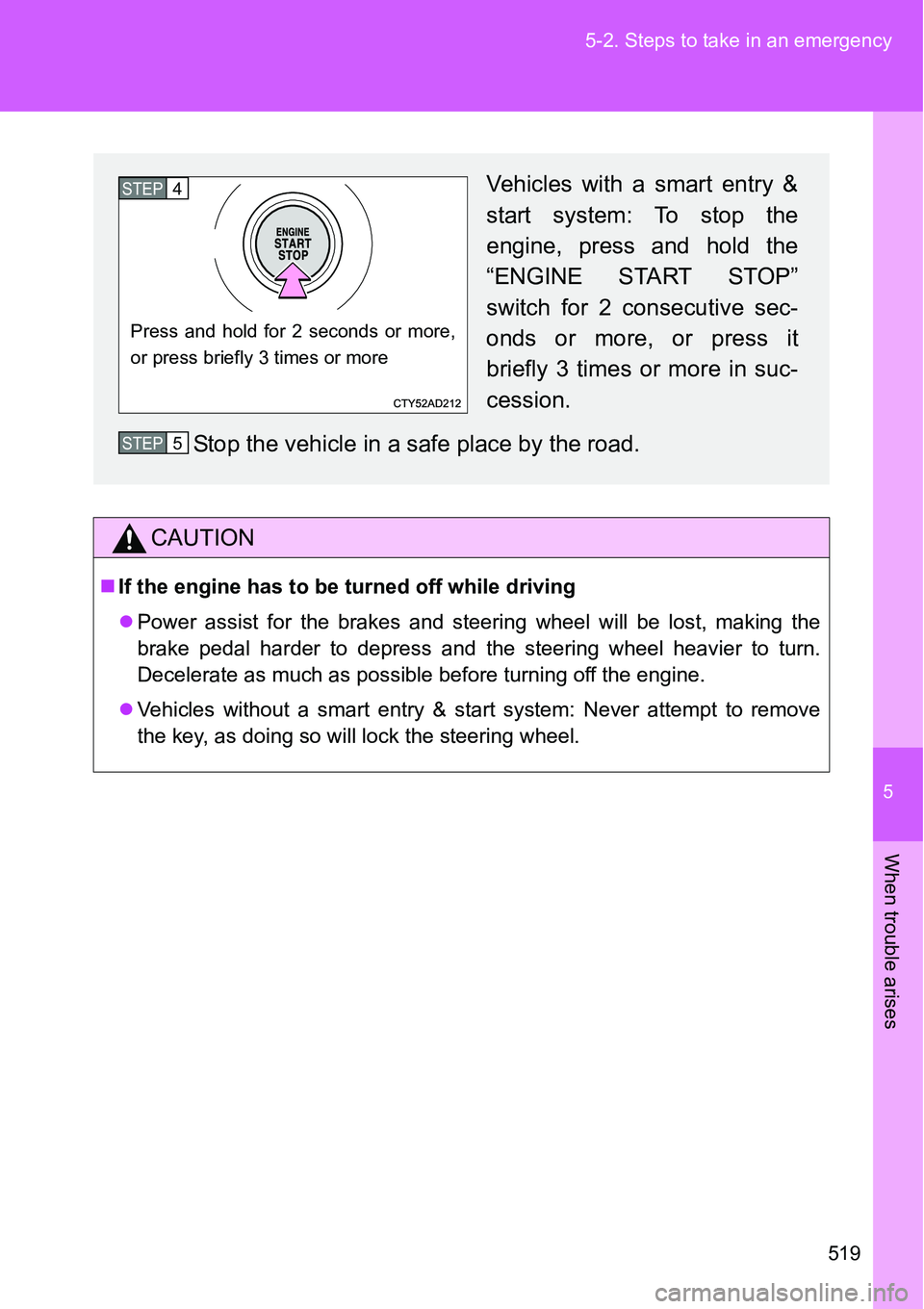
Vehicles with a smart entry &
start system: To stop the
engine, press and hold the
“ENGINE START STOP”
switch for 2 consecutive sec-
onds or more, or press it
briefly 3 times or more in suc-
cession.
Stop the vehicle in a safe place by the road.
Press and hold for 2 seconds or more,
or press briefly 3 times or more
STEP4
STEP5
Page 523 of 564
523 6-1. Specifications
6
Vehicle specifications
*1: Unladen vehicles
*2: Vehicles without Stop & Start system
*3: Vehicles with Stop & Start system
*4: Except vehicles with leather wrapped steering wheel
*5: Vehicles with leather wrapped steering wheel
Vehicle identification
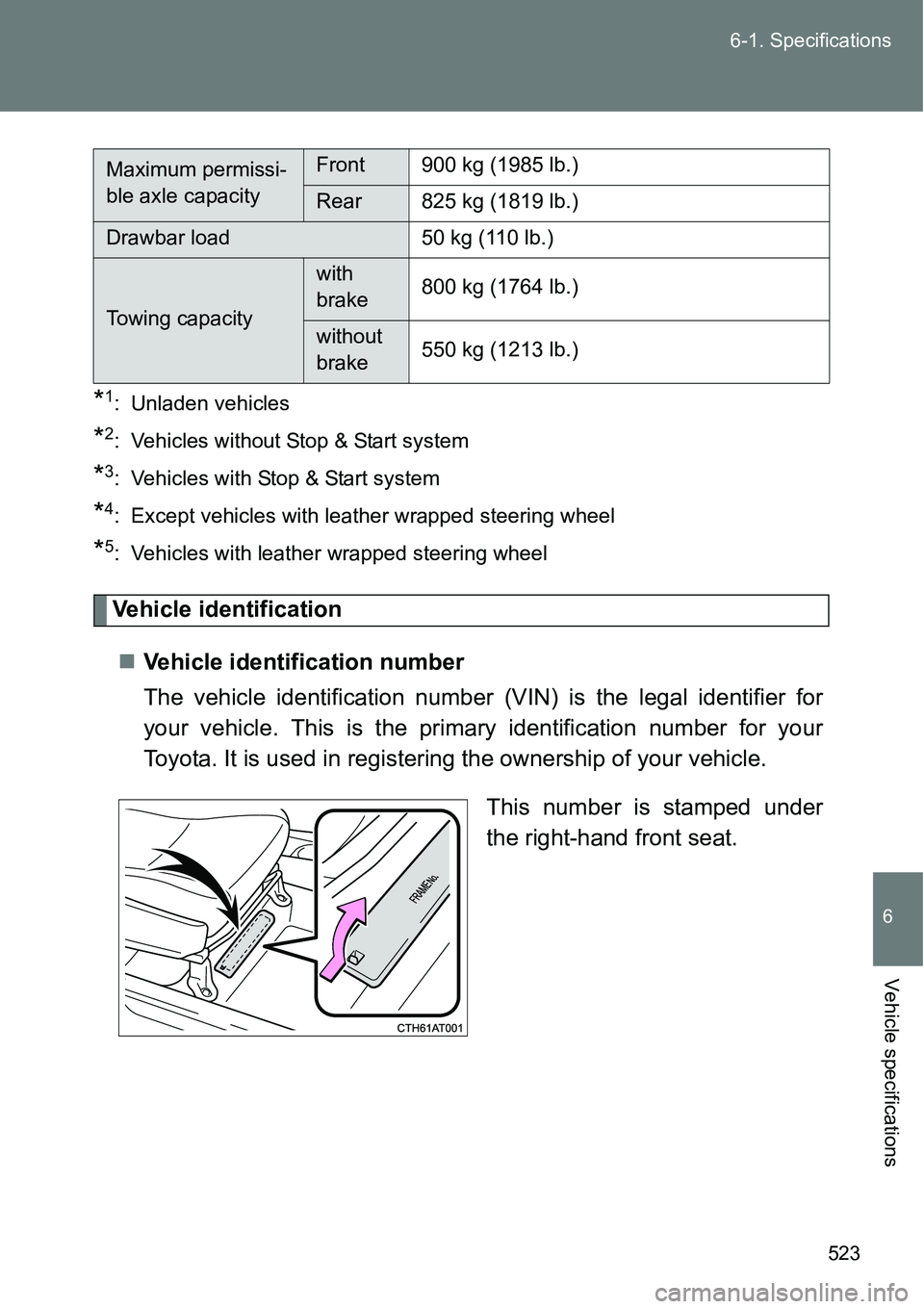
Vehicle identification number
The vehicle identification number (VIN) is the legal identifier for
your vehicle. This is the primary identification number for your
Toyota. It is used in registering the ownership of your vehicle.
This number is stamped under
the right-hand front seat.
Maximum permissi-
ble axle capacityFront 900 kg (1985 lb.)
Rear 825 kg (1819 lb.)
Drawbar load 50 kg (110 lb.)
Towing capacity
with
brake800 kg (1764 lb.)
without
brake550 kg (1213 lb.)
Page 534 of 564
534 6-1. Specifications
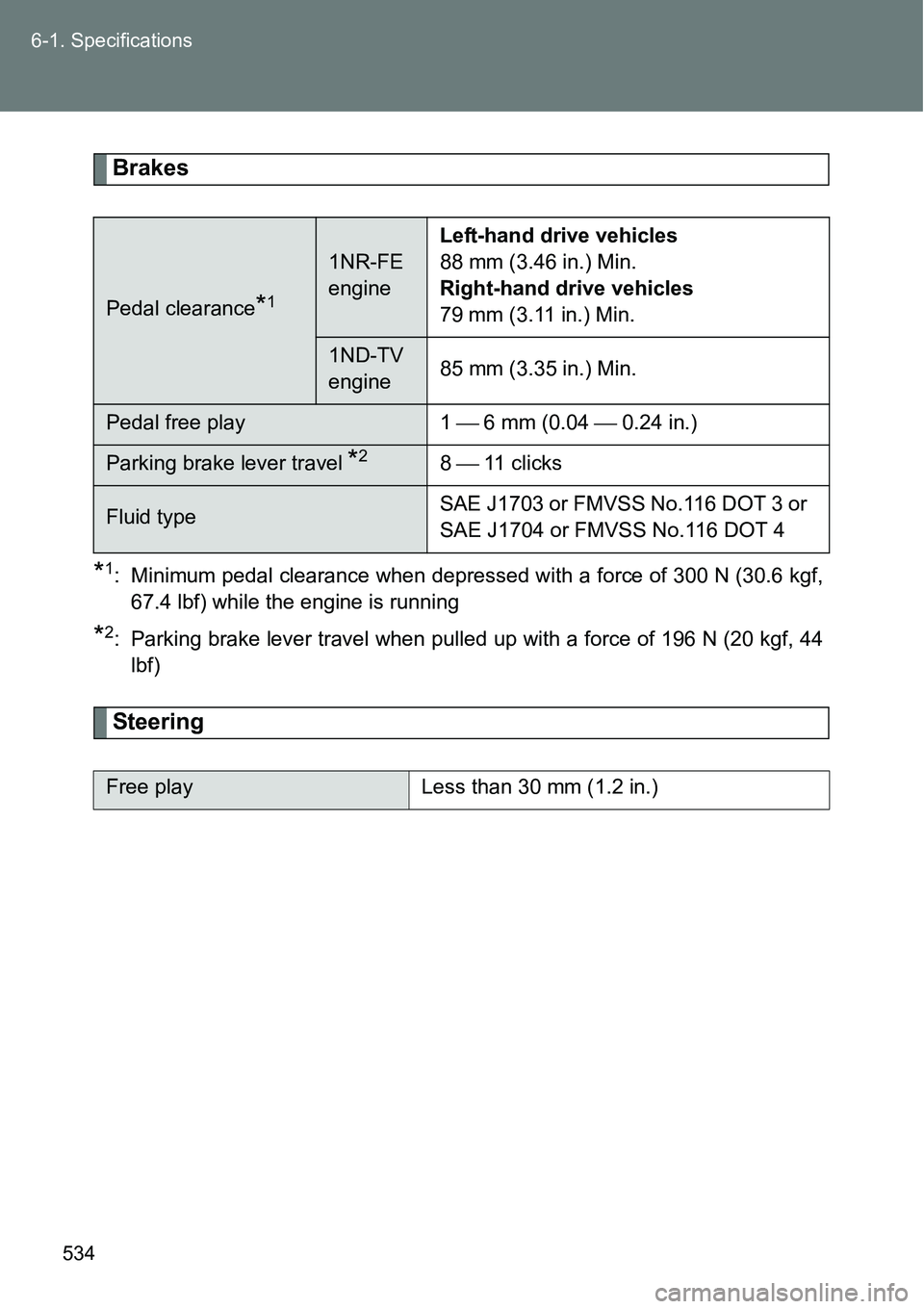
Brakes
*1: Minimum pedal clearance when depressed with a force of 300 N (30.6 kgf,
67.4 lbf) while the engine is running
*2: Parking brake lever travel when pulled up with a force of 196 N (20 kgf, 44
lbf)
Steering
Pedal clearance*1
1NR-FE
engineLeft-hand drive vehicles
88 mm (3.46 in.) Min.
Right-hand drive vehicles
79 mm (3.11 in.) Min.
1ND-TV
engine85 mm (3.35 in.) Min.
Pedal free play 1 6 mm (0.04 0.24 in.)
Parking brake lever travel *28 11 clicks
Fluid typeSAE J1703 or FMVSS No.116 DOT 3 or
SAE J1704 or FMVSS No.116 DOT 4
Free play Less than 30 mm (1.2 in.)
Page 546 of 564
546
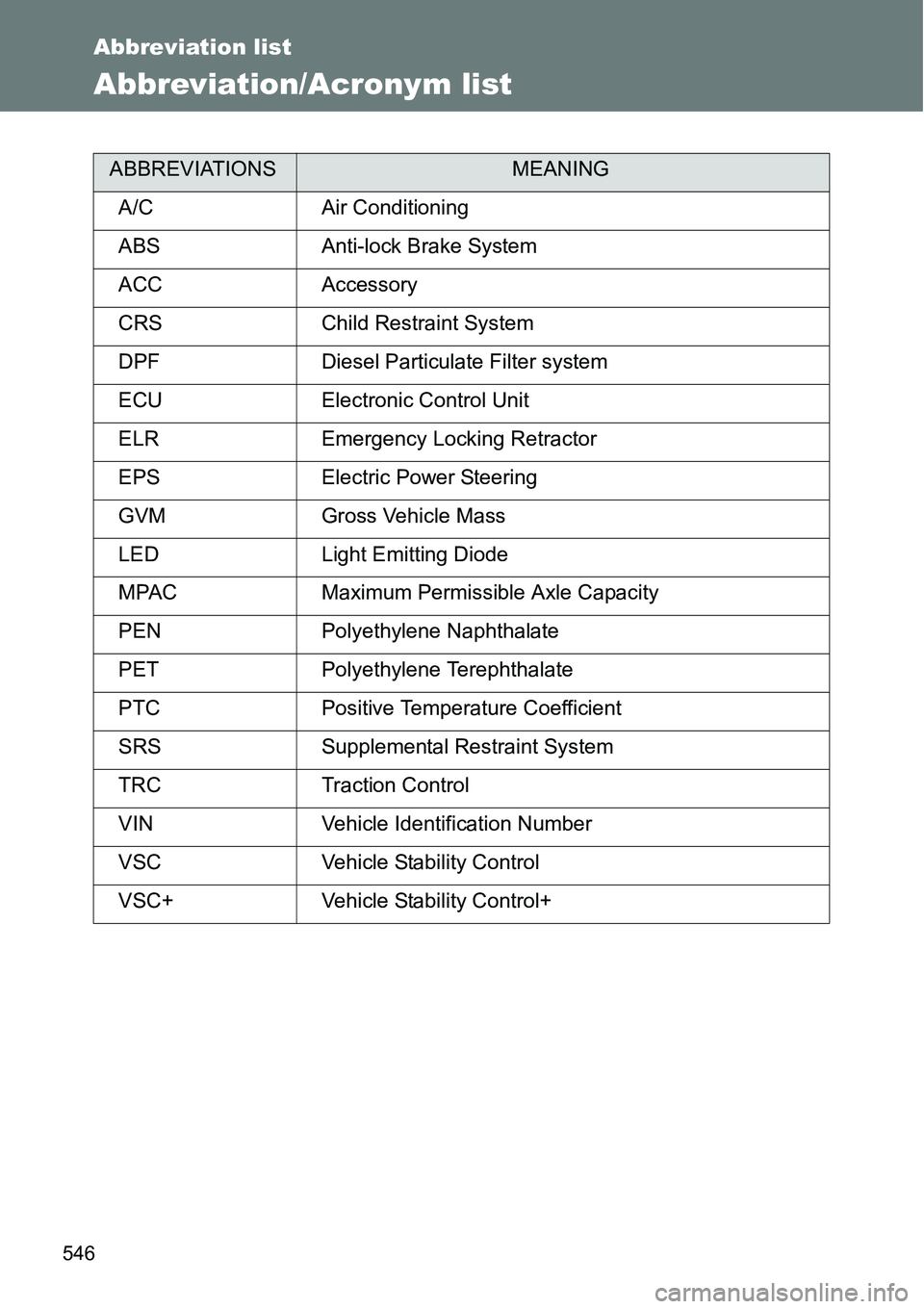
Abbreviation list
Abbreviation/Acronym list
ABBREVIATIONSMEANING
A/C Air Conditioning
ABS Anti-lock Brake System
ACC Accessory
CRS Child Restraint System
DPF Diesel Particulate Filter system
ECU Electronic Control Unit
ELR Emergency Locking Retractor
EPS Electric Power Steering
GVM Gross Vehicle Mass
LED Light Emitting Diode
MPAC Maximum Permissible Axle Capacity
PEN Polyethylene Naphthalate
PET Polyethylene Terephthalate
PTC Positive Temperature Coefficient
SRS Supplemental Restraint System
TRC Traction Control
VIN Vehicle Identification Number
VSC Vehicle Stability Control
VSC+ Vehicle Stability Control+