Jack TOYOTA YARIS 2009 2.G Owners Manual
[x] Cancel search | Manufacturer: TOYOTA, Model Year: 2009, Model line: YARIS, Model: TOYOTA YARIS 2009 2.GPages: 392, PDF Size: 8.52 MB
Page 4 of 392
TABLE OF CONTENTSIndex
4
4-3. Do-it-yourself maintenanceDo-it-yourself service precautions ...................... 239
Hood................................... 242
Positioning a floor jack ....... 243
Engine compartment .......... 245
Tires ................................... 258
Tire inflation pressure......... 264
Wheels ............................... 268
Air conditioning filter ........... 270
Key battery ......................... 273
Checking and replacing fuses ................................ 275
Light bulbs .......................... 286
5-1. Essential information Emergency flashers ........... 296
If your vehicle needs to be towed .......................... 297
If you think something is wrong ............................... 303
Fuel pump shut off system .............................. 304
Event data recorder............ 305
5-2. Steps to take in an emergency
If a warning light turns on or a warning buzzer
sounds... .......................... 307
If you have a flat tire ........... 317
If the engine will not start ... 329
If the shift lever cannot be shifted from P ................... 331
If you lose your keys .......... 332 If the vehicle battery is
discharged ........................ 333
If your vehicle overheats..... 337
If the vehicle becomes stuck ................................. 340
6-1. Specifications Maintenance data (fuel, oil level, etc.) ........... 344
Fuel information .................. 353
Tire information................... 356
6-2. Customization Customizable features ........ 369
Items to initialize ................. 371
Reporting safety defects for U.S. owners ................. 374
Seat belt instructions for Canadian owners
(in French) ........................ 375
Abbreviation list ........................ 380
Alphabetical index .................... 381
What to do if... ........................... 389
5When trouble arises
6Vehicle specifications
7For owners
Index
Page 170 of 392
170 2-5. Driving information
●Reversing with a trailer attached is difficult and requires practice.
Grip the bottom of the steering wheel and move your hand to the
left to move the trailer to the left. Move your hand to the right to
move the trailer to the right. (This is generally opposite to reversing
without a trailer attached.) Avoid sharp or prolonged turning. Have
someone guide you when reversing to reduce the risk of an acci-
dent.
● As stopping distance is increased when towing a trailer, vehicle-to-
vehicle distance should be increased. For each 10 mph (16 km/h)
of speed, allow at least o ne vehicle and trailer length.
● Avoid sudden braking as you may skid, resulting in jackknifing and
loss of control. This is especiall y true on wet or slippery surfaces.
● Avoid jerky starts or sudden acceleration. Vehicles with a manual
transmission, prevent excessive cl utch slippage by keeping engine
rpm low and not racing the engine. Always start out in first gear.
● Avoid jerky steering and sharp turns, and slow down before mak-
ing a turn.
● Note that when making a turn, th e trailer wheels will be closer than
the vehicle wheels to the inside of the turn. Compensate by making
a larger than normal turning radius.
● Crosswinds and rough roads will adversely affect handling of your
vehicle and trailer, causing sway . Periodically check the rear to
prepare for being passed by large trucks or buses, which may
cause your vehicle and trailer to sway. If swaying occurs, firmly grip
the steering wheel, reduce speed immediately but gradually, and
steer straight ahead. Never increase speed. If you make no
extreme correction with the stee ring or brakes, your vehicle and
trailer will stabilize.
● Take care when passing other v ehicles. Passing requires consider-
able distance. After passing a vehi cle, do not forget the length of
your trailer, and be sure you hav e plenty of room before changing
lanes.
Page 227 of 392
Maintenance and care4
227
4-1. Maintenance and careCleaning and protecting the vehicle exterior......... 228
Cleaning and protecting the vehicle interior.......... 230
4-2. Maintenance Maintenance requirements .................. 233
General maintenance....... 235
Emission inspection and maintenance (I/M)
programs........................ 238 4-3. Do-it-yourself maintenance
Do-it-yourself service precautions .................... 239
Hood ................................ 242
Positioning a floor jack ..... 243
Engine compartment ........ 245
Tires ................................. 258
Tire inflation pressure ...... 264
Wheels ............................. 268
Air conditioning filter......... 270
Key battery ....................... 273
Checking and replacing fuses .............................. 275
Light bulbs........................ 286
Page 243 of 392
243
4-3. Do-it-yourself maintenance
4
Maintenance and care
Positioning a floor jack
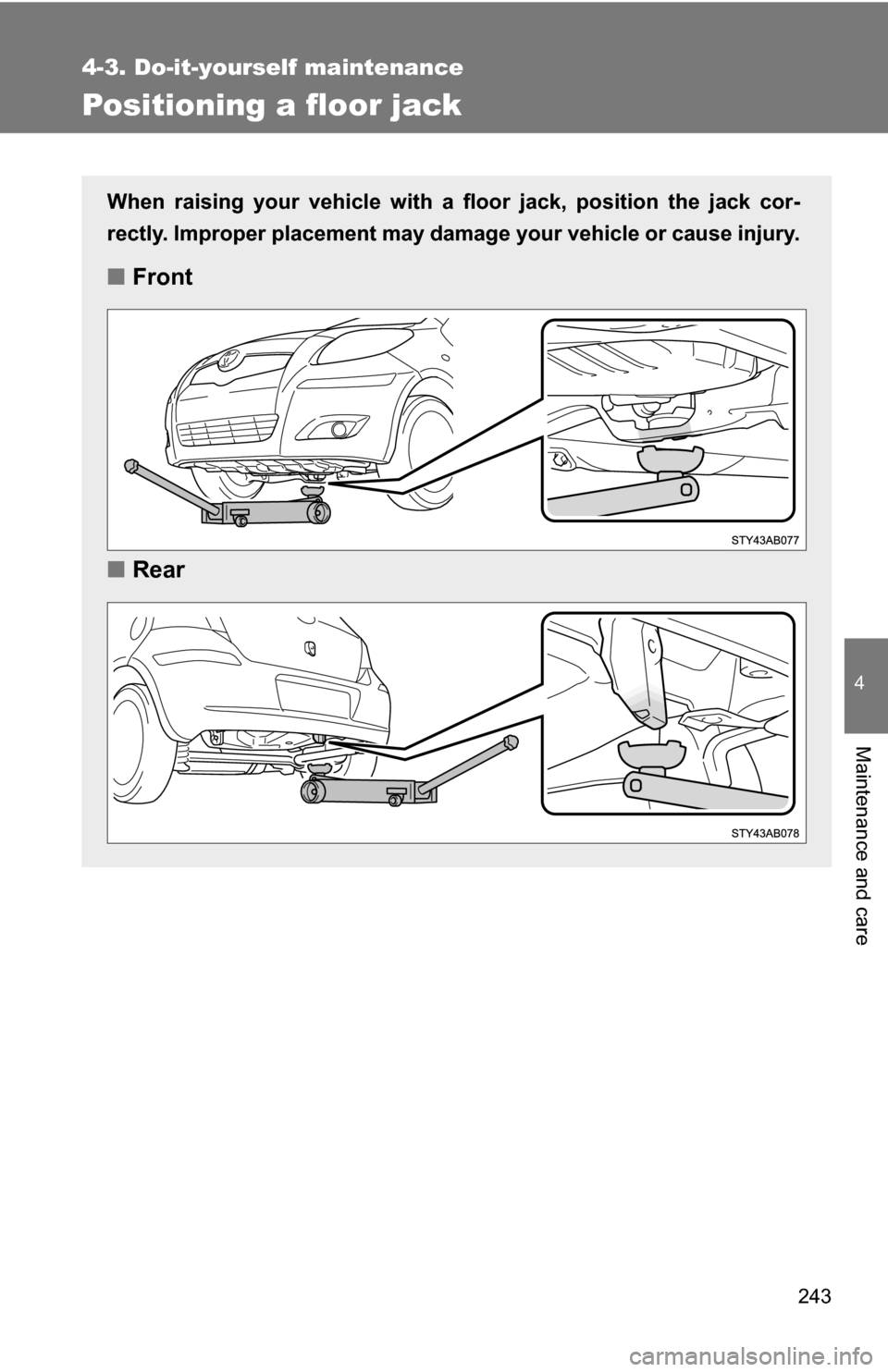
When raising your vehicle with a floor jack, position the jack cor-
rectly. Improper placement may damage your vehicle or cause injury.
■Front
■ Rear
Page 244 of 392

244 4-3. Do-it-yourself maintenance
CAUTION
■When raising your vehicle
Make sure to observe the following to reduce the possibility of death or\
seri-
ous injury.
●Do not use the jack that was supplied with your vehicle.
● Do not put any part of your body or get underneath the vehicle supported
only by the floor jack.
Always use automotive jack stands on a solid, level surface.
● Do not start the engine while the vehicle is supported by the floor jack.
● Stop the vehicle on level firm ground, firmly set the parking brake and put
the shift lever in P (automatic transmission) or R (manual transmission).
● Make sure to set the floor jack properly at the jack point.
Raising the vehicle with an improperly positioned floor jack will damage
the vehicle and may cause the vehicle to fall off the floor jack.
● Do not raise the vehicle while someone is in the vehicle.
● When raising the vehicle, do not place any objects on top of or underneath
the floor jack.
●Lift up the vehicle using a floor jack
such as the one shown in the illustra-
tion.
Page 317 of 392
5
When trouble arises
317
5-2. Steps to take in an emergency
If you have a flat tire
Remove the flat tire and replace it with the spare provided.
■Before jacking up the vehicle
●Stop the vehicle on a hard, flat surface.
● Set the parking brake.
● Shift the shift lever to P (automatic transmission) or R (manual
transmission).
● Stop the engine.
● Turn on the emergency flashers.
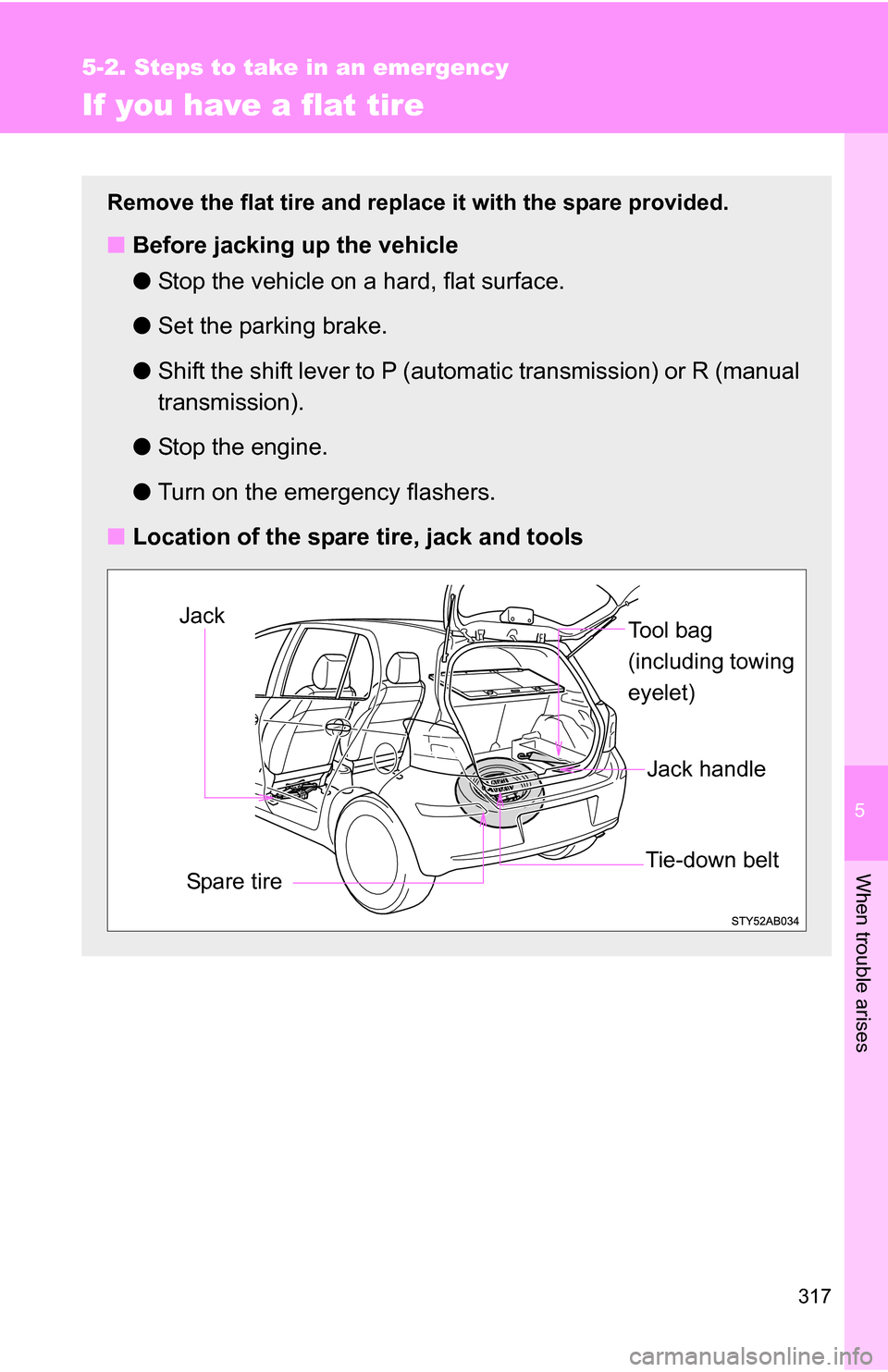
■ Location of the spare tire, jack and tools
Spare tire
Jack
Jack handle
Tie-down belt
Tool bag
(including towing
eyelet)
Page 318 of 392
318 5-2. Steps to take in an emergency
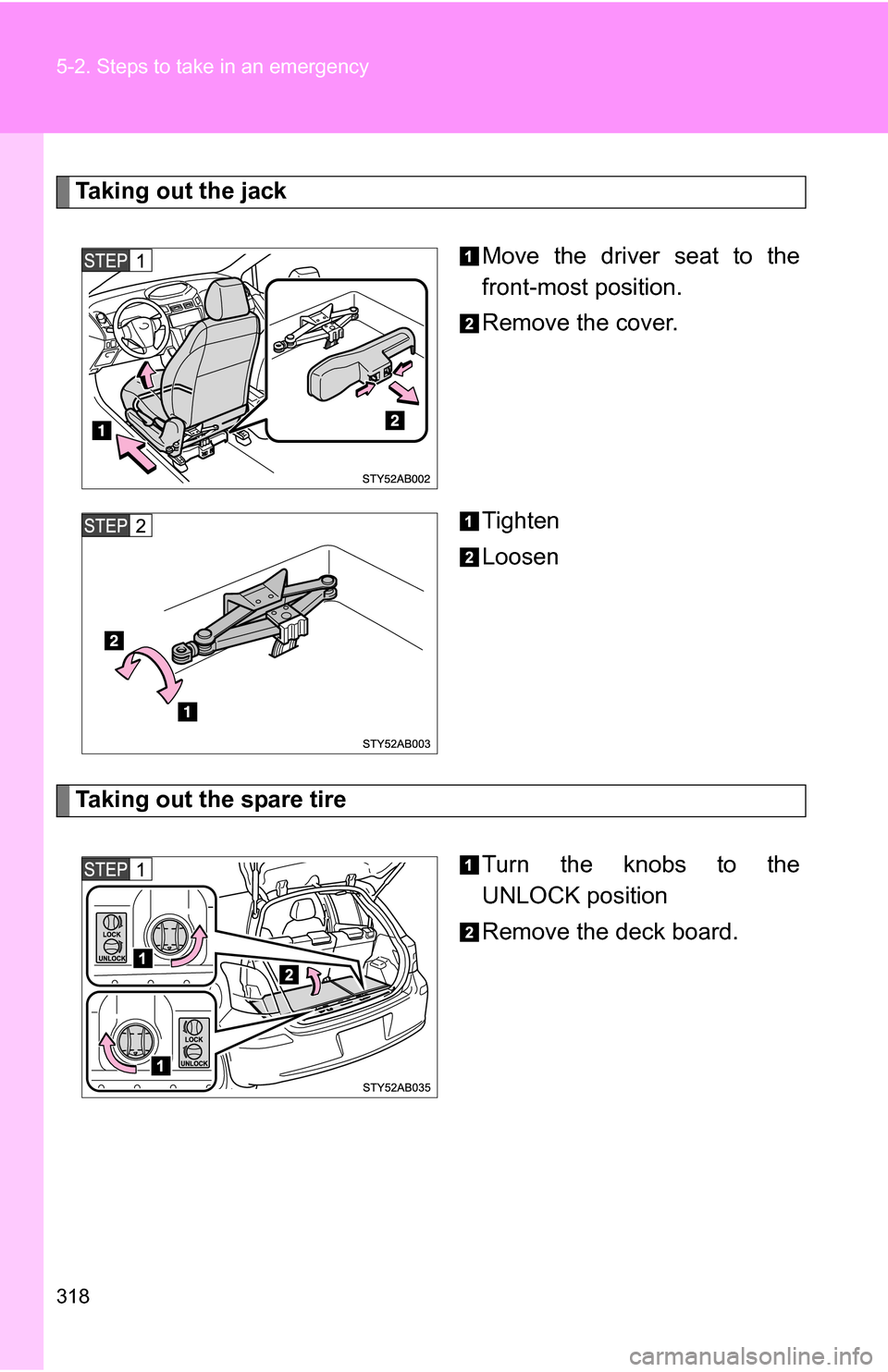
Taking out the jackMove the driver seat to the
front-most position.
Remove the cover.
Tighten
Loosen
Taking out the spare tire
Turn the knobs to the
UNLOCK position
Remove the deck board.
Page 321 of 392
5
When trouble arises
321
5-2. Steps to take in an emergency
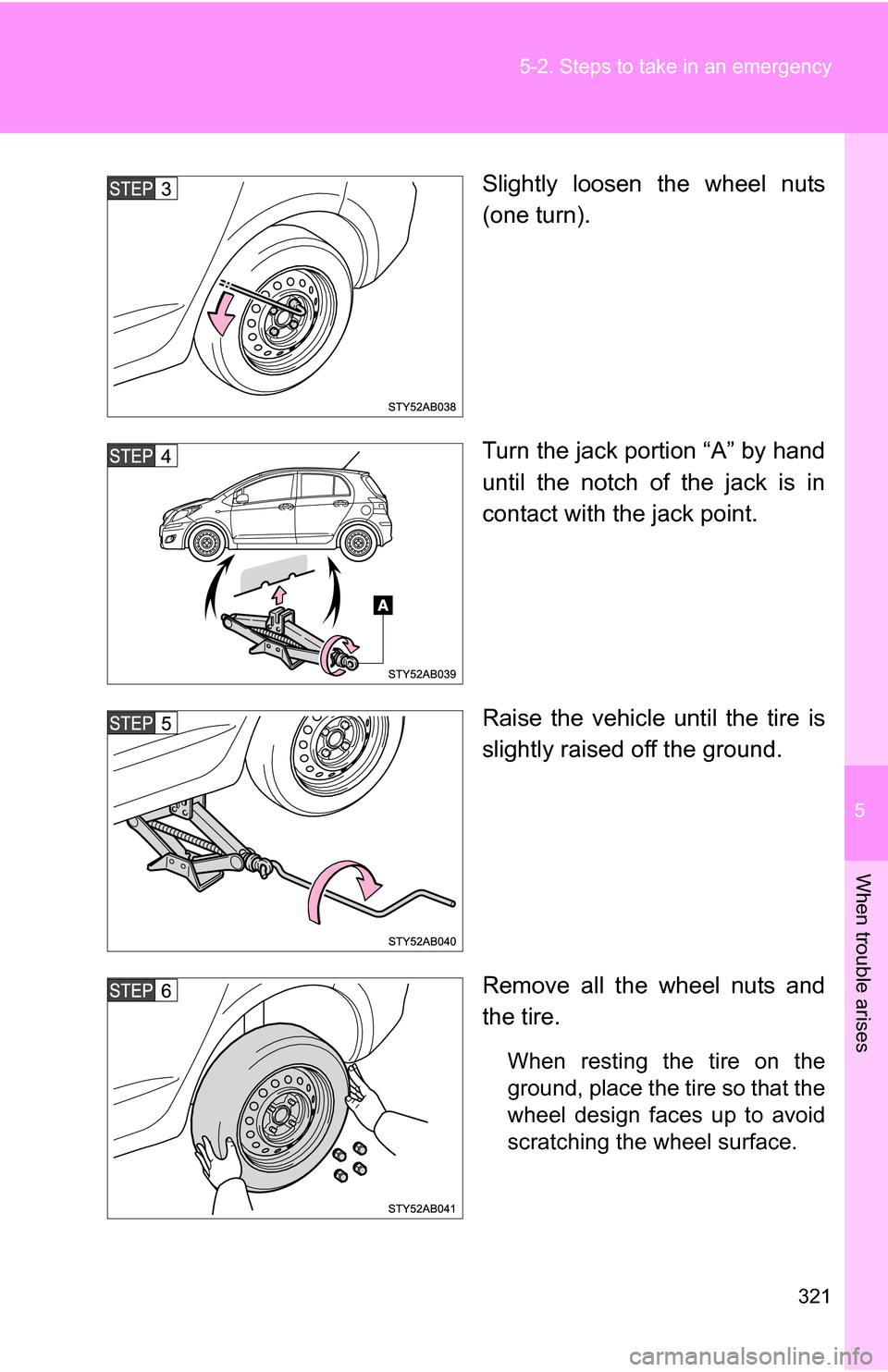
Slightly loosen the wheel nuts
(one turn).
Turn the jack portion “A” by hand
until the notch of the jack is in
contact with the jack point.
Raise the vehicle until the tire is
slightly raised off the ground.
Remove all the wheel nuts and
the tire.
When resting the tire on the
ground, place the tire so that the
wheel design faces up to avoid
scratching the wheel surface.
Page 323 of 392
5
When trouble arises
323
5-2. Steps to take in an emergency
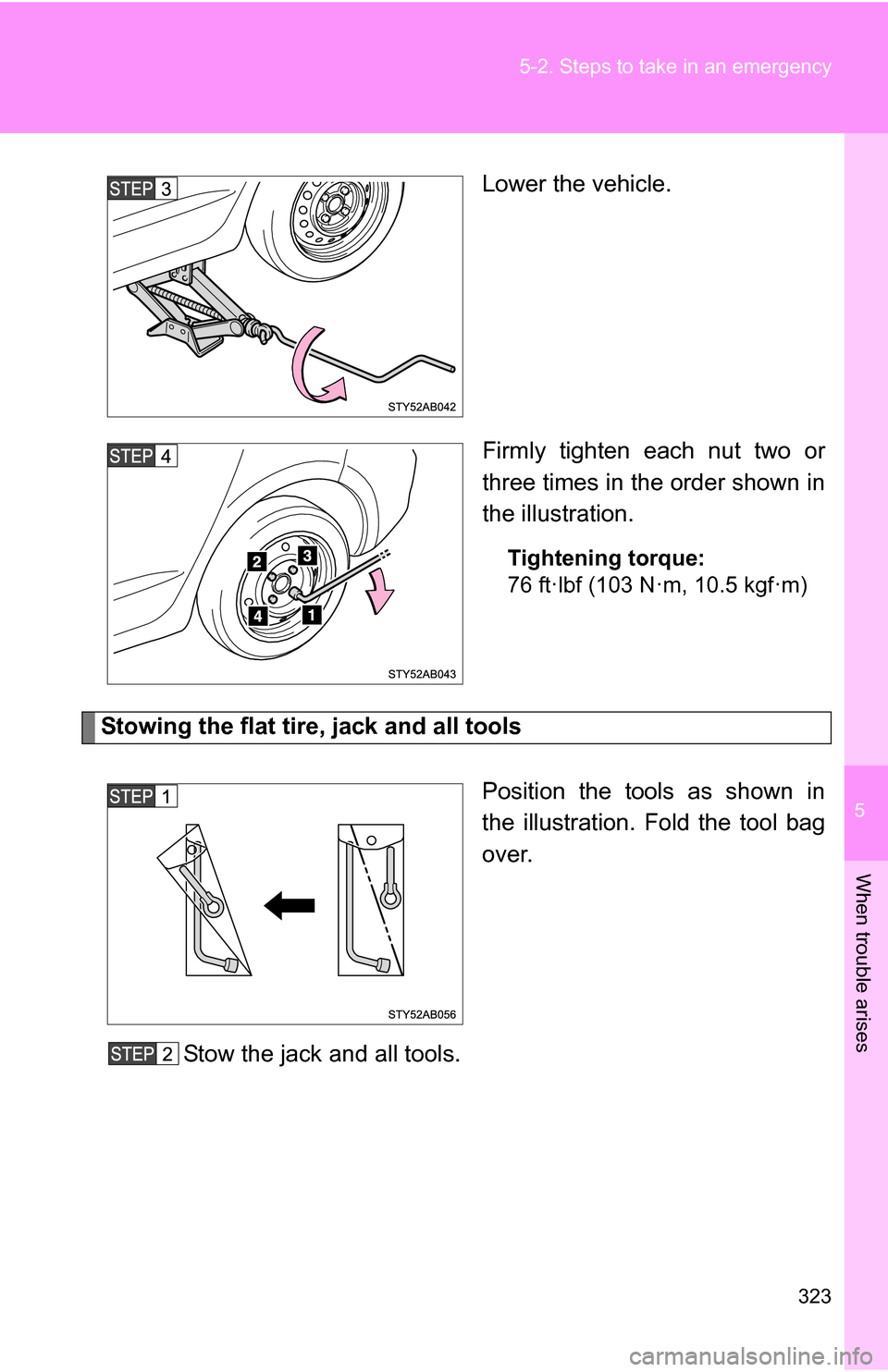
Lower the vehicle.
Firmly tighten each nut two or
three times in the order shown in
the illustration.
Tightening torque:
76 ft·lbf (103 N·m, 10.5 kgf·m)
Stowing the flat tire, jack and all tools
Position the tools as shown in
the illustration. Fold the tool bag
over.
Stow the jack and all tools.
Page 326 of 392
326 5-2. Steps to take in an emergency
CAUTION
■Using the jack
Improper use of the jack may lead to death or injuries due to the vehicle
suddenly falling off the jack.
●Do not use the jack for any purpose other than replacing tires or install-
ing and removing tire chains.
●Only use the jack that comes with this vehicle for replacing a flat tire.
Do not use it on other vehicles, an d do not use other jacks for replac-
ing tires on this vehicle.
●Always check that the jack is securely set to the jack point.
●Do not put any part of your body under the vehicle supported by a jack.
●Do not start or run the engine while your vehicle is supported by the
jack.
●Do not raise the vehicle while someone is in it.
●When raising the vehicle, do not put an object on or under the jack.
●Do not raise the vehicle to a hei ght greater than that required to
replace the tire.
●Use a jack stand if it is necessary to get under the vehicle.
Take particular care when lowering the vehicle to ensure that no one
working on or near the vehicle will be injured.
■Replacing a flat tire
Observe the following precautions to reduce the risk of death or serious
injury.
●Never use oil or grease on the wheel bolts or wheel nuts.
The oil or grease can cause the wheel nuts to loosen, causing a seri-
ous accident.
Remove any oil or grease on the wheel bolts or wheel nuts.
●Have the wheel nuts tightened with a torque wrench to 76 ft·lbf (103
N·m, 10.5 kgf·m) as soon as possible after changing wheels.
Failure to follow these precautions could cause the nuts to loosen and
the wheel may fall off, which could lead to an accident causing death
or serious injury.