Engine TOYOTA YARIS 2012 3.G Workshop Manual
[x] Cancel search | Manufacturer: TOYOTA, Model Year: 2012, Model line: YARIS, Model: TOYOTA YARIS 2012 3.GPages: 400, PDF Size: 9.68 MB
Page 189 of 400

189
2-5. Driving information
2
When driving
NOTICE
■
Dinghy towing direction
■ To prevent the steering from locking
Ensure the engine switch is in the “ACC” position.
Do not tow the vehicle backward.
Doing so may cause serious damage.
Page 198 of 400
198 3-1. Using the air conditioning system and defogger
■Air conditioning odors
●During use, various odors from inside and outside the vehicle may enter
into and accumulate in the air conditioning system. This may then cause
odor to be emitted from the vents.
● To reduce potential odors from occurring:
It is recommended that the air conditioning system be set to outside air
mode prior to turning the vehicle off.
■ Air conditioning filter
P. 268
CAUTION
■To prevent the windshield from fogging up
Do not use during cool air operation in extremely humid weather. The
difference between the temperature of the outside air and that of the wind-
shield can cause the outer surface of the windshield to fog up, blocking your
vision.
NOTICE
■To prevent battery discharge
Do not leave the air conditioning system on longer than necessary when the
engine is stopped.
Page 199 of 400
199
3-1. Using the air conditioning system and defogger
3
Interior features
Rear window and outside rear view mirror defoggers
: If equipped
■The defoggers can be operated when
The engine switch is in the “ON” position.
■ The outside rear view mirr or defoggers (if equipped)
Turning the rear window defogger on will turn the outside rear view mirror
defoggers on.
CAUTION
■ When the outside rear view mirr or defoggers are on (if equipped)
Do not touch the outside surface of the rear view mirrors, as they can
become very hot and burn you.
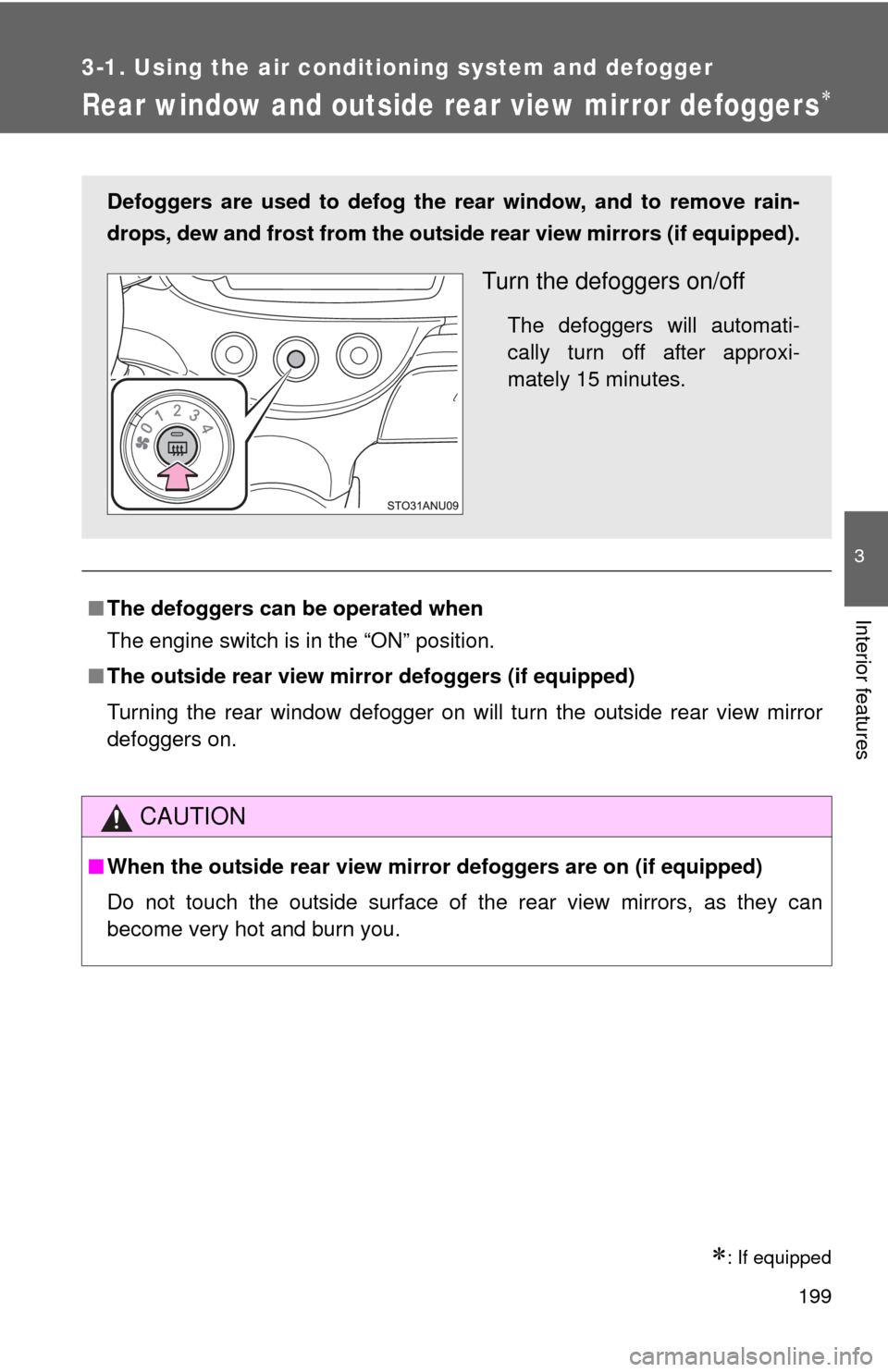
Defoggers are used to defog the rear window, and to remove rain-
drops, dew and frost from the outsid e rear view mirrors (if equipped).
Turn the defoggers on/off
The defoggers will automati-
cally turn off after approxi-
mately 15 minutes.
Page 203 of 400
203
3-3. Using the interior lights
3
Interior features
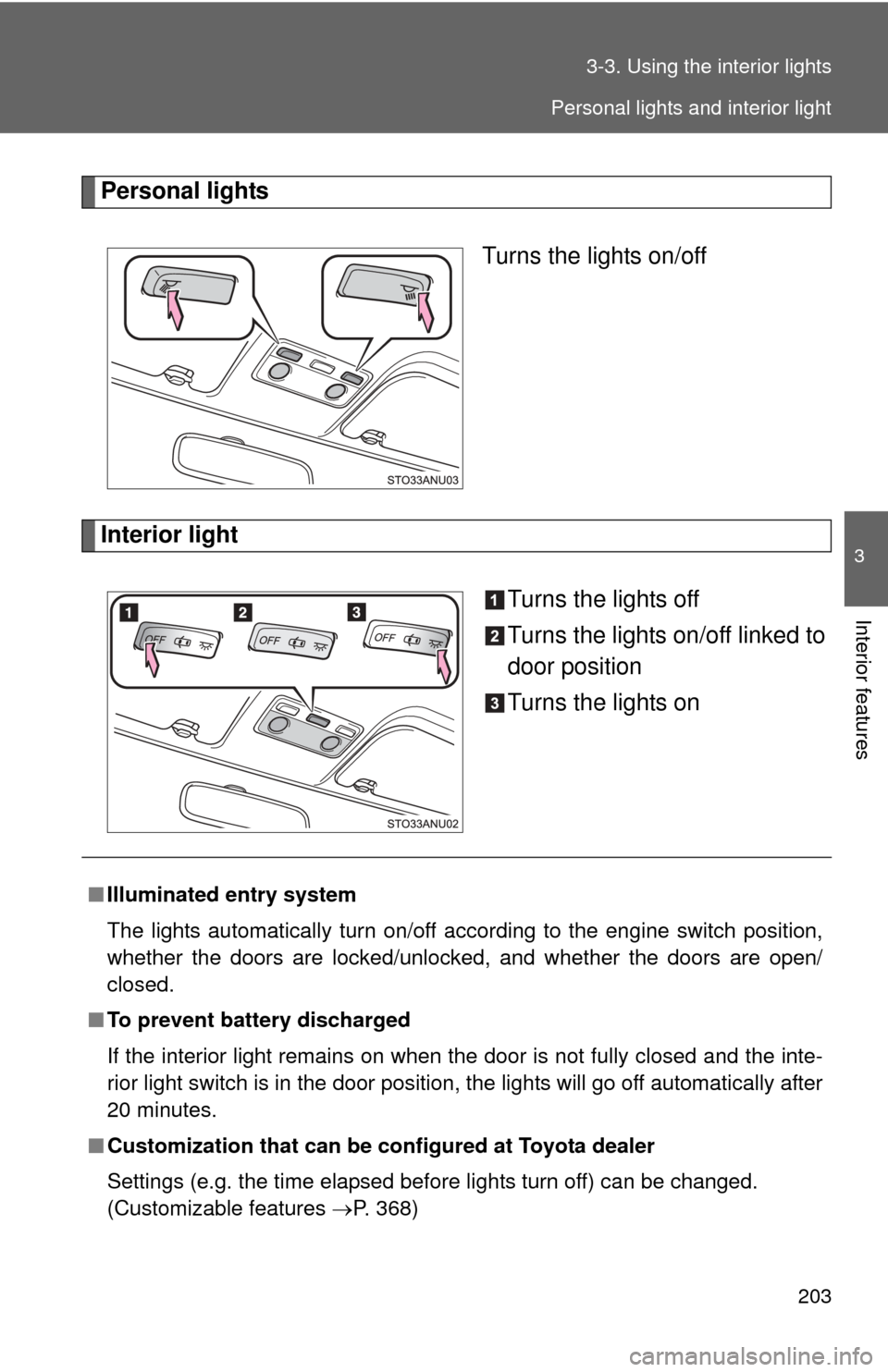
Personal lights
Turns the lights on/off
Interior light Turns the lights off
Turns the lights on/off linked to
door position
Turns the lights on
■Illuminated entry system
The lights automatically turn on/off according to the engine switch position,
whether the doors are locked/unlocked, and whether the doors are open/
closed.
■ To prevent battery discharged
If the interior light remains on when the door is not fully closed and the inte-
rior light switch is in the door position, the lights will go off automatically after
20 minutes.
■ Customization that can be co nfigured at Toyota dealer
Settings (e.g. the time elapsed before lights turn off) can be changed.
(Customizable features P. 368)
Personal lights and interior light
Page 210 of 400
210
3-5. Other interior features
Clock
■The clock is displayed when
The engine switch is in the “ON” position.
■ When disconnecting and reco nnecting battery terminals
The clock data will be reset.
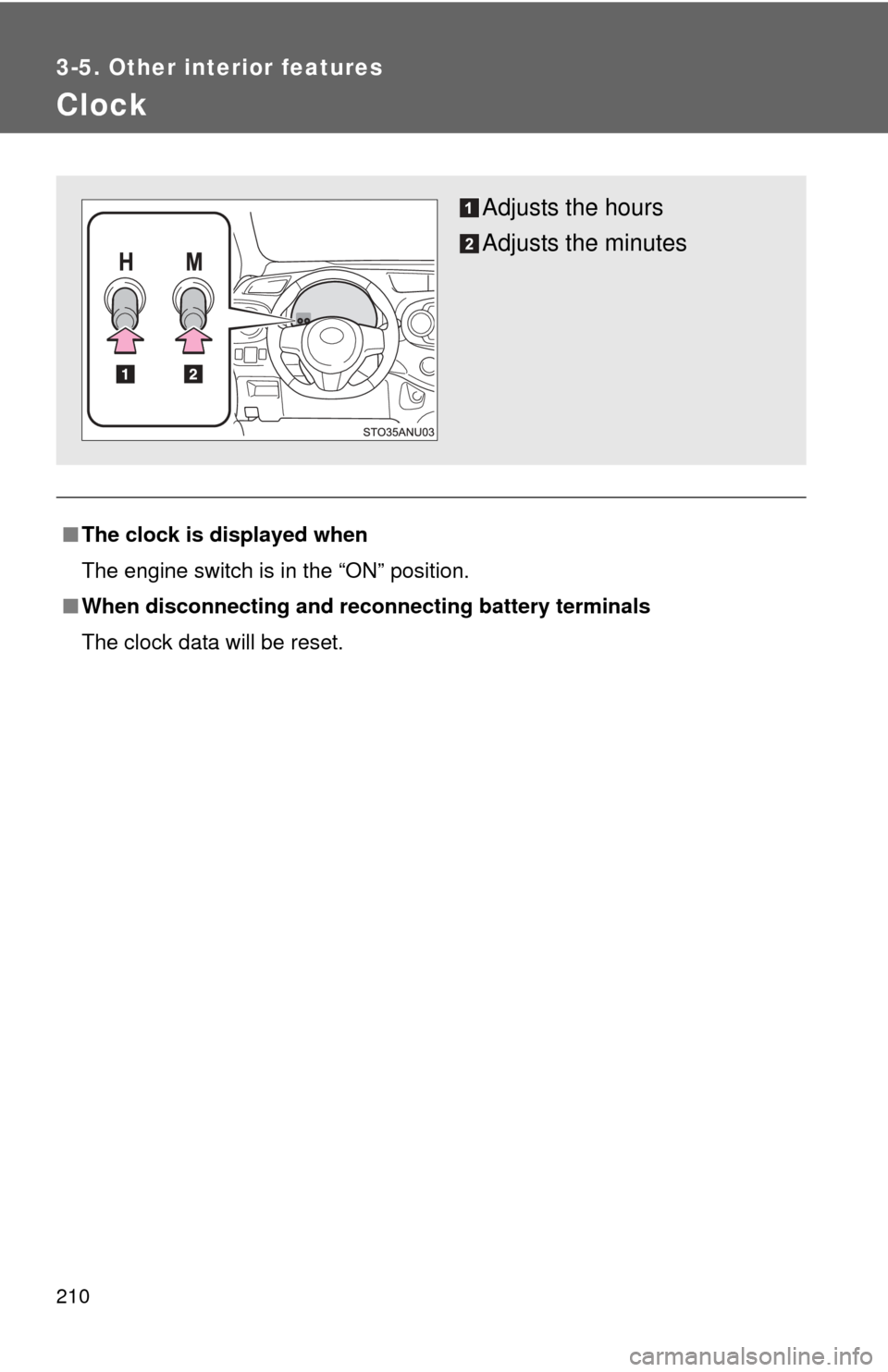
Adjusts the hours
Adjusts the minutes
Page 212 of 400

212 3-5. Other interior features
■The outside temperatur e is displayed when
The engine switch is in the “ON” position.
■ Display
In the following situations, the correct outside temperature may not be dis-
played, or the display may take longer than normal to change:
●When the vehicle is stopped, or moving at low speeds (less than 16 mph
[25 km/h])
● When the outside temperature has changed suddenly (at the entrance/
exit of a garage, tunnel, etc.)
■ When “ ” or “E” is displayed
The system may be malfunctioning. Take your vehicle to your Toyota dealer.
Page 213 of 400
213
3-5. Other interior features
3
Interior features
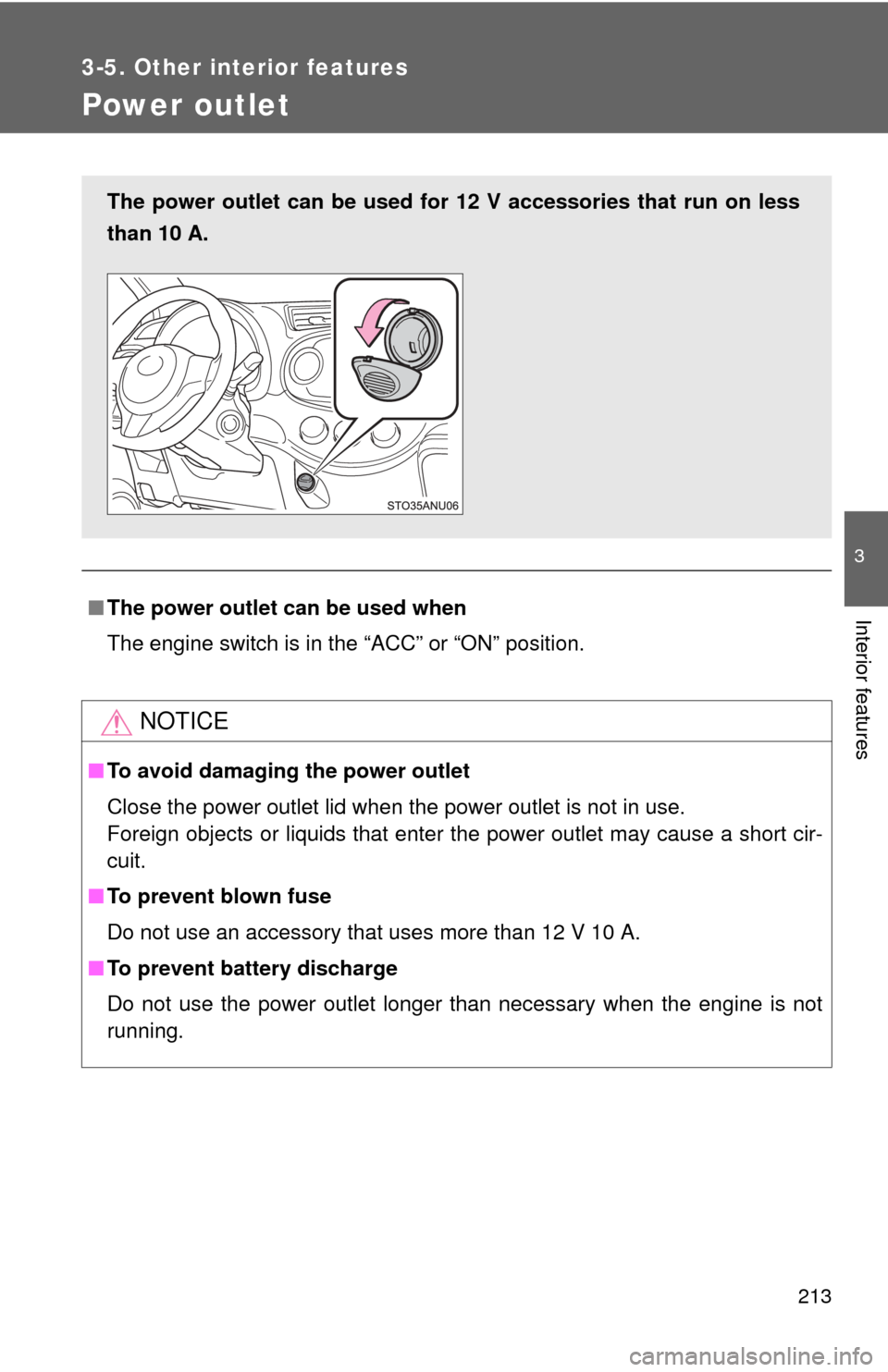
Power outlet
■The power outlet can be used when
The engine switch is in the “ACC” or “ON” position.
NOTICE
■To avoid damaging the power outlet
Close the power outlet lid when the power outlet is not in use.
Foreign objects or liquids that enter the power outlet may cause a short cir-
cuit.
■ To prevent blown fuse
Do not use an accessory that uses more than 12 V 10 A.
■ To prevent battery discharge
Do not use the power outlet longer than necessary when the engine is not\
running.
The power outlet can be used for 12 V accessories that run on less
than 10 A.
Page 215 of 400
215
3-5. Other interior features
3
Interior features
CAUTION
Observe the following precautions.
Failure to do so may cause the driver’s floor mat to slip, possibly interfering
with the pedals while driving. An unexpectedly high speed may result or it may
become difficult to stop the vehicle, leading to a serious accident.
■
When installing the driver’s floor mat
●Do not use floor mats designed for other models or different model year
vehicles, even if they are Toyota Genuine floor mats.
● Only use floor mats designed for the driver’s seat.
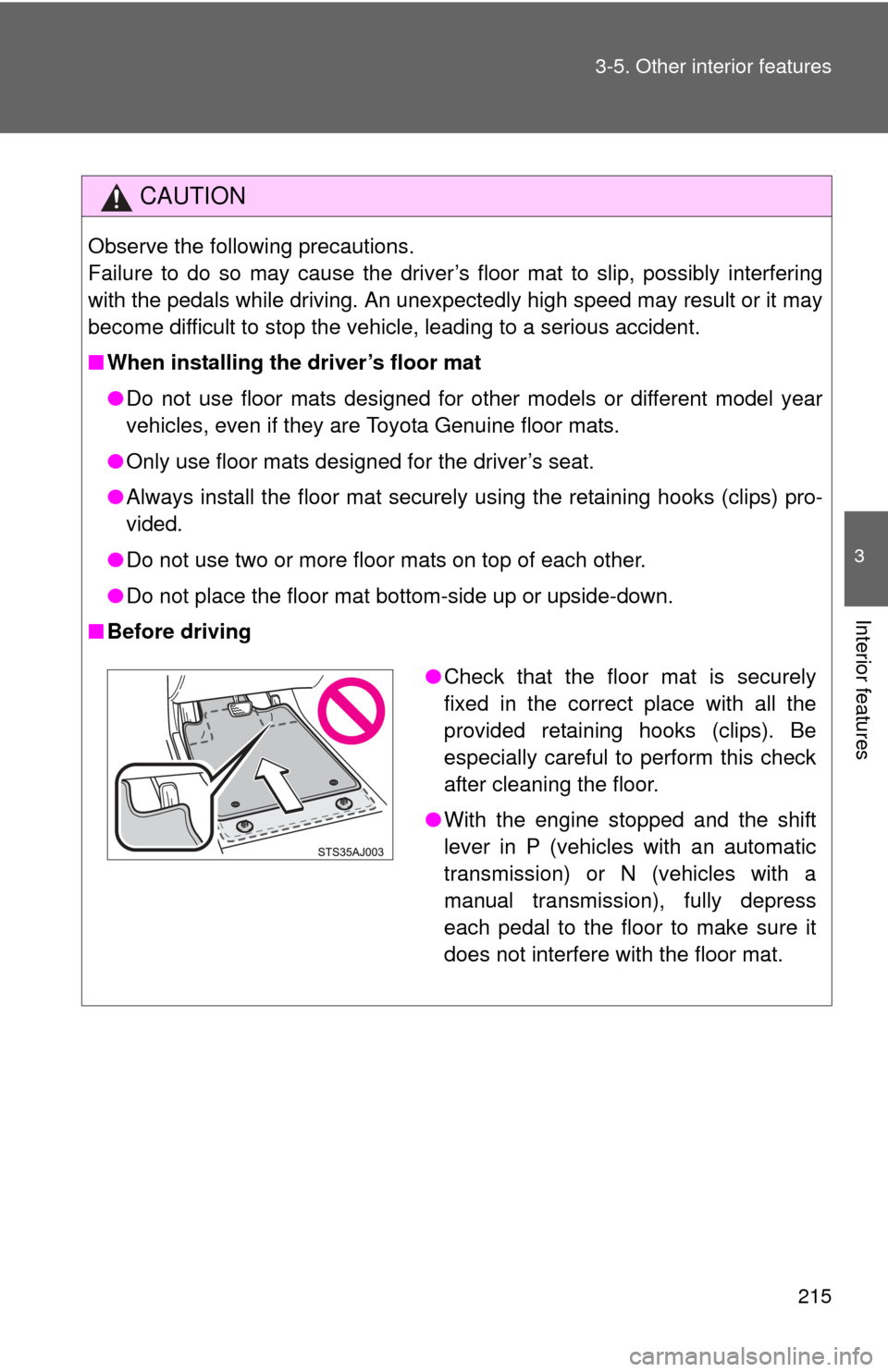
● Always install the floor mat securely using the retaining hooks (clips) pro-
vided.
● Do not use two or more floor mats on top of each other.
● Do not place the floor mat bottom-side up or upside-down.
■ Before driving
●Check that the floor mat is securely
fixed in the correct place with all the
provided retaining hooks (clips). Be
especially careful to perform this check
after cleaning the floor.
● With the engine stopped and the shift
lever in P (vehicles with an automatic
transmission) or N (vehicles with a
manual transmission), fully depress
each pedal to the floor to make sure it
does not interfere with the floor mat.
Page 219 of 400
Maintenance and care4
219
4-1. Maintenance and careCleaning and protecting the vehicle exterior......... 220
Cleaning and protecting the vehicle interior.......... 223
4-2. Maintenance Maintenance requirements .................. 226
General maintenance....... 228
Emission inspection and maintenance (I/M)
programs........................ 232 4-3. Do-it-yourself maintenance
Do-it-yourself service precautions .................... 233
Hood ................................ 236
Positioning a floor jack ..... 238
Engine compartment ........ 241
Tires ................................. 253
Tire inflation pressure ...... 261
Wheels ............................. 265
Air conditioning filter......... 268
Wireless remote control battery ............................ 270
Checking and replacing fuses .............................. 274
Light bulbs........................ 286
Page 221 of 400

221
4-1. Maintenance and care
4
Maintenance and care
■
Aluminum wheels (if equipped)
●Remove any dirt immediately by using a neutral detergent. Do not use
hard brushes or abrasive cleaners. Do not use strong or harsh chemical
cleaners.
Use the same mild detergent and wax as used on the paint.
● Do not use detergent on the wheels when they are hot, for example after
driving for long distance in the hot weather.
● Wash detergent from the wheels immediately after use.
● To preserve the wheels’ luster, do not allow hot water, such as from
steam cleaning, to contact them directly.
■ Bumpers
Do not scrub with abrasive cleaners.
CAUTION
■When washing the vehicle
Do not apply water to the inside of the engine compartment. Doing so may
cause the electrical components etc. to catch fire.
■ Precautions regardin g the exhaust pipe
Exhaust gasses cause the exhaust pipe to become quite hot.
When washing the vehicle, be careful not to touch the pipe until it has cooled
sufficiently, as touching a hot exhaust pipe can cause burns.