fuel TOYOTA YARIS 2012 User Guide
[x] Cancel search | Manufacturer: TOYOTA, Model Year: 2012, Model line: YARIS, Model: TOYOTA YARIS 2012Pages: 704, PDF Size: 27.58 MB
Page 48 of 704

48
YARIS_F (including HV)_WE_52C79E
1-1. Hybrid system (hybrid vehicle)
Hybrid system features
Hybrid vehicle has characteristics different from conventional vehi-
cles. Be sure you are closely familiar with the characteristics of your
vehicle, and operate with care.
The hybrid system combines the use of a gasoline engine and an
electric motor (traction motor) according to driving conditions,
improving fuel efficiency and reducing exhaust emissions.
Gasoline engine
Electric motor (Traction motor)
Page 53 of 704
53 1-1. Hybrid system (hybrid vehicle)
1
Before driving
YARIS_F (including HV)_WE_52C79E
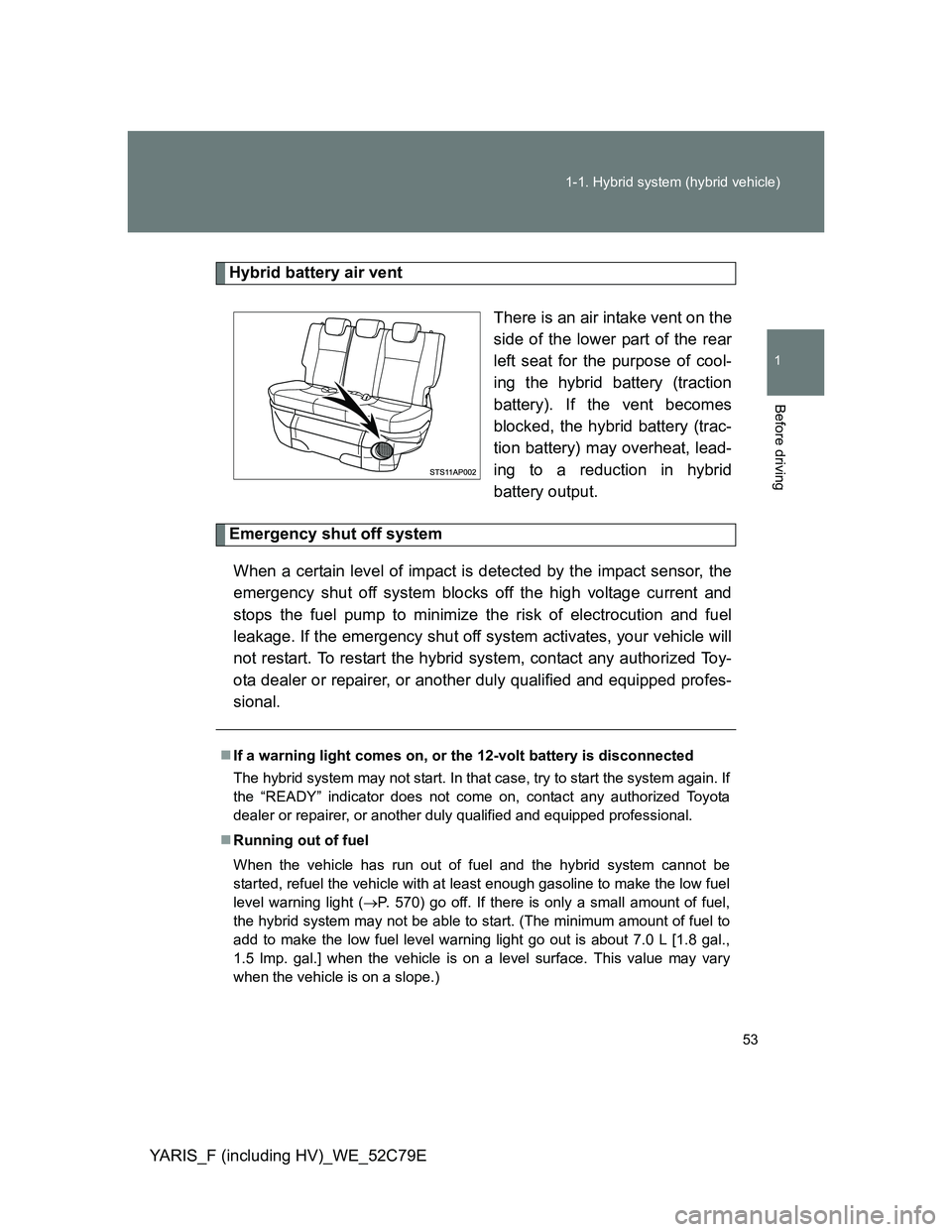
Hybrid battery air vent
There is an air intake vent on the
side of the lower part of the rear
left seat for the purpose of cool-
ing the hybrid battery (traction
battery). If the vent becomes
blocked, the hybrid battery (trac-
tion battery) may overheat, lead-
ing to a reduction in hybrid
battery output.
Emergency shut off system
When a certain level of impact is detected by the impact sensor, the
emergency shut off system blocks off the high voltage current and
stops the fuel pump to minimize the risk of electrocution and fuel
leakage. If the emergency shut off system activates, your vehicle will
not restart. To restart the hybrid system, contact any authorized Toy-
ota dealer or repairer, or another duly qualified and equipped profes-
sional.
If a warning light comes on, or the 12-volt battery is disconnected
The hybrid system may not start. In that case, try to start the system again. If
the “READY” indicator does not come on, contact any authorized Toyota
dealer or repairer, or another duly qualified and equipped professional.
Running out of fuel
When the vehicle has run out of fuel and the hybrid system cannot be
started, refuel the vehicle with at least enough gasoline to make the low fuel
level warning light (P. 570) go off. If there is only a small amount of fuel,
the hybrid system may not be able to start. (The minimum amount of fuel to
add to make the low fuel level warning light go out is about 7.0 L [1.8 gal.,
1.5 lmp. gal.] when the vehicle is on a level surface. This value may vary
when the vehicle is on a slope.)
Page 55 of 704
55 1-1. Hybrid system (hybrid vehicle)
1
Before driving
YARIS_F (including HV)_WE_52C79E
CAUTION
Road accident cautions
If your vehicle is involved in an accident, observe the following precautions
to reduce the risk of death or serious injury:
Stop the vehicle in a safe place to prevent subsequent accidents, shift the
shift lever to P, apply the parking brake, and turn the hybrid system off.
(P. 239, 244)
Do not touch the high voltage parts, cables or connectors.
If electric wires are exposed inside or outside your vehicle, an electric
shock may occur. Never touch exposed electric wires.
If a fluid leak occurs, do not touch the fluid as it may be strong alkaline
electrolyte from the hybrid battery (traction battery). If it comes into contact
with your skin or eyes, wash it off immediately with a large amount of water
or, if possible, boric acid solution. Seek immediate medical attention.
If a fire occurs in the hybrid vehicle, leave the vehicle as soon as possible.
Never use a fire extinguisher that is not meant for electric fires. Using even
a small amount of water may be dangerous.
If your vehicle needs to be towed, do so with front wheels raised. If the
wheels connected to the electric motor (traction motor) are on the ground
when towing, the motor may continue to generate electricity. This may
cause an electricity leakage leading to a fire. (P. 553)
Carefully inspect the ground under the vehicle. If you find that liquid has
leaked onto the ground, the fuel system may have been damaged. Leave
the vehicle as soon as possible and contact any authorized Toyota dealer
or repairer, or another duly qualified and equipped professional.
Nickel-metal hydride battery
Your vehicle contains a sealed nickel-metal hydride battery. If disposed of
improperly, it is hazardous to the environment and there is a risk of severe
burns and electrical shock that may result in death or serious injury.
Page 60 of 704
60 1-1. Hybrid system (hybrid vehicle)
YARIS_F (including HV)_WE_52C79E
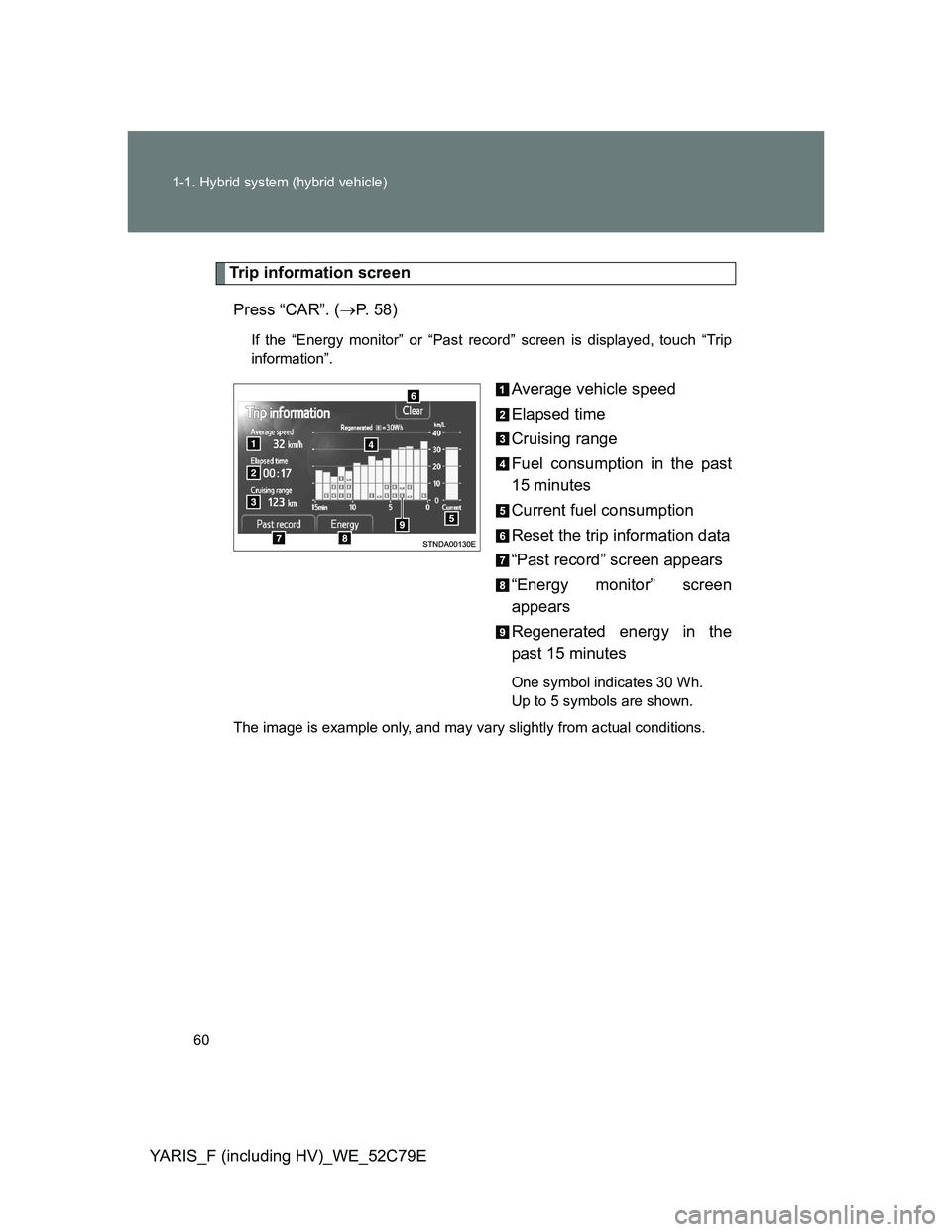
Trip information screen
Press “CAR”. (P. 58)
If the “Energy monitor” or “Past record” screen is displayed, touch “Trip
information”.
Average vehicle speed
Elapsed time
Cruising range
Fuel consumption in the past
15 minutes
Current fuel consumption
Reset the trip information data
“Past record” screen appears
“Energy monitor” screen
appears
Regenerated energy in the
past 15 minutes
One symbol indicates 30 Wh.
Up to 5 symbols are shown.
The image is example only, and may vary slightly from actual conditions.
Page 61 of 704
61 1-1. Hybrid system (hybrid vehicle)
1
Before driving
YARIS_F (including HV)_WE_52C79E
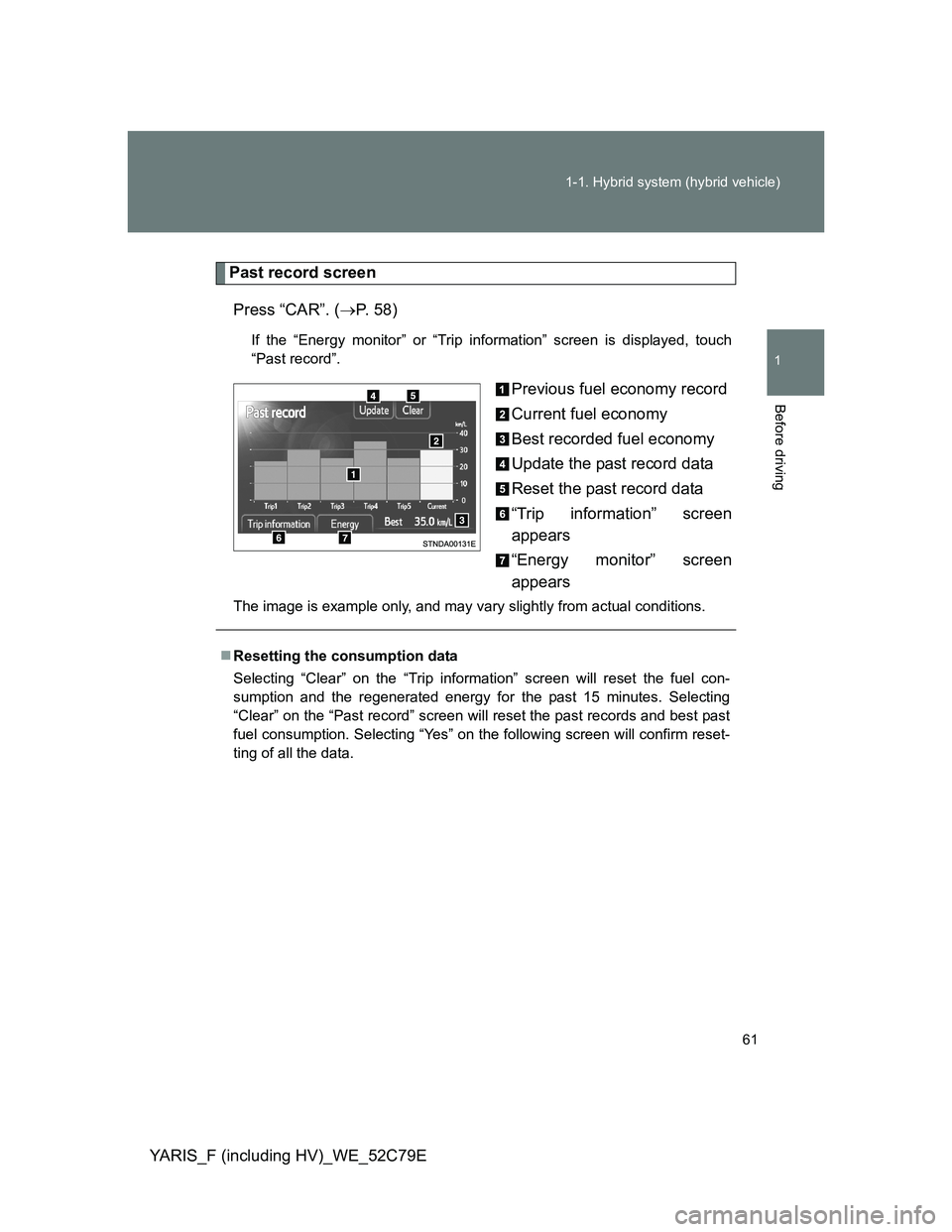
Past record screen
Press “CAR”. (P. 58)
If the “Energy monitor” or “Trip information” screen is displayed, touch
“Past record”.
Previous fuel economy record
Current fuel economy
Best recorded fuel economy
Update the past record data
Reset the past record data
“Trip information” screen
appears
“Energy monitor” screen
appears
The image is example only, and may vary slightly from actual conditions.
Resetting the consumption data
Selecting “Clear” on the “Trip information” screen will reset the fuel con-
sumption and the regenerated energy for the past 15 minutes. Selecting
“Clear” on the “Past record” screen will reset the past records and best past
fuel consumption. Selecting “Yes” on the following screen will confirm reset-
ting of all the data.
Page 62 of 704
62
1-1. Hybrid system (hybrid vehicle)
YARIS_F (including HV)_WE_52C79E
Hybrid vehicle driving tips
For economical and ecological driving, pay attention to the following
points:
Using Eco drive mode
P. 253
Use of Hybrid System Indicator
Eco-friendly driving is possible by keeping the indicator needle of
Hybrid System Indicator within Eco area. (P. 276)
When braking the vehicle
Make sure to operate the brakes gently and in good time. A greater
amount of electrical energy can be retained when slowing down.
Delays
Repeated acceleration and deceleration, as well as long waits at traffic
lights, will lead to bad fuel consumption. Check traffic reports before
leaving and avoid delays as much as possible. When encountering a
delay, gently release the brake pedal to allow the vehicle to move for-
ward slightly while avoiding overuse of the accelerator pedal. Doing so
can help control excessive gasoline consumption.
Highway driving
Control your speed and keep at a constant speed. Also, before stop-
ping at a toll booth or similar, allow plenty of time to release the acceler-
ator and gently apply the brakes. A greater amount of electrical energy
can be retained when slowing down.
Air conditioning
Use the air conditioning only when necessary. Doing so can help con-
trol excessive gasoline consumption.
In summer: In high temperatures, use the recirculated air mode. Doing
so will help to reduce the burden on the air conditioner and reduce fuel
consumption as well.
In winter: Because the gasoline engine will not automatically cut out
until the gasoline engine and the interior of the vehicle are warm, it will
consume fuel. Also, fuel consumption can be improved by avoiding
overuse of the heater such as setting the temperature too high.
Page 63 of 704
63 1-1. Hybrid system (hybrid vehicle)
1
Before driving
YARIS_F (including HV)_WE_52C79E
Checking tire inflation pressure
Make sure to check the tire inflation pressure frequently. Improper tire
inflation pressure can cause poor fuel consumption.
Also, as snow tires can cause large amounts of friction, their use on dry
roads can lead to poor fuel consumption. Use a tire that is appropriate
for the season.
Luggage
Carrying heavy luggage can lead to poor fuel consumption. Avoid car-
rying unnecessary luggage. Installing a large roof rack can also cause
poor fuel consumption.
Warming up before driving
Since the gasoline engine starts up and cuts out automatically when
cold, warming up the engine is unnecessary. Moreover, frequently driv-
ing short distances will cause the engine to repeatedly warm up, which
can lead to poor fuel consumption.
Page 151 of 704
151
1
Before driving
YARIS_F (including HV)_WE_52C79E
1-6. Refueling
Opening the fuel tank cap
Perform the following steps to open the fuel tank cap:
Before refueling the vehicle
Except hybrid vehicle (vehicles without a smart entry & start
system):
Turn the engine switch off and ensure that all the doors and
windows are closed.
Except hybrid vehicle (vehicles with a smart entry & start sys-
tem):
Turn the “ENGINE START STOP” switch off and ensure that
all the doors and windows are closed.
Hybrid vehicle (vehicles without an electronic key):
Turn the engine switch off and ensure that all the doors and
windows are closed.
Hybrid vehicle (vehicles with an electronic key):
Turn the “POWER” switch off and ensure that all the doors
and windows are closed.
Confirm the type of fuel. (P. 152)
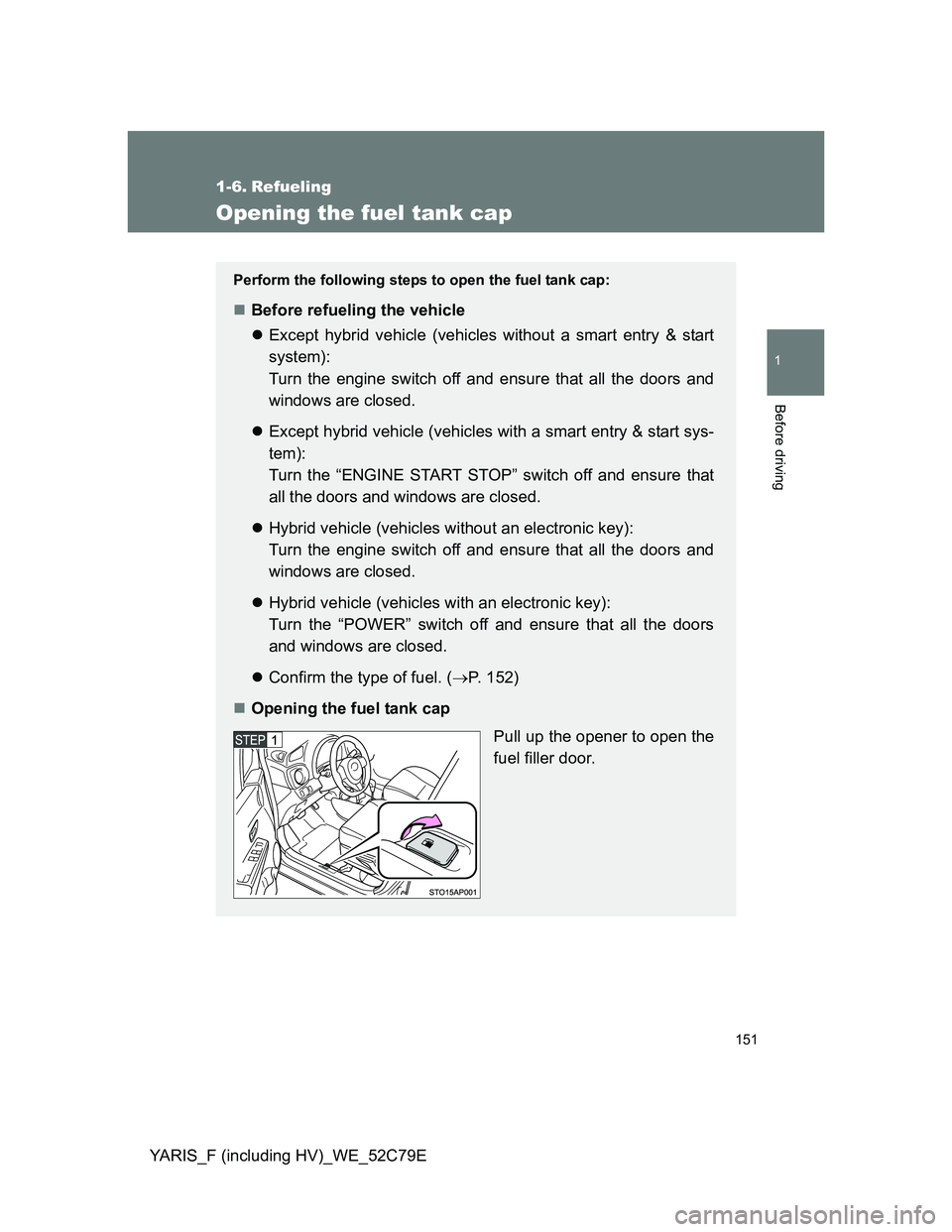
Opening the fuel tank cap
Pull up the opener to open the
fuel filler door.
Page 152 of 704
152 1-6. Refueling
YARIS_F (including HV)_WE_52C79E
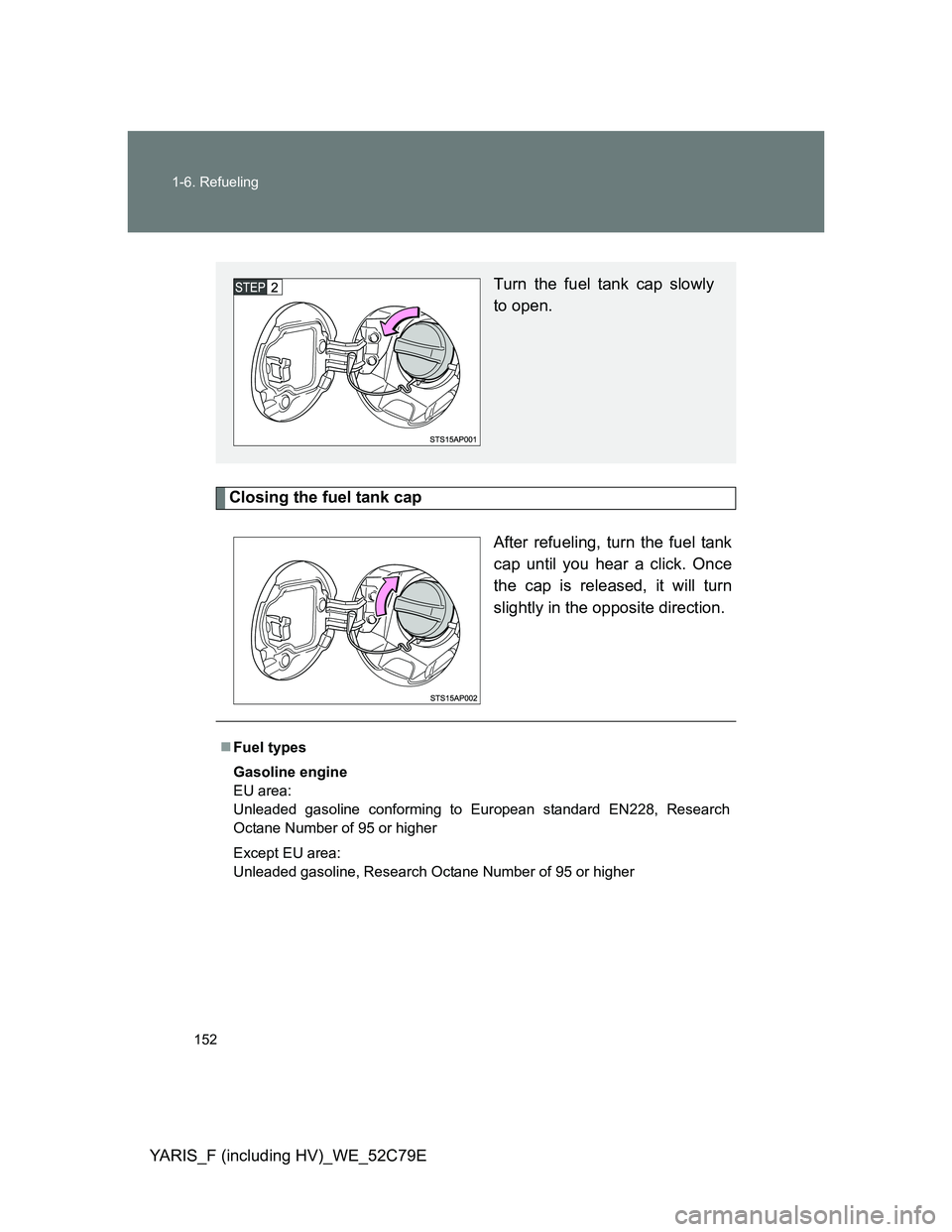
Closing the fuel tank cap
After refueling, turn the fuel tank
cap until you hear a click. Once
the cap is released, it will turn
slightly in the opposite direction.
Turn the fuel tank cap slowly
to open.
Fuel types
Gasoline engine
EU area:
Unleaded gasoline conforming to European standard EN228, Research
Octane Number of 95 or higher
Except EU area:
Unleaded gasoline, Research Octane Number of 95 or higher
Page 153 of 704
153 1-6. Refueling
1
Before driving
YARIS_F (including HV)_WE_52C79E
Diesel engine
EU area:
Diesel fuel conforming to European standard EN590
Except EU area:
Diesel fuel that contains 50 ppm or less of sulfur and has a cetane number of
48 or higher
Use of ethanol blended gasoline in a gasoline engine
Toyota allows the use of ethanol blended gasoline where the ethanol content
is up to 10%. Make sure that the ethanol blended gasoline to be used has a
Research Octane Number that follows the above.
CAUTION
When refueling the vehicle
Observe the following precautions while refueling the vehicle. Failure to do
so may result in death or serious injury.
After exiting the vehicle and before opening the fuel door, touch an
unpainted metal surface to discharge any static electricity. It is important to
discharge static electricity before refueling because sparks resulting from
static electricity can cause fuel vapors to ignite while refueling.
Always hold the grips on the fuel tank cap and turn it slowly to remove it.
A whooshing sound may be heard when the fuel tank cap is loosened.
Wait until the sound cannot be heard before fully removing the cap. In hot
weather, pressurized fuel may spray out the filler neck and cause injury.
Do not allow anyone that has not discharged static electricity from their
body to come close to an open fuel tank.
Do not inhale vaporized fuel.
Fuel contains substances that are harmful if inhaled.