fuel TOYOTA YARIS 2012 Owner's Guide
[x] Cancel search | Manufacturer: TOYOTA, Model Year: 2012, Model line: YARIS, Model: TOYOTA YARIS 2012Pages: 704, PDF Size: 27.58 MB
Page 289 of 704
289 2-2. Instrument cluster
2
When driving
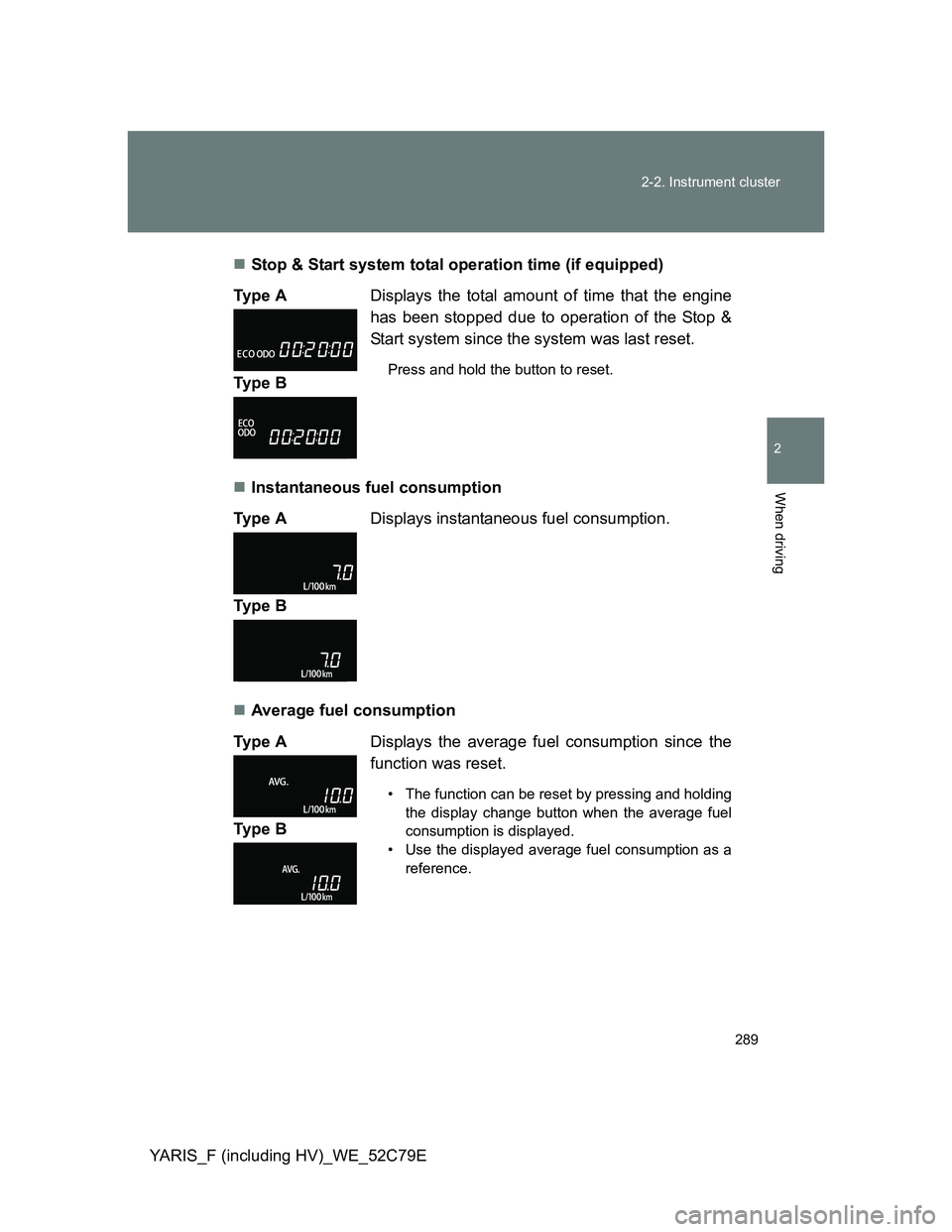
YARIS_F (including HV)_WE_52C79EStop & Start system total operation time (if equipped)
Instantaneous fuel consumption
Average fuel consumption Ty p e ADisplays the total amount of time that the engine
has been stopped due to operation of the Stop &
Start system since the system was last reset.
Press and hold the button to reset.Ty p e B
Ty p e ADisplays instantaneous fuel consumption.
Ty p e B
Ty p e ADisplays the average fuel consumption since the
function was reset.
• The function can be reset by pressing and holding
the display change button when the average fuel
consumption is displayed.
• Use the displayed average fuel consumption as a
reference.
Ty p e B
Page 290 of 704
290 2-2. Instrument cluster
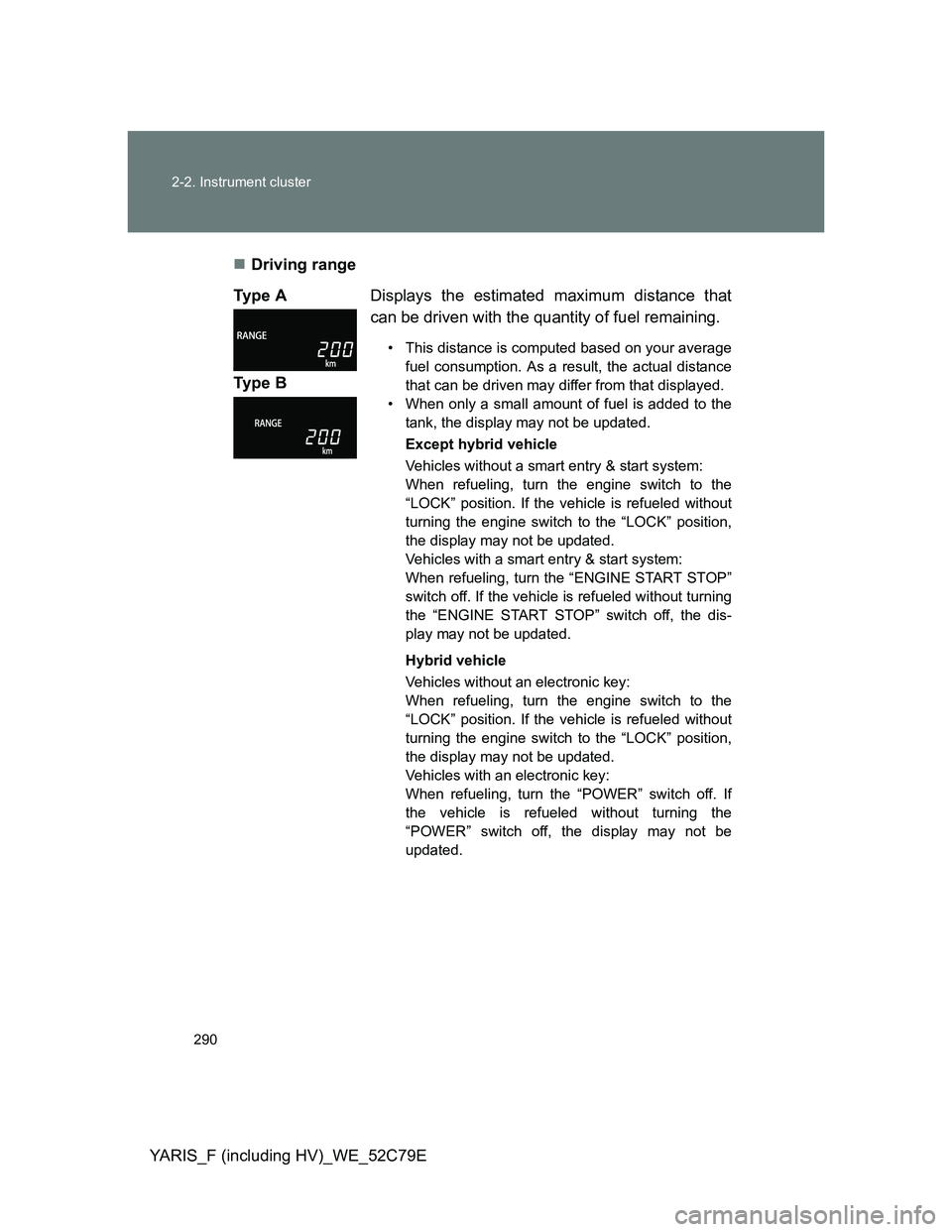
YARIS_F (including HV)_WE_52C79EDriving range
Ty p e ADisplays the estimated maximum distance that
can be driven with the quantity of fuel remaining.
• This distance is computed based on your average
fuel consumption. As a result, the actual distance
that can be driven may differ from that displayed.
• When only a small amount of fuel is added to the
tank, the display may not be updated.
Except hybrid vehicle
Vehicles without a smart entry & start system:
When refueling, turn the engine switch to the
“LOCK” position. If the vehicle is refueled without
turning the engine switch to the “LOCK” position,
the display may not be updated.
Vehicles with a smart entry & start system:
When refueling, turn the “ENGINE START STOP”
switch off. If the vehicle is refueled without turning
the “ENGINE START STOP” switch off, the dis-
play may not be updated.
Hybrid vehicle
Vehicles without an electronic key:
When refueling, turn the engine switch to the
“LOCK” position. If the vehicle is refueled without
turning the engine switch to the “LOCK” position,
the display may not be updated.
Vehicles with an electronic key:
When refueling, turn the “POWER” switch off. If
the vehicle is refueled without turning the
“POWER” switch off, the display may not be
updated.
Ty p e B
Page 292 of 704
292 2-2. Instrument cluster
YARIS_F (including HV)_WE_52C79E
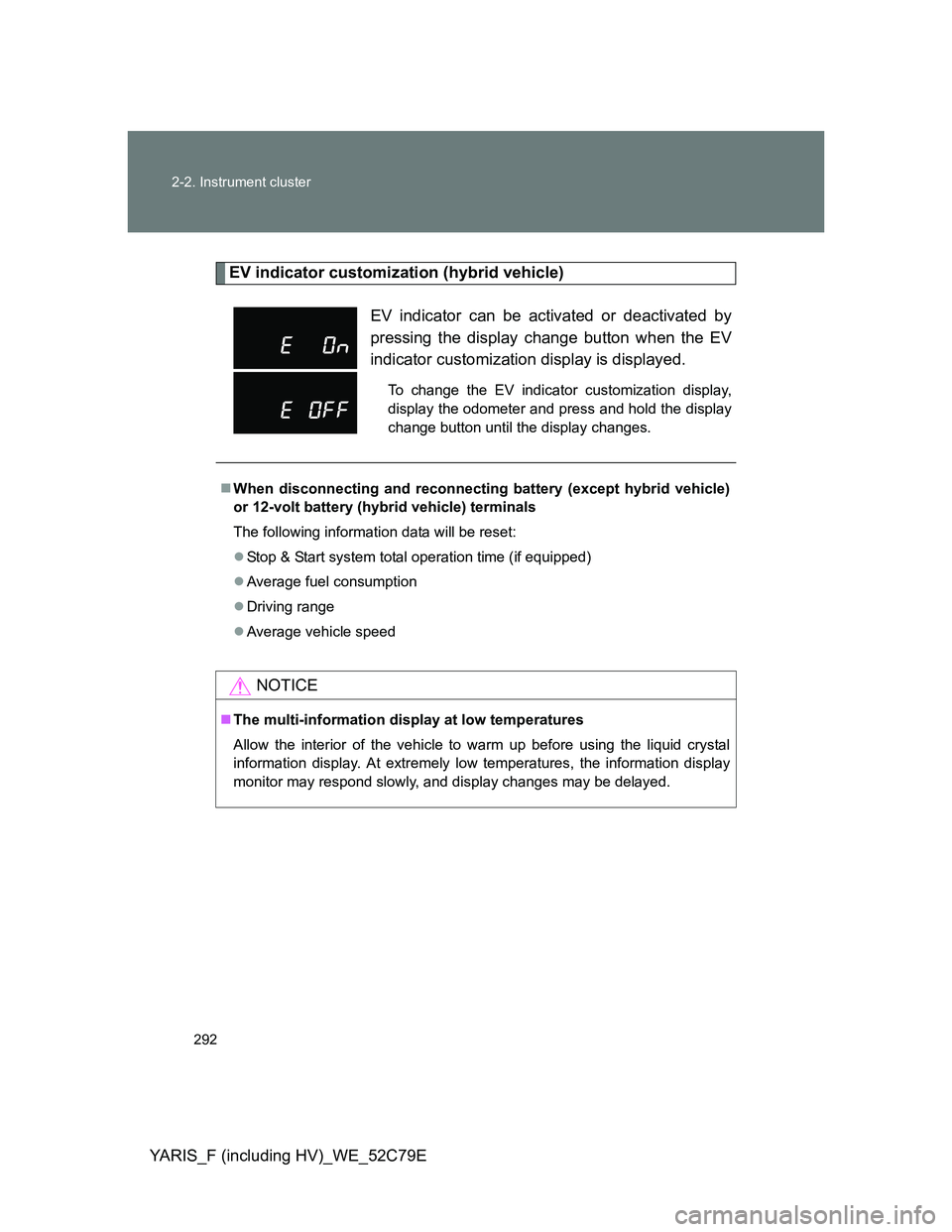
EV indicator customization (hybrid vehicle)
EV indicator can be activated or deactivated by
pressing the display change button when the EV
indicator customization display is displayed.
To change the EV indicator customization display,
display the odometer and press and hold the display
change button until the display changes.
When disconnecting and reconnecting battery (except hybrid vehicle)
or 12-volt battery (hybrid vehicle) terminals
The following information data will be reset:
Stop & Start system total operation time (if equipped)
Average fuel consumption
Driving range
Average vehicle speed
NOTICE
The multi-information display at low temperatures
Allow the interior of the vehicle to warm up before using the liquid crystal
information display. At extremely low temperatures, the information display
monitor may respond slowly, and display changes may be delayed.
Page 335 of 704
335 2-4. Using other driving systems
2
When driving
YARIS_F (including HV)_WE_52C79E
CAUTION
Exhaust pipe
Do not touch the exhaust pipe during cleaning, as the exhaust pipe and
exhaust gases will become particularly hot. Also, make sure that there are
no people or flammable materials near the exhaust pipe while the vehicle is
stopped.
Failure to do so may cause injury by burning or a fire.
NOTICE
To prevent the DPF system from failing
Do not use fuel other than the specified type
Do not use engine oil other than the recommended type
Do not modify the exhaust pipe
Page 336 of 704
336
YARIS_F (including HV)_WE_52C79E
2-5. Driving information
Cargo and luggage
CAUTION
Things that must not be carried in the luggage compartment
The following things may cause a fire if loaded in the luggage compartment:
Receptacles containing gasoline
Aerosol cans
Storage precautions
Observe the following precautions.
Failure to do so may result in death or serious injury.
Stow cargo and luggage in the luggage compartment whenever possible.
Do not stack anything in the luggage compartment higher than the seat-
backs.
Such items may be thrown about and possibly injure people in the vehicle
in the event of sudden braking or in an accident.
Do not place cargo or luggage in or on the following locations as the item
may get under the clutch, brake or accelerator pedal and prevent the ped-
als from being depressed properly, block the driver’s vision, or hit the
driver or passengers, causing an accident:
• At the feet of the driver
• On the front passenger or rear seats (when stacking items)
• On the luggage cover
• On the instrument panel
• On the dashboard
Take notice of the following information about storage precautions,
cargo capacity and load:
Stow cargo and luggage in the luggage compartment whenever
possible.
Be sure all items are secured in place.
To maintain vehicle balance while driving, position luggage
evenly within the luggage compartment.
For better fuel economy, do not carry unnecessary weight.
Page 343 of 704
![TOYOTA YARIS 2012 Owners Guide 343
2-5. Driving information
2
When driving
YARIS_F (including HV)_WE_52C79E
Trailer towing (except hybrid vehicle [except for South Africa])
Your vehicle is designed primarily as a passenger carrying](/img/14/49156/w960_49156-342.png "TOYOTA YARIS 2012 Owners Guide 343
2-5. Driving information
2
When driving
YARIS_F (including HV)_WE_52C79E
Trailer towing (except hybrid vehicle [except for South Africa])
Your vehicle is designed primarily as a passenger carrying")
343
2-5. Driving information
2
When driving
YARIS_F (including HV)_WE_52C79E
Trailer towing (except hybrid vehicle [except for South Africa])
Your vehicle is designed primarily as a passenger carrying vehicle.
Towing a trailer will have an adverse effect on handling, perfor-
mance, braking, durability, and fuel consumption. Your safety and
satisfaction depend on the proper use of correct equipment and cau-
tious driving habits. For your safety and the safety of others, do not
overload the vehicle or trailer.
To tow a trailer safely, use extreme care and drive the vehicle in
accordance with the trailer’s characteristics and operating condi-
tions.
Toyota warranties do not apply to damage or malfunction caused by
towing a trailer for commercial purposes.
Ask your local authorized Toyota dealer or repairer, or another duly
qualified and equipped professional, for further details before tow-
ing, as there are additional legal requirements in some countries.
Weight limits
Check the allowable towing capacity, GVM (Gross Vehicle
Mass), MPAC (Maximum Permissible Axle Capacity), and per-
missible drawbar load before towing. (P. 654)
Towing hitch/bracket
Toyota recommends the use of the Toyota hitch/bracket for your
vehicle. Other products of a suitable nature and comparable
quality may also be used.
Page 368 of 704
368 3-1. Using the air conditioning system and defogger
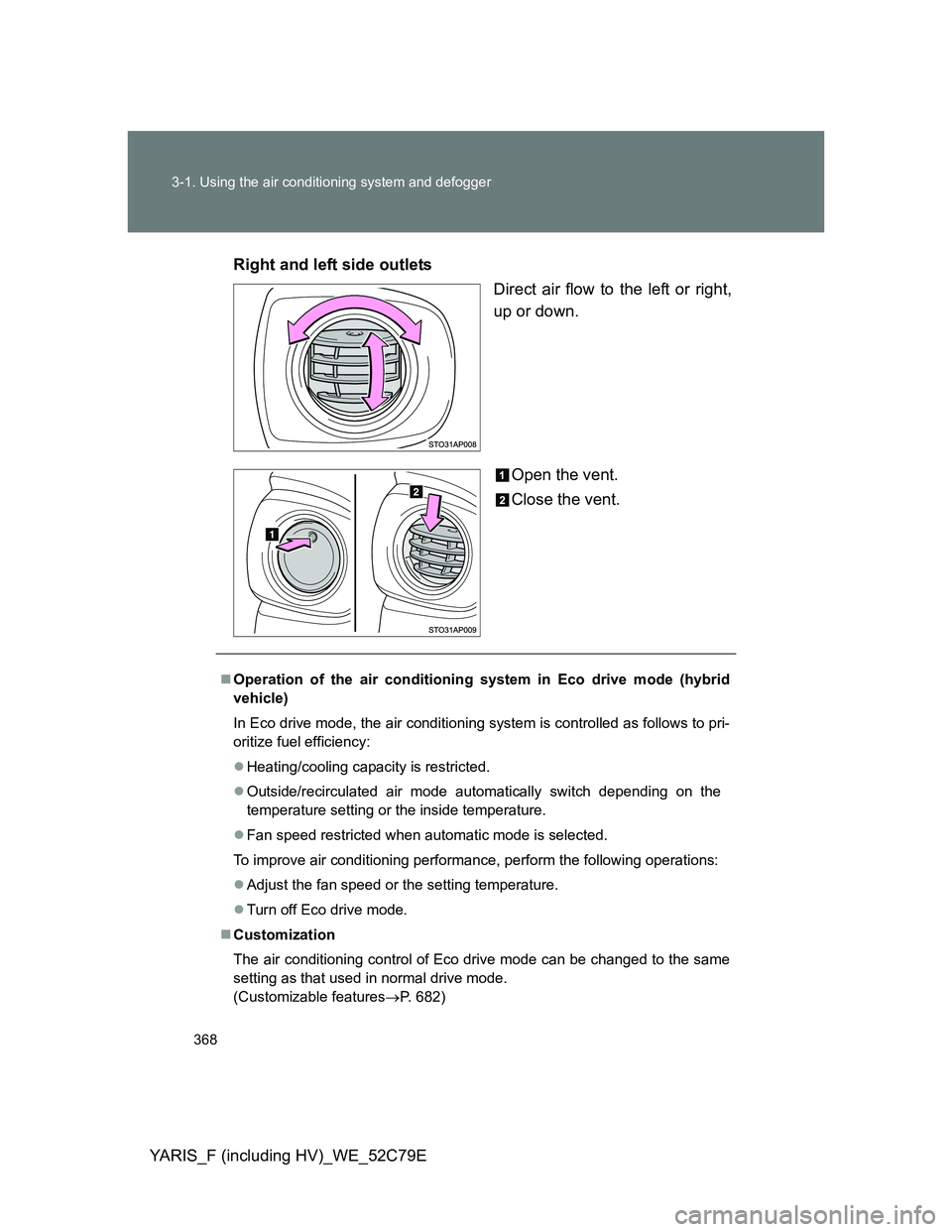
YARIS_F (including HV)_WE_52C79ERight and left side outlets
Direct air flow to the left or right,
up or down.
Open the vent.
Close the vent.
Operation of the air conditioning system in Eco drive mode (hybrid
vehicle)
In Eco drive mode, the air conditioning system is controlled as follows to pri-
oritize fuel efficiency:
Heating/cooling capacity is restricted.
Outside/recirculated air mode automatically switch depending on the
temperature setting or the inside temperature.
Fan speed restricted when automatic mode is selected.
To improve air conditioning performance, perform the following operations:
Adjust the fan speed or the setting temperature.
Turn off Eco drive mode.
Customization
The air conditioning control of Eco drive mode can be changed to the same
setting as that used in normal drive mode.
(Customizable featuresP. 682)
Page 372 of 704
372
3-1. Using the air conditioning system and defogger
YARIS_F (including HV)_WE_52C79E
Power heater
: If equipped
Power heater can be operated when
The engine is running.
Normal characteristics of power heater operation
The following cases do not indicate a malfunction:
When the power heater is turned on or off, some white smoke and a
slight odor may be emitted from the power heater exhaust that is located
under the floor.
When the power heater is used under extremely cold conditions, vapor
may be visible from its exhaust.
When the power heater is turned off, you may hear a sound in the engine
compartment for about 2 minutes until the power heater turns off com-
pletely.
After the heater is turned off
We recommend not restarting the heater for 10 minutes after you turn it off.
Otherwise, a noise may be heard as the heater ignites.
When refueling your vehicle
The engine must be turned off. Turning the engine off turns the power heater
off.
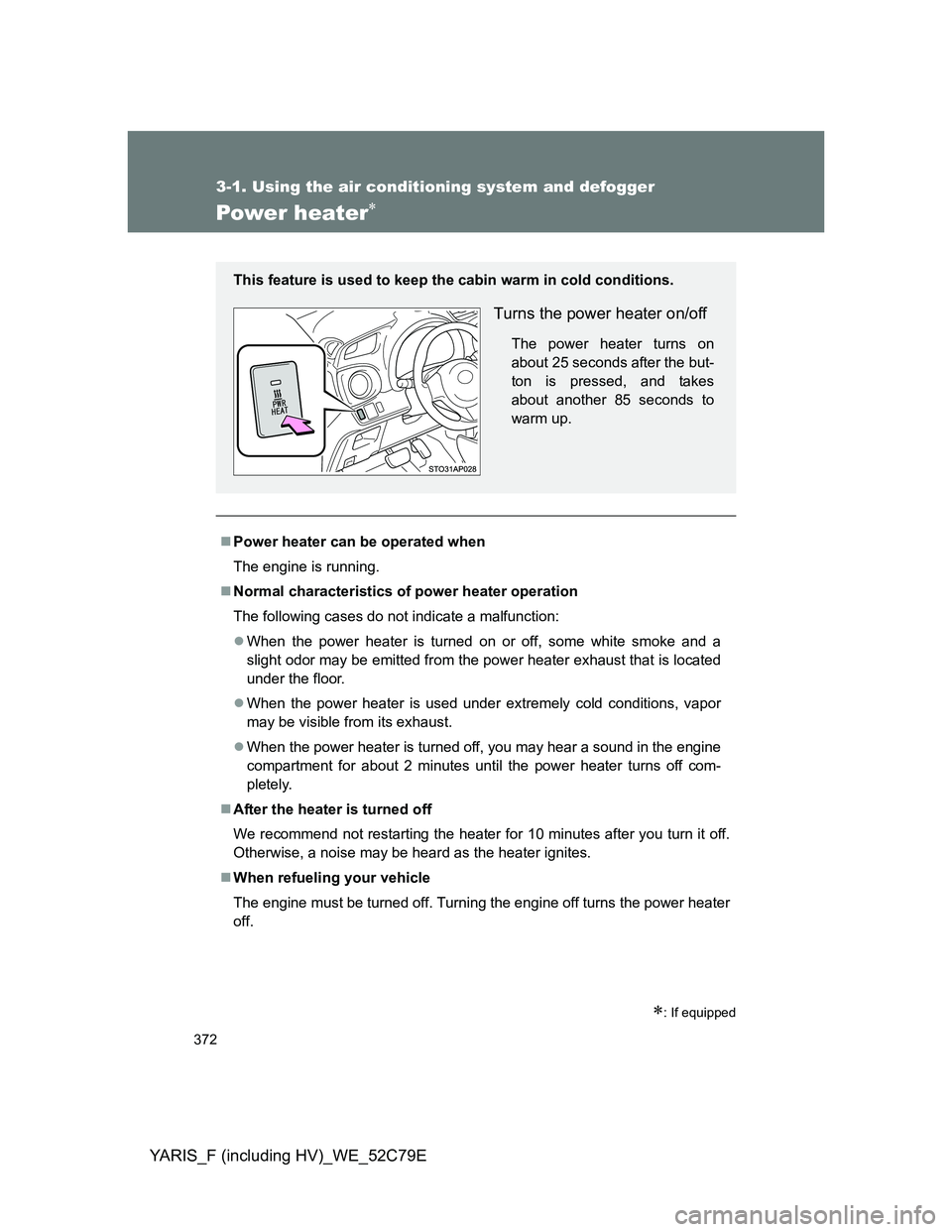
This feature is used to keep the cabin warm in cold conditions.
Turns the power heater on/off
The power heater turns on
about 25 seconds after the but-
ton is pressed, and takes
about another 85 seconds to
warm up.
Page 373 of 704
373 3-1. Using the air conditioning system and defogger
3
Interior features
YARIS_F (including HV)_WE_52C79E
CAUTION
To prevent burns or damage to your vehicle
NOTICE
To prevent damage to your vehicle
Do not turn the heater on and off repeatedly in 5 minute intervals as this
can shorten the life of the heater components. If the engine must be turned
on and off repeatedly within short intervals (such as when the vehicle is
being used for delivery purposes), turn the heater off.
Do not modify or open the heater without consulting any authorized Toyota
dealer or repairer, or another duly qualified and equipped professional, as
this may cause a heater malfunction or a fire.
Be careful not to splash or spill liquid directly on the heater or on the
heater fuel pump, as this may cause the heater to malfunction.
Keep the intake and exhaust pipes of the heater free from water, snow,
ice, mud, etc. If the pipes become clogged, this can cause the heater to
malfunction.
If you notice anything unusual, such as a fluid leak, smoke and poor oper-
ation, turn off the heater and have your vehicle checked by any authorized
Toyota dealer or repairer, or another duly qualified and equipped profes-
sional.
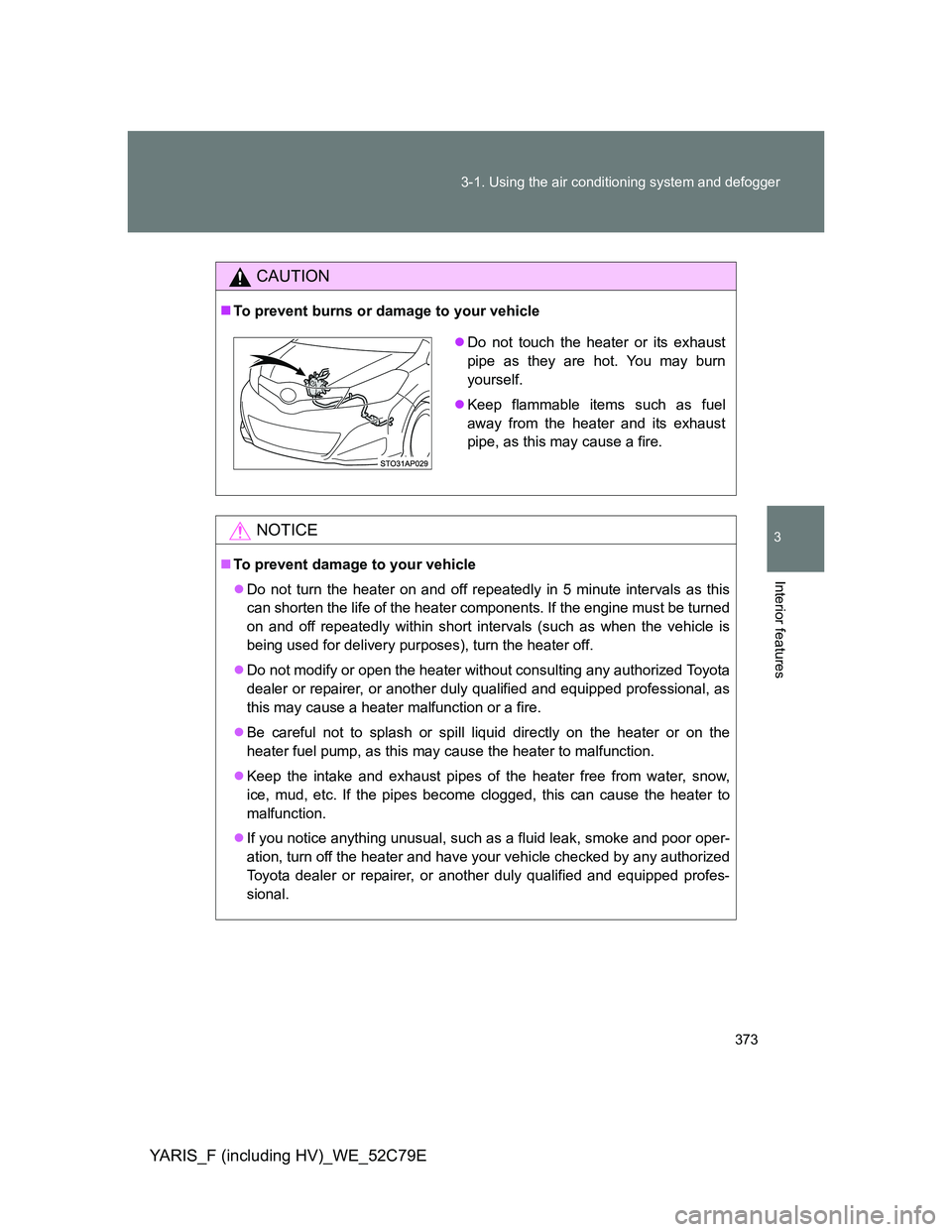
Do not touch the heater or its exhaust
pipe as they are hot. You may burn
yourself.
Keep flammable items such as fuel
away from the heater and its exhaust
pipe, as this may cause a fire.
Page 446 of 704
446
YARIS_F (including HV)_WE_52C79E
4-1. Maintenance and care
Cleaning and protecting the vehicle exterior
Automatic car washes
Fold the mirrors and remove the antenna before washing the vehicle.
Start washing from the front of the vehicle. Make sure to re-install the
antenna and extend the mirrors before driving.
Brushes used in automatic car washes may scratch the vehicle surface
and harm your vehicle’s paint.
Vehicles with a rear spoiler: In certain automatic car washes, the rear
spoiler may interfere with machine operation. This may prevent the vehi-
cle from being cleaned properly or result in damage to the rear spoiler.
High pressure car washes
Do not allow the nozzles of the car wash to come within close proximity
of the windows.
Before using the car wash, check that the fuel filler door on your vehicle
is closed properly.
Perform the following to protect the vehicle and maintain it in prime
condition:
Working from top to bottom, liberally apply water to the vehicle
body, wheel wells and underside of the vehicle to remove any
dirt and dust.
Wash the vehicle body using a sponge or soft cloth, such as a
chamois.
For hard-to-remove marks, use car wash soap and rinse thor-
oughly with water.
Wipe away any water.
Wax the vehicle when the waterproof coating deteriorates.
If water does not bead on a clean surface, apply wax when the vehicle
body is cool.