Start TOYOTA YARIS 2013 3.G Owner's Manual
[x] Cancel search | Manufacturer: TOYOTA, Model Year: 2013, Model line: YARIS, Model: TOYOTA YARIS 2013 3.GPages: 400, PDF Size: 9 MB
Page 182 of 400
182 2-5. Driving information
●Always place wheel blocks under both the vehicle and the trailer
wheels when parking. Apply the parking brake firmly, and put the
transmission in P (vehicles with an automatic transmission) or in 1
or R (vehicles with a manual transmission). Avoid parking on a
slope, but if unavoidable, do so only after performing the following:
Apply the brakes and keep them applied.
Have someone place wheel bloc ks under both the vehicle and
trailer wheels.
When the wheel blocks are in place, release the brakes slowly
until the blocks absorb the load.
Apply the parking brake firmly.
Shift into P (vehicles with an automatic transmission) or 1 or R
(vehicles with a manual transmission) and turn off the engine.
● When restarting after parking on a slope:
With the transmission in P (vehi cles with an automatic trans-
mission) or the clutch pedal (vehicles with a manual transmis-
sion) depressed, start the e ngine. On vehicles with an
automatic transmission, be su re to keep the brake pedal
pressed.
Shift into a forward gear. If reversing, shift into R.
Release the parking brake (also brake pedal on vehicles with
an automatic transmission), and slowly pull or back away from
the wheel blocks. Stop and apply the brakes.
Have someone retrieve the blocks.
Page 222 of 400
222
4-1. Maintenance and care
Cleaning and protecting the vehicle exterior
■Automatic car washes
●Fold the mirrors and remove the antenna before washing the vehicle.
Start washing from the front of the vehicle. Make sure to re-install the
antenna and extend the mirrors before driving.
● Brushes used in automatic car washes may scratch the vehicle surface
and harm your vehicle’s paint.
● For vehicles with the rear spoiler, in certain automatic car washes, the
rear spoiler may interfere with machine operation. This may prevent the
vehicle from being cleaned properly or result in damage to the rear
spoiler.
■ High pressure car washes
●Do not allow the nozzles of the car wash to come within close proximity
of the window and door borders, and high mounted stoplight.
● Before using the car wash, check that the fuel filler door on your vehicle
is closed properly.
Perform the following to protect the vehicle and maintain it in prime
condition:
● Working from top to bottom, liber ally apply water to the vehicle
body, wheel wells and underside of the vehicle to remove any
dirt and dust.
● Wash the vehicle body using a sponge or soft cloth, such as a
chamois.
● For hard-to-remove marks, use car wash soap and rinse thor-
oughly with water.
● Wipe away any water.
● Wax the vehicle when the waterproof coating deteriorates.
If water does not bead on a clean surface, apply wax when the vehi-
cle body is cool.
Page 229 of 400
229
4-2. Maintenance
4
Maintenance and care
■
Reset the maintenance data (except Canada)
After the required maintenance is performed according to the maintenance
schedule, please reset the maintenance data.
To reset the data, follow the procedures described below:
Switch the display to the trip meter “A” when the engine is running.
(P. 133)
Turn the engine switch to the “LOCK” position.
While pressing the display change button ( P. 133), turn the
engine switch to the “ON” position (do not start the engine because
reset mode will be canceled). Continue to press and hold the button
until the trip meter displays “000000”.
■ Allow inspection and repairs to be performed by a Toyota dealer
● Toyota technicians are well-trained specialists and are kept up to date
with the latest service information. They are well informed about the
operations of all systems on your vehicle.
● Keep a copy of the repair order. It proves that the maintenance that has
been performed is under warranty coverage. If any problem should arise
while your vehicle is under warranty, your Toyota dealer will promptly
take care of it.
CAUTION
■If your vehicle is not properly maintained
Improper maintenance could result in serious damage to the vehicle and
possible serious injury or death.
■ Handling of the battery
●Engine exhaust, some of its constituents, and a wide variety of automobile
components contain or emit chemicals known to the State of California to
cause cancer and birth defects and other reproductive harm. Work in a
well ventilated area.
● Oils, fuels and fluids contained in vehicles as well as waste produced by
component wear contain or emit chemicals known to the State of Califor-
nia to cause cancer and birth defects or other reproductive harm. Avoid
exposure and wash any affected area immediately.
● Battery posts, terminals and related accessories contain lead and lead
compounds which are known to cause brain damage. Wash your hands
after handling. ( P. 250)
Page 237 of 400

237
4-3. Do-it-yourself maintenance
4
Maintenance and care
CAUTION
■
When working near the electric cooling fan or radiator grille
Be sure the engine switch is off.
With the engine switch on, the electric cooling fan may automatically start to
run if the air conditioning is on and/or the coolant temperature is high.
( P. 248)
■ Safety glasses
Wear safety glasses to prevent flying or falling material, fluid spray, etc. from
getting in your eyes.
NOTICE
■If you remove the air cleaner filter
Driving with the air cleaner filter removed may cause excessive engine wear
due to dirt in the air.
Page 241 of 400
241
4-3. Do-it-yourself maintenance
4
Maintenance and care
CAUTION
■
When raising your vehicle
Make sure to observe the following precautions to reduce the possibility of
death or serious injury:
●When using a floor jack, follow the instructions of the manual provided with
the jack.
● Do not use the jack that was supplied with your vehicle.
● Do not put any part of your body underneath the vehicle when it is sup-
ported only by the floor jack.
● Always use floor jack and/or automotive jack stands on a solid, flat, level
surface.
● Do not start the engine while the vehicle is supported by the floor jack.
● Stop the vehicle on level, firm ground, firmly set the parking brake and shift
the shift lever to P (vehicles with an automatic transmission) or R (vehicles
with a manual transmission).
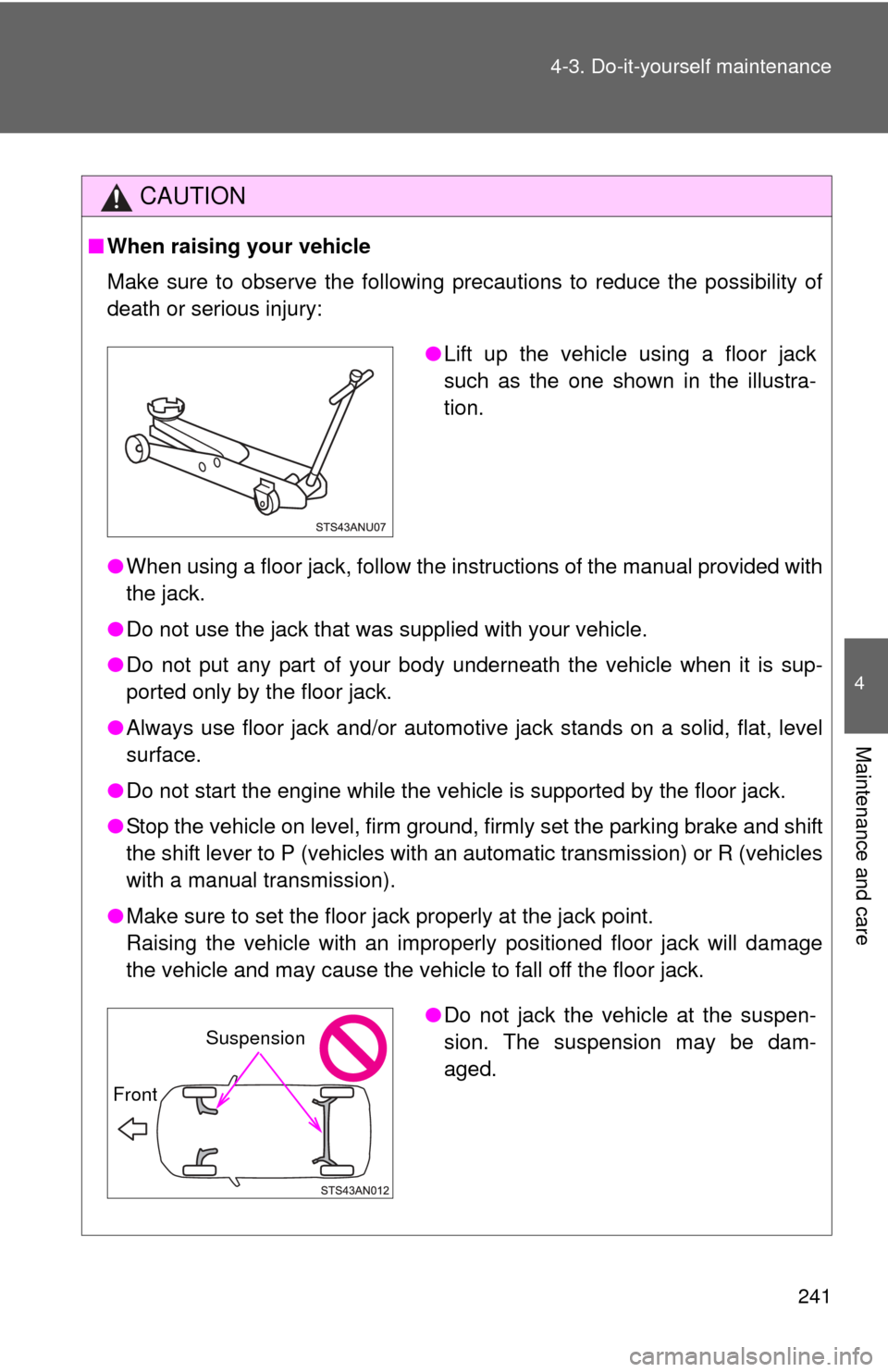
● Make sure to set the floor jack properly at the jack point.
Raising the vehicle with an improperly positioned floor jack will damage
the vehicle and may cause the vehicle to fall off the floor jack.
●Lift up the vehicle using a floor jack
such as the one shown in the illustra-
tion.
●Do not jack the vehicle at the suspen-
sion. The suspension may be dam-
aged.Suspension
Front
Page 280 of 400

280 4-3. Do-it-yourself maintenance
7 IGN15 AMultiport fuel injection system/
sequential multiport fuel injection
system
8 MET 7.5 A Gauges and meters
9 EPS 50 A Electric power steering system
10 ABS NO.2 30 AAnti-lock brake system, vehicle sta-
bility control system
11 DEF 30 ARear window defogger, outside
rear view mirror defoggers
12 SPARE 10 A Spare fuse
13 PTC 80 APTC heater, outside rear view mir-
ror defoggers
14 HTR 40 A Air conditioning system
15 H-LP CLN 30 A No circuit
16 RDI FAN 30 A Electric cooling fan
17 ABS NO.1 50 AAnti-lock brake system, vehicle sta-
bility control system
18 BBC 40 A No circuit
19 ST 30 A Starting system
20 AMP 15 A No circuit
21 D/L NO.2 25 A No circuit
22 D.C.C 30 A DOME, ECU-B NO.1, ECU-B NO.2
23 STR LOCK 20 A No circuit
24 ECU-B NO.1 5 A Multiport fuel injection system/
sequential multiport fuel injection
system, main body ECU
25 DOME 15 AInterior light, personal lights, audio
system, vehicle stability control
system
26 MIR-HTR 10 A No circuit
FuseAmpereCircuit
Page 281 of 400
281
4-3. Do-it-yourself maintenance
4
Maintenance and care
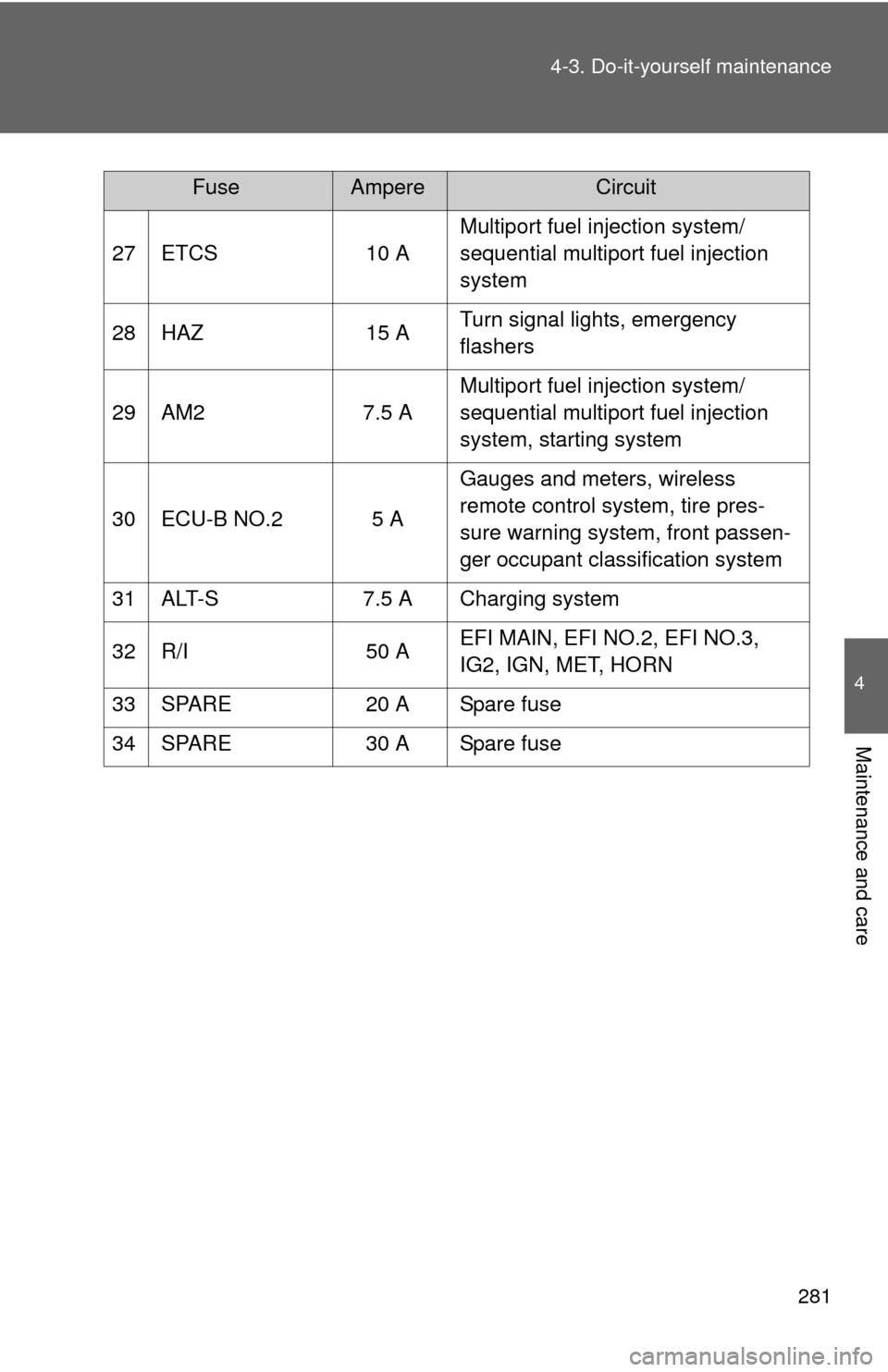
27 ETCS
10 AMultiport fuel injection system/
sequential multiport fuel injection
system
28 HAZ 15 ATurn signal lights, emergency
flashers
29 AM2 7.5 AMultiport fuel injection system/
sequential multiport fuel injection
system, starting system
30 ECU-B NO.2 5 A Gauges and meters, wireless
remote control system, tire pres-
sure warning system, front passen-
ger occupant classification system
31 ALT-S 7.5 A Charging system
32 R/I 50 AEFI MAIN, EFI NO.2, EFI NO.3,
IG2, IGN, MET, HORN
33 SPARE 20 A Spare fuse
34 SPARE 30 A Spare fuse
FuseAmpereCircuit
Page 285 of 400
285
4-3. Do-it-yourself maintenance
4
Maintenance and care
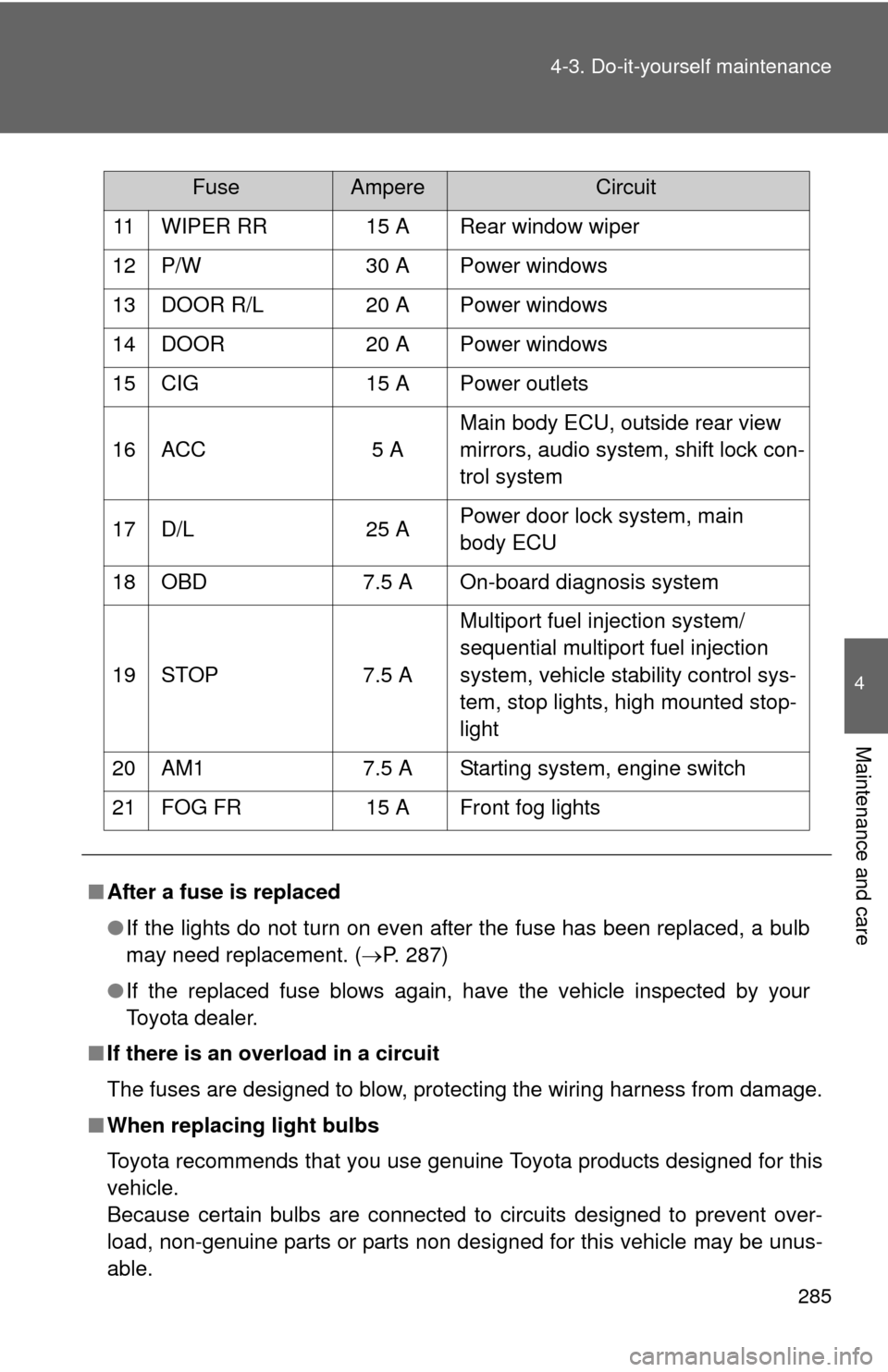
11 WIPER RR 15 A Rear window wiper
12 P/W 30 A Power windows
13 DOOR R/L 20 A Power windows
14 DOOR 20 A Power windows
15 CIG 15 A Power outlets
16 ACC 5 A Main body ECU, outside rear view
mirrors, audio system, shift lock con-
trol system
17 D/L 25 A Power door lock system, main
body ECU
18 OBD 7.5 A On-board diagnosis system
19 STOP 7.5 A Multiport fuel injection system/
sequential multiport fuel injection
system, vehicle stability control sys-
tem, stop lights, high mounted stop-
light
20 AM1 7.5 A Starting system, engine switch
21 FOG FR 15 A Front fog lights
■ After a fuse is replaced
●If the lights do not turn on even after the fuse has been replaced, a bulb
may need replacement. ( P. 287)
● If the replaced fuse blows again, have the vehicle inspected by your
Toyota dealer.
■ If there is an overload in a circuit
The fuses are designed to blow, protecting the wiring harness from damage.
■ When replacing light bulbs
Toyota recommends that you use genuine Toyota products designed for this
vehicle.
Because certain bulbs are connected to circuits designed to prevent over-
load, non-genuine parts or parts non designed for this vehicle may be unus-
able.
FuseAmpereCircuit
Page 295 of 400
When trouble arises5
295
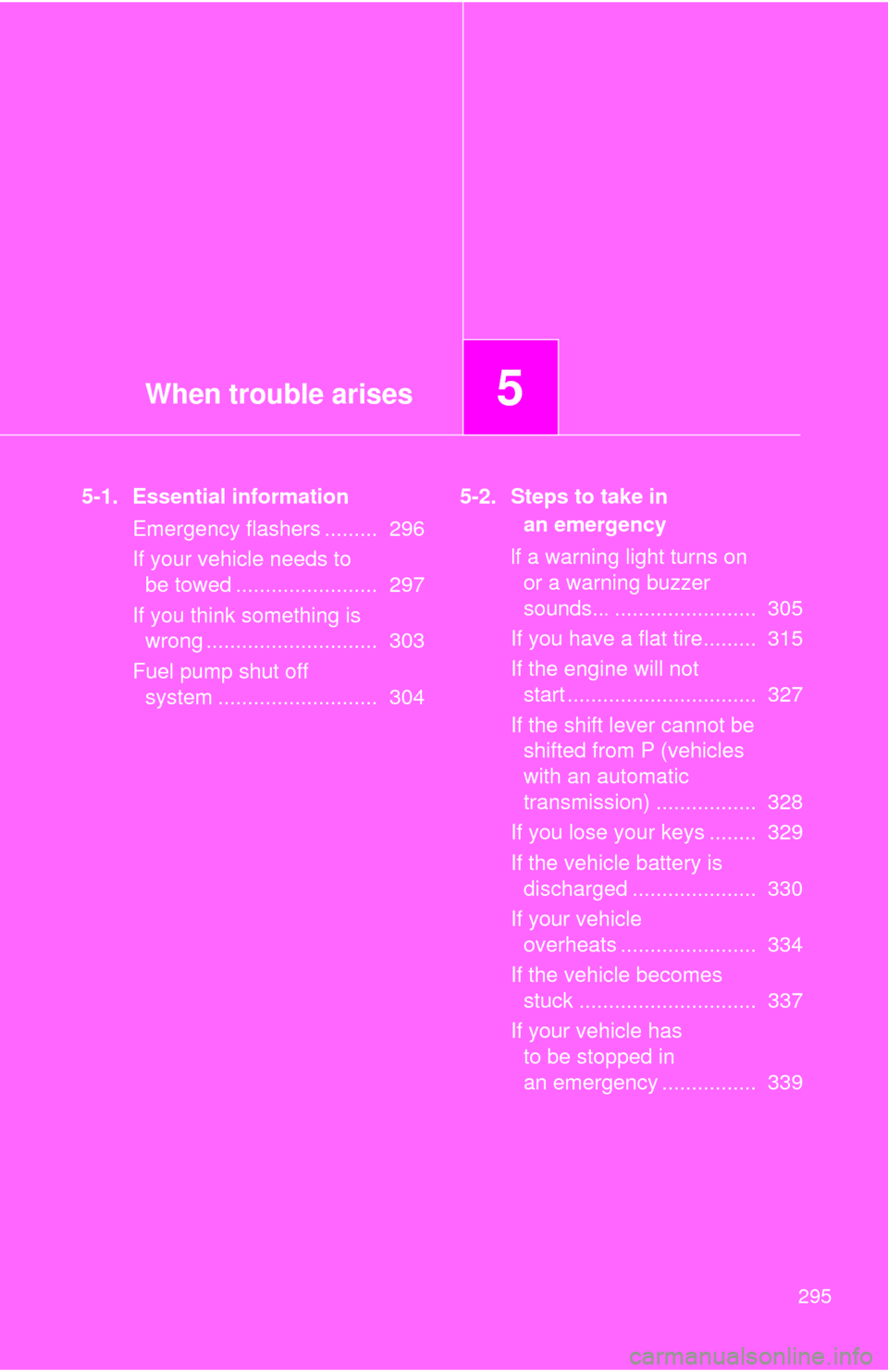
5-1. Essential informationEmergency flashers ......... 296
If your vehicle needs to be towed ........................ 297
If you think something is wrong ............................. 303
Fuel pump shut off system ........................... 304 5-2. Steps to take in
an emergency
If a warning light turns on or a warning buzzer
sounds..
......................... 305
If you have a flat tire......... 315
If the engine will not start ................................ 327
If the shift lever cannot be shifted from P (vehicles
with an automatic
transmission) ................. 328
If you lose your keys ........ 329
If the vehicle battery is discharged ..................... 330
If your vehicle overheats ....................... 334
If the vehicle becomes stuck .............................. 337
If your vehicle has to be stopped in
an emergency ................ 339
Page 302 of 400

302 5-1. Essential information
CAUTION
■Caution while towing
●Use extreme caution when towing the vehicle.
Avoid sudden starts or erratic driving maneuvers which place excessive
stress on the emergency towing eyelet and the cables or chains. Always
be cautious of the surroundings and other vehicles while towing.
● If the engine is not running, the power assist for the brakes and steering
will not function, making steering and braking more difficult.
■ Installing towing eyelet to the vehicle
Make sure that towing eyelet is installed securely.
If not securely installed, towing eyelet may come loose during towing. This
may lead to accidents that cause serious injury or even death.
NOTICE
■To prevent causing serious damage to the transmission when towing
using a wheel-lift type truck (vehic les with an automatic transmission)
Never tow this vehicle from the rear with the front wheels on the ground.
■ To prevent damage to the vehicle when towing using a wheel-lift type
truck (vehicles with an automatic transmission)
When raising the vehicle, ensure adequate ground clearance for towing at
the opposite end of the raised vehicle. Without adequate clearance, the
vehicle could be damaged while being towed.
■ To prevent damage to the vehicle when towing using a wheel-lift type
truck (vehicles with a manual transmission)
●Do not tow the vehicle from the rear when the engine switch is in the
“LOCK” position or the key is removed.
The steering lock mechanism is not strong enough to hold the front wheel
straight.
● When raising the vehicle, ensure adequate ground clearance for towing at
the opposite end of the raised vehicle. Without adequate clearance, the
vehicle could be damaged while being towed.
■ To prevent body damage when to wing with a sliding-type truck
Do not tow with a sling-type truck, either from the front or rear.