flat tire TOYOTA YARIS 2013 Owner's Guide
[x] Cancel search | Manufacturer: TOYOTA, Model Year: 2013, Model line: YARIS, Model: TOYOTA YARIS 2013Pages: 712, PDF Size: 30.2 MB
Page 609 of 712
5
609 5-2. Steps to take in an emergency
When trouble arises
YARIS_F (including HV)_WE_52E26EWith the compressor switch off, disconnect the nozzle from
the valve on the tire and then pull out the power plug from the
power outlet socket or cigarette lighter.
Some sealant may leak when the hose is removed.
Install the valve cap onto the valve of the emergency repaired
tire.
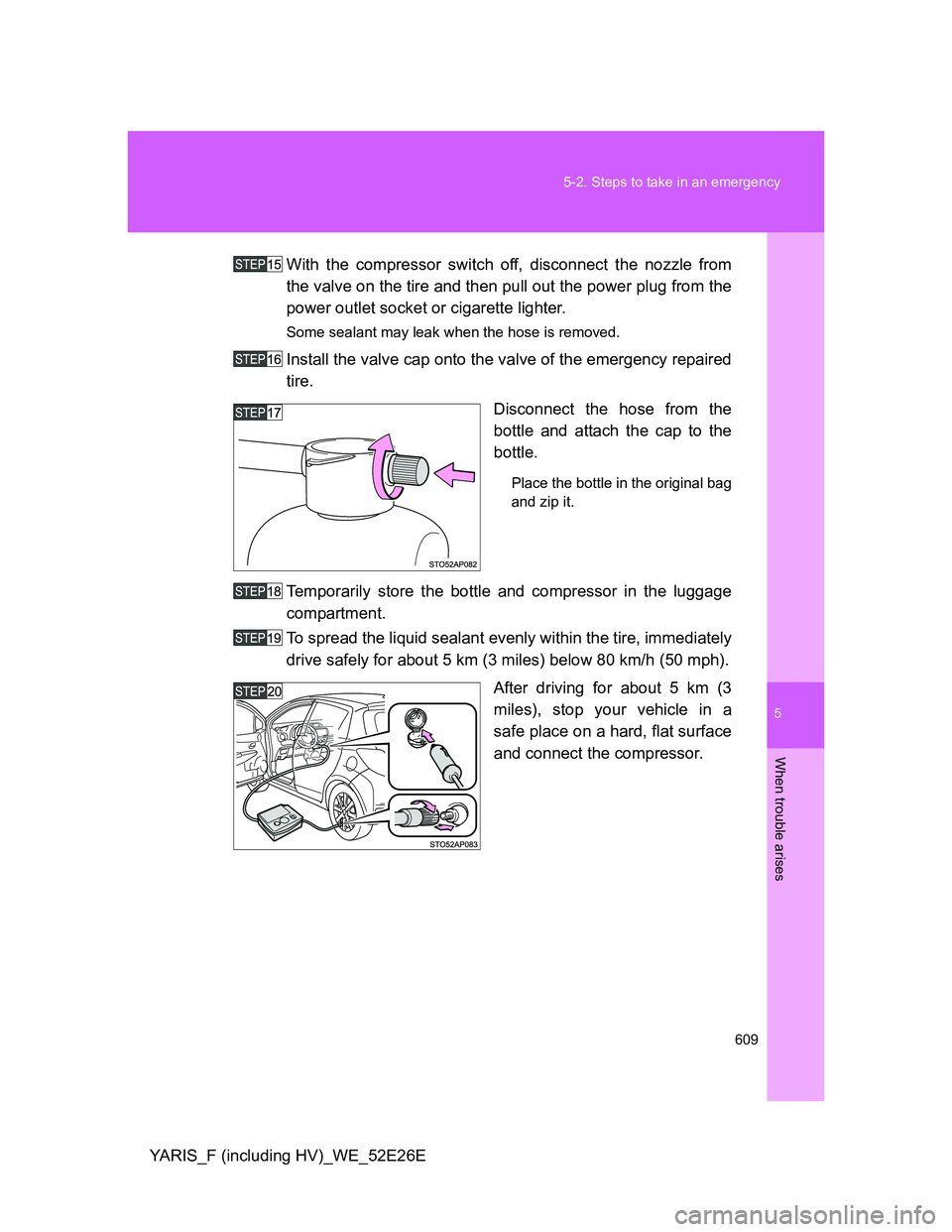
Disconnect the hose from the
bottle and attach the cap to the
bottle.
Place the bottle in the original bag
and zip it.
Temporarily store the bottle and compressor in the luggage
compartment.
To spread the liquid sealant evenly within the tire, immediately
drive safely for about 5 km (3 miles) below 80 km/h (50 mph).
After driving for about 5 km (3
miles), stop your vehicle in a
safe place on a hard, flat surface
and connect the compressor.
Page 610 of 712
610 5-2. Steps to take in an emergency
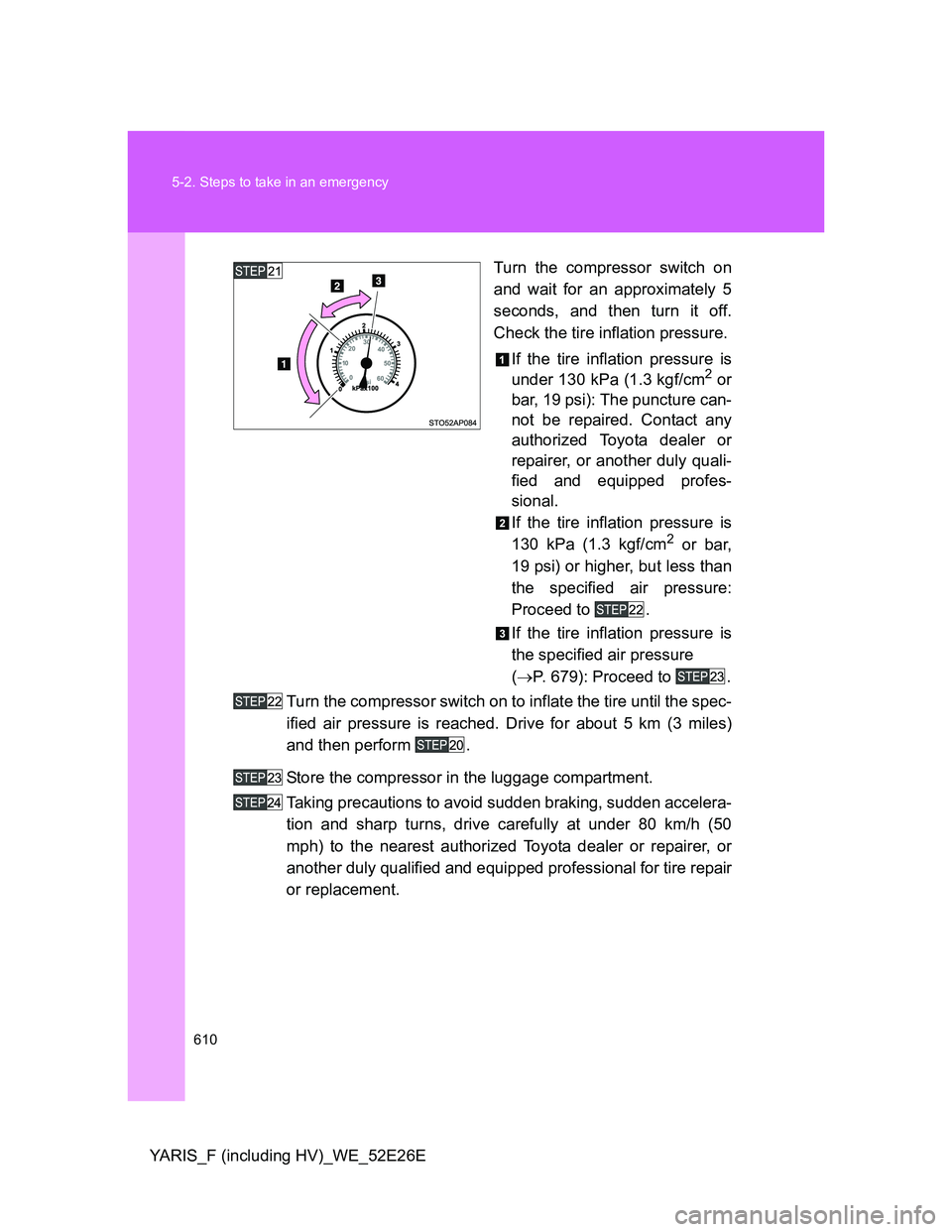
YARIS_F (including HV)_WE_52E26ETurn the compressor switch on
and wait for an approximately 5
seconds, and then turn it off.
Check the tire inflation pressure.
If the tire inflation pressure is
under 130 kPa (1.3 kgf/cm
2 or
bar, 19 psi): The puncture can-
not be repaired. Contact any
authorized Toyota dealer or
repairer, or another duly quali-
fied and equipped profes-
sional.
If the tire inflation pressure is
130 kPa (1.3 kgf/cm
2 or bar,
19 psi) or higher, but less than
the specified air pressure:
Proceed to .
If the tire inflation pressure is
the specified air pressure
(P. 679): Proceed to .
Turn the compressor switch on to inflate the tire until the spec-
ified air pressure is reached. Drive for about 5 km (3 miles)
and then perform .
Store the compressor in the luggage compartment.
Taking precautions to avoid sudden braking, sudden accelera-
tion and sharp turns, drive carefully at under 80 km/h (50
mph) to the nearest authorized Toyota dealer or repairer, or
another duly qualified and equipped professional for tire repair
or replacement.
Page 611 of 712
5
611 5-2. Steps to take in an emergency
When trouble arises
YARIS_F (including HV)_WE_52E26E
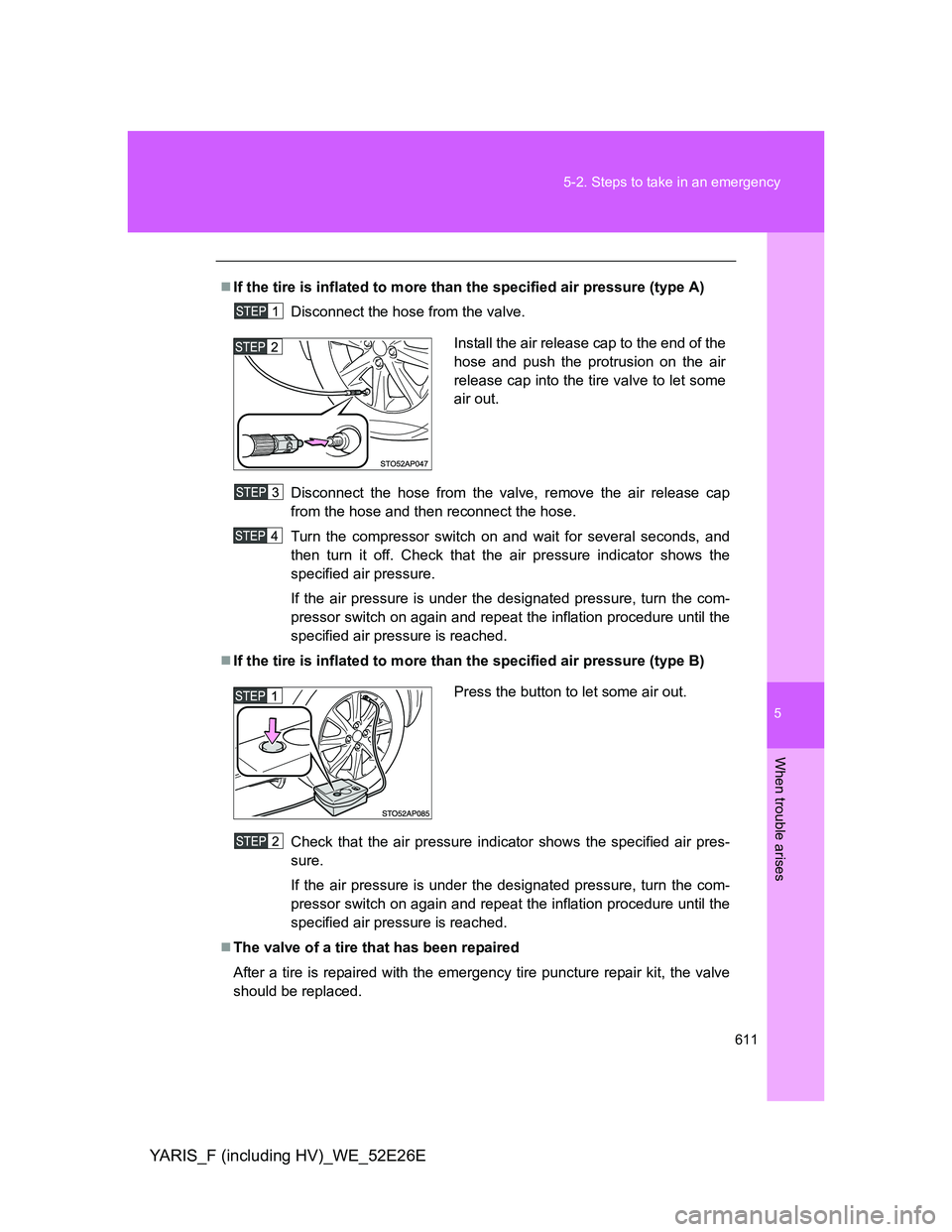
If the tire is inflated to more than the specified air pressure (type A)
Disconnect the hose from the valve.
Disconnect the hose from the valve, remove the air release cap
from the hose and then reconnect the hose.
Turn the compressor switch on and wait for several seconds, and
then turn it off. Check that the air pressure indicator shows the
specified air pressure.
If the air pressure is under the designated pressure, turn the com-
pressor switch on again and repeat the inflation procedure until the
specified air pressure is reached.
If the tire is inflated to more than the specified air pressure (type B)
Check that the air pressure indicator shows the specified air pres-
sure.
If the air pressure is under the designated pressure, turn the com-
pressor switch on again and repeat the inflation procedure until the
specified air pressure is reached.
The valve of a tire that has been repaired
After a tire is repaired with the emergency tire puncture repair kit, the valve
should be replaced.
Install the air release cap to the end of the
hose and push the protrusion on the air
release cap into the tire valve to let some
air out.
Press the button to let some air out.
Page 613 of 712
5
613 5-2. Steps to take in an emergency
When trouble arises
YARIS_F (including HV)_WE_52E26E
CAUTION
Do not drive the vehicle with a flat tire
Do not continue driving with a flat tire.
Driving even a short distance with a flat tire can damage the tire and the
wheel beyond repair.
Driving with a flat tire may cause a circumferential groove on the side wall. In
such a case, the tire may explode when using a repair kit.
Caution while driving
Store the repair kit in the luggage room.
Injuries may result in the event of an accident or sudden braking.
The repair kit is exclusively only for your vehicle.
Do not use repair kit on other vehicles, which could lead to an accident
causing death or serious injury.
Do not use repair kit for tires that are different size than the original ones,
or for any other purpose. If the tires have not been completely repaired, it
could lead to an accident causing death or serious injury.
Precautions for use of the sealant
Ingesting the sealant is hazardous to your health. If you ingest sealant,
consume as much water as possible, and then immediately consult a doc-
tor.
If sealant gets in eyes or adheres to skin, immediately wash it off with
water. If discomfort persists, consult a doctor.
When fixing the flat tire
Stop your vehicle in a safe and flat area.
Do not touch the wheels or the area around the brakes immediately after
the vehicle has been driven.
After the vehicle has been driven, the wheels and the area around the
brakes may be extremely hot. Touching these areas with hands, feet or
other body parts may result in burns.
To avoid risk of burst or severe leakage, do not drop or damage the bottle.
Visually inspect the bottle before use. Do not use a bottle with shock,
crack, scratch, leakage or any other damage. In such case, immediately
replace.
Page 614 of 712
614 5-2. Steps to take in an emergency
YARIS_F (including HV)_WE_52E26E
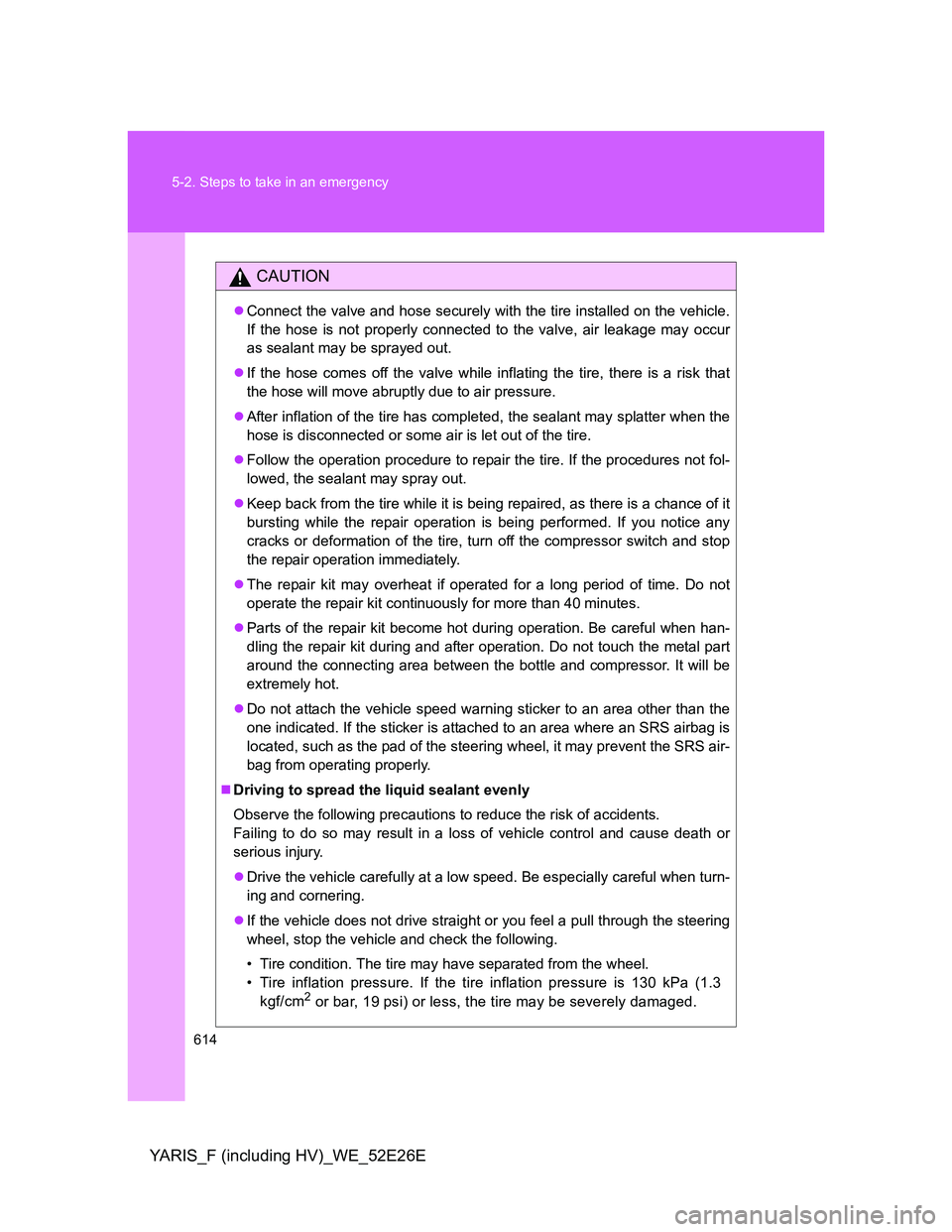
CAUTION
Connect the valve and hose securely with the tire installed on the vehicle.
If the hose is not properly connected to the valve, air leakage may occur
as sealant may be sprayed out.
If the hose comes off the valve while inflating the tire, there is a risk that
the hose will move abruptly due to air pressure.
After inflation of the tire has completed, the sealant may splatter when the
hose is disconnected or some air is let out of the tire.
Follow the operation procedure to repair the tire. If the procedures not fol-
lowed, the sealant may spray out.
Keep back from the tire while it is being repaired, as there is a chance of it
bursting while the repair operation is being performed. If you notice any
cracks or deformation of the tire, turn off the compressor switch and stop
the repair operation immediately.
The repair kit may overheat if operated for a long period of time. Do not
operate the repair kit continuously for more than 40 minutes.
Parts of the repair kit become hot during operation. Be careful when han-
dling the repair kit during and after operation. Do not touch the metal part
around the connecting area between the bottle and compressor. It will be
extremely hot.
Do not attach the vehicle speed warning sticker to an area other than the
one indicated. If the sticker is attached to an area where an SRS airbag is
located, such as the pad of the steering wheel, it may prevent the SRS air-
bag from operating properly.
Driving to spread the liquid sealant evenly
Observe the following precautions to reduce the risk of accidents.
Failing to do so may result in a loss of vehicle control and cause death or
serious injury.
Drive the vehicle carefully at a low speed. Be especially careful when turn-
ing and cornering.
If the vehicle does not drive straight or you feel a pull through the steering
wheel, stop the vehicle and check the following.
• Tire condition. The tire may have separated from the wheel.
• Tire inflation pressure. If the tire inflation pressure is 130 kPa (1.3
kgf/cm
2 or bar, 19 psi) or less, the tire may be severely damaged.
Page 679 of 712
679 6-1. Specifications
6
Vehicle specifications
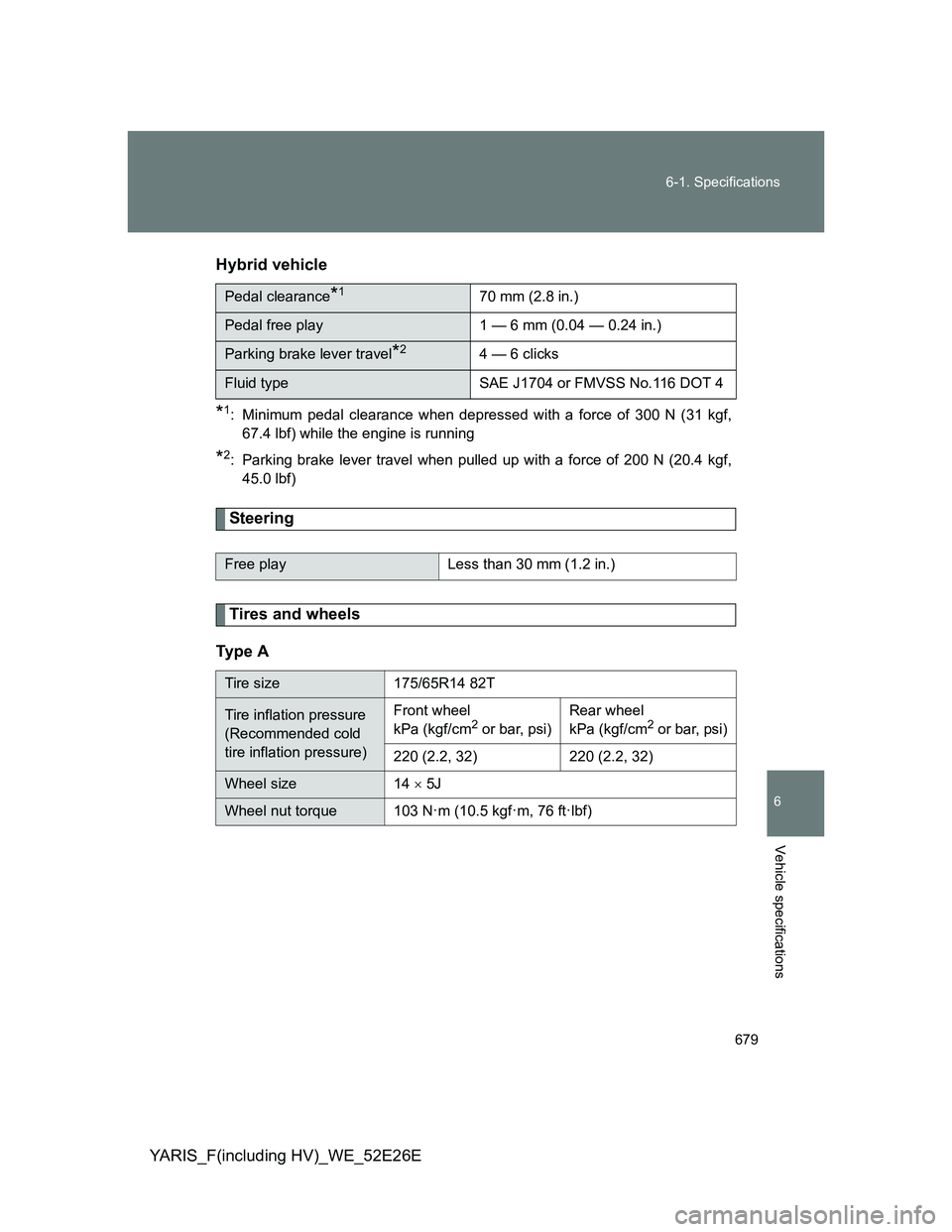
YARIS_F(including HV)_WE_52E26EHybrid vehicle
*1: Minimum pedal clearance when depressed with a force of 300 N (31 kgf,
67.4 lbf) while the engine is running
*2: Parking brake lever travel when pulled up with a force of 200 N (20.4 kgf,
45.0 lbf)
Steering
Tires and wheels
Ty p e A
Pedal clearance*170 mm (2.8 in.)
Pedal free play 1 — 6 mm (0.04 — 0.24 in.)
Parking brake lever travel*24 — 6 clicks
Fluid type SAE J1704 or FMVSS No.116 DOT 4
Free play Less than 30 mm (1.2 in.)
Tire size 175/65R14 82T
Tire inflation pressure
(Recommended cold
tire inflation pressure)Front wheel
kPa (kgf/cm2 or bar, psi)Rear wheel
kPa (kgf/cm2 or bar, psi)
220 (2.2, 32) 220 (2.2, 32)
Wheel size 14 5J
Wheel nut torque 103 N·m (10.5 kgf·m, 76 ft·lbf)
Page 680 of 712
680 6-1. Specifications
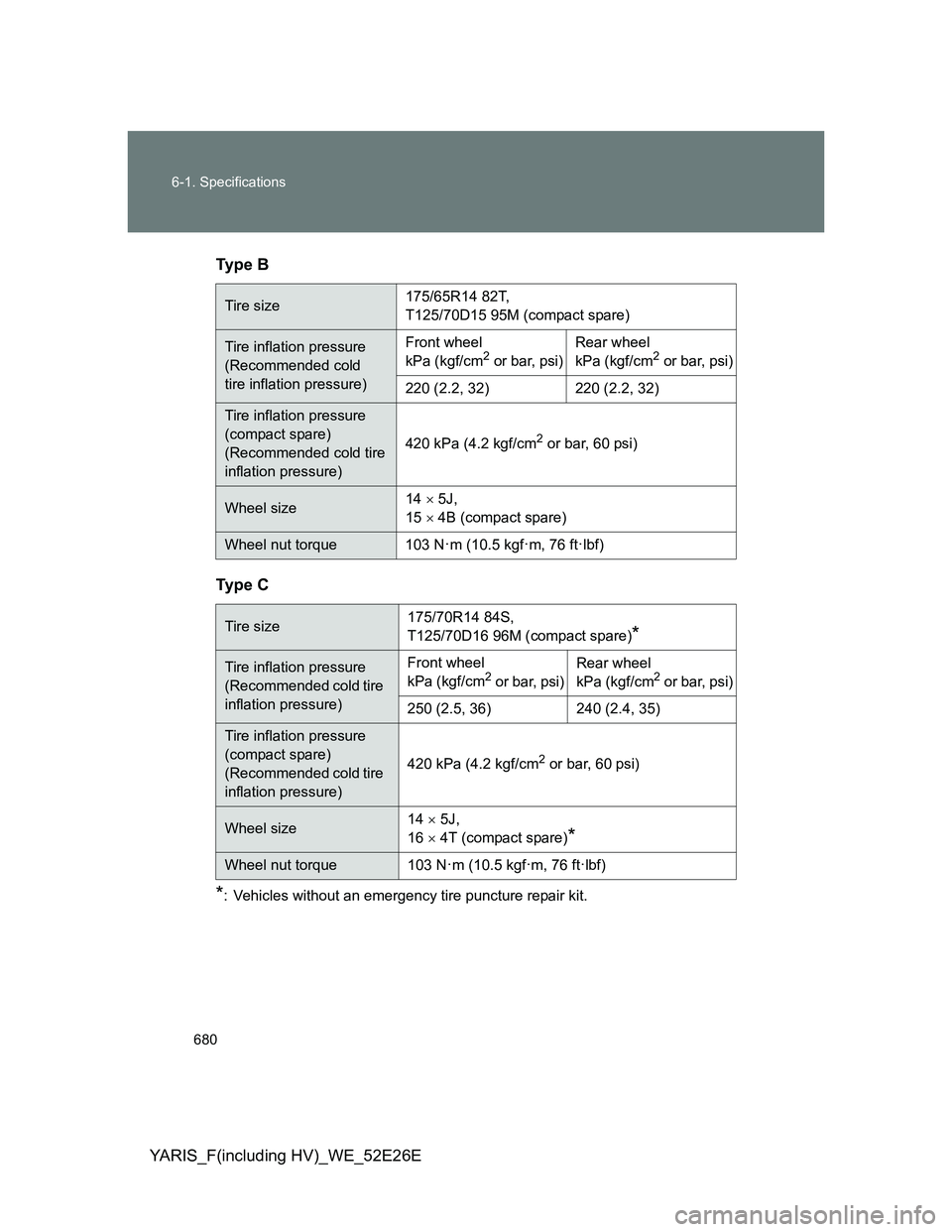
YARIS_F(including HV)_WE_52E26ETy p e B
Ty p e C
*: Vehicles without an emergency tire puncture repair kit.
Tire size175/65R14 82T,
T125/70D15 95M (compact spare)
Tire inflation pressure
(Recommended cold
tire inflation pressure)Front wheel
kPa (kgf/cm2 or bar, psi)Rear wheel
kPa (kgf/cm2 or bar, psi)
220 (2.2, 32) 220 (2.2, 32)
Tire inflation pressure
(compact spare)
(Recommended cold tire
inflation pressure)420 kPa (4.2 kgf/cm
2 or bar, 60 psi)
Wheel size14 5J,
15 4B (compact spare)
Wheel nut torque 103 N·m (10.5 kgf·m, 76 ft·lbf)
Tire size175/70R14 84S,
T125/70D16 96M (compact spare)*
Tire inflation pressure
(Recommended cold tire
inflation pressure)Front wheel
kPa (kgf/cm2 or bar, psi)Rear wheel
kPa (kgf/cm2 or bar, psi)
250 (2.5, 36) 240 (2.4, 35)
Tire inflation pressure
(compact spare)
(Recommended cold tire
inflation pressure)420 kPa (4.2 kgf/cm
2 or bar, 60 psi)
Wheel size14 5J,
16 4T (compact spare)*
Wheel nut torque 103 N·m (10.5 kgf·m, 76 ft·lbf)
Page 681 of 712
681 6-1. Specifications
6
Vehicle specifications
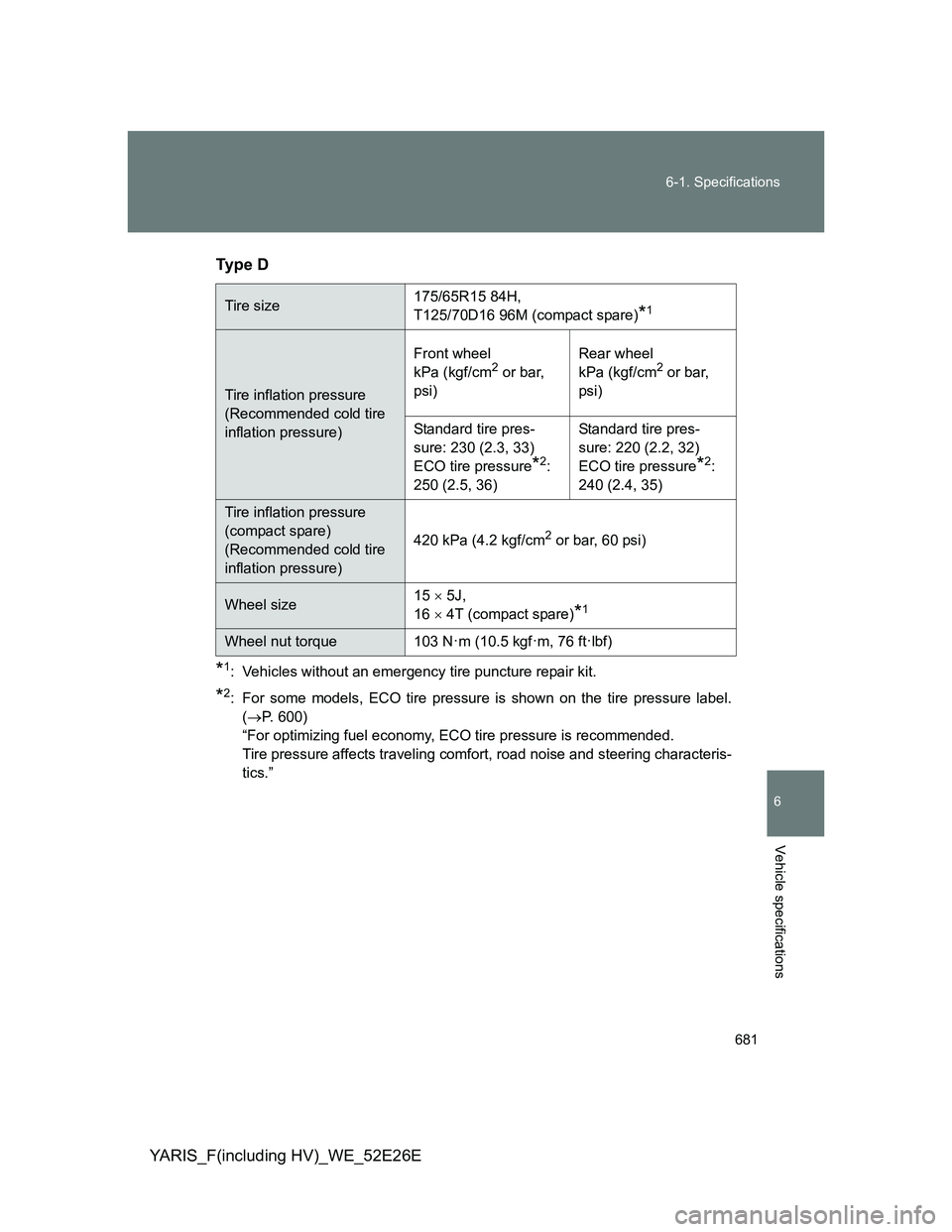
YARIS_F(including HV)_WE_52E26ETy p e D
*1: Vehicles without an emergency tire puncture repair kit.
*2: For some models, ECO tire pressure is shown on the tire pressure label.
(P. 600)
“For optimizing fuel economy, ECO tire pressure is recommended.
Tire pressure affects traveling comfort, road noise and steering characteris-
tics.”
Tire size175/65R15 84H,
T125/70D16 96M (compact spare)*1
Tire inflation pressure
(Recommended cold tire
inflation pressure)Front wheel
kPa (kgf/cm
2 or bar,
psi)Rear wheel
kPa (kgf/cm2 or bar,
psi)
Standard tire pres-
sure: 230 (2.3, 33)
ECO tire pressure
*2:
250 (2.5, 36)Standard tire pres-
sure: 220 (2.2, 32)
ECO tire pressure*2:
240 (2.4, 35)
Tire inflation pressure
(compact spare)
(Recommended cold tire
inflation pressure)420 kPa (4.2 kgf/cm
2 or bar, 60 psi)
Wheel size15 5J,
16 4T (compact spare)*1
Wheel nut torque 103 N·m (10.5 kgf·m, 76 ft·lbf)
Page 682 of 712
682 6-1. Specifications
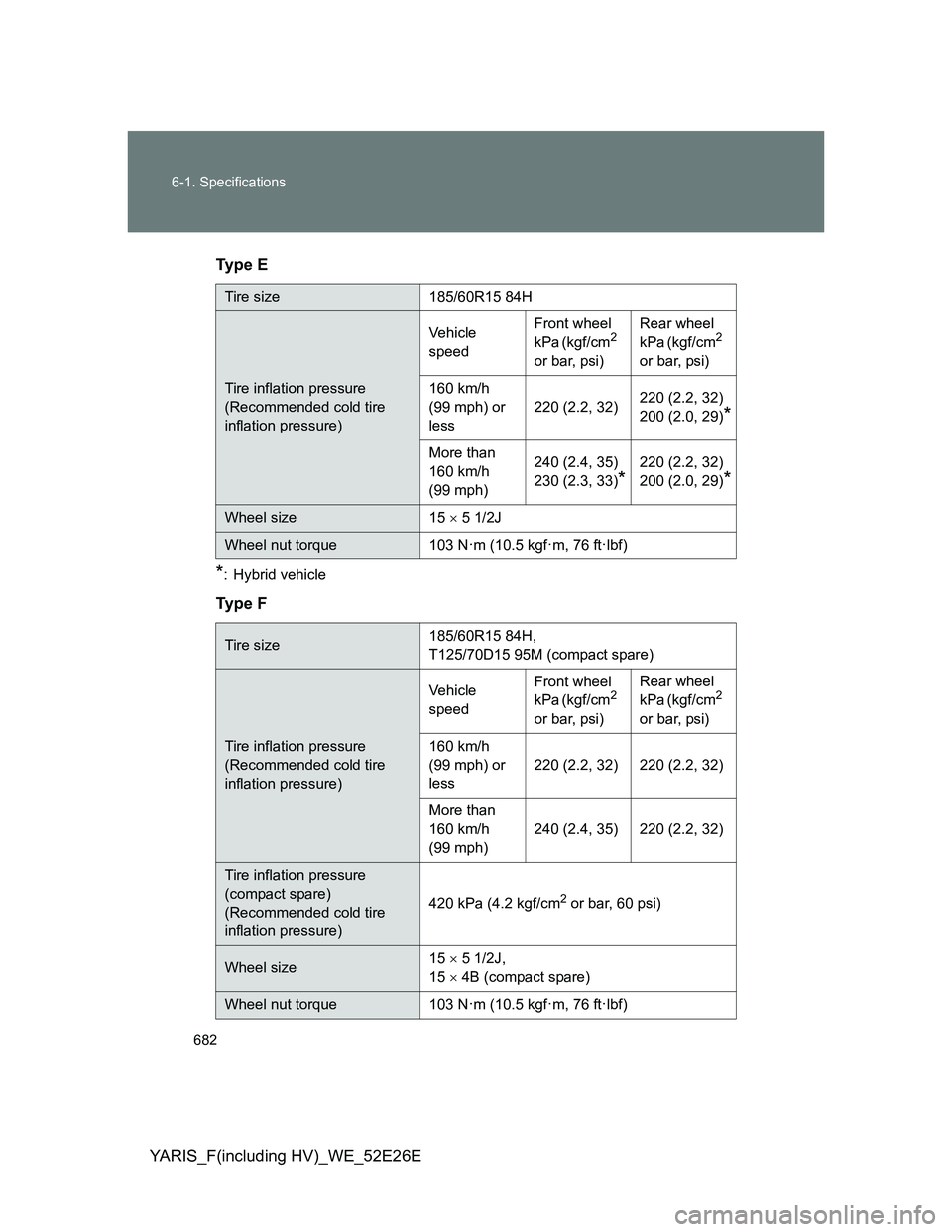
YARIS_F(including HV)_WE_52E26ETy p e E
*: Hybrid vehicle
Ty p e F
Tire size 185/60R15 84H
Tire inflation pressure
(Recommended cold tire
inflation pressure)Vehicle
speedFront wheel
kPa (kgf/cm
2
or bar, psi)Rear wheel
kPa (kgf/cm2
or bar, psi)
160 km/h
(99 mph) or
less220 (2.2, 32)220 (2.2, 32)
200 (2.0, 29)
*
More than
160 km/h
(99 mph)240 (2.4, 35)
230 (2.3, 33)
*
220 (2.2, 32)
200 (2.0, 29)
*
Wheel size 15 5 1/2J
Wheel nut torque 103 N·m (10.5 kgf·m, 76 ft·lbf)
Tire size185/60R15 84H,
T125/70D15 95M (compact spare)
Tire inflation pressure
(Recommended cold tire
inflation pressure)Vehicle
speedFront wheel
kPa (kgf/cm
2
or bar, psi)Rear wheel
kPa (kgf/cm2
or bar, psi)
160 km/h
(99 mph) or
less220 (2.2, 32) 220 (2.2, 32)
More than
160 km/h
(99 mph)240 (2.4, 35) 220 (2.2, 32)
Tire inflation pressure
(compact spare)
(Recommended cold tire
inflation pressure)420 kPa (4.2 kgf/cm
2 or bar, 60 psi)
Wheel size15 5 1/2J,
15 4B (compact spare)
Wheel nut torque 103 N·m (10.5 kgf·m, 76 ft·lbf)
Page 683 of 712
683 6-1. Specifications
6
Vehicle specifications
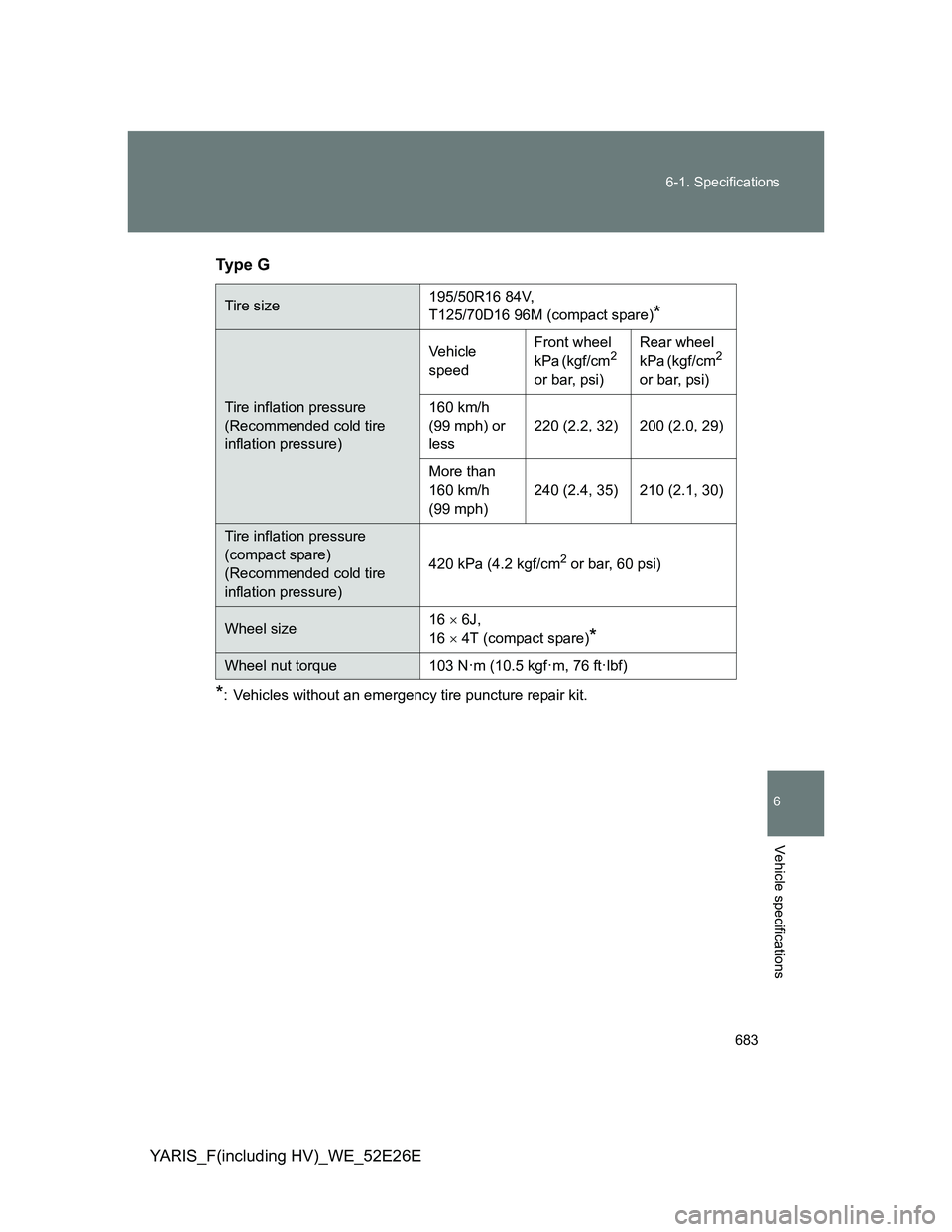
YARIS_F(including HV)_WE_52E26ETy p e G
*: Vehicles without an emergency tire puncture repair kit.
Tire size195/50R16 84V,
T125/70D16 96M (compact spare)*
Tire inflation pressure
(Recommended cold tire
inflation pressure)Vehicle
speedFront wheel
kPa (kgf/cm
2
or bar, psi)Rear wheel
kPa (kgf/cm2
or bar, psi)
160 km/h
(99 mph) or
less220 (2.2, 32) 200 (2.0, 29)
More than
160 km/h
(99 mph)240 (2.4, 35) 210 (2.1, 30)
Tire inflation pressure
(compact spare)
(Recommended cold tire
inflation pressure)420 kPa (4.2 kgf/cm
2 or bar, 60 psi)
Wheel size16 6J,
16 4T (compact spare)*
Wheel nut torque 103 N·m (10.5 kgf·m, 76 ft·lbf)