flat tire TOYOTA YARIS 2013 Owner's Manual
[x] Cancel search | Manufacturer: TOYOTA, Model Year: 2013, Model line: YARIS, Model: TOYOTA YARIS 2013Pages: 712, PDF Size: 30.2 MB
Page 585 of 712
5
585 5-2. Steps to take in an emergency
When trouble arises
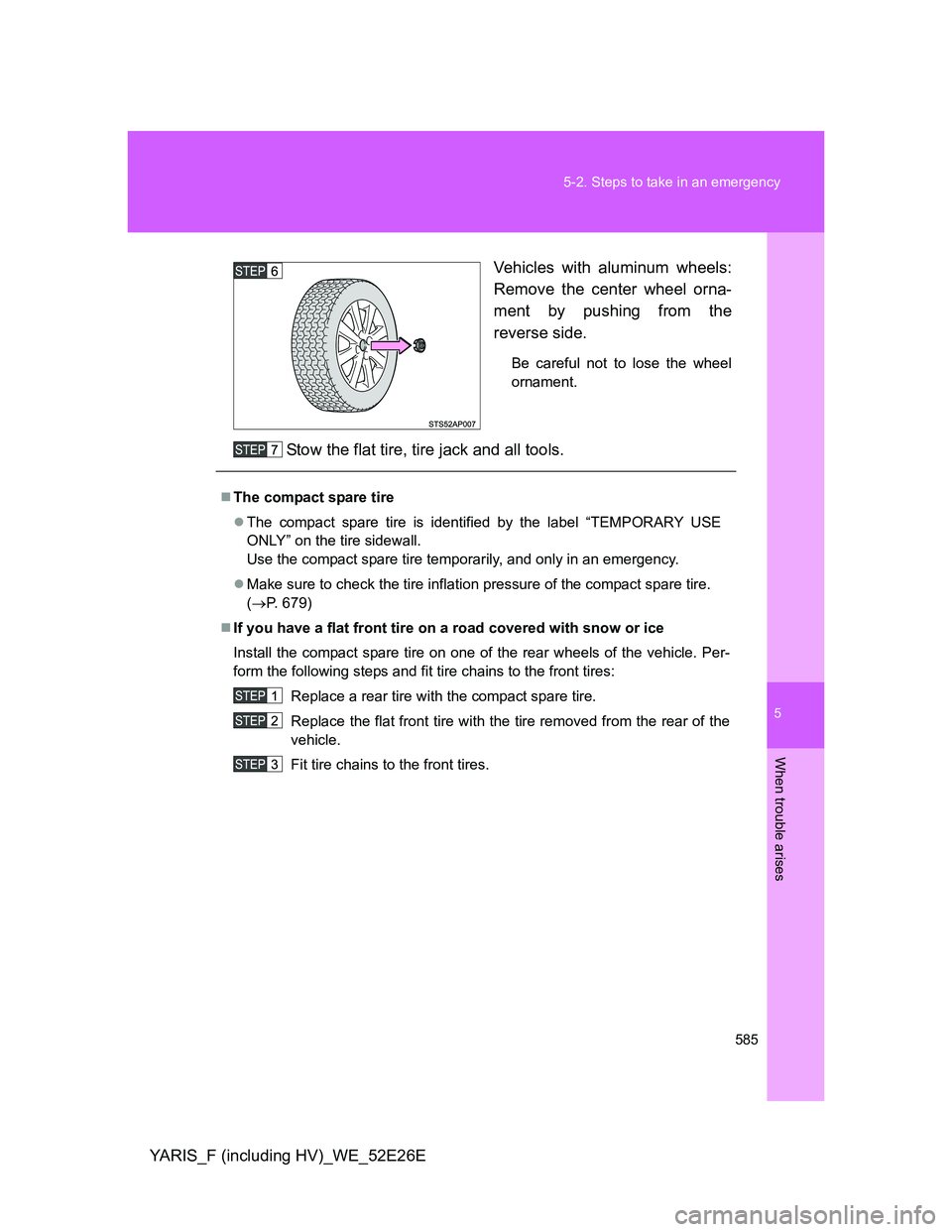
YARIS_F (including HV)_WE_52E26EVehicles with aluminum wheels:
Remove the center wheel orna-
ment by pushing from the
reverse side.
Be careful not to lose the wheel
ornament.
Stow the flat tire, tire jack and all tools.
The compact spare tire
The compact spare tire is identified by the label “TEMPORARY USE
ONLY” on the tire sidewall.
Use the compact spare tire temporarily, and only in an emergency.
Make sure to check the tire inflation pressure of the compact spare tire.
(P. 679)
If you have a flat front tire on a road covered with snow or ice
Install the compact spare tire on one of the rear wheels of the vehicle. Per-
form the following steps and fit tire chains to the front tires:
Replace a rear tire with the compact spare tire.
Replace the flat front tire with the tire removed from the rear of the
vehicle.
Fit tire chains to the front tires.
Page 589 of 712
5
589 5-2. Steps to take in an emergency
When trouble arises
YARIS_F (including HV)_WE_52E26E
CAUTION
Using the tire jack
Improper use of the tire jack may cause the vehicle to suddenly fall off the
jack, leading to death or serious injury.
Do not use the tire jack for any purpose other than replacing tires or install-
ing and removing tire chains.
Only use the tire jack that comes with this vehicle for replacing a flat tire.
Do not use it on other vehicles, and do not use other tire jacks for replac-
ing tires on this vehicle.
Always check that the tire jack is securely set to the jack point.
Do not put any part of your body under the vehicle while it is supported by
the jack.
Do not start or run the engine (except hybrid vehicle) or hybrid system
(hybrid vehicle) while your vehicle is supported by the jack.
Do not raise the vehicle while someone is inside.
When raising the vehicle, do not put an object on or under the jack.
Do not raise the vehicle to a height greater than that required to replace
the tire.
Use a jack stand if it is necessary to get under the vehicle.
Take particular care when lowering the vehicle to ensure that no one working
on or near the vehicle may be injured.
Page 590 of 712
590 5-2. Steps to take in an emergency
YARIS_F (including HV)_WE_52E26E
CAUTION
Replacing a flat tire
Do not touch the disc wheels or the area around the brakes immediately
after the vehicle has been driven.
After the vehicle has been driven the disc wheels and the area around the
brakes will be extremely hot. Touching these areas with hands, feet or
other body parts while changing a tire, etc. may result in burns.
Failure to follow these precautions could cause the wheel nuts to loosen
and the tire to fall off, resulting in death or serious injury.
• Have the wheel nuts tightened with a torque wrench to 103 N·m (10.5
kgf·m, 76 ft·lbf) as soon as possible after changing wheels.
• When installing a tire, only use wheel nuts that have been specifically
designed for that wheel.
• If there are any cracks or deformations in the bolt screws, nut threads
or bolt holes of the wheel, have the vehicle inspected by any autho-
rized Toyota dealer or repairer, or another duly qualified and equipped
professional.
• When installing the wheel nuts, be sure to install them with the tapered
ends facing inward. (P. 497)
NOTICE
Do not drive the vehicle with a flat tire
Do not continue driving with a flat tire.
Driving even a short distance with a flat tire can damage the tire and the
wheel beyond repair.
Be careful when driving over bumps with the compact spare tire
installed on the vehicle
The vehicle becomes lower when driving with the compact spare tire com-
pared to when driving with standard tires. Be careful when driving over
uneven road surfaces.
Driving with tire chains and the compact spare tire
Do not fit tire chains to the compact spare tire.
Tire chains may damage the vehicle body and adversely affect driving per-
formance.
Page 591 of 712
5
591
5-2. Steps to take in an emergency
When trouble arises
YARIS_F (including HV)_WE_52E26E
If you have a flat tire (vehicles with an emergency tire puncture repair kit)
A puncture caused by a nail or screw passing through the tire tread
can be repaired temporarily using the emergency tire puncture repair
kit. (The kit contains a bottle of sealant. The sealant can be used only
once to temporarily repair one tire without removing the nail or
screw from the tire.) Depending on the damage, this kit cannot be
used to repair the tire. (P. 595)
After temporarily repairing the tire with the kit, have the tire repaired
or replaced by any authorized Toyota dealer or repairer, or another
duly qualified and equipped professional. Repairs conducted using
the emergency tire puncture repair kit are only a temporary measure.
Have the tire repaired and replaced as soon as possible.
Before repairing the tire
Stop the vehicle in a safe place on a hard, flat surface.
Set the parking brake.
Vehicles with a hybrid transmission or a Multidrive: Shift the
shift lever to P.
Vehicles with a multi-mode manual transmission and manual
transmission: Shift the shift lever to N.
Stop the engine (except hybrid vehicle) or hybrid system
(hybrid vehicle).
Turn on the emergency flashers.
Page 600 of 712
600 5-2. Steps to take in an emergency
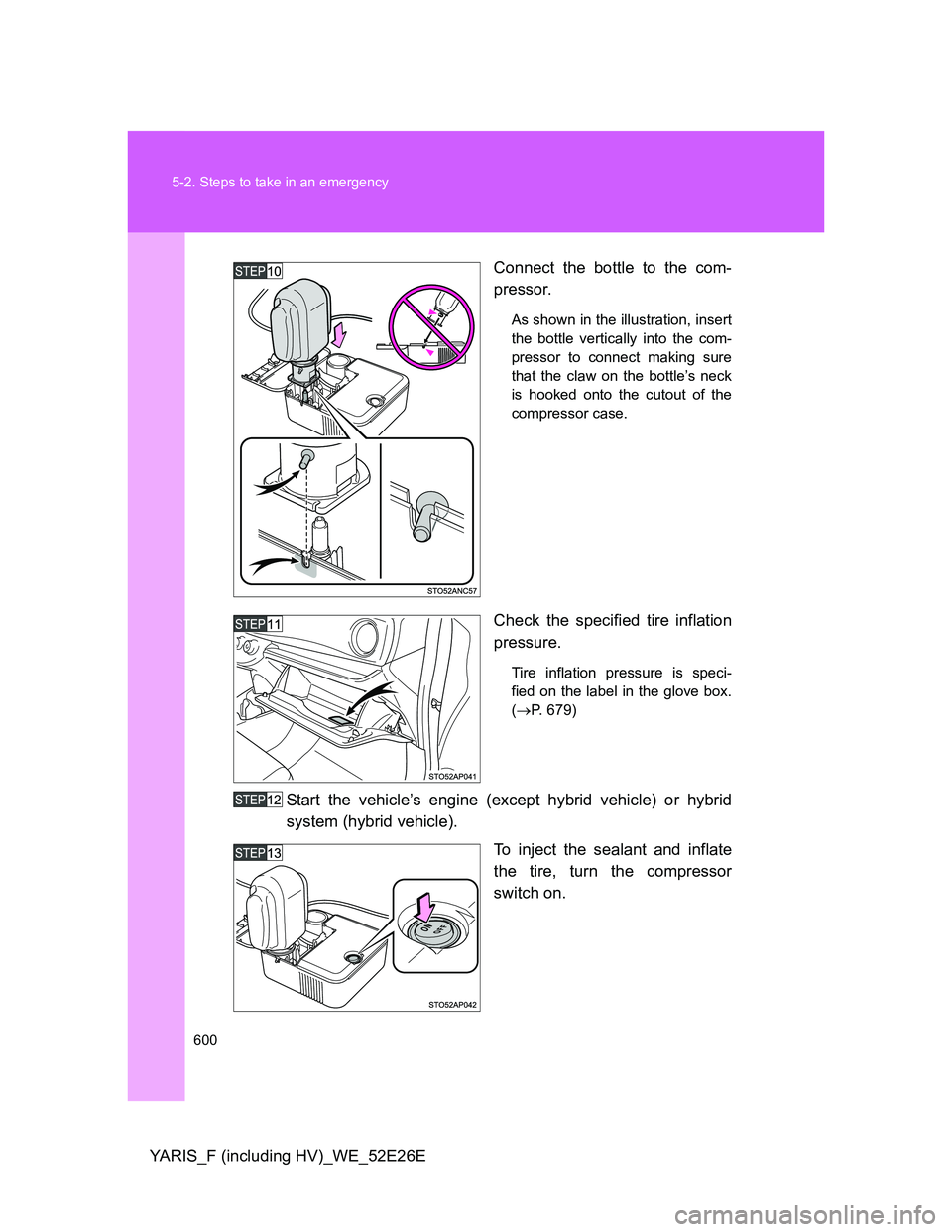
YARIS_F (including HV)_WE_52E26EConnect the bottle to the com-
pressor.
As shown in the illustration, insert
the bottle vertically into the com-
pressor to connect making sure
that the claw on the bottle’s neck
is hooked onto the cutout of the
compressor case.
Check the specified tire inflation
pressure.
Tire inflation pressure is speci-
fied on the label in the glove box.
(P. 679)
Start the vehicle’s engine (except hybrid vehicle) or hybrid
system (hybrid vehicle).
To inject the sealant and inflate
the tire, turn the compressor
switch on.
Page 601 of 712
5
601 5-2. Steps to take in an emergency
When trouble arises
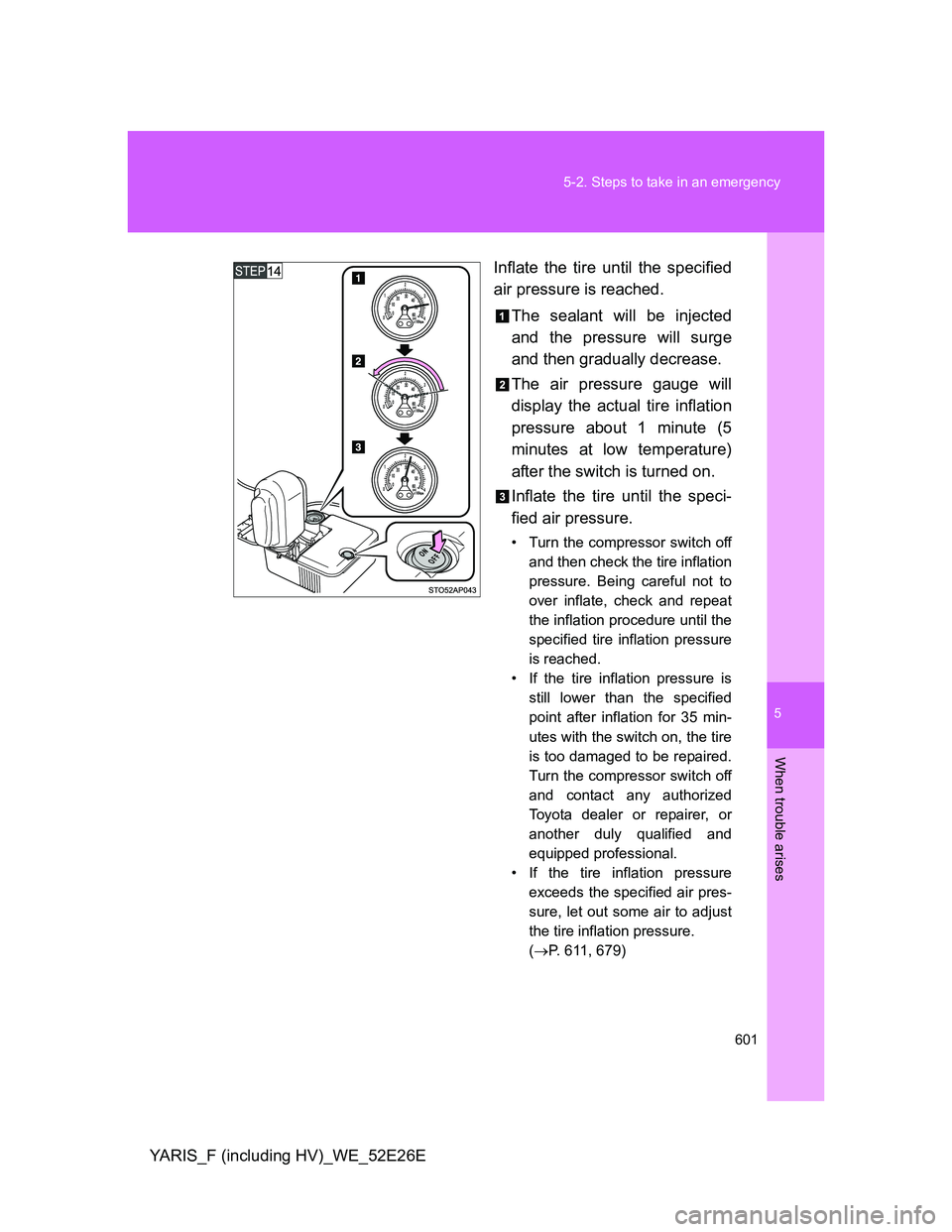
YARIS_F (including HV)_WE_52E26EInflate the tire until the specified
air pressure is reached.
The sealant will be injected
and the pressure will surge
and then gradually decrease.
The air pressure gauge will
display the actual tire inflation
pressure about 1 minute (5
minutes at low temperature)
after the switch is turned on.
Inflate the tire until the speci-
fied air pressure.
• Turn the compressor switch off
and then check the tire inflation
pressure. Being careful not to
over inflate, check and repeat
the inflation procedure until the
specified tire inflation pressure
is reached.
• If the tire inflation pressure is
still lower than the specified
point after inflation for 35 min-
utes with the switch on, the tire
is too damaged to be repaired.
Turn the compressor switch off
and contact any authorized
Toyota dealer or repairer, or
another duly qualified and
equipped professional.
• If the tire inflation pressure
exceeds the specified air pres-
sure, let out some air to adjust
the tire inflation pressure.
(P. 611, 679)
Page 602 of 712
602 5-2. Steps to take in an emergency
YARIS_F (including HV)_WE_52E26EWith the compressor switch off, disconnect the hose from the
valve on the tire and then pull out the power plug from the
power outlet socket or cigarette lighter socket.
Some sealant may leak when the hose is removed.
Install the valve cap onto the valve of the emergency repaired
tire.
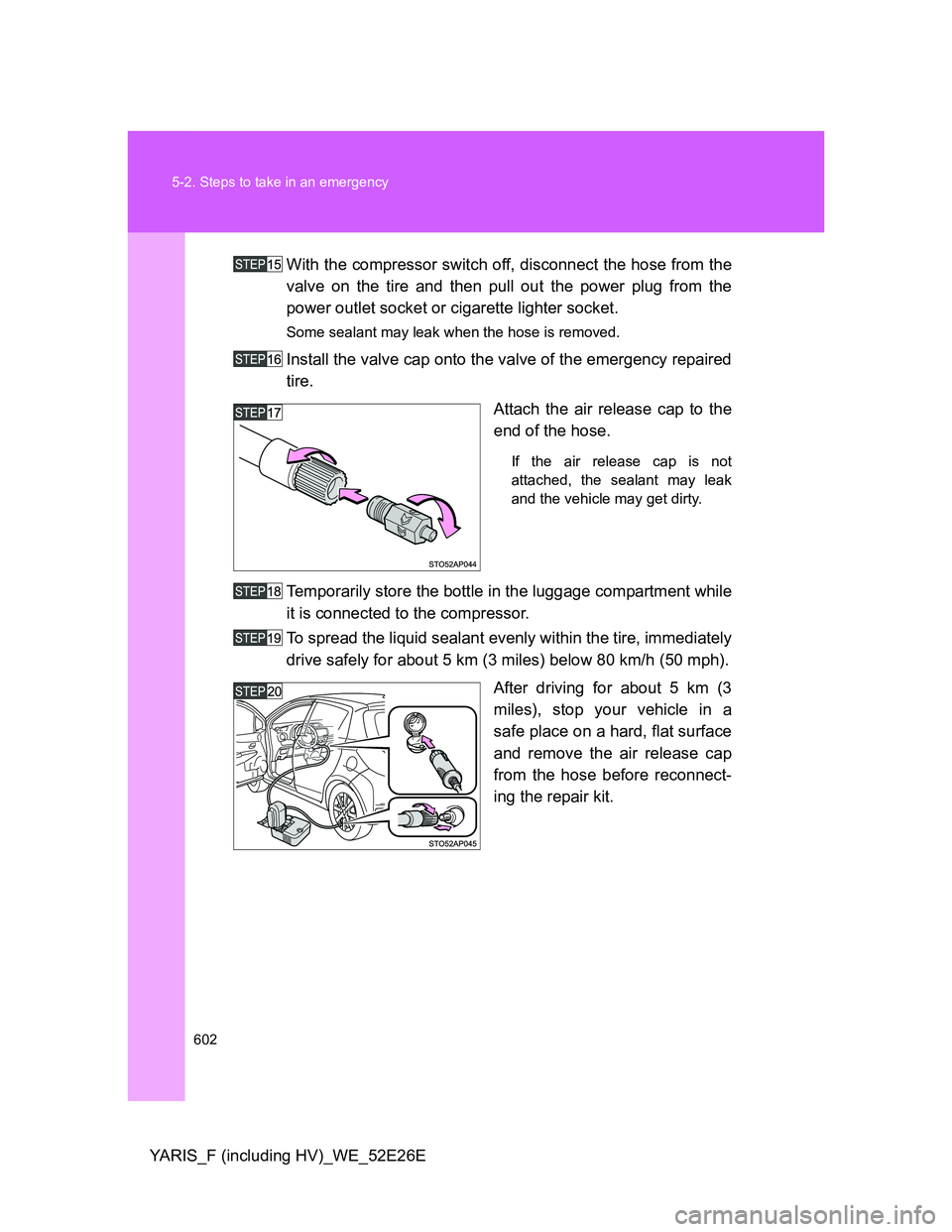
Attach the air release cap to the
end of the hose.
If the air release cap is not
attached, the sealant may leak
and the vehicle may get dirty.
Temporarily store the bottle in the luggage compartment while
it is connected to the compressor.
To spread the liquid sealant evenly within the tire, immediately
drive safely for about 5 km (3 miles) below 80 km/h (50 mph).
After driving for about 5 km (3
miles), stop your vehicle in a
safe place on a hard, flat surface
and remove the air release cap
from the hose before reconnect-
ing the repair kit.
Page 603 of 712
5
603 5-2. Steps to take in an emergency
When trouble arises
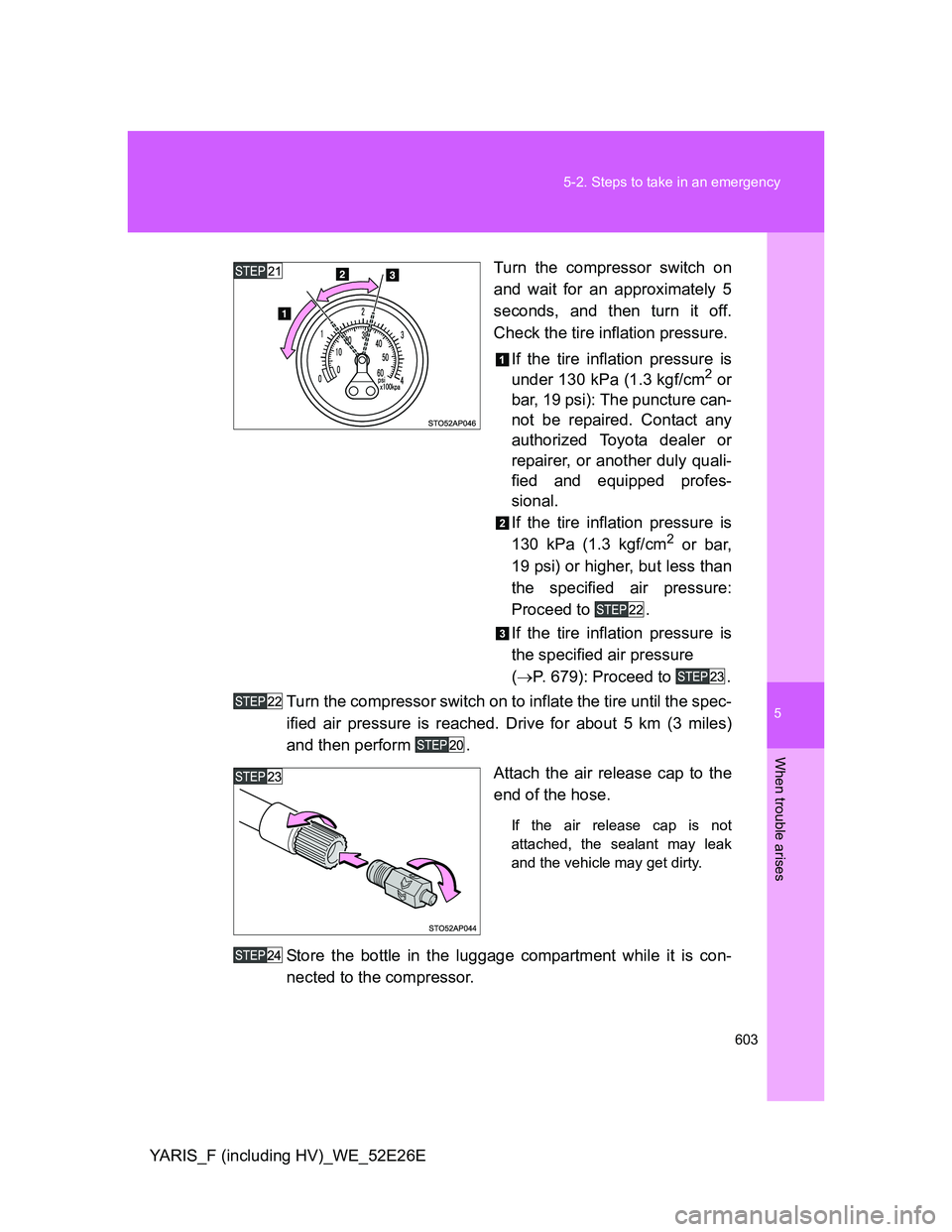
YARIS_F (including HV)_WE_52E26ETurn the compressor switch on
and wait for an approximately 5
seconds, and then turn it off.
Check the tire inflation pressure.
If the tire inflation pressure is
under 130 kPa (1.3 kgf/cm
2 or
bar, 19 psi): The puncture can-
not be repaired. Contact any
authorized Toyota dealer or
repairer, or another duly quali-
fied and equipped profes-
sional.
If the tire inflation pressure is
130 kPa (1.3 kgf/cm
2 or bar,
19 psi) or higher, but less than
the specified air pressure:
Proceed to .
If the tire inflation pressure is
the specified air pressure
(P. 679): Proceed to .
Turn the compressor switch on to inflate the tire until the spec-
ified air pressure is reached. Drive for about 5 km (3 miles)
and then perform .
Attach the air release cap to the
end of the hose.
If the air release cap is not
attached, the sealant may leak
and the vehicle may get dirty.
Store the bottle in the luggage compartment while it is con-
nected to the compressor.
Page 607 of 712
5
607 5-2. Steps to take in an emergency
When trouble arises
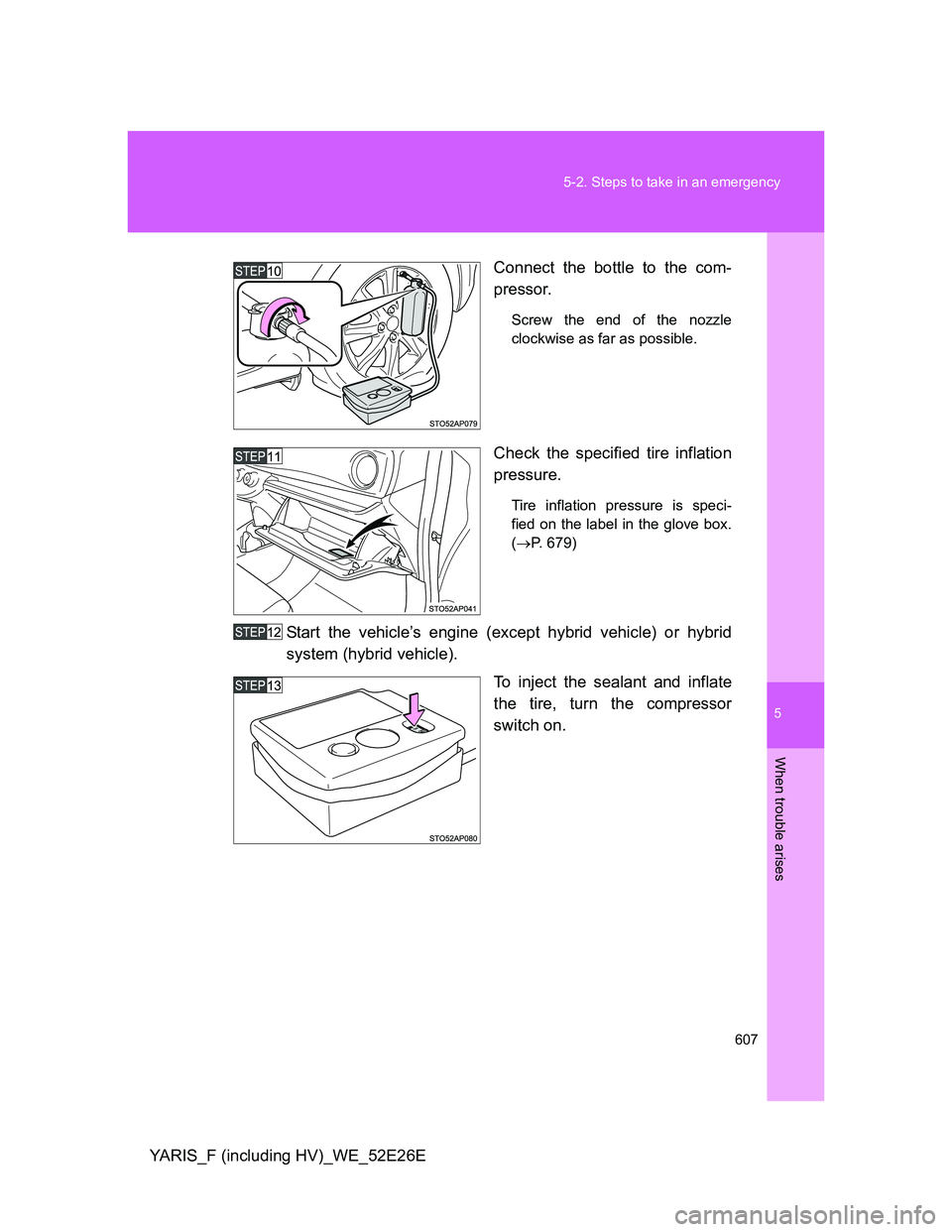
YARIS_F (including HV)_WE_52E26EConnect the bottle to the com-
pressor.
Screw the end of the nozzle
clockwise as far as possible.
Check the specified tire inflation
pressure.
Tire inflation pressure is speci-
fied on the label in the glove box.
(P. 679)
Start the vehicle’s engine (except hybrid vehicle) or hybrid
system (hybrid vehicle).
To inject the sealant and inflate
the tire, turn the compressor
switch on.
Page 608 of 712
608 5-2. Steps to take in an emergency
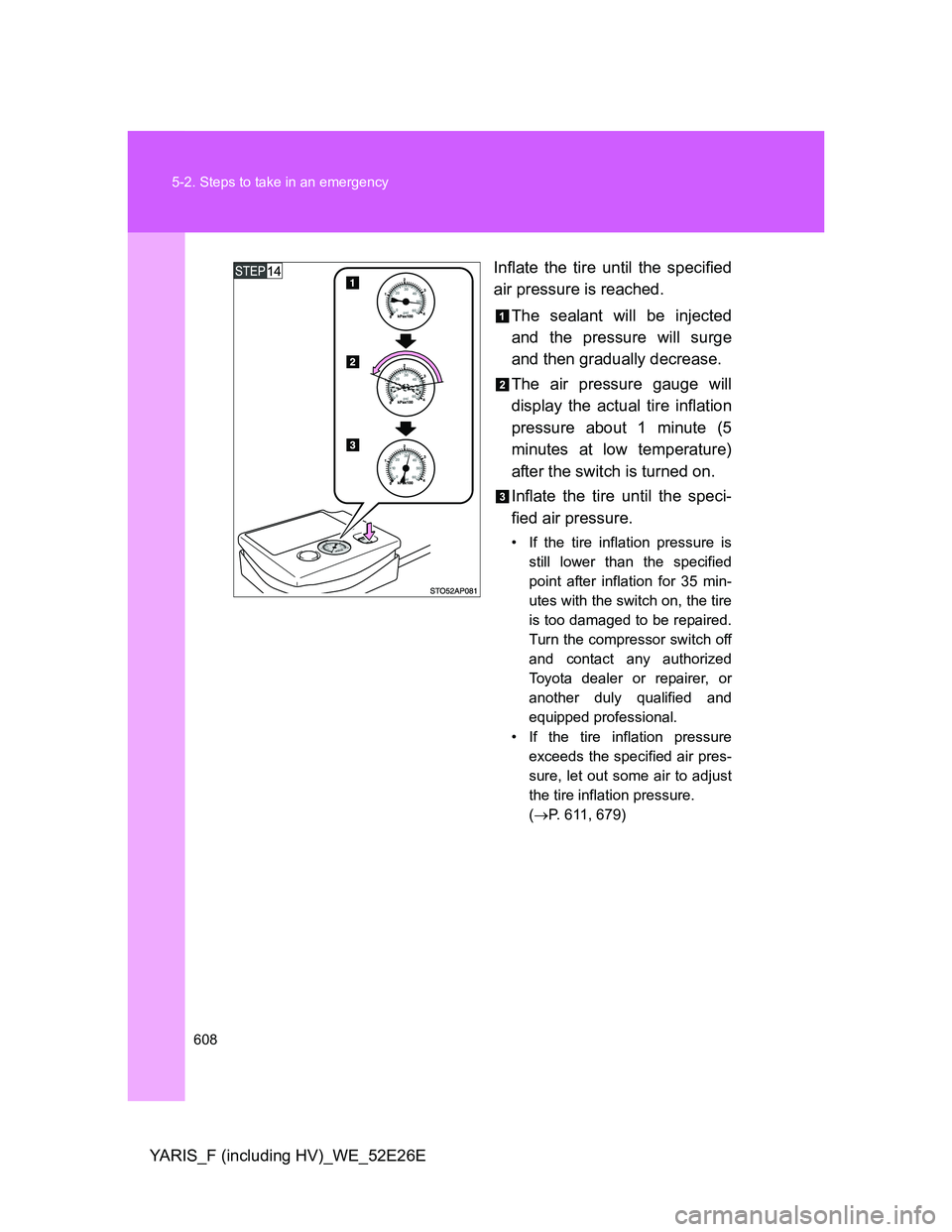
YARIS_F (including HV)_WE_52E26EInflate the tire until the specified
air pressure is reached.
The sealant will be injected
and the pressure will surge
and then gradually decrease.
The air pressure gauge will
display the actual tire inflation
pressure about 1 minute (5
minutes at low temperature)
after the switch is turned on.
Inflate the tire until the speci-
fied air pressure.
• If the tire inflation pressure is
still lower than the specified
point after inflation for 35 min-
utes with the switch on, the tire
is too damaged to be repaired.
Turn the compressor switch off
and contact any authorized
Toyota dealer or repairer, or
another duly qualified and
equipped professional.
• If the tire inflation pressure
exceeds the specified air pres-
sure, let out some air to adjust
the tire inflation pressure.
(P. 611, 679)