brake TOYOTA YARIS 2013 Workshop Manual
[x] Cancel search | Manufacturer: TOYOTA, Model Year: 2013, Model line: YARIS, Model: TOYOTA YARIS 2013Pages: 712, PDF Size: 30.2 MB
Page 261 of 712
261 2-1. Driving procedures
2
When driving
YARIS_F(including HV)_WE_52E26E
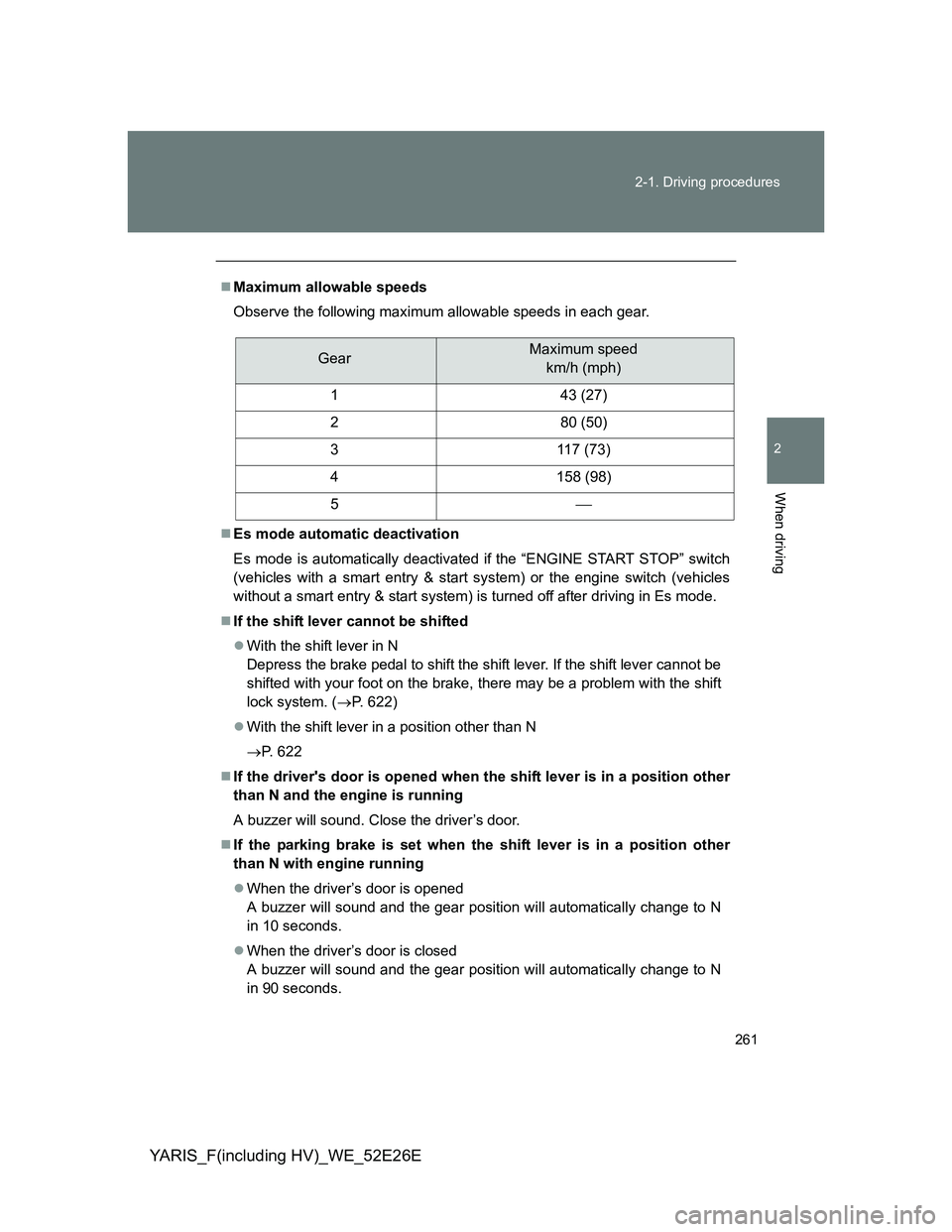
Maximum allowable speeds
Observe the following maximum allowable speeds in each gear.
Es mode automatic deactivation
Es mode is automatically deactivated if the “ENGINE START STOP” switch
(vehicles with a smart entry & start system) or the engine switch (vehicles
without a smart entry & start system) is turned off after driving in Es mode.
If the shift lever cannot be shifted
With the shift lever in N
Depress the brake pedal to shift the shift lever. If the shift lever cannot be
shifted with your foot on the brake, there may be a problem with the shift
lock system. (P. 622)
With the shift lever in a position other than N
P. 622
If the driver's door is opened when the shift lever is in a position other
than N and the engine is running
A buzzer will sound. Close the driver’s door.
If the parking brake is set when the shift lever is in a position other
than N with engine running
When the driver’s door is opened
A buzzer will sound and the gear position will automatically change to N
in 10 seconds.
When the driver’s door is closed
A buzzer will sound and the gear position will automatically change to N
in 90 seconds.
GearMaximum speed
km/h (mph)
1 43 (27)
2 80 (50)
3 117 (73)
4 158 (98)
5
Page 262 of 712
262 2-1. Driving procedures
YARIS_F(including HV)_WE_52E26E
If the “M” indicator does not come on even after shifting the shift lever
to M
This may indicate a malfunction in the multi-mode manual transmission sys-
tem. Have the vehicle inspected by any authorized Toyota dealer or repairer,
or another duly qualified and equipped professional immediately.
(In this situation, the transmission will operate in the same manner as when
the shift lever is in E.)
If the “N” indicator is flashing
When shifting the shift lever
Shift the shift lever to N. Wait a few seconds and shift the shift lever to the
desired position.
When the engine is turned off
Vehicles without a smart entry & start system: Turn the engine switch to
the “ON” position. Depress the brake pedal and shift the shift lever to N,
and then to the desired position.
Vehicles with a smart entry & start system: Turn the “ENGINE START
STOP” switch to IGNITION ON mode. Depress the brake pedal and shift
the shift lever to N, and then to the desired position.
If the indicator still flashes after the above operations, shift the shift lever to
N and start the engine. Then, shift the shift lever to the desired position.
If the “N” indicator is flashing and warning buzzer is beeping
Shift the shift lever to N, and then to E, M or R.
Reverse warning buzzer
When shifting into R, a buzzer will sound to inform the driver that the shift
lever is in R.
Downshift restriction warning buzzer (in E mode [when the paddle shift
switches are operated] or M mode)
To help ensure safety and driving performance, downshifting operation may
sometimes be restricted. In some circumstances, downshifting may not be
possible even when the shift lever or paddle shift switches are operated. (A
buzzer will sound twice.)
Page 269 of 712
269
2-1. Driving procedures
2
When driving
YARIS_F(including HV)_WE_52E26E
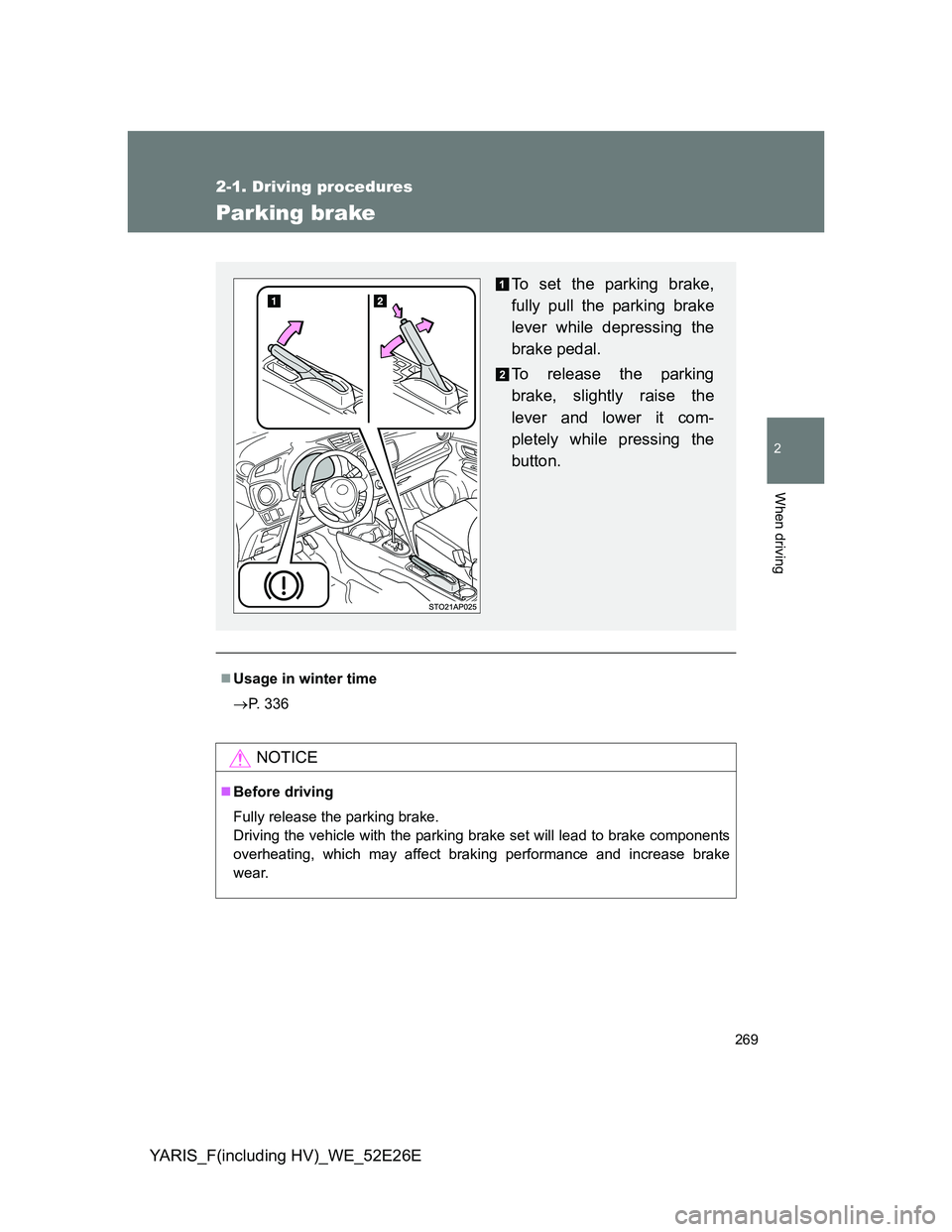
Parking brake
Usage in winter time
P. 336
NOTICE
Before driving
Fully release the parking brake.
Driving the vehicle with the parking brake set will lead to brake components
overheating, which may affect braking performance and increase brake
wear.
To set the parking brake,
fully pull the parking brake
lever while depressing the
brake pedal.
To release the parking
brake, slightly raise the
lever and lower it com-
pletely while pressing the
button.
Page 295 of 712
295 2-3. Operating the lights and wipers
2
When driving
YARIS_F(including HV)_WE_52E26E
Daytime running light system
Except hybrid vehicle (if equipped)
To make your vehicle more visible to other drivers, the headlights and tail
lights turn on automatically whenever the engine is started. Daytime running
lights are not designed for use at night.
Hybrid vehicle
To make your vehicle more visible to other drivers, the daytime running lights
turn on automatically when the parking brake lever is released, if hybrid sys-
tem is operating. (However, these lights will dim when the headlight switch is
operated manually or the automatic headlight system turns on the tail lights.)
Daytime running lights are not designed for use at night.
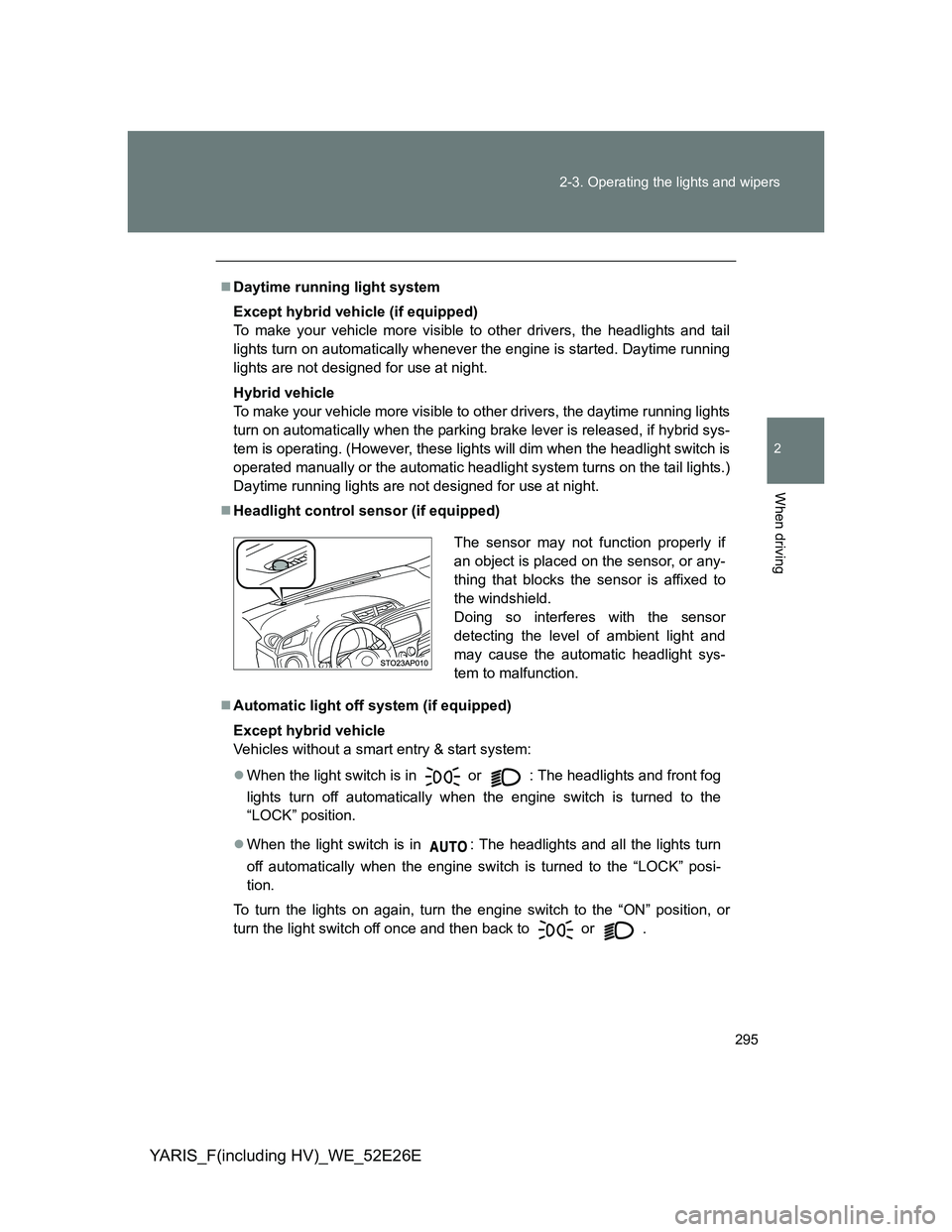
Headlight control sensor (if equipped)
Automatic light off system (if equipped)
Except hybrid vehicle
Vehicles without a smart entry & start system:
When the light switch is in
or : The headlights and front fog
lights turn off automatically when the engine switch is turned to the
“LOCK” position.
When the light switch is in : The headlights and all the lights turn
off automatically when the engine switch is turned to the “LOCK” posi-
tion.
To turn the lights on again, turn the engine switch to the “ON” position, or
turn the light switch off once and then back to
or .
The sensor may not function properly if
an object is placed on the sensor, or any-
thing that blocks the sensor is affixed to
the windshield.
Doing so interferes with the sensor
detecting the level of ambient light and
may cause the automatic headlight sys-
tem to malfunction.
Page 310 of 712
310 2-4. Using other driving systems
YARIS_F(including HV)_WE_52E26E
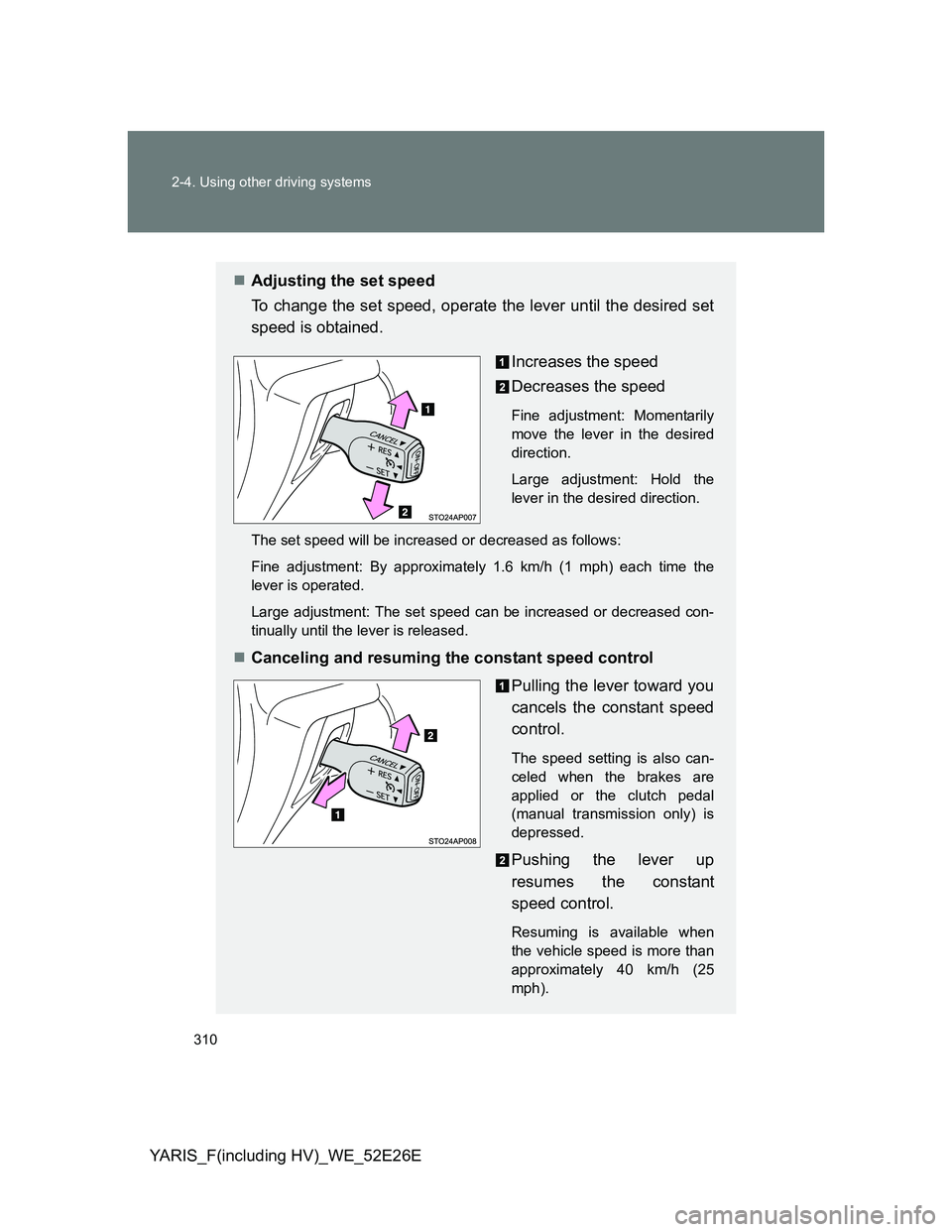
Adjusting the set speed
To change the set speed, operate the lever until the desired set
speed is obtained.
Increases the speed
Decreases the speed
Fine adjustment: Momentarily
move the lever in the desired
direction.
Large adjustment: Hold the
lever in the desired direction.
The set speed will be increased or decreased as follows:
Fine adjustment: By approximately 1.6 km/h (1 mph) each time the
lever is operated.
Large adjustment: The set speed can be increased or decreased con-
tinually until the lever is released.
Canceling and resuming the constant speed control
Pulling the lever toward you
cancels the constant speed
control.
The speed setting is also can-
celed when the brakes are
applied or the clutch pedal
(manual transmission only) is
depressed.
Pushing the lever up
resumes the constant
speed control.
Resuming is available when
the vehicle speed is more than
approximately 40 km/h (25
mph).
Page 316 of 712
316
2-4. Using other driving systems
YARIS_F(including HV)_WE_52E26E
Stop & Start system
: If equipped
Vehicles with a Multidrive:
The Stop & Start system stops and restarts the engine according to
the brake pedal and shift lever operation for stopping and starting
the vehicle.
Vehicles with a manual transmission:
The Stop & Start system stops and restarts the engine according to
the clutch pedal operation for stopping and starting the vehicle.
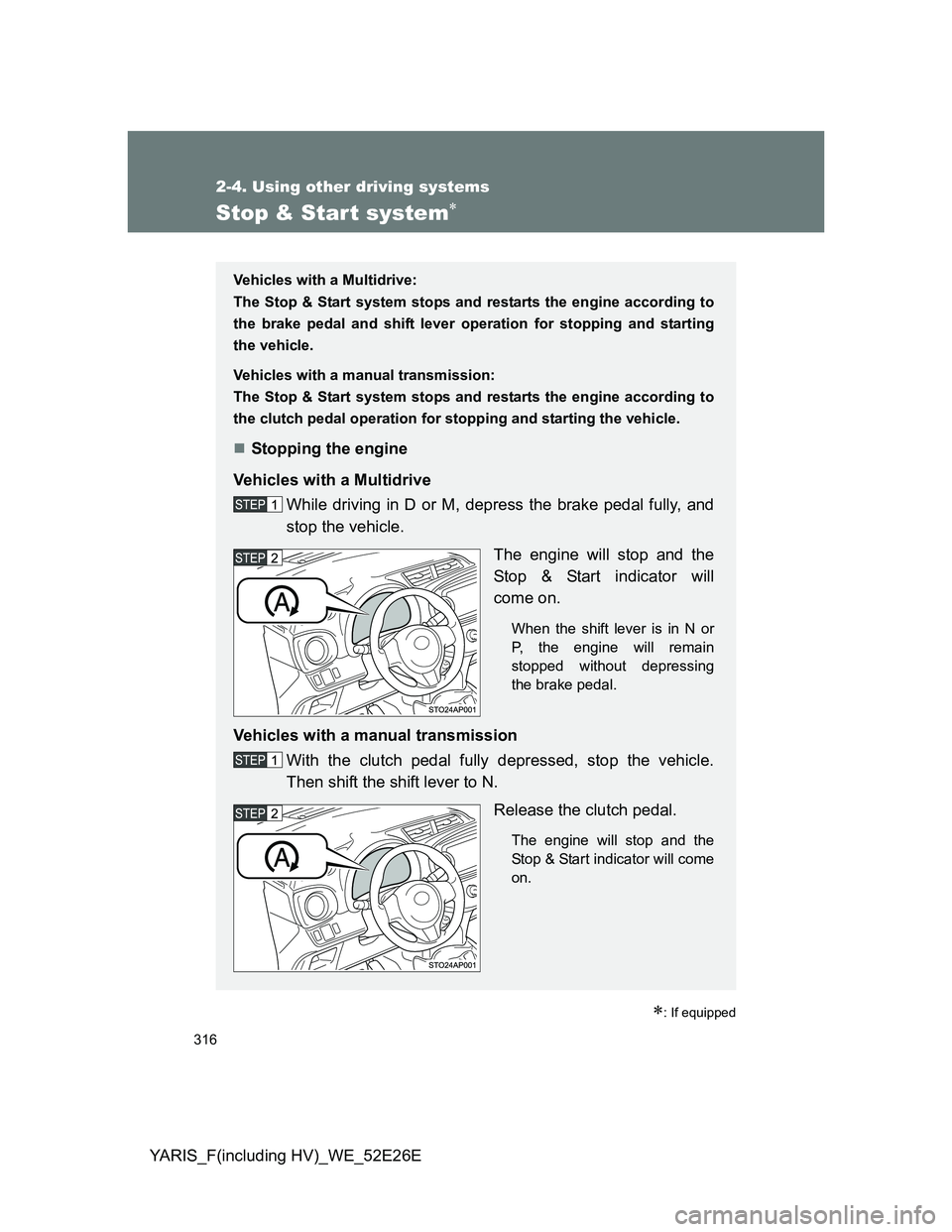
Stopping the engine
Vehicles with a Multidrive
While driving in D or M, depress the brake pedal fully, and
stop the vehicle.
The engine will stop and the
Stop & Start indicator will
come on.
When the shift lever is in N or
P, the engine will remain
stopped without depressing
the brake pedal.
Vehicles with a manual transmission
With the clutch pedal fully depressed, stop the vehicle.
Then shift the shift lever to N.
Release the clutch pedal.
The engine will stop and the
Stop & Start indicator will come
on.
Page 317 of 712
317 2-4. Using other driving systems
2
When driving
YARIS_F(including HV)_WE_52E26E
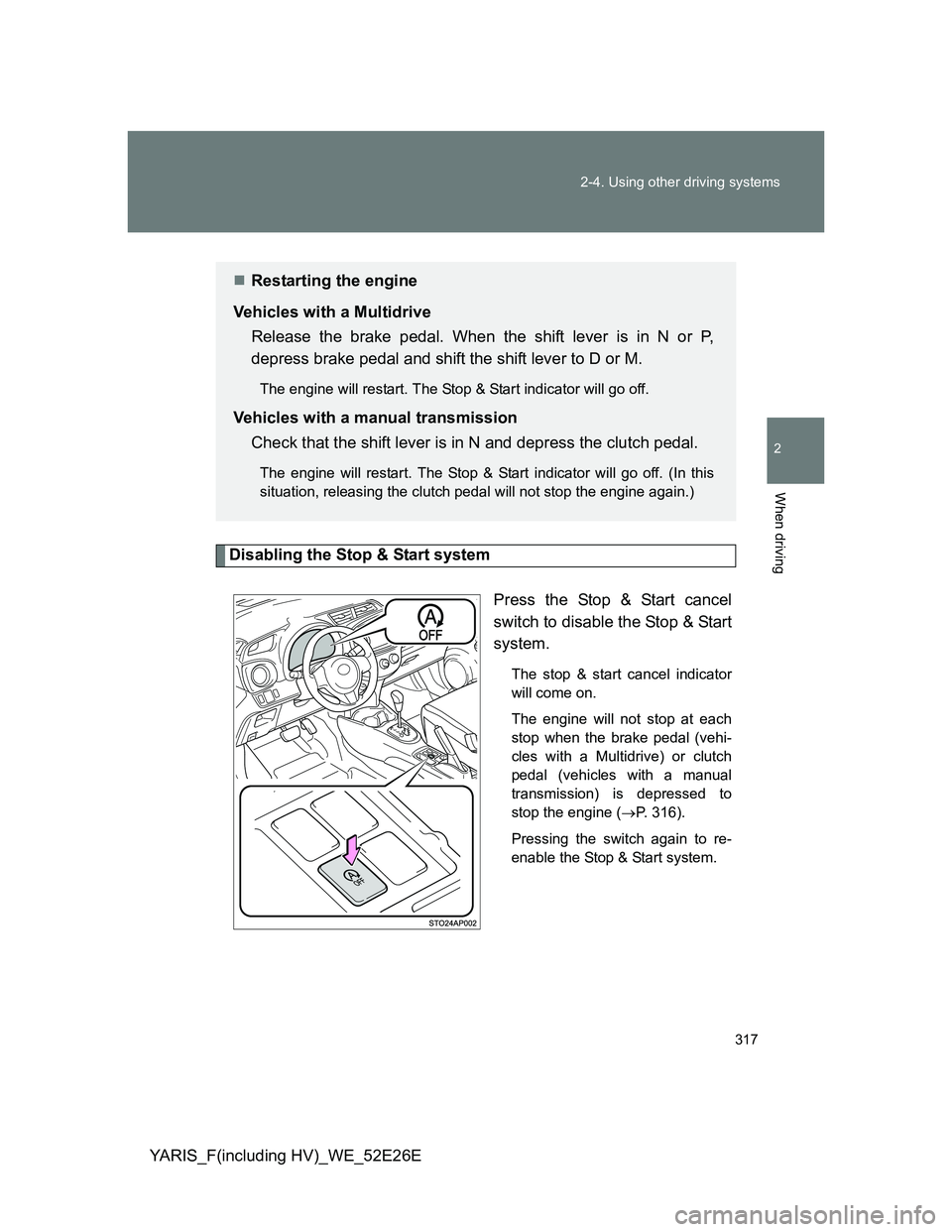
Disabling the Stop & Start system
Press the Stop & Start cancel
switch to disable the Stop & Start
system.
The stop & start cancel indicator
will come on.
The engine will not stop at each
stop when the brake pedal (vehi-
cles with a Multidrive) or clutch
pedal (vehicles with a manual
transmission) is depressed to
stop the engine (P. 316).
Pressing the switch again to re-
enable the Stop & Start system.
Restarting the engine
Vehicles with a Multidrive
Release the brake pedal. When the shift lever is in N or P,
depress brake pedal and shift the shift lever to D or M.
The engine will restart. The Stop & Start indicator will go off.
Vehicles with a manual transmission
Check that the shift lever is in N and depress the clutch pedal.
The engine will restart. The Stop & Start indicator will go off. (In this
situation, releasing the clutch pedal will not stop the engine again.)
Page 318 of 712
318 2-4. Using other driving systems
YARIS_F(including HV)_WE_52E26EIf the Stop & Start cancel switch is pressed while the vehicle is
stopped
When the engine is stopped by the Stop & Start system, press-
ing the Stop & Start cancel switch will restart the engine.
From the next time the vehicle is stopped (after Stop & Start sys-
tem has been turned off), the engine will not be stopped.
With the Stop & Start system disabled, pressing the Stop & Start
cancel switch will re-enable the system but not stop the engine.
From the next time the vehicle is stopped (after Stop & Start sys-
tem has been turned on), the engine will be stopped.
Operating conditions
The Stop & Start system is operational when all of the following condi-
tions are met:
• The engine is adequately warmed up.
• The battery is sufficiently charged.
• The driver’s door is closed.
• Vehicles with a Multidrive: The driver’s seat belt is fastened.
• The hood is closed.
• The accelerator pedal is not being depressed.
• The shift lever is not in R.
In the following circumstances the engine may not be stopped by the
Stop & Start system. This is not a malfunction of the Stop & Start system.
• Engine coolant temperature or transmission fluid temperature is too
low or too high.
• The air conditioning system is being used when the vehicle interior
temperature is extremely high such as after the vehicle was parked
under the hot sun.
• Vehicles with an automatic air conditioning system only: The wind-
shield defogger is being used.
• The battery is not sufficiently charged, or is undergoing a periodic
recharge.
• Due to traffic or other circumstances the vehicle is stopped repeatedly,
resulting in the amount of time the engine is stopped by the Stop &
Start system to become excessively high.
• The brake pedal is not depressed firmly.
Page 319 of 712
319 2-4. Using other driving systems
2
When driving
YARIS_F(including HV)_WE_52E26E
• The vehicle is stopped on a steep hill.
• The brake booster vacuum is low.
• A large amount of electricity is being used.
• At high altitude.
When the above conditions improve, the Stop & Start system will stop and
restart the engine from the next time the vehicle is stopped.
In the following situations, the engine may start even without the brake
pedal being released (vehicles with a Multidrive) or clutch pedal being
depressed (vehicles with a manual transmission).
• The brake pedal is pumped or strongly depressed.
• The air conditioning system is being used or turned on.
• Vehicles with an automatic air conditioning system only: The wind-
shield defogger is turned on.
• The battery is not sufficiently charged.
• The vehicle starts to roll on an incline.
• Vehicles with a Multidrive: The hood is opened when the shift lever is in
N or P.
• The accelerator pedal is depressed.
• A large amount of electricity is being used.
• Vehicles with a Multidrive: The driver’s door is opened.
• Vehicles with a Multidrive: The driver’s seat belt is unfastened.
In the following situations, it may take longer than normal for the Stop &
Start system to activate.
• The battery is discharged.
• After the battery terminals have been disconnected and reconnected
after a battery replacement, etc.
• The engine coolant temperature is low.
Automatic reactivation of the Stop & Start system
Vehicles without a smart entry & start system:
Even if the Stop & Start system is disabled by the Stop & Start cancel switch,
it will be automatically re-enabled once the engine switch is turned to the
“LOCK” position then to the “START” position.
Vehicles with a smart entry & start system:
Even if the Stop & Start system is disabled by the Stop & Start cancel switch,
it will be automatically re-enabled once the “ENGINE START STOP” switch
is turned off then the engine is started.
Page 320 of 712
320 2-4. Using other driving systems
YARIS_F(including HV)_WE_52E26E
The Stop & Start system protection feature
Vehicles without a smart entry & start system:
When an excessively loud sound is being projected by the audio system, the
audio system may be automatically cut off in order to maintain power for the
Stop & Start system function.
If this occurs, turning the engine switch to the “LOCK” position then to the
“ACC” or “ON” position re-enables the audio system.
Vehicles with a smart entry & start system:
When an excessively loud sound is being projected by the audio system, the
audio system may be automatically cut off in order to maintain power for the
Stop & Start system function.
If this occurs, turning the “ENGINE START STOP” switch off then to ACCES-
SORY mode or IGNITION ON mode re-enables the audio system.
Steering wheel operation
When the engine is stopped by the Stop & Start system, the steering wheel
may become heavier than when driving.
Hood
If the hood is opened while the engine is stopped by the Stop & Start system,
the engine cannot be restarted by the Stop & Start system or by the auto-
matic engine start function. Restart the engine with the engine switch opera-
tion. (P. 222, 226)
Vehicles with a Multidrive: If the hood is opened while the engine is stopped
by the Stop & Start system and the shift lever is in N or P, the engine will
restart.
Hill-start assist control (vehicles with a Multidrive)
On a steep uphill grade, the vehicle may roll backward after hill-start
assist control is released. In this situation, apply the parking brake and
operate the brake pedal when putting the vehicle in motion.
This system operates on flat surfaces as well as steep grades.
When the engine is stopped due to Stop & Start system operation, the
force required to depress the brake pedal may change, but this is not a
malfunction.
When to use the Stop & Start system
Use the Stop & Start system when stopping the vehicle temporarily at red
lights, intersections, etc. When stopping the vehicle for a longer period of
time, turn off the engine completely.