Eps TOYOTA YARIS 2014 3.G Owners Manual
[x] Cancel search | Manufacturer: TOYOTA, Model Year: 2014, Model line: YARIS, Model: TOYOTA YARIS 2014 3.GPages: 400, PDF Size: 9 MB
Page 4 of 400

TABLE OF CONTENTSIndex
4
4-2. MaintenanceMaintenance requirements .................... 228
General maintenance ......... 230
Emission inspection and maintenance (I/M)
programs .......................... 234
4-3. Do-it-yourself maintenance Do-it-yourself service precautions ...................... 235
Hood................................... 238
Positioning a floor jack ....... 240
Engine compartment .......... 243
Tires ................................... 254
Tire inflation pressure......... 262
Wheels ............................... 266
Air conditioning filter ........... 269
Wireless remote control battery .............................. 271
Checking and replacing fuses ................................ 275
Light bulbs .......................... 287
5-1. Essential information Emergency flashers ........... 296
If your vehicle needs to be towed .......................... 297
If you think something is wrong ............................... 303
Fuel pump shut off system .............................. 304 5-2. Steps to take in an emergency
If a warning light turns on or a warning buzzer
sounds... .......................... 305
If you have a flat tire ........... 315
If the engine will not start .... 327
If the shift lever cannot be shifted from P (vehicles
with an automatic
transmission) .................... 328
If you lose your keys ........... 329
If the vehicle battery is discharged ........................ 330
If your vehicle overheats..... 334
If the vehicle becomes stuck ................................. 337
If your vehicle has to be stopped in
an emergency................... 339
6-1. Specifications Maintenance data (fuel, oil level, etc.) ........... 342
Fuel information .................. 353
Tire information................... 356
6-2. Customization Customizable features ........ 368
Items to initialize ................. 370
5When trouble arises
6Vehicle specifications
Page 69 of 400
69
1
Before driving
1-5. Refueling
Opening the fuel tank cap
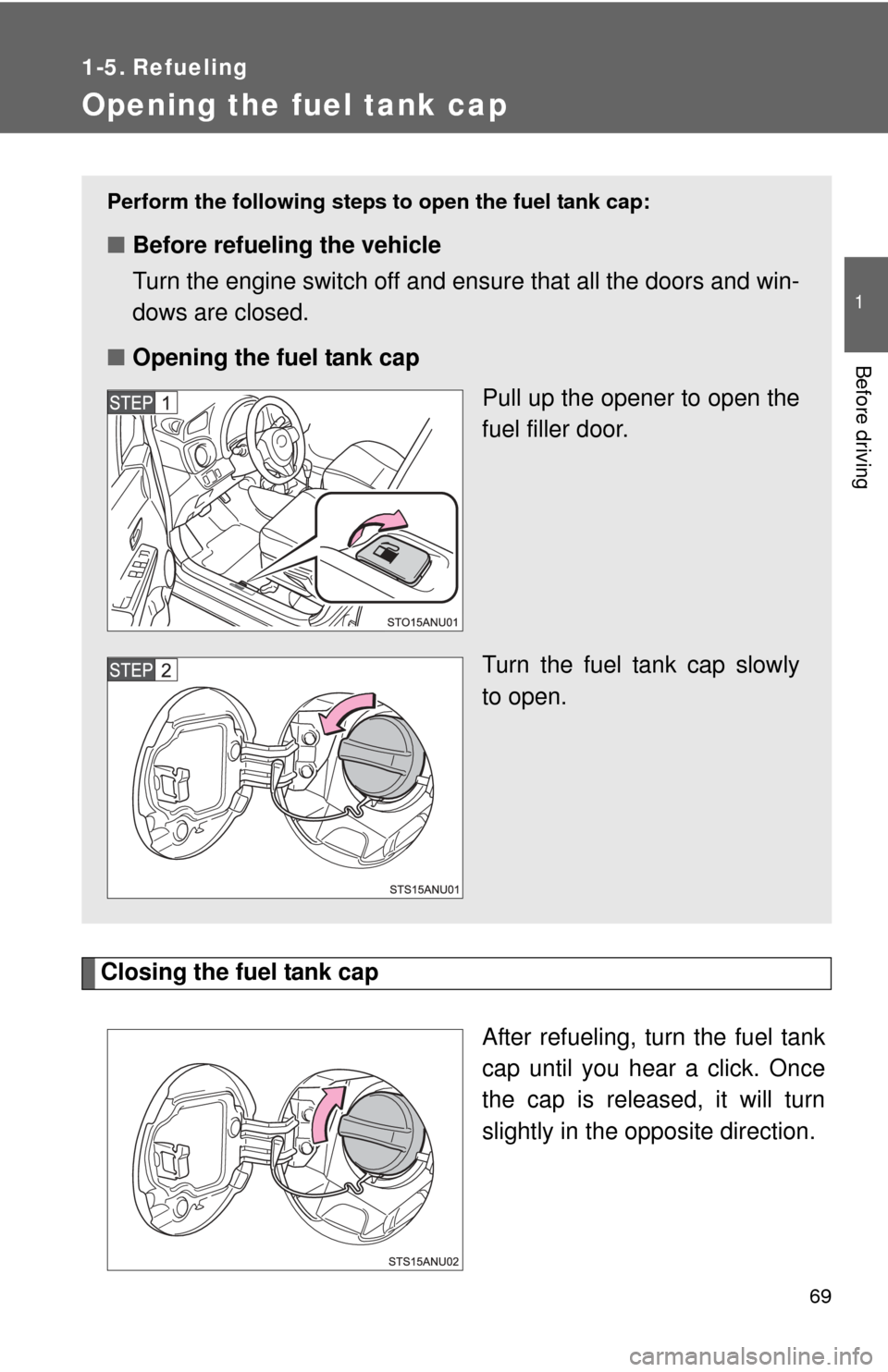
Closing the fuel tank capAfter refueling, turn the fuel tank
cap until you hear a click. Once
the cap is released, it will turn
slightly in the opposite direction.
Perform the following steps to open the fuel tank cap:
■Before refueling the vehicle
Turn the engine switch off and ensure that all the doors and win-
dows are closed.
■ Opening the fuel tank cap
Pull up the opener to open the
fuel filler door.
Turn the fuel tank cap slowly
to open.
Page 163 of 400
163
2-4. Using other driving systems
2
When driving
Driving assist systems
To help enhance driving safety and performance, the following sys-
tems operate automatically in res ponse to various driving situations.
Be aware, however, that these systems are supplementary and
should not be relied upon too heavi ly when operating the vehicle.
■ABS (Anti-lock Brake System)
Helps to prevent wheel lock when the brakes are applied suddenly, or if
the brakes are applied while driving on a slippery road surface.
■Brake assist
Generates an increased level of braking force after the brake pedal is
depressed when the system detects a panic stop situation.
■VSC (Vehicle Stability Control)
Helps the driver to control skidding when swerving suddenly or turning
on slippery road surfaces.
■TRAC (Traction Control)
Helps to maintain drive power and prevent the drive wheels from spin-
ning when starting the vehicle or accelerating on slippery roads.
■EPS (Electric Power Steering)
Employs an electric motor to help reduce the amount of effort needed
to turn the steering wheel.
Page 165 of 400
165
2-4. Using other
driving systems
2
When driving
■Turning off both TRAC and VSC systems
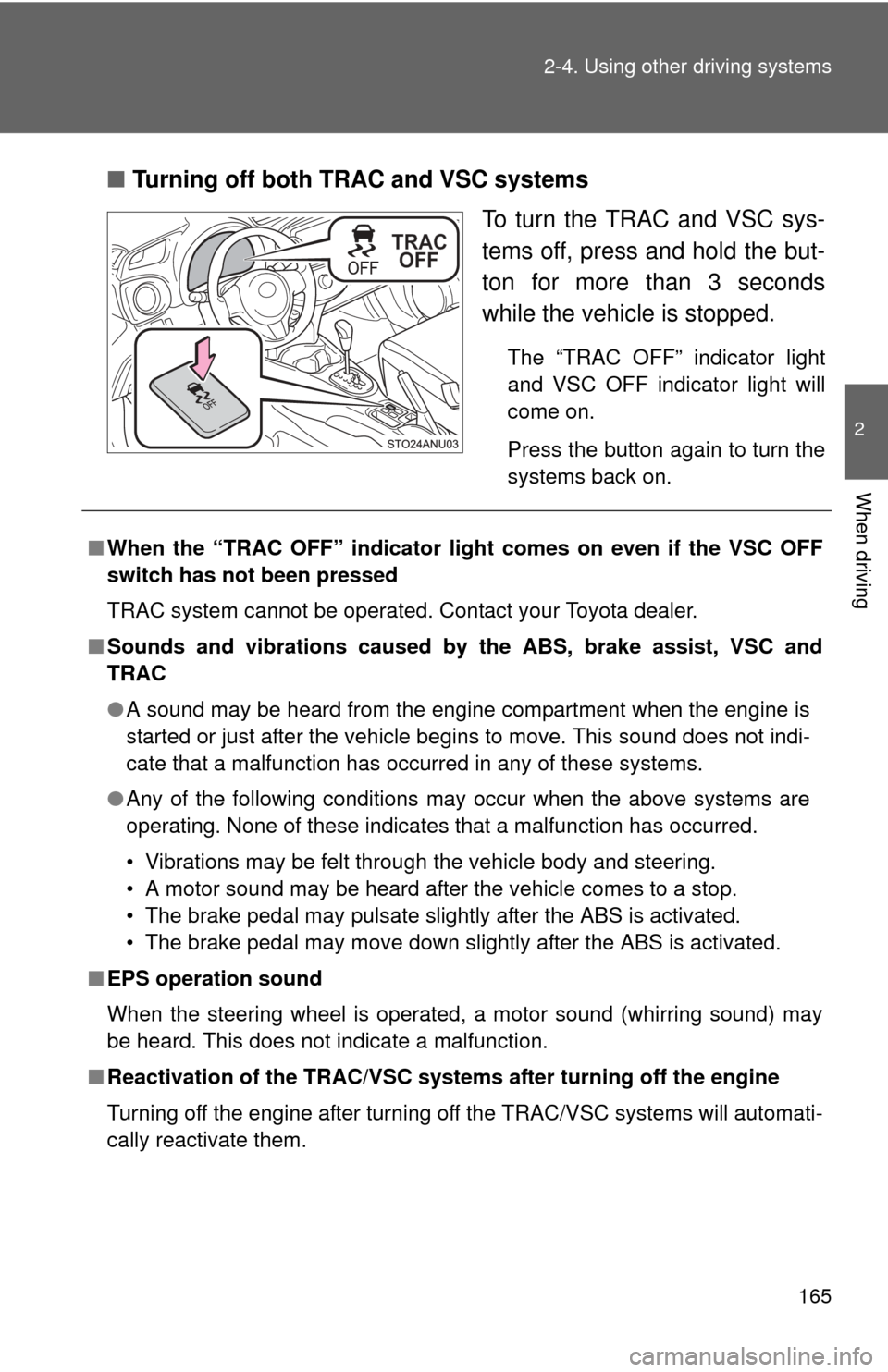
To turn the TRAC and VSC sys-
tems off, press and hold the but-
ton for more than 3 seconds
while the vehicle is stopped.
The “TRAC OFF” indicator light
and VSC OFF indicator light will
come on.
Press the button again to turn the
systems back on.
■When the “TRAC OFF” indicator light comes on even if the VSC OFF
switch has not been pressed
TRAC system cannot be operated. Contact your Toyota dealer.
■ Sounds and vibrations caused by the ABS, brake assist, VSC and
TRAC
● A sound may be heard from the engine compartment when the engine is
started or just after the vehicle begins to move. This sound does not indi-
cate that a malfunction has occurred in any of these systems.
● Any of the following conditions may occur when the above systems are
operating. None of these indicates that a malfunction has occurred.
• Vibrations may be felt through the vehicle body and steering.
• A motor sound may be heard after the vehicle comes to a stop.
• The brake pedal may pulsate slightly after the ABS is activated.
• The brake pedal may move down slightly after the ABS is activated.
■ EPS operation sound
When the steering wheel is operated, a motor sound (whirring sound) may
be heard. This does not indicate a malfunction.
■ Reactivation of the TRAC/VSC systems after turning off the engine
Turning off the engine after turning off the TRAC/VSC systems will automati-
cally reactivate them.
Page 166 of 400
166 2-4. Using other driving systems
■Reactivation of the TRAC system linked to vehicle speed
When only the TRAC system is turned off, the TRAC system will turn on
when vehicle speed increases. However, when both TRAC and VSC sys-
tems are turned off, the systems will not turn on even when vehicle speed
increases.
■ Reduced effectiveness of the EPS system
The effectiveness of the EPS system is reduced to prevent the system from
overheating when there is frequent steering input over an extended period of
time. The steering wheel may feel heavy as a result. Should this occur,
refrain from excessive steering input or stop the vehicle and turn the engine
off. The EPS system should return to normal within 10 minutes.
■ If the slip indicator comes on...
It may indicate a malfunction in the driving assist systems. Contact your
Toyota dealer.
CAUTION
■The ABS does not operate effectively when
●The limits of tire gripping performance have been exceeded (such as
excessively worn tires on a snow covered road).
● The vehicle hydroplanes while driving at high speed on the wet or slick
roads.
■ Stopping distance when the ABS is operating may exceed that of nor-
mal conditions
The ABS is not designed to shorten the vehicle’s stopping distance. Always
maintain a safe distance from the vehicle in front of you, especially in the fol-
lowing situations:
● When driving on dirt, gravel or snow-covered roads
● When driving with tire chains
● When driving over bumps in the road
● When driving over roads with potholes or roads with uneven surfaces
Page 168 of 400
168
2-5. Driving information
Cargo and luggage
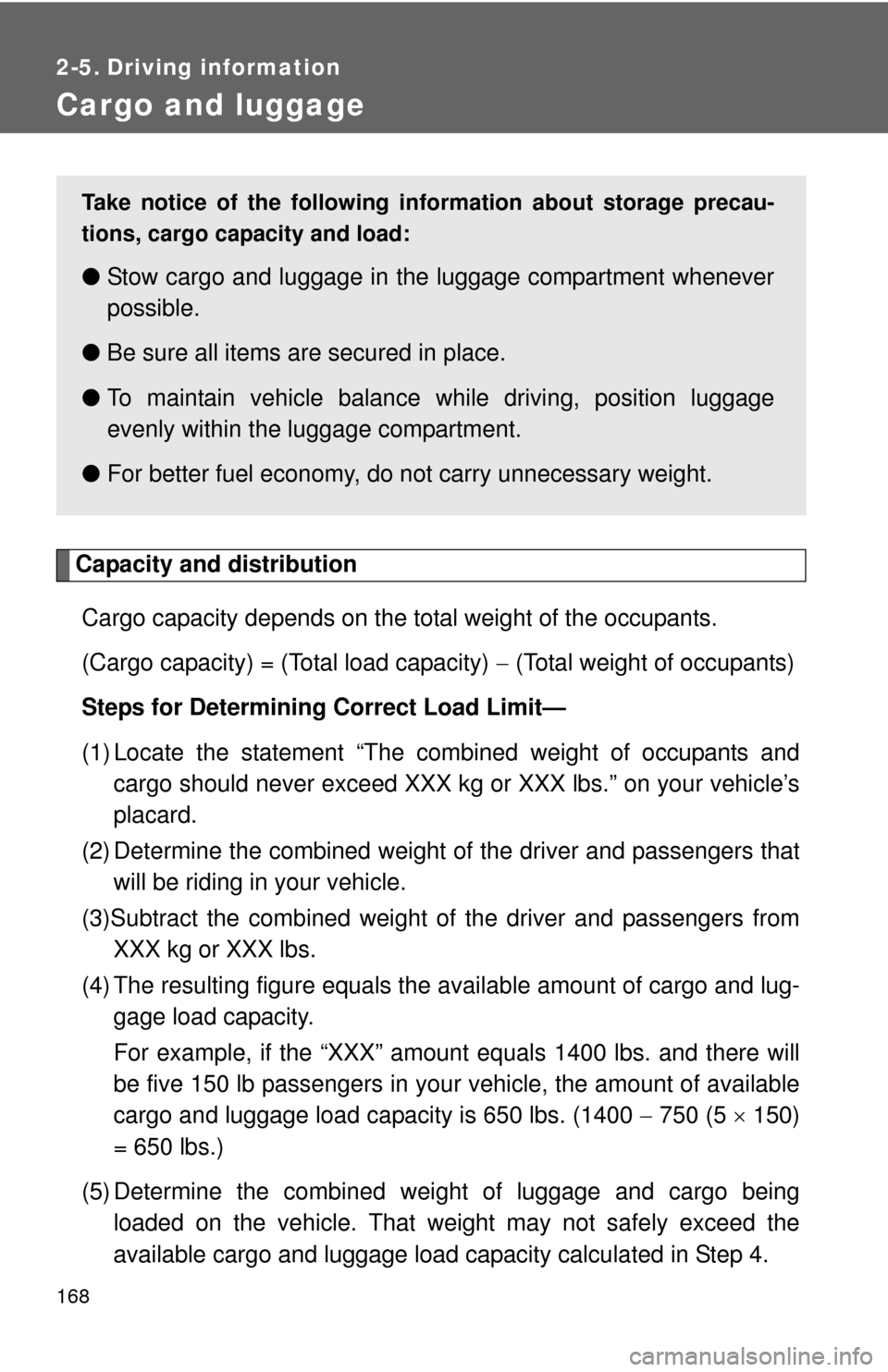
Capacity and distributionCargo capacity depends on the total weight of the occupants.
(Cargo capacity) = (Total load capacity) (Total weight of occupants)
Steps for Determining Correct Load Limit—
(1) Locate the statement “The co mbined weight of occupants and
cargo should never exceed XXX kg or XXX lbs.” on your vehicle’s
placard.
(2) Determine the combined weight of the driver and passengers that
will be riding in your vehicle.
(3)Subtract the combined weight of the driver and passengers from XXX kg or XXX lbs.
(4) The resulting figure equals the av ailable amount of cargo and lug-
gage load capacity.
For example, if the “XXX” amount equals 1400 lbs. and there will
be five 150 lb passengers in your vehicle, the amount of available
cargo and luggage load capacity is 650 lbs. (1400 750 (5 150)
= 650 lbs.)
(5) Determine the combined weight of luggage and cargo being loaded on the vehicle. That weight may not safely exceed the
available cargo and luggage load capacity calculated in Step 4.
Take notice of the following information about storage precau-
tions, cargo capacity and load:
●Stow cargo and luggage in the luggage compartment whenever
possible.
● Be sure all items are secured in place.
● To maintain vehicle balance while driving, position luggage
evenly within the luggage compartment.
● For better fuel economy, do no t carry unnecessary weight.
Page 280 of 400

280 4-3. Do-it-yourself maintenance
7 IGN15 AMultiport fuel injection system/
sequential multiport fuel injection
system
8 MET 7.5 A Gauges and meters
9 EPS 50 A Electric power steering system
10 ABS NO.2 30 AAnti-lock brake system, vehicle sta-
bility control system
11 DEF 30 ARear window defogger, outside
rear view mirror defoggers
12 SPARE 10 A Spare fuse
13 PTC 80 APTC heater, outside rear view mir-
ror defoggers
14 HTR 40 A Air conditioning system
15 H-LP CLN 30 A No circuit
16 RDI FAN 30 A Electric cooling fan
17 ABS NO.1 50 AAnti-lock brake system, vehicle sta-
bility control system
18 BBC 40 A No circuit
19 ST 30 A Starting system
20 AMP 15 A No circuit
21 D/L NO.2 25 A No circuit
22 D.C.C 30 A DOME, ECU-B NO.1, ECU-B NO.2
23 STR LOCK 20 A No circuit
24 ECU-B NO.1 5 A Multiport fuel injection system/
sequential multiport fuel injection
system, main body ECU
25 DOME 15 AInterior light, personal lights, audio
system, vehicle stability control
system
26 MIR-HTR 10 A No circuit
FuseAmpereCircuit
Page 283 of 400
283
4-3. Do-it-yourself maintenance
4
Maintenance and care
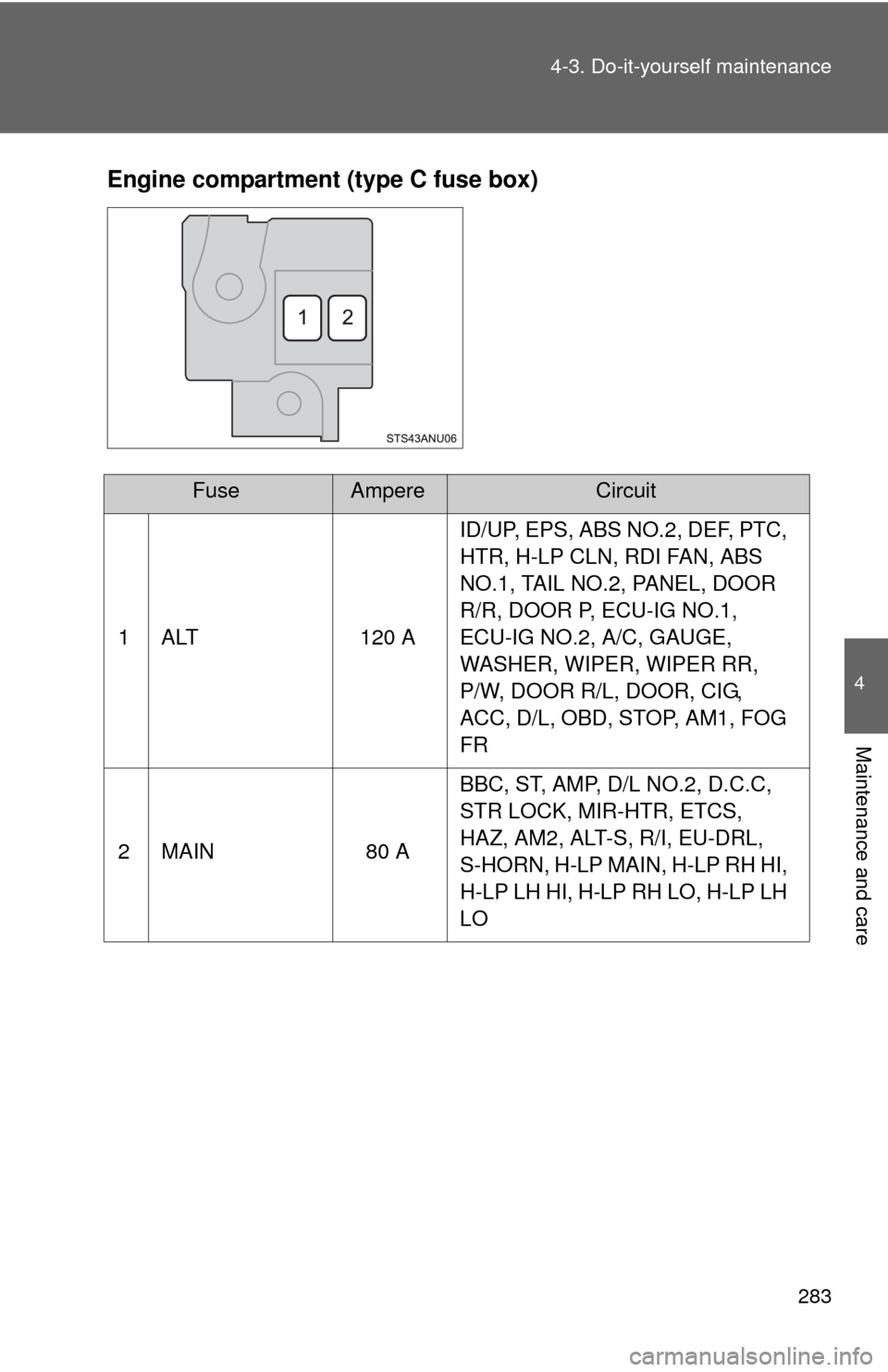
Engine compartment (type C fuse box)
FuseAmpereCircuit
1 ALT 120 A ID/UP, EPS, ABS NO.2, DEF, PTC,
HTR, H-LP CLN, RDI FAN, ABS
NO.1, TAIL NO.2, PANEL, DOOR
R/R, DOOR P, ECU-IG NO.1,
ECU-IG NO.2, A/C, GAUGE,
WASHER, WIPER, WIPER RR,
P/W, DOOR R/L, DOOR, CIG,
ACC, D/L, OBD, STOP, AM1, FOG
FR
2 MAIN 80 A BBC, ST, AMP, D/L NO.2, D.C.C,
STR LOCK, MIR-HTR, ETCS,
HAZ, AM2, ALT-S, R/I, EU-DRL,
S-HORN, H-LP MAIN, H-LP RH HI,
H-LP LH HI, H-LP RH LO, H-LP LH
LO
Page 295 of 400
When trouble arises5
295
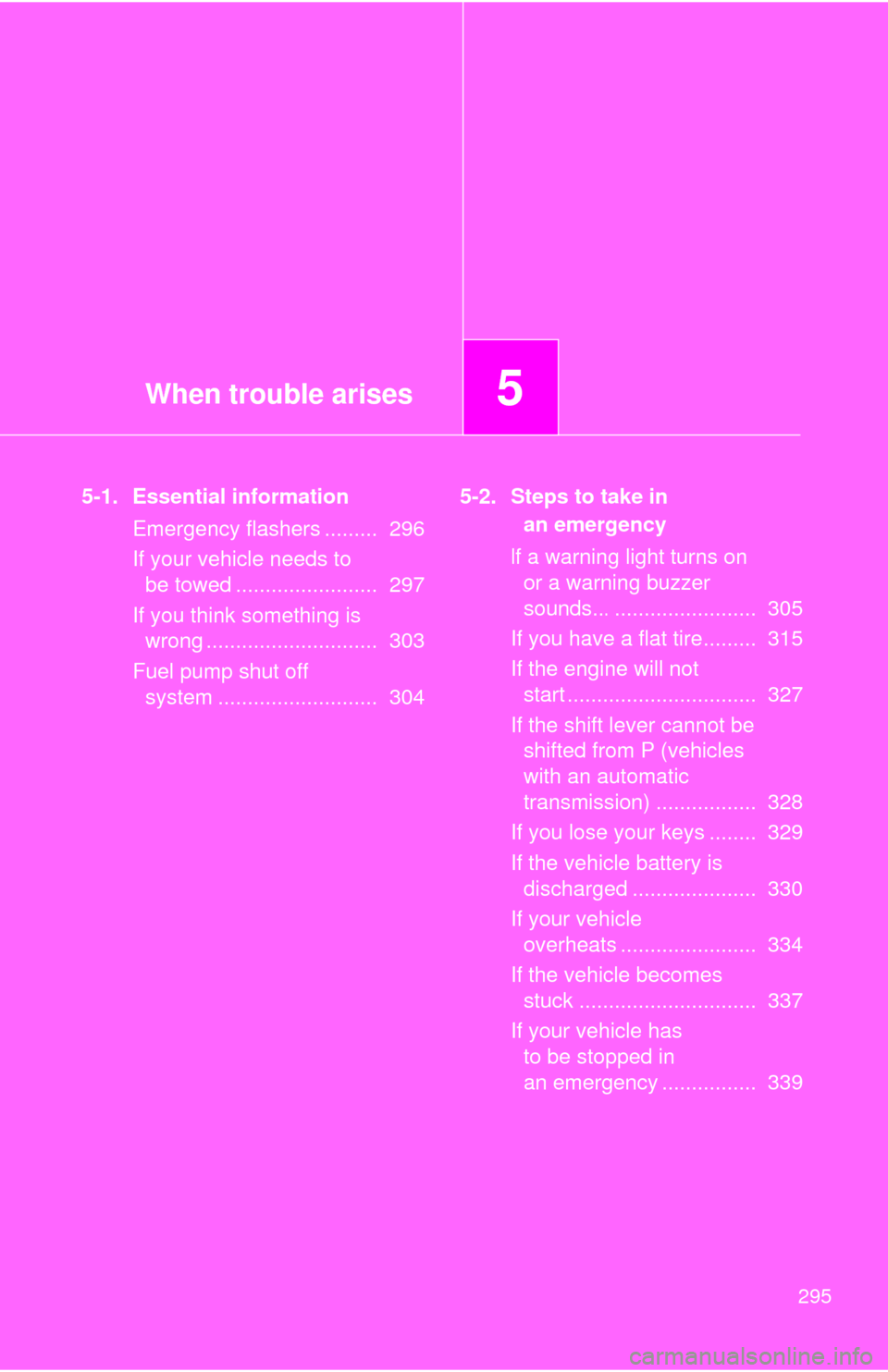
5-1. Essential informationEmergency flashers ......... 296
If your vehicle needs to be towed ........................ 297
If you think something is wrong ............................. 303
Fuel pump shut off system ........................... 304 5-2. Steps to take in
an emergency
If a warning light turns on or a warning buzzer
sounds..
......................... 305
If you have a flat tire......... 315
If the engine will not start ................................ 327
If the shift lever cannot be shifted from P (vehicles
with an automatic
transmission) ................. 328
If you lose your keys ........ 329
If the vehicle battery is discharged ..................... 330
If your vehicle overheats ....................... 334
If the vehicle becomes stuck .............................. 337
If your vehicle has to be stopped in
an emergency ................ 339
Page 305 of 400
5
When trouble arises
305
5-2. Steps to take in an emergency
If a war ning light turns on or a war ning buzzer sounds...
Stop the vehicle immediately. Continuing to drive the vehicle
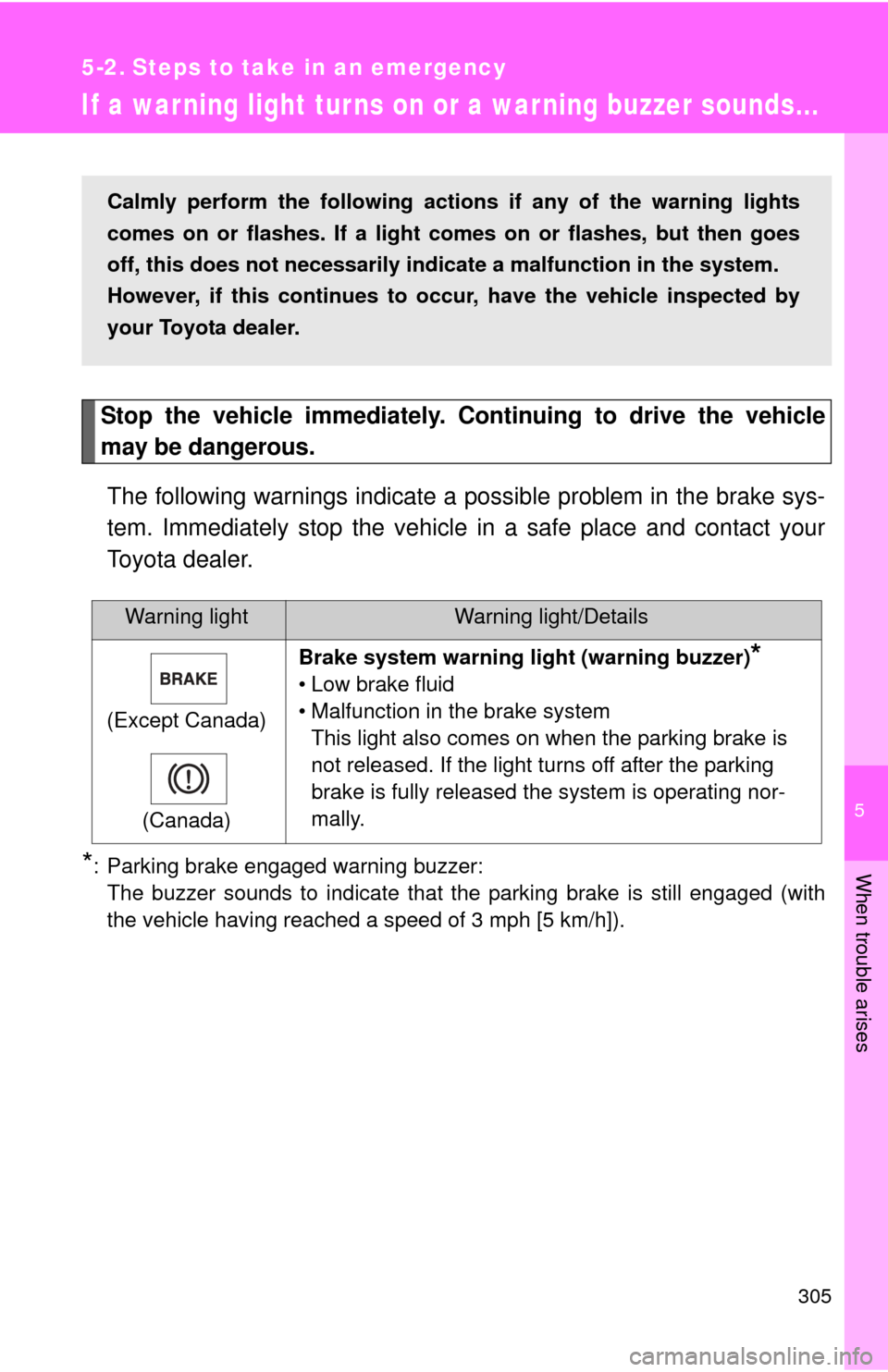
may be dangerous.The following warnings indicate a possible problem in the brake sys-
tem. Immediately stop the vehicle in a safe place and contact your
Toyota dealer.
*: Parking brake engaged warning buzzer: The buzzer sounds to indicate that the parking brake is still engaged (with
the vehicle having reached a speed of 3 mph [5 km/h]).
Warning lightWarning light/Details
(Except Canada) (Canada) Brake system warning light (warning buzzer)
*
• Low brake fluid
• Malfunction in the brake system
This light also comes on when the parking brake is
not released. If the light turns off after the parking
brake is fully released the system is operating nor-
mally.
Calmly perform the following actio ns if any of the warning lights
comes on or flashes. If a light comes on or flashes, but then goes
off, this does not necessarily indi cate a malfunction in the system.
However, if this continues to o ccur, have the vehicle inspected by
your Toyota dealer.