light TOYOTA YARIS 2014 Service Manual
[x] Cancel search | Manufacturer: TOYOTA, Model Year: 2014, Model line: YARIS, Model: TOYOTA YARIS 2014Pages: 712, PDF Size: 30.2 MB
Page 180 of 712
180 1-8. Safety information
YARIS_F(including HV)_WE_52E26EHybrid vehicle
Vehicles without an electronic
key:
Insert the key into the cylinder
and turn to the “OFF” position.
The “OFF” indicator light turns on
(only when the engine switch is in
the “ON” position).
Vehicles with an electronic key:
Insert the mechanical key into
the cylinder and rotate to the
“OFF” position.
The “OFF” indicator light turns on
(only when the “POWER” switch
is in ON mode).
“PASSENGER AIR BAG” indicator information
If any of the following problems occur, it is possible that there is a malfunc-
tion in the system. Have the vehicle inspected by any authorized Toyota
dealer or repairer, or another duly qualified and equipped professional.
Neither “ON” nor “OFF” comes on.
The indicator light does not change when the airbag manual on-off switch
is switched to “ON” or “OFF”.
Page 195 of 712
195 1-8. Safety information
1
Before driving
YARIS_F(including HV)_WE_52E26E
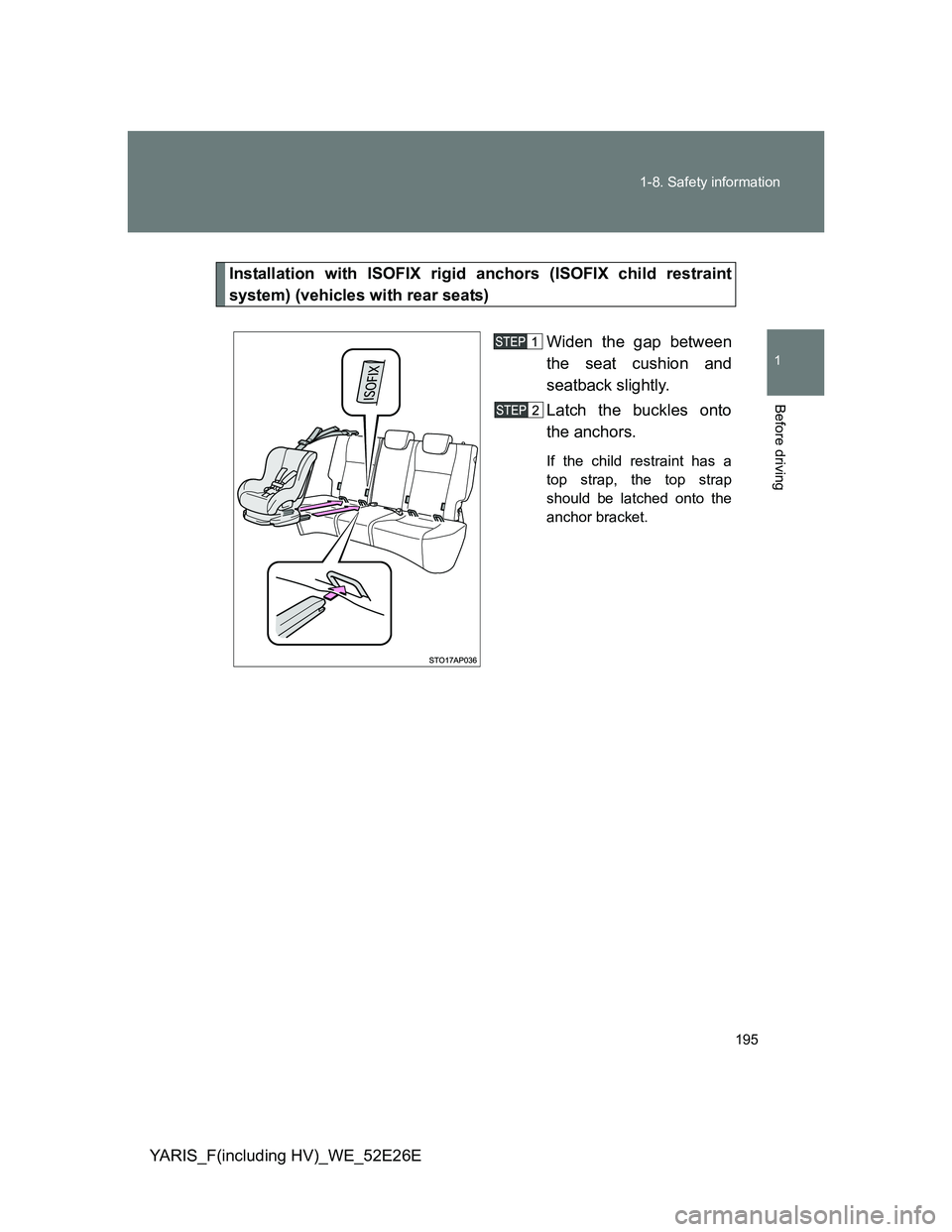
Installation with ISOFIX rigid anchors (ISOFIX child restraint
system) (vehicles with rear seats)
Widen the gap between
the seat cushion and
seatback slightly.
Latch the buckles onto
the anchors.
If the child restraint has a
top strap, the top strap
should be latched onto the
anchor bracket.
Page 201 of 712
2When driving
201
YARIS_F(including HV)_WE_52E26E
2-1. Driving procedures
Driving the vehicle ............ 202
Engine (ignition) switch
(except hybrid vehicle
[vehicles without a smart
entry & start system])...... 222
Engine (ignition) switch
(except hybrid vehicle
[vehicles with a smart
entry & start system])...... 226
Engine (ignition) switch
(hybrid vehicle [vehicles
without an electronic
key]) ................................ 236
Power (ignition) switch
(hybrid vehicle [vehicles
with an electronic key]) ... 241
EV drive mode
(hybrid vehicle) ............... 248
Hybrid transmission .......... 250
Multidrive .......................... 253
Multi-mode manual
transmission ................... 258
Manual transmission......... 263
Turn signal lever ............... 267
Parking brake ................... 269
Horn .................................. 270
2-2. Instrument cluster
Gauges and meters .......... 271
Indicators and warning
lights ............................... 276
Multi-information display ... 2842-3. Operating the lights and
wipers
Headlight switch................ 291
Fog light switch ................. 300
Windshield wiper and
washer ............................ 302
Rear window wiper and
washer ............................ 307
2-4. Using other driving systems
Cruise control.................... 309
Speed limiter ..................... 313
Stop & Start system .......... 316
Driving assist systems ...... 324
Hill-start assist control
(hybrid vehicle) ............... 330
Diesel particulate filter
system ............................ 332
2-5. Driving information
Cargo and luggage ........... 334
Winter driving tips ............. 336
Trailer towing
(hybrid vehicle) ............... 340
Trailer towing (except
hybrid vehicle [except for
South Africa]) .................. 341
Page 206 of 712
206 2-1. Driving procedures
YARIS_F(including HV)_WE_52E26E
Starting off on a steep uphill
Vehicles with a hybrid transmission or a Multidrive
Firmly set the parking brake with the brake pedal depressed,
and then shift the shift lever to D.
Release the brake pedal and gently depress the accelerator
pedal.
Release the parking brake.
Vehicles with a multi-mode manual transmission
With the brake pedal depressed, firmly set the parking brake
and shift the shift lever to E or M.
When shifting the shift lever to E: Make sure that the display of the
gear position indicator shows E.
When shifting the shift lever to M: Make sure that the display of the
gear position indicator shows 1.
Gently depress the accelerator pedal.
Release the parking brake.
Vehicles with a manual transmission
With the parking brake firmly set and the clutch pedal fully
depressed, shift the shift lever to 1.
Lightly depress the accelerator pedal at the same time as
gradually releasing the clutch pedal.
Release the parking brake.
Driving in the rain
Drive carefully when it is raining, because visibility will be reduced, the
windows may become fogged-up, and the road will be slippery.
Drive carefully when it starts to rain, because the road surface will be
especially slippery.
Refrain from high speeds when driving on an expressway in the rain,
because there may be a layer of water between the tires and the road
surface, preventing the steering and brakes from operating properly.
Page 208 of 712
208 2-1. Driving procedures
YARIS_F(including HV)_WE_52E26E
Idling time before stopping the engine (diesel engine)
To prevent damage to the turbocharger, allow the engine to idle immediately
after high-speed driving or driving up a hill.
Eco-friendly driving (vehicles with a Multidrive)
Driving conditionIdling time
Normal city driving Not necessary
High-speed driv-
ingConstant speed of approx.
80 km/h (50 mph)Approximately 20
seconds
Constant speed of approx.
100 km/h (63 mph)Approximately 1 minute
Steep hill driving or continuous driving at 100
km/h (63 mph) or more (race track driving etc.)Approximately 2
minutes
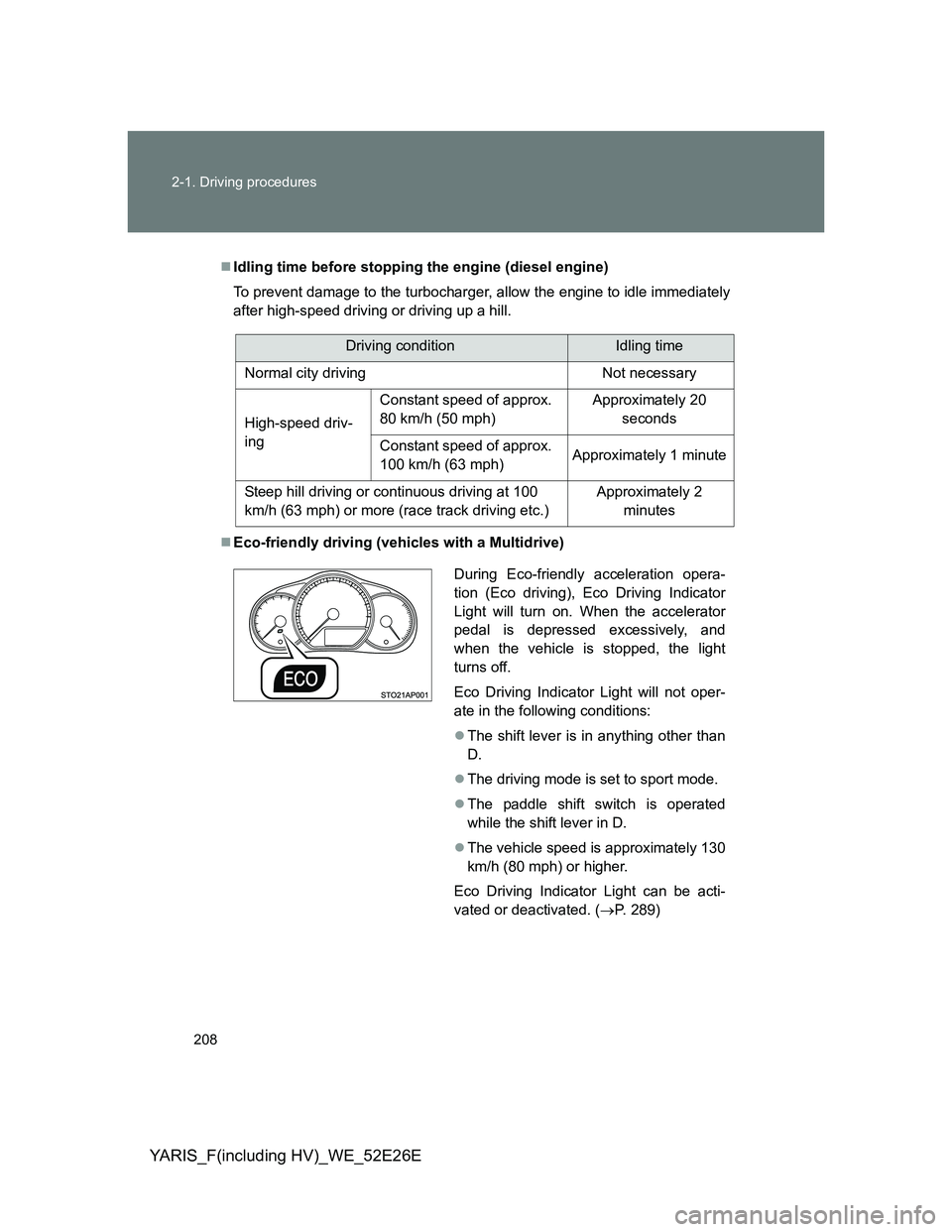
During Eco-friendly acceleration opera-
tion (Eco driving), Eco Driving Indicator
Light will turn on. When the accelerator
pedal is depressed excessively, and
when the vehicle is stopped, the light
turns off.
Eco Driving Indicator Light will not oper-
ate in the following conditions:
The shift lever is in anything other than
D.
The driving mode is set to sport mode.
The paddle shift switch is operated
while the shift lever in D.
The vehicle speed is approximately 130
km/h (80 mph) or higher.
Eco Driving Indicator Light can be acti-
vated or deactivated. (P. 289)
Page 209 of 712
209 2-1. Driving procedures
2
When driving
YARIS_F(including HV)_WE_52E26E
Operating your vehicle in a foreign country
Comply with the relevant vehicle registration laws and confirm the availability
of the correct fuel. (P. 667)
For efficient use (Hybrid vehicle)
Shift the shift lever to D when driving.
In the N position, the gasoline engine operates but electricity cannot be
generated. The hybrid battery (traction battery) will discharge, requiring
unnecessary engine power to recharge.
Drive your vehicle smoothly.
Avoid abrupt acceleration and deceleration. Gradual acceleration and
deceleration will make more effective use of the electric motor (traction
motor) without having to use gasoline engine power.
Avoid repeated acceleration.
Repeated acceleration consumes hybrid battery (traction battery) power,
resulting in poor acceleration. Battery power can be restored by driving
with the accelerator pedal slightly released.
Shift the shift lever to P when parking.
In the N position, the hybrid battery (traction battery) does not recharge.
Leaving the shift lever in the N position for an extended period of time
may discharge the hybrid battery. The vehicle cannot run if the hybrid
battery is discharged.
Page 210 of 712
210 2-1. Driving procedures
YARIS_F(including HV)_WE_52E26E
CAUTION
When starting the vehicle
On vehicles with a hybrid transmission, always keep your foot on the brake
pedal while stopped with the hybrid system operating. This prevents the
vehicle from creeping.
On vehicles with a Multidrive, always keep your foot on the brake pedal
while stopped with the engine running. This prevents the vehicle from creep-
ing.
On vehicles with a multi-mode manual transmission, always keep your foot
on the brake pedal while stopped with the engine running. This prevents the
vehicle from moving unexpectedly.
When driving the vehicle
Do not drive if you are unfamiliar with the location of the brake and accel-
erator pedals to avoid depressing the wrong pedal.
• Accidentally depressing the accelerator pedal instead of the brake
pedal will result in sudden acceleration that may lead to an accident
that could result in death or serious injury.
• When backing up, you may twist your body around, leading to a diffi-
culty in operating the pedals. Make sure to operate the pedals properly.
• Make sure to keep a correct driving posture even when moving the
vehicle only slightly. This allows you to depress the brake and acceler-
ator pedals properly.
• Depress the brake pedal using your right foot. Depressing the brake
pedal using your left foot may delay response in an emergency, result-
ing in an accident.
On hybrid vehicles, the driver should pay extra attention to pedestrians
when the vehicle is powered only by the electric motor (traction motor).
Because there is no engine noise, the pedestrians may misjudge the vehi-
cle’s movement.
Page 213 of 712
213 2-1. Driving procedures
2
When driving
YARIS_F(including HV)_WE_52E26E
CAUTION
When driving on slippery road surfaces
Sudden braking, acceleration and steering may cause tire slippage and
reduce your ability to control the vehicle, resulting in an accident.
Sudden acceleration, engine braking due to shift changing, or changes in
engine speed could cause the vehicle to skid, resulting in an accident.
After driving through a puddle, lightly depress the brake pedal to make
sure that the brakes are functioning properly. Wet brake pads may prevent
the brakes from functioning properly. If the brakes on only one side are wet
and not functioning properly, steering control may be affected, resulting in
an accident.
When shifting the shift lever (vehicles with a hybrid transmission, a
Multidrive or a multi-mode manual transmission)
Be careful not to shift the shift lever with the accelerator pedal depressed.
Shifting the shift lever to a gear other than P (vehicles with a hybrid transmis-
sion or a Multidrive only) or N may lead to unexpected rapid acceleration of
the vehicle that may cause an accident and result in death or serious injury.
If you hear a squealing or scraping noise (brake pad wear indicators)
Have the brake pads checked and replaced by any authorized Toyota dealer
or repairer, or another duly qualified and equipped professional as soon as
possible.
Rotor damage may result if the pads are not replaced when needed.
It is dangerous to drive the vehicle when the wear limits of the brake pads
and/or those of the brake discs are exceeded.
Page 215 of 712
215 2-1. Driving procedures
2
When driving
YARIS_F(including HV)_WE_52E26E
CAUTION
When the vehicle is parked
Do not leave glasses, cigarette lighters, spray cans, or soft drink cans in
the vehicle when it is in the sun.
Doing so may result in the following:
• Gas may leak from a cigarette lighter or spray can, and may lead to a
fire.
• The temperature inside the vehicle may cause the plastic lenses and
plastic material of glasses to deform or crack.
• Soft drink cans may fracture, causing the contents to spray over the
interior of the vehicle, and may also cause a short circuit in the vehi-
cle's electrical components.
Do not leave cigarette lighters in the vehicle. If a cigarette lighter is in a
place such as the glove box or on the floor, it may be lit accidentally when
luggage is loaded or the seat is adjusted, causing a fire.
Do not attach adhesive discs to the windshield or windows. Do not place
containers such as air fresheners on the instrument panel or dashboard.
Adhesive discs or containers may act as lenses, causing a fire in the vehi-
cle.
Do not leave a door or window open if the curved glass is coated with a
metallized film such as a silver-colored one. Reflected sunlight may cause
the glass to act as a lens, causing a fire.
On vehicles with a hybrid transmission, always apply the parking brake,
shift the shift lever to P, stop the hybrid system and lock the vehicle.
Do not leave the vehicle unattended while the hybrid system is operating.
Sound or shuddering may not be noticed even when the hybrid vehicle is
ready to drive (when the “READY” indicator is illuminated).
On vehicles with a Multidrive, always apply the parking brake, shift the
shift lever to P, stop the engine and lock the vehicle.
Do not leave the vehicle unattended while the engine is running.
Page 218 of 712
218 2-1. Driving procedures
YARIS_F(including HV)_WE_52E26E
CAUTION
When braking
When the brakes are wet, drive more cautiously.
Braking distance increases when the brakes are wet, and this may cause
one side of the vehicle to brake differently than the other side. Also, the
parking brake may not securely hold the vehicle.
If the brake actuator (hybrid vehicle) or brake booster (except hybrid vehi-
cle) does not operate, do not follow other vehicles closely and avoid hills
or sharp turns that require braking.
In this case, braking is still possible, but the brake pedal should be
depressed more firmly than usual. Also, the braking distance will increase.
Do not pump the brake pedal if the engine stalls.
Each push on the brake pedal uses up the reserve for the power-assisted
brakes.
Except hybrid vehicle: The brake system consists of 2 individual hydraulic
systems; if one of the systems fails, the other will still operate. In this case,
the brake pedal should be depressed more firmly than usual and the brak-
ing distance will increase. If this happens, do not continue to drive the
vehicle. Have your brakes fixed immediately.
Hybrid vehicle: The brake system consists of 2 individual hydraulic sys-
tems; if one of the systems fails, the others will still operate. In this case,
the brake pedal should be depressed more firmly than usual and the brak-
ing distance will increase. If this happens, do not continue to drive the
vehicle. If the brake system warning light (red indicator) comes on together
with the buzzer sound while driving, immediately stop the vehicle in a safe
place and contact any authorized Toyota dealer or repairer, or another duly
qualified and equipped professional.