Temperature TOYOTA YARIS 2015 3.G User Guide
[x] Cancel search | Manufacturer: TOYOTA, Model Year: 2015, Model line: YARIS, Model: TOYOTA YARIS 2015 3.GPages: 364, PDF Size: 5.74 MB
Page 175 of 364
1755-1. Using the air conditioning system and defogger
5
Interior features
■Other functions
●Switching between outside air and recirculated air modes
( P. 175)
● Defogging the windshield ( P. 175)
● Defogging the rear window and outside rear view mirrors
( P. 176)
■Switching between outside air and recirculated air modes
Press .
The mode switches between outside air mode (introduces air from
outside the vehicle) (indicator off) and recirculated air mode (recy-
cles air inside the vehicle) (indicator on) each time the button is
pressed.
■Defogging the windshield
Defoggers are used to defog the windshield and front side win-
dows.
Set the air outlet selector dial to position.
If the recirculated air mode is used, it will automatically switch to the out-
side air mode.
In this position, the outside/recirculated air mode cannot be changed to
the recirculated air mode.
Perform the following operations accordingly:
● To adjust the fan speed, turn the fan speed control dial.
● To adjust the temperature setting, turn the temperature control
dial.
● Vehicles with the button: If the dehumidification function is
not operating, press to oper ate the dehumidification func-
tion.
To defog the windshield and the side windows early, turn the air flow and
temperature up.
Other functions
Page 178 of 364
1785-1. Using the air conditioning system and defogger
■Fogging up of the windows
●Vehicles with the button: The windows will easily fog up when the
humidity in the vehicle is high. Turning on will dehumidify the air from
the outlets and defog the windshield effectively.
● Vehicles with the button: If you turn off, the windows may fog up
more easily.
● The windows may fog up if the recirculated air mode is used.
■ Outside/recirculated air mode
When driving on dusty roads such as tunnels or in heavy traffic, set the out-
side/recirculated air mode button to the recirculated air mode. This is effective
in preventing outside air from entering the vehicle interior. During cooling
operation, setting the recirculated air mode will also cool the vehicle interior
effectively.
■ When the indicator light on goes off by itself (vehicles with the
button)
Press to turn off the dehumidification function and turn it on again. There
may be a problem in the air conditioning system if the indicator light goes off
again. Turn the air conditioning system off and have it inspected by your Toy-
ota dealer.
■ When the outside temperature falls to nearly 32 F (0 C) (vehicles with
the button)
The dehumidification function may not operate even when is pressed.
■ Ventilation and air conditioning odors
●To let fresh air in, set the air conditioning system to the outside air mode.
● During use, various odors from inside and outside the vehicle may enter into
and accumulate in the air conditioning system. This may then cause odor to
be emitted from the vents.
● To reduce potential odors from occurring:
It is recommended that the air conditioning system be set to outside air
mode prior to turning the vehicle off.
■ Air conditioning filter
P. 238
Page 179 of 364
1795-1. Using the air conditioning system and defogger
5
Interior features
WARNING
■To prevent the windshield from fogging up
Do not set the air outlet selector dial to
during cool air operation in
extremely humid weather. The difference between the temperature of the
outside air and that of the windshield can cause the outer surface of the
windshield to fog up, blocking your vision.
■ When the outside rear view mirr or defoggers (if equipped) are on
Do not touch the outside surface of the rear view mirrors, as they can
become very hot and burn you.
NOTICE
■ To prevent battery discharge
Do not leave the air conditioning system on longer than necessary when the
engine is stopped.
Page 184 of 364
1845-4. Using the storage features
List of storage features
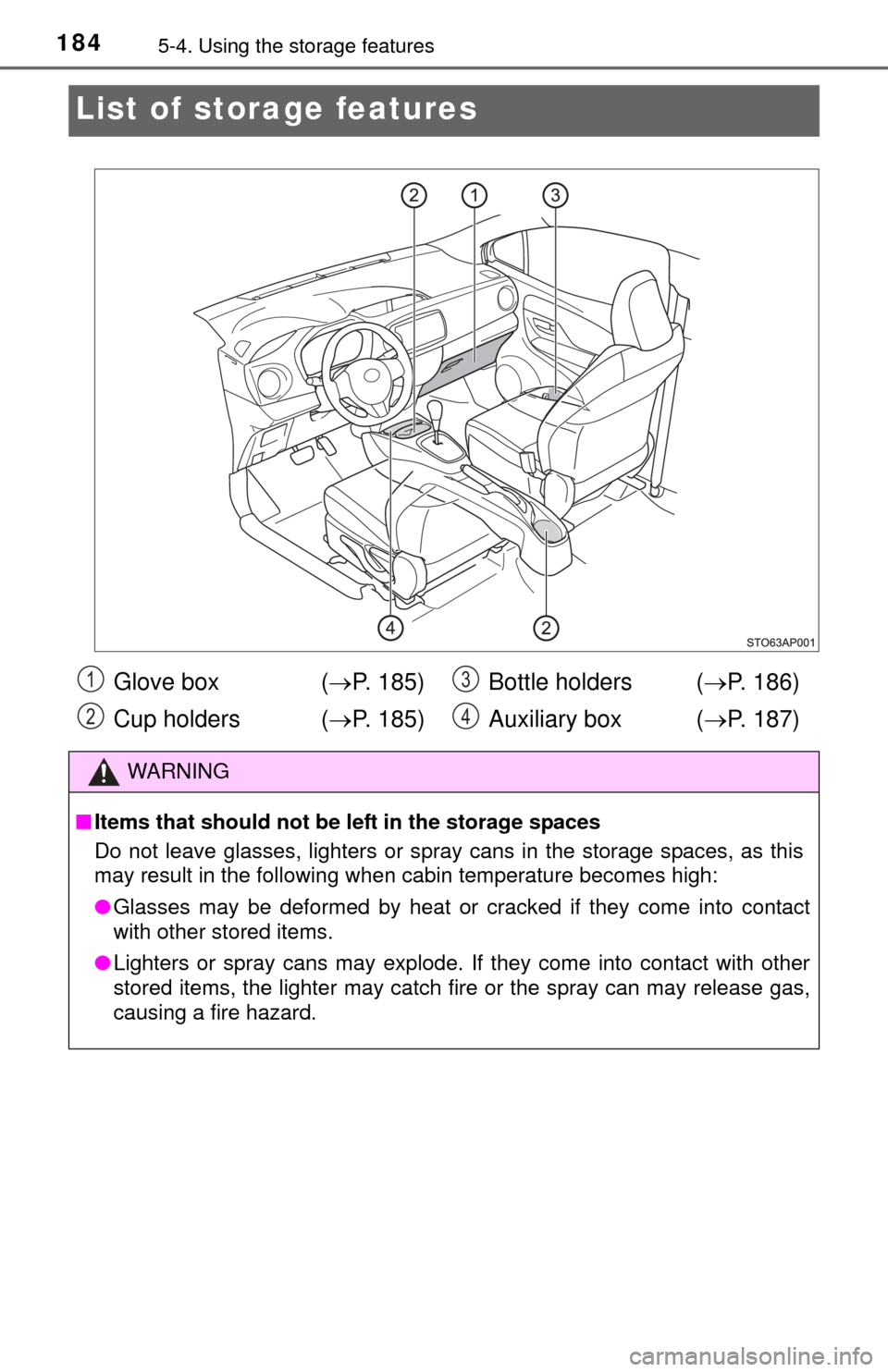
Glove box ( P. 185)
Cup holders ( P. 185) Bottle holders (
P. 186)
Auxiliary box ( P. 187)
WARNING
■Items that should not be left in the storage spaces
Do not leave glasses, lighters or spray cans in the storage spaces, as this
may result in the following when cabin temperature becomes high:
● Glasses may be deformed by heat or cracked if they come into contact
with other stored items.
● Lighters or spray cans may explode. If they come into contact with other
stored items, the lighter may catch fire or the spray can may release gas,
causing a fire hazard.
1
2
3
4
Page 214 of 364
2146-3. Do-it-yourself maintenance
With the engine at operating temperature and turned off, check the oil
level on the dipstick.
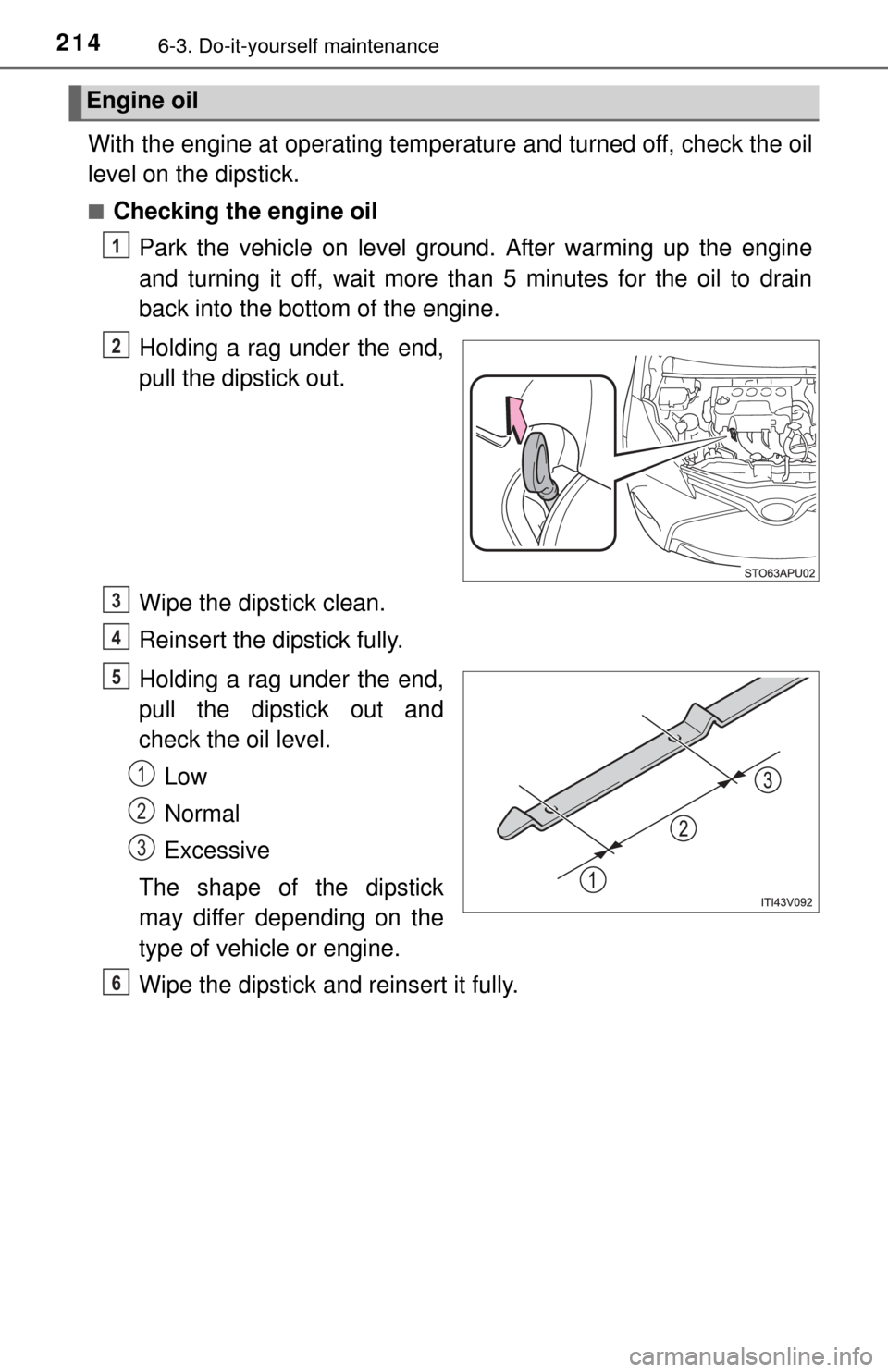
■Checking the engine oilPark the vehicle on level ground. After warming up the engine
and turning it off, wait more than 5 minutes for the oil to drain
back into the bottom of the engine.
Holding a rag under the end,
pull the dipstick out.
Wipe the dipstick clean.
Reinsert the dipstick fully.
Holding a rag under the end,
pull the dipstick out and
check the oil level.Low
Normal
Excessive
The shape of the dipstick
may differ depending on the
type of vehicle or engine.
Wipe the dipstick and reinsert it fully.
Engine oil
1
2
3
4
5
1
2
3
6
Page 217 of 364
2176-3. Do-it-yourself maintenance
6
Maintenance and care
■Coolant selection
Only use “Toyota Super Long Life Coolant” or a similar high quality ethylene
glycol based non-silicate, non-amine, non-nitrite, and non-borate coolant with
long-life hybrid organic acid technology.
Except Canada
“Toyota Super Long Life Coolant” is a mixture of 50% coolant and 50% deion-
ized water. (Minimum temperature: -31 F [-35 C])
Canada
“Toyota Super Long Life Coolant” is a mixture of 55% coolant and 45% deion-
ized water. (Minimum temperature: -44 F [-42 C])
For more details about coolant, contact your Toyota dealer.
■ If the coolant level drops within a short time of replenishing
Visually check the radiator, hoses, engine coolant reservoir caps, radiator
cap, drain cock and water pump.
If you cannot find a leak, have your Toyota dealer test the cap and check for
leaks in the cooling system.
WARNING
■When the engine is hot
Do not remove the radiator cap.
The cooling system may be under pressure and may spray hot coolant if the
cap is removed, causing serious injuries, such as burns.
NOTICE
■When adding coolant
Coolant is neither plain water nor straight antifreeze. The correct mixture of
water and antifreeze must be used to provide proper lubrication, corrosion
protection and cooling. Be sure to read the antifreeze or coolant label.
■ If you spill coolant
Be sure to wash it off with water to prevent it from damaging parts or paint.
Page 222 of 364
2226-3. Do-it-yourself maintenance
WARNING
■When adding washer fluid
Do not add washer fluid when the engine is hot or running as washer fluid
contains alcohol and may catch fire if spilled on the engine, etc.
NOTICE
■ Do not use any fluid other than washer fluid
Do not use soapy water or engine antifreeze instead of washer fluid.
Doing so may cause streaking on the vehicle’s painted surfaces.
■ Diluting washer fluid
Dilute washer fluid with water as necessary.
Refer to the freezing temperatures listed on the label of the washer fluid bot-
tle.
Page 270 of 364
2707-2. Steps to take in an emergency
If you think something is wrong
●Fluid leaks under the vehicle
(Water dripping from the air co nditioning after use is normal)
● Flat-looking tires or uneven tire wear
● High engine coolant temperature warning light flashes or comes on
● Low engine coolant temperature indicator comes on or does not
come on continuously
● Changes in exhaust sound
● Excessive tire squeal when cornering
● Strange noises related to the suspension system
● Pinging or other noises related to the engine
● Engine misfire, stumbling or running roughly
● Appreciable loss of power
● Vehicle pulls heavily to one side when braking
● Vehicle pulls heavily to one side when driving on a level road
● Loss of brake effectiveness, spon gy feeling, pedal almost touches
the floor
If you notice any of the follow ing symptoms, your vehicle proba-
bly needs adjustment or repair. Contact your Toyota dealer as
soon as possible.
Visible symptoms
Audible symptoms
Operational symptoms
Page 272 of 364
2727-2. Steps to take in an emergency
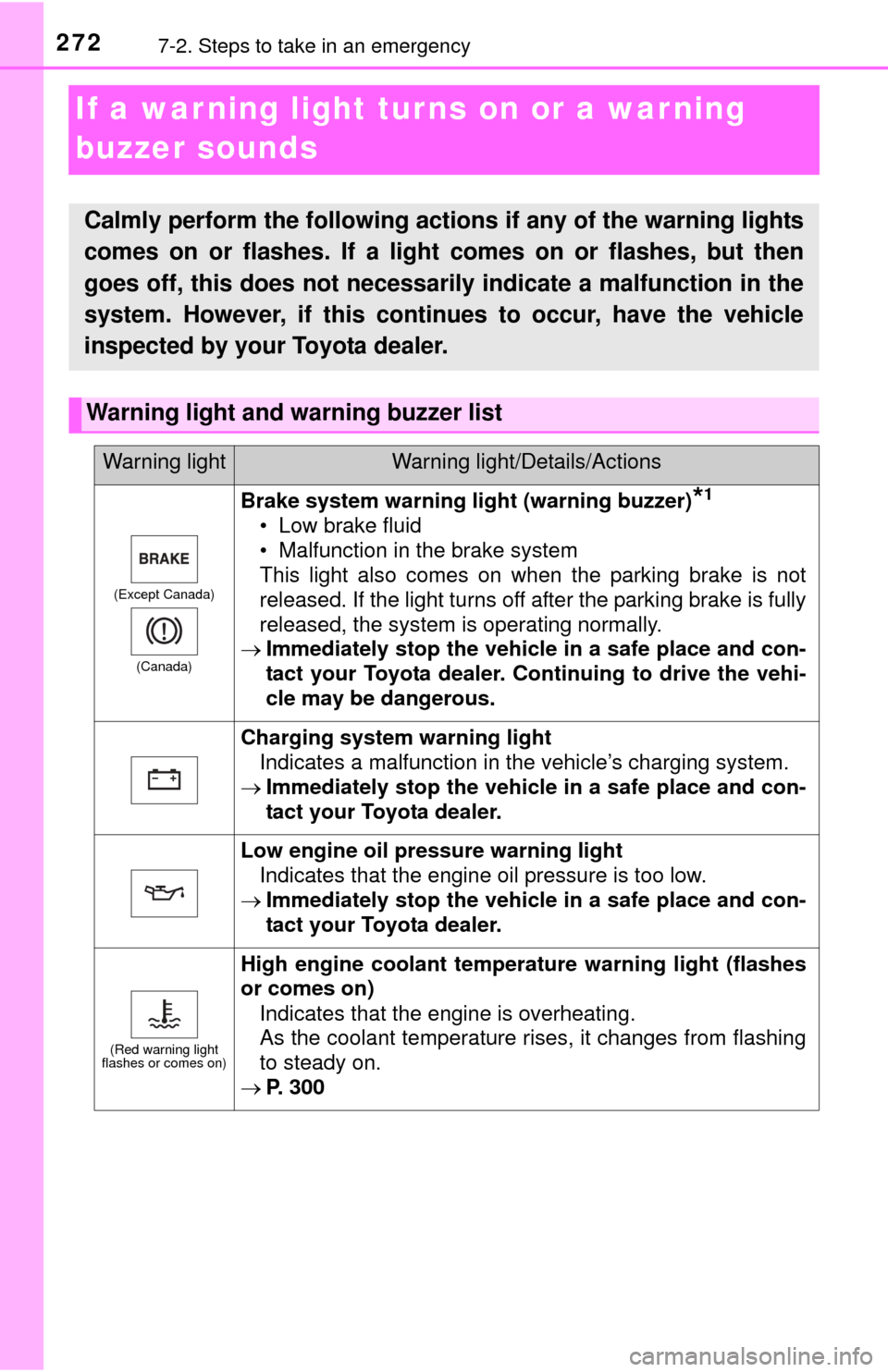
If a warning light turns on or a warning
buzzer sounds
Calmly perform the following actions if any of the warning lights
comes on or flashes. If a light comes on or flashes, but then
goes off, this does not necessarily indicate a malfunction in the
system. However, if this continues to occur, have the vehicle
inspected by your Toyota dealer.
Warning light and warning buzzer list
Warning lightWarning light/Details/Actions
(Except Canada)
(Canada)
Brake system warning light (warning buzzer)*1
• Low brake fluid
• Malfunction in the brake system
This light also comes on when the parking brake is not
released. If the light turns off after the parking brake is fully
released, the system is operating normally.
Immediately stop the vehicle in a safe place and con-
tact your Toyota dealer. Continuing to drive the vehi-
cle may be dangerous.
Charging system warning light
Indicates a malfunction in the vehicle’s charging system.
Immediately stop the vehicle in a safe place and con-
tact your Toyota dealer.
Low engine oil pressure warning light
Indicates that the engine oil pressure is too low.
Immediately stop the vehicle in a safe place and con-
tact your Toyota dealer.
(Red warning light
flashes or comes on)
High engine coolant temperature warning light (flashes
or comes on)
Indicates that the engine is overheating.
As the coolant temperature rises, it changes from flashing
to steady on.
P. 300
Page 300 of 364
3007-2. Steps to take in an emergency
If your vehicle overheats
●The high engine coolant temperature warning light ( P. 272)
comes on or flashes, or a loss of engine power is experienced. (For
example, the vehicle sp eed does not increase.)
● Steam comes out from under the hood.
Stop the vehicle in a safe place and turn off the air conditioning sys-
tem, and then stop the engine.
If you see steam:
Carefully lift the hood after the steam subsides.
If you do not see steam:
Carefully lift the hood.
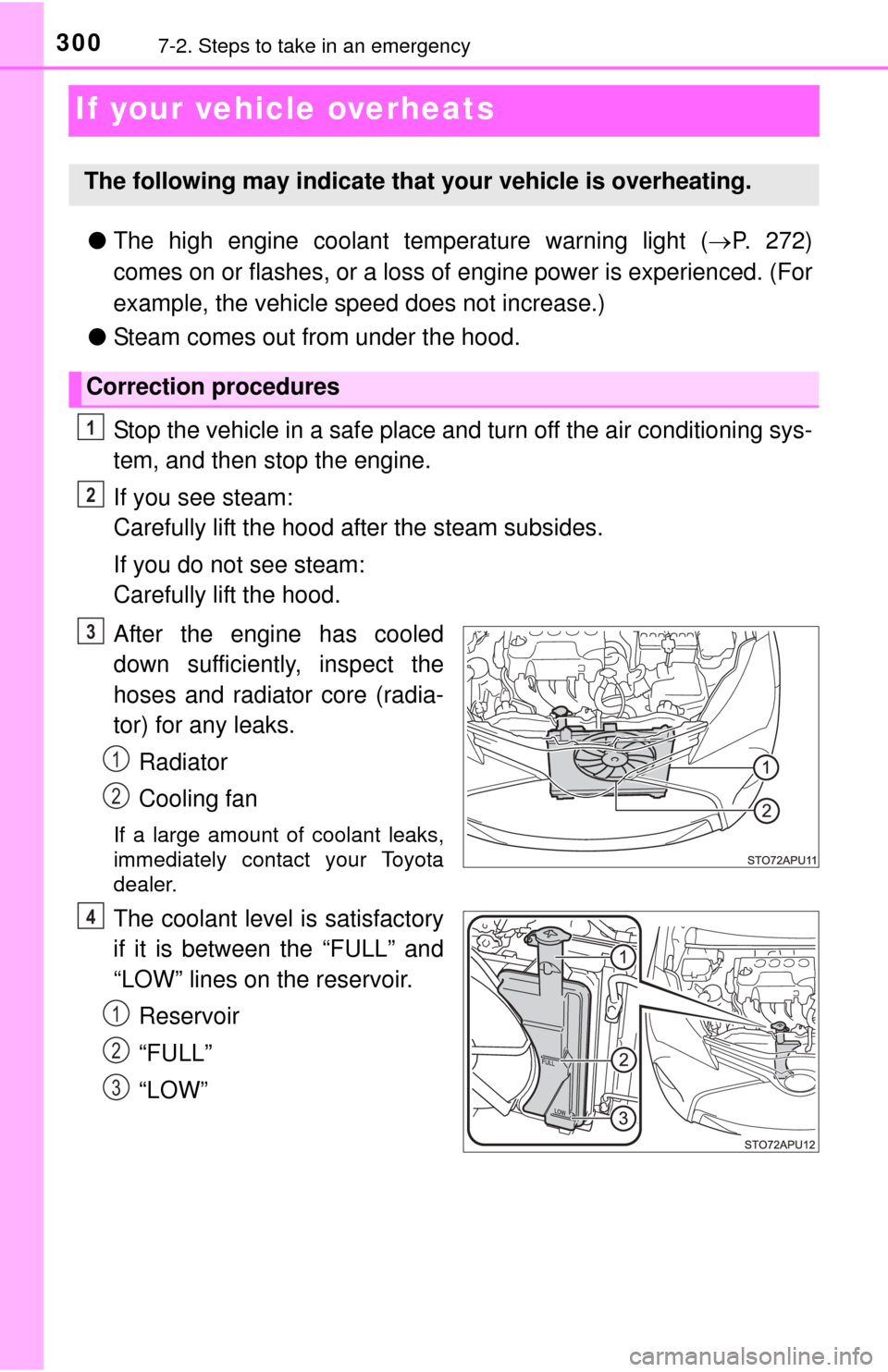
After the engine has cooled
down sufficient ly, inspect the
hoses and radiator core (radia-
tor) for any leaks.
Radiator
Cooling fan
If a large amount of coolant leaks,
immediately contact your Toyota
dealer.
The coolant level is satisfactory
if it is between the “FULL” and
“LOW” lines on the reservoir.Reservoir
“FULL”
“LOW”
The following may indicate that your vehicle is overheating.
Correction procedures
1
2
3
1
2
4
1
2
3