Temperature TOYOTA YARIS 2015 3.G Owner's Manual
[x] Cancel search | Manufacturer: TOYOTA, Model Year: 2015, Model line: YARIS, Model: TOYOTA YARIS 2015 3.GPages: 364, PDF Size: 5.74 MB
Page 301 of 364
3017-2. Steps to take in an emergency
7
When trouble arises
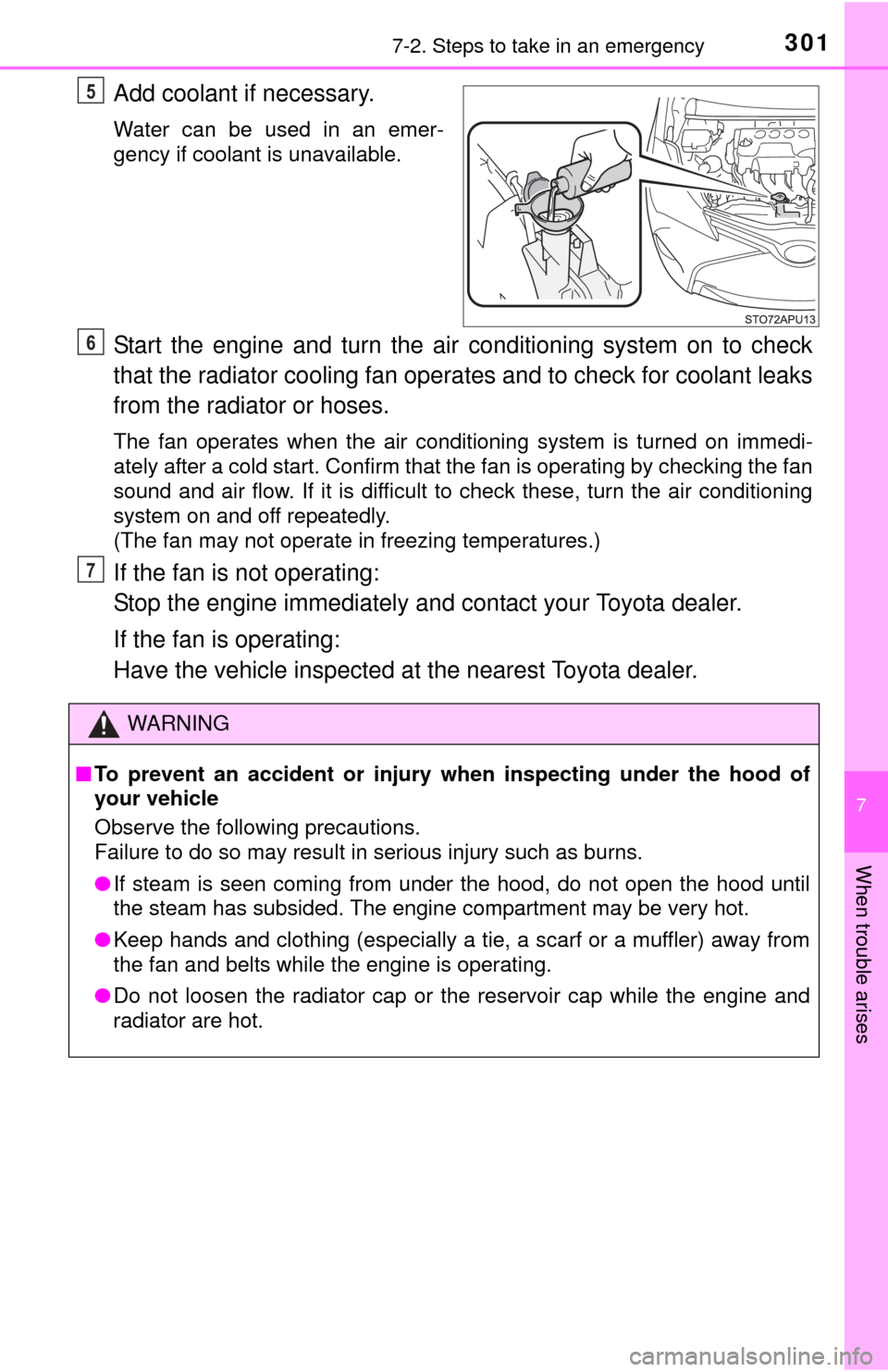
Add coolant if necessary.
Water can be used in an emer-
gency if coolant is unavailable.
Start the engine and turn the air conditioning system on to check
that the radiator cooling fan opera tes and to check for coolant leaks
from the radiator or hoses.
The fan operates when the air conditioning system is turned on immedi-
ately after a cold start. Confirm that the fan is operating by checking the fan
sound and air flow. If it is difficult to check these, turn the air conditioning
system on and off repeatedly.
(The fan may not operate in freezing temperatures.)
If the fan is not operating:
Stop the engine immediately and contact your Toyota dealer.
If the fan is operating:
Have the vehicle in spected at the nearest Toyota dealer.
5
WARNING
■To prevent an accident or injury when inspecting under the hood of
your vehicle
Observe the following precautions.
Failure to do so may result in serious injury such as burns.
● If steam is seen coming from under the hood, do not open the hood until
the steam has subsided. The engine compartment may be very hot.
● Keep hands and clothing (especially a tie, a scarf or a muffler) away from
the fan and belts while the engine is operating.
● Do not loosen the radiator cap or the reservoir cap while the engine and\
radiator are hot.
6
7
Page 310 of 364
3108-1. Specifications
*: The engine oil capacity is a reference quantity to be used when changingthe engine oil. Warm up and turn off the engine, wait more than 5 minutes,
and check the oil level on the dipstick.
■
Engine oil selection
“Toyota Genuine Motor Oil” is used in your Toyota vehicle. Use
Toyota approved “Toyota Genuine Motor Oil” or equivalent to satisfy
the following grade and viscosity.
Oil grade: ILSAC GF-5 multigrade engine oil
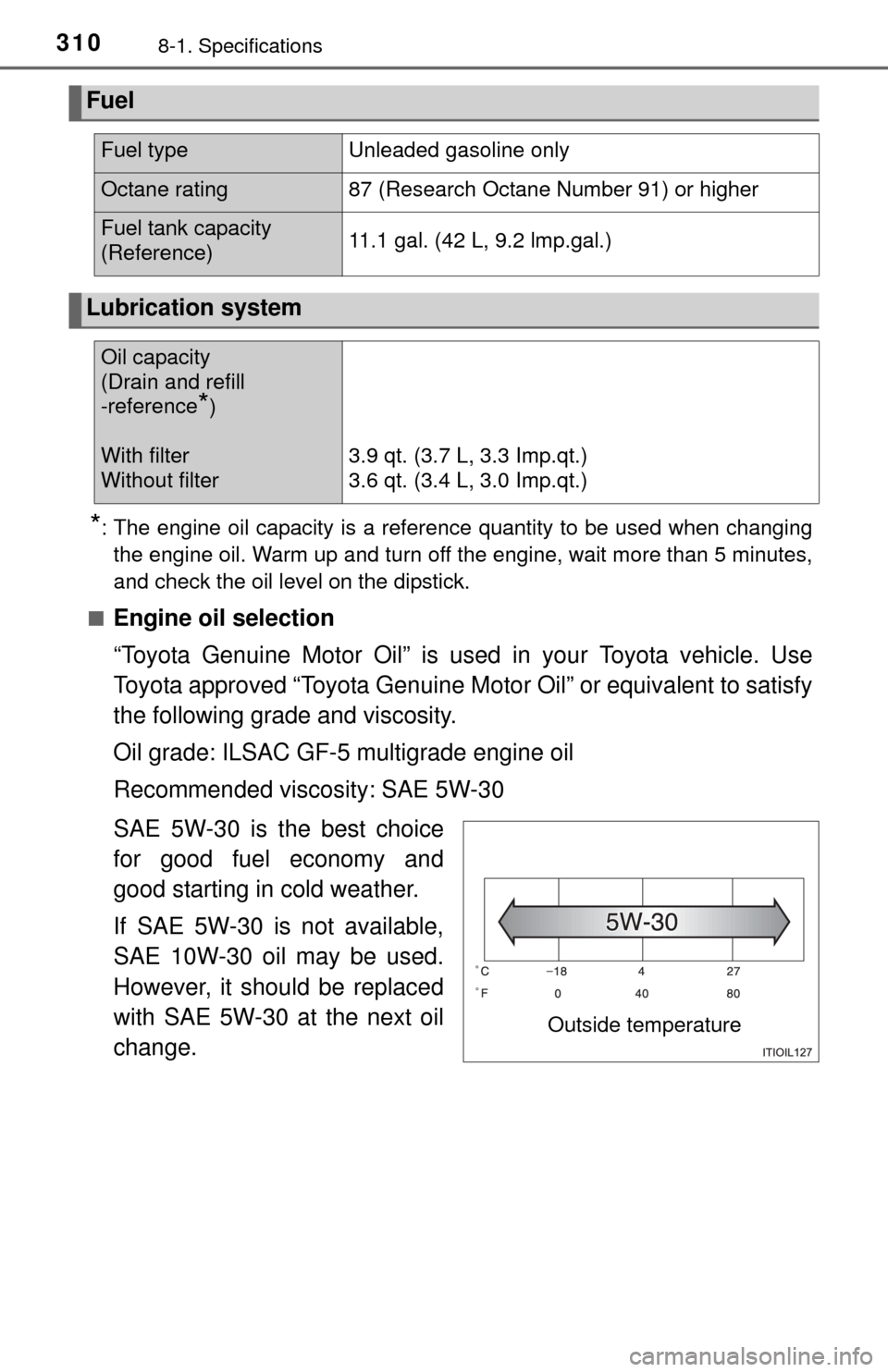
Recommended viscosity: SAE 5W-30
SAE 5W-30 is the best choice
for good fuel economy and
good starting in cold weather.
If SAE 5W-30 is not available,
SAE 10W-30 oil may be used.
However, it should be replaced
with SAE 5W-30 at the next oil
change.
Fuel
Fuel typeUnleaded gasoline only
Octane rating87 (Research Octane Number 91) or higher
Fuel tank capacity
(Reference)11.1 gal. (42 L, 9.2 lmp.gal.)
Lubrication system
Oil capacity
(Drain and refill
-reference
*)
With filter
Without filter 3.9 qt. (3.7 L, 3.3 Imp.qt.)
3.6 qt. (3.4 L, 3.0 Imp.qt.)
Outside temperature
Page 311 of 364
3118-1. Specifications
8
Vehicle specifications
Oil viscosity (5W-30 is explained here as an example): • The 5W in 5W-30 indicates the characteristic of the oil which
allows cold startability. Oils wi th a lower value before the W allow
for easier starting of the engine in cold weather.
• The 30 in 5W-30 indicates the viscosity characteristic of the oil when the oil is at high temperature. An oil with a higher viscosity
(one with a higher value) may be better suited if the vehicle is
operated at high speeds, or under extreme load conditions.
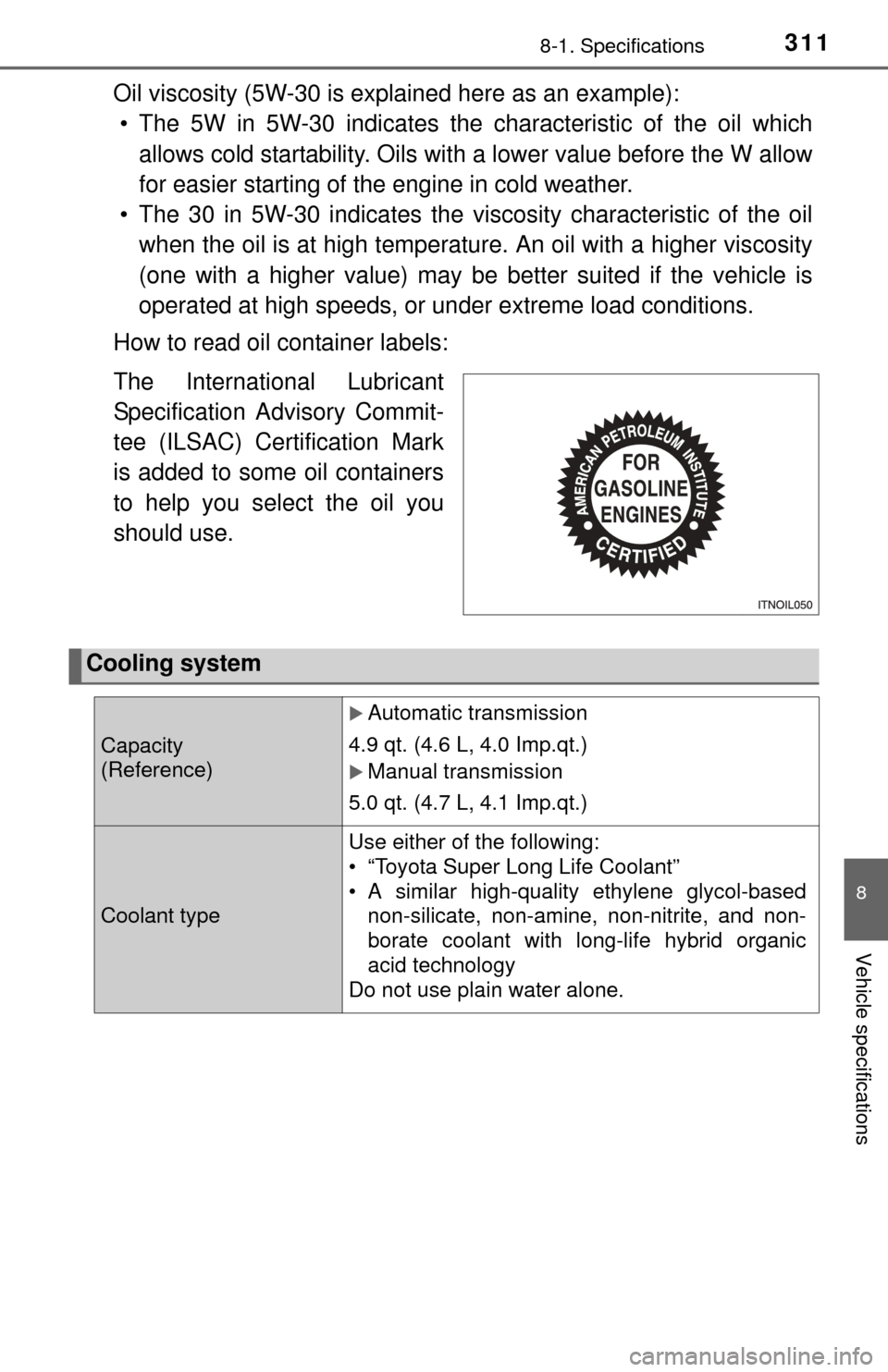
How to read oil container labels:
The International Lubricant
Specification Advisory Commit-
tee (ILSAC) Certification Mark
is added to some oil containers
to help you select the oil you
should use.
Cooling system
Capacity
(Reference)
Automatic transmission
4.9 qt. (4.6 L, 4.0 Imp.qt.)
Manual transmission
5.0 qt. (4.7 L, 4.1 Imp.qt.)
Coolant type
Use either of the following:
• “Toyota Super Long Life Coolant”
• A similar high-quality ethylene glycol-based non-silicate, non-amine, non-nitrite, and non-
borate coolant with long-life hybrid organic
acid technology
Do not use plain water alone.
Page 324 of 364

3248-1. Specifications
This information has been prepared in accordance with regulations
issued by the National Highway Traffic Safety Administration of the
U.S. Department of Transportation.
It provides the purchasers and/or prospective purchasers of Toyota
vehicles with information on uniform tire quality grading.
Your Toyota dealer will help answer any questions you may have as
you read this information.
■DOT quality grades
All passenger vehicle tires must c onform to Federal Safety Require-
ments in addition to these grades. Quality grades can be found
where applicable on the tire sidewall between tread shoulder and
maximum section width.
For example: Treadwear 200 Traction AA Temperature A
■Treadwear
The treadwear grade is a comparative rating based on the wear
rate of the tire when tested under controlled conditions on a speci-
fied government test course.
For example, a tire graded 150 wo uld wear one and a half (1 - 1/2)
times as well on the government course as a tire graded 100.
The relative performance of tire s depends upon the actual condi-
tions of their use. Performance may differ significantly from the norm
due to variations in driving habits , service practices and differences
in road characteristics and climate.
Uniform Tire Quality Grading
Page 325 of 364

3258-1. Specifications
8
Vehicle specifications
■Traction AA, A, B, C
The traction grades, from highest to lowest, are AA, A, B and C,
and they represent the tire’s ability to stop on wet pavement as
measured under controlled conditions on specified government test
surfaces of asphalt and concrete.
A tire marked C may have poor traction performance.
Warning: The traction grade assigned to this tire is based on braking
(straight ahead) traction tests and does not include cornering (turn-
ing) traction.
■Temperature A, B, C
The temperature grades are A (the hi ghest), B, and C, representing
the tire’s resistance to the generation of heat and its ability to dissi-
pate heat when tested under cont rolled conditions on a specified
indoor laboratory test wheel.
Sustained high temperature can cause the material of the tire to
degenerate and reduce tire life, and excessive temperature can lead
to sudden tire failure.
The grade C corresponds to a level of performance which all pas-
senger car tires must meet under the Federal Motor Vehicle Safety
Standard No. 109.
Grades B and A represent higher le vels of performance on the labo-
ratory test wheel than the minimum required by law.
Warning: The temperature grades for this tire are established for a
tire that is properly inflated and not overloaded.
Excessive speed, underinflation, or excessive loading, either sepa-
rately or in combination, can cause heat buildup and possible tire
failure.
Page 357 of 364

357Alphabetical index
Driver’s seat belt reminder light......................................... 274
Driving ...................................... 116
Break-in tips .......................... 119
Correct driving posture ........... 24
Procedures ........................... 116
Winter drive tips .................... 167
Eco Driving Indicator Light..... 120
Electric Power Steering (EPS)....................................... 162 Function ................................ 162
Warning light ......................... 273
Emergency flashers ................ 262
Emergency, in case of If the engine will not start ...... 294
If the shift lever cannot be shifted from P ..................... 296
If the vehicle battery is discharged .......................... 297
If the warning buzzer
sounds ................................ 272
If the warning light turns on .............................. 272
If you have a flat tire ............. 281
If you lose your keys ............... 86
If you think something is wrong.................................. 270
If your vehicle becomes stuck ................................... 303
If your vehicle has to be stopped in an emergency ... 263
If your vehicle needs to be
towed .................................. 265
If your vehicle overheats ....... 300 Engine
“ACC” position ...................... 136
Compartment ........................ 213
Engine switch ....................... 136
Hood ..................................... 209
How to start the engine......... 136
Identification number ............ 308
If the engine will not start ...... 294
If your vehicle has to be stopped in an emergency ... 263
Ignition switch (engine switch) ................... 136
Overheating .......................... 300
Engine coolant......................... 216 Capacity................................ 311
Checking............................... 216
Preparing and checking before winter ...................... 167
Engine coolant temperature
warning light.......................... 272
Engine immobilizer system ...... 67
Engine oil ................................. 214 Capacity................................ 310
Checking............................... 214
Preparing and checking before winter ...................... 167
Engine switch (ignition switch) .................... 136
EPS (Electric Power Steering) ................................ 162 Function ................................ 162
Warning light......................... 273
Event data recorder..................... 8
E
Page 363 of 364

363Alphabetical index
Warning buzzersBrake system ....... ................. 272
Key reminder ........................ 137
Open door ............................. 274
Seat belt reminder ................ 274
Warning lights............................ 73 ABS....................................... 273
Brake system ....... ................. 272
Charging system ................... 272
Cruise control indicator ......... 274
Electric power steering system ......... ....................... 273
High engine coolant
temperature ........................ 272
Low engine oil pressure ........ 272
Low fuel level ........................ 274
Malfunction indicator lamp .... 273
Open door ............................. 274
Seat belt reminder light ......... 274
Slip indicator ......................... 273
SRS ...................................... 273
Tire pressure......................... 274 Washer ............................. 149, 152
Checking............................... 221
Preparing and checking before winter ...................... 167
Switch ........................... 149, 152
Washing and waxing ............... 194
Weight ...................................... 306
Wheels ...................................... 235 Replacing.............................. 235
Size....................................... 315
Window glasses ...................... 113
Window lock switch ................ 113
Windows................................... 113 Power windows..................... 113
Rear window defogger.......... 176
Washer ................................. 149
Windshield wipers ................... 149
Winter driving tips ................... 167
Wireless remote control key ............................................ 85 Locking/Unlocking .................. 85
Replacing the battery............ 240
W